"Love follows knowledge."
"Beauty above all beauty!"
– St. Catherine of Siena

Showing posts with label Paradiso. Show all posts

Sunday, March 7, 2021

Dante’s Divine Comedy: Blog Links

Since Dante’s La Commedia is the most commented work on my blog, and since the number of posts on Dante Alighieri or his work amount to 56, I thought it worthwhile to have a post where they are collected and organized for user friendly linking.  So the following are links to all my posts on the Divine Comedy, organized by canticle and canto.

General posts on the overall work can be found here.

(1) TheDivine Comedy: Overview   

(2) Rod Dreher on Dante’s Divine Comedy 

(3) Dante Alighieri’s 750th Birthday 

(4) Literature in the News: Pope Frances Releases, Candor Lucis Aeternae


Inferno


Cantos I thru V

(1) Summary 

(2) Commentary 

Cantos VI thru XI

(1) Summary

(2) Commentary 

(3) Commentary, Dante’s Inferno, Canto VIII

XII thru XVII

(1) Summary 

(2) Commentary 

Cantos XVIII thru XXIII

(1) Summary 

(2) Commentary 

Cantos XXIV thru XXIX

(1) Summary 

(2) Commentary 

Cantos XXX thru XXXIV

(1) Summary 

(2) Commentary 


Purgatorio


Overall:

(1) Overview 

(2) Introduction 

(3) Structure & Ante Purgatory 

(4) Middle Section 

(5) Ending https://ashesfromburntroses.blogspot.com/2015/06/purgatorio-by-dante-alighieri-part-4.html   

Note: Posts 2, 3, 4, 5 were from a 2014-15 read.

Cantos I thru V

(1) Summary 

(2) Commentary 

(3) Notable Quote from Canto 2 

Cantos VI thru XI

(1) ) Summary 

(2) Commentary 

Cantos XII thru XVII

(1) ) Summary 

(2) Commentary 

Cantos XVIII thru XXIII

(1) ) Summary 

(2) Commentary 

Cantos XXIV thru XXVIII

(1) ) Summary 

(2) Commentary 

(3) On Arnaut Daniel 

Cantos XXIX thru XXXIII

(1) ) Summary 

(2) Commentary-1 

(3) Commentary-2 

(4) Commentary-3 


Paradiso


Overall:

(1) Introduction 

Cantos I thru V

(1) Summary 

(2) Comments 

Cantos VI thru IX

(1) Summary 

(2) Comments 

Cantos X thru XIV

(1) Summary 

(2) Comments 

Cantos XV thru XVIII

(1) Summary 

(2) Comments 

Cantos XIX thru XXII

(1)Summary 

(2) Comments 

Cantos XXIII thru XXVI

(1) Summary 

(2) Comments 

Cantos XXVII thru XXX

(1) Summary 

(2) Comments 

Cantos XXXI thru XXXIII

(1) Summary 

(2) Comment-1 

(3) Comment-2 

(4) Comment-3 


Thursday, August 8, 2019

Comments to Dante’s Paradiso, Cantos XXXI thru XXXIII, Part 3

Indeed, vision and eyes are of the utmost importance in the last canto leading to the theophany.  Actually eyes and vision have been a motif in the entire Commedia.  But here in the last canto the motif seems to reach a crescendo.  Almost every other tercet has a reference to vision or sight or eyes.  If Christ, and more generally God, is light, then how could sight not be a significant means of comprehending divinity?  It is the Holy Mother’s eyes who looks on Dante with love and then turns her eyes toward God.  Dante is allowed to withstand the intense brightness through her sight.  It’s almost as if he merges his sight with hers (43-57).

Finally the theophoric vision is the climax of the entire journey.  Dante (the character) is allowed to see what no mortal has ever been allowed to see—the vision of the Trinity.  Here’s how he describes the moment before he witnesses the theophany.

I believe, from the keenness of the living ray
that I endured, I would have been undone
had I withdrawn my eyes from it.

And I remember that, on this account,
I grew more bold and thus sustained my gaze
until I reached the Goodness that is infinite.

O plenitude of grace, by which I could presume
to fix my eyes upon eternal Light
until my sight was spent on it!  (XXXIII. 76-84)


As he witnesses the fullness of God, he is granted one more grace, that for a brief instant, for a fleeting moment, he is given comprehension of the entire order of all things.

In its depth I saw contained,
by love into a single volume bound,
the pages scattered through the universe:

substances, accidents, and the interplay between them,
as though they were conflated in such ways
that what I tell is but a simple light.

I believe I understood the universal form
of this dense knot because I feel my joy expand,
rejoicing as I speak of it.  (85-93)

And what is this vision of God?  Several cantos prior, Dante’s first vision of God was a point of light.  But now that his sight has been enlarged and strengthened, he can now see that point of light is a full circle.  Indeed, it is three circles, one for each person of the Trinity, each overlaying on top of each other, each a different color.

In the deep, transparent essence of the lofty Light
there appeared to me three circles
having three colors but the same extent,

and each one seemed reflected by the other
as rainbow is by rainbow, while the third one seemed fire,
equally breathed forth by one and by the other.  (115-120)

This is the Father and the Son, and that which proceeds from the two, the Holy Spirit.  And as he held his gaze he sees a face within the circles.

That circling which, thus conceived,
appeared in you as light's reflection,
once my eyes had gazed on it a while, seemed,

within itself and in its very color,
to be painted with our likeness,
so that my sight was all absorbed in it.  (127-132)

“An image painted with our likeness.”  Is that the face of God or the face of Christ, or is that the same thing?  It is our likeness, we made in the image of God. 

Overwhelmed, perhaps even disoriented, Dante in an instant finds himself back home trying to understand what has happened to him and understand “the Love that moves the sun and all the other stars” (145).

And so ends the greatest work of literature ever written.


###

Some concluding statements.  I began reading Paradiso believing it was the weakest of the three canticas of Inferno, Pugatorio, and Paradiso.  Such a notion was implanted from what I can only say are biased academics.  Paradiso does not have the fanciful torments of Inferno.  It does not have the bodily tensions of Purgatorio.  But Paradiso is special.  Perhaps it is the most theological of the three canticas—and that is why I think that academic biased developed.  But the theology is dramatized in imagery, proposed in beautiful similes and metaphors, all leading to that vision of God as the Trinity.  Paradiso is the most beautiful of the three canticas.  The sublimity of the imagery is unsurpassed.  One can be horrified at the imagery of Inferno, and feel empathy at the imagery of Purgatorio.  But one longs to embrace the imagery of Pardiso.  Indeed, one longs to participate in the imagery of Paradiso. 

In the very first canto of Paradiso, Beatrice in response to a question as to why all things move upward provides an answer which I think is the central thesis of not just Paradiso but of the entire Devine Comedy.

'All things created have an order
in themselves, and this begets the form
that lets the universe resemble God.

'Here the higher creatures see the imprint
of the eternal Worth, the end
for which that pattern was itself set forth.

'In that order, all natures have their bent
according to their different destinies,
whether nearer to their source or farther from it.

'They move, therefore, toward different harbors
upon the vastness of the sea of being,
each imbued with instinct that impels it on its course.  (Par.I.103-114)

That the universe has an order, that things created have an order, all of which resembles God, who has created all forms out of reason and love, is at the heart of this epic.  The entire Commedia is shaped to reflect God’s order.  The order in Inferno, as it winds its way down to the bottom pit of hell, reflects God’s ordering of justice.  The penitential climb up the mountain in Purgatorio reflects the order to retrain the soul to what you were made to be.  The order of Paradiso, with its impelling motion toward the city of God, reflects the order of God’s love as He draws us into His bosom as a parent draws their child.  No other epic has such a complete vision of humanity in its relationship to his universe, and, indeed, to his creator.


Which is the greatest of the three canticas?  You can’t think of it that way.  Each fulfills the other two.  They complement each other as a trinity for a unified vision.  So which of the three canticas do I prefer?  Whichever I have read last, which at the moment is Paradiso.

Robert and Jean Hollander

The great translators, Robert and Jean Hollander.

Friday, July 19, 2019

Comments to Dante’s Paradiso, Cantos XXXI thru XXXIII, Part 2


St. Bernard’s prayer to Mary in the last canto is of such beauty it should be quoted in its entirety and have its own post. 

'Virgin Mother, daughter of your Son,
more humble and exalted than any other creature,
fixed goal of the eternal plan,

'you are the one who so ennobled human nature
that He, who made it first, did not disdain
to make Himself of its own making.

'Your womb relit the flame of love --
its heat has made this blossom seed
and flower in eternal peace.

'To us you are a noonday torch of charity,
while down below, among those still in flesh,
you are the living fountainhead of hope.

'Lady, you are so great and so prevail above,
should he who longs for grace not turn to you,
his longing would be doomed to wingless flight.

'Your loving kindness does not only aid
whoever seeks it, but many times
gives freely what has yet to be implored.

'In you clemency, in you compassion,
in you munificence, in you are joined
all virtues found in any creature.

'This man who, from within the deepest pit
the universe contains up to these heights
has seen the disembodied spirits, one by one,

'now begs you, by your grace, to grant such power
that, by lifting up his eyes,
he may rise higher toward his ultimate salvation.

'And I, who never burned for my own seeing
more than now I burn for his, offer all my prayers,
and pray that they may not fall short,

'so that your prayers disperse on his behalf
all clouds of his mortality and let
the highest beauty be displayed to him.

'This too, my Queen, I ask of you, who can achieve
            whatever you desire, that you help him preserve,
after such vision, the purity of his affections.

'Let your protection rule his mortal passions.
See Beatrice, with so many of the blessed,
palms pressed together, joining me in prayer.'  (XXXIII. 1-39)


###

Two points can be made about St. Bernard’s prayer. 

(1) He captures the paradoxical mysteries on which Christianity rests:  Virgin/Mother, daughter/of your son, humble/exalted, fixed/eternal.  These paradoxes all lead to most paradoxical mystery of them all, of three yet one.

(2) The prayer follows the Salve Regina. 

Hail, Holy Queen, Mother of Mercy, our life, our sweetness and our hope! To thee do we cry, poor banished children of Eve. To thee do we send up our sighs, mourning and weeping in this valley of tears! Turn, then, most gracious advocate, thine eyes of mercy toward us, and after this, our exile, show unto us the blessed fruit of thy womb, Jesus. O clement, O loving, O sweet Virgin Mary.

Pray for us, O holy Mother of God.
That we may be made worthy of the promises of Christ.

Bernard’s prayer is an appeal to her as “most gracious advocate” for her Son, just as we ask for advocacy in the Salve Regina.  Bernard in his prayer appeals for her to turn her eyes on this poor sinner (Dante), just as we appeal in the Salve, and, as we appeal in the prayer to be made worthy, Bernard appeals for her to pray to make Dante worthy of the blessed vision.


Friday, July 12, 2019

Comments to Dante’s Paradiso, Cantos XXXI thru XXXIII, Part 1

It’s been really hard to pick a starting point for commentary on these last three cantos.  One could start with the centrality of the Blessed Virgin in the conclusion.  One could start with the climatic mystical vision of the Trinity—the theophany—and back the steps to there.  One could start with the surprise transition to a new guide for just a mere three cantos.  But I’ll start as Dante (the author) with the beauty and strange imagery the mystical Rose, referred to as the Empyrean, which constitutes the City of God.

As Dante’s (the character) vision clears after immersing his eyes into the river of light, he finds himself in a remarkable place, almost like a sudden transition from one scene to another in a movie.  He uses three sparkling similes in Canto XXXI as an attempt to approximate the wonder.  These are the pilgrim similes.  Here’s the first.

 If the barbarians, coming from that region
which Helice covers every day,
wheeling with her son, in whom she takes delight,

were dumbstruck at the sight of Rome
and her majestic monuments,
when the Lateran surpassed all other works of man,

I, who had come to things divine from man's estate,
to eternity from time,
from Florence to a people just and sane,

with what amazement must I have been filled!
Indeed, between the wonder and my joy, I was content
neither to hear nor speak a word. (XXXI. 31-42)

Just like barbarians, who have probably lived in thatched huts all their lives, are filled with wonder when they first enter Rome and see the immense architecture and vast city, so Dante is taken aback with the wonder of Empyrean.  The second (lines 43-48) describe that same pilgrim wondering in such a spectacular city planning to tell his tale to those back home when he returns. And finally the third pilgrim simile foreshadows the climax:

As the man who, perhaps from Croatia, has come
to set his gaze on our Veronica,
his ancient craving still not satisfied,

            and who thinks to himself while it is shown:
'My Lord Jesus Christ, God Himself,
was this then how You really looked?',

just so was I, gazing on the living love
of him who, still within the confines of this world,
in contemplation tasted of that peace.  (XXXI. 103-111)

Just like a man from Croatia—that is a country bumpkin—comes to Rome to see Veronica’s relic, the face of Christ on a towel and wonders if this is how Christ truly looked, so too Dante -feels like a country bumpkin, and remember Dante is a pretty sophisticated guy.  Notice, that face is what Dante will actually see at the theophany in a few moments.

The image of angels as bees interacting with the human souls, who are as flowers is stunning.  The bees gather the “pollen” of God’s love and pollinate the followers.  We are indeed in a new world charged with God’s grace.  As the Israelites crossed the desert to a land of milk and honey, Dante has arrived at his journey’s end.

This city of God is in the shape of a white rose.  In each petal of the rose resides a sanctified soul.  Is this rose a corresponding and contrasting image to the inner city of hell, Cocytus?   One would have to surmise so, and then a comparison could not be avoided.  Cocytus is a frozen lake with souls stuck in the frozen ice, cold, sterile, and bleak.  The rose, on the other hand, suggests beauty, life affirming, fertility, warmth.  In Canto XXXIII, an allusion is made that Mother Mary’s womb is a flower: “'Your womb relit the flame of love --/its heat has made this blossom seed/and flower in eternal peace” (7-9).  The rose is a womb which is a tabernacle.

Just as Dante (the character) was frozen from fear to find Virgil disappeared toward the end of Purgatorio, so he is frozen from fear to find Beatrice gone at the end of Paradisio.  And both times a new guide replaces the old.

Dante’s prayer to Beatrice (XXXI. 79-90) pays tribute to the woman who saved his soul and led him “from servitude to freedom.”  In that respect Beatrice is an analogue for Moses who in turn is an analogue for Christ. 

But why introduce a new guide here with only three cantos to the end?  At the end of Purgatorio it made sense a new guide would be needed since Virgil, a pagan, could not enter heaven.  There is nothing obstructing Beatrice from continuing into the heart of Empyrean.  In fact we see her seated in her place in the Rose.  Bernard seems unnecessary.

But by having Bernard complete Dante’s journey, Dante (the author) accomplishes two vital points.  First it highlights the centrality of the Blessed Virgin’s position in these latter cantos.  St. Bernard is one of history’s greatest devotees of the Blessed Mother, and so he is most fitting as a guide here.  More on that centrality in a bit.

Second, Dante (the author) creates a web of intercessors from which Dante’s (the character) salvation rests.  Recall that in the first two cantos of Inferno, when Dante was in a midlife crises and lost in the wood, it was the Blessed Mother’s compassion that dispatched St. Lucy to dispatch Beatrice who dispatched Virgil to guide Dante.  But why were all those links needed?  Why couldn’t the Blessed Mother come herself to Dante and lead him through?  Indeed, why couldn’t Christ Himself appear to Dante and guide him?  Perhaps a Protestant author would have done it that way.

But it would have been so much a lesser work.  Besides the rich narrative complexity that would have been lost, it would also have lacked showing the communion of saints that work for our intercession.  While we face God alone in our judgement, our journeys are not solitary.  We have many earthly and spiritual people who come to our aid.  The Blessed Mother, St. Lucy, Beatrice, Virgil form a web of spiritual intercessors.  We have such a web at our disposal too. 

With this understanding we see that the Virgin Mary’s quiet centrality has been throughout the Divine Comedy.  She’s the one who set in motion the means for Dante’s (the character’s) salvation.  Her centrality is evident within the Empyrean.  When Bernard points up to the top of the Rose, it is the Queen Mother who stands out brightest.

Once Mary is identified as the central locus in the Rose, Bernard then points out various saints relative to her position.  Notice the pattern that Bernard creates as he identifies blessed souls.  He follows a line down from Mary, and then to the left of her, and then to the right.  This forms the shape of a cross.  On the mirror opposite side from Mary, he forms another cross, this time with John the Baptist at the top.  Indeed, the divisions of the Empyrean can be seen as sectors formed by the lines of cross.  The left-right divide formed by the shaft (stipes) divides the worthy Hebrews from the Christian saved.  The top-bottom divide formed by the crossbar divides adult saved from the infants saved.

Finally Bernard tells Dante if he wants to be worthy of the ultimate vision, he must refocus on the Blessed Mother.  Notice how he phrases this:

'Look now on the face that most resembles Christ,
for nothing but its brightness
can make you fit to look on Christ.' (XXXII. 85-87)


“The face that most resembles Christ” is pregnant (pun intended!) with meaning.  The Blessed Mother most resembles Christ in that (1) she is sinless, (2) she has an equal heart of compassion, and (3) she was His physical mother.  Dante (the author) could not have known about genetics but certainly it was evident that children resembled their parents.  One should never minimize the importance of the corporeal nature of the incarnation.


Wednesday, July 10, 2019

Dante's Paradiso Cantos XXXI thru XXXIII, Summary

Canto XXXI

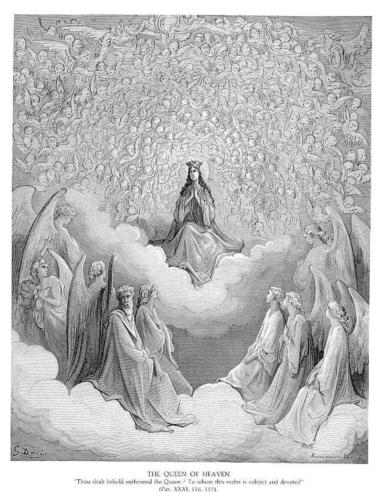
In the Empyrean, Dante (the character) surveys what is around him now that his eyes have been fully opened.  He sees the heavenly structure before him that is in the shape of a white rose.  This is the Empyrean and it is filled with all the blessed souls in paradise.  He sees angels flying around, going back and forth from the center point, which is God, to the flowers, who are the souls sitting inside the white rose.  He is so awestruck he feels like a barbarian who has lived in huts stepping into the glory of the city of Rome for the first time.  He stares into the rose and for the first time since coming to paradise can see clear faces, other than that of Beatrice.  He turns to ask Beatrice some questions but finds that she is gone and in her place is a kindly, old man who later we learn is St. Bernard of Clairvaux.  Bernard tells Dante to look at the third to last row of the rose and there he can see the beautiful face of Beatrice who has taken her assigned heavenly seat.  Though the distance may be hundreds of miles away, Dante can clearly see her face as if it were close by.  Realizing that his time with Beatrice is over, he says a prayer of homage and gratitude to her for saving his soul.  She smiles back in acknowledgement that she has heard his prayer.  Bernard instructs Dante to now focus on the Queen of heaven if he wishes to experience the complete divine vision.  Looking up Dante sees the brightest face of the Empyrean, the Blessed Virgin, shining like the sun and with a host of angels dancing about her, bringing pleasure to all the other souls.  Dante and Bernard stare at the Virgin Mother in fixed mystical gaze.


Canto XXXII

At the Empyrean, St. Bernard describes to Dante the structure of the rose and points out several of the inhabitants, using Mary as the frame of reference.  Sitting below the Blessed Mother is Eve, and below Eve is Rachel.  To Rachel's right across the dividing line that separates the pre-Christian and post-Christian souls is Beatrice.  Below Rachel in successive rows are Sarah, Rebecca, and Ruth.  These women form a wall that separates those that believed in the coming messiah (the Old Testament Jews) from those that believed in Christ that is the messiah.  Bernard points out that the Old Testament half is filled while the Christian half, which has the same number of seating, is unfilled and to be filled.  Directly across the Virgin Mother on the Christian side is St. John the Baptist.  In subsequent rows below him are Francis, Benedict, and Augustine.  This is the upper half of the rose.  In the lower half reside a multitude of saved babies, children that were too young to commit willful sins.  These children are divided into three categories:  the Jewish infants before circumcision was instituted, the Jewish infants who are circumcised, and the Christian infants that are baptized.  Unbaptized children who don't fit these categories are in Limbo.  Bernard redirects Dante's gaze back "to the face that most resembles Christ," Mary.  The angel Gabriel has come singing the Ave Maria to her.  Bernard continues to point out more of the blessed: Adam, St. Peter, St. John the Evangelist, Moses, St. Anne, and St. Lucy.  Finally Bernard tells Dante it is time to seek the complete vision of God and the only way to do it is to pray to Mary for such a grace.  Bernard will start the prayer but asks Dante to join his heart to it.


Canto XXXIII


Continuing from where the previous canto ended, St. Bernard offers a prayer to the Virgin Mother to grant Dante the complete vision of God.  He starts by paying homage to the Blessed Mother, a lady both humble and exalted who through her acceptance of God's will changed human history.  Bernard continues by citing her virtues, kindness, compassionate, munificent.  He appeals to her on Dante's behalf to grant him the most blessed theophany which no living person has ever seen.  He begs her to use her prayers for him, not only to see God but to preserve his purity after the vision and protect him from his mortal inclinations.  He further implores that Beatrice and other souls in the rose are joining him in this prayer.  Mary's eyes, which are fixed on Bernard, signal her appreciation, and then turn toward the center light.  Dante, staring upward, feels his sight grow purer and sharper, penetrating the exalted light of God.  What he sees he cannot now articulate, and stepping out of the narrative appeals to God to recall what he saw so that now he can express it.  He now recalls that his sight merged with the "goodness that is infinite" and felt the love that unifies the differed elements of the universe.  At that moment, in a flash, Dante understands "the universal form" that unites all disparate, knotted things.  What he sees are three overlaying circles of different colors, yet fused into one.  As if from the colors themselves and within the circles, the face of Christ suddenly appears, and in a moment as instant as lightning, the vision disappears.


Wednesday, June 19, 2019

Comments to Dante’s Paradiso, Cantos XXVII thru XXX

These four cantos fill in Dante’s (the author) vision of the cosmos.  Let’s walk through this to see how stunning and beautiful it actually is. 

The Crystalline Sphere comprises the ninth circlet of either orbits of celestial planets (moon through Saturn) or circumscribing regions such as the Starry Sphere, which are constellations of stars, and the Crystalline Sphere.  The earth is the center of the physical universe as commonly thought then.  What is the Crystalline Sphere?  We learn it is the swiftest circling of the spheres (XXVII.99) and Beatrice explains its nature.

'This heaven has no other where
but in the mind of God, in which is kindled
the love that turns it and the power it pours down.

'Light and love enclose it in a circle,
as it contains the others. Of that girding
He that girds it is the sole Intelligence. (XXVII.109-114)

It doesn’t have a physical existence and exists in the mind of God.  It’s made up of light and love and it wraps the entire universe into a sort of encompassing ball if you can imagine it three dimensionally.  Dante uses the metaphor of a flowerpot to describe how it wraps the entrails of the physical universe.  While it is in the mind of God, I think the implication is that is actually part of the mind of God. 

If the Crystalline Sphere is part of the mind of God, in the next canto Dante is allowed to see God Himself, albeit from a far distance.  At first Dante sees God reflected in Beatrice’s two eyes.  It is a beam of light which he refers to as a “double-candle lamp’ (XXVIII.4).  It’s double because it’s reflecting in each eye, but when he turns around he can see it’s a single pinpoint beam of light.

When I turned back and my eyes were struck
by what appears on that revolving sphere --
if one but contemplates its circling –

I saw a point that flashed a beam of light
so sharp the eye on which it burns
must close against its piercing brightness.  (13-18)

He goes on to describe the size of that point.  He says if you take the smallest star that one sees and puts it beside this point, the star would seem the size of our moon relative to the point (19-20).  In other words, that point is infinitesimally small.

Now contemplate the wonder of this.  God is simultaneously an infinitesimal point—which is one dimensional, not even two and certainly not three—and infinitely huge when you consider that the mind of God, the Crystalline Sphere, enwraps the entire universe.  Dante has conceptualized the infinite from both ends of size simultaneously in God.  Next time a snotty atheist ridicules you for believing in an “old man in the sky,” present this as the nature of God.

That pin point which is God also has nine ringlets around it, just like the physical universe.  Each ring is made up of a multitude of angels, a huge number, gathered in a queue and circling about the point which is God.  There are nine types of angels and each ring is comprised of a particular type.  From the inner ring to the out, they are Seraphim, Cheraphim, Thrones, Dominions, Virtues, Powers, Principalities, Archangels, and Angels.  I don’t understand enough about angels to understand the progression, but I am sure there is a logic to the progression. 

While the concentric circles of the physical universe increase in rotating speed the further you go out, the concentric circles surrounding God increase in speed the further in toward God you go.  It is explained that the inner circle is “spurred on by flaming love” (XXVIII.45).  The outer circle of angels is in contact with Crystalline Sphere, and the motion of the angels drives the motion of the physical universe.  It’s almost as if it is two gears are in contact with each other, one driving the other.  So God at the center propels the energy of its gear wheel which drives the second gear wheel.  God’s bursting love is the energy that makes the cosmos move.

Side note.  T. S. Eliot in his great The Four Quartets, refers to a “still point point of the turning world.”  This is what he is alluding to, Dante’s vision of God as a point in the center of the universe that propels everything.

I’m not completely sure, but I don’t think the Crystalline Sphere and the Primum Mobile are the same thing.  Or perhaps the Primum Mobile may be a subset of the Crystalline Sphere.  I’m speculating a little here, but I think the contact surface between the outer ring of angels and the Crystalline Sphere is Dante’s conception of the Primum Mobile.  The Primum Mobile was not a Dantean invention but something conceptualized as far back as classical astronomy.  It is the point from which God moves the universe, the first cause of a link of causes that enacts God’s will.  So here is Dante’s total cosmic conception: God causes the angels to metaphysically enact His will which transfers to a physical act at the Primum Mobile, which effects events down at the earth.  Beatrice explains it thus:

'Greater goodness makes for greater blessedness,
and greater bliss takes on a greater body
when all its parts are equal in perfection.

'This sphere, therefore, which sweeps into its motion
the rest of the universe, must correspond
to the ring that loves and knows the most,

'so that, if you apply your measure,
not to their appearances but to the powers themselves
of the angels that appear to you as circles,

'you will see a marvelous congruence,
larger with more, smaller with less, in each sphere
according to its celestial Intelligence. (XXVIII.67-78)

Now one can fully picture the journey through Paradiso that Dante (the character) has been on.  There are two groups of concentric circles, almost as if two pebbles have been dropped in a lake, each having ripples of circles emanating outward.  Dante starts at the center of the first, the earth, and traverses outward until he reaches the end and has to traverse into the other group of ripples.  And from there he is projected into the center of the second group, the center which is God.  This is not only Dante’s journey, but the journey of all saved souls who will come to rest in heaven.

It is a vision of cosmic creation, function, and harmony worthy of any mystic.  It is beautiful and complete.

###

These are very rich cantos.  Let me provide some more thoughts.

Canto XXIX is almost entirely spent on the creation and nature of angels.  It reminds me of medieval philosophical arguments on angels, the common joke being that they argued over how many angels can dance on the head of a pin, It is pointed out that God did not need to create angels to enact His will.  He can do it through His word.  So why did He?  Beatrice explains:

'Not to increase His store of goodness,
a thing impossible, but that His splendor,
shining back, might say Subsisto,

'in His eternity, beyond time, beyond
any other limit, as it pleased Him,
in these new loves, Eternal Love unfolded. (XXIX.13-18)

Through the creative act, God unfolded the love that He is into other substances, so that shining back they gave existence to love, all for His pleasure.  How many angels did He create?  Dante (through Beatrice) decidedly stipulates that it is a finite number but a number that is huge.  It’s greater than two to the sixty-fourth power (a doubling of each square of a chess board) which amounts to 18 followed by 18 zeros.  Why so many?  Because God in His abundant love creates abundantly.  Cureently it’s spring time here and all the little buds and leaves are starting to open green, and when one steps back one can see such an abundance of new life.  That’s God in action creating angels, like the blossoming of every new bud or leaf or blade.

It is interesting that the rebellion and defeat of the bad angels happened almost immediately after their creation.  Time seems to always be conflated in Dante’s heaven.  Remember that Adam back in Canto XXVI says that his fall from grace happened six hours after creation.  Dante’s (the character) trip through Paradiso amounts to a single day.  Is eternity in the Dantean cosmology the living out of a single day forever?  I don’t know.

While these four cantos capture the most sublime visions and conceptions of God and the heavens, there are several moments where Dante (the author) contrasts such beauty and divine with the fallen and sordid.  In Canto XXVII we see St. Peter, the first Pope, angrily rant against Pope Boniface VIII, Dante's nemesis. 

'He who on earth usurps my place,
my place, my place, which in the eyes
of God's own Son is vacant,

'has made my tomb a sewer of blood and filth,
so that the Evil One, who fell from here above,
takes satisfaction there below.' (22-27)

St. Peter says it three times, Boniface VIII has desecrated "my place/my place, my place,"  making it a sewer.  Putting the words in the mouth of the most important Holy Father ever makes the condemnation of Boniface even more forceful. 

Later in Canto XXVII, when Beatrice and Dante are half way up the Crystalline Sphere and they stop to look back on earth, Dante (the character) identifies not some noble earthly spot but the locations where some disreputable events occurred.

Since the last time I looked down
I saw I had traversed all of the arc
from the midpoint of the first clime to its end,

so that on the one side I could see, beyond Gades,
the mad track of Ulysses, on the other, nearly
to the shore where Europa made sweet burden of herself. (79-84)

The "mad track of Ulysses" beyond Gades refers to Ulysses' last voyage to penetrate God's domain (see Inferno, Canto XXVI) and the shore where Zeus seduced Europa.  Both these stories trace back to the earliest roots of civilization, perhaps indicating intrinsic qualities to mankind, pride for Ulysses and lust for Europa.

Other examples of contrasting baseness are the fallen angels, the bad preachers who in their pride drift into heresy and buffoonery (XXIX.83-117), and Beatrice's last words where once again Pope Boniface is denigrated:

'But short shall be the time God suffers him
in holy office, for he shall be thrust
down there where Simon Magus gets what he deserves,
and push that fellow from Anagni deeper down.' (XXX.145-148)

The contrast for the fallen is just as important as the sublime.  It accentuates the sublime. 

Allow me this one personal opinion.  Far be it from me to tell Dante how to write the greatest work of literature, but at this point in heaven I think it would have been best for Dante to let go the bitterness of Boniface VIII's treacherous actions that led to Dante being exiled, but if he could not forgive him, at least be at peace with him.  He is before the Divine Being, where forgiveness is mandated for Christians.  Consider this.  If it wasn't for Dante being exiled, he would most likely not have written the Divine Comedy.  He would probably be remembered as a good poet who was a bureaucrat in the Florentine government.  The Commedia would never have existed.

When Dante (the character) passes into the Primmum Mobile, he goes blind again.  When his eyes adjust he sees a flowing river of light.  Beatrice explains his final baptism: 'But you must drink first of these waters before your great thirst may be satisfied’ (XXX.74-75).  Notice the echo of Christ words to the Samaritan woman at the well, “Everyone who drinks this water will be thirsty again; but whoever drinks the water I shall give will never thirst; the water I shall give will become in him a spring of water welling up to eternal life” (John 4:13-14).  Dante creates that spring in the Empyrean. 

When Dante lifts his head out of the flowing light, he now can see everything.  He sees the river actually flows circularly.  He sees what he thought were flowers to be saints and what he thought to be sparks to be angels.  He sees the light of God above and vast court of heaven beyond him, which is in the shape of a rose. 

There is a light above that makes the Creator
visible to every creature
that finds its only peace in seeing Him.

It spreads itself into so vast a circle
that its circumference would be larger
than the sphere that is the sun. (XXX.100-105)

Beatrice welcomes him to the rose where the blessed reside.

I, like a man who is silent but would speak,
was led by Beatrice, and she said: 'Behold
how vast the white-robed gathering!

'See our city, with its vast expanse!
See how many are the seats already filled --
few are the souls still absent there! (127-132)

This city is akin to a huge stadium where each of the blessed have a seat, and at the center, equidistant to any seat is God. 


It is striking how many images of circles we have been given in heaven, with a crescendo of circlets here at the inner regions; the planetary orbits, the crystalline sphere, the rose, the pinpoint that is God, the nine circles of angels rotating about God, the universe circling about the pinpoint, the circular river of light.  The circle is the symbol of eternity, of perfection, and of wholeness.  The circle makes things complete, which is what heaven does to us.