This
is my final post on The Interior Castle and it takes up the last two mansions,
the sixth and seventh. As a reminder,
these are my comments I posted on the Goodreads Catholic Thoughts book club,
and I copied over other people’s comments in reply to one of my comments so
that you could see the give and take.
You can read Part 1, here.
You can read Part 2, here.
You can read Part 3, here.
You can also read The Interior Castle on line, here.
Sixth
Mansion
Susan
Margaret wrote: "Rather than me just putting forth a monologue or summary
of what we have read, I was thinking that discussion questions might help to
promote more participation. If anyone wants to post some questi...lthough most
of us may only be in the first, second, or third mansions, what advice can you
take from Teresa from her comments in the sixth mansion that you can apply to
your journey in the first three mansions? "
The sixth mansion is so long I'm having a difficult time finding a key passage
or two. In fact the sixth mansion is more than a third of the book. I'll try
posting something later, but to answer your question, I would say pray and
perform acts of compassion for your fellow neighbor. It's through those two
things that we increase in spirituality.
In
the third chapter of the sixth mansion, Theresa starts talking about
“locutions,” or as I understand it, voices from God. It is interesting that she stipulates that
just because one hears such locutions in the midst of meditative prayer does
not mean that they are from God. She
says, “these may come from God, in any of the ways I have mentioned, or they
may equally well come from the devil or from one's own imagination.” So how does one know if they are from
God? She writes:
“To
return, then, to our first point: whether they come from within, from above or
from without, has nothing to do with their coming from God. The surest signs
that one can have of their doing this are, in my opinion, as follows. The first
and truest is the sense of power and authority which they bear with them, both
in themselves and in the actions which follow them. I will explain myself
further. A soul is experiencing all the interior disturbances and tribulations
which have been described, and all the aridity and darkness of the
understanding. A single word of this kind -- just a "Be not troubled"
-- is sufficient to calm it. No other word need be spoken; a great light comes
to it; and all its trouble is lifted from it, although it had been thinking
that, if the whole world, and all the learned men in the world, were to combine
to give it reasons for not being troubled, they could not relieve it from its
distress, however hard they might strive to do so. Or a soul is distressed
because its confessor, and others, have told it that what it has is a spirit
sent by the devil, and it is full of fear. Yet that single word which it hears:
"It is I, fear not," takes all its fear from it, and it is most
marvellously comforted, and believes that no one will ever be able to make it
feel otherwise. Or it is greatly exercised because of some important piece of
business and it has no idea how this will turn out. It is then given to understand
that it must be, and all will turn out well; and it acquires a new confidence
and is no longer troubled. And so with many other things.”
So
the first sign that it is from God is the power and authority of the word. I won’t quote the entire passages, but there
are two more signs. Second “is that a
great tranquillity dwells in the soul, which becomes peacefully and devoutly
recollected, and ready to sing praises to God.”
And third “is that these words do not vanish from the memory for a very
long time: some, indeed, never vanish at all.”
So power, tranquility, and lasting memory.
As
I said, the sixth mansion is very large and so it’s hard to select just an idea
or two to highlight, but I think this one I’m going to highlight now is very
important. In chapter seven of the sixth
mansion she talks about not excluding the physical humanity of Christ.
“You
will also think that anyone who enjoys such sublime favours will not engage in
meditation on the most sacred Humanity of Our Lord Jesus Christ, because by
that time he will be wholly proficient in love. This is a thing of which I have
written at length elsewhere, and, although I have been contradicted about it
and told that I do not understand it, because these are paths along which Our
Lord leads us, and that, when we have got over the first stages, we shall do
better to occupy ourselves with matters concerning the Godhead and to flee from
corporeal things, they will certainly not make me admit that this is a good
way.”
What
I think she’s saying there is that those who are intensely focused on prayer
and meditation may have a tendency to only consider the spiritual and divine
dimension of our Lord, and therefore exclude his humanity. It sounds like at one point in her life, she
had succumbed to this tendency herself.
She goes on:
“I
may be wrong and we may all be meaning the same thing; but it was clear to me
that the devil was trying to deceive me in this way, and I have had to learn my
lesson. So, although I have often spoken about this, I propose to speak to you
about it again, so that you may walk very warily. And observe that I am going
so far as to advise you not to believe anyone who tells you otherwise. I will
try to explain myself better than I did before. If by any chance a certain
person has written about it, as he said he would, it is to be hoped that he has
explained it more fully; to write about it in a general way to those of us who
are not very intelligent may do a great deal of harm.”
She
feels this is so important she really needs to re-emphasize it. When you think about the heresies of Arianism
and Gnosticism, I can fully understand St. Theresa’s concern. If one only conceptualizes on the
incorporeal, then the physical disappears.
In addition to forgetting the humanity of Christ, an additional danger
is that we may also forget the Blessed Mother and the saints”
“Some
souls also imagine that they cannot dwell upon the Passion, in which case they
will be able still less to meditate upon the most sacred Virgin and the lives
of the saints, the remembrance of whom brings us such great profit and
encouragement. I cannot conceive what they are thinking of; for, though angelic
spirits, freed from everything corporeal, may remain permanently enkindled in
love, this is not possible for those of us who live in this mortal body.”
By
contemplating on the corporeal as well as the spiritual, it will lead us to
acts of mercy for the living, our friends and neighbors:
“We
need to cultivate, and think upon, and seek the companionship of those who,
though living on earth like ourselves, have accomplished such great deeds for
God; the last thing we should do is to withdraw of set purpose from our
greatest help and blessing, which is the most sacred Humanity of Our Lord Jesus
Christ. I cannot believe that people can really do this; it must be that they
do not understand themselves and thus do harm to themselves and to others. At
any rate, I can assure them that they will not enter these last two Mansions;
for, if they lose their Guide, the good Jesus, they will be unable to find
their way; they will do well if they are able to remain securely in the other
Mansions. For the Lord Himself says that He is the Way; the Lord also says that
He is light and that no one can come to the Father save by Him; and "he
that seeth Me seeth my Father." It may be said that these words have
another meaning. I do not know of any such meaning myself; I have got on very
well with the meaning which my soul always feels to be the true one.”
And
these physically acts of mercy are part of the graces that leads us through the
fifth and sixth mansions.
Seventh
Mansion
When
discussing the fourth mansion (I think it was) I said I wasn’t sure if Theresa
considered the spiritual marriage a metaphor or a real marriage. I’m now convinced. It is a true marriage. She says so in the first chapter of the
seventh mansion:
“When
Our Lord is pleased to have pity upon this soul, which suffers and has suffered
so much out of desire for Him, and which He has now taken spiritually to be His
bride, He brings her into this Mansion of His, which is the seventh, before
consummating the Spiritual Marriage. For He must needs have an abiding-place in
the soul, just as He has one in Heaven, where His Majesty alone dwells: so let
us call this a second Heaven”
While
that is not as physical as St. Catherine of Siena describes her spiritual
marriage, I would say it’s a real event and not a metaphor. Back when discussing the fourth mansion, I
mentioned how I tend to focus on how a work is organized, and that there was
certain a break between the third and fourth mansions. Some people see the structure of the Interior Castle as the first three
mansions constitute one unit—call it the sections requiring human effort—and
the last four as the sections requiring supernatural grace. I see the Interior Castle divided into three
sections, the first three, the next three, and the seventh mansion as its own
unit. Later in the first chapter Theresa
says:
“But
in this Mansion everything is different. Our good God now desires to remove the
scales from the eyes of the soul, so that it may see and understand something
of the favour which He is granting it, although He is doing this in a strange
manner. It is brought into this Mansion by means of an intellectual vision, in
which, by a representation of the truth in a particular way, the Most Holy
Trinity reveals Itself, in all three Persons. First of all the spirit becomes
enkindled and is illumined, as it were, by a cloud of the greatest brightness.
It sees these three Persons, individually, and yet, by a wonderful kind of
knowledge which is given to it, the soul realizes that most certainly and truly
all these three Persons are one Substance and one Power and one Knowledge and
one God alone; so that what we hold by faith the soul may be said here to grasp
by sight, although nothing is seen by the eyes, either of the body or of the
soul, for it is no imaginary vision. Here all three Persons communicate
Themselves to the soul and speak to the soul and explain to it those words
which the Gospel attributes to the Lord -- namely, that He and the Father and
the Holy Spirit will come to dwell with the soul which loves Him and keeps His
commandments.
Oh,
God help me! What a difference there is between hearing and believing these
words and being led in this way to realize how true they are! Each day this
soul wonders more, for she feels that they have never left her, and perceives
quite clearly, in the way I have described, that They are in the interior of
her heart -- in the most interior place of all and in its greatest depths. So
although, not being a learned person, she cannot say how this is, she feels
within herself this Divine companionship.”
As
Theresa says, “everything is different” in the seventh mansion. The spirit is illumined, a knowledge is
conferred, and the Trinity speaks to the soul.
They, the Trinity, “are in the interior of the heart” and feels the
“Divine companionship.” What has
happened here is what I would call a transfiguration, like that of our Lord on
top of the mountain. While it’s still a
grace that one progresses to the seventh, but I think the experience of the seventh
mansion goes beyond that of any of the other mansions.
Irene
Replied:
“I
am not sure how you are distinguishing between metaphore and real in your
comment. But, I would argue that, whenever we are applying human language to
the Divine, there is always a level of the metaphoric to it. Marriage is a
human covenant. I think Teresa is using this very human experience to talk
about something sublime, something for which there is no more precise language
to describe it. However, I do agree that there is a real union of the soul with
God in this final stage of this spiritual journey.”
My
reply to Irene:
“Good
question, Irene. I'm very familiar with St. Catherine of Siena's mystical
marriage. It would take too long to find the passages in my books on her to
pull out exactly what happened during her ceremony so I'll go by memory. But
according to her it was an actual ceremony where Christ entered her room, the
Blessed Mother handed Christ over as spouse, and she was given a ring to
confirm the marriage. One can either believe her or not, but if one believes
her, then that's a fairly physical experience, sort of like a stigmata is
physical. A metaphor would be someone saying that he/she was married to Christ,
but without some "physical" mystical experience.
For St Theresa, it sounds like Christ physically came to her in a marriage,
though she doesn't get anywhere as detailed as St. Catherine, at least not in
this book. I guess you can read about mystical marriages here:
By the way it occurs to me that those with religious vows are actually married
to Christ. I wasn't thinking along those lines.”
Irene
Replied:
“No
where in Teresa's writing does she describe a vision of a ritual paralleling a
marriage ceremony. She describes a mystical union on a spiritual level that is
a total union of love with the beloved. Based on other texts I have read by
Teresa, I think she would say that her experience of the 7th mansion was like
and unlike human marriage. I think she is using the term metaphorically, but
that the union of love is very real.”
My
reply to Irene:
This
is the only work I have read of St. Theresa’s, and I do think it was a mistake
to start with this. In many places she
assumes you have read her previous works, and that puts the reader at a
disadvantage. I guess that’s understandable
since she is writing for her nuns.
My
first impulse was to say Theresa’s spiritual marriage is metaphor, but it does
strike me as more physical than not. I
agree there is no ceremony in Interior Castle, and I can’t speak for her other
writings. But look here at chapter 2 of
the 7th mansion.
“LET
us now come to treat of the Divine and Spiritual Marriage, although this great
Favour cannot be fulfilled perfectly in us during our lifetime, for if we were
to withdraw ourselves from God this great blessing would be lost. When granting
this favour for the first time, His Majesty is pleased to reveal Himself to the
soul through an imaginary vision of His most sacred Humanity, so that it may
clearly understand what is taking place and not be ignorant of the fact that it
is receiving so sovereign a gift. To other people the experience will come in a
different way. To the person of whom we have been speaking the Lord revealed
Himself one day, when she had just received Communion, in great splendour and
beauty and majesty, as He did after His resurrection, and told her that it was
time she took upon her His affairs as if they were her own and that He would
take her affairs upon Himself; and He added other words which are easier to
understand than to repeat.”
You
can probably read that in both ways.
Christ coming in “His most sacred Humanity” strikes me as quite
physical. But then it is also though a
vision. But remember, even Catherine’s
ceremony was in a vision. Theresa
continues:
“This,
you will think, was nothing new, since on other occasions the Lord had revealed
Himself to that soul in this way. But it was so different that it left her
quite confused and dismayed: for one reason, because this vision came with
great force; for another, because of the words which He spoke to her, and also
because, in the interior of her soul, where He revealed Himself to her, she had
never seen any visions but this. For you must understand that there is the
greatest difference between all the other visions we have mentioned and those
belonging to this Mansion, and there is the same difference between the
Spiritual Betrothal and the Spiritual Marriage as there is between two
betrothed persons and two who are united so that they cannot be separated any
more.”
She
says there is something different going on in the 7th mansion than
the previous, and it comes “with great force.”
The next paragraph is rather long and I won’t quote it all. At first she distinguishes between a
spiritual betrothal and a spiritual marriage, and I’m not sure I get the
difference, except that a spiritual marriage goes way deeper. She goes on to say:
“But
what passes in the union of the Spiritual Marriage is very different. The Lord
appears in the centre of the soul, not through an imaginary, but through an
intellectual vision (although this is a subtler one than that already
mentioned), just as He appeared to the Apostles, without entering through the
door, when He said to them: "Pax vobis". This instantaneous
communication of God to the soul is so great a secret and so sublime a favour,
and such delight is felt by the soul, that I do not know with what to compare
it, beyond saying that the Lord is pleased to manifest to the soul at that
moment the glory that is in Heaven, in a sublimer manner than is possible
through any vision or spiritual consolation. It is impossible to say more than
that, as far as one can understand, the soul (I mean the spirit of this soul)
is made one with God, Who, being likewise a Spirit, has been pleased to reveal
the love that He has for us by showing to certain persons the extent of that
love, so that we may praise His greatness. For He has been pleased to unite
Himself with His creature in such a way that they have become like two who
cannot be separated from one another: even so He will not separate Himself from
her.”
She
says Christ appears in her “just as He appeared to the Apostles.” Well, that’s quite real. Today’s Mass reading we see St. Thomas sticks
his hand into Christ’s side. And that
“union” she speaks of in those last few sentences I quoted, that strikes me as
physical, not metaphor. I guess this
could be in the eye of the reader, but we are reading about spiritual
phenomena, and that in itself is abstract, so we might reach a conclusion that
it’s metaphor. But if the spirit is a
real thing, then the happenings to the spirit are real and not metaphor. Do you see where I’m coming from?
Irene
replied:
“I
see where you are coming from. I suspect we are using words differently. Since
she continually speaks of soul and spirit, and since the soul is our spiritual
nature and is not a physical reality, but a spiritual reality, I would not call
this union physical, but spiritual. Since marriage is a physical as well as a
spiritual union, I would use metaphore for her use of the term.”
My
reply:
To
clarify terms, Irene, metaphor would be a comparison of one thing with
another. For instance Teresa compares
the evolution of the soul to a butterfly.
She doesn’t literally mean the soul is a butterfly. She compares the flow of God’s graces into
the soul as water flows into a cup. She
doesn’t mean that water actually flows into the soul. Now in this case she says that Christ unites
with her in marriage. Her soul is “made
one with God,” pulling the quote from that last paragraph I quoted. That doesn’t sound like the same thing as the
butterfly or the water. I think she
means Christ really, physically (though it’s spiritual) unites with her. OK, we may just have to disagree. :)
Irene
Replied:
Maybe
we don't have to disagree. I don't think Teresa is using union in a metaphoric
way. I think she has experienced a union with Christ that is profound, so
profound that it is like a marriage bond. I think marriage is a metaphore for
this very real mystical union.
My
Reply:
That's
a good point Irene. The union is
certainly physical. We agree there. The question then is whether referring to the
union as marriage is metaphor. I don't
think Teresa is clear, but maybe that's because she thinks whichever way she
intends it's self-evident. Is the term marriage itself a metaphor? What exactly is a marriage, let alone a
"spiritual marriage?" Thinking
back to when I got married, it was all so - what's the right word? - nebulous,
intangible, surreal. A priest and a
rabbi (my wife is Jewish) said some words, we exchanged rings, sealed it with a
kiss, and signed a piece of paper, and all of a sudden your whole life is
different. What exactly just
happened? LOL. Of course if I dared to tell my wife our
marriage was all a metaphor, she might whack me with the nearest frying
pan. :-P
Irene
Replied:
Well,
we might disagree on the term physical. Since Teresa always speaks of the soul
in regard to the union, and since the soul is not physical, I would not use
physical for the union. I would definitely call it real, but a spiritual
reality rather than a physical reality in keeping with Catholic understanding
of the soul.
My
Comment
I
wanted to end this book discussion with one last passage from the Seventh
Mansion that I think is a summation of what this journey through the Castle is about. In the second chapter Teresa speaks on the
results of prayer and contemplation lead to Christ inside one’s selfg:
“This,
with the passage of time, becomes more evident through its effects; for the soul
clearly understands, by certain secret aspirations, that it is endowed with
life by God. Very often these aspirations are so vehement that what they teach
cannot[229] possibly be doubted: though they cannot be described, the soul
experiences them very forcibly. One can only say that this feeling is produced
at times by certain delectable words which, it seems, the soul cannot help
uttering, such as: "O life of my life, and sustenance that sustaineth
me!" and things of that kind. For from those Divine breasts, where it
seems that God is ever sustaining the soul, flow streams of milk, which solace
all who dwell in the Castle; it seems that it is the Lord's will for them to
enjoy all that the soul enjoys, so that, from time to time, there should flow
from this mighty river, in which this tiny little spring is swallowed up, a
stream of this water, to sustain those who in bodily matters have to serve the
Bridegroom and the bride. And just as a person suddenly plunged into such water
would become aware of it, and, however unobservant he might be, could not fail
to become so, the same thing may be said, with even greater confidence, of
these operations to which I refer. For just as a great stream of water could
never fall on us without having an origin somewhere, as I have said, just so it
becomes evident that there is someone in the interior of the soul who sends
forth these arrows and thus gives life to this life, and that there is a sun
whence this great light proceeds, which is transmitted to the faculties in the
interior part of the soul. The soul, as I have said, neither moves from that
centre nor loses its peace, for He Who gave His peace to the Apostles when they
were all together can give peace to the soul.”
Christ
has come within and is the source of a divine sustenance that one feeds
upon. The water from that river symbol
she keeps using has become a sort of milk.
And in the next paragraph she tells us in this state we leave the
corporeal and inter into a pure spirituality.
“For
it is quite certain that, when we empty ourselves of all that is creature and
rid ourselves of it for the love of God, that same Lord will fill our souls
with Himself. Thus, one day, when Jesus Christ was praying for His Apostles (I
do not know where this occurs), He asked that they might become one with the
Father and with Him, even as Jesus Christ our Lord is in the Father and the
Father is in Him. I do not know what greater love there can be than this. And
we shall none of us fail to be included here, for His Majesty went on to say: "Not
for them alone do I pray, but also for all who believe in Me"; and again:
"I am in them."
So
to bring Christ in means to empty ourselves out. One then has become an empty vessel from
which the flowing water (or milk) pours into and fills the space.
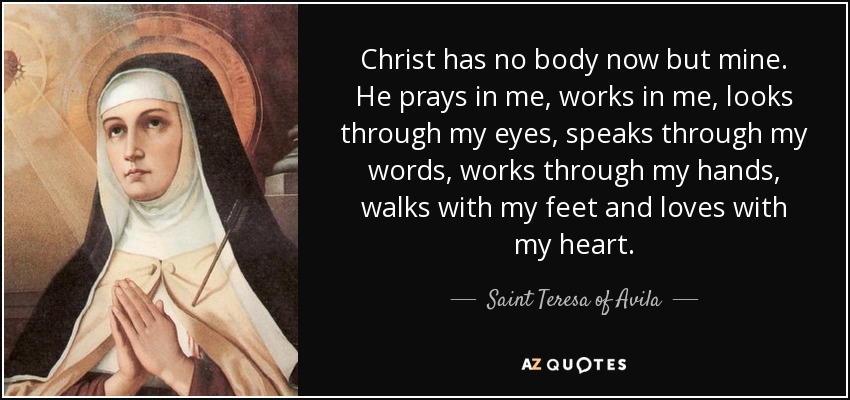


 Tuesday, October 15th was the feast day from
one our most insightful saints, St. Teresaof Ávila,
both a mystic and a doctor of the church.
I have wanted to read her most famous work, The Interior Castle, and it’s on my bookshelf, but I haven’t gotten to it yet. So many books, so little time. Perhaps next year.
Tuesday, October 15th was the feast day from
one our most insightful saints, St. Teresaof Ávila,
both a mystic and a doctor of the church.
I have wanted to read her most famous work, The Interior Castle, and it’s on my bookshelf, but I haven’t gotten to it yet. So many books, so little time. Perhaps next year.
