"Love follows knowledge."
"Beauty above all beauty!"
– St. Catherine of Siena

Showing posts with label Mexico. Show all posts

Tuesday, December 7, 2021

The Power and the Glory by Graham Greene, Post #5

This is the fifth and last post on my reading of Graham Greene’s The Power and the Glory.

You can read Post #1 here.  

Post#2 here.  

Post #3 here

Post #4 here


Parts 3 and 4

Summary

Chapter 1

The priest is in safe territory now staying at the house of a married German, Lutheran couple, who though they disapprove of Catholicism give the priest safe haven.  In town, the priest hears confessions, celebrates Mass, and performs baptisms.  He finds this safe life uncomfortable.  Just as he’s to depart for another city he meets the mestizo again, who implores him to go with him back into dangerous territory because the criminal gringo is dying and needs a final confession.  Fully realizing that this is a trap, the whisky priest decides to go.

Chapter 2

The priest and mestizo come to a group of huts, and the mestizo leads him into one where the gringo is actually there and dying.  The priest tries to induce a confession from the gringo who only tells him to go away and to take his knife.  The priest insists on a confession, but the gringo dies. 

Chapter 3

Suddenly the lieutenant comes into the doorway and makes himself known.  The priest realizes it has been a trap.  He offers no resistance and in a way is actually glad his running is over.  The lieutenant is to take him back to the town of his police station to stand trial for treason, but it is raining and so decides to wait for the rain to end.  While waiting the lieutenant and the priest sit by candlelight and talk over their views of Catholicism.  The priest’s humility seems to touch the lieutenant and he appears to feel a certain remorse, and asks the priest for a request.  The priest just wants to say his last confession and be absolved of his sins.  The storm ends and they get on horses for the trip. 

Chapter 4

Back at town, the lieutenant goes to Padre Jose’s house to bring him to the police station to hear the whisky priest’s confession.  Padre Jose is willing to go but his wife refuses to let him go.  The lieutenant goes back to the dark cell where the priest has been placed and tells him he could not get him his confessor.  But he does give him one last bottle of brandy to pass the night.  Alone and drunk he goes through his last sins attempting at repentance, but he thinks of his daughter and the love he feels for her.  He has a dream of being at an altar and partaking a feast where he sees the girl, Coral, who taps out Morse code.  He awakes and it is morning and he feels the regret of not accomplishing more as a priest.

Part 4

Captain and Mrs. Fellows are in a hotel talking about going home.  Mrs. Fellows is sick as usual but wants to return to their home while Captain Fellows does not want to.  From the conversation we surmise that Coral has died, and they recall that priest she protected.

Mr. Tench is working on the bad tooth of the Jefe, and he tells him that his wife has written to him and wants a divorce.  Outside below in the courtyard Mr. Tench hears commotion and looks out the window to see a firing squad getting ready.  A small man is led out and Mr. Tench recognizes him as the priest who had shared brandy with him.  The priest is shot, and the body is dragged away.  The event repulses Mr. Tench and brings over him a feeling of loneliness.

The woman with the children who had harbored the priest tells her children the story of Juan the martyr.  The boy asks if the priest the police shot today was a martyr, and the mother assures him he was.  When the boy goes to bed he has a dream about the priest and his funeral, but a knock on the door wakes him and upon answering it finds it is another priest coming to stay.

###

I’ve been trying to find a way to wrap up this novel, and I admit it’s been a little difficult.  Some have said this is a very depressing novel.  Perhaps that is unavoidable given its topic.  What makes this a great novel, a great Christian novel, and great Catholic novel?  I’ll try to highlight a few points, which I think will lift some of the gloom off the story. 

First off this is a first rate novel because of its crisp narrative, its memorable characters, and its wonderfully suspenseful plotting.  Graham Greene is a master storyteller.  Coupling the central character (the whiskey priest) with a different character not only moves the plot along but creates a suspense for that anticipated conflict with his nemesis, the lieutenant, when the two will undoubtedly meet.  As a story, the plotting is perfection: the whiskey priest, flawed and fallen, resisting the dystopian government that persecutes him.  Can he escape?  Does he want to escape?  Will he survive?  These are all questions that hang in the balance throughout the novel until its climatic end.

What elevates this novel even higher is the psychological portrayal of a very complicated central character.  Above all this is a psychological novel which looks at the world through what I call Christian anthropology, that is, a Christian understanding of man.  Within the whiskey priest are two human impulses that are rooted in a Biblical human nature: “What I do, I do not understand. For I do not do what I want, but I do what I hate.” (Rom 7:15) and “If God loved us, we must love one another” (1 Jn 4:7).  And so the priest is caught in this existential conflict of doing what he cannot help from doing and doing it for love of his fellow man.  Indeed, the whiskey priest can be seen as having the same “thorn in the flesh” that propels him forward to his fate as it did St. Paul, a grace of power from weakness made perfect (2 Cor. 7-10).  The psychological novel came to its height in the first half of the twentieth century, and this novel is among the best and rooted in a Christian worldview.  Even the minor characters have complex psychologies that can be traced to a Christian anthropology. 

Third, this is also a great Catholic novel.  Just about all the sacraments are interwoven through the novel but the governing action of most of the novel is the whiskey priest’s commitment to consecrate the Eucharist and spread it to the faithful.  The whiskey priest is the only man left in this region of Mexico that can and is willing to be the instrument of grace that only a priest can be.  Only a priest has the ability to transubstantiate bread and wine into the body and blood of Christ.  And so then one understands why a good deal of the plot revolves around the priest’s search for available wine in a country where all alcoholic beverages have been made illicit.  He risks being caught in order to provide the grace for the common folk to live in Christ: “He who eats my flesh and drinks my blood abides in me, and I in him” (Jn 6:56).  The whiskey priest is attempting to sanctify his time and place and the living souls around him through the consecration of the Eucharist, the Mass, the representation of the sacrifice of Christ, and in so doing bring life to the sterility of what has become a dystopian world.

You might consider the priest a failure, having the wine he had on hand thrown out by the mother of his child, and when he finally is able to buy more having it drunk from under him by the authorities.  There are no baptisms in the entire novel, no confirmations, no marriages, no confessions.  Indeed faced with his impending execution the priest cannot even get his own confession heard.  There is no Sacrament of the Eucharist given out.  In the one Mass he is able to celebrate the authorities storm the makeshift chapel right after the consecration, and so the whiskey priest has to hurriedly swallow the consecrated bread and wine before offering it to the congregation.  No priest is given the Sacrament of Holy Orders.  Indeed, one priest, Padre Jose, renounces his Holy Orders.  And finally there are no last rites administered.  The desperado gringo from the United States, shot and dying, refuses them.  No sacrament in the novel is actually fulfilled in the dystopian region.  The priest attempts to provide the graces of the sacraments in the context of a sterile wasteland.  T.S. Eliot’s poem “The Waste Land” is certainly alluded. 

But is the whiskey priest a failure?  If the priest cannot give graces through the sacraments, he does provide graces through his very being.  As I’ve pointed out the novel is structured where each chapter couples the whiskey priest exclusively with another character.  While this is a really innovative way to move the plot forward it also allows us to see how the priest’s very being effects the other characters.  And in each case the priest provides some sort of grace to the other character.  As the priest interacts with the other, there is some sort of Cor Ad Cor Loquitur, heart speaking to heart.  It’s as if the priest is a living sacrament, offering himself to each person and bringing God’s grace into their lives.  One certainly can see the allusion in the narrative to Christ’s Passion and crucifixion, and certainly the whiskey priest can be seen as a Christ-figure in the novel, but I think it’s more than that.  The priest’s execution is actually a re-presentation of Christ’s sacrifice, just like every Mass is a re-presentation of Christ.  And so the priest is not a failure, just as Christ is not a failure.  We see at the end a new priest come—a resurrection of sorts—and now the region has been sanctified by the whiskey priest’s death and the lives he has touched.  Though the novel never reaches further into the future, we know how the dystopia turns out.  Mexico renounces this anti-Catholicism and returns to faith.

This short little novel is one of the giants of the twentieth century.


Thursday, December 2, 2021

The Power and the Glory by Graham Greene, Post #4

This is the fourth post on my reading of Graham Greene’s The Power and the Glory.

You can read Post #1 here.  

Post#2 here.  

Post #3 here


Finally the last paired conversation with the whisky priest that is worth looking at in detail is with the lieutenant.  The lieutenant is perhaps the hardest of the characters to touch his heart, but here too I think the priest’s heart to heart conversation works on the police officer.  The two meet for the final time at the gringo’s death where the whisky priest was trying to give the gringo last rites.  The gringo has died and the lieutenant springing the trap comes into the hut and makes himself known.


‘You didn’t expect to see me,’ he said.


‘Oh, but I did,’ the priest said. ‘I must thank you.’


‘Thank me, what for?’


‘For letting me stay alone with him.’


‘I am not a barbarian,’ the officer said. ‘Will you come out now, please? It’s no use at all your trying to escape. You can see that,’ he added, as the priest emerged and looked round at the dozen armed men who surrounded the hut.


‘I’ve had enough of escaping,’ he said.  (p. 190)

And so the lieutenant gets his first shock, being thanked by the priest.  In fact I think one could look at the conversation between the two as a mini enlightenment, an undermining of his preconceived notions.  The lieutenant says “he is not a barbarian.”  He says it again moments later.  He is not a barbarian and yet he kills priests, those who harbor them, and indiscriminately peasants in order to pressure people to turn them in.  It’s amazing how people can rationalize their evil.  A storm ensues and the two are stuck in the hut and get into a conversation.  In the course of the conversation, the priest lets out he has fathered a child.


He [the lieutenant] said with contempt, ‘So you have a child?’


‘Yes,’ the priest said.


‘You a priest?’


‘You mustn’t think they are all like me.’ He watched the candlelight blink on the bright buttons. He said, ‘There are good priests and bad priests. It is just that I am a bad priest.’


‘Then perhaps we will be doing your Church a service …’


‘Yes.’


The lieutenant looked sharply up as if he thought he was being mocked. (191)

The priest’s honesty and humility is another shock to the lieutenant.  The priest shows him magic card tricks, like he wanted to show Brigitta.  It leads to a subject about the parish Guilds, which I take as some sort of religious camp or tent revival that served as a means to preaching.  The lieutenant has bad memories of it recalling some sort of hypocrisy.  The priest actually acknowledges the hypocrisy.


The priest said, ‘You are so right.’ He added quickly, ‘Wrong too, of course.’


‘How do you mean?’ the lieutenant asked savagely. ‘Right? Won’t you even defend…?’


‘I felt at once that you were a good man when you gave me money at the prison.’


The lieutenant said, ‘I only listen to you because you have no hope. No hope at all. Nothing you say will make any difference.’


‘No.’


He had no intention of angering the police officer, but he had had very little practice the last eight years in talking to any but a few peasants and Indians. Now something in his tone infuriated the lieutenant. He said, ‘You’re a danger. That’s why we kill you. I have nothing against you, you understand, as a man.’ (193)

That is the most satanic line of the whole novel: “That’s why we kill you. I have nothing against you, you understand, as a man.”  It disregards the man’s humanity.  And what is it that overrides his innate sense of human compassion?  The conversation continues, the priest disagreeing.


‘Of course not. It’s God you’re against. I’m the sort of man you shut up every day—and give money to.’


‘No, I don’t fight against a fiction.’


‘But I’m not worth fighting, am I? You’ve said so. A liar, a drunkard. That man’s worth a bullet more than I am.’


‘It’s your ideas.’ The lieutenant sweated a little in the hot steamy air. He said, ‘You are so cunning, you people.  (194)


It’s the ideas he thinks the priest represents.  The priest’s humanity has been devalued because of some abstract ideas.  And priest goes on to explain his life, tries to explain his failings as a priest, tries to explain how he has tried to serve.  He tries to explain the state of the world: “We have facts, too, we don’t try to alter—that the world’s unhappy whether you are rich or poor—unless you are a saint, and there aren’t many of those” (194-5).  The first part of their conversation ends with the priest kindness, “You have listened very patiently,” and the lieutenant responding with “I am not afraid of other people’s ideas” (197).  Has the priest altered something in the lieutenant?  It’s not evident but the lieutenant has now listened to a different point of view.

You can tell that something has changed within the lieutenant because later that evening, having stopped for the night and while the two men are sleeping in the same hut but both unable to sleep, it is the lieutenant who initiates the conversation.  “You’re a man of education,” he addresses the priest.  He wants to understand more.  The lieutenant goes on to explain his views.


‘I’ve had to think things out for myself. But there are some things which you don’t have to learn in a school. That there are rich and poor.’ He said in a low voice, ‘I’ve shot three hostages because of you. Poor men. It made me hate you.’(198)

And later he continues, “Those men I shot. They were my own people. I wanted to give them the whole world.”  What a violation of the heart.  He wanted to give them the whole world because he identified with their poverty, and yet he killed them as a result of his ideology.  It all stems not from love but from hate.

But the priest continues in his humility, denying his educated status. 


‘I was never any good at books,’ the priest said. ‘I haven’t any memory. But there was one thing always puzzled me about men like yourself. You hate the rich and love the poor. Isn’t that right?’


‘Yes.’


‘Well, if I hated you, I wouldn’t want to bring up my child to be like you. It’s not sense.’


‘That’s just twisting …’


‘Perhaps it is. I’ve never got your ideas straight. We’ve always said the poor are blessed and the rich are going to find it hard to get into heaven. Why should we make it hard for the poor man too? Oh, I know we are told to give to the poor, to see they are not hungry—hunger can make a man do evil just as much as money can. But why should we give the poor power? It’s better to let him die in dirt and wake in heaven—so long as we don’t push his face in the dirt.’ (199)

The priest here shows the lieutenant that there are a good intentions toward the poor.  It is not a callus extortion of the poor but something that fits within the priest’s worldview.  The lieutenant recoils:


‘I hate your reasons,’ the lieutenant said. ‘I don’t want reasons. If you see somebody in pain, people like you reason and reason. You say—pain’s a good thing, perhaps he’ll be better for it one day. I want to let my heart speak.’

The priest’s logic doesn’t fit into his worldview.  He says he wants “to let his heart speak.”  Now this is where I am convinced that Graham Greene is alluding to John Henry Newman’s motto Cor Ad Cor Loquitur, heart speaks to heart.  Greene is an Englishman and a convert to Catholicism.  John Henry Newman was an Englishman and possibly the most famous Englishman to convert to Catholicism.  Greene is a writer, and Newman was especially known for his exceptional writing, both as a prose stylist and as a Catholic intellectual.  There is no doubt that Greene would have been familiar a good portion of Newman’s writings, and certainly would be aware of Newman’s motto.  I think that heart speaking to heart is at the crux of the novel.

It is fascinating that it is the lieutenant that wants to speak from the heart, but his heart has been altered by fallen world and his ideology.  It is now the priest who recoils.


‘At the end of a gun.’


‘Yes, At the end of a gun.’


‘Oh well, perhaps when you’re my age you’ll know the heart’s an untrustworthy beast. The mind is too, but it doesn’t talk about love. Love. And a girl puts her head under water or a child’s strangled, and the heart all the time says love, love.’(199)

It is the priest who rejects the speaking from the heart.  Speaing from the heart is not enough.  The heart needs to be filled with God, not filled with the world.  To explain the priest practically quotes from John’s first epistle.


‘Oh,’ the priest said, ‘that’s another thing altogether—God is love. I don’t say the heart doesn’t feel a taste of it, but what a taste. The smallest glass of love mixed with a pint pot of ditch-water. We wouldn’t recognize that love. It might even look like hate. It would be enough to scare us—God’s love. It set fire to a bush in the desert, didn’t it, and smashed open graves and set the dead walking in the dark. Oh, a man like me would run a mile to get away if he felt that love around.’ (199-200)

God is love and our heart speaks God’s love if it abides in God.  But this wonderful metaphor must be highlighted: “The smallest glass of love mixed with a pint pot of ditch-water.”  This recalls what the angel Gabriel addresses the Blessed Virgin, “Hail Mary, full of grace.”  It has been described that Mary, like a glass, is full of grace while we lesser creatures are granted varying amounts of grace.  I’ve jokingly said that while Mary’s glass is full, mine only contains a thimble full.  But Greene takes that metaphor of the glass and has the contents mixed with love—and one can think of it as the grace to love—and ditch water, alluding to the fallen nature in our beings.  That is brilliant. 

Does the lieutenant understand any of that?  No, he gives no indication.  He says that if a man served him like God serves us he would “put a bullet in his head” (200), quite a sacrilegious thing to say.  Finally the priest opens up with sincerity, with empathy, and with communion with his fellow man.


‘Listen,’ the priest said earnestly, leaning forward in the dark, pressing on a cramped foot, ‘I’m not as dishonest as you think I am. Why do you think I tell people out of the pulpit that they’re in danger of damnation if death catches them unawares? I’m not telling them fairy stories I don’t believe myself. I don’t know a thing about the mercy of God: I don’t know how awful the human heart looks to Him. But I do know this—that if there’s ever been a single man in this state damned, then I’ll be damned too.’ He said slowly, ‘I wouldn’t want it to be any different. I just want justice, that’s all.’  (200)

And this is a good place to conclude the close look between their conversations.  We see the lieutenant is not intellectually convinced, but his reaction to the priest does change.  He has felt his heart moved.  From there he treats the priest with a certain dignity.  He goes out of his way to offer kindness to the priest.  The priest becomes a human being and not an object of his ideology.  He tries to get the priest a person to hear his last confession; he offers putting him in a cell with others to pass the last night; he gives him a bottle of brandy to ease the nerves.  But he will not let him escape, and he carries out the passion narrative to its conclusion.  We don’t hear of the lieutenant’s future but perhaps the grace experienced from the priest’s heart and his sacrificial death will have a beneficial effect in time.

###


Part 2, Chpts 3 & 4

Summary

Chapter 3

In jail the priest is placed in a crowded cell with an assortment of people.  There is even a couple having sex in the dark.  Some in the cell get into a conversation which turns to sin and priests, and in the process the whisky priest admits to being a priest, fully expecting that one of the cell mates will now turn him in for the reward.  In so doing the whisky priest confesses his sins of alcoholism and of fathering a child.  A pious woman in the cell asks him to hear her confession, but he refuses, and she, upset, scorns him bitterly. 

In the morning, fully expecting to be identified as a priest, he is surprised that no one turned him in.  In one of the cells is the mestizo who he had traveled down, but he too does not turn the priest in.  Finally he is confronted by the lieutenant, who does not recognize him, and finally sends him off, even giving him money to get by with.

Chapter 4

The priest, not having anywhere to go, returns to the Captain Fellows house, hoping to get some food from Cora.  He finds the house is mysteriously empty and abandoned, and without any food.  There is only a crippled dog, and the whisky priest fights over and takes a discarded meaty bone. 

He leaves the Fellows house and finds shelter in a village hut.  The village too is abandoned, but there is a mysterious Indian woman who has hung about.  Her actions make him suspicious and he searches the hut and finds hidden a child with multiple bullet holes, bleeding badly.  He tries to save the child but he dies in his arms.  Despite the inability to communicate, he learns the violence was caused by the fugitive American bandit and she learns that he is a priest.  She presses him to go with her to bury her child, and she takes him on several day journey across wilderness and mountains to a place of crosses.  The Indian woman places the body of her child at the foot of the largest cross and begins to pray.  The priest leaves her there, exhausted and delusional from lack of food.  Feeling guilty for abandoning her he returns to find her gone when a man with a gun finds him at the point of death.  He is not the police but a man from the north, who nurses him and takes him north where it is safe to be a priest.

###

I have to say, chapter 4 of Part 2 is one of the best pieces of fiction writing one will ever find.  The passages with the Indian child and mother and the trek to the field of crosses is absolutely heartbreaking but superbly written.  It may not have the purple prose of an Evelyn Waugh or an F. Scott Fitzgerald, but the tone and pacing and detail is of the highest quality.  One should really just appreciate the writing in that chapter.  I think I’ll read it again.

###

As I was going through this month’s Magnificat magazine and which overlapped with my reading of The Power and the Glory, I came across this passage which instantly recalled the novel.  Magnificat has a regular feature where it provides a short biography of a saint, and each issue coordinates the saints’ by a topic.  In this issue the topic was “Saints Who Were Leaders.”  I was shocked to find this saint I had never heard of, but was very much relevant to the Cristero War and of course The Power and the Glory.


Saint Who?  Saints Who Were Leaders


Saint Josè María Robles Hurtado

Martyr († 1927)        Feast: June 26


A native in Mascota in Jailisco, Mexico, Josè was ordained a priest at twenty-four and two years later founded the Sisters of the Sacred Heart of Jesus, with a focus on Eucharistic devotion.  After several years in mission work, he was assigned to a parish.  Although a new Mexican constitution outlawed public devotions, Josè went forward nevertheless with a bold plan to erect a giant cross devoted to Christ the King in the geographic center of Mexico.  To announce the laying of the cornerstone, he had signs placed throughout the countryside declaring Christ the “King of Mexico.”


After this the authorities began to put increasing pressure on Josè to curtail his work.  He was forced into hiding, but he continued to minister to his parishioners in secret.  On the feast of the Sacred Heart, June 25, 1927, he was arrested when he was about to say a private Mass in a family home.  The next day, he was taken to a large oak tree outside a nearby village and hanged.  Josè placed the noose on his own neck so that none of his executioners would bear the guilt of that act.


Shortly beforehand, Josè had penned a poem anticipating his death: “I want to love you until martyrdom…/With my soul I bless you, my Sacred Heart./Tell me: is the instant of my eternal union near?/Stretch out your arms, O Jesus/Because I am your “little one.”


Loving Father, through the intercession of Saint Josè María Robles Hurtado, take me at the moment of my death into your eternal embrace.

(p. 80, Magnificat, Aug. 2021, Vol. 23, No. 6.)

That cross Josè built might be the same cross in the fourth chapter of Part 2, the giant cross the Indian woman places her dead child at the foot.


Monday, November 15, 2021

The Power and the Glory by Graham Greene, Post #3

This is the third post on my reading of Graham Greene’s The Power and the Glory.

You can read Post #1 here.  

Post#2 here.  


Another important pairing is the priest with Coral Fellows.  Coral is thirteen, just prior to puberty.  But she is profoundly intelligent, precocious in her empathy, and maybe even prescient in the sense that she seems to understand things in a way beyond limitations.  When her mother tells her father Coral has been entertaining a policeman at the house, her father goes to interrogate her.  Here’s her introduction to the scene.


She stood in the doorway watching them with a look of immense responsibility. Before her serious gaze they became a boy you couldn’t trust and a ghost you could almost puff away, a piece of frightened air. She was very young—about thirteen—and at that age you are not afraid of many things, age and death, all the things which may turn up, snake-bite and fever and rats and a bad smell. Life hadn’t got at her yet; she had a false air of impregnability. But she had been reduced already, as it were, to the smallest terms—everything was there but on the thinnest lines. That was what the sun did to a child, reduced it to a framework. The gold bangle on the bony wrist was like a padlock on a canvas door which a fist could break.  (p. 33)

She carries an air of responsibility (her parents stand as a “boy” before, that is she becomes their parent), is unafraid, and “reduced” from the sun which I take to mean thin and smallish.  But she comes across as “impregnable” because “life hadn’t got at her yet.”  Despite her intelligence and sense of responsibility—after all she takes care of her emotionally debilitated mother—there is a quality of innocence.  All these qualities and with perhaps a certain providential grace, she understands and gets correct the moral situation before her.  She keeps the priest hidden from the police.

What we learn is that she has lied to the lieutenant about a priest on their property and has hidden the priest while kept the lieutenant at bay.  It is through her directives that first she resolves the situation with the lingering policeman, then explains to her father there really is a priest hidden, and finally she takes her father to him.  The father has absolutely no empathy for the priest.  He is the exact opposite of Coral, refusing to give him drink and food, and insists he leave as soon as it gets dark. 

What is astonishing is that the “politics” of the situation is completely irrelevant to Coral.  As they are walking to the barn, her father snaps at the girl, “We’ve no business interfering with politics.”  But Coral responds: This isn’t politics. I know about politics. Mother and I are doing the Reform Bill” (37).  Her father is completely configured to the politics.  Coral is configured differently.  So she sneaks back out later.


Coral put down the chicken legs and tortillas on the ground and unlocked the door. She carried a bottle of Cerveza Moctezuma under her arm. There was the same scuffle in the dark: the noise of a frightened man. She said, ‘It’s me,’ to quieten him, but she didn’t turn on the torch. She said, ‘There’s a bottle of beer here, and some food.’


‘Thank you. Thank you.’


‘The police have gone from the village—south. You had better go north.’


He said nothing.


She asked, with the cold curiosity of a child, ‘What would they do to you if they found you?’


‘Shoot me.’


‘You must be very frightened,’ she said with interest.


He felt his way across the barn towards the door and the pale starlight. He said, ‘I am frightened,’ and stumbled on a bunch of bananas. (39)

She feels his hunger, and feeds him secretly.  Not only has she lied to the police, she has disobeyed her father.  Why?  She doesn’t really know whether he’s innocent.  She helps him because there is a suffering man who seems to have his dignity reduced.  If the whisky priest is on a passion narrative in this novel—and that is one way to look at the story—Coral is Veronica wiping the face of Jesus at the sixth station of the cross.  Her reaction when he tells her of the consequences of being caught is empathy: “You must be very frightened.”  She looks into his heart and connects with it.  The politics of the world crumble when faced with the humanity before her.

They continue this heart to heart conversation.  At one point she offers a solution to his situation.


She said, ‘Of course you could—renounce.’


‘I don’t understand.’


‘Renounce your faith,’ she explained, using the words of her European History.


He said, ‘It’s impossible. There’s no way. I’m a priest. It’s out of my power.’


The child listened intently. She said, ‘Like a birthmark.’ (40)

“Like a birthmark,” she intuits the sacrament of Holy Orders.  Like Baptism, Holy Orders is a mark on your soul that cannot be taken away (see Ps 110:4 “The Lord has sworn and will not waver: "You are a priest forever in the order of Melchizedek” and echoed in Heb 7:17).  She understands his existential predicament.  And so she offers him to return any time to hide out.  She tries to tech him Morse code and asks him when he comes to signal with two longs and one short (41).  It is interesting that two longs and one short in Morse code stand for the letter “G.”  Why “G”?  Perhaps standing for God?

The conversation then turns toward God.  He asks her if she believes in God, and she says she has “lost her faith” at the age of ten.  Here now it is the whisky priest’s turn to talk to her heart.  He tells her twice he will pray for her and gives her hope that with a little brandy he can “defy the devil.” 

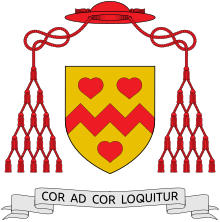
Again, as in the conversation with Mr. Tench, what we have is heart speaking to heart.  In these and other pired conversations with the priest throughout the novel, what I find is heart speaking to heart.  Now this recalls St. John Henry Cardinal Newman’s episcopal motto, “Cor Ad Cor Loquitur,” Heart Speaks to Heart.  Newman took the phrase from a letter from Saint Francis de Sales, but today it’s identified with Newman.  Now Cor Ad Cor Loquitur could be referring to God’s heart speaking to man’s heart, or vice versa.  Or it could mean a human heart speaking to another human heart with God’s language.  For a full understanding of the motto see this article, “Cor ad cor loquitur” John Henry Cardinal Newman’s Coat of Arms” from the he International Centre of Newman Friends.   From the article, “The Church is the communion of Christians who are “one heart and one soul” (Acts 4:32), speaking the new language inspired by the Word of God: cor ad cor.” 


The priest speaks in this language of the heart, and all the characters respond in some measure also with their hearts, but that measure is perhaps a level of grace granted to the character.  Mr. Tench receives the language of the heart and is touched enough to break his apathy and write to his wife, who writes back granting him a divorce.  He is touched enough to feel the heartache of the priest’s death at the end of the novel. 

Coral responds the most, as I’ve pointed out here.  Later we see she has been touched by the priest when she brings up God and faith to her mother.  The priest’s conversation, heart, and, indeed, his prayers have been working on the girl.  In his dream of the night before the execution, the priest dreams of Coral.  She is there at the feast in heaven, where he sees himself eating hungrily just like he did when Coral fed him in the barn.  In the dream she, who we learn in the course of the novel has died, taps out Morse code for the priest.  Notice also that in heaven she taps out differently than what she proposed in the barn.  In the dream she taps out three longs and one short.  There is no single letter in Morse code for three longs and a short.  Three longs stand for “O” and one short stands for “E.”  I could be off base here but could those be the vowels surrounding the word “love”?  Of course that’s speculation, but the one thing for sure is that she communicates with him from heaven.  Heart speaks to heart.

###

The next paired conversation with the whisky priest that leads to more insight of the novel is that with Brigitta, his illegitimate daughter.  Of all the people in the entire novel, we know that Brigitta is special to him.  It is almost the first thing he brings up when he comes to his village and sees her mother, Maria.


He said gently, not looking at her, with the same embarrassed smile, ‘How’s Brigitta?’ His heart jumped at the name: a sin may have enormous consequences: it was six years since he had been—home.


‘She’s as well as the rest of us. What did you expect?’


He had his satisfaction, but it was connected with his crime; he had no business to feel pleasure at anything attached to that past.  (p. 61-62)

And so we see here the paradox of pain and joy.  Later children come by to kiss the hand of a priest, and he looks for his daughter among them, though he has no idea what she looks like.


The real children were coming up now to kiss his hand, one by one, under the pressure of their parents. They were too young to remember the old days when the priests dressed in black and wore Roman collars and had soft superior patronizing hands; he could see they were mystified at the show of respect to a peasant like their parents. He didn’t look at them directly, but he was watching them closely all the same. Two were girls—a thin washed-out child—of five, six, seven? he couldn’t tell, and one who had been sharpened by hunger into an appearance of devilry and malice beyond her age. A young woman stared out of the child’s eyes. He watched them disperse again, saying nothing: they were strangers.  (62-63)

The continuity of faith between generations has been atrophied.  They don’t know the significance of a priest now that the persecution has been going on since before they were born.  It is the girl with the appearance of devilry that turns out to be his daughter.  In her eyes he sees a “young woman,” not a child.  It is also important to note that he attributes hunger (the “one who had been sharpened by hunger”) for what I’ll call a loss of innocence.  Yes, she is only seven but there is a lack of innocence in Brigitta that was there with Coral who was twice her age.  In fact, when the priest has a moment of personal anguish, it is Brigitta who laughs at him.  The anguish is in reaction to hearing that a man was executed from not turning in the priest.


He gave a little yapping cry like a dog’s—the absurd shorthand of grief. The old-young child laughed. He said, ‘Why don’t they catch me? The fools. Why don’t they catch me?’ The little girl laughed again; he stared at her sightlessly, as if he could hear the sound but couldn’t see the face. Happiness was dead again before it had had time to breathe; he was like a woman with a stillborn child—bury it quickly and forget and begin again. Perhaps the next would live.  (63-64)


At this point he still doesn’t know that this is his daughter.  Later he specifically asks for her.


He said shyly, ‘And Brigitta … is she … well?’


‘You saw her just now.’


‘No.’ He couldn’t believe that he hadn’t recognized her. It was making light of his mortal sin: you couldn’t do a thing like that and then not even recognize …


‘Yes, she was there.’ Maria went to the door and called, ‘Brigitta, Brigitta,’ and the priest turned on his side and watched her come in out of the outside landscape of terror and lust—that small malicious child who had laughed at him. ‘Go and speak to the father,’ Maria said. ‘Go on.’


He made an attempt to hide the brandy bottle, but there was nowhere … he tried to minimize it in his hands, watching her, feeling the shock of human love.  (65)

“The shock of human love” is what makes the priest transcend his sins.  It is his love for all humanity—not just in a general sense but with every specific human being—that makes him a true Christian.  Jesus commands us to love our neighbor, but it is John in his first epistle that describes it as more than a commandment but of a thing of the heart.


Beloved, let us love one another, because love is of God; everyone who loves is begotten by God and knows God.  Whoever is without love does not know God, for God is love... Beloved, if God so loved us, we also must love one another.  No one has ever seen God. Yet, if we love one another, God remains in us, and his love is brought to perfection in us…We have come to know and to believe in the love God has for us.  God is love, and whoever remains in love remains in God and God in him.  In this is love brought to perfection among us, that we have confidence on the day of judgment because as he is, so are we in this world.  There is no fear in love, but perfect love drives out fear because fear has to do with punishment, and so one who fears is not yet perfect in love.  We love because he first loved us.  If anyone says, “I love God,” but hates his brother, he is a liar; for whoever does not love a brother whom he has seen cannot love God whom he has not seen.  This is the commandment we have from him: whoever loves God must also love his brother.  (1 Jn 4:7-21)

It is a long passage, and though I took out part through ellipses, but I think that passage is central to the novel.  It is through being in God’s love that makes us love, and then there is no room for hate.  You cannot hate your fellow human being if you are in God’s love.  But there is an implied corollary from this as well.  How can you love your brother in general if you don’t love someone specific?  Love of brother is not an abstraction of general humanity, but of specific persons.

Here the whisky priest loves his daughter in this specific way.  And so he feels that “shock” of love. His empathy goes out to her.  He protects her against her mother’s castigation (67) and wants to show her magic tricks (68).  He wants to come down to her level and speak heart to heart.  The child’s impudence prevents him.  Still the child saves his life when the lieutenant enters the town and child identifies him as her father, which should rule out being a priest (76).  Later he tells Maria “The next Mass I say will be for her” (79).  The priest has one more conversation with Brigitta after the lieutenant leaves.  At the garbage heap while looking for his thrown out papers, the child comes to him.  They talk heart to heart.  She tells him “they laugh at her” and that “everyone else has a father” (81).  He is taken aback.


He was appalled again by her maturity, as she whipped up a smile from a large and varied stock. She said, ‘Tell me—’ enticingly. She sat there on the trunk of the tree by the rubbish-tip with an effect of abandonment. The world was in her heart already, like the small spot of decay in a fruit. She was without protection—she had no grace, no charm to plead for her; his heart was shaken by the conviction of loss. He said, ‘My dear, be careful …’


‘What of? Why are you going away?’


He came a little nearer; he thought—a man may kiss his own daughter, but she started away from him.


‘Don’t you touch me,’ she screeched at him in her ancient voice and giggled. Every child was born with some kind of knowledge of love, he thought; they took it with the milk at the breast; but on parents and friends depended the kind of love they knew—the saving or the damning kind. Lust too was a kind of love. He saw her fixed in her life like a fly in amber—Maria’s hand raised to strike: Pedro talking prematurely in the dusk: and the police beating the forest—violence everywhere. He prayed silently, ‘O God, give me any kind of death—without contrition, in a state of sin—only save this child.’

And here we get more Christian anthropology: “Every child [is] born with some kind of knowledge of love” but “the world was in her heart already, like the small spot of decay in a fruit.”  [Actually as I think on it, this is more Catholic anthropology then general Christian.  Some Protestant denominations believe in total depravity of humanity.  That doesn’t fit here.  Catholics believe we are born with the capacity for both.]  And so we see why Brigitta is alluded to as a “young woman” and not a child.  She has lost her innocence.  Hunger, her mother’s harshness, Pedro’s worldly diatribes have smudged her soul.  He makes one last effort to speak to her heart.  I can’t quote the entire scene, but it’s worth reading.  At one point he falls to his knees.


He went down on his knees and pulled her to him, while she giggled and struggled to be free: ‘I love you. I am your father and I love you. Try to understand that.’ He held her tightly by the wrist and suddenly she stayed still, looking up at him. He said, ‘I would give my life, that’s nothing, my soul … my dear, my dear, try to understand that you are—so important.’ (82)

I don’t think that giving up your soul for someone, which would be the ultimate death, is something the Catholic Church would approve (it smacks of making a deal with the devil) but he does say that several times in the novel.  And I think he’s sincere about it too.  It’s Greene trying to show he will die for his love.  Right after the priest says he loves her and she’s so important, we get this coming from the priest’s inner thoughts:


That was the difference, he had always known, between his faith and theirs, the political leaders of the people who cared only for things like the state, the republic: this child was more important than a whole continent.

And just like Coral, who separated the politics of a situation from the human connection, so too the whisky priest separates the politics of Mexico with his love for her.  The philosophic underpinnings are right out of John’s first epistle, the separation of the worldly with the love in God, as I quoted above.

Finally he tries again to reach her heart, manages a kiss, says goodbye, and when he departs can feel the “whole vile world coming round the child to ruin her.”  We never do hear about Brigitta again, but one hopes that just as the whisky priest’s heart to heart conversation and prayers effects Mr. Tench and his life, one hopes they will have a positive effect on Brigitta too in the future.