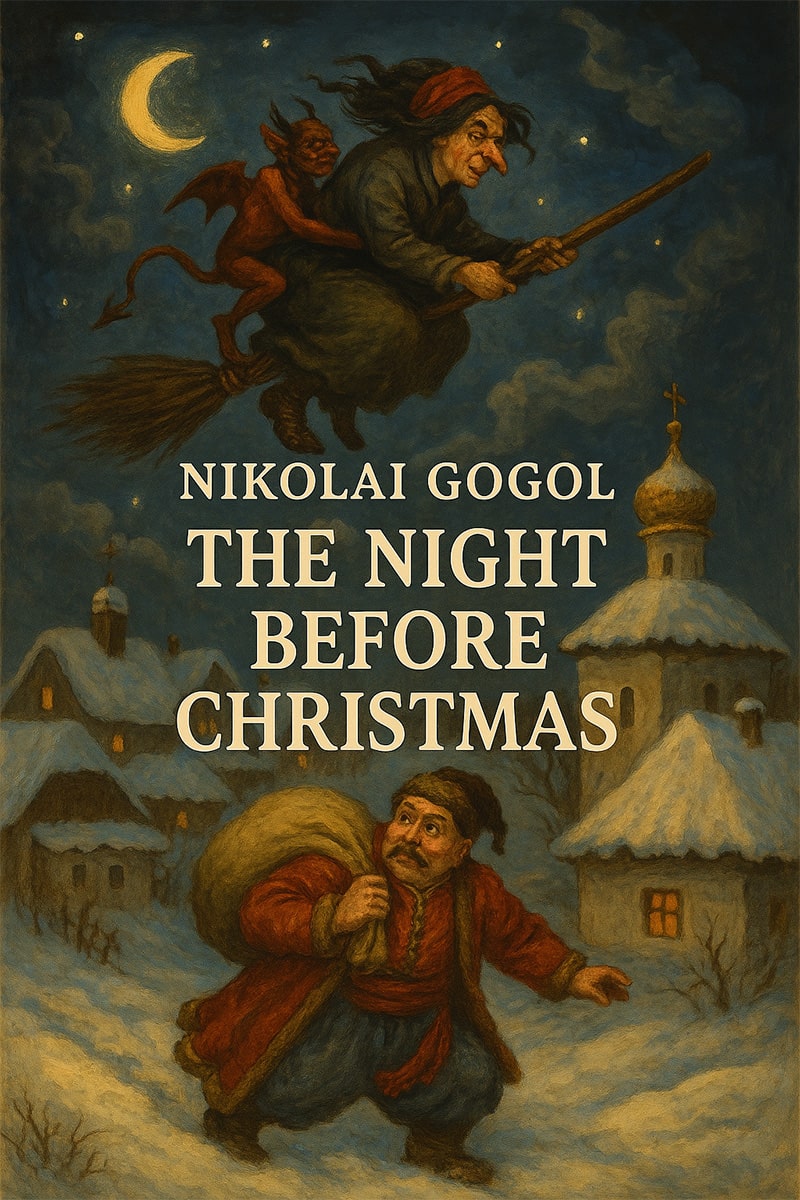
This is the second of
three posts on the short story “The
Night Before Christmas” by Nicolai Gogol.
You can find Post #1 here.

Kerstin Completing the
Summary:
Here is the rest of the summary:
Rumors fly over the assumed suicide of Vakula and
accusations of adultery between the village wives. Oksana doesn’t think he
ended his life and risk his salvation, but leaving Dikanka for good was a
possibility. After a restless night she finds herself in love with Vakula.
It is Christmas morning and the village is assembled
at church for divine worship and Vakula’s absence is noticed.
Vakula had arrived early that morning, thanked the
devil by smacking him and sent him on his way, then he fell asleep and missed
church on a holiday. After awaking he swore to do penance and made his way over
to Oksana’s with the shoes and ask for her in marriage. Chub gives his blessing
and Oksana, all shy now, remarks she didn’t need the shoes anymore.
A year has passed and Oksana holds a baby. Their house
is beautifully painted by Vakula. He also continued painting in the church
including one particular painting by the entrance of the church.
Beside the church door he had drawn a portrait of the
devil in hell, so unspeakably ugly that everyone spat at it as they walked in.
If a mother wanted to distract a fussy baby, she’d bring it closer to the
painting, saying, “Here, look, what a yaka kaka,” and the fascinated child
would hold back its tears, clutching at its mother’s breast.
###
My Comment:
Before I delve into themes,
I just wanted to highlight some of the special writing. Vladimir Nobokov, a great literary artist himself,
thought very highly of Gogol as an artist of fiction. And there are many famous writers that
Nabokov did not think highly of, so his praise of Gogol is notable. After reading this story, I would have to
agree. Let’s look at that scene where Vakula
goes to Paunchy Patsiuk, the Cossack wizard, for help in getting the devil to
aid him. I’m taking this off the
internet, so the spellings are different from the Pevear/Volokhonsky
translation.
Vakoola, after having run for some time along the
streets, stopped to take breath. "Well, where am I running?" thought
he; "is really all lost? —I'll try one thing more; I'll go to the fat
Patzuck, the Zaporoghian. They say he knows every devil, and has the power of
doing everything he wishes; I'll go to him; 'tis the same thing for the
perdition of my soul." At this, the devil, who had long remained quiet and
motionless, could not refrain from giving vent to his joy by leaping in the
sack. But the blacksmith thinking he had caught the sack with his hand, and
thus occasioned the movement himself, gave a hard blow on the sack with his
fist, and after shaking it about on his shoulders, went off to the fat Patzuck.
This fat Patzuck had indeed once been a Zaporoghian. Nobody, however, knew whether he had been turned out of
the warlike community, or whether he had fled from it of his own accord.
He had already been for some ten, nay, it might even be for some fifteen years, settled at Dikanka. At first, he had lived as best suited a Zaporoghian; working at nothing, sleeping three-quarters of the day, eating not less than would satisfy six harvest-men, and drinking almost a whole pailful at once. It must be allowed that there was plenty of room for food and drink in Patzuck; for, though he was not very tall, he tolerably made up for it in bulk. Moreover, the trousers he wore were so wide, that long as might be the strides he took in walking, his feet were never seen at all, and he might have been taken t for a wine cask moving along the streets. This, may have been the reason for giving him the nick-name of "Fatty." A few weeks had hardly passed since his arrival in the village, when it came to be known that he was a wizard. If any one happened to fall ill, he called Patzuck directly; and Patzuck had only to mutter a few words to put an end to the illness at once. Had any hungry Cossack swallowed a fish-bone, Patzuck knew how to give him right skilfully a slap on the back, so that the fish-bone went where it ought to go without causing any pain to the Cossack's throat. Latterly, Patzuck was scarcely ever seen out of doors. This was perhaps caused by laziness, and perhaps, also, because to get through the door was a task which with every year grew more and more difficult for him. So the villagers were obliged to repair to his own lodgings whenever they wanted to consult him. The blacksmith opened the door, not without some fear. He saw Patzuck sitting on the floor after the Turkish fashion. Before him was a tub on which stood a tureen full of lumps of dough cooked in grease. The tureen was put, as if intentionally, on a level with his mouth. Without moving a single finger, he bent his head a little towards the tureen, and sipped the gravy, catching the lumps of dough with his teeth. "Well," thought Vakoola to himself, "this fellow is still lazier than Choop; Choop at least eats with a spoon, but this one does not even raise his hand!" Patzuck seemed to be busily engaged with his meal, for he took not the slightest notice of the entrance of the blacksmith, who, as soon as he crossed the threshold, made a low bow.
The image of of this fat,
lazy Cossack is stark. He sleeps most of
the day and his whole life seems to revolve around meals. I love some of these details: “Nobody,
however, knew whether he had been turned out of the warlike community, or
whether he had fled from it of his own accord.”
One has a hard time imagining this short, fat guy being much of a
soldier. Did he leave or was pushed
out? We are in Valuka’s point of view,
so we will not know. And how about the
details of his wide, swinging gait with wide trousers. His wide, round body appeared to be a wine barrel
moving.
"I am come to thy worship, Patzuck!" said Vakoola, bowing once more. The fat Patzuck lifted his head and went on eating the lumps of dough.
Sitting on the floor,
“Turkish fashion,” with the bowl on a stand before him, he bends down to put
his face into the bowl and eat like an animal!
"They say that thou art—I beg thy pardon,"
said the blacksmith, endeavouring to compose himself, "I do not say it to
offend thee—that thou hast the devil among thy friends;" and in saying
these words Vakoola was already afraid he had spoken too much to the point, and
had not sufficiently softened the hard words he had used, and that Patzuck
would throw at his head both the tub and the tureen; he even stepped a little
on one side and covered his face with his sleeve, to prevent it from being
sprinkled by the gravy.
But Patzuck looked up and continued sipping.
The encouraged blacksmith resolved to proceed —"I am come to thee, Patzuck; God grant thee plenty of everything, and bread in good proportion!" The blacksmith knew how to put in a fashionable word sometimes; it was a talent he had acquired during his stay at Poltava, when he painted the centurion's palisade. "I am on the point of endangering the salvation of my sinful soul! nothing in this world can serve me! Come what will, I am resolved to seek the help of the devil. Well, Patzuck," said he, seeing that the other remained silent, "what am I to do?"
Vakula is the one
character in the entire story who is virtuous, but here it appears he too sinks
into sin. Using the “unclean powers,” which
is how it is referred to at some place in the story (at least in my
translation) is a sin. At first I
thought Gogol may not have regarded it as a sin in the context of the story,
but here he clearly has Vakula allude to it as “endangering” his soul.
"If thou wantest the devil, go to the
devil!" answered Patzuck, not giving him a single look, and going on with
his meal.
"I am come to thee for this very reason,"
returned the blacksmith with a bow; "besides thyself, methinks there is
hardly anybody in the world who knows how to go to the devil."
Patzuck, without saying a word, ate up all that
remained on the dish. "Please, good man, do not refuse me!" urged the
blacksmith. "And if there be any want of pork, or sausages, or buckwheat,
or even linen or millet, or anything else—why, we know how honest folk manage
these things. I shall not be stingy. Only do tell me, if it be only by a hint,
how to find the way to the devil."
"He who has got the devil on his back has no great way to go to him," said Patzuck quietly, without changing his position.
This is such an austere aphorism
that it has to have broader significance for the story. Afterall, this scene with Fatty Patzuck has
no narrative significance. It’s a step
toward using the devil, but it’s a step that could have been eliminated. Vakula could have realized this on his
own. Do every character in the story
have the “devil on his back”? The scene
gets funnier. As Vakula ponders the
meaning of the fat Cossack’s words, he opens his mouth to swallow them just as
Patzuck swallows his food.
Vakoola fixed his eyes upon him as if searching for the meaning of these words on his face. "What does he mean?" thought he, and opened his mouth as if to swallow his first word. But Patzuck kept silence. Here Vakoola noticed that there was no longer either tub or tureen before him, but instead of them there stood upon the floor two wooden pots, the one full of curd dumplings, the other full of sour cream. Involuntarily his thoughts and his eyes became riveted to these pots. "Well, now," thought he, "how will Patzuck eat the dumplings? He will not bend down to catch them like the bits of dough, and moreover, it is impossible; for they ought to be first dipped into the cream." This thought had hardly crossed the mind of Vakoola, when Patzuck opened his mouth, looked at the dumplings, and then opened it still wider. Immediately, a dumpling jumped out of the pot, dipped itself into the cream, turned over on the other side, and went right into Patzuck's mouth. Patzuck ate it, once more opened his mouth, and in went another dumpling in the same way. All Patzuck had to do was to chew and to swallow them. "That is wondrous indeed," thought the blacksmith, and astonishment made him also open his mouth; but he felt directly, that a dumpling jumped into it also, and that his lips were already smeared with cream; he pushed it away, and after having wiped his lips, began to think about the marvels that happen in the world and the wonders one may work with the help of the devil; at the same time he felt more than ever convinced that Patzuck alone could help him. "I will beg of him still more earnestly to explain to me—but, what do I see? to-day is a fast, and he is eating dumplings, and dumplings are not food for fast days![19] What a fool I am! staying here and giving way to temptation! Away, away!" and the pious blacksmith ran with all speed out of the cottage. The devil, who remained all the while sitting in the sack, and already rejoiced at the glorious victim he had entrapped, could not endure to see him get free from his clutches. As soon as the blacksmith left the sack a little loose, he sprang out of it and sat upon the blacksmith's neck.
And what a dramatic visual. Gogol has the dumplings lift on their own, dip into the sour cream, and flip into Patzuick’s mouth, and all the while with the devil inside the sack on Vakula’s shoulder. This is wonderful writing.
###
Frances’s Comment:
And this was wonderful
analysis — both you and Kerstin. I am so impressed with the extent and depth of
your insights.
“the wonders one may work with the help of the devil. . .’’ How that echoes through life and through literature.

###
The story is couched in the form of a folk tale. A folk tale is a story formed within a community and spread by means of oral transmission. Typically they use cultural elements of the community and typically gets modified by the community at large as it is retold and enhanced. They are also typically have a moral, use conventions that transcend realism, and touch on common fears of the community but usually in a comic manner. This story has many elements of a folk tale, but it is not a folk tale. Folk tales are not fifty something pages long and don’t have several subplots. Because of the multiplot lines I wouldn’t even consider this a short story. In my view this is a novella.
So if an extended and complex story such as this utilizes many of the same conventions of a folk tale, especially the transgression of accepted realism, does it become magic realism? Is this story an early example of Magic Realism? Elements of Magic Realism include supernatural events, character acceptance of this super natural as natural, and the blurring of boundaries of time and space, all set within a realistic setting. Wikipedia has an excellent entry for “Magic Realism.” A key definition is attributed to David Lodge:
In The Art of Fiction,
British novelist and critic David Lodge defines magic realism: "when
marvellous and impossible events occur in what otherwise purports to be a
realistic narrative—is an effect especially associated with contemporary Latin
American fiction (for example the work of the Colombian novelist Gabriel García
Márquez) but it is also encountered in novels from other continents, such as
those of Günter Grass, Salman Rushdie and Milan Kundera.
Notice that all the practitioners listed are writers from the mid-20th century on. In that Wikipedia entry it identifies the roots of Magic Realism to Nicolai Gogol:
19th-century Romantic writers such as E. T. A. Hoffmann and Nikolai Gogol, especially in their fairy tales and short stories, have been credited with originating a trend within Romanticism that contained "a European magical realism where the realms of fantasy are continuously encroaching and populating the realms of the real".
Let’s look at an example of the magic elements within this story. Here when the devil lifts Vakula up into the air and flies him to St. Petersburg. This is from the Pevear/Volokhonsky translation.
At first Vakula found it
frightening when he rose to such a height that he could see nothing below and
flew like a fly right under the moon, so that if he hadn't ducked slightly he
would have brushed it with his hat. However, in a short while he took heart and
began making fun of the devil. He was extremely amused by the way the devil
sneezed and coughed whenever he took his cypress-wood cross from his neck and
put it near him. He would purposely raise his hand to scratch his head, and the
devil, thinking he was about to cross him, would speed up his flight.
Everything was bright aloft. The air was transparent, all in a light silvery
mist. Everything was visible; and he could even observe how a sorcerer, sitting
in a pot, raced past them like the wind; how the stars gathered together to
play blindman's buff; how a whole swarm of phantoms billowed in a cloud off to
one side; how a devil dancing around the moon took his hat off on seeing the
mounted blacksmith; how a broom came flying back, having just served some witch
. . . they met a lot more trash. Seeing the blacksmith, all stopped for a
moment to look at him and then rushed on their way again. The blacksmith flew
on, and suddenly Petersburg, all ablaze, glittered before him. (It was lit up
for some occasion.) The devil, flying over the toll gate, turned into a horse,
and the blacksmith saw himself on a swift racer in the middle of the street.
This is just wild and imaginative. The Constance Burnett translation online seems to edit out a number of passages that is why I went with my P/V translation. The Burnett passage of this paragraph excludes the taunting of the devil with the cross. I wonder why? However, no folk tale would actually add all those details. The details of depicting reality in an oral folk tale are not critical to the tale but in a written form that extends fifty pages, the writer is compelled to bring more details to establish the feel of reality. I love what Gogol is doing in this story. It almost has the feel of a Canto of Inferno from Dante’s Divine Comedy.

###
Kerstin’s Reply:
Caroling for treats is done in other places as well. How far and wide the custom goes I don’t know. I imagine it would be in places that remained Catholic over the centuries. I do know there is a custom near Salzburg, Austria, where young boys dress up as shepherds and go house to house. They sing carols and recite an old rhyme and in exchange they get a treat.
Kerstin Comment:
I checked who translated the kindle version I have,
and it is Anna Summers. She didn't leave any details out that you mentioned :-)
The magical realism connection is fascinating. I
thought of it as a Christian fairy tale. It is a truly enchanted story.
“No folk tale would actually add all those details.
The details of depicting reality in an oral folk tale are not critical to the
tale but in a written form that extends fifty pages, the writer is compelled to
bring more details to establish the feel of reality.”
How about professional story tellers? Wouldn't they add embellishments of various kinds?
My Reply to Kerstin:
How about professional story tellers? Wouldn't they
add embellishments of various kinds?"
I'm not sure what you mean by story tellers. Do you
mean oral telling of stories? Homer was an oral teller of narrative but I would
not call The Iliad or The Odyssey folk tales. It's not just the length of the
story, though the length drives you to the elements that generate the form, if
I'm articulating this well. I'm not sure I am. It's how the details are used.
Here are distinctions. Look at the Grimm's folk tale, "Rumpelstiltskin."
This story has a lot in common with Gogol's story. It has sinful people
interacting where the central character is working her way through a moral
minefield. It will take you five minutes to read.
Notice the difference in the level of detail,
especially from that scene I quoted above where the blacksmith is flying
through the air. The details are limited to just the bare necessity to propel
the story forward. There are no what might be considered embellishments. Now
look at the paragraph I quoted from Gogol. Notice how there are all sorts of
things flying through the air, brooms, sorcerers and phantoms, and a whole slew
of details. They don't have anything to do with the core story. You might be tempted
to just label them as embellishments. All those details in a realistic story
are not just embellishments but details that build a stream of illusion so that
it feels real for the reader . The details flow with time to create that
illusion. You don't have that in the folk tale. One moment the girl is spinning
yarn, and then in the next sentence time has passed to where she is now queen.
The details are bare and they are discontinuous with time. It's all there to
tell the moral and not provide the illusion of reality.
Magic realism takes those fantastic elements of the folk tale but creates the details to make the story feel real. It's fantastic and yet it's realism. I hope that makes sense.
Kerstin Comment:
About E.T.A. Hoffmann, I started reading Nutcracker and Mouse King / The Tale of the Nutcracker last year, and it is so long-winded I lost steam. The chapters are really long bordering on tedious.
My Reply to Kerstin:
I've never actually read that. I wonder if it has only
survived because it was made into a ballet.
Kerstin’s Reply:
I wouldn't rule it out. There are so many battle
scenes it becomes confusing with all the troop movements told in much detail.
In a ballet all of this is visualized, no wordy sentences needed.
Another aspect is that many of the books published in the 18th and 19th century
were really long. Those idle folk who could afford them at the time I imagine
welcomed the lengthy diversion. I've been gnawing through Tom Jones for
months now, lol! It started out quite funny and short-paced until you get into
a long, adventurous interlude I've been picking at one chapter at a time. If it
weren't for authors like Gogol with his brilliant linguistic precision, one
could get quite a different sense of the literature at that time.
My Reply to Kerstin:
Yes, I remember enjoying Tom Jones except it was so darn long. It's been a long time since I read it. Tom Jones I believe was a model for future writers, including those from outside England. The structure of Tom Jones was especially well done if I remember.
Frances Comment:
You’ve both given us a professional presentation,
Kerstin and Manny, so richly detailed. Thank you. I’d like to refer again to
the Russian novel The Master and Margarita, by Mikhail Bulgakov. If you type in
“Is Gogol’s ‘The Night Before Christmas’ similar to ‘The Master and
Margarita?’’’ you’ll see a detailed commentary on the two works. They are
similar ‘’in tone, theme and style, particularly regarding the use of the
supernatural, folklore and satire.” The role of the devil is pivotal in both
stories, also.
Thank you again for the excellence you brought to your analysis.
My Reply to Frances:
I did that search Frances and there are number
articles that show the relationship between stories. I hope to read The Master
and Margarita some day.