"Love follows knowledge."
"Beauty above all beauty!"
– St. Catherine of Siena

Showing posts with label Isaac Bashevis Singer. Show all posts

Wednesday, December 20, 2017

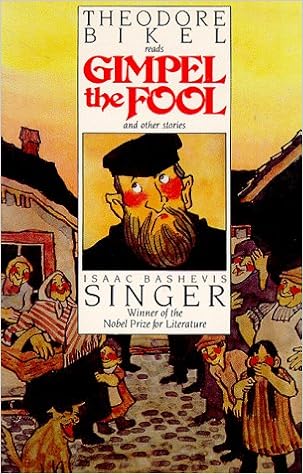
Lines I Wished I’d Written: Gimpel’s Wife from “Gimpel the Fool” by Isaac Bashevis Singer

“Gimpel the Fool” is one of those classic short stories that everyone should read by one of the greats in the short story world, Isaac Bashevis Singer.  For the most part, the story is a character study of a person who most people take advantage, Reb Gimpel.  In about ten pages it surveys his life from birth to old age, but it mostly centers on his relation with his wife.  Since the story is not overly complex, I’m not doing an analysis but just provide an extended passage that captures the heart of the story.  This passage opens with Gimpel’s wedding night.  The wedding has ended and Gimpel is going to the bedroom where his wife, Elka, is closed up.  Some background may be warranted.  Singer is Jewish and the story was written in Yiddish and takes place in some small town in one of the old countries, presumably Poland.  A number of Jewish rituals are referenced, especially the post menstrual bathing ritual, the mikveh.  I’m sure you know what a circumcision is.

At night I came where my wife lay, but she wouldn’t let me in.  “Say, look here, is this what they married us for?” I said.  And she said, “My monthly has come.”  “But yesterday they took you to the ritual bath, and that’s afterward, isn’t it supposed to be?”  “Today isn’t yesterday,” said she, “and yesterday’s not today.  You can beat it if you don’t like it.”  In short, I waited.

Not four months later, she was in childbed.  The townsfolk hid their laughter with their knuckles.  But what could I do?  She suffered intolerable pains and clawed at the walls.  “Gimpel,” she cried, “I’m going.  Forgive me!”  The house filled with women.  They were boiling pans of water.  The screams rose to the welkin.

The thing to do was to go to the house of prayer and repeat psalms, and that was what I did.

The townsfolk liked that, all right.  I stood in a corner saying psalms and prayers, and they shook their heads at me.  “Pray, pray!” they told me.  “Prayer never made any woman pregnant.”  One of the congregation put a straw in my mouth and said, “Hay for the cows.”  There was something to that too, by God!

She gave birth to a boy.  Friday at the synagogue the sexton stood up before the Ark, pounded on the reading table, and announced, “The wealthy Reb Gimpel invites the congregation to a feast in honor of the birth of a son.”  The whole house of prayer rang with laughter.  My face was flaming.  But there was nothing I could do.  After all, I was the one responsible for the circumcision honors and rituals.

Half the town came running.  You couldn’t wedge another soul in.  Women brought peppered chick-peas, and there was a keg of beer from the tavern.  I ate and drank as much as anyone, and they all congratulated me.  Then there was a circumcision, and I named the boy after my father, may he rest in peace.  When all were gone and I was left with my wife alone, she thrust her head through the bed-curtain and called me to her.

“Gimpel,” said she, “why are you silent?  Has your ship gone and sunk?”

“What shall I say,” I answered.  “A fine thing you’ve done to me!  If my mother had known of it she’d have died a second time.”

She said, “Are you crazy, or what?”

“How can you make such a fool,” I said, “of one who should be the lord and master?” 

“What’s the matter with you?” she said.  “What have you taken it into your head to imagine?”

I saw that I must speak bluntly and openly.  “Do you think this is the way to use an orphan?” I said.  “You have borne a bastard.”

She answered, “Drive this foolishness out of your head.  The child is yours.”

“How can he be mine?” I argued.  He was born seventeen weeks after the wedding.”

She told me then he was premature.  I said, “Isn’t he a little too premature?”  She said, she had a grandmother who carried just as short a time and she resembled this grandmother of her as one drop of water does another.  She swore to it with such oaths that you would have believed a peasant at the fair if he had used them.  To tell the plain truth, I didn’t believe her; but when I talked it over next day with the schoolmaster, he told me that the very same thing had happened to Adam and Eve.  Two they went up to bed, and four they descended.

“There isn’t a woman in the world who is not the granddaughter of Eve,” he said. 

That was how it was; they argued me dumb.  But then, who really knows how such things are?

I began to forget my sorrow.  I loved the child madly, and he loved me too.  As soon as he saw me he’d wave his little hands and want me to pick him up, and when he was colicky I was the only one who could pacify him.  I bought him a little bone teething ring and a little gilded cap.  He was forever catching the evil eye from someone, and then I had to run to get one of those abracadabras for him that would get him out of it.  I worked like an ox.  You know how expenses go up when there’s an infant in the house.  I don’t want to lie about it; I didn’t dislike Elka either, for that matter.  She swore at me and cursed, and I couldn’t get enough of her.  What strength she had!  One of her looks could rob you of the power of speech.  And her orations!  Pitch and sulphur, that’s what they were full of, and yet somehow also full of charm.  I adored her every word.  She gave me bloody wounds though.

And that is essentially Gimpel’s character, one repeatedly taken for a fool, but one with love in his heart.  He prays, he works, he takes in the children.  He goes on to stay with his wife, and she bears him six children, none of which are naturally his.  At one point Gimpel goes to a rabbi for some advice, and the rabbi delivers the central theme of the story.  He says, “It is written, better to be a fool all your days than for one hour to be evil.  You are not a fool.  They are the fools.  For he who causes his neighbor to feel shame loses Paradise himself.”  Toward the end of the story when Elka has died, and Gimpel is angry at the world, he is tempted to do an evil thing to the entire town, and starts to, but then he stops and doesn’t.  The story ends with Gimpel dreaming of being with his wife in paradise where he contemplates, “there even Gimpel cannot be deceived.” 


If I’ve piqued your interest in the story, it can be found online, here.  Do read it.

Wednesday, November 5, 2014

Lines I Wished I’d Written: The Demonic Invasion from “The Gentleman from Cracow” by Isaac Bashevis Singer

Last Friday was Halloween but on a Friday I much preferred to post faith filled post, especially since the next day was All Saints Day.  So I went with a saintly post instead of a fiendish one.  But now let me make a Halloween post, an excerpt from a short story by Isaac Bashevis Singer titled, “The Gentleman from Cracow.”  Part IV of the story is a perfect Halloween read, from the eerie, portentous setting to the evil supernatural beings that invade from the sky. 

Let me give you the context.  The town of Frampol, already a humble town, has been further impoverished because of a drought.  Just when the inhabitants are about to abandon the town, suddenly a rich man from Cracow comes to settle, a relatively young widower, and he starts giving away money like it’s sand, and of course the poor people start taking it and going along with his wishes.  Slowly, step by sinful step, the traditional religious ways are compromised and a Sodom and Gomorrah mentality pervades the town.  Finally at a dance the Gentleman (we are never told his name) throws to marry every girl in the town by random lottery, social breakdown ensues and evil spirits take over the town.  In the passage below there are a lot of what appears to be Jewish folkloric references which I don’t recognize, but I don’t think the specific references are significant.  Perhaps they are to those that get them, but one doesn’t need to know them to appreciate this passage.  Also, the girl Hodle in the passage is a girl from the outskirts of town who has been raised loosely and has a reputation for promiscuous and serial sex.  The story is part realism, part folklore, and part cautionary tale, and only a master short story writer as Singer could pull this off in just thirteen pages.  Enjoy, and happy Halloween. 


IV
The setting sun, remarkably large, stared down angrily, like a heavenly eye, upon the Frampol market place. Never before had Frampol seen such a sunset. Like rivers of burning sulphur, fiery clouds streamed across the heavens, assuming the shapes of elephants, lions, snakes, and monsters. They seemed to be waging a battle in the sky, devouring one another, splitting apart, breathing fire. It almost seemed to be the River of Fire they watched, where demons tortured the evildoers amid glowing coals and heaps of ashes. The moon swelled, became vast, blood-red, spotted, scarred, and gave off little light. The evening grew very dark, dissolving even the stars. The young men fetched torches, and a barrel of burning pitch was prepared. Shadows danced back and forth as though attending a ball of their own. Around the market place the houses seemed to vibrate; roofs quivered, chimneys shook. Such gaiety and intoxication had never before been known in Frampol. Everyone, for the first time in months, had eaten and drunk to the full. Even the animals participated in the merrymaking. Horses neighed, cows mooed, and the few roosters that had survived the general slaughter crowed. Flocks of strange birds flew in to pick at the leavings. Fireflies illumined the darkness, and lightning flashed on the horizon. But there was no thunder. A weird circular light glowed in the sky for a few moments and then suddenly plummeted toward the horizon, trailing a crimson tail. Then, as everyone stared in wonder at the sky, the gentleman from Cracow spoke:

“Listen to me. I have wonderful things to tell you, but let no one be overcome by joy. Men, take hold of your wives. Young men, look to your girls. You see in me the wealthiest man in the entire world. Money is sand to me, and diamonds are pebbles. I come from the Land of Ophir, where King Solomon found the gold for his Temple. I dwell in the palace of the Queen of Sheba. My coach is solid gold, its wheels inlaid with sapphires, with axles of ivory, its lamps studded with rubies and emeralds, opals and amethysts. The Ruler of the Ten Lost Tribes of Israel knows of your miseries, and he has sent me to be your benefactor. But there is one condition. Tonight, every virgin must marry. I will provide a dowry of ten thousand ducats for each maiden, as well as a string of pearls down to her knees. But make haste. Every girl must have a husband before the clocks strike twelve.”
The crowd was hushed. It was as quiet as New Year’s Day before the blowing of the ram’s horn. One could hear a fly buzz.
Then one old man called out, “But that’s impossible. The girls are not even betrothed!”
“Let them become betrothed.”
“To whom?”
“We can draw lots,” the gentleman from Cracow replied. “Whoever is to be married will have his or her name written on a card. Mine also. And then we shall draw to see who is meant for whom.”
“But a girl must wait seven days. She must have the prescribed ablutions.”
“Let the sin be on me. She needn’t wait.”
_____________
Despite the protests of the older men and their wives, a sheet of paper was torn into bits, and on each piece the name of a young man or young woman was written by a scribe. The town’s beadle, now in the service of the gentleman from Cracow, drew from one skullcap the names of the young men, and from the other those of the young women, chanting their names in the same tune as when he called up members of the congregation for the reading of the Torah.
“Nahum, son of Katriel, betrothed to Yenel, daughter of Nathan. Solomon, son of Dov Baer, betrothed to Trina, daughter of Jonah Lieb.” The assortment was a strange one, but in the night all cats are gray, and the matches seemed not too absurd. After each drawing, the newly engaged couple, hand in hand, approached the doctor to collect the dowry and wedding gift. As he had promised, the gentleman from Cracow gave each the stipulated sum of ducats, and on the neck of each bride he hung a strand of pearls. Now the mothers, unable to restrain their joy, began to dance and shout. The fathers stood by, bewildered. When the girls lifted their dresses to catch the gold coins given by the doctor, they showed their legs and underclothing, which sent the men into paroxysms of lust. Fiddles screeched, drums pounded, trumpets blared. The uproar was deafening. Twelve-year-old boys were mated with “spinsters” of nineteen. The sons of substantial citizens received the daughters of paupers as brides; midgets were coupled with giants, beauties with cripples. On the last two slips appeared the name of the gentleman from Cracow and that of Hodle, the daughter of Lipa the ragpicker.
The same old man who had called out previously cried out, “Woe unto us, the girl is a harlot!”
“Come to me, Hodle, come to your bridegroom,” the doctor bade.
Hodle, her hair in two long braids, dressed in a calico skirt, and with sandals on her feet, did not wait to be asked twice. As soon as she had been called she walked to where the gentleman from Cracow sat on his mare, and fell to her knees. She prostrated herself seven times before him.
“Is it true, what that old fool says?” her prospective husband asked her.
“Yes, my lord, it is so.”
“Have you sinned only with Jews or with Gentiles as well?”
“With both.”
“Was it for bread?”
“No. For the sheer pleasure.”
“How old were you when you started?”
“Not quite ten.”
“Are you sorry for what you have done?”
“No.”
“Why not?”
“Why should I be?” she answered shamelessly.
“You don’t fear the tortures of hell?”
“I fear nothing—not even God. There is no God.”
Once more the old man began to scream, “Woe to us, woe to us, Jews! A fire is upon us, burning, Jews, Satan’s fire. Save your souls, Jews. Flee, before it is too late!”
“Gag him,” the gentleman from Cracow commanded.
The guards seized the old man and gagged him. The doctor, leading Hodle by the hand, began to dance. Now, as though the Powers of Darkness had been summoned, the rain and hail began to fall; flashes of lightning were accompanied by mighty thunderclaps. But heedless of the storm, pious men and women embraced without shame, dancing and shouting as though possessed. Even the old were affected. In the furor, dresses were ripped, shoes dropped off, hats, wigs, and skullcaps trampled in the mud. Sashes, slipping to the ground, twisted there like snakes. Suddenly there was a terrific crash. A huge bolt of lightning had with one blast struck the synagogue, the study house, and the ritual bath. The whole town was on fire.
Now at last the deluded people realized that all these seeming occurrences of nature were unnatural in origin. Though the rain kept falling, and even increased, the fire was not extinguished. An eerie light glowed in the market place. Those few prudent individuals who tried to disengage themselves from the demented crowd were crushed to earth and trampled.
And then the gentleman from Cracow revealed his true identity. He was no longer the young man the villagers had welcomed, he was a creature covered with scales, with an eye in his chest, and on his forehead a horn that rotated at great speed. His arms were covered with hair, thorns, and elflocks, and his tail was a mass of live serpents; for he was none other than Ketev Mriri, Chief of the Devils.
Witches, werewolves, imps, demons, and hobgoblins plummeted from the sky, some on brooms, others on hoops, still others on spiders. Osnath, the daughter of Machlath, her fiery hair loosened in the wind, her breasts bare and thighs exposed, leaped from chimney to chimney, and skated along the eaves. Namah, Hurmizah the daughter of Aff, and many other she-devils did all sorts of somersaults. Satan himself gave away the bridegroom, while four evil spirits held the poles of the canopy, which had turned into writhing pythons. Four dogs escorted the groom. Hodle’s dress fell from her and she stood naked. Her breasts hung down to her navel and her feet were webbed. Her hair was a wilderness of worms and caterpillars. The groom held out a triangular ring and, instead of saying,” With this ring be thou consecrated to me according to the laws of Moses and Israel,” he said, “With this ring be thou desecrated to me according to the blasphemy of Korah and Ishmael.” The evil spirits called out, “Bad luck,” and they began to chant,
“The curse of Eve, the mark of Cain,
The cunning of the snake, unite the twain.”
Screaming for the last time, the old man clutched at his head and died. Ketev Mriri began his eulogy,
“Devil’s dung and Satan’s spell
Bring his ghost to roast in hell.”


I didn’t think it possible, but the entire story is on the internet.  Commentary magazine posted the story.  If my excerpt was enticing—and how could it not be—run over and read the entire story.  It’s not very long and Singer is one of the great short story writers.  Let me know what you think.  


Also, for some reason Commentary does not attribute the translation on their posting.  The translation on the internet is the same as the one in The Collected Stories from which I read.  The English translators from the original Yiddish are Martha Glicklich and Elaine Gottlieb.


Sunday, February 3, 2013

Notable Quote: Isaac Bashevis Singer

In a comment to my blog entry on the Isaac Bashevis Singer's short story, "Grandfather and Grandson," my friend Sue mentioned she had just come across noteworthy quotes by that very author.  So in this Notable Quote entry I shall highlight one of his penetrating insights.


The very essence of literature is the war between emotion and intellect, between life and death. When literature becomes too intellectual - when it begins to ignore the passions, the emotions - it becomes sterile, silly, and actually without substance.
Isaac Bashevis Singer


Singer identifies the two extremes of poor written art, overly emotional or overly intellectual.  With overly emotional, the writer is expresses everything with no shape.  With overly intellectual, the writer provides a clever puzzle that ultimately doesn't engage the reader.


Wednesday, January 30, 2013

Short Story Review: “Grandfather and Grandson,” by Isaac Bashevis Singer

The short story is a remarkable art form.  It is not the same form as a novel, the short story hypothetically being just shorter novel.  No.  It is distinct and perhaps one day I’ll put together why; though it uses many of the same elements as the novel, I believe it is a separate medium.
 

Isaac Bashevis Singer, winner of the Nobel Prize in Literature in 1978, worked in both mediums.  I’ve never read any of his novels (if anyone can recommend one, please do), but his short stories are of the highest caliber.  Singer, though he had emigrated from Poland to the United States in 1935 (and thereby as a Polish Jew surviving the holocaust) wrote his works in Yiddish , though fluent in several languages.  Yiddish is the language of the Ashkenazi Jews, the Jews of central and Eastern Europe.  Today I believe it is limited to the Hasidim and Orthodox Jewish communities.
 

“Grandfather and Grandson” is a wonderful story which brings the reader into the Hasidic Jewish world of Reb Mordecai Meir.  “Reb” in Yiddish is a title of respect equivalent to “Mister” and does not imply the man is a rabbi.  .  It does not seem to say (unless I missed it) that Meir is or is not a rabbi, but he is most definitely an extremely religious man.


Reb Mordecai Meir was a small man with a yellowish-white beard, a broad forehead, bushy eyebrows, beneath which peeped a pair of yellow eyes.  On the tip of his nose there grew a little beard.  Wisps of hair stuck out of his ears and nostrils.  In the course of time his back became bowed and he always looked as if he were searching for something on the floor.  He didn’t walk but shuffled his feet.  All year round he wore a cotton caftan with a sash, low shoes, and a velvet hat over two skullcaps.  He spoke in half sentences, only to the initiated Hasidim.


[Excerpts taken from The Collected Stories of Isaac Bashevis Singer, Farrar, Straus and Giroux, New York, 1982.  “Grandfathers and Grandsons” is translated by Evelyn Torton Beck and Ruth Schachner Finkel.]

I worked through college in a supermarket in a Hasidic community, and I have most definitely seen older Hasidic men just like that.  And yes, the really religious hardly ever talk to the non-Hasidim.  I used to think they were just snobs, but as you’ll see from this story speaking to non-followers of the Torah is defilement, an act causing impurity. 


Even among the Hasidim, Reb Mordecai Meir was known as an impractical man. Though he had lived in Warsaw for years, he was not at all acquainted with the streets of Warsaw. The only road he knew was from his home to the Hasidic house of prayer and back. During the year, he occasionally traveled to the Rabbis of Alexandrow, but he always had difficulty finding the trolley to the railway station, changing cars, and buying tickets. In all this he had to be assisted by the young men who knew their way around. He had neither the time nor the patience for such externals.


At midnight he arose for study and prayer. Very early each morning he recited the Gemara and the Tosephot commentary. After that came psalms, more prayers, delving into Hasidic books, and discussing Hasidic matters. The winter days were short. Before one had a bite to eat and a nap, it was time to return to the study house for evening prayers. Even though the summer days were long, there were not enough of them. First it was Passover, then the Feast of Omer, and before you could turn around it was Shevouth. After that came the seventeenth of Tammuz, the three weeks of mourning for the destruction of the Temple, the nine days of refraining from meat, and then the Tishe b’Av, the Sabbath of Comfort. These were followed by the month of Elul, when even fish in water tremble. Later there was Rosh Hashanah, the ten days of Penitence, Yom Kippur, Sukkoth, the Day of Rejoicing in the law, and then Sabbath of Genisis.


As a boy, Reb Mordecai Meir had already realized that if one wanted to be a real Jew there was no time for anything else. Prasied be God, his wife, Beyle Teme, had understood this. She never asked him to assist in the store, to concern himself with business, to carry the burden of earning a living. He seldom had any money with him except for a few guldens which she gave him each week for alms, the ritual bath, books, snuff, and pipe tobacco. Reb Mordecai Meir wasn’t even certain of the exact location of the store and the merchandise sold there. A shopkeeper had to talk to women customers and he knew well that it was only one short step from talking, to looking, to lecherous thoughts.


The street on which Reb Mordecai Meir lived teemed with unbelievers, loose women. Boys peddled Yiddish newspapers which were full of mockery and atheism. The saloons swarmed with ruffians. In his library, Reb Mordecai Meir kept the windows shut, even during summer. As soon as he opened the transom of the window, he immediately heard the playing of frivolous songs on the gramophone and female laughter. In the courtyard, bareheaded jugglers often performed their tricks, which he felt might be black magic. Reb Mordecai Meir was told that Jewish boys and girls went to the Yiddish theater where they made fun of Jewishness. There emerged worldly writers, writing in Hebrew and Yiddish. They incited the readers to sin. At every turn the Evil Spirit lay in wait. There was only one way to defeat him: with Torah, prayer, Hasidism.

What an amazing characterization.  If I were to use a Catholic analogy, Meir lives a monk’s or some other religious recluse’s life, but within a surrounding city teeming with elements that penetrate into his spiritual cocoon.  What I find fascinating there is how Singer slights Meir as “an impractical man” and yet is sympathetic toward him by showing his desire to be “a real Jew.”  The details support both those authorial stances, but ultimately we have to look at Meir as someone has isolated himself, and though we can sympathize with his holiness, we can see the detriment to those around him.  Meir is not a monk or some unconnected recluse but has a family.  The world will attempt to break into the cocoon.


As an aside, I found that passage remarkable for how similar a devout Jew’s life is with a devout Catholic.  A priest’s life is not that much different in reverential behavior, though a priest is engaged with the society at large and would not have built such a cocoon. 

And so life goes on.  Meir’s only living child, a daughter, Zelda Rayzel, dies.  His wife becomes melancholy, even complains to God, and finally dies as well.  He sells his store, arranges for a cook and house cleaner, and so resolves to complete his living days in full faith.  The cocoon is now complete.  If you look at the story as structured in what in classical music is called Sonata-Allegro Form, theme A is now complete.  Meir and the building of his cocoon is theme A.  The contrasting theme B disturbs the equilibrium.


One summer morning, while reading The Generations of Jacob Joseph, he dozed off and was awakened by the sound of knocking. He opened the door and saw a young man without a beard, a head of long hair over which he wore a broad-brimmed black hat, in a black blouse tied with a sash, and checkered pants. In one hand he carried a satchel and in the other a book. His face was pale and he had a short nose.


Reb Mordecai Meir asked, “What do you want?”


Blinking his widely separated eyes, he stammered, “I am Fulie…You are my grandfather.”


Reb Mordecai Meir stood dumbfounded. He had never heard the name Fulie. Then he realized that this was most probably the modern variation of the old Jewish name Raphael. It was Zelda Rayzel’s eldest son. Reb Mordecai Meir felt both pain and shame. He had a grandson who tried to imitate the Gentiles. He said, “So come in.” After hesitating a moment, the boy came in and put his suitcase down. Reb Mordecai Meir asked, “What kind—is that—?” and pointed to the book.


“Economics.”


“Of what use is that to you?”


"Well…”


“What’s new in Slonim?” Reb Mordecai Meir asked. He didn’t want to mention the name of his former son-in-law, who was an anti-Hasid. Fulie made a face as if to indicate that he did not fully comprehend his grandfather’s question.


“In Slonim? Just like everywhere else. The rich get richer and the workers get nothing to eat. I had to leave because…” and Fulie stopped himself.


“What will you do here?”


“Here—I’ll look around—I’ll…”


Well, a stutterer, Reb Mordecai Meir thought. His throat scratched and his stomach started to turn. It was his daughter Zelda Rayzel’s son, but as long as he shaved his beard and dressed like a Gentile, what would he, Reb Mordecai Meir, do with him? He nodded his head and gaped. It seemed that the boy took after the other side of the family with his high cheekbones, narrow forehead, and wide mouth. His bedraggled and famished appearance reminded Reb Mordecai Meir of the recruits who starve themselves to avoid conscription.


“Wash your hands. Eat something. Don’t forget you are a Jew.”


“Grandfather, they don’t let you forget.”

And through Fulie, we see the outside world force its way into Meir’s cocoon.  Fulie is obviously running from some trouble in his home town.  We learn he is a socialist or possibly communist agitator.  He is passionate, carries a gun, and is an ideologue.  He stays with the grandfather for an indefinite time, the grandfather allowing him only reluctantly.  Their lifestyles do not mesh well and they reach a point where they barely speak to each other, each just carrying out their personal business.  Until one day, and there we start the development section. 


The Sabbath meal was prepared by another neighbor. Reb Mordecai Meir lit the Sabbath candles himself. He ate at the table alone, in his threadbare satin coat, worn-out fur hat, chanting Sabbath chants, dipping a piece of hallah into the glass of ritual wine. The boy (which was what Reb Mordecai Meir called Fulie) didn’t show himself on the Sabbath. The neighbor’s daughter brought in rice soup, meat, carrot pudding. Reb Mordecai Meir half sang, half moaned.


If the old rabbi were still alive, Reb Mordecai Meir would have gone to live with him. But Reb Henokh was dead. The new rabbi was still a young man who cared more for the young Hasidim than the old. It was whispered that he was learned in worldly affairs. Many of the older Hasidim had died out and no new ones joined.


One Sabbath day, when Reb Mordecai Meir was sitting at the table murmuring, “I shall sing with praise,” he heard the crack of a gun and a hideous scream. In the courtyard there was a din. Windows were thrown open. The sound of a police whistle pierced the air. A neighbor came in to tell Reb Mordecai Meir that the “comrades,” the strikers, had shot one of their own, a bootmaker who was said to have denounced them to the police. Reb Mordecai Meir trembled.


 “Who did it—Jews?”


“Yes, Jews.”


“It is the end of the world.” And Reb Mordecai Meir immediately regretted his words. It was not permitted to be sad or utter words of despair on the Sabbath.

 
There is no need to outline the story development further.  I don’t want to spoil the denouement for readers who haven’t read it, and there isn’t much to gain from going further.  The characters, the themes, and the conflict are enough to give a full description of this story.  However, the final paragraphs are important to capture the full pathos of Meir’s life.  After some calamitous event, Meir is being taken to the police station. 


It was not customary to say Kaddish without a quorum or for someone who had not yet been buried, but Reb Mordecai Meir knew that he had little time left. He mumbled the Kaddish. Then he recited a chapter from the Mishnah which he knew from memory. “At what time is it permissible to recite the Shema in the evening? From the time that the priests enter the Temple to eat their food offerings. So sayeth Rabbi Eliezer. And the sages say: Until midnight.”


“Hey, you, Jew, old dog, who are you talking to, your God?” the policeman asked. Somehow Reb Mordecai Meir understood these few words. What does he know? How can he understand? Reb Mordecai Meir defended him in his thoughts. Since no evil can come from God, those created in His image can’t be completely wicked. He said to the policeman, “Yes, I am Jew. I pray God.”


Those were all the Gentile words Reb Mordecai Meir knew.

 
And so the recapitulation brings us back to the impracticality of the man—he’s wondering back to pre-destruction Temple rules while facing police actions against him—and the identity of his Jewishness through his deep faith.  But now this is a different man.  His compassion has spread out to his very different grandson and even the Gentile man who has just insulted him.

 
What makes this story so well told is the clean and clear structure, the distinct central characters of the Grandfather and Grandson, and the super rich detail of the world of a devout Hasidic man.  There is no free e-text of the story, but if you can find it, it’s well worth reading.