The
most important theological concept in these first few cantos I think is this
inequality of graces that are distributed and attained. And what I think makes it difficult to grasp,
at least for me, is the multifaceted nature of it. Let’s look at the several suggestions in the
text. First is right in the opening
lines:
The glory of Him who
moves all things
pervades the universe and
shines
in one part more and in
another less.
I was in that heaven
which receives
more of His light. He who
comes down from there
can neither know nor tell
what he has seen,
for, drawing near to its
desire,
so deeply is our
intellect immersed
that memory cannot follow
after it. (Par. I.1-9)
So
right at the beginning we see that God’s light permeates “in one part more and
in another less.” This appears to
suggest that there is an uneven distribution of blessings. Later in the canto Dante states “The lamp of
the world rises on us mortals/at different points” (ll. 37-38) which on the
surface is a simple statement of astronomical fact, but as you read further
down it makes you wonder if Dante implies more.
The bright heavenly light shines into Beatrice, and Beatrice turns
toward her left (l. 46) to fully face the sun, and the rays bounce off her and
return to the heavens, Dante peering
into her eyes is a recipient of the light and through her can see the glory of
the sun. And then:
Much that our powers here
cannot sustain is there
allowed by virtue of the
nature of the place
created as the dwelling
fit for man.
I could not bear it long,
yet not so brief a time
as not to see it sparking
everywhere,
like liquid iron flowing
from the fire. (ll. 55-60)
Light
is clearly more than just the external energy we experience but in the poem a
symbol of God’s grace. So he was allowed
to receive this grace because he is up in heaven and not on earth, so location
does seem to make a difference, but even here he could only sustain it for a
“brief time.” Again by itself, I don’t
think it reaches a complete theological point, but it is accumulating
force.
Let’s
continue. And then in Canto II we get
the discourse on varying spots of the moon.
Dante believes it has to do with density and rarity but Beatrice first
refutes him and goes on with her experiment of three mirrors:
‘Take three mirrors,
placing two at equal distance
from you, letting the
third, from farther off,
also meet your eyes,
between the other two.
‘Still turned to them,
have someone set,
well back of you, a light
that, shining out,
returns as bright
reflection from all three.
‘Although the light seen
farthest off
seems smaller in its
size, still you will observe
that it must shine with
equal brightness.
‘Now, as the substantial
form of snow,
if struck by warming
rays, is then deprived
both of its former color
and its cold,
‘I shall now reshape your
intellect,
thus deprived, with a
light so vibrant
that your mind will
quiver at the sight. (II. 97-111)
The
location of the mirror is critical to the size of the source, and the further
from the source, the less the intensity.
Also important here is how the recipient reacts to the light. Just as snow melts from sunlight, so does
one’s mind and intellect get reshaped by the light. She goes on to explain that the source of
light is behind it all and His light moves the varying spheres, which direct
their distinctive influence across the universe for His purpose. Ultimately this reaches the individual:
‘And the heaven made fair
by all these lights
takes its stamp from the
intellect that makes it turn,
making of itself the very
seal of that imprinting.
‘And as the soul within
your dust
is distributed through
the different members,
conforming to their
various faculties,
‘so angelic intelligence
unfolds its bounty,
multiplied down through
the stars,
while revolving in its
separate oneness. (II. 130-138)
It
is from this “imprinting” of heavenly light that we receive grace and influence
from above. But that is still not the
complete picture because a “stamping” would eliminate the free will. “The soul within [the] dust”—that is the
fundamental element of ones being—varies in faculty, and so reacts individually
to that light. Just so the moon
spots. They are reacting differently to
the light.
So
to sum up here, Dante is trying to capture the immense complexity of God
working His will while we individuals maintain our free will. Light, allegorically standing for grace, does
not permeate evenly through the universe, and we the receptacle of that grace
do not process it equally.
We
can then see it worked out in Canto III with the character of Piccarda. She is under the influence of the moon
because she has been inconstant in her vow to be a nun. Unfortunately her brother, Corso, forced her
out of the convent to marry for his political advantage. She did not want to break her vow, but was
forced to. Same goes for her neighbor in
this sphere, Constanza, ironically named because she was inconstant. Constanza too was forced out of her convent
against her will to marry the Holy Roman Emperor.
Later,
Dante (the character) in Canto IV asks Beatrice—actually more precisely intends
to ask but Beatrice can read his mind and articulates it before he does—about
the justice of these two spirits limited from the highest spheres of heaven
because they were forced to break their vows against their will. Beatrice clarifies:
No, all adorn the highest
circle –
\but they enjoy sweet
life in differing measure
as
they feel less or more of God’s eternal breath.
‘Those souls put
themselves on view here
not because they are
allotted to this sphere
but as sign of less
exalted rank in Heaven. (IV. 34-39)
There
is no injustice. All saved souls reside
in the highest circle, but they experience God’s breath (another metaphor for grace)
“in different measure.” They are here at
the moon because they are “of a less exalted rank.” This explains why the two spirits are in this
sphere but it still doesn’t quite answer why a forced broken vow is
inconstant. Beatrice explains this further
down in a beautiful simile:
‘For the will, except by
its own willing, is not spent,
but does as by its nature
fire does in flame,
though violence may force
it down one thousand times.
‘Thus, if it stays bent,
whether much or little,
it then accepts that
force, as indeed did these,
since they could have
retreated to their holy place. (IV.
76-81)
The
human will is like a flame striving upward.
If force attempts to curb it, it will either be indomitable or it will
acquiesce. There is here a subtle
difference between those that resist the force and those that accept the
force. Beatrice goes on to contrast
Piccarda and Constanza against St. Lawrence and Gaius Mucius Scaevola. Someone constant will finds a way to keep their
vow or dies trying.
Each
person, then, has a different capacity to receive God’s grace, which shines
unequally on people. So is the notion of
unequal capacity for grace theologically sound?
St. Paul in his first letter to the Corinthians outlines the differences
in abilities between humans:
There are different kinds
of spiritual gifts but the same Spirit; there are different forms of service
but the same Lord; there are different workings but the same God who produces
all of them in everyone. To each
individual the manifestation of the Spirit is given for some benefit. To one is given through the Spirit the
expression of wisdom; to another the expression of knowledge according to the
same Spirit; to another faith by the same Spirit; to another gifts of healing
by the one Spirit; to another mighty deeds; to another prophecy; to another
discernment of spirits; to another varieties of tongues; to another
interpretation of tongues. But one and
the same Spirit produces all of these, distributing them individually to each
person as he wishes. (1 Cor 12: 4-11)
Dante
aesthetically reformulates St. Paul’s differences of gifts into his influences
of the spheres. And so we will see that
each sphere has a gift associated with it.
Jupiter for just rulers, Mercury for ambition, the sun for wisdom, and
so on. What about the notion that
everyone receives varying degrees of light, and therefore grace? Yes, that is Church doctrine. God provides sufficient grace to all to
attain salvation, but it is not equally distributed. And what about the notion that each
individual can only hold so much grace?
Well, look at Luke 1:28 where the angel Gabriel addresses the Blessed
Virgin, “Hail, full of grace, the Lord is with thee.” If Our Lady is “full of grace,” then others
are not “full.” In Dante’s anthropology,
then, humans are like cups—receptacles—holding quantities of God’s grace, some
bigger, some smaller, some full, some not so full. Picture the Blessed Mother as being one
supersized cup filled to the top. Perhaps
then someone like St. Francis of Assisi is a large cup, maybe three-quarters
full. Someone like Piccarda is a regular
sized cup maybe just half full. Now
perhaps sinner me is probably only a small whiskey shot glass perhaps only a
quarter full. ;)
If
you’ve understood this concept, I think you’ve understood one of the most
difficult concepts in the Paradiso.
###
Some
random observations.
In
the middle of the first canto, in answering Dante’s question on why he is able
to move through matter, Beatrice makes what I think is a statement that
captures the aesthetics of the entire Divine
Comedy:
‘All things created have
an order
in themselves, and this
begets the form
that lets the universe
resemble God. (Par. I. 103-105)
All
things have a reason for their form, which in turn is an image of God. So too does the Commedia, an order built on the form of logical patterns—spiraling
circles downward for hell based on justice, rising ringlets upward in heaven
built on levels of grace. The form of
the book is the form of the universe, which resembles God.
In
that passage, Beatrice in explaining why Dante is moving upward, she describes
the bent of natural inclination, either upward or downward.
‘In that order, all
natures have their bent
according to their
different destinies,
whether nearer to their
source or farther from it.
‘They move, therefore,
toward different harbors
upon the vastness of the
sea of being,
each imbued with instinct
that impels it on its course.
‘This instinct carries
fire toward the moon,
this is the moving force
in mortal hearts,
this binds the earth to
earth and makes it one. (I. 109-117)
Each
created thing will move toward its destiny, and the created thing of man is
like the flame is designed to move upward toward God like flame moves toward
the moon. She goes on to explain why not
all move souls move upward.
It is true that as a work
will often fail
correspond to its
intended form, its matter
deaf and unresponsive to
the craftsman’s plan,
‘so sometimes a creature,
having the capacity
to swerve, will, thus
impelled, head off another way,
in deviation from the
better course
‘and, just as sometimes
we see fire
falling from a cloud,
just so the primal impulse,
diverted by false
pleasure, turns it toward earth. (I. 127-135)
So
given free will (“having the capacity/to swerve) man does not always choose to
respond “to the craftsman’s plan.” The
“primal impulse” to go upward is perverted.
Sin therefore pulls us down. The
natural state of man is really to go up.
See
how this works in the conceptualizations of hell, purgatory, and heaven? When one is fixed in sin, one spirals
downward to ones fixed level of justice in hell. The climb up the mountain of purgatory is the
struggle to dispose of this sin and find one’s true natural state. Once one reconfigures to the state one was
intended, one rises to its heavenly position.
The
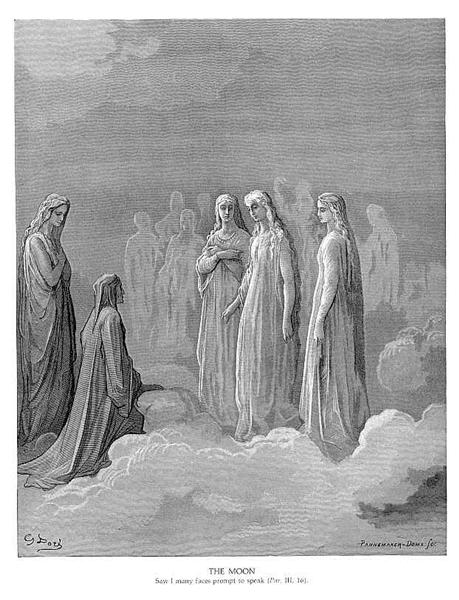
workings of heaven are such that the spirits have very little definition. When Dante first sees Piccarda and the other
spirits in the moon, it seems to him that they are vague reflections. He describes them as such.
As through clear,
transparent glass
or through still and
limpid water,
not so deep that its bed is lost
from view,
the outlines of our faces
are returned
so faint a pearl on a
pallid forehead
comes no less clearly to
our eyes,
I saw many such faces
eager to speak,
at which I fell into the
error opposite to that
which inflamed a man to
love a fountain. (Par. III. 10-18)
The
outlines of their faces are so faint that their heads I think look like
pearls. That is interesting. What we’ll find is that each character’s features
get less distinguishable the further into heaven Dante travels. In a few spheres further in, the characters
will be no more than just lights. Dante
later points out to Piccarda how her face shines forth.
Then I said to her: ‘From
your transfigured faces
shines forth a divinity I
do not know,
and it transforms the
images I can recall. (III. 58-60)
So
those in heaven have achieved a “transfiguration” and the shine is of the
measure of grace. No wonder as Dante
goes further into paradise the character’s faces, actually their entire bodies,
have a more intense glow.
I
guess the outline of Piccarda’s face is clear enough to see her smile when
Dante asks her if she is content with the lowest level of paradise. She smiles when she answers him. The facial smile is certainly a leitmotif in
these early cantos. In addition to
Piccarda here, Beatrice smiles twice in these cantos (lines I.95, III.25). Recall how at the end of Purgatorio after Dante receives absolution he can now look into
Beatrice’s face and sees her second beauty, her smile. This was associated with love. And there is much more smiling in
heaven. Hollander in his notes points
out that Paradiso refers to twice as
many smiles as in Purgatorio, and I
don’t believe there were any in Inferno.
Piccarda’s
answer to Dante about being content is a well-known passage, and warrants
quoting the entire speech.
Brother, the power of
love subdues our will
so that we long for only
what we have
and thirst for nothing
else.
‘If we desired to be more
exalted,
our desires would be
discordant
with His will, which
assigns us to this place.
‘That, as you will see,
would not befit these circles
if to be ruled by love is
here required
and if you consider well
the nature of that love.
‘No, it is the very
essence of this lessed state
that we remain within the
will of God,
so that our wills combine
in unity.
‘Therefore our rank, from
height to height,
throughout this kingdom
pleases all the kingdom,
as it delights the King
who wills us to His will.
‘And in His will is our
peace.
It is to that sea all
things move,
both what His will
creates and that which nature makes.’ (III.70-87)
The
power of love subdues our will so that our blessed state depends on God’s will,
and “in His will is our peace.” St.
Thomas Aquinas defines love as wanting the best for the other person. We see it here in action. Wanting others to have the highest grace is
more important than we achieving the highest.
There is no envy, even though Piccarda was denied a higher place because
of her brother’s despicable action and not through of her fault.