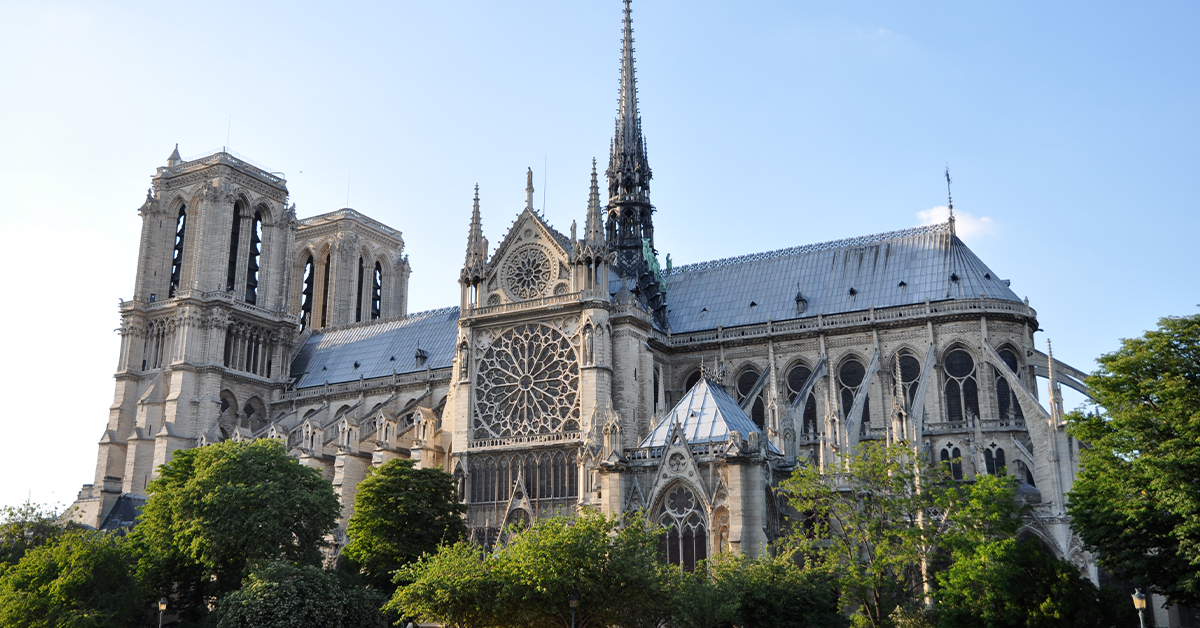
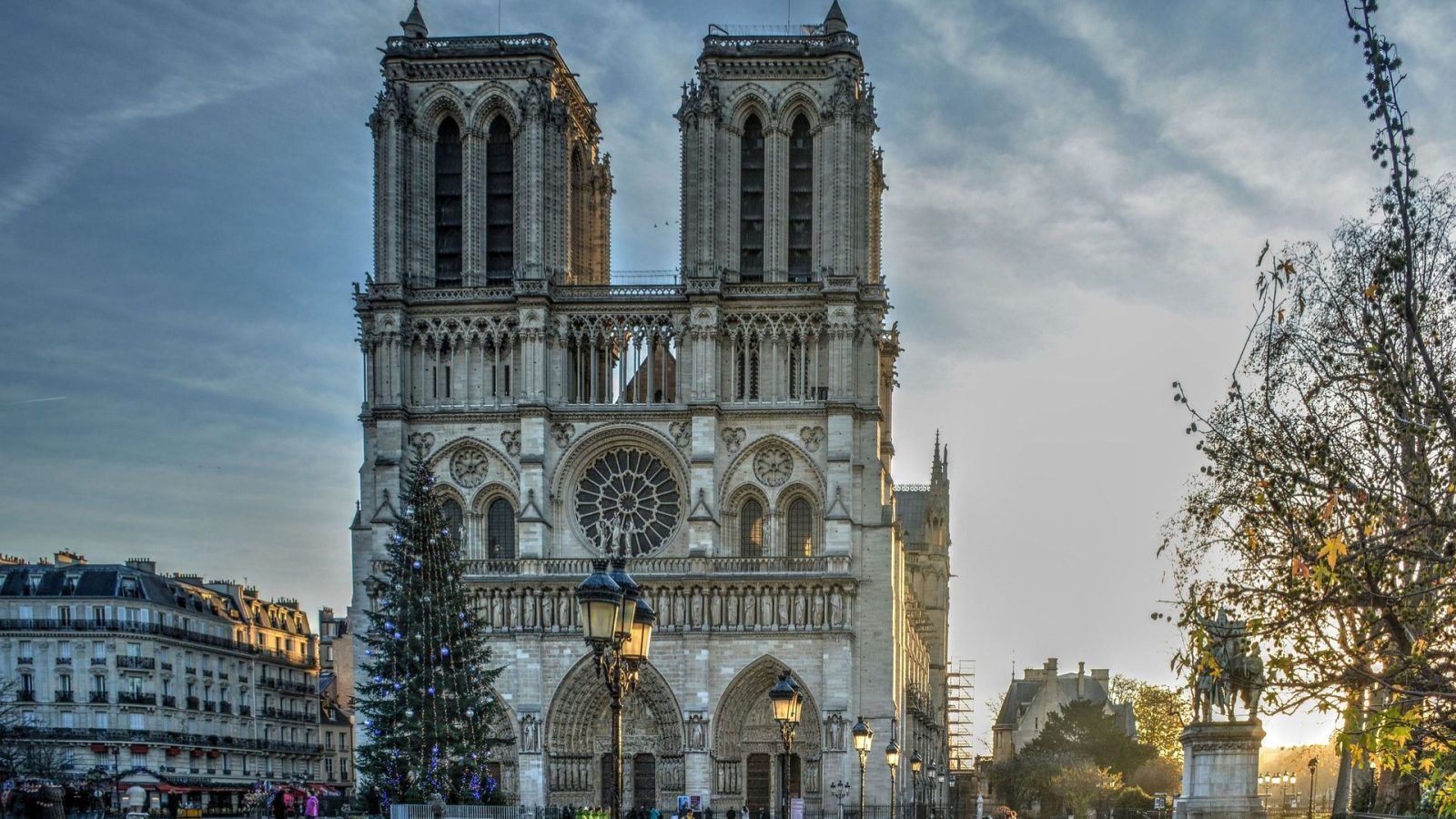
This weekend Paris was
abuzz with the reopening ceremonies and Mass at Notre Dame Cathedral. After an
intensive five-year restoration program, most of the scaffolding came down, the
boarding disappeared, and the beautiful Gothic structure opened its doors to
the world.
That
article from Aleteia provides many of
the highlights in written form.But you
can watch the highlights in these YouTube videos.First on the restoration from CBS’s Sunday Morning.
If
you want just sights and sounds of the celebration, this nice compilation comes from NBC News.
I
found this CNN news segment broadcast just prior to the reopening interesting,
mainly because it outline the cost, which was remarkably on budget and less
than one would have thought.
This
lovely light show with music by Michael Canitrot was well done..
Finally,
let’s end with this rendition of Mozart’s LAUDATE DOMINUM (translates to “Praise
the Lord” I think) performed at the reopening and sung by Julie Fuchs.It provides breathtaking images of the
Cathedral.
I
was in tears five years ago when I saw the Cathedral burning.I thought it was the image of disappearing
Christianity.Today my heart has been
restored as the beautiful Cathedral.
Early
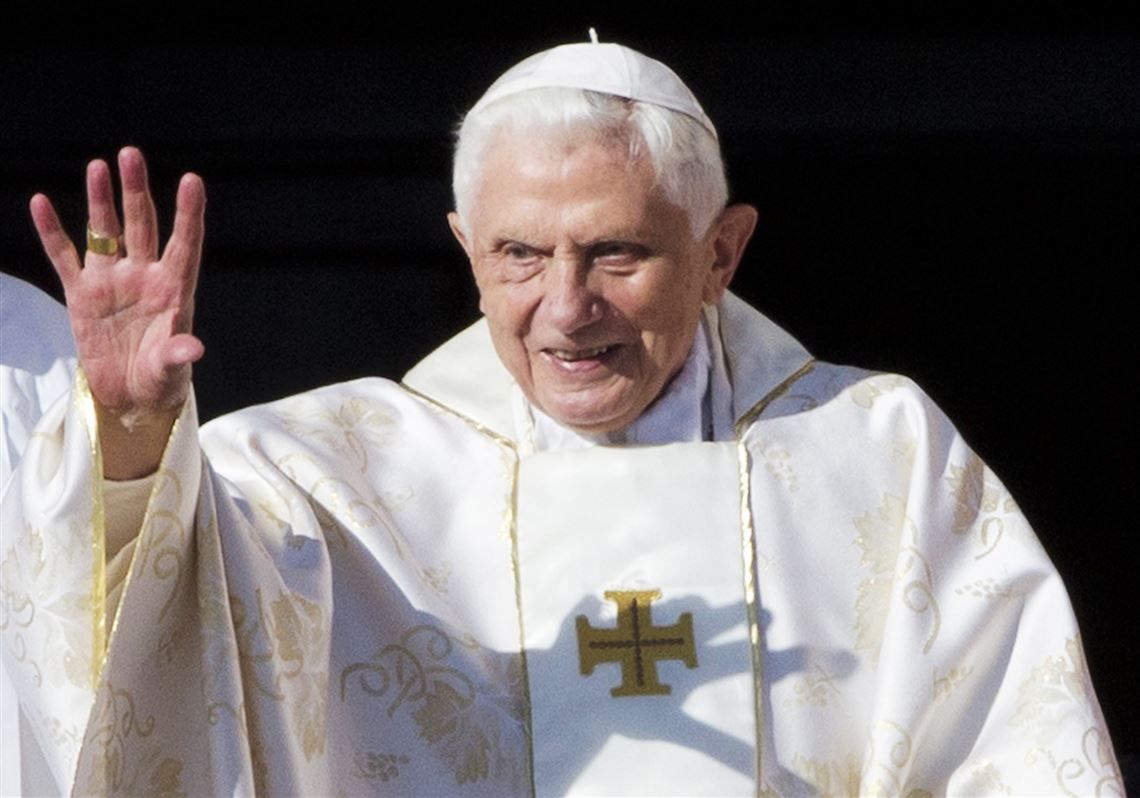
this morning, as many of you probably know, our beloved Pope Emeritus Benedict XVIpassed away at the age of 95.Where do I even begin to summarize his epic
life?He lived through almost a hundred
years of eventful history, participated in some of it directly, and wrote about
the theological implications of most of it.He wrote 66 books, three Church Encyclicals, four Apostolic Exhortations,
and a number of major speeches.His
output was immense.He was one of the
key intellectuals behind the Vatican II Council, and an intellectual guide for
the papacy of his predecessor, Pope John Paul II.Through it all, and there were many who
demonized him both within and outside the Church, he was a gentle man, a lover
of the arts, a man of prayer and spirituality.One aspect of his character that seems to go unnoticed was his
humility.He was an intellectual giant
of the type I deeply respect and have always wanted to emulate.In short, he was my favorite pope of my
lifetime.
From
what I gathered surfing around the news world, Pope BXVI (my shorthand for Pope
Emeritus Benedict XVI) will be remembered for being the first pope in almost
600 years to resign the office.I have
seen criticism of it, but he was 85, frail, in not the best health, and trying
to perform the duties of the modern era.He went on to live ten years, but from accounts he did not expect to
live a year.
If
you want a general perspective on his life, writings, and thoughts, this
article from Aleteia, “Benedict XVI,the pope of surprises” did what seems to be a thorough job.
There
are many theological ideas that Pope Benedict explored and commented on, but he
had a way of bringing out their societal implications.For instance, he first observed how the
relativism of faith has had implications on our society, a concept he called “the
dictatorship of relativism.”
“Today, a particularly insidious
obstacle to the task of education is the massive presence in our society and
culture of that relativism which, recognizing nothing as definitive, leaves as
the ultimate criterion only the self with its desires,” he said in an address
in Rome in 2005. “And under the semblance of freedom it becomes a prison for
each one, for it separates people from one another, locking each person into
his or her own ego.”
Can
you see how gay marriage and what I’ll call the relativism of gender has flowed
from what contemporary society has determined to be a lack of fixed
truths?
You
can easily find the highlights of his life, so I’m not going to list them.Instead I’m going to embed a video where
Bishop Robert Baron puts Pope Benedict XVI’s life and ideas into context.It’s just over a half hour.
Finally,
BXVI was a great lover of music, and from what I understand an accomplished
pianist.Aleteia also has an article
on BXVI’s favorite musical pieces, and it’s a good deal of Mozart and Bach.
He
seemed to have a special love for Mozart.From the article:
Pope Benedict XVI once
described one of his early encounters with the music of Mozart, while attending
a Mass penned by the great composer. He described Mozart’s treatment of the
Mass as “music that could only come from heaven; music in which was revealed to
us the jubilation of the angels over the beauty of God.” He added:
“The joy that Mozart
gives us, and I feel this anew in every encounter with him, is not due to the
omission of a part of reality; it is an expression of a higher perception of
the whole, something I can only call inspiration out of which his compositions
seem to flow naturally.”
The
article also goes on to say that the first concert Joseph Ratzinger ever
attended was a performance of Mozart’s Requiem Mass.So as a fitting conclusion to this post, I
want to conclude this post with three pieces from “The Requiem in D minor, K.
626.”First the Introit and Kyrie which
are here together.
The
third piece will be the Domine Jesu,
an appeal to Christ to save the soul of the dead.
Here are the lyrics in English.
Lord Jesus Christ, King
of glory,
deliver the souls of all
the faithful departed
from the pains of hell
and from the bottomless pit:
deliver them from the
lion's mouth,
that hell swallow them
not up,
that they fall not into
darkness,
but let the
standard-bearer holy Michael
lead them into that holy
light:
Which Thou didst promise of
old to Abraham and to his seed.
That
is just so beautiful.I am certainly
saddened by the death of my beloved BXVI.But given his age, and watching my mother struggle with old age, I can
see how it is eventually a blessing.May
Pope Emeritus Benedict XVI continue to bless us from above.
Eternal rest
grant unto him, O Lord, and let perpetual light shine upon him.
Is
Beethoven greater than Mozart? When you’re
dealing with the greatest of the great of any artistic medium, it’s impossible
to say one is greater than another. It
becomes a matter of preference. At the
catholic blog, Inebriate Me, Pascal-Immanuel
Goby wrote a post titled “Beethoven > Mozart.” The “>” symbol signifies “greater than.”
I
like Goby’s blog, though it can be more philosophical than my tastes run in
reading about Catholicism. But he’s got
an interesting, out of the box, yet still traditional take on things. I like his perspective on economics and
Catholicism. Most Catholic bloggers don’t
understand economics, but Goby does. I
never refer to him in my head as Goby. From
writing literary essays I’m trained to use last names but the way I think of him
is by the first half of his name, Pascal.
He seems to share a number of things with the famous Pascal: an
intellectual Catholicism and that he’s French.
I know he lives in France, but he does write in English, so if he’s not
French, then his parents were certainly Francophiles to name him Pascal.
In
“Beethoven > Mozart” Goby wonders bemoans that theologians prefer Mozart as
their favorite composer, while Goby clearly believes that Beethoven is the
greatest. Why this this preference for
Mozart over Beethoven. Here’s part of
what he wrote:
We need more
theologians who love Beethoven. (We need more theologians who love Led
Zeppelin!)
I love Mozart. Truly.
He had access to the Forms. However…
We have many
theologians who love Mozart. Balthasar and Barth connected (in part) on their
shared love of Mozart as the greatest composer in history. Ratzinger, as is
well known, is a devotee of Mozart. All good.
But, but, but.
No, Mozart is not the
greatest. Mozart is not the greatest, because for all his attempts to move
beyond, all his pathos, he remains the classical composer par excellence.
Mozart is the Parthenon. Mozart represents art understood as submission to, and
fulfillment of, form.
No. This is not the
full truth of art. The full truth of art must have as its primary impulse the
expression of human subjectivity (an expression of subjectivity which only
through its embrace of itself can then point to universality), even as it
incorporates, uses, and in its fullness, transcends, aesthetic rules. And here
we are talking about Beethoven. Mozart expressed the fullness of humanity
within the classical rules. Beethoven expressed the fullness of humanity by
transcending (through incorporating) the classical rules.
Beethoven is not afraid
of being off-balance. Mozart raises the mind to contemplation, Beethoven grabs
you by the throat. Mozart is Aquinas, wonderful Aquinas, building angelic
cathedrals. Beethoven is Paul, frustratingly unsystematic, cajoling,
browbeating, repudiating, pleading, ordering, crying on the page.
The
comparison of Aquinas to Mozart, Beethoven to St. Paul is kind of apt. But I don’t see why that would make Beethoven
greater than Mozart. Here’s my comment
to his post.
Mozart is not the
greatest because he died too young. Had lived another twenty years he would
have been the greatest. I agree it would be great if more theologians loved
Beethoven as they do Mozart (I'm surprised they don't) but I think you're being
silly with Led Zeppelin. Bach is probably the greatest of them all. Where I
disagree is with how you value aesthetics. It's not that Beethoven is greater
because he is subjective in his art or because he is off balance. Neither of
those makes art greater or lesser. They are just different approaches.
Greatness comes from how well you create and how well your vision is
represented aesthetically. We are still under the guiding force of Romanticism,
so off balance appears to the general person to be of greater aesthetic
quality. If and when we return to a neo-classical zeitgeist, Beethoven might
appear to be ugly, or I should say uglier. Is Dante's Divine Comedy any lesser
because of its balance and interconnectiveness and rational form? I would argue
that Dante is closer to Mozart than Beethoven. And then perhaps one could say
that Shakespeare might be closer to Beethoven than Mozart, though perhaps
that's arguable. Dante and Shakespeare, as Mozart and Beethoven, have different
approaches. It's not the approaches that make them greater or lesser.
Goby
never replied to my comment; he usually does, but I sense he’s been busy
lately. Another person replied to me and
we had an interesting conversation about Led Zeppelin, so you can go over to
check that out if you wish. Goby’s
central thesis is that Christian theologians are too neo-classically oriented
and lack the passion of Romanticism. He does
end his post with this summation: “We need, in other words, Appasionnata
theology, we need Hymn to Joy theology, we need 5th and 6th symphony theology.” The “Hymn to Joy” allusion is actually a
reference to Beethoven’s concluding Ninth Symphony movement where Friedrich Schiller’s poem “Ode to Joy” is set in a choral. I’m sure people here know of it.
And
just a few days after reading the Goby post, I came across in almost divine
guided happenstance a post written by Stephen Klugewitz at The Imaginative
Conservative, titled “Did Mozart Write the “Ode to Joy”?” Klugewitz’s claim is that Beethoven took the theme
from Mozart.
Only a few pieces of
music in the Western canon rival the fame of the “Ode to Joy” theme: the
opening chords of Beethoven’s own Fifth Symphony, “Spring” from Vivaldi’s Four
Seasons, Wagner’s “Ride of the Valkyries,” the first notes of Mozart’s Eine
Kleine Nachtmusik, to name a few. The “Ode to Joy,” however, seems to stand
above these, due to its hymn-like, sublime character and its elevated call to
universal brotherhood. It will be forever associated with Beethoven’s name, and
alone would ensure his legacy as one of the greatest composers—in the
estimation of many, THE greatest composer—who ever lived.
The problem is that the
“Ode to Joy” theme is not entirely Beethoven’s. He borrowed the main part of it
from none other than Wolfgang Amadeus Mozart.
In 1775, at the age of
nineteen, Mozart composed the “Misericordias Domini,” K. 222, a six-minute
sacred work that is little recorded and seldom performed today, yet which
constitutes a minor masterpiece. Mozart employs what became the germ of the
“Ode to Joy” theme three times throughout the work
You
can read the rest of Klugewitz’s thoughts there and here Mozart’s “Misericordias
Domini” side by side to Beethoven’s fourth movement. Tell me if they sound similar. They do to my ear. What Klugewitz doesn’t show is that Beethoven
was aware of this little known Mozart piece.
It’s quite possible that it coincidental. But after listening side by side I tend to agree;
I think Beethoven stole it! Even the
arrangement is similar.
For
Music Tuesday I offer Beethoven’s “Ode to Joy.” section of the fourth movement
of his Ninth Symphony, here conducted by the late, great Leonard Bernstein. The actual “Ode to Joy” theme starts at about
3:50; the chorus stats at 7:55.
I love this Violin Concerto. I know there are others
that are ranked greater. Mozart composed his violin concertos when he was
young, this his last at 19 years old. All five are bright and vivacious and
written in a major key. This one does have its own Wikipedia entry.
Its full title is Violin Concerto No. 5, K. 219
"Turkish.”The nickname “Turkish”
comes from the third movement’s deviation from a minuet into an exotic melody
associated with Turkish music, though not necessarily truly from Turkey.
I'm not going to post the entire concerto, just the
third movement.That’s where the Turkish
excursion takes place.I think it
transforms the entire last movement.The
rondo form is based on a returning melody alternating with a cadenza.This third movement uses a very stately minuet
as its rondo melody, and then at about 3:45 transitions into the Turkish
section, and that lasts for two and a quarter minutes, returning da capo to the minuet.
The finale is an urbane
minuet that unfolds, at first, in a perfectly rondo form. But just
when the end seems nigh, Mozart interpolates an episode even more astonishing
than the Adagio in the first movement: a hundred and thirty bars of the
sort of tongue-in-cheek “Turkish” music he used in works like The Abduction
from the Seraglio. All of the conventional building-blocks of
eighteenth-century “Turkish”music are here: the key of A minor, march-like 2/4
time, drone basses, “gypsy” violin writing, leaping themes, pervasive
chromaticism, “exotic” melodic intervals like the augmented second, repeated
notes, frequent ornamentation, and grotesque, and percussive scoring. This
episode has a handful of melodies of its own, several borrowed from folk music,
arranged to form a separate little movement—a rondo within the rondo. When it’s
over, the minuet returns to complete its appointed rounds, and like the first
movement the finale ends quietly, wittily, with a little arpeggio decorated
with grace notes—a wink and a smile.
Yes, “rondo within a rondo” is the perfect way
to describe it.Besides the structural peculiarity,
what really gets me is the sharp contrast between a reserved 18th
century European classism with an exotic, exuberant, and wild foreignism.
Here is the third movement with Gideon Kremer (soloist),
Nicholas Harnoncourt (conductor), Wiener Philharmoniker orchestra. Listen for the transition at just after 3:45, and after listening to the entire movement, try to answer this question: Is the "Turkish" excursion integral to the entire piece or does it sound like two separate pieces yoked together?
If you go to Youtube you’ll be able to find both the
first and second movements.If you have
a half hour, listen to all three movements in succession as meant to be
heard.The recording I own is with ItzhakPerlman (soloist), James Levine (conductor), and also with the Wiener Philharmoniker orchestra
and I highly recommend it.
For yesterday's Memorial Day, I want to offer the opening movement of Mazart's Requiem Mass in D Minor. When I was growing up, Memorial Day was not just the first day of summer activities, but a day to reflect and pay respects to those soldiers who gave the ultimate sacrifice for our country. The emphasis was on homage to the dead, not an easy day out of school or off from work, and I don't know if it's just me, but it seems like the emphasis has shifted to the latter.
There are many fine Requiems. A Requiem is a mass for the dead set to music. and it follows the mass structure. Of the Requiem's I've listened to, I have to say that despite it not being completed, the Mozart Requiem is the one I favor. It just sounds most like what a Requiem should sound like.
In honor of the over 1.25 million Americans (according to my tally from this listing of American casualties) that have perished in service to our land since the Revolutionary War, I offer the Introit to Mozart's Requiem. The Introit is the opening part of the mass in the traditional Latin Mass, and for masses for the dead, it takes these verses:
Requiem æternam dona eis, Domine, et lux perpetua luceat eis. Te decet hymnus Deus, in Sion, et tibi reddetur votum in Ierusalem. Exaudi orationem meam; ad te omnis caro veniet. Requiem æternam dona eis, Domine, et lux perpetua luceat eis.
In English that translates to the following:
Grant them eternal rest, O Lord, and let
perpetual light shine upon them. A hymn becomes
you, O God, in Zion, and to you
shall a vow be repaid in Jerusalem. Hear my prayer; to you shall
all flesh come. Eternal rest
grant unto them, O Lord, and let
perpetual light shine upon them.