"Love follows knowledge."
"Beauty above all beauty!"
– St. Catherine of Siena

Showing posts with label Christianity. Show all posts

Friday, August 16, 2024

Mere Christianity by C. S. Lewis, Post #1

This is the first of a series of posts on Mere Christianity by C. S. Lewis.

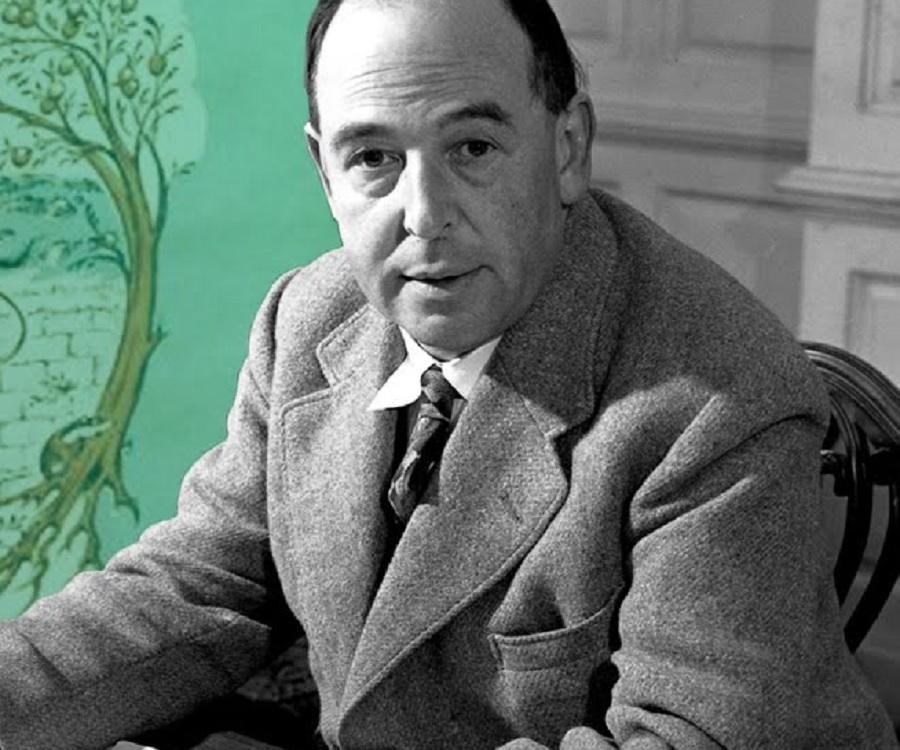
Some six months ago, the Catholic Thought Book Club read C. S. Lewis’s Mere Christianity.  Clive Staples Lewis (1898 – 1963) was a novelist and Christian apologist from Oxford University and was highly influential in the Catholic revival in England.  Now Lewis was not a Catholic but he must have been a High Church Anglican because he shares close to a Catholic worldview.  He was friends with J. R. R. Tolkien, who was Catholic, and they were part of a group at Oxford made up of Catholics and Protestants who called themselves the Inklings.  The Inklings shared their writings and critiqued each other.  While Tolkien was known for his Lord of the Rings, Lewis was known for his Chronicles of Narnia series, his science fiction novels, and his works of apologetics. 

Mere Christianity was initially an explanation of the faith to the British public over a series of BBC radio broadcasts during the World War II years of 1941 to 1944.  The book does not delve into the areas where Christian sects might disagree, but explain the fundamentals of why there is a God and why the Christian understanding of that God makes the most sense.  After the BBC broadcasts, Lewis compiled the discussions and published it as a book after the war in 1953.  The book is divided into four “Books,” each having a number of chapters.  The total number of chapters add up to thirty-three.  Here is the table of contents.


Preface

BOOK I. RIGHT AND WRONG AS A CLUE TO THE MEANING OF THE UNIVERSE

1.The Law of Human Nature

2.Some Objections

3.The Reality of the Law

4.What Lies Behind the Law

5.We Have Cause to be Uneasy

BOOK II. WHAT CHRISTIANS BELIEVE

1.The Rival Conceptions of God

2.The Invasion

3.The Shocking Alternative

4.The Perfect Penitent

5.The Practical Conclusion

BOOK III. CHRISTIAN BEHAVIOUR

1.The Three Parts of Morality

2.The “Cardinal Virtues”

3.Social Morality

4.Morality and Psychoanalysis

5.Sexual Morality

6.Christian Marriage

7.Forgiveness

8.The Great Sin

9.Charity

10.Hope

11.Faith

12.Faith

BOOK IV. BEYOND PERSONALITY: OR FIRST STEPS IN THE DOCTRINE OF THE TRINITY

1.Making and Begetting

2.The Three-personal God

3.Time and Beyond Time

4.Good Infection

5.The Obstinate Toy Soldiers

6.Two Notes

7.Let’s Pretend

8.Is Christianity Hard or Easy?

9.Counting the Cost

10.Nice People or New Men

11.The New Men

The book is structured as (1) why there is a God, (2) what Christians believe about that God, (3) moral behavior as a result of that God, and (4) the nature of this God.

If you wish to read Mere Christianity online, you can access it for free in several different formats here.  

I’m going to summarize the major sections and highlights and present some of our conversation it proves enlightening.

Summary

Book I

Chapter 1: The Law of Human Nature

There is a universal law of human nature—the law of right and wrong—and we intuitively know this law even if we fail to follow it.

Chapter 2: Some Objections

Objections to this moral law include the law as an innate instinct, and the law as a social convention; neither are satisfactory explanations.

Chapter 3: The Reality of the Law

The law of right and wrong is not a law we all follow, but a law we all know we ought to follow it.

Chapter 4: What Lies Behind the Law

Men find themselves under this moral law, a law they did not make but know they ought to obey.

Chapter 5: We Have Cause to be Uneasy

The moral law could only have been put in us by something outside of humanity, that is, God.

###

I was impressed with how systematic Lewis was in Book 1. Each chapter built on the previous. I could see it as stepping toward his conclusion. I put this together as to what I thought the steps through Book 1 consisted.  I think it could serve as a summary:


Steps through Book 1:


There is an inherent human nature of the moral law.


This moral law cannot be explained by the two objections of instinct and of social convention.


The law of human nature is verified across humanity.


There are only two views of understanding the universe, the materialist view—that is of chance—and the religious view—that is of a creator God outside the universe.


The existence of the moral law within man points to something beyond the materialist view of the universe.


The existence of the moral law within man points to a “Somebody or a Something behind the moral law.


That Something or Somebody is the Christian concept of God in that it asks us to repent and promises forgiveness. 

###

My Comment:

I just finished Book 1 and found this fascinating. Unlike Thomas Aquinas, CS Lewis does not start with the first cause argument for God. He starts with the moral law written in human nature argument, and I have to admit I found it powerful. There are so many places I would like to highlight, but let me limit it to this paragraph from chapter 4. I'll break up the paragraph because it's kind of large.


Ever since men were able to think, they have been wondering what this universe really is and how it came to be there. And, very roughly, two views have been held. First, there is what is called the materialist view. People who take that view think that matter and space just happen to exist, and always have existed, nobody knows why; and that the matter, behaving in certain fixed ways, has just happened, by a sort of fluke, to produce creatures like ourselves who are able to think. By one chance in a thousand something hit our sun and made it produce the planets; and by another thousandth chance the chemicals necessary for life, and the right temperature, occurred on one of these planets, and so some of the matter on this earth came alive; and then, by a very long series of chances, the living creatures developed into things like us.


The other view is the religious view. According to it, what is behind the universe is more like a mind than it is like anything else we know. That is to say, it is conscious, and has purposes, and prefers one thing to another. And on this view it made the universe, partly for purposes we do not know, but partly, at any rate, in order to produce creatures like itself—I mean, like itself to the extent of having minds. Please do not think that one of these views was held a long time ago and that the other has gradually taken its place. Wherever there have been thinking men both views turn up.


It had never occurred to that all views of the universe conflate to one of the two. It has always been so. By the way, he shoots down the hybrid view pretty easily. Yes, that's silly

Casey Replied:

A bit of a quibble, Manny. Lewis doesn't shoot down the hybrid view exactly but shuts down those who reject the implications. There's a sense in which the hybrid idea is exactly right. Creation is always emerging, striving, evolving but it is truly doing so, not randomly and conveniently so. It actually strives with purpose and intent. Purpose and intent are sort of outside-in. They can't be explained simply by atoms crashing into atoms. A turtle strives for the lettuce. Atoms don't bump together in a way that appears to be a turtle striving for lettuce.


The idea that there's a bunch of stuff randomly appearing to aim a single something which doesn't exist is where it gets silly.

My Reply to Casey:

Well, wait a second. This is what Lewis says exactly:


People who hold this view say that the small variations by which life on this planet “evolved” from the lowest forms to Man were not due to chance but to the “striving” or “purposiveness” of a Life-Force. When people say this we must ask them whether by Life-Force they mean something with a mind or not. If they do, then “a mind bringing life into existence and leading it to perfection” is really a God, and their view is thus identical with the Religious. If they do not, then what is the sense in saying that something without a mind “strives” or has “purposes”? This seems to me fatal to their view.


It seems like he's shooting it down to me. I think somewhere in Book I Lewis supported evolution, so he's not against evolution per se.

Casey Replied to Me:

Let me try this analogy.... If an arrow is flying through the air toward a target this implies a shooter. Let's say an "atheist" position would be 'not necessarily.' The Life-Force position would be yes there is a force behind the motion of the arrow that we might call a shooter but not necessarily a mind. A "Theist" position would be that there must be a shooter with a mind because it is the mind that creates the target.


Once you accept that the arrow has a target (an aim, a purpose) then you must accept the implication of a mind. If you reject the mind behind the motion then you must reject the idea of the target.


The reason for my quibble is that the Theist hybridizes by accepting both the mechanical, emergent elements and the mindful elements simultaneously. The Life-Forcer is hybridizing both to try to keep one foot in each camp but it doesn't work. You must accept the implications in full. It is the rejection of the implications that's problematic.

My Reply to Casey:

Actually Casey, I think we agree. I'm saying the hybrid is problematic too. And so is Lewis. Anyway, I love your analogy with the arrow. That is a great visual to capture the movement of life and the universe.

Casey’s Reply to Me:

Oh yes, we agree but I feel it is important to make the distinction about the implications because I think for decades Christians have been so engaged with atheists they've neglected the in-betweeners which is a category that has grown enormously. Probably because the waters have been muddied so much by the Christian-atheist jibber-jabber.

Madeleine’s Comment:

For me the strongest argument for God is that no one has ever been able to answer how it is possible that anything, living or not, especially human beings with intellect and abilities and a free will, is able to exist in the first place.

My Reply to Madeleine:

That is also from Aquinas. You can read about the five ways or proofs of God from Aquinas here.  


I agree with you Madeleine. That is the argument that holds the most weight for me too. But I can understand how Lewis starts with the innate moral law argument. Since Aquinas science has been so far advanced that most people in the last 200 years think science can answer everything. If they don't currently have an answer to how something started from nothing, they expect that some day science will. I've actually had this come up in a debate with atheists. They argue like this: "Just because we currently don't know doesn't mean some magic God did it; science will eventually figure it out."


The innate moral law I think still has holes. I'm not sure he satisfactorily answered the objection to social conventions. It does seem to me that various cultures have different perspectives as to what is morally acceptable. Other cultures might not agree on a Christian moral universe. But I don't know.

Kerstin Replied to Me:

Manny wrote: " If they don't currently have an answer to how something started from nothing, they expect that some day science will.

That's scientism. I know they don't see it, but we're crossing the line between the physical and metaphysical. The natural sciences, shortened today into "science", can only show us what you can see and measure according the the physical realities of this universe. If you take all matter away and with it all laws governing matter, science becomes obsolete.

I've actually had this come up in a debate with atheists. They argue like this: "Just because we currently don't know doesn't mean some magic God did it; science will eventually figure it out."
The infamous "God of the gaps" argument. Once we find the "God particle" science will explain everything. ;-)

Frances Comment:

These thoughts of Benedict XVI when he was the young theology professor Joseph Ratzinger expand on the religious view: “Finite being, as we experience it, is marked, through and through, by intelligibility, that is to say, by a formal structure that makes it understandable to an inquiring mind. In point of fact, all of the sciences rest on the assumption that at all levels, microscopic and microcosmic, being can be known. . . The only finally satisfying explanation for this universal objective intelligibility is a great Intelligence who has thought the universe into being. Our language provides an intriguing clue in this regard, for we speak of our acts of knowledge as moments of ‘recognition,’ literally a re-cognition, a thinking again what has already been thought. ‘’


(Bishop Robert Barron, Catholicism, Image Books, pages 67-68)

Kerstin’s Reply to Frances:

The argument of intelligibility is simply brilliant.


Wednesday, April 24, 2024

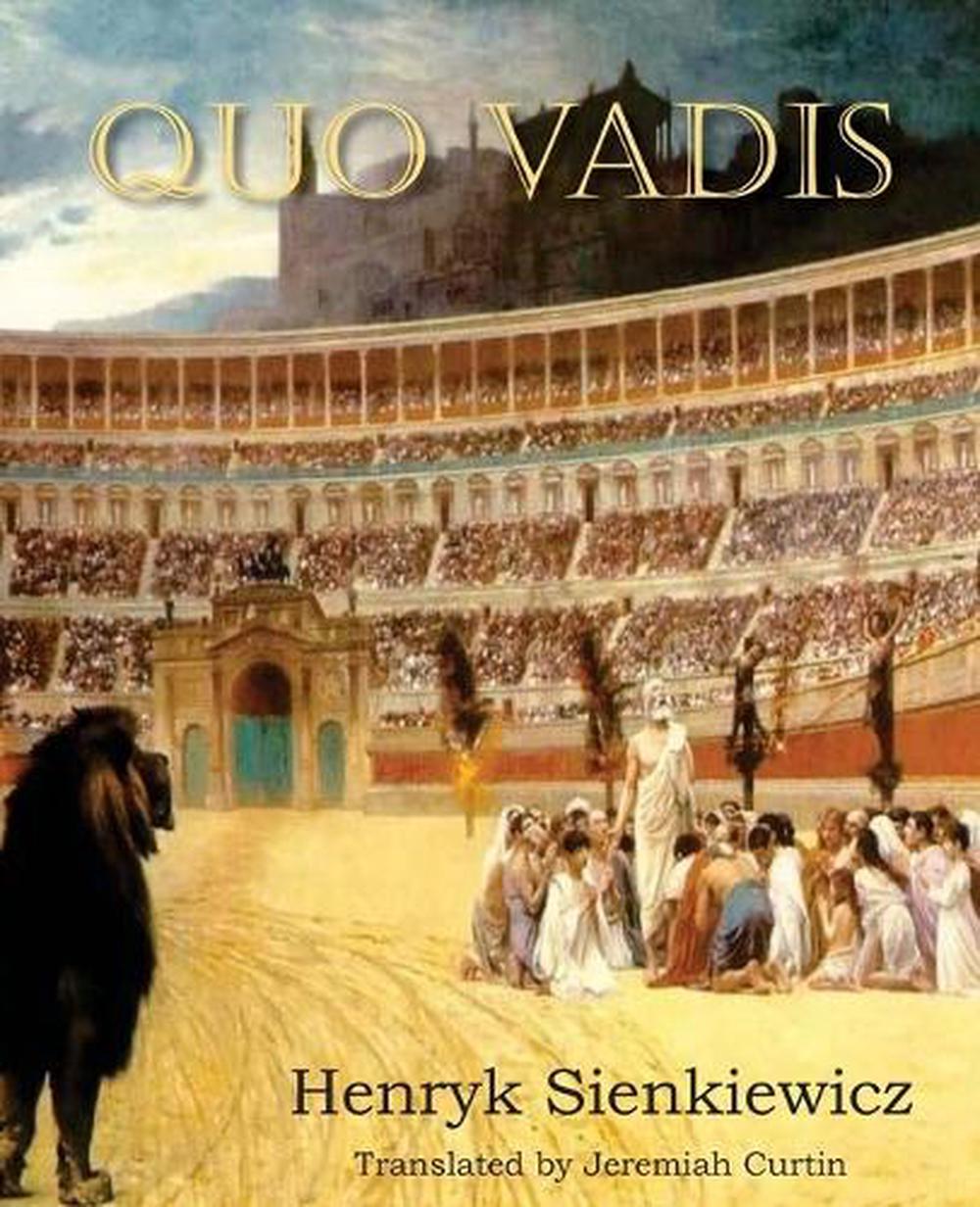
Quo Vadis: A Narrative of the Time of Nero by Henryk Sienkiewicz, Part 8


This is the eighth post of Henryk Sienkiewicz’s historical novel, Quo Vadis.

You can find Post #1 here.  

Post #2, here

Post #3 here.  

Post #4 here

Post #5 here. 

Post #6 here.  

Post #7 here


Chapters 50 thru 56

Summary

After Petronius returns to his home, which out of fortune had been spared from the fire.  He is convinced his life will be taken by Nero, and he weighs the moral depravity of his enemies.  If his life must end, he concludes he will do what he can to save Vinicius and Lygia.  He tells Vinicius what transpired at Nero’s, and impels him to go save Lygia before she is rounded up.  He is also determined to stifle the plans of Tigellinus and Nero.  Petronius rests with Eunice, who he will dearly miss when his life is taken.  A centurion arrives with a letter from Caesar, an invitation to listen to Nero’s new composition.  The centurion also tells him he’s on the way to round up Christians for the games.  Petronius goes off to listen to Caesar and he and Tigellinus are clearly in tension.  But Petronius as the great arbiter of elegance is back to his advantage listening to Nero’s composition.  On the way back he stops at Vinicius’ home.  Through the streets he hears the chants of “To the Lions the Christians.”  Vinicius is home in a desperate mood.  He did not reach Lygia in time.  She has been carted to the prison.  He and Petronius decide to go to the prison.  On the way, Petronius kills an abusive drunk, and from Petronius’s familiarity with the guards they are led in where the Christians are singing hymns.

For the games, an enormous wooden amphitheater is being built.  Wild animals are sought from within and beyond the empire and then caged in Rome.  Christians are being violently rounded up across the city.  Petronius has Acte visit Lygia in prison where she brings Lygia clothing and food.  Guards are bribed to prevent Lygia from being raped and other violence.  Nero is fixated on providing the greatest spectacle ever seen in Rome.  Vinicius does all he can to save Lygia, bribing everyone in the prison.  He even wants to beg Caesar but Petronius advises against it.  It would only harden Nero’s heart further.  Vinicius offers himself as a sacrifice to Christ and cannot understand why Christ would let this tragedy happen.

Everything Vinicius attempts in trying to save Lygia fails.  Finally the amphitheater’s construction is complete.  It is finally coming to a head.  The prisons are overfilled with Christians and disease was spreading.  Vinicius passed whole nights outside the prison, kneeling and praying.  He finds out that Peter was not imprisoned and where he is staying.  He goes to Peter and finds him praying with other Christians.  Vinicius asks where is Christ in this evil?  Peter tries to comfort everyone and strengthened them with his prayers.  Peter reminds them that Christ was crucified, and yet he rose from the dead.  Raising his hands and his eyes fixed into a vision, Peter continues to pray and bless.  When he finishes, Vinicius falls to his knees at Peter’s feet and implores him to pray for Lygia.  He offers his life to spare her’s. 

After, Vinicius once again goes to the prison, this time with new hope from the power of prayer.  He finds out that Lygia has taken ill and that one of the Pretorian guards is a Christian himself.  Filled with a little more hope, Vinicius goes to Petronius’s house.  Petronius tells him of an incident that happened that day at Nero’s.  Poppaea had brought her child from a previous marriage to Nero performance, and the boy fell asleep in the middle of it.  Nero hurled a goblet at the boy and injured him.  Petronius believes that he and Poppaea can come to an agreement, Petronius saving her son Rufius if she saves Lygia.  The first of the games are scheduled in ten days, so there is a little time to work the deal.  In the meantime, Lygia is with fever, which has spared her from being defiled.  Vinicius writes a letter to Lygia and delivers it himself to the prison.  He spends another night outside where he has a terrible dream.  When he wakes, he finds a retinue with Chilo at the center.  Chilo has been highly rewarded and is an aristocrat himself now.  Vinicius accuses him of betraying Lygia, and Chilo responds that when he was in need Vinicius had him flogged.

Lygia writes back to Vinicius, telling him no matter what happens she will always be his.  She does not fear what might happen to her.  Vinicius writes back that he will go every day to the walls of the prison and that he believes Christ will save her.  Petronius meets with Poppaea, who he finds caring for Rufius who is now in a fever.  He proposes the deal to her, and she says the only way to convince Nero to release Lygia is for the head Vestal Virgin to persuade Caesar.  Poppaea leaves that evening to go to the Virgin, but when she was out two hired men carried out Nero’s orders to strangle the boy and toss his body into the sea.  When Poppaea returns and finds the boy disappeared, she screams in agony.

The day of the Morning Games is here but these games will last all day given all the Christians that need to be killed.  The amphitheater is packed, and the audience is amazed at the sound of the Christians singing hymns.  Vinicius ventures down to the Christian cell where he finds many sewn into animal skins to be attacked by the wild animals.  He finds Crispus there preaching repentance for their upcoming day of wrath.  Two well-known gladiators were to open the games with a match.  In the fight one makes a misstep and falls and asks for mercy.  Nero, having lost previously with this gladiator refuses mercy, and the gladiator is killed.  Next small armies of soldiers fight battles, and there is so much killing that the bodies are piled up and the blood runs across the entire arena.  The audience is enthralled with the bloodbath.  Chilo, on the other hand, not used to these games is repulsed by the slaughter.  The Romans laugh at his innocence.  Next the Christians are up to be slaughtered.  They are led out dressed in animal skins, women with children and unarmed men.  They kneel in prayer and look to heaven.  Wild dogs are let loose upon them and they tear human flesh limb from limb and satiate themselves on the carcasses.  Up above in the elevated section, Peter has been snuck in and, visibly moved, prays and blesses the martyrs below.  Chilo watching flesh being torn off bodies faints from the revulsion.  The lions were to be kept for the next day, but the audience in their bloodlust call for them now.  Nero wishing to please and with more Christians on hand he gives the order to let the lions in.  The lions storm the arena and gorge on the Christians.  Blood is everywhere.  Nero then lets all the wild beasts enter, and the spectacle becomes an orgy of blood.  To clear the arena, Nero orders archers to kill the animals after all the Christians have been slaughtered.  Bodies of Christians and beasts cover the arena.  After the bodies are cleared, Nero steps down into the arena and with his harp sings his composition.  Peter up above is seen crying.

At evening while the crowds are departing, Nero disappointed at not being praised for his song asks Petronius why the song was not appreciated.  Petronius explains it was the wrong time and place, the crowd gorged on the bloodbath.  Still he compliments the song and mentions a line that needs improving.  Chilo, recovered, obsequiously compliments Nero’s song.  They all talk about the Christians that in their dying moments are looking as if in a vision toward heaven.  Petronius and Vinicius depart and they find Nazarius, the son of Miriam, at Vinicius’s home.  He confirms that Lygia is still in prison, ill from fever, and he has been assigned to load caskets of the dead.  Petronius comes up with a plan to place Lygia, simulating being dead, into a casket and have her taken out with the dead, where Vinicius will take her out of the casket.  That evening they try the plan and as they wait for the procession Nazarius comes up to say she was taken to another prison, the Esquiline dungeons, before they could put her in the casket.


###

Michelle Comment:

It was even more striking having St. Peter witness this.

Kerstin Comment:

The scenes in the arena are hard to read. So much blood and gore.

###

The first excerpt from these chapters is from chapter 51 where we see the frenzy the Roman people were seized with against the scapegoated Christians as they wanted to purify themselves of whatever malediction the gods had given them. 


The cry, "Christians to the lions!" was heard increasingly in every part of the city. At first not only did no one doubt that they were the real authors of the catastrophe, but no one wished to doubt, since their punishment was to be a splendid amusement for the populace. Still the opinion spread that the catastrophe would not have assumed such dreadful proportions but for the anger of the gods; for this reason "piacula," or purifying sacrifices, were commanded in the temples. By advice of the Sibylline books, the Senate ordained solemnities and public prayer to Vulcan, Ceres, and Proserpina. Matrons made offerings to Juno; a whole procession of them went to the seashore to take water and sprinkle with it the statue of the goddess. Married women prepared feasts to the gods and night watches. All Rome purified itself from sin, made offerings, and placated the Immortals. Meanwhile new broad streets were opened among the ruins. In one place and another foundations were laid for magnificent houses, palaces, and temples. But first of all they built with unheard-of haste an enormous wooden amphitheatre in which Christians were to die. Immediately after that consultation in the house of Tiberius, orders went to consuls to furnish wild beasts. Tigellinus emptied the vivaria of all Italian cities, not excepting the smaller ones. In Africa, at his command, gigantic hunts were organized, in which the entire local population was forced to take part. Elephants and tigers were brought in from Asia, crocodiles and hippopotamuses from the Nile, lions from the Atlas, wolves and bears from the Pyrenees, savage hounds from Hibernia, Molossian dogs from Epirus, bisons and the gigantic wild aurochs from Germany. Because of the number of prisoners, the games were to surpass in greatness anything seen up to that time. Cæsar wished to drown all memory of the fire in blood, and make Rome drunk with it; hence never had there been a greater promise of bloodshed.


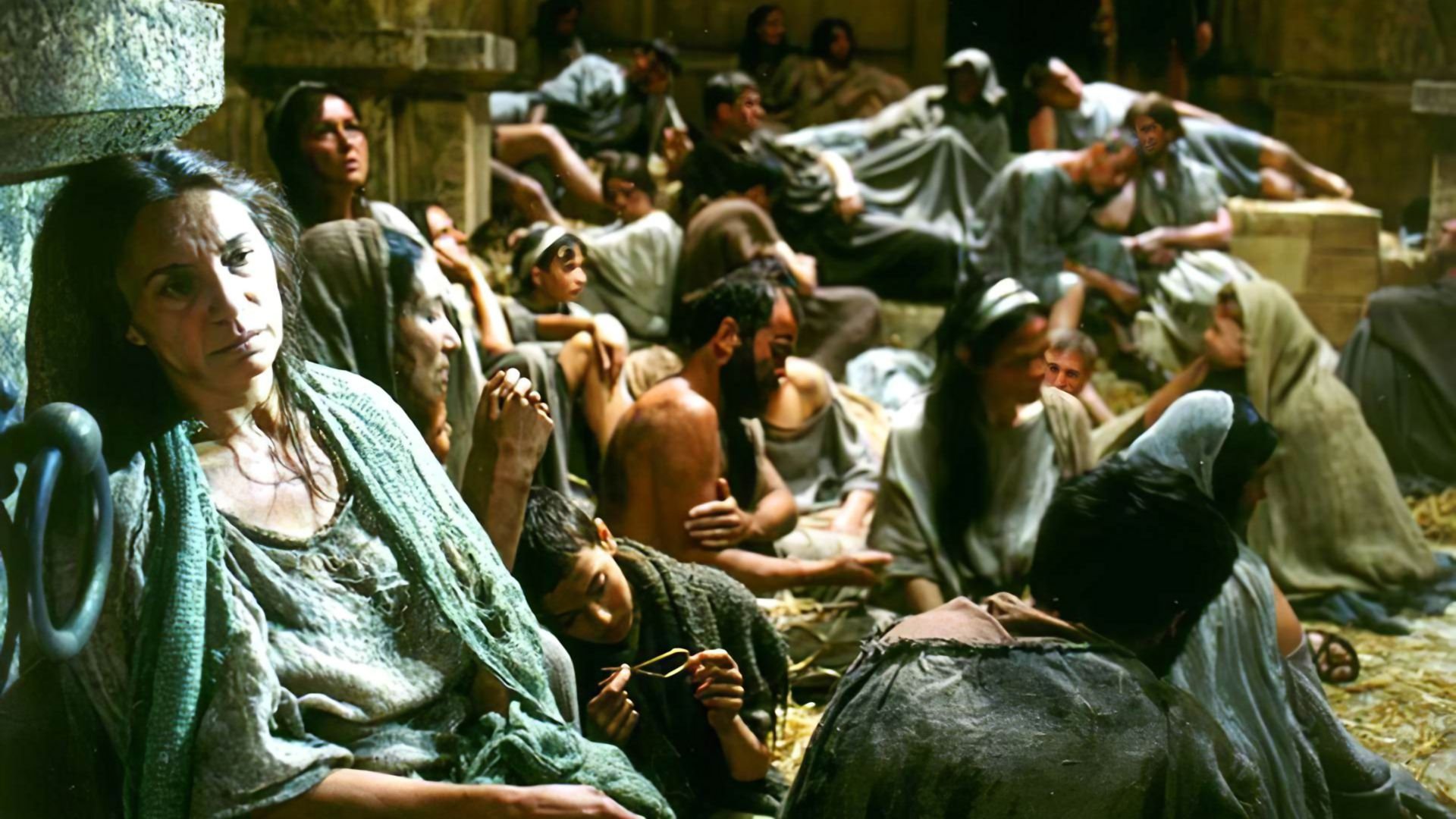
The willing people helped guards and pretorians in hunting Christians. That was no difficult labor for whole groups of them camped with the other population in the midst of the gardens, and confessed their faith openly. When surrounded, they knelt, and while singing hymns let themselves be borne away without resistance. But their patience only increased the anger of the populace, who, not understanding its origin, considered it as rage and persistence in crime. A madness seized the persecutors. It happened that the mob wrested Christians from pretorians, and tore them to pieces; women were dragged to prison by the hair; children's heads were dashed against stones. Thousands of people rushed, howling, night and day through the streets. Victims were sought in ruins, in chimneys, in cellars. Before the prison bacchanalian feasts and dances were celebrated at fires, around casks of wine.


In the evening was heard with delight bellowing which was like thunder, and which sounded throughout the city. The prisons were overflowing with thousands of people; every day the mob and pretorians drove in new victims. Pity had died out. It seemed that people had forgotten to speak, and in their wild frenzy remembered one shout alone: "To the lions with Christians!" Wonderfully hot days came, and nights more stifling than ever before; the very air seemed filled with blood, crime, and madness.


And that surpassing measure of cruelty was answered by an equal measure of desire for martyrdom,—the confessors of Christ went to death willingly, or even sought death till they were restrained by the stern commands of superiors. By the injunction of these superiors they began to assemble only outside the city, in excavations near the Appian Way, and in vineyards belonging to patrician Christians, of whom none had been imprisoned so far. It was known perfectly on the Palatine that to the confessors of Christ belonged Flavius, Domitilla, Pomponia Græcina, Cornelius Pudens, and Vinicius. Cæsar himself, however, feared that the mob would not believe that such people had burned Rome, and since it was important beyond everything to convince the mob, punishment and vengeance were deferred till later days. Others were of the opinion, but erroneously, that those patricians were saved by the influence of Acte. Petronius, after parting with Vinicius, turned to Acte, it is true, to gain assistance for Lygia; but she could offer him only tears, for she lived in oblivion and suffering, and was endured only in so far as she hid herself from Poppæa and Cæsar.


###

The second excerpt comes from chapter 50, the start of the Morning Games.  After opening the ceremonies and a gladiatorial bout which ended in a thumbs-down death dictum from Nero, the Christians are led into the amphitheater covered in animal hides.  Wild dogs are let in for the slaughter of the kneeling and praying Christians.


The turn of the Christians was at hand. But since that was a new spectacle for people, and no one knew how the Christians would bear themselves, all waited with a certain curiosity. The disposition of the audience was attentive but unfriendly; they were waiting for uncommon scenes. Those people who were to appear had burned Rome and its ancient treasures. They had drunk the blood of infants, and poisoned water; they had cursed the whole human race, and committed the vilest crimes. The harshest punishment did not suffice the roused hatred; and if any fear possessed people's hearts, it was this: that the torture of the Christians would not equal the guilt of those ominous criminals.


Meanwhile the sun had risen high; its rays, passing through the purple velarium, had filled the amphitheatre with blood-colored light. The sand assumed a fiery hue, and in those gleams, in the faces of people, as well as in the empty arena, which after a time was to be filled with the torture of people and the rage of savage beasts, there was something terrible. Death and terror seemed hovering in the air. The throng, usually gladsome, became moody under the influence of hate and silence. Faces had a sullen expression.


Now the prefect gave a sign. The same old man appeared, dressed as Charon, who had called the gladiators to death, and, passing with slow step across the arena amid silence, he struck three times again on the door.


Throughout the amphitheatre was heard the deep murmur,—


"The Christians! the Christians!"


The iron gratings creaked; through the dark openings were heard the usual cries of the scourgers, "To the sand!" and in one moment the arena was peopled with crowds as it were of satyrs covered with skins. All ran quickly, somewhat feverishly, and, reaching the middle of the circle, they knelt one by another with raised heads. The spectators, judging this to be a prayer for pity, and enraged by such cowardice, began to stamp, whistle, throw empty wine-vessels, bones from which the flesh had been eaten, and shout, "The beasts! the beasts!" But all at once something unexpected took place. From out the shaggy assembly singing voices were raised, and then sounded that hymn heard for the first time in a Roman amphitheatre, "Christus regnat!" ["Christ reigns!"]


Astonishment seized the spectators. The condemned sang with eyes raised to the velarium. The audience saw faces pale, but as it were inspired. All understood that those people were not asking for mercy, and that they seemed not to see the Circus, the audience, the Senate, or Cæsar. "Christus regnat!" rose ever louder, and in the seats, far up to the highest, among the rows of spectators, more than one asked himself the question, "What is happening, and who is that Christus who reigns in the mouths of those people who are about to die?" But meanwhile a new grating was opened, and into the arena rushed, with mad speed and barking, whole packs of dogs,—gigantic, yellow Molossians from the Peloponnesus, pied dogs from the Pyrenees, and wolf-like hounds from Hibernia, purposely famished; their sides lank, and their eyes bloodshot. Their howls and whines filled the amphitheatre. When the Christians had finished their hymn, they remained kneeling, motionless, as if petrified, merely repeating in one groaning chorus, "Pro Christo! Pro Christo!" The dogs, catching the odor of people under the skins of beasts, and surprised by their silence, did not rush on them at once. Some stood against the walls of the boxes, as if wishing to go among the spectators; others ran around barking furiously, as though chasing some unseen beast. The people were angry. A thousand voices began to call; some howled like wild beasts; some barked like dogs; others urged them on in every language. The amphitheatre was trembling from uproar. The excited dogs began to run to the kneeling people, then to draw back, snapping their teeth, till at last one of the Molossians drove his teeth into the shoulder of a woman kneeling in front, and dragged her under him.


Tens of dogs rushed into the crowd now, as if to break through it. The audience ceased to howl, so as to look with greater attention. Amidst the howling and whining were heard yet plaintive voices of men and women: "Pro Christo! Pro Christo!" but on the arena were formed quivering masses of the bodies of dogs and people. Blood flowed in streams from the torn bodies. Dogs dragged from each other the bloody limbs of people. The odor of blood and torn entrails was stronger than Arabian perfumes, and filled the whole Circus.


At last only here and there were visible single kneeling forms, which were soon covered by moving squirming masses.


Friday, April 5, 2024

Quo Vadis: A Narrative of the Time of Nero by Henryk Sienkiewicz, Part 7

This is seventh post of Henryk Sienkiewicz’s historical novel, Quo Vadis.

You can find Post #1 here.  

Post #2, here.

Post #3 here.  

Post #4 here

Post #5 here. 

Post #6 here.  


Chapters 42 thru 49

Summary

Upon hearing that Rome is ablaze, Vinicius gathers a few of his slaves and a horse and heads for Rome in the dark of night.  While riding furiously and with great haste, his thoughts are with Lygia’s safety.  He remembers things that Nero had said in court about trying to describe a burning city.  He comes to the conclusion that Caesar had ordered the city to burn.  The general traffic on the road is heading in the opposite direct, as people are trying to flee Rome.  At one moment Vinicius prays to God, the God of the Christians, that if He saves Lygia he will offer himself in sacrifice.  As he approaches the city he finds a detachment of praetorians and having a rank of tribune commands them to help him through the crowd.  He meets a Senator, Junius, who tells him their homes are burnt, and that this is no ordinary fire but a deliberate one.  Vinicius decides to go around the city to come through a different entrance.

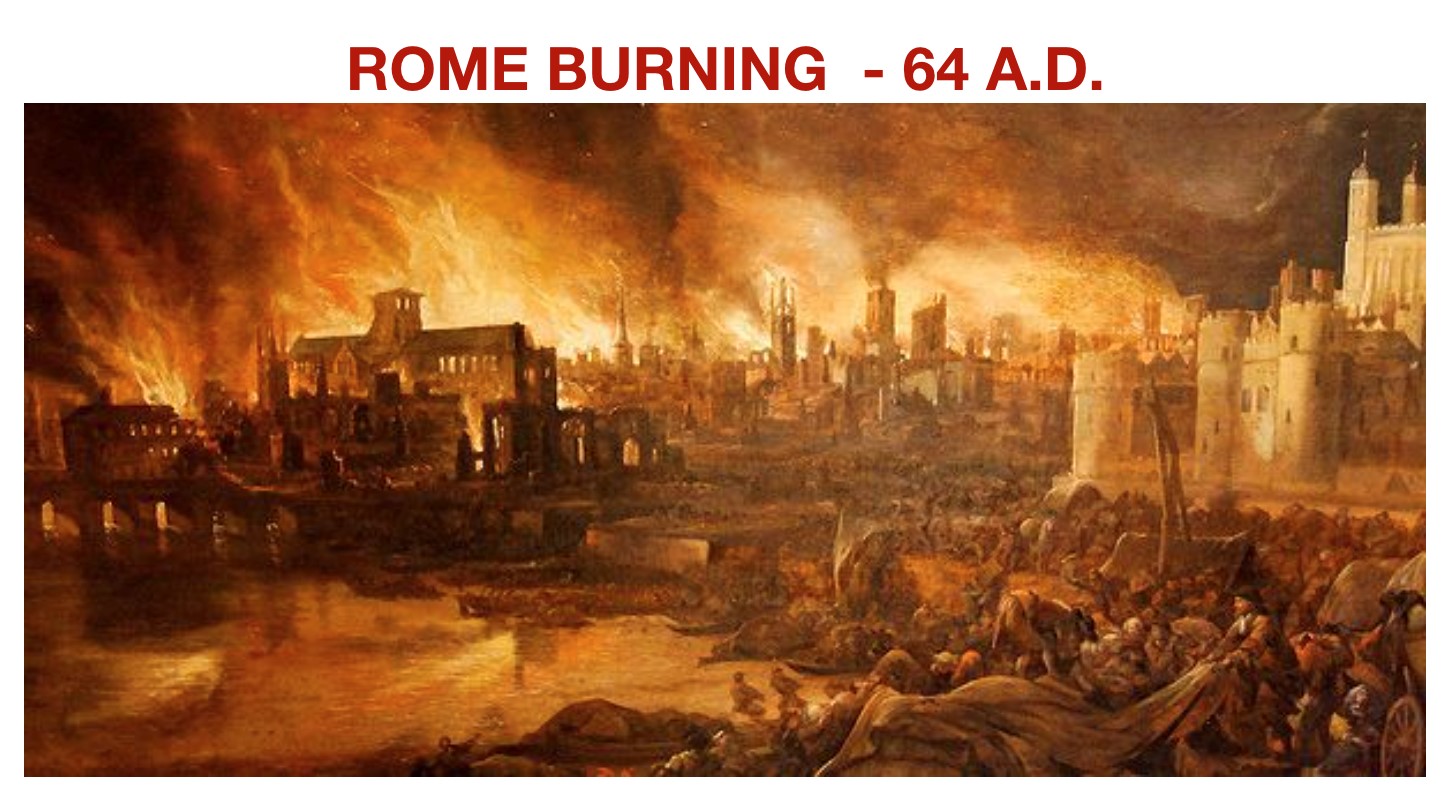
When he approaches the wall at the Appian Way, masses of people have encamped or settled in some sort of shelter.  People are trampling and fighting and robbing others.  Gangs have formed to exploit and victimize refugees.  All levels of society have become blurred and languages from all over the world could be heard.  The city is burning so bright that the sky seems like daylight but smoke moving with the shifting winds adds to the chaos.  The heat from the fire is overwhelming, and so Vinicius decides to head back out and down to the Trans-Tiber.  He finds another detachment of soldiers and orders them to fight through the crowd.  He is convinced that Nero has started the fire and needs to be overthrown, and he even imagines himself becoming emperor.  The crowds at Trans-Tiber are in violent disorder, fighting with each other.  His horse is wounded and so he jumps on foot and heads toward Linus’s house.  The smoke and the heat are overwhelming but he perseveres.  When he reaches Linus’s house, which had not burned, he calls for Lygia, but no one is home.  Falling from exhaustion and his tunic smoldering, two men with water come to him.  The two are Christians.  Suddenly the familiar voice of Chilo comes before him.  Chilo tells him he knows where Linus is staying.

The terrible light of a burning city fills the night sky.  Fire spreads and starts anew in every neighborhood.  Thousands of people are encamped or fleeing.  Violence and looting is everywhere while others implore the gods for mercy.  Hundreds of burnt bodies lay about.  Hardly a family is unaffected; women could be heard screaming in despair, and people do not know where to run.  The fire continues to rage and spread, and the city has turned into pandemonium. 

Macrinus, one of the Christians who had saved Vinicius, tells him that Linus and the other Christians have gone to Ostrianum.  This meant that most of the Christians had been saved from the fire, and he hurries toward Ostrianum.  With two mules, he and Chilo go around the city to minimize the clutter from the crowds.  Still it is difficult and the conflagration beyond them looks like the end of the world.  Vinicius asks Chilo where he was when the fire broke out, and Chilo says by the Circus Maximus, “meditating on Christ.”  Chilo tells him that he saw Lygia and the other Christians in Ostrianum before the fire.  With suspicion, Vinicius asked him what was he doing there, and Chilo claims he is half Christian now, and the Christians were giving him food.  Through the hills, and away from the Jews who had been persecuting the Christians, Chilo leads Vinicius to the Christians where he finds them kneeling and singing hymns.  He finds the congregation in prayer and in expectation of Christ’s return as judge.  When a roar shakes the earth, the congregation falls to their knees, and at that moment Peter walks in.  With Peter’s reassuring words, a calmness pervades, and Vinicius falls to Peter’s knees in supplication.

The city continues to crumble under the flames, and the fire rages further.  Tigellinus has been sent to Rome to do what he could.  He has houses torn down to try to halt the spreading fire.  Whole neighborhoods are destroyed and so are food provisions.  Hunger is beginning to spread through the refugees.  Tigellinus organizes food to be brought in, but fights start by those trying to loot it.  Days continue with thick smoke in the air; the fire is still uncontrolled.  Tigellinus sends word to Nero to come since the fire is still a spectacle, and Nero decides to delay so that he could enter at night to better see the fury of the fire.  All the while Nero is composing lines of verse describing the burning city.  Some of the people along the way cheer him, but most curse him.  Clothed in his actor’s wardrobe, he sings his versus to the crowd, and though unmoved by the tragic circumstances of the masses before him, he is delighted with his performance.  Both Petronius and Seneca counsel him that he needs to pacify the people.  Petronius volunteers to speak to the rabble.  After he quiets the crowd, he promises them that Caesar will provide food and games for everyone. 

With Peter’s calming words and the fire, while not burnt out, at least ceasing to advance, the Christians return to their temporary dwellings.  Vinicius and Chilo follow Peter toward Linus’s house, but Chilo in possession of the mules is directed to take them back to Macrinus.  On the way Vinicius asks Peter what else he must do to be ready for baptism, and Peter says “Love men as thy own brothers, for only with love mayest thou serve Him.”  As the two approach Linus’s house, Vinicius spots Ursus and Lygia, who is preparing to cook fish.  They embrace in another reunion.  (How many reunions are we up to now, four?) They exchange informal marriage vows, per the Roman custom.  Vinicius then turns to the others and advises to seek safety.  Mobs are killing people within the city and Nero may bring troops to establish order.  Peter gives permission for others to escape Rome but he must stay with his sheep, the Christians.

Meanwhile back at Rome, it has been a six days and provisions have begun to come in to at least feed the encamped masses.  But robbery and violence is still unchecked.  The fire is still burning in places, but at least the night sky no longer reflects blood red.  The provisions did not appease the masses as they continued to curse Caesar.  Of the aristocracy, only Petronius continues to be respected.  At Caesar’s court, the aristocrats look to deflect blame for the fire, but to deflect blame from themselves they must also clear Nero. Petronius advises that Nero keep his planned trip to Greece to get out until the Roman anger has subsided.  Tigellinus advises the opposite; the Roman senate might declare another emperor.  Nero declares that to satisfy vengeance, a victim must be provided.  He looks about the room for volunteers.  Tigellinus suggests that the Pretorian guard would avenge aristocratic deaths, which shuts Nero up.  Just when Nero agrees to go to Greece, Poppaea and Tigellinus propose to blame the Christians.  Their deaths can be a spectacle for the public’s blood revenge.  In this Petronius saw the danger to his beloved nephew and risks his very life to propose otherwise.  He says the truth is the truth and Nero will be blamed by history not just for the fire but for cowardice to live up to it.  Tigellinus jumps on this and points Petronius as a traitor.  All the aristocrats call to punish Petronius, but Nero holds his hand.

Later, Tigellinus leads Nero over to Poppaea’s section of the palace.  With her are two rabbis and Chilo.  The rabbis and Chilo agree that the Christians are enemies of the state and started the fire.  Chilo speaks of how the philosophy of the Christians leads them exterminate all people and destroy the earth.  He gives details how they had done him wrong, particularly one named Glaucus, and how he has now been acquainted with their chief priests.  He speaks of how Christians kill children to sprinkle their blood in ceremonies and how they bewitched Nero’s daughter into illness and death.  He tells them that Vinicius has become a Christian through Lygia.  Tigellinus adds that perhaps Petronius is a Christian too.  Chilo tells them he can lead them to where they are all hiding and all their places of worship.  Tigellinus proposes to have nephew and uncle immediately killed, but Nero says not now.  Chilo is given soldiers to round up the Christians.

###


Some thoughts on these chapters.

These were such an intense set of chapters.  The burning of Rome was so well described that it felt I was there.  Nero wants to see a burning city so he can describe it better than Virgil’s description.  But Nero’s description is a complete failure.  But Sienkiewicz’s description in these chapters was truly magnificent, comparable to Virgil’s of Troy.  So the irony is that Sienkiewicz does in the novel what Nero wanted to do but couldn’t. 

Vinicius’s trek through the burning city for Lygia was a passion procession of suffering akin to Christ’s passion.  He even offers himself in sacrifice.  It was through this suffering that he earned his initiation into the faith.

Christian compassion is contrasted distinctly against the pagan looting and violence during the burning fire.  

I found the drama of Nero’s court as they sought a fall man to blame for the fire just as intense as the description of the burning city.  The power play between Tigellinus and Petronius was gripping as they vied for Nero’s approbation.  It was a life and death battle.

The love of Petronius for his nephew is a rudimentary—or perhaps a better word would be natural—love akin to Christian love.  It is love written in the heart according to natural law.  He even puts himself at sacrificial risk of death for Vinicius.  If I were to start reading the novel over, I would look for all the bonds of love that hold people together, and all those who like Nero or Poppaea reject those bonds.  Chilo has many instances of building a relationship of mutual love and he rejects it.  Could we look at the characters as receiving grace to cooperate with God’s love?  Again I would look for implications of this on a second read.  Vinicius’s conversion is built on the his love for Lygia.  I think Peter’s words to Vinicius in chapter 47 is the central theme of the novel: “Love men as thy own brothers, for only with love mayest thou serve Him.”

Chilo is the Judas character.  Interestingly Sienkiewicz is playing with a Roman sterotype about never trusting the Greeks.  It goes back to Homer who used the Greek’s charade of the Trojan Horse to sack Troy.  It continued through the Roman Empire, and indeed into the Middle Ages.  During the Crusades, the Latin west routinely claimed the Greeks were untrustworthy.  Chilo reminds me of the mestizo character who betrays the Whiskey Priest in Graham Greene’s The Power and the Glory.  We read that just over two years ago in 2021 for those that participated in that read.  That discussion is in our history boards. 

###

Michelle Comment:

Thank you for this great summary! Chilo was a great source of frustration for me up to this point. I mean, I expected vile behavior from Nero, Poppaea and Tigellinus, but opportunistic Chilo liked the Christians. I liked the way Petronius became so very protective of Vinicius, too.


I hadn't thought of Chilo as a Judas character, but I see that now. Judas also must have cared for and liked his fellow apostles but still betrayed.

Kerstin Comment:

These are very gripping and intense chapters. The descriptions of the mass chaos were masterfully done. Sienkiewicz focuses for long chapters on the common people, something we don't get out of history books. The juxtaposition to the mad behavior of the singing Nero couldn't be more surreal.

Michelle Reply:

I was also very impressed with the realism in those chapters--very easy to imagine what that must have been like. I imagine it may have been very like the recent conflagration in Maui.

###


An excerpt from Chapter 42, Vinicius dashes to the burning city of Rome, and along the way has the epiphany that Nero was behind the fire..


Vinicius had barely time to command a few slaves to follow him; then, springing on his horse, he rushed forth in the deep night along the empty streets toward Laurentum. Through the influence of the dreadful news he had fallen as it were into frenzy and mental distraction. At moments he did not know clearly what was happening in his mind; he had merely the feeling that misfortune was on the horse with him, sitting behind his shoulders, and shouting in his ears, "Rome is burning!" that it was lashing his horse and him, urging them toward the fire. Laying his bare head on the beast's neck, he rushed on, in his single tunic, alone, at random, not looking ahead, and taking no note of obstacles against which he might perchance dash himself.


In silence and in that calm night, the rider and the horse, covered with gleams of the moon, seemed like dream visions. The Idumean stallion, dropping his ears and stretching his neck, shot on like an arrow past the motionless cypresses and the white villas hidden among them. The sound of hoofs on the stone flags roused dogs here and there; these followed the strange vision with their barking; afterward, excited by its suddenness, they fell to howling, and raised their jaws toward the moon. The slaves hastening after Vinicius soon dropped behind, as their horses were greatly inferior. When he had rushed like a storm through sleeping Laurentum, he turned toward Ardea, in which, as in Aricia, Bovillæ, and Ustrinum, he had kept relays of horses from the day of his coming to Antium, so as to pass in the shortest time possible the interval between Rome and him. Remembering these relays, he forced all the strength from his horse.


Beyond Ardea it seemed to him that the sky on the northeast was covered with a rosy reflection. That might be the dawn, for the hour was late, and in July daybreak came early. But Vinicius could not keep down a cry of rage and despair, for it seemed to him that that was the glare of the conflagration. He remembered the consul's words, "The whole city is one sea of flame," and for a while he felt that madness was threatening him really, for he had lost utterly all hope that he could save Lygia, or even reach the city before it was turned into one heap of ashes. His thoughts were quicker now than the rush of the stallion, they flew on ahead like a flock of birds, black, monstrous, and rousing despair. He knew not, it is true, in what part of the city the fire had begun; but he supposed that the Trans-Tiber division, as it was packed with tenements, timber-yards, storehouses, and wooden sheds serving as slave marts, might have become the first food of the flames.


In Rome fires happened frequently enough; during these fires, as frequently, deeds of violence and robbery were committed, especially in the parts occupied by a needy and half-barbarous population. What might happen, therefore, in a place like the Trans-Tiber, which was the retreat of a rabble collected from all parts of the earth? Here the thought of Ursus with his preterhuman power flashed into Vinicius's head; but what could be done by a man, even were he a Titan, against the destructive force of fire?


The fear of servile rebellion was like a nightmare, which had stifled Rome for whole years. It was said that hundreds of thousands of those people were thinking of the times of Spartacus, and merely waiting for a favorable moment to seize arms against their oppressors and Rome. Now the moment had come! Perhaps war and slaughter were raging in the city together with fire. It was possible even that the pretorians had hurled themselves on the city, and were slaughtering at command of Cæsar.


And that moment the hair rose from terror on his head. He recalled all the conversations about burning cities, which for some time had been repeated at Cæsar's court with wonderful persistence; he recalled Cæsar's complaints that he was forced to describe a burning city without having seen a real fire; his contemptuous answer to Tigellinus, who offered to burn Antium or an artificial wooden city; finally, his complaints against Rome, and the pestilential alleys of the Subura. Yes; Cæsar has commanded the burning of the city! He alone could give such a command, as Tigellinus alone could accomplish it. But if Rome is burning at command of Cæsar, who can be sure that the population will not be slaughtered at his command also? The monster is capable even of such a deed. Conflagration, a servile revolt, and slaughter! What a horrible chaos, what a letting loose of destructive elements and popular frenzy! And in all this is Lygia.


A second excerpt is Chilo and the Rabbis before Nero and Poppaea betraying the Christians through lies.  This is such marvelous dialogue with Chilo unctuously flattering Caesar and his wife to be on their good side.


"Do ye accuse the Christians of burning Rome?" inquired Cæsar.


"We, lord, accuse them of this alone,—that they are enemies of the law, of the human race, of Rome, and of thee; that long since they have threatened the city and the world with fire! The rest will be told thee by this man, whose lips are unstained by a lie, for in his mother's veins flowed the blood of the chosen people."


Nero turned to Chilo: "Who art thou?"


"One who honors thee, O Cyrus; and, besides, a poor Stoic-"


"I hate the Stoics," said Nero. "I hate Thrasea; I hate Musonius and Cornutus. Their speech is repulsive to me; their contempt for art, their voluntary squalor and filth."


"O lord, thy master Seneca has one thousand tables of citrus wood. At thy wish I will have twice as many. I am a Stoic from necessity. Dress my stoicism, O Radiant One, in a garland of roses, put a pitcher of wine before it; it will sing Anacreon in such strains as to deafen every Epicurean."


Nero, who was pleased by the title "Radiant," smiled and said,-"Thou dost please me."


"This man is worth his weight in gold!" cried Tigellinus.


"Put thy liberality with my weight," answered Chilo, "or the wind will blow my reward away."


"He would not outweigh Vitelius," put in Cæsar.


"Eheu! Silver-bowed, my wit is not of lead."


"I see that thy faith does not hinder thee from calling me a god."


"O Immortal! My faith is in thee; the Christians blaspheme against that faith, and I hate them."


"What dost thou know of the Christians?"


"Wilt thou permit me to weep, O divinity?"


"No," answered Nero; "weeping annoys me."


"Thou art triply right, for eyes that have seen thee should be free of tears forever. O lord, defend me against my enemies."

"Speak of the Christians," said Poppæa, with a shade of impatience.


"It will be at thy command, O Isis," answered Chilo. "From youth I devoted myself to philosophy, and sought truth. I sought it among the ancient divine sages, in the Academy at Athens, and in the Serapeum at Alexandria. When I heard of the Christians, I judged that they formed some new school in which I could find certain kernels of truth; and to my misfortune I made their acquaintance. The first Christian whom evil fate brought near me was one Glaucus, a physician of Naples. From him I learned in time that they worship a certain Chrestos, who promised to exterminate all people and destroy every city on earth, but to spare them if they helped him to exterminate the children of Deucalion. For this reason, O lady, they hate men, and poison fountains; for this reason in their assemblies they shower curses on Rome, and on all temples in which our gods are honored. Chrestos was crucified; but he promised that when Rome was destroyed by fire, he would come again and give Christians dominion over the world."


"People will understand now why Rome was destroyed," interrupted Tigellinus.


"Many understand that already, O lord, for I go about in the gardens, I go to the Campus Martius, and teach. But if ye listen to the end, ye will know my reasons for vengeance. Glaucus the physician did not reveal to me at first that their religion taught hatred. On the contrary, he told me that Chrestos was a good divinity, that the basis of their religion was love. My sensitive heart could not resist such a truth; hence I took to loving Glaucus, I trusted him, I shared every morsel of bread with him, every copper coin, and dost thou know, lady, how he repaid me? On the road from Naples to Rome he thrust a knife into my body, and my wife, the beautiful and youthful Berenice, he sold to a slave-merchant. If Sophocles knew my history—but what do I say? One better than Sophocles is listening."


"Poor man!" said Poppæa.


"Whoso has seen the face of Aphrodite is not poor, lady; and I see it at this moment. But then I sought consolation in philosophy. When I came to Rome, I tried to meet Christian elders to obtain justice against Glaucus. I thought that they would force him to yield up my wife. I became acquainted with their chief priest; I became acquainted with another, named Paul, who was in prison in this city, but was liberated afterward; I became acquainted with the son of Zebedee, with Linus and Clitus and many others. I know where they lived before the fire, I know where they meet. I can point out one excavation in the Vatican Hill and a cemetery beyond the Nomentan Gate, where they celebrate their shameless ceremonies. I saw the Apostle Peter. I saw how Glaucus killed children, so that the Apostle might have something to sprinkle on the heads of those present; and I saw Lygia, the foster-child of Pomponia Græcina, who boasted that though unable to bring the blood of an infant, she brought the death of an infant, for she bewitched the little Augusta, thy daughter, O Cyrus, and thine, O Isis!"


"Dost hear, Cæsar?" asked Poppæa.


"Can that be!" exclaimed Nero.


"I could forgive wrongs done myself," continued Chilo, "but when I heard of yours, I wanted to stab her. Unfortunately I was stopped by the noble Vinicius, who loves her."