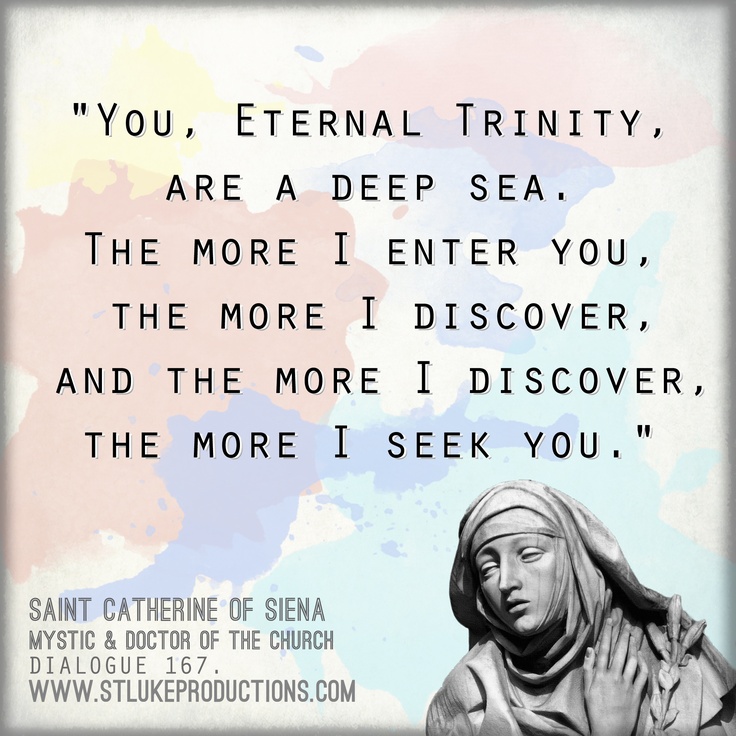
"Love follows knowledge."
"Beauty above all beauty!"
– St. Catherine of Siena

Showing posts with label Suzanne Noffke OP. Show all posts

Thursday, January 8, 2026

Redeemer in the Womb: Jesus Living in Mary by John Saward, Post #6

This is the sixth and final post on Redeemer in the Womb: Jesus Living in Mary by John Saward.

You can find Post #1 here

Post #2 here.  

Post #3 here

Post #4 here

Post #5 here


Summary

Chapter 7: The Witness of Three Women

Saward opens the chapter with this from St. Pope John Paul II:


John Paul argues that there are spiritual qualities that are peculiarly feminine. Woman, he says, in the unity of her material body and spiritual soul, is disposed by the Creator to motherhood, to the welcoming of new life. At her body’s center is a space to be occupied by another human being, a child, the fruit of married love and a gift of God. This is the physical predisposition for the spiritual receptiveness that, though often suppressed or corrupted, distinguishes the minds and hearts of women, both married and unmarried.

The chapter follows the meditations of Jesus in the womb by three women in the church: St. Catherine of Siena, St. Elizabeth of the Trinity, and the mystic Caryll Houselander.


Chapter 8: Revelation in the Womb

Saward outlines the chapter with the following:


The revelatory work of Jesus in the womb is mysterious and silent. He reveals, first of all, simply by being who he is (the eternal Son) and what he has become (true man, a real human embryo). He reveals by the miraculous manner of his conception and birth: “Such a birth befits God.” The first human person privileged to receive this revelation and ponder it in prayer is the Ever-Virgin Mother. From her it is communicated to St. Joseph, St. John the Baptist, St. Elizabeth, St. Zechariah, and so, through the Apostles and Evangelists, to the Church of every age. Our Lady’s faith in the incarnate Word has a chronological and theological priority in the history of salvation; as St. John Paul II says, she “precedes” us in faith. The believing Church first exists in her. More specifically, the Church first exists in the fiat of faith and loving obedience through which the Word took flesh and dwelt within her. Our Lady, great with child, is the image and beginning of the Church that with her “magnifies the Lord.”

The fact that Christ is hidden in the womb and then made manifest with His birth, parallels the Divine hiddenness of God and revealed in the manifestation of the Son.

###

Michelle’s Comment:

I had never heard of Caryll Houselander until reading her thoughts here, and I purchased one of her books. She had some lovely and introspective thoughts. I had highlighted this insight from her:


"In becoming a child, God the Son united himself to every child. Every little one of the human family is a reminder of the Infant God, of the divine humility the demons so despise. Every child preaches the Gospel just by being what he is. He embodies the simplicity needed for entry to heaven (see Matt. 18:3). He calls his parents out of self-absorption into self-giving."

Michael’s Reply to Michelle:

Michelle wrote: "Every child preaches the Gospel just by being what he is. He embodies the simplicity needed for entry to heaven (see Matt. 18:3). He calls his parents out of self-absorption into self-giving."

Wonderful. Thanks for sharing!

My Reply to Michelle:

Michelle wrote: "I had never heard of Caryll Houselander until reading her thoughts here, and I purchased one of her books. She had some lovely and introspective thoughts. I had highlighted this insight from her:

Oh you must read Caryll Houselander. She is a brilliant writer. I have read 
The Way of the Cross and thought it a great Lenten read. I have a review here on Goodreads if you can find it. I highly recommend it for the upcoming Lent if you're looking for a book. I don't remember it being that long. She has such mystical insights. Actually I've been thinking of picking up another one of her books.

Michelle’s Reply:

I have that one on my list and two others. I bought Little Way of the Infant Jesus and haven't been in the right frame of mind to read it yet. Good to hear that she's worth reading!

Michelle’s Comment:

In Chapter 8, this stood out to me:


"Studiousness, the humble quest for understanding, can be perverted into curiosity, the proud craving for information."


I have this fault! I can get lost down the rabbit-hole for hours looking up countries, customs, NASA, Antarctica, the Penninsula Wars, etc. I have been trying not to do this anymore. I read something St. Padre Pio once said which is inline with the above quote. Someone asked him what the gravest sins were, and he named curiosity as one of them.


Also in this chapter, I thought the comparison of the tiny Jesus in the womb beginning as a zygote to a mustard seed was very profound. He grew into the Tree of Life over all.

Michael’s Reply to Michelle:

Michelle wrote: "I have this fault! I can get lost down the rabbit-hole for hours looking up countries, customs, NASA, Antarctica, the Penninsula Wars, etc. I have been trying not to do this anymore. I read something St. Padre Pio once said which is inline with the above quote. Someone asked him what the gravest sins were, and he named curiosity as one of them."

I think curiosity, like everything else, can be good or bad, Michelle. When the Apostles tell Jesus what people are saying about him, he asks them, "Who do you say that I am?"
Perhaps this means that as long as the engine of our curiosity is God, it's good. But when curiosity leads you down the path of obscurity, it can be a bad move. Occultism, for example, is all about curiosity about magic and similar stuff.


###

My Comment:

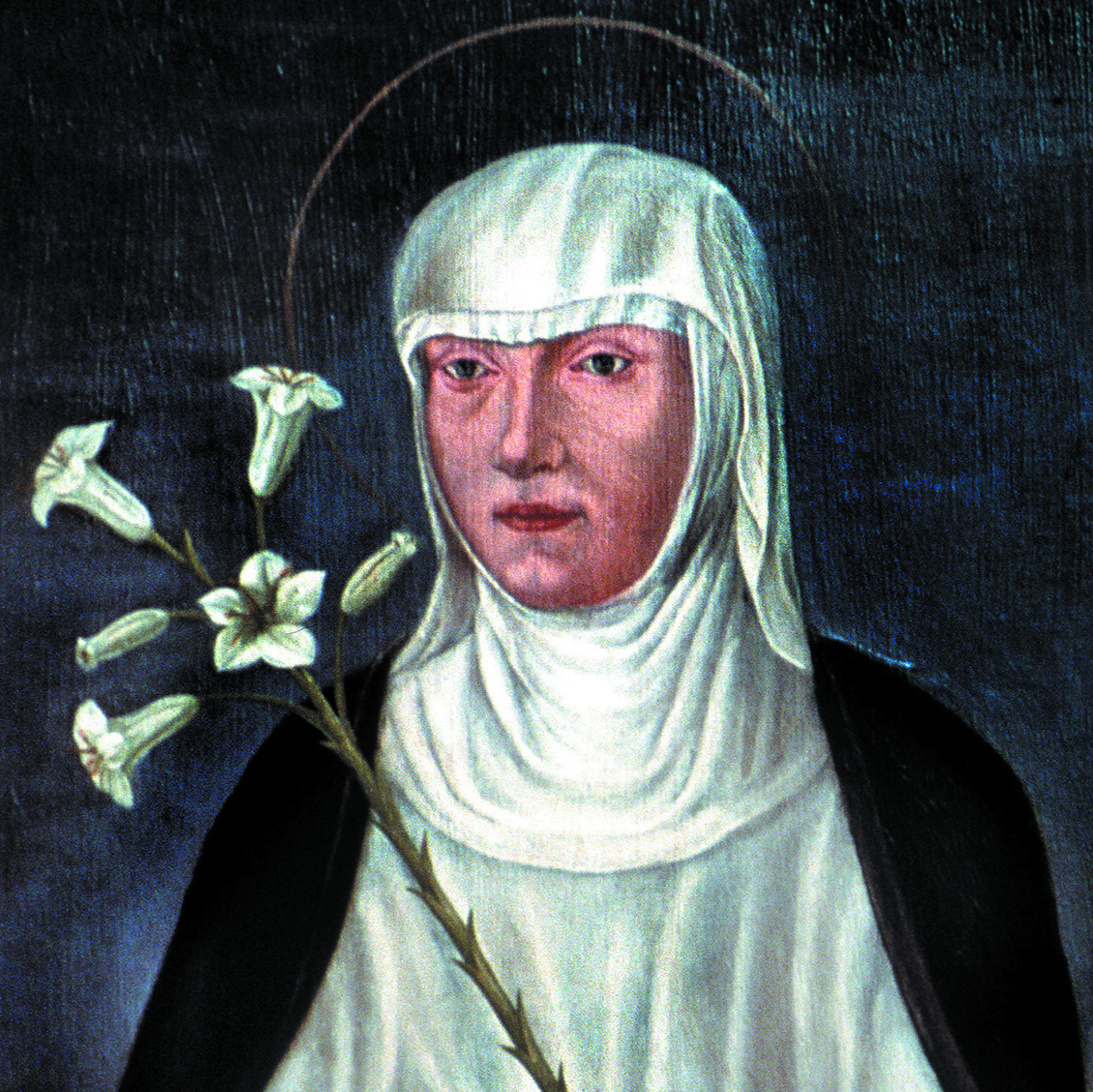
I was surprised to see Saward included St. Catherine of Siena.  As some of you may know, I consider her my patron saint.  Though she prayed to the Blessed Mother, she was not Marian centric.  She was more focused on the incarnate Christ, and I guess Christ is there in the womb.  Despite hidden in the womb, the fetus is incarnate and so is physically there. 


For St. Catherine, as much as for the early Christian author Tertullian, “the flesh is the hinge of salvation.” Her genius, says François-Marie Léthel, is “to give bodily expression to all the spiritual realities.” So, when she speaks of the Holy Spirit, and of the charity he pours into our hearts, she thinks of the fire by which he revealed himself at Pentecost. Christian ‘interiority’ is not a disincarnate abstraction but the Christian’s participation in the mysteries of the Word incarnate’s life in his Virgin Mother’s womb and of the Church’s birth from his wounded side on the cross.


Saward goes on to quote from a prayer of St. Catherine of Siena.  I’m not going to quote Saward’s quoting of the prayer, but I will quote from my edition of the collected prayers.  Saward quotes from a Cavallini translation, but I think the Suzanne Noffke translation is more to his point. 


Oh Mary, my tenderest love!  In you is written the Word from whom we have the teaching of life.  You are the tablet that sets this teaching before us.  I see that this Word, once written in you, was never without the cross of holy desire.  Even as he was conceived within you, the desire to die for the salvation of humankind was engrafted and bound into him.  (The Prayers of Catherine of Siena, 2nd Edition, Suzanne Noffke, OP, Translator and Editor, pp. 193-4)


Actually that translation came out in 2001, after Saward had published Redeemer in the Womb.  But you can see the metaphor St. Catherine uses, Mary is the book on which the Word is written.  Noffke lists that prayer as Number 18, prayed on the Feast of the Annunciation, March 25th, 1379 in Rome.  Another factoid, March 25th happened to be St. Catherine’s 32nd birthday, and she was about thirteen months from her death on April 29th, 1380. 


Saward develops further from St, Catherine’s prayer, and he concludes the meditation from St. Catherine with this observation.


St. Catherine sees Our Lady of the Annunciation as not only speaking for mankind but embodying all that is best and most beautiful in mankind, whether by nature or by grace.


I continue to find St. Catherine of Siena one of the most brilliant of persons to have lived.


###

My Comment:

I don’t know that much about St. Elizabeth of the Trinity.  I have come across excerpts of her writing as meditations in the daily readings of Magnificat.  I have been impressed and would love to explore more.  I know she had a spirituality focused on the indwelling of the Trinity.  Here is how Saward opens his section on her meditations.


The spiritual doctrine of the Dijon Carmelite St. Elizabeth of the Trinity (1880–1906) is centered on the indwelling of the Trinity in the souls of the just. She came to see the Advent Mary, the expectant Virgin, as the highest model of the contemplative, within whose heart Christ lives by grace and charity and prayer.


Then he quotes this from one of her works.


It seems to me that the attitude of the Virgin during the months between the Annunciation and the Nativity is the model for interior souls, for those whom God has chosen to live inwardly, in the depths of the unfathomable abyss.


That sounds like the central thesis of the whole book.  If one needed to summarize Redeemer in the Womb in one sentence, that’s hits it spot on.


Saward also quotes St. Elizabeth from a letter to her sister Guite.


Think what must have been going on in the Virgin’s soul after the Incarnation, when she possessed within her the Word incarnate, the Gift of God. . . . In what silence, what recollection, what adoration she must have buried herself in the depths of her soul in order to embrace this God whose Mother she was. My little Guite, he is in us. O let us stay close to him in this silence, with this love, of the Virgin. That is the way to spend Advent, isn’t it?


I think other writers have been quoted in this book as such as well: the contemplative life is an act of gestating Jesus within us just as the Blessed Mother carried Jesus for nine months.

Michelle’s Reply:

"...the contemplative life is an act of gestating Jesus within us just as the Blessed Mother carried Jesus for nine months." This is a lovely way of looking at things!

###

My Comment:

Saward ends the book on a chapter on how the hiddenness of Christ in the womb leading to His birth is a reflection of the revelation of God through Jesus Christ’s incarnation.  Saward quotes Dei Verbum from Vatican II:


Jesus Christ, the Word made flesh, sent “as man to men,” “speaks the words of God” (John 3:34) and accomplishes the saving work that the Father gave him to do (cf. John 5:36; 17:4). It was therefore he himself—to see him is to see the Father (cf. John 14:9)—who completed and perfected revelation and confirmed it by divine testimony. He did this by his whole presence and self-manifestation: by words and deeds, by signs and wonders, but especially by his death and glorious Resurrection from the dead, and finally by sending the Spirit of Truth.


Saward seems to imply that the gestation time and subsequent birth for Jesus’ birth was fitting as a process for revelation.  He also quotes St. Bernard of Clairvaux.  “He who is incomprehensible and invisible, said St. Bernard, wanted to be comprehended and seen.”  This brings Saward to a concluding statement.


The same is true of the Word’s first nine months as man. Even then, as truly as when he “preached on the mountain,” he was at the work of revelation; by the simplicity of his embryonic life, Christ revealed God.


Saward expounds the thought further, but I think that’s the gist.


###

My Comment:

I also found this passage in the final chapter beautiful.


For nine months, Mary’s faith and love are embodied in the physical and emotional experience of pregnancy. It begins, as it does for every expectant mother, with “a blind sense of touch, with the bodily sensing of a presence.” Touch, as Aristotle and St. Thomas well understood, is not a deficient form of sensation, but the foundation of all the other senses; it can even supply for sight and hearing in those born blind and deaf. The other senses operate through a medium, but touch is direct encounter. This first sensation, in which the Son of the Most High is felt deep within the Virgin Mother’s body, as he draws his bodily substance and sustenance from her, will not be cast aside but be incorporated into all her later seeing, hearing, and holding. She knows with unique authority what it means to say that “the Word was made flesh and dwelt among us.” And Our Lady’s experience is more than simply individual. It is utterly unique, yet completely Catholic: in some way, it can be shared in the communion of saints. For the sake of the whole Church, by touching the marks left by the nails and the lance, St. Thomas the Apostle, who could not at first believe, proved the bodily solidity of the risen Christ. Similarly, for us all, by her touch, Mary, who never wavered in her faith, felt within her the reality of God’s taking of flesh. The mind and heart of the Holy Virgin, while she is with Child, are the beginning and the permanent measure of the Church’s confession of the realism of the Incarnation. A Christology that does not have something of Mary’s wonder at the Verbum abbreviatum, the embryonic Word within her, is destined for Docetism, the heresy that imagines that God assumed the semblance of a human body.


The point of the last sentence is interesting.  Jesus nine months of gestation shows He was truly man, not the illusion of a man as per the Docetic heresy.  He didn’t just show up on earth one day.  One might also conclude that a natural fertilization of Mary’s egg occurred in her womb.  It wasn’t just something planted in her.


I also found in this passage the beauty in the touch that developed between mother and child during the nine months.  I’ve never obviously been pregnant with child (:-P) but I can imagine the tactile relationship was as great or if not greater than that of St. Thomas the Apostle when he put his fingers into Christ’s wounds.

###

My Comment:

Finally, Saward ends the book not with Mary, not with Jesus, but with St. Joseph who Saward feels is the vocation of every Christian, “to welcome Jesus living in Mary into our souls by faith alive with love and for their sake to welcome and keep safe every unborn human child and his mother.”  He continues:


St. Joseph was the first man to grant the Virgin Mother of God “a room in his abode.” Before ever he sought for her the hospitality of the innkeepers of Bethlehem, he took her into his own heart and home (see Matt. 1:24). He is the model of the chivalry of Catholic faith and charity. He offered a house, a roof but also a lineage, to the unborn Jesus. He gave sanctuary to God incarnate and his Ever-Virgin Mother. May St. Joseph by his prayers keep us faithful to the Gospel of Life first preached by the Redeemer in the womb.


Does this seem like a sequence of Russian nesting dolls?  Jesus inside Mary inside Joseph inside Me! 


I thought this was a marvelous advent devotional. 

Frances Comment:

Beautiful image, Manny. Thank you.


Monday, April 29, 2024

St. Catherine of Siena: Letter to a Layman

Today, April 29th, is St. Catherine of Siena’s feast day.  As you may know, she is the patron saint of this blog and my personal patron saint.

The magazine Magnificat has a meditation with today’s Mass readings by St. Catherine for her feast day.  The meditation is an excerpt of one of her letters, one of 380 letters that have survived.  The magazine does not give any details of the letter, so I looked through my volumes of her letters and after an hour of searching I found it!  The letter can be found in Volume 1 of the four volume complete collection of her letters titled, The Letters of Catherine of Siena, translated and annotated by Suzanne Noffke, O. P.  It is a magisterial collection that is a prize in my library.

So the letter is identified as T60, written in the summer of 1375 from Catherine’s stay in Pisa.  The addressee is unidentified and Sister Noffke deduces from the comments in the letter that he is a layman and a parent.  Catherine exhorts him to keep the commandments and embrace the virtues.  Her image two wings is as striking as is the image earlier in the letter of the fountain sprinkling out the blood of Jesus.  Here is the excerpt as published in Magnificat.


I long to see you a true servant of Jesus Christ, an observer of his commandments.  No one can have the life of grace who is not the keeper of those commandments….Once we see that of ourselves we are nothing at all, we are completely humbled at the knowledge of what our benefactor has done for us.  We so grow in love when we recognize God’s great goodness at work in us that we would rather die than transgress our dear Creator’s command.  This holy trembling brings us to tremendous love, a love we draw from the fountain of the blood of God’s Son, which was shed for our redemption just to wash away the guilt of sin….


I beg you then to make use of these two wings that will help you keep God’s commandments and, once you have managed the commandments, will enable you to fly into everlasting life.  The first wing is hatred and contempt for sin and for selfish self-love, the source of every vice.  The second wing is being the lover of virtue.  Once we see that virtue is essential for us, we love it; we see God wants us to be lovers of virtue and despisers of vice.  Oh how sweet it will be for you to have this virtue!  It frees you from slavery to the devil and gives you liberty, delivers you from death and gives you life, relieves you of darkness and gives you light.  Sin is just the opposite: it leads one into every sort of misery.


I beg you, for love of Christ crucified, let your soul’s eye be directed toward God in all that you do.  Oh what great joy and happiness you will feel when the time comes for you to be called by First Truth, knowing you are in company of the virtues, supported by the staff of the most holy cross from which you have learned God’s holy commandments!  And you will hear at the end those sweet words: Come, my blessed son, and possess the kingdom of heaven, because you conscientiously cast aside desire and affection for conformity to the world, and reared and nurtured your family in holy fear of me.  Now I am giving you perfect rest, for I am the one who repays you for all you have suffered for me (cf. Mt 25:34).

She ends with a quote from Matthew’s Gospel, chapter 25, where Jesus where Jesus welcomes onto the kingdom those who taken care of the least but improvises her ow theology onto it.  This is so Catherinian.  We do keep the commandments for love of God because God has done so much for us, including the shedding of the blood of His beloved Son.  And the great sin, the sin that leads to all other sins, she identifies as “self-love,” that is, selfishness.  She is just brilliant.

Happy Feast of St. Catherine of Siena.


###

Monday is my Adult Faith Formation class and we’ve been reading Sigrid Undset’s biography of St. Catherine.  I have covered this book extensively here on the blog.  Since Catherine’s feast day fell on a Monday night class, we had a little celebration.  I brought in black and white cookies, the colors of the Dominican Order.  Fr. Eugene, our pastor, had a cake ordered and we had a special writing on top of the cake. 


Beloved Catherine, I hope you’re smiling on us.  Pray for us.


Saturday, April 29, 2023

Faith Filled Friday: St. Catherine of Siena on Suffering for the Salvation of Souls

This is posted on early morning Saturday, in the wee hours and in the in-between of Friday, which is our faithful remembrance of the Lord’s suffering, and of Saturday, which is April 29th, the feast day of my beloved patroness, and the patroness of this blog, St. Catherine of Siena.  


Painting above is titled, Saint Catherine of Siena and the Beggar by Giovanni di Paolo. You can read about the painting here.  

In the past to commemorate St. Catherine’s feast day I have posted an excerpt from one of her many letters or perhaps a poem prayer she wrote.  But I have never posted an excerpt from her single great book titled, The Dialogue.  The book was initially dictated while Catherine was in a state of mystical ecstasy, but she did attempt to edit herself the writing.  The dialogue is between herself and God the Father, a conversation mostly on truth and love.  The book is the most complex expression of Catherine’s thought, touching on all aspects of Christian faith, from commonplace morality to mystical exchange with the divine.  Indeed, the difficulties I think that some find with the book is that Catherine at times reaches for language to describe a transcendent experience that cannot really be described. 

I excerpt chapter 5, a short two paragraph chapter where the voice is of God the Father responding to Catherine’s wish to take on suffering for the salvation of others.  The salvation of souls was always a deep concern for Catherine.  She felt real horror and pity thinking that some, even though evil, would be damned to hell.  Here is God’s response.


The willing desire to suffer every pain and hardship even to the point of death for the salvation of souls is very pleasing to me.  The more you bear, the more you show your love for me.  In loving me you come to know more of my truth, and the more you know, the more intolerable pain and sorrow you will feel when I am offended.


You asked for suffering, and you asked me to punish you for the sins of others.  What you were not aware of was that you were, in effect, asking for love and light and knowledge of the truth.  For I have already told you that suffering and sorrow increase in proportion to love: When love grows, so does sorrow.  So I say to you: Ask and it shall be given to you.  I will not say no to anyone who asks in truth.  Consider that the soul’s love in divine charity is so joined with perfect patience that the one cannot leave without the other.  The soul, therefore, who chooses to love me must also choose to suffer for me anything at all that I give her.  Patience is not proved except in suffering, and patience is one with charity, as has been said.  Endure courageously, then.  Otherwise you will not show yourself to be—nor will you be—faithful spouses and children of my Truth, nor will you show that your delight is in my honor and in the salvation of souls.  (p. 33)

There are parts of this that I do not fully understand.  For instance, I don’t quite know in a full way how “divine charity is joined with perfect patience.”  I don’t think I really know what perfect patience is.  But I do understand how the desire and request to take on suffering leads to an enlightenment, and in that desire is love of God and neighbor.  With love comes suffering, even with love of God.  I pray for the salvation of all souls. 

I quote from The Catherine of Siena: The Dialogue edition, translated and with an Introduction by Suzanne Noffke, O.P. copyright 1980 by Paulist Press, Inc.  If you have a desire to read it, do not get any other translation but the Noffke translation.  The others you will find are poorly translated and poorly abridged.  It took the Noffke translation to make Catherine’s book readable and coherent in English. 

Friday, April 29, 2022

Faith Filled Friday: St. Catherine of Siena’s Letter to the Queen of Naples

Today, April 29th, is the feast day of St. Catherine of Siena, patron saint of this blog and my personal patron, as many of you know.  In honor of this day I want to go through one of her letters, a letter to Giovanna d’Angiò, also known as Joanna I of Naples, the queen of Naples in Catherine’s day.  This letter is remarkable for several reasons, which I’ll get to. 


First some context.  Suzanne Noffke in her editing of The Letters of Catherine of Siena provides this biographical note about Queen Joanna:


GIOVANNA D’ANGIÒ (Jeanne d’Angou): Letters T133, T138, T143, T312, T317, T348, T362.

Great-granddaughter of Charles Martel, she became queen of Naples in 1333, when she was only seven.  She was licentious, violent, and fickle, an opportunist of the first degree.  It was she who had sold Avignon (which she owned as Countess of Provence) to the pope for a nominal sum in 1347 after convincing him of her innocence in the murder of her husband, Andrew of Hungary.  She ruled over the liveliest and most splendid court in the peninsula, and eventually sided with the Clementine cause in the schism of 1378.  Urban VI excommunicated her in 1380 and enthroned Charles of Durazzo in her place. (p. 540, The Letters of Catherine of Siena, Vol 1, 2000)

The “T133, etc” are a numbering scheme of Catherine’s letters, and it shows that Catherine sent seven letters in all to Joanna in her life.  We also see that Joanna was a very worldly woman, experienced in court intrigue going back to her childhood.  She came from a long lineage of famous aristocracy, and was a very powerful woman who had to kill off a husband in order to retain power.  She herself would later be murdered as well.  The letter we are going to examine is T143, and despite the numbering sequence, this is the second letter to Joanna.  The first letter was to ask Joanna to contribute to a crusade that Pope Gregory XI was trying to organize. 

There are six paragraphs to the letter after the heading and introduction, and I’ll number them at the beginning for clarity.  The letter was written on the fourth of August in 1375, before Catherine’s trip to Avignon to convince the Pope to move back the papal court to Rome.  Since her first letter, it seems from the language that Joanna has written back to Catherine.  The letter is also taken from Suzanne Noffke’s The Letters of Catherine of Siena, Volume 1.


To Giovanna d’Angiò, Queen of Naples

4 August 1375


In the name of Jesus Christ Crucified and of gentle Mary


Honorable and dearest mother, milady the queen,


(1) Your unworthy servant and the slave of Christ’s servants is writing to you in the precious blood of God’s Son.  I long to see you a true daughter and spouse consecrated to our dear God.  You are called daughter by First Truth because we were created by God and came forth from him.  This is what he said: “Let us make humankind in our image and likeness.”  And his creature was made his spouse when God assumed our human nature.  Oh Jesus, gentlest love, as a sign that you had espoused us you gave us the ring of your most holy and tender flesh at the time of your holy circumcision on the eighth day.  You know my reverend mother, that on the eighth just enough flesh was taken from him to make a circlet of a ring.  To give us a sure hope of payment in full he began by paying this pledge.  And we received the full payment on the wood of the most holy cross, when this Bridegroom, the spotless Lamb, poured out his blood freely from every member and with it washed away the filth and sin of humankind his spouse.

We see in the first paragraph Catherine’s humble diminution of herself, “servant” and “slave”and taking on Christ’s mantle by writing in His “precious blood.”  The blood imagery is of paramount importance to Catherine, and we’ll see it in the body of this letter. Now here’s one of the amazing things of this letter.  Catherine was a twenty-eight year old uneducated woman of no title, and yet she tells the queen “I long to see you a true daughter and spouse consecrated to our dear God.”  Who is Catherine to tell the queen she wants to see her in any manner at all?  We will see this sort of chutzpah throughout the letter. 

Now the italic writing is Noffke’s way of showing Catherine’s spontaneous breaking from addressing the letter’s recipient to addressing Christ in prayer.  “Oh Jesus, gentlest love, as a sign that you had espoused us you gave us the ring of your most holy and tender flesh at the time of your holy circumcision on the eighth day.”  Now here we get the second remarkable thing of this letter, Catherine’s imagery of ring when envisioning the snipped off flesh of Christ’s circumcision, when “on the eighth just enough flesh was taken from him to make a circlet of a ring.”  And then she calls this flesh and loss of blood an initial payment for the final payment of blood He will make on the cross.  Isn’t that unbelievably creative, to see that particular piece of flesh as a ring?  Catherine had poet’s eye for imagery and it spills over in all her writing.  Let’s continue with the letter.


(2) Notice that the fire of divine charity gave us a ring not of gold but of his own purest flesh.  This gentlest of fathers celebrated his wedding with us in a feast not of animal flesh but of his own precious body.  This food is Lamb, roasted over the fire of charity on a wood of the sweet cross.  So I beg you most courteously in Christ Jesus to lift up your heart and soul with all your affection, energy, and caring, to love and serve so gentle and dear a Father and Spouse as God, high eternal Truth, who tenderly loved us without being loved.

Here she continued with the ring imagery, the wedding imagery, the crucified Christ imagery, and her exhortation for the queen to be holy. 


(3) Let no one then, nor any status or grandeur, any power or other human glory (all of which are empty and vanish like the wind) lure us away from this true love, our soul’s life and glory and happiness.  So will we show that we are faithful spouses.  And when we love no one other than our Creator and desire nothing apart from him, then everything we love and everything we do is for him.  Whatever we see to be outside his will—vice and sin, all injustice and every other wrong—we hate so much that, because of the holy hatred we have conceived against sin, we would sooner die than break faith with our eternal Spouse.  Let us, oh let us be faithful, following in the footsteps of Christ crucified, scorning vice and embracing virtue, undertaking and accomplishing for him every great deed!

Now here’s the third remarkable moment in the letter, telling the queen not to seek status, grandeur, power, or glory!  This is Queen Giovanna d’Angiò she is writing to.  Catherine may not know the queen’s full history, but she must know the queen has a reputation of seeking power.  Or perhaps not.  Now here’s another bit of irony, telling this queen they should be “faithful spouses” of Christ.  Giovanna will be married four times and one of her husbands she had killed off.


(4) I want you to know, my reverend lady, that my soul is jubilantly happy after receiving your letter.  It gave me great consolation because, it seems to me, you have a holy and wholesome readiness to give both your possessions and your life for the glory of the name of Christ crucified.  You can show no greater sacrifice or love than to be ready to give even your life, if necessary, for him.  Oh what a great joy it will be to see you giving blood for blood!  May I see the fire of holy desire so growing in you at the resemblance of the blood of God’s Son that you may be leader and patroness of this holy crusade just as you bear the title of the queen of Jerusalem.  Thus the holy place will no longer be held by these evil unbelievers but honorably possessed by Christians, and by you as something of your own.

Now in the fourth paragraph Catherine finally gets to the point of the letter.  She is responding with gratitude in what seems the queen’s letter back from Catherine’s request to contribute to the crusade was in the affirmative.  And then Catherine prays that the queen will be the leader of the crusade to take back what she thinks is Joanna’s rightful title of Queen of Jerusalem.  Now she cannot be alluding to Joanna as another Joan of Arc, who was not born for another 37 years.  But it does seem to give imagery of Joanna off to battle in a suit of armor.  I’ll just provide the last two paragraghs:


(5) I want you to know that the holy father wants this very badly.  So I would like you to show your good will (which the Holy Spirit has put into your soul) by sending him word of it to even further increase his desire.  I would like you to ask to make this holy crusade—you in particular, and all the other Christians who might want to join you.  For it would stand up and declare your willingness to do this, and if you put your holy resolution into action, you will find Christians very willing to follow you.  I beg you for love of Christ crucified to be zealous about this.  And I, as far as my weakness allows me, shall pray God’s supreme eternal goodness to give you clear guidance in this and all your good works, and to increase in you desire upon desire.


(6) Ablaze with the fire of love may you go forward from your reign in this poor fleeting life to that eternal city of Jerusalem, the vision of peace, where divine mercy will make us all kings and queens, lords and ladies.  There he who in his tender love helps us carry every load will himself reward our every effort.

            Keep living in God’s holy love.

            Jesus!  Jesus!  Jesus!

                                                                                    Done on the fourth day of August.

I love the passion of Catherine’s exhortations.  Unlike the queen she has a simple innocence.  The future letter will not have Catherine speaking so reverently to the queen.  In 1378 the Church experienced the Great Western Schism, and Catherine and the Queen fell on opposite sides of the issue.  Indeed, Queen Joanna would be excommunicated for her support of the schismatic pope.  Catherine would not be pleased with the queen.  I wrote about this later interaction when I discussed Catherine's biography.  

I pray that all who read this receive God’s blessing on St. Catherine’s feast day.


Thursday, April 29, 2021

St. Catherine of Siena, Being One with God’s Will

Today, April 29th is St. Catherine of Siena’s feast day.  She is the patron saint of this blog and one of my personal patron saints.  I try to honor this day every year.

Last year on this date I mentioned acquiring three of the four volumes of her annotated Letters.  Just as last year I want to highlight a particular letter in honor of this day.

Letter T41/G105/DT3, from The Letters of Catherine of Siena, Volume 1, Translated and Annotated by Suzanne Noffke, O.P., Arizona Center for Medieval and Renaissance Studies, Tempe, Arizona, 2000.

To Frate Tommaso dalla Fonte, in San Quirico.  Noffke dates this letter as before 1374 but possibly 1368, making her 21 years old, and a year after she famously exited her self-imposed cell.  Tommaso is her cousin who as a child came to live at Catherine’s household, and so they grew up as siblings.  Tammaso has become a Dominican friar and priest at the time of this letter, and is living away from Siena in San Quirico.  I’m going to take one key paragraph from this letter which is thick with Catherine’s theology.


Dearest Father, I beg you to fulfill my longing to see you united with and transformed in God.  But this is impossible unless we are one with his will.  Oh sweet eternal will, to have taught us how to discover your holy will!  If we were to ask that gentlest most loving young man and most merciful father, this is how he would answer us: “Dearest children, if you wish to discover and experience the effects of my will, dwell within the cell of your soul.”  This cell is a well in which there is earth as well as water.  In the earth we recognize our own poverty: we see that we are not.  For we are not.  We see that our being is from God.  Oh ineffable blazing charity!  I see next as we discover the earth we get to the living water, the very core of the knowledge of God’s true and gentle will which desires nothing else but that we be made holy.  So let us enter into the depths of that well.  For if we dwell there, we will necessarily come to know both ourselves and God’s goodness.  In recognizing that we are nothing we humble ourselves.  And in humbling ourselves we enter that flaming, consumed heart, opened up like a window without shutters, never to be closed.  As we focus there the eye of the free will God has given us, we see and know that his will has become nothing other than our sanctification.

I am always amazed at how a young uneducated girl could reach such heights of theological reasoning.  I am also amazed at how she as a twenty-one year old has the chutzpah to instruct an educated priest.  First she implores the friar to holiness by uniting his will with that of God.  And then she has a rhetorical flourish by switching perspective and offering advice on how to do so by speaking through the voice of God: “Dearest children, if you wish to discover and experience the effects of my will, dwell within the cell of your soul.”  Here she speaks of her concept of the soul as a “cell” from which you can reach God.  Then she uses the metaphor of a well to explain the cell.  It contains earth, which is our poor humanity, but deeper one reaches a spring of water, where we reach God.  Of course there is the Biblical allusion there of the woman at the well in John’s Gospel. 


There are a couple of other concepts in that short paragraph.  She says in recognizing our poverty in the earth that “we see that we are not.”  Noffke annotates this as an early expression of Catherine’s future, more developed thought that “God is, and we are not.”  It is the realization that God creates us and maintains our existence through His will, and that our will has nothing to do with our existence. 

In realizing this poverty of humanity, we humble ourselves before God.  And in this humility we are able to enter into Christ: “we enter that flaming, consumed heart, opened up like a window without shutters, never to be closed.”  Noffke’s note here is that Catherine is alluding to Christ as the door, taken from a Sermon from St. Augustine of Hippo, “the entrance opened for you when his side was pierced with a lance” (Sermones CCCXI, Chapter III).  Catherine could be alluding to St. Augustine, but I find it hard to believe she read it.  The open hole in Christ’s side is an image she could have picked up anywhere.  Nonetheless, this is a remarkable passage of profound theological insight.

So go deep into the well of your soul and find God’s will.  St. Catherine of Siena, pray for us.