This
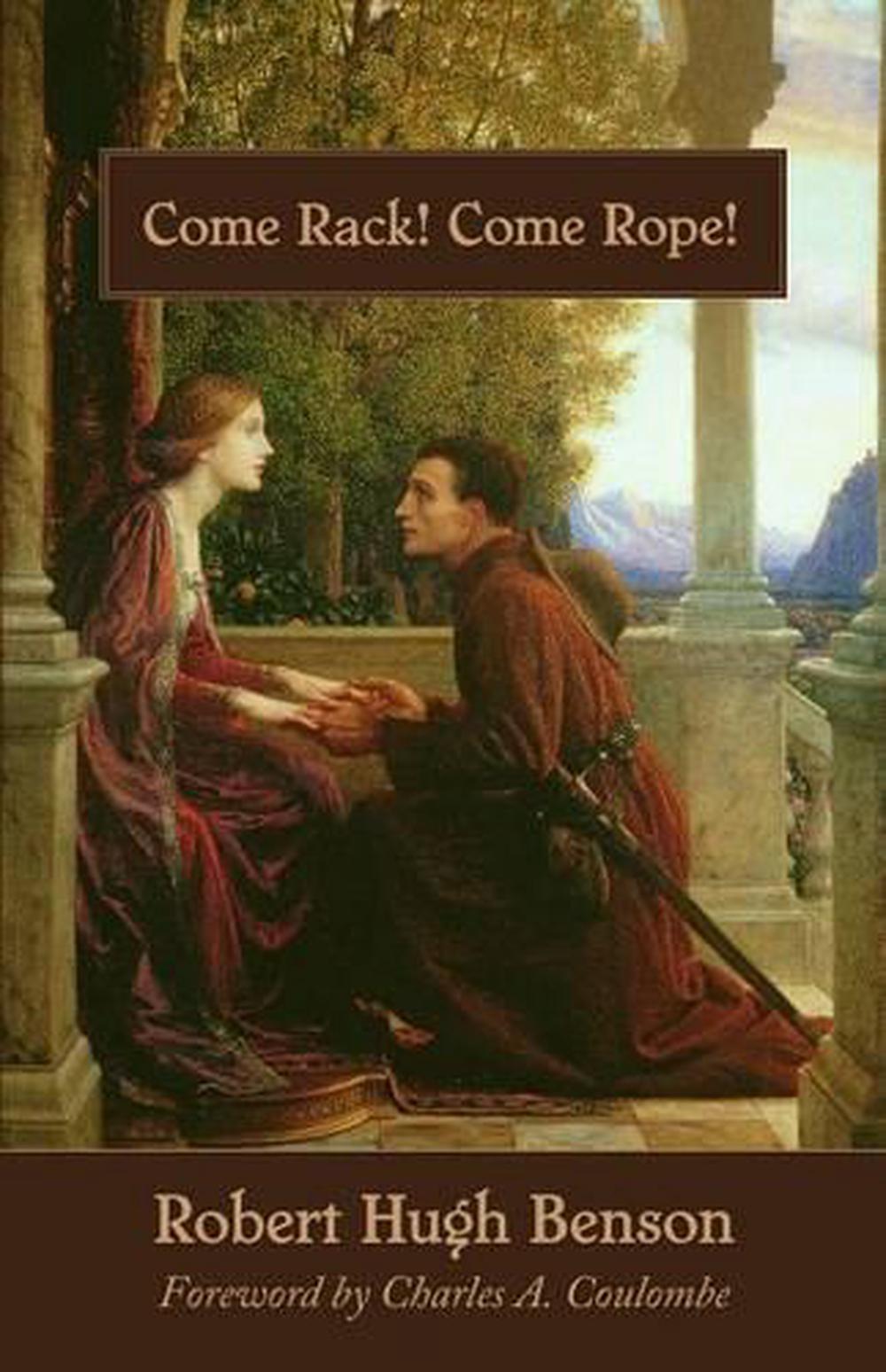
is second post of a series on the historical novel Come Rack! Come Rope! by Robert Hugh Benson.
You
can find Post #1 here.
Part
1, Chapters 1 thru 4
Summary
We
meet the Robin Audrey and Marjorie Manners, two seventeen year old Catholics
who are in love and have secretly sworn to marry. Robin tells her that his father, frustrated
with the taxes and difficulties and harassment of keeping Catholic, has decided
to turn Protestant. It was a shock to
both, and they decide that if he does Robin is to quietly go away. Robin goes away with Marjorie’s gift of a
rosary and meets Anthony Babington, one year older than Robin, and passionate
about his Catholic faith. Babington
seems to understand the politics that has circled around the Catholic
oppression. Robin, with “black shame,”
tells Babington that his father intends to leave the Church.
On
the next day, Robin on his way to Babington’s house meets a number of people
who are also to meet with Anthony. They
meet with a secret priest. When Robin
returns home and his father and mentions of a Mass to be celebrated, his father
asks where the Mass will be said, Robin refuses to tell him, and coldness comes
between the two.
A
few days later, his father confronts Robin at dinner. An argument ensues because Robin has refused
to be open to his father. The argument
escalates into a verbal confrontation, Robin admitting he loves Marjorie and
that he told her of his plans to turn Protestant. Ashamed at confronting his father, Robin
leaves a note of apology.
Robin
meets with his Catholic friends again. He
returns to find the note crumbled and tossed.
He meets with Marjorie. He tells
her what has happened between him and his father. He tells her about the traveling priest. It seems a person who is a fine horseman and
knows the area would be best suited to be priest. Marjorie intimates of a coming sorrow and
holds Robin close.
###
Joseph
Commented:
I really enjoyed these
opening chapters. We quite often read about the immediate back and forth under
Henry VIII, Edward V, and Mary I but outside of knowing that Catholicism was
illegal under Elizabeth I we don't usually read much about the persecutions. A
few years ago I was game master for the Solomon Kane RPG and I tried to work
some of this history into the play, but Robert E. Howard didn't discuss it much
in his original stories so it's not well fleshed out in the setting itself even
though the stories take place about the same time as this.
My
Reply to Joseph:
Yes, I particularly
enjoyed the scenic descriptions. I went back to my comments on our first novel
of Benson's we read, Lord of the World, and I particularly highlighted how good
Benson was at drawing scenes and describing narrative. I did say his drawing of
characters was a bit two dimensional, and while it is too early in the novel to
tell I get the same impression. For instance, Robin's father's anger and
confrontation seems a bit too out of nowhere. Here is a loving father of
seventeen years and a good Catholic for all his life and he turns from Dr.
Jeckyll to Mr. Hyde rather suddenly. There's no sense of depth to his flip, no
compunction of his reaction to his son. But I'm being picayune. It's enjoyable.
Joseph
Replied:
I would quibble with that
as the first couple of chapters point out that the families have been selling
off their estates in order to pay the penalty for not attending Anglican
services. They're out in Derbyshire so their income is entirely from the rents
paid by the farmers on their estates so we're talking about a few, small
farming villages. If there are a couple of years of poor harvests then that
income is going to take a major hit and it sounds like the penalties for land
owners were pretty steep though I would need to do more research to be sure.
My
Reply to Joseph:
I wasn't criticizing the
fact that he intends to convert - I understand that - but that there is no
regret and that he has a total lack of understanding it seems for Robin
refusing to follow in his conversion. If money were the sole reason for
converting, then you would expect a person to have a sense of sadness over it
all and he would have some empathy for Robin. If not empathy, at least
understanding.
###
I
did get lost with some of the characters we meet in the scenes away from
Robin’s home or his time with Marjorie.
I’m going to list them, and where I can give a one line summary of who
they are I will. On those I can’t, see
if you can help out and provide that one line summary. I would like to keep a running list of the
characters.
Mr.
Barton – Protestant minister
Thomas
FitzHerbert - ?
Anthony
Babington – Young, Catholic man involved in the Catholic/Protestant politics.
John
Merton – Owner of a farm in Dethick; Catholic.
Mr.
Thomas – Is that the same person as Thomas FitzHerbeert?
Mistress
Westley – Mr. Thomas’s wife.
Mr.
Fenton - ?
Mr.
Bassett - ?
Mr.
Garlick - ?
Mr.
Simpson – Secret Catholic priest.
Cuthbert
Maine – Recently executed Catholic priest.
Dick
Sampson - ?
John
FitzHerbert – Thomas’s father.
Mr.
Nelson - ?
Mr.
Ludlam - ?
That’s
all I can find for now. Were there
others? Strange, I could not find
Robin’s father’s first name. Did I miss
it?
###
Peej
reminded me that I wanted to mention Shakespeare, in a historical context
rather than literary. These early scenes
are set I think in the 1580s. Has anyone
pinpointed a date or a marker that would indicate a rough time frame? Shakespeare was born in 1564 and did in
1616. His life overlaps the novel’s
setting. He would have been sixteen in
1580 and twenty-three in 1587 when Mary Queen of Scots was executed. He was born and raised in Stratford-upon-Avon,
which is about an hour’s drive south from Derbyshire where these early scenes
take place. This was the heart of the
Catholic resistance, and Shakespeare lived through it, and I am convinced was a
Catholic himself. Whether he actively
participated in the resistance is hard to tell.
So much of his personal life is unknown.
There is no question that in his plays he frequently ridicules the
Puritans and there are a number of sympathies to Catholic or Catholic
themes. The fact that so many of his
plays are set in Italy and France is startling when you think of the
international politics going on. The
fact that his histories glorify a pre-Protestant England is also telling. But it’s more than this. He had family members, including his in-laws,
who were known recusants. The fact that
as a playwright in England there is no record of him attending Anglican
services is noticeable. Shakespeare’s
daughter Susanna married a recusant. His
father left a last will and testimony proclaiming he was Catholic. While there is no smoking gun evidence that
Shakespeare himself was Catholic, there is no smoking gun evidence he was not,
and there are just too many connections to Catholics and Catholicism for it to
not be so. A book that pulls this all
together, and which I highly recommend, is Joseph Pearce’s The Quest for Shakespeare. It is a great read and might be a nice
complement to this novel.
Joseph
Pearce summarizes the case for Shakespeare's Catholicism in this National Catholic Register article.
###
Frances
Commented:
This is a book I have
only heard of, not read: Will in the World: How Shakespeare Became Shakespeare,
by Harvard professor Stephen Greenblatt. In one fascinating chapter, Greenblatt
imagines that young Shakespeare met Edmund Campion (martyred in 1581). Is
anyone in our group familiar with the book?
My
Reply to Frances:
I have not Frances. I
have yet to find a book on Shakespeare that address the strong possibility of
his Catholicism. It's as if they don't want to admit it because a heck of a lot
of literary understanding of his plays would go out the window. For instance
there are Catholic readings of King Lear and Hamlet which flies in the face of
the existential, skeptical readings of those plays that has dominated secular
criticism for the past hundred plus years. A lot of modern readings of his
plays should go out the window. If the Greenblatt book addresses Shakespeare's
Catholicism, then I might pick it up. Otherwise I'm done with secular
misreadings of Shakespeare.
Frances
Replied:
I haven’t read it, Manny.
This week I did some reading about it. The NYTimes reviewer seems to conclude
that speculation about Shakespeare’s religion is just that—speculation. I went
to Amazon and read reviews of the book, made by people who thave read it.
They’re very interesting reading; Shakespeare always seems to elude us, though.
References to a meeting
between S. And Edmund Campion appear in several places in addition to Will in
the World, but not — at least from what I read — definitively. One Jesuit who
does stand out as a direct influence on Shakespeare was a surprise to me:
Robert Southwell, also martyred. I have to go back and look but in one place I
read direct comparisons between Southwell’s writing and scenes in King Lear.
I’m sorry not to be of
more help. Joseph has read Will in the World. He’d undoubtedly be a better
person to ask. What I find most interesting are the many mentions of Catholic
influence on Shakespeare in a number of scholarly works.
I discovered this today:
in the February 21, 2021 issue of The Catholic World Report (online), Joseph
Pearce gives a striking interview concerning Robert Southwell and Shakespeare.
Southwell, although he’s recognized as a Jesuit martyr, isn’t recognized nearly
enough for the brilliant poet he was. And he died at age 33.
Why not look at the
reviews of Greenblatt’s book and see what you think?
My
Reply to Frances:
Frances, do yourself a
favor, read Joseph Pearce's The Quest for
Shakespeare. Look at all the evidence from a Catholic's perspective. And by
that, I mean by a perspective that has not been tainted by secularist and/or
anti Catholic bias. Not only that, you will love the book.
Frances, that is an
excellent article. I highly recommend reading it. It really does pertain to our
Come Rack! Come Rope! read in that it sketches the life of the secret priests
in the day and of what hung, drawn, and quartered actually was. Here is a link
to the article.
###
Robert
Hugh Benson is such a fine writer of prose.
I want to present a lovely written
passage in each of the sections that we fragment for our reading
purposes. In chapter two, I was struck
by this passage as Robin goes to Dethick, John Merton’s estate. Here has dinner with Merton, Anthony
Babington, and Thomas FitzHerbert, key members of the local Catholic families.
It was a great day for a
yeoman when three gentlemen should take their dinners in his house; and the
place was in a respectful uproar. From the kitchen vent went up a pillar of
smoke, and through its door, in and out continually, fled maids with dishes.
The yeoman himself, John Merton, a dried-looking, lean man, stood cap in hand
to meet the gentlemen; and his wife, crimson-faced from the fire, peeped and
smiled from the open door of the living-room that gave immediately upon the
yard. For these gentlemen were from three of the principal estates here about.
The Babingtons had their country house at Dethick and their town house in
Derby; the Audreys owned a matter of fifteen hundred acres at least all about
Matstead; and the FitzHerberts, it was said, scarcely knew themselves all that
they owned, or rather all that had been theirs until the Queen’s Grace had
begun to strip them of it little by little on account of their faith. The two
Padleys, at least, were theirs, besides their principal house at Norbury; and
now that Sir Thomas was in the Fleet Prison for his religion, young Mr. Thomas,
his heir, was of more account than ever.
(p. 22)
Not
only is that lovely but I think it fills in the novel’s key characters. The Catholic characters come from rural
families who own a good deal of property, and have a lot to lose by refusing to
join the Protestant supremacy.
###
Part
1, Chapters 5 thru 9
Summary
Marjorie’s
parents learn of Robin and Marjorie’s love and intent to marry, and they learn
of Robin’s father’s intent to apostasy.
When Mr. Manners questions Marjorie, the daughter confesses but insists
that Robin may not ask her to marry despite his love, and this confuses the
parents. Marjorie doesn’t tell them that
she fears Robin will become a priest instead.
On
Easter Sunday we see Mr. Audrey attend the Protestant services and partake of
Protestant communion. He is picked up by
his servant Dick and brought back home, where the rest of the servants notice a
difference in their master.
At
the same time the Catholic Easter services take place at Padley, where an
Easter Mass is celebrated by Mr. Simpson.
In attendance are all the Catholic families and their servants. Robin and Marjorie have time after the Mass
to speak privately where Robin reveals he has not made up his mind about the
priesthood. Robin gets angry when he
suspects Marjorie is pushing him away, though it’s more a reaction to the
stress than to really believing Marjorie wants him gone. He apologizes.
Mr.
Simpson, the priest, reads a letter from a friend who witnessed the execution
of two Catholics in London by being hung, drawn, and quartered. One was a priest, which was sad but not
surprising, and the other was a layman which surprised and sent shivers down
the congregation. It seems as if the
persecution of Catholics had returned.
Queen Elizabeth had not initially returned to the persecutions that were
common under Henry VIII, but now it seemed circumstances had changed.
A
week later Robin returns home where another confrontation with his father takes
place. Babington tells Robin of Mr.
Audrey’s anger beforehand. The father’s
verbal attack then on Robin is merciless, belying any fatherly love for his
son. The father refuses to pay the
Catholic tax the son would owe and gives him until Pentecost to leave. In a dream, Robin receives a singular grace
to be a priest and accepts it and wakes his father to tell him and that he is
leaving for Rheims.
That
same night, Marjorie also has a grace, an insight that Robin has chosen the
priesthood. She wakes her mother to tell
her, and she cries at her feet. Two days
later Robin rides to Marjorie to tell her.
On telling her, it puts an end to their relationship. He kisses her goodbye.
###
Kerstin
Commented:
So far the focus hasn't
been on Mr. Audrey's inner struggle to become Protestant. Aside from the
hardships, which were not inconsiderable, how did the average person deal with
all the changes that shook a person's very core? Fr. Benson touches on this when
he attends Easter services:
Yet here he sat—a man
feared and even loved by some—the first of his line to yield to circumstance,
and to make peace with his times. Not a man of all who looked on him believed
him certainly to be that which his actions professed him to be; some doubted,
especially those who themselves inclined to the old ways or secretly followed
them; and the hearts of these grew sick as they watched.
Here is the scene when
Mr. Audrey takes the Protestant communion. He seems a bit hesitant at first,
but then stoically and quickly, as if to get it over with, takes it. What is
remarkable here, is that the pastor, Mr. Barton, hesitates before offering the
bread and cup. With everyone watching, it seems everyone present knows what is
happening here is just an imitation, done for theatric's skake.
For a moment the minister
stood before the seat, as if doubtful what to do. He held the plate in his left
hand and a fragment of bread in his fingers. Then, as he began the words he had
to say, one thing at least the people saw, and that was that a great flush dyed
the old man's face, though he sat quiet. Then, as the minister held out the
bread, the squire seemed to recover himself; he put out his fingers quickly,
took the bread sharply and put it into his mouth; and so sat again, until the
minister brought the cup; and this, too, he drank of quickly, and gave it back.
Then, as the communicants, one by one, took the bread and wine and went back to
their seats, man after man glanced up at the squire. But the squire sat there,
motionless and upright, like a figure cut of stone.
I wonder if Mr. Audrey's
abrupt manner isn't just a cover to hide the immense tension he is buckling
under. A person doesn't do an about-face like this out of nowhere. Perhaps he
pushes Robin so relentlessly so as to gain an ally, that his apostasy isn't as
glaring to the life-long friends he is turning his back to.
My
Reply to Kerstin:
Good observation Kerstin.
It's hard to say what Benson is trying to convey about Audrey. I could read his
hesitation as habit being tough to overcome, but his desire to join the
Protestants is there. There is nothing in all the scenes where we have seen
Audrey that he in any way has qualms about his apostasy. If anything he is
bullheaded about it, so bullheaded that he doesn't seem to mind the loss of his
son.
The drawing of Audrey's
character is the one aspect of the novel I think weak.
###
For
this section of chapters, I want to highlight the Easter Mass, which ends
chapter seven. It certainly contrasts
with the Protestant Easter service from the chapter before, but I think more
importantly it coordinates with the novel’s themes. Pay attention to the priest’s homily. Whenever you get a sermon in literature, it
almost always echoes the themes in some way.
It was a strange and an
inspiriting sight that the young priest (for it was Mr. Simpson who was saying
the mass) looked upon as he turned round after the gospel to make his little
sermon. From end to end the tiny chapel was full, packed so that few could
kneel and none sit down. The two doors were open, and here two faces peered in;
and behind, rank after rank down the steps and along the little passage, the
folk stood or knelt, out of sight of both priest and altar, and almost out of
sound. The sanctuary was full of children—whose round-eyed, solemn faces looked
up at him—children who knew little or nothing of what was passing, except that
they were there to worship God, but who, for all that, received impressions and
associations that could never thereafter wholly leave them. The chapel was
still completely dark, for the faint light of dawn was excluded by the heavy
hangings over the windows; and there was but the light of the two tapers to
show the people to one another and the priest to them all.
It was an inspiriting
sight to him then—and one which well rewarded him for his labours, since there
was not a class from gentlemen to labourers who was not represented there. The
FitzHerberts, the Babingtons, the Fentons—these, with their servants and
guests, accounted for perhaps half of the folk. From the shadow by the door
peeped out the faces of John Merton and his wife and son; beneath the window
was the solemn face of Mr. Manners the lawyer, with his daughter beside him,
Robin Audrey beside her, and Dick his servant behind him. Surely, thought the
young priest, the Faith could not be in its final decay, with such a gathering
as this.
His little sermon was
plain enough for the most foolish there. He spoke of Christ’s Resurrection; of
how death had no power to hold Him, nor pains nor prison to detain Him; and he
spoke, too, of that mystical life of His which He yet lived in His body, which
was the Church; of how Death, too, stretched forth his hands against Him there,
and yet had no more force to hold Him than in His natural life lived on earth
near sixteen hundred years ago; how a Resurrection awaited Him here in England
as in Jerusalem, if His friends would be constant and courageous, not
faithless, but believing.
“Even here,” he said, “in
this upper chamber, where we are gathered for fear of the Jews, comes Jesus and
stands in the midst, the doors being shut. Upon this altar He will be
presently, the Lamb slain yet the Lamb victorious, to give us all that peace
which the world can neither give nor take away.”
And he added a few words
of exhortation and encouragement, bidding them fear nothing whatever might come
upon them in the future; to hold fast to the faith once delivered to the
saints, and so to attain the heavenly crown. He was not eloquent, for he was
but a young man newly come from college, with no great gifts. Yet not a soul
there looked upon him, on his innocent, wondering eyes and his quivering lips,
but was moved by what he saw and heard.
The priest signed himself
with the cross, and turned again to continue the mass.
Aeterna Press. Kindle Edition. (pp. 67-68)
###
Kerstin
Comment:
There is another aspect
that is worth looking into, which I find we don’t do often enough when reading
literature: the meaning of the names of the main protagonists.
Robin is a version of
Robert, and it means “fame” and “bright”. How this will unfold in our narrative
has yet to be revealed.
Marjorie is a version of
Margaret, and it is the Greek word for pearl. There is a lot of Christian symbolism
to unpack here.
Pearls are formed in
various species of shells and have always been very precious, as they are very
rare in nature. For pearls to form they need the shell, no shells, no pearls.
The shell is a symbol of
the Virgin Mary because she carried Jesus, the precious pearl, in her womb. So
Jesus is identified with the pearl. The shell also became a symbol of Christ’s
sepulchre and of the Resurrection in the Middle Ages. In art when Jesus gets
baptized the water is often poured from a shell. Many priests use shells during
baptisms. Baptismal fonts are often shaped in the form of a shell or have them
as ornamentation.
Jesus reminds us to
safeguard what is holy in Matthew 7:6
Do not give dogs what is
holy; and do not throw pearls before swine, lest they trample them under foot
and turn to attack you.
Dogs in Jewish culture
were largely stray scavengers, and swine considered unclean. In other words,
the Gospel should not be profaned.
Then Jesus compares the
Kingdom of God with a pearl in Matthew 13: 45-46
”Again, the kingdom of
heaven is like a merchant in search of fine pearls, who, on finding one pearl
of great value, went and sold all that he had and bought it”
And the last quote, in
Revelation 21:21 when the New Jerusalem is described,
And the twelve gates were
twelve pearls, each of the gates made of a single pearl, and the street of the
city was pure gold, transparent as glass.
Now what does it mean for
our story that Marjorie is a living pearl, what does she represent?
My
Reply to Kerstin:
That too is spot on
Kerstin. On Robin, also I think there might be an allusion to Robin Hood in
some way, though I haven't seen it yet. When I did a search, Derby is only 32
miles from Sherwood Forest