
For the Twenty-Nineth Sunday in Ordinary Time of Year A, we are still in what Dr. Nina Heereman calls the “Temple Discourse,” as I explained last week. At the Temple during Christ’s last week leading to His passion, He comes in direct confrontation with the Jewish leaders. In today’s passage the Jewish groups of the Pharisees and the Herodians try to lay a trap for Jesus.
This passage is well-known for Christ’s saying of giving unto Caesar what is Caesar’s and onto God what is God’s, but what I find fascinating, and perhaps less mentioned is how the Pharisees deviously egg Jesus into being as frank as possible. They tell Him He is a “truthful man.” The irony is Jesus is the Truth, the Truth with a capital “T.” Buttering Him up is a means of getting Him to answer their question.
And He will answer their question, and He will answer it with Truth but it is not as the Pharisee’s expected. Jesus will have none of it. He calls them hypocrites to their face.
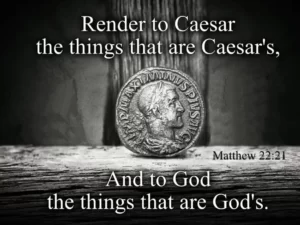
The key to this passage is not so much the implied division of church and state from Jesus’s answer, but the play on the word “image”: the image of Caesar versus the image of God in which humanity was made in.
Today’s Gospel:
The Pharisees went off
and plotted how they might entrap Jesus in speech.
They sent their disciples to him, with the Herodians, saying,
"Teacher, we know that you are a truthful man
and that you teach the way of God in accordance with the truth.
And you are not concerned with anyone's opinion,
for you do not regard a person's status.
Tell us, then, what is your opinion:
Is it lawful to pay the census tax to Caesar or not?"
Knowing their malice, Jesus said,
"Why are you testing me, you hypocrites?
Show me the coin that pays the census tax."
Then they handed him the Roman coin.
He said to them, "Whose image is this and whose inscription?"
They replied, "Caesar's."
At that he said to them,
"Then repay to Caesar what belongs to Caesar
and to God what belongs to God."
~Mt: 22:15-21
I’m returning to Archbishop Edward J. Weisenburger from the diocese of
Detroit for the exegetical homily.
Archbishop Weisenburger:
Now, recall that
there were three taxes for the Jews of Jesus' day. First, an income tax, about
1% of your annual income. Second, a 10% tax on grain and grapes used for wine, but
then a third tax that was the same for every adult Jewish citizen, roughly the
equivalent of a day's wage. That third tax historically began as a way to
rebuild the Great Temple in Jerusalem, but when the Roman armies overtook and
occupied Palestine during Jesus' era, the Romans shifted this sacred temple tax
to pay for the upkeep of their own temple to the pagan gods in Rome. And thus,
you can see the crisis. Many faithful Jews saw the payment of that tax as an
evil cooperation in reusing a tax meant for the holiest of purposes instead for
something blasphemous. Notably, the Herodians quietly had no problem with it.
They were actually the ones cooperating with King Herod and the Roman
occupiers, and their cooperation with them brought them wonderful
privilege. The Pharisees, for their
part, were less open about it, but they also pretty much had free movement in
the culture, and so they may quietly have grumbled about paying that
blasphemous tax, but few took a public stance, knowing it easily could lead to
their being disappeared. And so now in
the temple precincts, these two groups try to force Jesus to either one, be a
sellout with the Romans, with overtones of blasphemy, or two, the other option,
publicly place a target on his back with the Romans.
Okay, it's at this
point that Jesus, standing on sacred temple ground, asks them to show him a
Roman coin, which of course was imprinted with the emperor's face. It also bore an inscription we know for a
fact indicating Caesar was God's "high priest." A blasphemous statement. And two, most biblical
scholars note that for a faithful Jew to simply have that coin on his person
while on holy temple ground was itself blasphemous. Which perhaps explains the reason why Jesus had
to ask someone to "show me the coin," not having one on him himself. And revealing
the Pharisees' own hypocrisy. Okay, with
that background in mind, Jesus takes the dilemma of them trying to trap him, and
as we so often see, flips it right back on their heads. The coin itself is a
blasphemous thing. Money in Jesus' day, much like our own day, technically
belonged to the government, with citizens being able to use it for
commerce. Technically, in the law, it
did belong to Caesar. So, it seems Jesus
says: give that horrible thing back to a horrible person. But if that's really
more context or background, then I think there's still a deeper meaning of the
encounter. A deeper meaning for those with the ears to hear and the eyes to
see. And that real or deeper meaning of
the encounter was the remainder of what Jesus said to them. "Give to God what belongs to God."
And to the extent that we focus too much on what the coin meant might be the
extent to which we too missed the point. Rather, Jesus' intent was the
teaching. Give to God what belongs to God.
Brothers and sisters, just as a coin in Jesus' day was stamped with an image, you and I have been created, stamped if you will, in God's image. And you and I are no investment of which he wants simply a part. He really, really wants all of us. And he wants all of you. Moreover, God calls us to recognize and reverence that image of him imprinted on every human being. And to be sure, the image has little or nothing to do with physical appearance. Being in the image of God is to reflect God's love in creative and redemptive ways…. Brothers and sisters, I pray that you will have what Jesus would call "the ears to hear, and the eyes to see." Be not like the Pharisees or Herodians, twisting religion into something self-serving with a hefty benefit of status and stature. Rather, in recognizing first and foremost in whose image you have been created, and from there recognizing that same divine imprint on every human being, your task is to find ways in life to give to God what belongs to God. Trust me, the Caesars of today can take care of themselves.
And what belongs to God? Your
worship and your service.
For the pastoral sermon (not a homily) I’m going to turn to someone new,
Susan Breton of U. S. Catholic Magazine.
Ms. Breton:
Have you ever lost
something? How did you get it back? Maybe
it was your purse, your wallet, your phone, your keys, something of sentimental
value. When someone found it, they knew
it belonged to you because there was something on it that identified it as
being yours. Your name, your picture, something that said, "This belongs
to someone." And maybe that's what we are being asked today. What Jesus is asking us, who do we belong to?
So Jesus asks for a coin. He asks whose image is this and whose inscription? And they answer Caesar. And Jesus says, then repay to Caesar what belongs to Caesar and to God what belongs to God. The word Jesus uses for image is the Greek word eikōn which means icon, image and likeness. The coin bears the icon, the image and likeness of Caesar. So Jesus is acknowledging that the coin belongs to Caesar. But Jesus's answer goes much deeper than taxes. In another place in scripture, we hear this word image. In Genesis, we hear God created human beings in his image and likeness. And in the Greek translation of Genesis, that same word icon is used, icon. The coin bear Caesar's image or icon. We bear God's image, his icon. Maybe that's the deeper question that Jesus is putting before us today. If the coin bears Caesar's image and therefore belongs to Caesar, then if we bear God's image, to whom do we belong? We belong to God.
There’s an interesting perspective. Your image stamped by God identifies you as
God’s possession!
Sunday Meditation: “Teacher,
we know that you are a truthful man."
One of my son Matthew’s favorite hymns as a child, “We Are the Light of the
World.” Here is Chris Brunelle performing.
Chorus: We Are the
light of the world, may our light shine before all, that they may see the good
that we do, and give glory to God
Vs.1
Blessed are they who
are poor in spirit, theirs is the kingdom of God. Bless us, O Lord, make us
poor in spirit
Vs. 2
Blessed are they who
are meek and humble, they will inherit the earth. Bless us, O Lord, make us
meek and humble; bless us, O Lord, our God
Vs. 3
Blessed are they who
will mourn in sorrow, they will be comforted. Bless us, O Lord, when we share
their sorrow; bless us, O Lord, our God
Vs. 4
Bless those who
hunger and thirst for justice, they will be satisfied. Bless us, O Lord, hear
our cry for justice; bless us, O Lord, our God
We, whose image is of God, are the light of the world!

No comments:
Post a Comment