"Love follows knowledge."
"Beauty above all beauty!"
– St. Catherine of Siena

Showing posts with label Magnificat Magazine. Show all posts

Sunday, January 4, 2026

Sunday Meditation: Gold, Frankincense, and Myrrh

Today is the Feast of the Epiphany of the Lord.  I’ve had a number of posts on this feast and the subject of the Magi.  You can access past posts on these subjects here.    There are posts on the significance of the Epiphany as well as to its details.  There are posts on Fr. Dwight Longenecker’s wonderful book unlocking the mystery of these wise men, The Mystery of the Magi: The Quest to Identify the Three Wise Men.   And there are analysis of poems by G.K. Chesterton and T.S. Eliot on the subject of the Magi.  All well worth exploring.

Today I would like to emphasize the gifts the Magi present infant Jesus.  It is commonly understood that the gift of gold represents Jesus’ royalty, frankincense represents his priestly office, and myrrh His sacrificial death.  Pierre-Marie Dumont in this month’s Magnificat magazine (Jan 2026, Vol. 21, No. 11, pp 6-7) proposes we offer these gifts to Jesus today in the form of spiritual gifts.  The gold we give is our love, “gold refined by the fire mentioned in the Book of Revelation (3:18).”  The frankincense we offer are our prayers “that ascend to God as a sweet-smelling offering.”  The myrrh we offer is “our communion in the Passion and death of Jesus,” consisting of our sacrifices and offerings to the Lord.  I found that beautiful.


Here is today’s Gospel reading.


When Jesus was born in Bethlehem of Judea, in the days of King Herod, behold, magi from the east arrived in Jerusalem, saying, “Where is the newborn king of the Jews?

We saw his star at its rising and have come to do him homage.”

When King Herod heard this, he was greatly troubled, and all Jerusalem with him.

Assembling all the chief priests and the scribes of the people,

He inquired of them where the Christ was to be born.

They said to him, “In Bethlehem of Judea, for thus it has been written through the prophet:

And you, Bethlehem, land of Judah, are by no means least among the rulers of Judah; since from you shall come a ruler, who is to shepherd my people Israel.”

Then Herod called the magi secretly and ascertained from them the time of the star’s appearance.

He sent them to Bethlehem and said,

“Go and search diligently for the child.

When you have found him, bring me word, that I too may go and do him homage.”

After their audience with the king they set out.

And behold, the star that they had seen at its rising preceded them, until it came and stopped over the place where the child was.

They were overjoyed at seeing the star, and on entering the house they saw the child with Mary his mother.

They prostrated themselves and did him homage.

Then they opened their treasures and offered him gifts of gold, frankincense, and myrrh.

And having been warned in a dream not to return to Herod, they departed for their country by another way..

~Mt 2:1-12


Bishop Barron explains the traditional understanding of the three gifts, but he also connects the expedition of the Magi with a search for the ultimate fulfillment which is the quest to discover God. 


What is admirable in the Magi is that they follow the sign so that the longing will be fulfilled if we move in this direction.  “We’re the three kings longing for Christ.”  That is beautiful. 

I have presented pastoral homilies by different members of the Capuchin Franciscan Friars before in their YouTube channel, “A Simple Word.”  I have never presented Fr. Christopher Gama before, and here he provides an insightful homily.


We can only find God through the virtue of humility.  “Creation points out the way, and God finishes the path.  Grace builds on nature!”  It changes us and sends us home in another way.


Sunday Meditation: “They opened their treasures and offered him gifts of gold, frankincense, and myrrh.”


Let’s end with this lovely Christmas carol perfect for the epiphany, performed by North Valley Chamber Chorale:


I love this version. 

Friday, October 11, 2024

Faith Filled Friday: Pope Pius X’s Prayer to Saint Joseph

In the devotional magazine Magnificat, Anthony Esolen has a monthly feature called Poetry of Praise where each month he analyzes a different prayer.  In the September 2024 issue he analyzed the prayer to St. Joseph composed by Pope Pius X.  Esolen selected this prayer in honor of Labor Day which occurs early in that month.  I’m not going to quote any of Esolen’s analysis—and it’s quite good and interesting—but I was so struck with the prayer that I wanted to present it to you. 


 O Glorious Saint Joseph, model of all those who are devoted to labor, obtain for me the grace to work in a spirit of penance for the expiation of my many sins; to work conscientiously, putting the call of duty above my natural inclinations; to work with thankfulness and joy, considering it an honor to employ and develop by means of labor the gifts received from God; to work with order, peace, moderation and patience, never shrinking from weariness and trials; to work above all with purity of intention and detachment from self, keeping unceasingly before my eyes death and the account that I must give of time lost, talents unused, good omitted, and vain complacency in success, so fatal to the work of God.


All for Jesus, all through Mary, all after thy example, O Patriarch, Saint Joseph. Such shall be my watch-word in life and in death. Amen.


It is also interesting the prayer calls to work with “order.”  When I was in college I had a part time job working in a supermarket in the produce department.  It was a blessing not only for the money I earned but because there were times I got to work with my Uncle Val, may he rest in peace, who also worked there.  He was a good mentor, and he taught me well.  I remember some of his principles.  One was to always to be organized.  Work like a gentleman he used to say.  This prayer captured my Uncle Val perfectly.  Thinking back, it felt like I was a child working under the tutelage of St. Joseph.  I built quite a relationship with my Uncle Val.  He became my favorite uncle.  The power of working together builds such bonds.  You might even call it a religious bond.  Uncle Valentino, I miss him so. 


I particular like the line in the prayer “to work above all with purity of intention and detachment from self.”  Besides applying that to the labor by which I earn my living, that also applies to the labor of this blog, which is sort of labor of love.  What I write here perhaps is putting into labor the “gifts received from God.”  May it be worthy of God’s trust. 

If you want it to hear prayer read, you can listen to it on this clip. 


Many people pray this prayer before starting work.  What a wonderful idea.


Friday, September 6, 2024

Faith Filled Friday: Through The Cross To The Light

As followers of this blog well know, I read the monthly magazine, Magnificat religiously.  I particularly read the Gospel readings and the meditations that go along with it.  I have highlighted several of the meditations here, but frankly in every monthly issue there are several that could be highlighted as exceptional.  Here is one from last month’s issue that’s been on my mind.

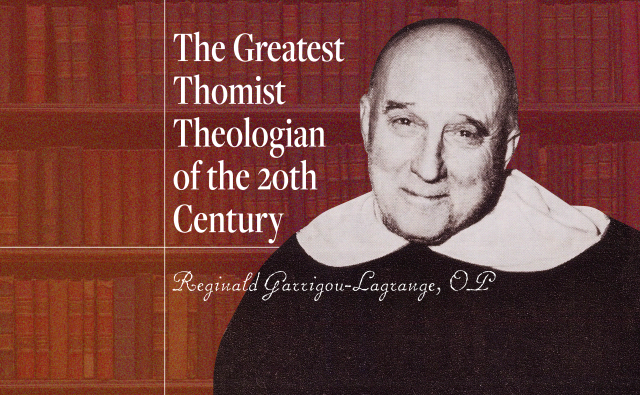
This meditation is teamed with the Gospel passage, Mt 16:13-23 where Jesus tells the disciples he must go to Jerusalem and suffer greatly.  Peter responds with “God forbid,” and Jesus tells Peter, “Get behind me Satan…you are thinking not as God does, but as human beings do.”  So the Gospel is about the need to suffer.  The meditation is taken from Fr. Réginald Garrigou-Lagrange, O.P. where he describes what our suffering does for us.


Our Lord asks us to allow him to work—to allow him to work to reproduce his image in us.  Our Lord does not ask us to love suffering in itself, but to love it as a means of salvation, just as a very bitter medicine that will give us back our health can be loved.  We are not asked to feel his love in a sensible way, but to give proof of it by persevering, despite tribulations, in the practice of our religious duties, especially prayer.  Jesus expects us to turn to him with ardent prayer, because he has already decided to hear us and to lead us much higher than we ourselves could desire.  Therefore, we should love the cross for the love of souls and gladly accept being associated with our Lord in his work of redemption.


The cross is necessary to us.  The Lord tries us only because he loves us, because he wishes to assimilate us to himself, to supernatralize our spirit, to give us more exalted knowledge of ourselves and of him, and also to give us a stronger love.  Together with humility, the cross develops in us the three virtues that are properly divine and are the heart of the Christian life: faith, hope, and charity. The cross makes our soul similar to the soul of Christ, and therefore similar to God.  Sometimes this effect of the cross is so sublime that it is reflected in the human body.  Saint Benedict Joseph Labre was passing through the streets of Rome one day when an artist, who had visited all the museums of Italy without finding what he was searching for, stopped him.  He begged the saint to follow him and led him to his room.  There, after he had painted the resemblance of the poor man of Christ, the artist knelt down, kissed his hands, and exclaimed, “You have the face of Christ!”  On another occasion, the poor saint was seen enveloped by a brilliant light.  Emanating from his face were rays that shone with such splendor that he seemed to be on fire.  Such was the fruit of the cross in the soul of this saint.  For such crosses the angels envy us, being unable to give God this testimony of love.  The cross leads all Christians to the true light of God, the prelude to heaven: Per crucem ad lucem.  Through the cross to the light.

~ Fr. Réginald Garrigou-Lagrange, O.P (from Magnificat, August 2024, Vol 26, No. 6, p.110-11, originally quoted from Knowing the Love of God: Lessons from a Spiritual Master, 2015)


Fr.  Garrigou-Lagrange was a Dominican priest from France from the early to the middle of the 20th century.  He was very influential at Vatican II, and was teacher and friend to the future Pope John Paul II.  He wrote many books on theology and spirituality.

No one wants suffering.  Job endured it, and when he questioned it was left without an answer.  God could not answer it because Jesus had not been revealed yet.  Job would finally get this answer harrowed hell and brought out all the Old Testament righteous.  Job would learn when Christ came to raise him to the light that his suffering was a cross given to him to configure to Christ.  Fr. Réginald points out here that our suffering is the stamp of Christ placed upon our face.  Another way to say it is, “we are the clay, you are the potter, the work of your hands”  Sometimes I wonder if I suffer enough. 

Per crucem ad lucem.


Thursday, January 19, 2023

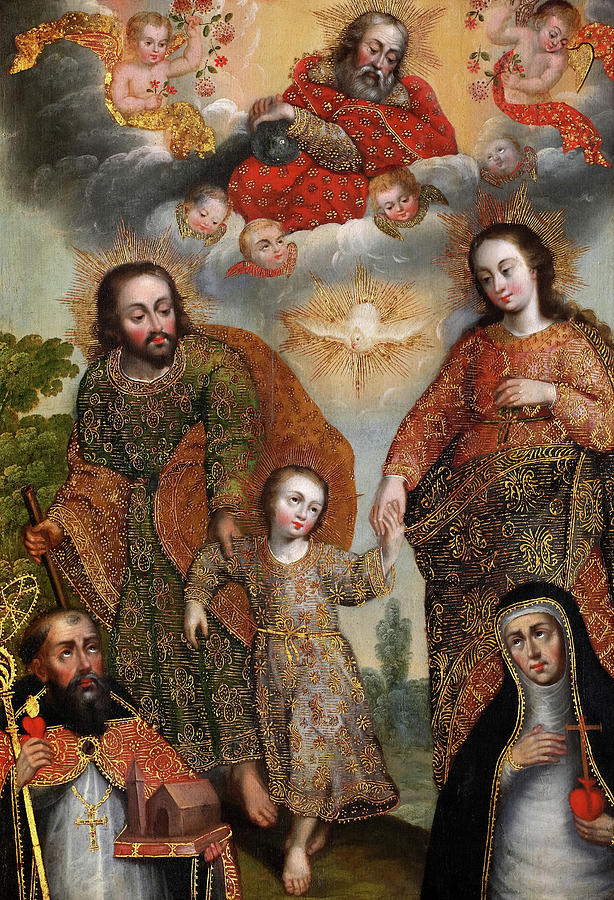
Art: Double Trinity with Saint Augustine and Saint Catherine of Siena

This painting was highlighted in last month’s Magnificat (Dec 2022) magazine with an analysis by Fr. Gabriel Torretta, O.P. 


I was really smitten with this work.  The artist is anonymous but from Peru and from the Cusco School   The painting, Double Trinity with Saint Augustine and Saint Catherine of Siena, is dated between 1700 and 1730.  I was surprised when I looked up Peruvian Baroque art to find just how rich and superb it is, but this painting may be the crowning achievement.  The Wikipedia entry on the Cusco School explained its origins:


The tradition originated after the 1534 Spanish conquest of the Peru,[1] and it is considered the first artistic center that systematically taught European artistic techniques in the Americas. The Spanish contribution, and in general European, to the Cusco School of painting, is given from very early time, when the construction of the Cathedral of Cusco begins. However, it is the arrival of the Italian painter Bernardo Bitti in 1583, that marks a beginning of the development of Cuzqueño art. The Jesuit introduced in Cusco one of the fashionable currents in Europe of the time, Mannerism, whose main characteristics were the treatment of figures in a somewhat elongated way, with the light focused on them.


A Trinity in art is of course when an artist renders the Holy Trinity of God the Father, Jesus Christ, and the Holy Spirit.  A Double Trinity is when you couple the Holy Trinity with the trinity of Jesus, Mary, and Joseph—the Holy Family.  That is what you have here.  The scene is supposed to allude to the finding of the boy Jesus at the Temple after being lost (Luke 2:41-52), and the Google Arts and Culture entry mentions how His parents hold him tightly from the experience.


The coordination of the clothing pattern and colors of the holy family is striking.  The patterns are very similar but each individually unique.  The two parents seem to have the same shade while that of Jesus’s is lighter—perhaps suggesting youth—but if my eyes are seeing correctly the shade and pattern of Jesus matches that of God the Father’s sleeve.  The similar colors create a diamond shape between the holy family and God the Father with the Holy Spirit binding them in the center.


Interestingly here the Holy Trinity is rendered vertically with God the Father looking down and Jesus looking up. The holy family, on the other hand, is aligned horizontally with their eyes looking down at Jesus.  The vertical and horizontal lines notably form a cross with all eyes turned to Jesus. 


The artist also includes St. Augustine of Hippo and St. Catherine of Siena in the foreground, on the extreme sides of the canvas.  Fr. Gabriel rightly points out that this makes the painting a Triple Trinity since Jesus and the two saints form a third triangle.  Why St. Augustine and St. Catherine of Siena?  Google Arts and Culture suggests that it may have been the personal preference of the whoever commissioned the painting, and that may be.  But there may be an additional element which may more thought to the painting.    


Both St. Augustine and St. Catherine are holding hearts.  Now it is no coincidence that these two saints would hold hearts as part of their iconography.  St. Augustine famously said in his Confessions, “My heart is restless O Lord, until it rests on thee.”  One of St. Catherine of Siena’s most famous mystical experiences was when she lay in a coma and had her heart taken out by Jesus (mystically of course) and replaced with Christ’s heart.  So heart becomes a thematic element of the composition, and with that in mind we can see that not only are everyone’s eyes turned toward Jesus but so is everyone’s heart: God the Father through the Holy Spirit, and the two earthly parents having just found their lost child.  When we gaze at a beloved, it is through eyes but those eyes are linked to our hearts.


This painting is a magnificent achievement, worthy of any Italian Renaissance artist.  Who knew that such art was being created in seventeenth and eighteenth century Peru?

Friday, November 19, 2021

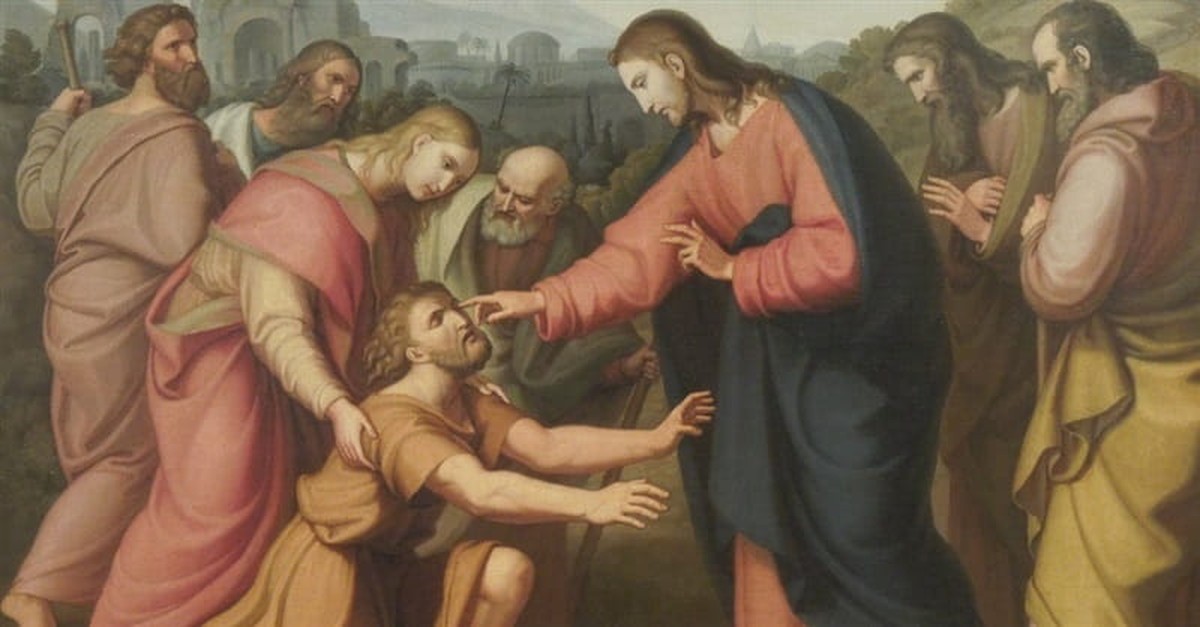
Faith Filled Friday: You Are Bartimaeus

There was a marvelous meditation in last month’s Magnificat (October 2021, p. 356-7) taken from a St. Josemaría Escrivà homily regarding the Bartimaeus passage in Mark.   Escrivà (1902-1975) was a priest from Spain who founded the religious institution, Opus Dei, an organization where mostly lay people commit to a life of holiness.  Here’s the Gospel passage first:


They came to Jericho.  And as he was leaving Jericho with his disciples and a sizable crowd, Bartimaeus, a blind man, the son of Timaeus, sat by the roadside begging.  On hearing that it was Jesus of Nazareth, he began to cry out and say, “Jesus, son of David, have pity on me.”  And many rebuked him, telling him to be silent. But he kept calling out all the more, “Son of David, have pity on me.”  Jesus stopped and said, “Call him.” So they called the blind man, saying to him, “Take courage; get up, he is calling you.”  He threw aside his cloak, sprang up, and came to Jesus.  Jesus said to him in reply, “What do you want me to do for you?” The blind man replied to him, “Master, I want to see.”  Jesus told him, “Go your way; your faith has saved you.” Immediately he received his sight and followed him on the way.  (Mk 10:46-52)


One certainly identifies with the blind man and we empathize with his predicament.  Escrivà puts us into Bartimaeus’ shoes. 


Don’t you feel the same urge to cry out?  You who are also waiting at the side of the way, of this highway of life that is so very short?  You who need more light, you who need more grace to make up your mind to seek holiness?  Don’t you feel an urgent need to cry out, Jesus, son of David, have pity on me?  What a beautiful aspiration for you to repeat again and again!  I recommend that you meditate slowly on the events preceding the miracle, to help you keep this fundamental idea clearly engraved upon your minds: what a world of difference there is between the merciful Heart of Jesus and our own poor hearts!  This thought will help you at all times, and especially in the hour of trial and temptation, and also when the time comes to be generous in the little duties you have, or in moments when heroism is called for. 

Yes, meditate on Bartimaeus’ helplessness, and that the only power he has is to call on Him.  That is us, today, here and now, in a desperate state with the only real power we have is to call on Him: Jesus, son of David, have pity on me. Escrivà continues to turn the screw on your Bartimaeus predicament:


Many of them rebuked him, telling him to be silent, as people have done to you, when you sensed that Jesus was passing your way.  Your heart beat faster and you too began to cry out, prompted by an intimate longing.  Then your friends, the easy life, your surroundings, all conspired to tell you: “Keep quiet, don’t cry out.  Who are you to be calling Jesus?  Don’t bother him.”  But poor Bartimaeus would not listen to them.  He cried out all the more.  Our Lord, who had heard him right from the beginning, let him persevere in his prayer.  He does the same with you.  Jesus hears our cries from the very first, but he waits.  He wants us to be convinced that we need him.  He wants us to beseech him, to persist, like the blind man waiting by the road from Jericho.  Let us imitate him.  Even if God does not immediately give us what we ask, even if many people try to put us off our prayers, let us still go on praying.

So when Escrivà puts us in Bartimaeus’ shoes, it’s not that we are transported to Bartimaeus’ time.  We are Bartimaeus in our contemporary time.  Imagine now our Lord approaching you, and just as Bartimaeus can’t see Jesus, so too are you blind to Him.  Escrivà continues for the climax:


And now begins a marvelous dialogue that moves us and sets our hearts on fire, for you and I are now Bartimaeus.  Christ, who is god, begins to speak and asks, What do you want me to do for you?  The blind man answers, Lord, that I may see.  How utterly logical!  How about yourself, can you really see?  Haven’t you too experienced at times what happened to the blind man of Jericho?  I can never forget how when meditating on this passage many years back, and realizing that Jesus was expecting something of me, I made up my own aspirations: “Lord, what is it you want?  What are you asking of me?”  I had a feeling that he wanted me to take on something new and the cry Master, that I may see, moved me to beseech Christ again and again.  Lord, whatever it is that you wish, let it be done.

And so you ask Him, I want to see, and if you let Him touch your eyes, you can see Him.  After this encounter, Bartimaeus followed Jesus all the way to Jerusalem to His Passion.  In those moments you do see Jesus, when you feel His touch on your eyes, you can do nothing else but follow Him all the way.

This was a moving meditation.


Friday, August 27, 2021

Faith Filled Friday: Saint Josè María Robles Hurtado

As I was going through this month’s Magnificat magazine and which overlapped with my reading of The Power and the Glory, I came across this passage which instantly recalled the novel.  Magnificat has a regular feature where it provides a short biography of a saint, and each issue coordinates the saints’ by a topic.  In this issue the topic was “Saints Who Were Leaders.”  I was shocked to find this saint I had never heard of, but was very much relevant to the Cristero War and of course The Power and the Glory.


Saint Who?  Saints Who Were Leaders


Saint Josè María Robles Hurtado

Martyr († 1927)        Feast: June 26


A native in Mascota in Jailisco, Mexico, Josè was ordained a priest at twenty-four and two years later founded the Sisters of the Sacred Heart of Jesus, with a focus on Eucharistic devotion.  After several years in mission work, he was assigned to a parish.  Although a new Mexican constitution outlawed public devotions, Josè went forward nevertheless with a bold plan to erect a giant cross devoted to Christ the King in the geographic center of Mexico.  To announce the laying of the cornerstone, he had signs placed throughout the countryside declaring Christ the “King of Mexico.”


After this the authorities began to put increasing pressure on Josè to curtail his work.  He was forced into hiding, but he continued to minister to his parishioners in secret.  On the feast of the Sacred Heart, June 25, 1927, he was arrested when he was about to say a private Mass in a family home.  The next day, he was taken to a large oak tree outside a nearby village and hanged.  Josè placed the noose on his own neck so that none of his executioners would bear the guilt of that act.


Shortly beforehand, Josè had penned a poem anticipating his death: “I want to love you until martyrdom…/With my soul I bless you, my Sacred Heart./Tell me: is the instant of my eternal union near?/Stretch out your arms, O Jesus/Because I am your “little one.”


Loving Father, through the intercession of Saint Josè María Robles Hurtado, take me at the moment of my death into your eternal embrace.

        (p. 80, Magnificat, Aug. 2021, Vol. 23, No. 6.)

That cross Josè built might be the same cross in the fourth chapter of Part 2, the giant cross the Indian woman places her dead child at the foot.


Friday, July 9, 2021

Faith Filled Friday: St. Catherine on Fastening to the Cross

There was a marvelous meditation in the June 2021 Magnificat taken from a letter of St. Catherine of Siena.  The Magnificat editors pull parts of that letter to form this wonderful quote:


In the name of Jesus Christ crucified and of gentle Mary.  I Caterina, useless servant of Jesus Christ, send you my greetings.  I long to see us united with and transformed into the gentle pure eternal truth, the truth that rids us of all falsehoods and lies…I shudder at the thought of the devil’s deceptiveness.  My only trust is in God’s goodness.  I do not—I know that I cannot—trust in myself…


I am always fearful of my own weakness and the devil’s cleverness.  For I realize that though the devil lost beatitude he did not lose his intelligence—or better, cleverness—I know, as I said, that he could deceive me.  But then I turn to the tree of the most holy cross of Christ crucified; there I lean; there I want to nail myself fast.  I have no doubt that if I am nailed fast with him in love and in deep humility, the devils will have no power over me.  And this is not because of my own power but because of the power of Christ crucified.


Keep living God’s holy and tender love.  Gentle Jesus!  Jesus love!  O fire, oh abyss of charity!  You are a fire ever burning but not consuming.  You are filled with gladness, with rejoicing, with gentleness.  To the heart pierced by this arrow, all bitterness seems sweet.  Oh sweet love the feeds and fattens our soul!


Yet even though we said it burns without consuming, I say also that it burns and consumes: it dissolves and destroys all sin, all ignorance, all indifference in the soul, for charity is not inactive; no, it does great things.  (Magnificat, June 2021, p. 421-2)

That is such an incredible quote, and the entire letter can be found in Suzanne Noftke’s The Letters of Catherine of Siena: Volume I.  Indeed, I found it and it’s identified as “Letter T92/G305/DT19” for those who understand that numbering scheme, and the letter is addressed to “a religious person in Florence.”  There was no name provided of the addressee but from the contents of Catherine’s letter we can tell she was responding to a religious person, that is, one with religious orders.  Also from the entire content of Catherine’s letter we can see that the religious person has written to her criticizing what he sees as her severe fasting, which he suggests can be at the result of the devil.  The letter is dated as being between “July 1375 to early 1376.”  This would put St. Catherine as being twenty-eight to twenty-nine years old.  She died in 1380.

For those that may not know, St. Catherine did subject herself to severe fasting, especially from her late teens to her early twenties, which in time caused her digestive system to shut down.  And in this letter, which I think is the central intent of the letter, is to explain her situation and that she no longer can hold food down and that she prays for this to change. 

So in the quoted part from Magnificat, we see that in the first stanza, after her typical way of opening a letter, she acknowledges she cannot trust herself.  In the second paragraph she acknowledges that the devil is capable of deceiving her.  But then in that paragraph she identifies what ultimately saves her: “But then I turn to the tree of the most holy cross of Christ crucified; there I lean; there I want to nail myself fast.  I have no doubt that if I am nailed fast with him in love and in deep humility, the devils will have no power over me.  And this is not because of my own power but because of the power of Christ crucified.”

The third paragraph is one of her typical disjointed digressions—but which are so poetic—where she starts speaking to Christ.  Notice that she ends that it is Jesus who “fattens her soul.”  So while addressing the thinning of her physical body, she refers to the fattening of her soul.

She concludes by modifying her metaphor to say that by grasping the cross with crucified Jesus, it consumes sin, ignorance, indifference, and leads her to holy charity.

St. Catherine of Siena, pray for us!