Kerstin,
started a conversation at our “Catholic Art” folder at our Goodreads Catholic Thought Book Club on this painting. Discussion on this painting starts at Comment #10.
Kerstin
Commented:
Every year subscribers of
the devotional Magnificat get a new bookmark. It is the size of a small
postcard with a picture of fine religious art on one side and a short
reflection on the other. In past years these reflections have been written by
Bishop Robert Barron. I want to concentrate on the picture chosen for this
year. It is the main part of a painting by the German romantic painter Caspar David Friedrich (1774-1840) and the title of the painting is Winter Landscape
with Church. It is a deeply contemplative painting, and while the main part is
on the bookmark, it is only in seeing the entire painting that I noticed the
crutches left behind in the snow.
This is a painting worth
discussing. There are so many layers to ponder. What do you see? What is your
interpretation?
Madeleine
Replied:
Impressive and striking
painting. The church, the rocks, the trees--there's a connection there, but the
crutches take my reflection elsewhere--lots to think about. It's poetic,
something to think about with a pencil. I've been considering subscribing to Magnificat,
but there are so many things on my plate I fear it will sit in my paper pile
too many days. It is a beautiful magazine, though!
Casey
Replied:
The Crucifix, the rock,
the trees, the snow, the cold, the material. In the distance, through fog and
darkness, a Church. Can we get there from here? On crutches? Is there a path?
Is there even land? Or an abyss? Show me the way, Oh Lord.
I notice, too, the
sources of light. Sunlight appears to be shining from behind us. But there
seems to be another, softer, gentle, sunrise light behind the Church. A
different kind of light. A heavenly light?
Also see the way the
trees mirror the Church imperfectly. Natural and beautiful but not fully
ordered as the spires are. The Church on Earth mirroring the heavenly church?
My
Reply to Casey:
Yes that has to be the
most interesting part of the painting. The tree reflects the church.
I can’t say I’m a fan of
this painting. If it wasn’t mentioned in the title I would not have taken the
towers in the distance for a church. It looks more like a castle to me. I guess
the connection is the natural religion of the trees is at the heart of church
religion. Or maybe it’s saying that the natural religion is more prominent than
church religion. I don’t know.
The crutches confuse. Was
the person they belonged to swallowed by snow, saved, or just abandoned the
crutches? Whichever, they are melodramatic. I don’t like them here.
Casey’s
Reply to Me:
The owner of the crutches
is praying against the rock in front of the Crucifix.
What I'm seeing is that
we can't get to the Church of heaven on our own because of our weaknesses. We
can only humble ourselves in the Church of earth and pray.
My
Reply to Casey in Surprise:
Oh wow. I didn’t even
notice him there. You can barely make him out. Well that changes things. I’ll
have to give this more thought.
Frances
Commented:
He’s left his crutches
behind in an act of total abandonment to God’s will?
Kerstin
Comment:
In the foreground
everything is in focus. We can see the trees, rocks, the snow, the crutches,
etc. These are things we can grasp and comprehend. In the background it gets
foggy and misty. Above the mist floats the silhouette of a church. The eye is
entering a mystical space, a space that's other-worldly, where realities exist
that are not easily grasped nor comprehended. The bridge between the seen and
the unseen, is the crucifix.
The trees we see aren't
just any trees, but pine trees, the ones we use as Christmas trees. Visually
they pierce into the mist and the tall one is at the same height as the church
steeples.
There is also
perspective, even though we see the tall pine tree at the same height as the
church, the church is in the background, so we automatically know she is much
bigger.
My
Comment:
That man I didn't
initially notice does make a big difference in understanding the painting. It
is definitely a positive interpretation of faith within whatever precisely is
the theme. I can't quite grasp the theme though. I do think there is some sort
of allusion to Christianity existing within nature, and perhaps since the man
blends so easily within nature is also part of that theme. But nature here
isn't just a loving blessing from God. It's hard and cold and isolating. The
man's smallness emphasizes our smallness. The crutches emphasizes our smallness
and weakness and the need to rely on faith. I still think they are
melodramatic. I can't even understand how that man walked to the spot in that
snow using crutches. The trees (I think there's more than one bunched together)
alludes to the cross and to the Tree of Life in paradise. I am now positive on
this painting, but I can't say I love it!
Casey’s
Reply:
It suffers from the fact
that it is simultaneously didactic and opaque.
My
Reply to Casey:
LOL, yes that is so true!
Kerstin
Replied to One of My Comments:
Manny
wrote: " I can't even understand how that man walked to the spot in that
snow using crutches."
This is such a typical
German landscape that I made certain assumptions ;-)
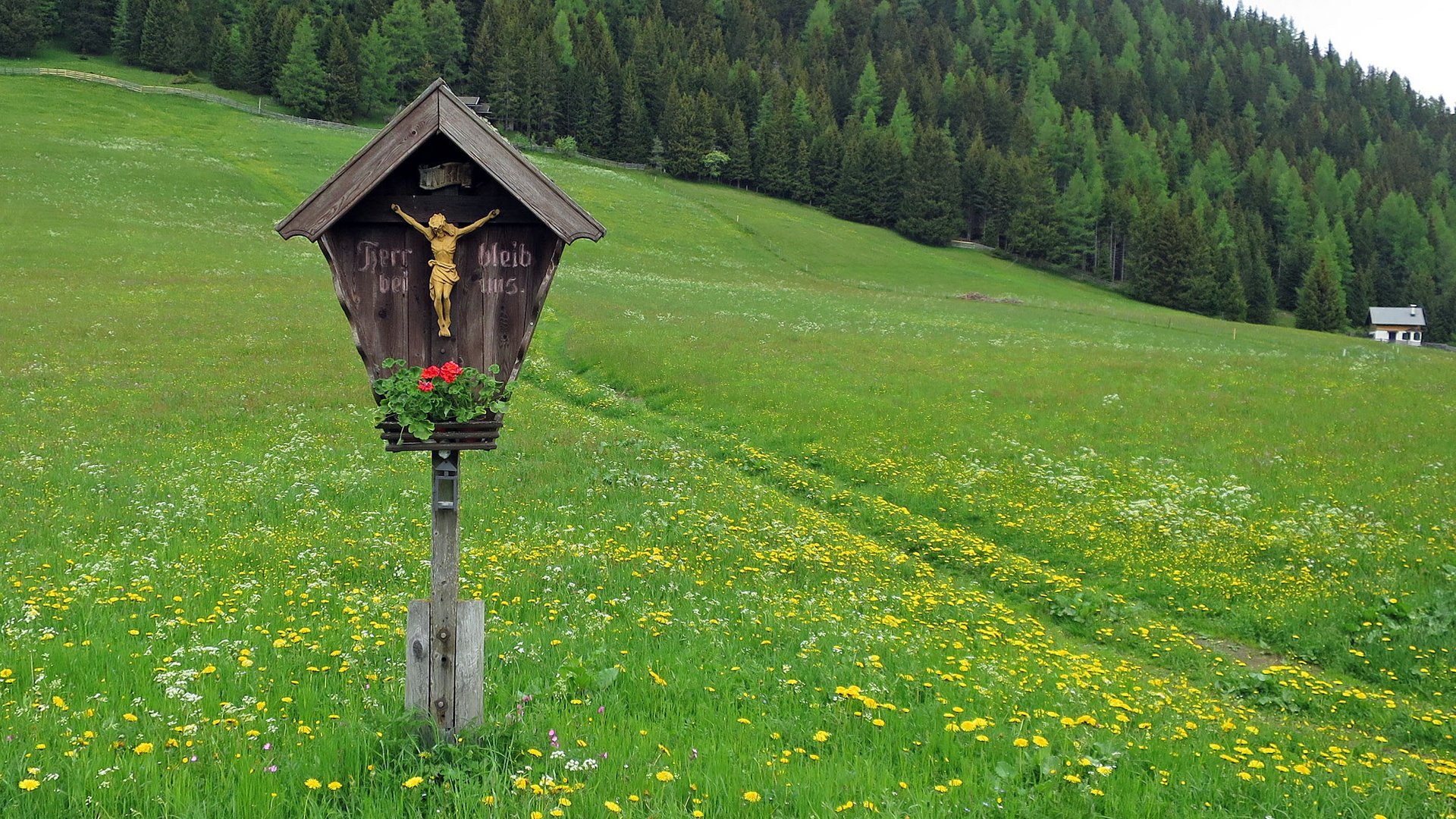
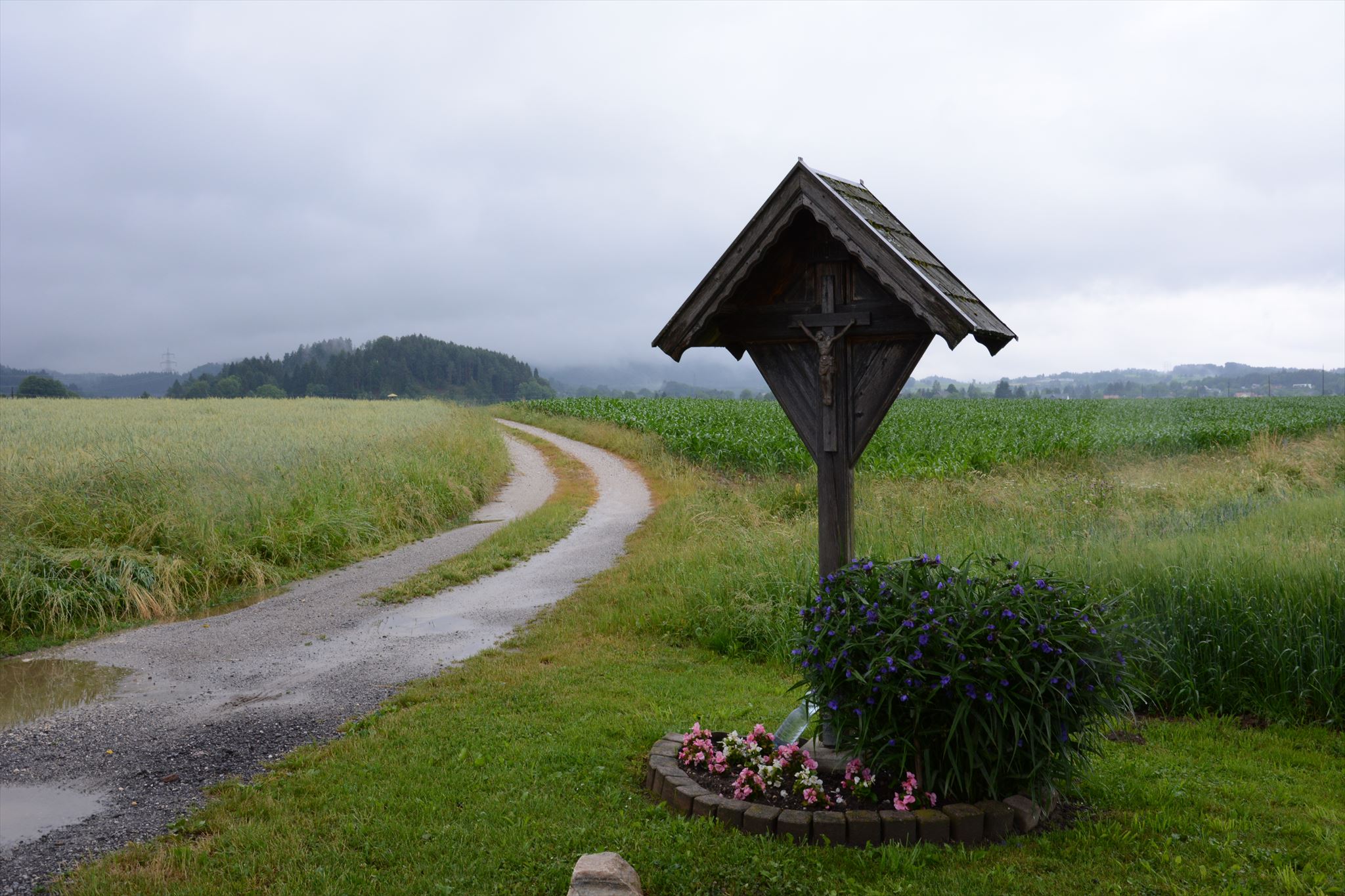
The crucifix depicted is
called a "Wegkreuz" in German, literally meaning "path
crucifix". They dot the landscape along country roads, farm access roads,
walking paths, hiking trails, etc. mostly in regions that are primarily
Catholic. They are placed by people or communities, not officially by the
Church. Sometimes they have a bench too, so one can sit and rest. So in looking
at the painting I automatically assume there is a country lane or walking path
there now obscured by the snow. If you look on the left by the rocks and small
pine trees there is a path or wagon rut.
Kerstin
then posted some pictures of mountain crucifixes from Germany.
Kerstin
Edit: The writing on the cross means "Lord stay with us"
Kerstin
Comment:
Snow obscures the
landscape. It obscures the terrain and the paths you travel. For country folk
this hazard is all too real. Are you still on the path or off into the fields?
Falling into a ditch or getting stuck in a snow drift? The snow symbolizes the
unknown. We really don't know what is under our feet, what life throws at us.
We have to have trust in God to keep us on the right path, to keep us safe, so
we can enter Heaven, depicted as the Church above the mist.
The painting would work
very poorly in a city setting. City folk still have a sidewalk under their feet
even if covered in snow.
The crutches are a
stand-in for technology, man's reliance on himself. The way we use crutches is
to lean on them with our full body weight while we hobble along. Self-reliance
without God makes us less than human, we can only limp.
The crutches also signify
man's spiritual brokenness. We create our own devices to move along, but
ultimately that isn't enough, we need Divine healing to make us whole.
My
Reply to Kerstin:
I’m so glad you posted
those pictures, Kerstin. I was reminded
of a travel essay by the novelist and poet D.H. Lawrence. The essay is titled “The Crucifix Across the
Mountains” and it’s collected in his Italian travel essays called Twilight in Italy. Actually he starts his journey in Bavaria and
eventually goes over the Tirol and into Italy.
But in “The Crucifix Across the Mountains” he stops to admire all these
German crucifixes across the mountains.
You can read the essay here.
Let me quote some
pertinent sections. Here he first comes
across the crucifixes.
The crucifixes are there,
not mere attributes of the road, yet still having something to do with it. The
imperial processions, blessed by the Pope and accompanied by the great bishops,
must have planted the holy idol like a new plant among the mountains, there
where it multiplied and grew according to the soil, and the race that received
it.
As one goes among the
Bavarian uplands and foothills, soon one realizes here is another land, a
strange religion. It is a strange country, remote, out of contact. Perhaps it
belongs to the forgotten, imperial processions.
Coming along the clear,
open roads that lead to the mountains, one scarcely notices the crucifixes and
the shrines. Perhaps one's interest is dead. The crucifix itself is nothing, a
factory-made piece of sentimentalism. The soul ignores it.
But gradually, one after
another looming shadowily under their hoods, the crucifixes seem to create a
new atmosphere over the whole of the countryside, a darkness, a weight in the
air that is so unnaturally bright and rare with the reflection from the snows
above, a darkness hovering just over the earth. So rare and unearthly the light
is, from the mountains, full of strange radiance. Then every now and again recurs
the crucifix, at the turning of an open, grassy road, holding a shadow and a
mystery under its pointed hood.
This leads to a sort of
contemplation.
Whether it is singing or
dancing or play-acting or physical transport of love, or vengeance or cruelty,
or whether it is work or sorrow or religion, the issue is always the same at
last, into the radiant negation of eternity. Hence the beauty and completeness,
the finality of the highland peasant. His figure, his limbs, his face, his
motion, it is all formed in beauty, and it is all completed. There is no flux
nor hope nor becoming, all is, once and for all. The issue is eternal,
timeless, and changeless. All being and all passing away is part of the issue,
which is eternal and changeless. Therefore there is no becoming and no passing
away. Everything is, now and for ever. Hence the strange beauty and finality
and isolation of the Bavarian peasant.
It is plain in the
crucifixes. Here is the essence rendered in sculpture of wood. The face is
blank and stiff, almost expressionless. One realizes with a start how
unchanging and conventionalized is the face of the living man and woman of
these parts, handsome, but motionless as pure form. There is also an underlying
meanness, secretive, cruel. It is all part of the beauty, the pure, plastic
beauty. The body also of the Christus is stiff and conventionalized, yet
curiously beautiful in proportion, and in the static tension which makes it
unified into one clear thing. There is no movement, no possible movement. The being
is fixed, finally. The whole body is locked in one knowledge, beautiful,
complete. It is one with the nails. Not that it is languishing or dead. It is
stubborn, knowing its own undeniable being, sure of the absolute reality of the
sensuous experience. Though he is nailed down upon an irrevocable fate, yet,
within that fate he has the power and the delight of all sensuous experience.
So he accepts the fate and the mystic delight of the senses with one will, he
is complete and final. His sensuous experience is supreme, a consummation of
life and death at once.
He gives a beautiful
description of the German peasant who took him up there.
The driver of the
pack-horses is afraid. The fear is always there in him, in spite of his sturdy,
healthy robustness. His soul is not sturdy. It is blenched and whitened with
fear. The mountains are dark overhead, the water roars in the gloom below. His
heart is ground between the mill-stones of dread. When he passes the extended
body of the dead Christ he takes off his hat to the Lord of Death. Christ is
the Deathly One, He is Death incarnate.
And the driver of the
pack-horses acknowledges this deathly Christ as supreme Lord. The mountain
peasant seems grounded upon fear, the fear of death, of physical death. Beyond
this he knows nothing. His supreme sensation is in physical pain, and in its
culmination. His great climax, his consummation, is death. Therefore he
worships it, bows down before it, and is fascinated by it all the while. It is
his fulfilment, death, and his approach to fulfilment is through physical pain.
Then he tries to
psychoanalyze the artistry of the crucifixes.
This is modernist literature after all.
But the tendency of the
crucifix, as it nears the ridge to the south, is to become weak and sentimental.
The carved Christs turn up their faces and roll back their eyes very piteously,
in the approved Guido Reni fashion. They are overdoing the pathetic turn. They
are looking to heaven and thinking about themselves, in self-commiseration.
Others again are beautiful as elegies. It is dead Hyacinth lifted and extended
to view, in all his beautiful, dead youth. The young, male body droops forward
on the cross, like a dead flower. It looks as if its only true nature were to
be dead. How lovely is death, how poignant, real, satisfying! It is the true
elegiac spirit.
Then there are the
ordinary, factory-made Christs, which are not very significant. They are as
null as the Christs we see represented in England, just vulgar nothingness. But
these figures have gashes of red, a red paint of blood, which is sensational.
Beyond the Brenner, I
have only seen vulgar or sensational crucifixes. There are great gashes on the
breast and the knees of the Christ-figure, and the scarlet flows out and
trickles down, till the crucified body has become a ghastly striped thing of
red and white, just a sickly thing of striped red.
Of course Lawrence gets
Christianity all wrong. Or perhaps he
takes liberties with meaning to express a point. But some of what he says is somewhat ridiculous. Here is his conclusion, which looks inward to
his psychological state.
On a small mountain track
on the Jaufen, not far from Meran, was a fallen Christus. I was hurrying
downhill to escape from an icy wind which almost took away my consciousness,
and I was looking up at the gleaming, unchanging snow-peaks all round. They
seemed like blades immortal in the sky. So I almost ran into a very old
Martertafel. It leaned on the cold, stony hillside surrounded by the white
peaks in the upper air.
The wooden hood was
silver-grey with age, and covered, on the top, with a thicket of lichen, which
stuck up in hoary tufts. But on the rock at the foot of the post was the fallen
Christ, armless, who had tumbled down and lay in an unnatural posture, the
naked, ancient wooden sculpture of the body on the naked, living rock. It was
one of the old uncouth Christs hewn out of bare wood, having the long,
wedge-shaped limbs and thin flat legs that are significant of the true spirit,
the desire to convey a religious truth, not a sensational experience.
The arms of the fallen
Christ had broken off at the shoulders, and they hung on their nails, as
ex-voto limbs hang in the shrines. But these arms dangled from the palms, one
at each end of the cross, the muscles, carved sparely in the old wood, looking
all wrong, upside down. And the icy wind blew them backwards and forwards, so
that they gave a painful impression, there in the stark, sterile place of rock
and cold. Yet I dared not touch the fallen body of the Christ, that lay on its
back in so grotesque a posture at the foot of the post. I wondered who would
come and take the broken thing away, and for what purpose.
I always loved Lawrence’s
writing. His prose rises to poetry, but
one has to take his ideas with a grain of salt.
Sometimes they are downright baffling.
But he can capture a moment so well.
My
Comments to Kerstin:
Kerstin wrote: "The
crutches also signify man's spiritual brokenness. We create our own devices to
move along, but ultimately that isn't enough, we need Divine healing to make us
whole."
Oh! I didn't think of that. Yes, that does fit
Kerstin wrote: "I
think a strong theme is Trust in God."
Yes, but there has to be more. There is the whole nature element that has to be
included in the theme. The trees reflecting the church is such a strong motif
that it has to be part of the theme somehow.
My
Reply to Casey:
Casey wrote:
"Kerstin wrote: "I think a strong theme is Trust in God"
Even more specifically, I think it is the realization that Trust in God is all
there is."
It certainly man against nature with God to as the refuge.
Casey’s
Reply:
Why do you say
"against?"
What I'm seeing is a man
who has reached the limits of nature while still being contained within nature.
I don't see evidence of battling nature or some such thing.
My
Reply to Casey:
Good point. But nature
does seem harsh, the rocks, the snow, the vast space. It must have taken some
effort for him to get there. But I don't know. Like you said before, the
meaning is opaque.
Kerstin
Comment on the D.H. Lawrence Essay:
How interesting! Yes,
D.H. Lawrence gets some things wrong. For one, the wooden crucifixes are
hand-carved, not factory made - at least the old ones. Today with modern laser
cutting who knows! But my hunch is people don't want factory made, they want
the real thing - at least for this purpose. There are fewer and fewer artisanal
shops who do it, but there also is a pride of passing on the art and the
culture of woodcarving as it is practiced in the Alps.
Drawing the locals as
fearful is overdrawn as well. I would say they are watchful and cautious and
they have respect of the nature of the landscape they live in. The mountains
are dangerous places. We are in awe of their grandeur and majesty, but you have
to keep your wits about you where you tread. There are the constant dangers of
rockfalls, wash-outs, etc.
I know exactly where
Lawrence travelled, I've been through the Brenner Pass into Italy many times.
It is an ages-old roadway to traverse the Alps. Today it is a four-lane
highway, and you go up, up, up for many miles. You pass underneath many
terraces specifically built to protect the road from rockfalls and avalanches.
Here and there you get to see the old road leading up to the pass, and it is
treacherous indeed.
I find it interesting
that Lawrence doesn't want to touch the corpus of the broken crucifix. Somehow
he knows it represents something sacred.
###
In
summary, I think everyone made good points.
There is the theme of faith amidst nature, the smallness and feebleness
of man to make it alone without faith, and I particularly liked Kerstin’s
observation that the crucifix is a bridge from the natural foreground to the
misty, mystical other world. Perhaps it’s
not that opaque after all. The Wegkreuz photos and the D.H. Lawrence
essay put into a German folkloric perspective the crucifix in the middle of nowhere.