"Love follows knowledge."
"Beauty above all beauty!"
– St. Catherine of Siena

Showing posts with label Palm Sunday. Show all posts

Sunday, March 29, 2026

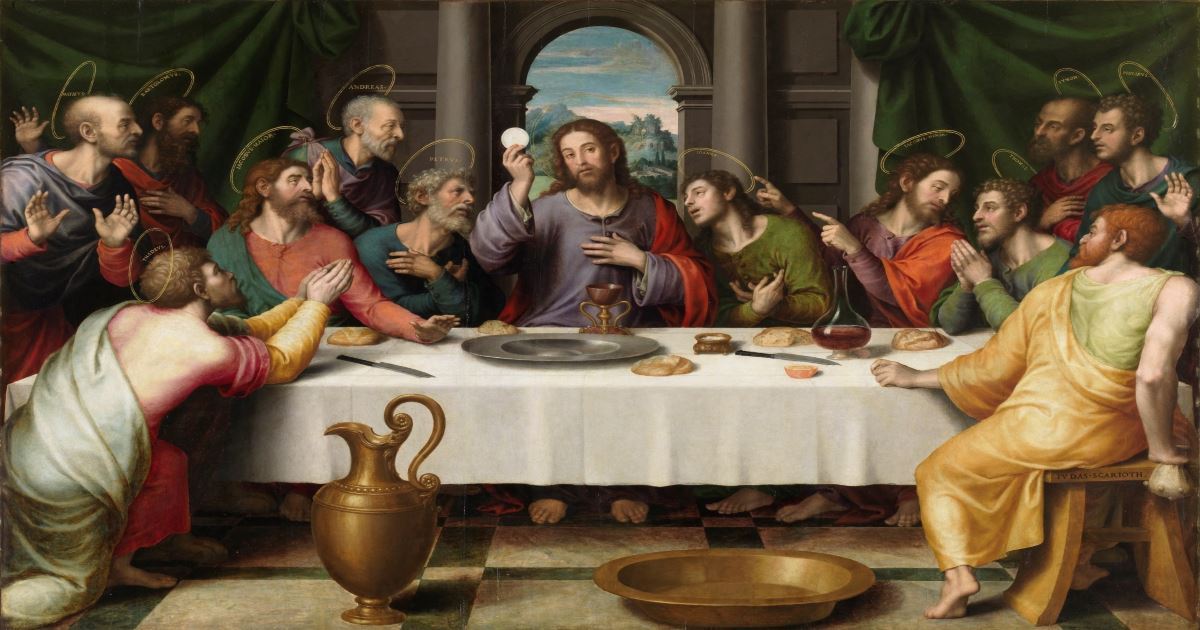
Sunday Meditation: Holy Week and the Institution of the Eucharist

I’ve had several posts on Palm Sunday over the years.  The latest from Year A was three years ago where you could hear Dr. Brant Pitre explain Jesus’ entrance into Jerusalem and about the two donkeys of Matthew’s version.  Or you can hear Fr. Geoffrey Plant explain Palm Sunday on a Year C Gospel reading.  Or you can just search all my “Palm Sunday” blog posts to pull them all up. 

Today I want to focus on Holy Week and the Institution of the Eucharist.  The Passion reading stretches across the week and includes Matthew’s version of the Institution narrative.  But I want also post a summary of the Holy Week Gospel events.  This is a simplified listing of the salient events.  It is not comprehensive.


Jesus Raises Lazerus

Week Prior to Palm Sunday

Jesus Retreats to Ephriam

Week Prior to Palm Sunday

Jesus Travels Back to Bethany

Week Prior to Palm Sunday

Mary Anoints Jesus

Saturday Before Palm Sunday

Jesus Enters Jerusalem

Palm Sunday

Jesus Cleans the Temple

Holy Monday

Jesus Sermon on the End of Times

Holy Tuesday

Judas Agrees to Betray Jesus

Holy Wednesday/Spy Wednesday

The Last Supper

Holy Thursday

Jesus’s Anguish in the Garden of Gethsemane

Holy Thursday Evening

Jesus is Apprehended

Holy Thursday Evening

Jesus’s Trial Before the Sanhedrin

Holy Thursday Evening

Jesus’s Trial Before Pilate

Early Good Friday Morning

Jesus is Scourged, Crucified, Dies, and Buried

Good Friday

Jesus’s Harrowing of Hell

Holy Saturday

Jesus’s Resurrection

Easter Sunday


Here is the Institution Narrative from Matthew’s Passion.


While they were eating,

Jesus took bread, said the blessing,

broke it, and giving it to his disciples said,

"Take and eat; this is my body."

Then he took a cup, gave thanks, and gave it to them, saying,

"Drink from it, all of you,

for this is my blood of the covenant,

which will be shed on behalf of many

for the forgiveness of sins.

I tell you, from now on I shall not drink this fruit of the vine

until the day when I drink it with you new

in the kingdom of my Father."

Then, after singing a hymn,

they went out to the Mount of Olives.

~Mt:26:26-29


I will start with a pastoral homily first this Sunday.  Fr. Thomas McCarthy of the Order of St. Augustine—the same Order from which Pope Leo XIV heralds—explains Palm Sunday and the Institution of the Eucharist.


Fr. Thomas McCarthy:

It was at that meal that he instituted the priesthood and the Eucharist by taking bread and saying, "This is my body. Do this in memory of me." By taking the chalice filled with wine and saying, "This is my blood. Do this in memory of me. As Catholics, we say those words every time we go to mass. We are doing exactly what Jesus said. He did not say this is a symbol.  He did not say this is kind of almost/sort of/like/maybe. He said this is my body. This is my blood. Do it in memory of me. And so that's why as Catholics we believe in the real presence that the Eucharist is not a symbol. It is not a reenactment. is not a kind of sort of like almost maybe. And so it all happened at the last supper. And it was also at that last supper that Jesus humbled himself, took the form of a slave and washed his disciples feet.

So what are we to do this week?  Fr. Thomas says, “This holy week begins today and I hope that all of us will take time to truly celebrate and prayerfully be attentive to what's happening this week.  So my friends, how good it is that we are here. And I just want to encourage us all to really live out this this week.

To explain Holy Week, I found this new YouTube channel called Catholic Snack that explains Catholic theology and Catholic news of the day.  Here is the video on the Holy Week events.


Catholic Snack:

This is Holy Week. And if you've never understood what really happened during those eight days, stay with me because this story will change the way you see everything.  Every year, Christians around the world enter into a sacred season called Holy Week, the final week of Lent leading up to Easter Sunday. But for many people, sit can feel like a blur of church services, prayers, and traditions without fully grasping the weight of what actually happened. Holy Week is not just a religious calendar event. It is the story of God stepping fully into human suffering, betrayal, abandonment, agony, death, and then doing something no one expected. It is the greatest story ever told. And it happened in real time over eight unforgettable days. So, let's walk through it together, day by day, step by step.

That is pretty good for a “snack.”  I wonder why they named themselves that.  I have not found any background on this channel.  I found this part on Holy Saturday profound.

Catholic Snack:

We live so much of our lives on Holy Saturday, in the in between, after the loss, before the answer, in the silence where God seems absent, but is in fact working. The church's tradition tells us that on this day Christ descended to the dead, reaching even into the depths to bring light where there had only ever been darkness.  In the silence of Holy Saturday, God was not absent. He was at work in the places we couldn't see.  This is the day of waiting, of darkness before dawn, of faith without sight. And sit is one of the most important lessons of Holy Week. Because most of us know this place. Most of us have sat in this silence. And Holy Saturday tells us, "Hold on. Morning is coming, Sunday.

I loved this as a conclusion.

Catholic Snack:

Holy Week is not a story that happened 2,000 years ago and stayed there. It is a story that is still happening in every person who carries a cross they didn't choose.  In every moment of betrayal, grief, and silence, in every mourning that arrives when you thought the darkness would never end, Jesus walked through all of it. He didn't observe it from a safe distance. He entered it fully, flesh, blood, tears, nails, and all so that no human experience would ever be outside the reach of his presence. When you are in your Palm, Sunday, joyful, full of hope, he is there. When you are in your Gethsemane, afraid on your knees, asking God to take the cup away, he is there.  When you are in your Holy Saturday, silent, waiting, uncertain, he is there. And he is always, always moving toward Easter. This Holy Week, I invite you not just to observe the liturgy, but to enter the story, to let it find you where you are, to allow the passion of Christ to speak to your own.  Because that is what Holy Week is for.  Not to make us spectators, but to make us witnesses.


Sunday Meditation: “I tell you, from now on I shall not drink this fruit of the vine until the day when I drink it with you new in the kingdom of my Father."


This is supposed to be a traditional hymn for Palm Sunday, “All Glory, Laud, and Honor.”


All glory, laud, and honour

to you, Redeemer, King!

To whom the lips of children

made sweet hosannas ring.


You are the King of Israel

and David's royal Son,

now in the Lord's name coming,

the King and Blessed One.


ll glory, laud, and honour

to you, Redeemer, King!

To whom the lips of children

made sweet hosannas ring.


The company of angels

are praising you on high;

and mortals joined with all things

created make reply.


All glory, laud, and honour

to you, Redeemer, King!

To whom the lips of children

made sweet hosannas ring.


Sunday, April 13, 2025

Sunday Meditation: Palm Sunday of the Lord's Passion

We arrive at Holy Week and Jesus’s triumphant entrance into Jerusalem, known as Palm Sunday.  Today at Palm Sunday Mass, sitting next to Olga, who serves as our Eucharistic Minister, she made a palm cross for me.  She is an expert on making these.


Thank you Olga.  God bless you.

I have posted quite often on Palm Sunday, and you can peruse the various Palm Sunday posts here.  There is a lot of good stuff in the various posts over the years.  I will try to make this post contain fresh and new material.  First the Gospel reading for Year C.  I cannot post the entire Passion narrative from Luke, but I will post the Gospel reading. 


Jesus proceeded on his journey up to Jerusalem.

As he drew near to Bethphage and Bethany

at the place called the Mount of Olives,

he sent two of his disciples.

He said, "Go into the village opposite you,

and as you enter it you will find a colt tethered

on which no one has ever sat.

Untie it and bring it here.

And if anyone should ask you,

'Why are you untying it?'

you will answer,

'The Master has need of it.'"

So those who had been sent went off

and found everything just as he had told them.

And as they were untying the colt, its owners said to them,

"Why are you untying this colt?"

They answered,

"The Master has need of it."

So they brought it to Jesus,

threw their cloaks over the colt,

and helped Jesus to mount.

As he rode along,

the people were spreading their cloaks on the road;

and now as he was approaching the slope of the Mount of Olives,

the whole multitude of his disciples

began to praise God aloud with joy

for all the mighty deeds they had seen.

They proclaimed:

"Blessed is the king who comes

in the name of the Lord.

Peace in heaven

and glory in the highest."

Some of the Pharisees in the crowd said to him,

"Teacher, rebuke your disciples."

He said in reply,

"I tell you, if they keep silent,

the stones will cry out!"

~Lk 19:28-40

Fr. Geoffrey Plant has a wealth of information on Palm Sunday.  So do you know which of the four Gospels is the only one that mentions palms for the entry into Jerusalem?  Find out.


Fr. Geoffrey quotes Hans Urs von Balthasar : “Through the cross and only through the cross will the gates of the kingdom be opened.” 


Along those same lines of the cross, Bishop Robert Barron gives a homily that knocked my socks off.  This is a must watch.


That is one of the best pastoral homilies I have ever heard.  “Jesus, remember me when you come into your kingdom.”


Sunday Meditation: "Blessed is the king who comes in the name of the Lord.  Peace in heaven and glory in the highest."


For the hymn, let’s double up on the good thief’s contrite words, performed by Taizé. 


The images to go with the music are as spectacular as the musical rendition.

Sunday, March 24, 2024

Sunday Meditation: At the Procession with Palms

We finally come to the Passion Week, and of course we start with Jesus entering Jerusalem in triumph on what has become to be called Palm Sunday.  Mass starts with the short narrative of the entry into the city.


When Jesus and his disciples drew near to Jerusalem,

to Bethphage and Bethany at the Mount of Olives,

he sent two of his disciples and said to them,

“Go into the village opposite you,

and immediately on entering it,

you will find a colt tethered on which no one has ever sat.

Untie it and bring it here.

If anyone should say to you,

‘Why are you doing this?’ reply,

‘The Master has need of it

and will send it back here at once.’”

So they went off

and found a colt tethered at a gate outside on the street,

and they untied it.

Some of the bystanders said to them,

“What are you doing, untying the colt?”

They answered them just as Jesus had told them to,

and they permitted them to do it.

So they brought the colt to Jesus

and put their cloaks over it.

And he sat on it.

Many people spread their cloaks on the road,

and others spread leafy branches

that they had cut from the fields.

Those preceding him as well as those following kept crying out:

    “Hosanna!

        Blessed is he who comes in the name of the Lord!

        Blessed is the kingdom of our father David that is to come!

    Hosanna in the highest!”

~Mk 11:1-10

The Gospel passage continues with the long Passion narrative starting with the Wednesday evening at Bethany to the arrest, the torture, the crucifixion, and the burial of Jesus.  It is too long a narrative (Mk 14:1 to Mk 15:47) to quote, so I’m only going to provide the scene with Mary anointing Jesus.


The Passover and the Feast of Unleavened Bread

were to take place in two days’ time.

So the chief priests and the scribes were seeking a way

to arrest him by treachery and put him to death.

They said, “Not during the festival,

for fear that there may be a riot among the people.”


When he was in Bethany reclining at table

in the house of Simon the leper,

a woman came with an alabaster jar of perfumed oil,

costly genuine spikenard.

She broke the alabaster jar and poured it on his head.

There were some who were indignant.

“Why has there been this waste of perfumed oil?

It could have been sold for more than three hundred days’ wages

and the money given to the poor.”

They were infuriated with her.

Jesus said, “Let her alone.

Why do you make trouble for her?

She has done a good thing for me.

The poor you will always have with you,

and whenever you wish you can do good to them,

but you will not always have me.

She has done what she could.

She has anticipated anointing my body for burial.

Amen, I say to you,

wherever the gospel is proclaimed to the whole world,

what she has done will be told in memory of her.”

~Mk 14:1-9


Fr. Geoffrey Plant provides an understanding of the narrative.


Second, Bishop Robert Barron provides the more theological implications of the passage.


I think between Fr. Geoffrey’s and Bishop Barron’s homilies one understands the fullness of the Passion Week.


Meditation: “She has anticipated anointing my body for burial.”

I close with a musical antiphon for the day.


“Palm Sunday Entrance Antiphon" by Sarah Hart, Curtis Stephan and Steve Angrisano.  Happy Palm Sunday.

Sunday, April 2, 2023

Sunday Meditation: Riding Into Jerusalem

On Palm Sunday, strangely, the Gospel is read first, and it’s always on Christ’s triumphal entry into Jerusalem riding on a colt.


When Jesus and the disciples drew near Jerusalem

and came to Bethphage on the Mount of Olives,

Jesus sent two disciples, saying to them,

"Go into the village opposite you,

and immediately you will find an ass tethered,

and a colt with her.

Untie them and bring them here to me.

And if anyone should say anything to you, reply,

'The master has need of them.'

Then he will send them at once."

This happened so that what had been spoken through the prophet

might be fulfilled:

Say to daughter Zion,

"Behold, your king comes to you,

meek and riding on an ass,

and on a colt, the foal of a beast of burden."

The disciples went and did as Jesus had ordered them.

They brought the ass and the colt and laid their cloaks over them,

and he sat upon them.

The very large crowd spread their cloaks on the road,

while others cut branches from the trees

and strewed them on the road.

The crowds preceding him and those following

kept crying out and saying:

"Hosanna to the Son of David;

blessed is he who comes in the name of the Lord;

hosanna in the highest."

And when he entered Jerusalem

the whole city was shaken and asked, "Who is this?"

And the crowds replied,

"This is Jesus the prophet, from Nazareth in Galilee."

        -Mt 21:1-11 

Dr. Brant Pitre explains the passage with his typical Old Testament insights.


But if you notice, there are two donkeys in this triumphal entry, a jenny and her colt.  All three of the other Gospels (Mark 11, Luke 19, John 12) only mention one colt.  As you can imagine, a lot of discussion has been spent on this, with some claiming a contradiction.  Is this a contradiction?  (1) The three other Gospels don’t say there wasn’t a second donkey, and (2) if there is a colt (a baby donkey) a mother (called a jenny) is usually near by.  Here is an explanation by Michael Jones of Inspiring Philosophy of the whole controversy and why I believe Matthew is giving us a more accurate detail.


Ride on King Jesus!