"Love follows knowledge."
"Beauty above all beauty!"
– St. Catherine of Siena

Showing posts with label Life On The Mississippi. Show all posts

Saturday, March 29, 2014

Life on the Mississippi by Mark Twain, Part 2


You can read Part 1 of my reflection of Life on the Mississippi by Mark Twain here.

 
What Twain finds on his journey into the deep south is not just the language differences between North and South, not just the cultural differences that had always and still to this day exist, but psychological differences.  As the nation psychologically suffered a deep wound from the Civil War, the South as loser, suffered the brunt of the change.  The North changed in that it became more industrial; the South changed in that it developed demons. 

IN the North one hears the war mentioned, in social conversation, once a month; sometimes as often as once a week; but as a distinct subject for talk, it has long ago been relieved of duty. There are sufficient reasons for this. Given a dinner company of six gentlemen to-day, it can easily happen that four of them--and possibly five--were not in the field at all. So the chances are four to two, or five to one, that the war will at no time during the evening become the topic of conversation; and the chances are still greater that if it become the topic it will remain so but a little while.  If you add six ladies to the company, you have added six people who saw so little of the dread realities of the war that they ran out of talk concerning them years ago, and now would soon weary of the war topic if you brought it up.

The case is very different in the South. There, every man you meet was in the war; and every lady you meet saw the war.  The war is the great chief topic of conversation. The interest in itis vivid and constant; the interest in other topics is fleeting.  Mention of the war will wake up a dull company and set their tongues going, when nearly any other topic would fail.  In the South, the war is what A.D. is elsewhere: they date from it.  All day long you hear things 'placed' as having happened since the waw; or du 'in' the waw; or befo' the waw; or right aftah the waw; or 'bout two yeahs or five yeahs or ten yeahs befo' the waw or aftah the waw.  It shows how intimately every individual was visited, in his own person, by that tremendous episode.  It gives the inexperienced stranger a better idea of what a vastand comprehensive calamity invasion is than he can ever get by readingbooks at the fireside.

At a club one evening, a gentleman turned to me and said, in an aside--

'You notice, of course, that we are nearly always talking about the war. It isn't because we haven't anything else to talk about, but because nothing else has so strong an interest for us. And there is another reason: In the war, each of us, in his own person, seems to have sampled all the different varieties of human experience; as a consequence, you can't mention an outside matter of any sort but it will certainly remind some listener of something that happened during the war--and out he comes with it. Of course that brings the talk back to the war.  You may try all you want to, to keep other subjects before the house, and we may all join in and help, but there can be but one result: the most random topic would load every man up with war reminiscences, and shut him up, too; and talk would be likely to stop presently, because you can't talk pale inconsequentialities when you've got a crimson fact or fancy in your head that you are burning to fetch out.'

The poet was sitting some little distance away; and presently he began to speak--about the moon.

The gentleman who had been talking to me remarked in an 'aside:' 'There, the moon is far enough from the seat of war, but you will see that it will suggest something to somebody about the war; in ten minutes from now the moon, as a topic, will be shelved.'

The poet was saying he had noticed something which was a surprise to him; had had the impression that down here, toward the equator, the moonlight was much stronger and brighter than up North; had had the impression that when he visited New Orleans, many years ago, the moon--

Interruption from the other end of the room--

'Let me explain that. Reminds me of an anecdote.  Everything is changed since the war, for better or for worse; but you'll find people down here born grumblers, who see no change except the change for the worse. There was an old negro woman of this sort. A young New-Yorker said in her presence, "What a wonderful moon you have down here!" She sighed and said, "Ah, bless yo' heart, honey, you ought to seen dat moon befo' de waw!" '

            -from Chpt XLV, “Southern Sports”

All excerpts taken from Literature Network. 
 
That “everything has changed since the war,” is the central contrast from the two halves of the memoir.  People have changed, the mood has changed, the culture has changed, the landscape has changed.  Twain makes one of the most insightful observations of southern culture, pre and post Civil War.  The pre-Civil War South was built on an idealism largely traced to Walter Scott’s novels.   

Then comes Sir Walter Scott with his enchantments, and by his single might checks this wave of progress, and even turns it back; sets the world in love with dreams and phantoms; with decayed and swinish forms of religion; with decayed and degraded systems of government; with the sillinesses and emptinesses, sham grandeurs, sham gauds, and sham chivalries of a brainless and worthless long-vanished society.  He did measureless harm; more real and lasting harm, perhaps, than any other individual that ever wrote. Most of the world has now outlived good part of these harms, though by no means all of them; but in our South they flourish pretty forcefully still. Not so forcefully as half a generation ago, perhaps, but still forcefully.  There, the genuine and wholesome civilization of the nineteenth century is curiously confused and commingled with the Walter Scott Middle-Age sham civilization; and so you have practical, common-sense, progressive ideas, and progressive works; mixed up with the duel, the inflated speech, and the jejune romanticism of an absurd past that is dead, and out of charity ought to be buried.  But for the Sir Walter disease, the character of the Southerner--or Southron, according to Sir Walter's starchier way of phrasing it--would be wholly modern, in place of modern and medieval mixed, and the South would be fully a generation further advanced than it is.  It was Sir Walter that made every gentleman in the South a Major or a Colonel, or a General or a Judge, before the war; and it was he, also, that made these gentlemen value these bogus decorations.  For it was he that created rank and caste down there, and also reverence for rank and caste, and pride and pleasure in them.  Enough is laid on slavery, without fathering upon it these creations and contributions of Sir Walter.

Sir Walter had so large a hand in making Southern character, as it existed before the war, that he is in great measure responsible for the war.  It seems a little harsh toward a dead man to say that we never should have had any war but for Sir Walter; and yet something of a plausible argument might, perhaps, be made in support of that wild proposition. The Southerner of the American Revolution owned slaves; so did the Southerner of the Civil War: but the former resembles the latter as an Englishman resembles a Frenchman.  The change of character can be traced rather more easily to Sir Walter's influence than to that of any other thing or person.

                        -from Chpt XLVI, “Enchantments and Enchanters”

 
The culture of the old south had been built up on a Romanticized ideal in the manner of Walter Scott’s novels.  It was a culture built on honor and inflated pride and when the Civil War came – actually the Civil War was a result of that honor—the reality and brutality of the war shattered the idealism.  It was a falling from innocence, and, if innocence falls to a maturity, this new state was a dysfunctional maturity.  In the second part of Life on the Mississippi, there is an undercurrent of life tinged with immorality, despite the charm of the steamboat life, despite the beauty of the river scenes, despite the warmth of the people he encounters.  And it’s not just Southerners.  Businessmen trying to rig business deals, gamblers cheating innocent people, cock fights on the farms and thieves and murderers in shady areas.  For Twain, something has happened to the country after the war. 
 

And then comes the most remarkable turn of events.  Twain arrives to his home town, the very town where he dreamt of piloting river boats in his youth.   

DURING my three days' stay in the town, I woke up every morning with the impression that I was a boy--for in my dreams the faces were all young again, and looked as they had looked in the old times--but I went to bed a hundred years old, every night--for meantime I had been seeing those faces as they are now.

            -from Chpt LV, “A Vendetta and Other Things”

The memoir here is at the climax of the narrative.  Twain has journeyed back to himself and recalls a place where once the town jail stood.  It had burned down. 

THE slaughter-house is gone from the mouth of Bear Creek and so is the small jail (or 'calaboose') which once stood in its neighborhood.  A citizen asked, 'Do you remember when Jimmy Finn, the town drunkard, was burned to death in the calaboose?'

Observe, now, how history becomes defiled, through lapse of time and the help of the bad memories of men. Jimmy Finn was not burned in the calaboose, but died a natural death in a tan vat, of a combination of delirium tremens and spontaneous combustion.  When I say natural death, I mean it was a natural death for Jimmy Finn to die. The calaboose victim was not a citizen; he was a poor stranger, a harmless whiskey-sodden tramp.  I know more about his case than anybody else; I knew too much of it, in that bygone day, to relish speaking of it.

                        -from Chpt LVI, “A Question of Law”

A town drunk who was caught in a fire.  But Twain knows more about that fire and the drunk’s death than anyone else. 

That tramp was wandering about the streets one chilly evening, with a pipe in his mouth, and begging for a match; he got neither matches nor courtesy; on the contrary, a troop of bad little boys followed him around and amused themselves with nagging and annoying him.  I assisted; but at last, some appeal which the wayfarer made for forbearance, accompanying it with a pathetic reference to his forlorn and friendless condition, touched such sense of shame and remnant of right feeling as were left in me, and I went away and got him some matches, and then hied me home and to bed, heavily weighted as to conscience, and unbuoyant in spirit.  An hour or two afterward, the man was arrested and locked up in the calaboose by the marshal--large name for a constable, but that was his title. 

A group of boys, of which Twain is a part, harass the drunkard, but ultimately Twain gives the tramp some matches for his pipe.   

At two in the morning, the church bells rang for fire, and everybody turned out, of course--I with the rest.  The tramp had used his matches disastrously: he had set his straw bed on fire, and the oaken sheathing of the room had caught.  When I reached the ground, two hundred men, women, and children stood massed together, transfixed with horror, and staring at the grated windows of the jail. Behind the iron bars, and tugging frantically at them, and screaming for help, stood the tramp; he seemed like a black object set against a sun, so white and intense was the light at his back.  That marshal could not be found, and he had the only key.  A battering-ram was quickly improvised, and the thunder of its blows upon the door had so encouraging a sound that the spectators broke into wild cheering, and believed the merciful battle won. But it was not so. The timbers were too strong; they did not yield.  It was said that the man's death-grip still held fast to the bars after he was dead; and that in this position the fires wrapped him about and consumed him. As to this, I do not know. What was seen after I recognized the face that was pleading through the bars was seen by others, not by me. 

With those matches, the drunk accidently set the jail on fire and he stuck behind the bars was burnt to death.   

I saw that face, so situated, every night for a long time afterward; and I believed myself as guilty of the man's death as if I had given him the matches purposely that he might burn himself up with them.  I had not a doubt that I should be hanged if my connection with this tragedy were found out. The happenings and the impressions of that time are burnt into my memory, and the study of them entertains me as much now as they themselves distressed me then.  If anybody spoke of that grisly matter, I was all ears in a moment, and alert to hear what might be said, for I was always dreading and expecting to find out that I was suspected; and so fine and so delicate was the perception of my guilty conscience, that it often detected suspicion in the most purposeless remarks, and in looks, gestures, glances of the eye which had no significance, but which sent me shivering away in a panic of fright, just the same.  And how sick it made me when somebody dropped, howsoever carelessly and barren of intent, the remark that 'murder will out!'For a boy of ten years, I was carrying a pretty weighty cargo.
 

He believed to be guilty of the man’s death.  He had harassed him; he’d given the matches to a drunkard; he knew the drunk was incapable of being careful.  So the journey back for Twain is to find that he was just as immoral as any other, that at the root of what was innocence harbored sin, and that sin was there all along ready to blossom into full scale immorality.  The Mississippi nurtured innocence and sin alike, a source of joy and a source of gloom.  It was the great bifurcator of the country and also of the soul.
 

Saturday, March 22, 2014

Life on the Mississippi by Mark Twain, Part 1

Just like the great river bisects the country, this combination memoir/travel book by Mark Twain bifurcates in many ways.  It is shaped as a contrast of opposites, a dualism in perspective.  I had intended for this exploration of Life on the Mississippi to be held to one post, but the complexity of the work stretched this into two posts.  It may just be a memoir and a travel log, but it captures the life and times of two moments in the history of the country, that of pre and post Civil War America.  The work is not as simple as it appears on the surface.

The memoir was written in two distinct moments.  The first part of the novel was written in 1876, the second in 1883, where the two parts were married together.  Second there are a multitude of contrasting perspectives: the inexperienced versus the skilled; the innocent versus the jaundiced; the child versus the adult; the virtuous versus the reprobate; the rural versus the industrial; the north versus the south; the pre-civil war versus the post; the upstream versus the downstream, as Twain voyages aboard Mississippi riverboats. 

That first part, the first twenty-one chapters, is a look back to his childhood growing up on a riverside town and of his initiation into the piloting of river steamboats.  Desire and Romanticism shapes the young boy, and the elder Twain looking back feels nostalgia of an innocent time.  He becomes a trainee pilot, a cub pilot.   

WHAT with lying on the rocks four days at Louisville, and some other delays, the poor old 'Paul Jones' fooled away about two weeks in making the voyage from Cincinnati to New Orleans.  This gave me a chance to get acquainted with one of the pilots, and he taught me how to steer the boat, and thus made the fascination of river life more potent than ever for me.

It also gave me a chance to get acquainted with a youth who had taken deck passage--more's the pity; for he easily borrowed six dollars of me on a promise to return to the boat and pay it back to me the day after we should arrive. But he probably died or forgot, for he never came.  It was doubtless the former, since he had said his parents were wealthy, and he only traveled deck passage because it was cooler.  ['Deck' Passage, i.e. steerage passage.]

I soon discovered two things. One was that a vessel would not be likely to sail for the mouth of the Amazon under ten or twelve years; and the other was that the nine or ten dollars still left in my pocket would not suffice for so imposing an exploration as I had planned, even if I could afford to wait for a ship.  Therefore it followed that I must contrive a new career.  The 'Paul Jones' was now bound for St. Louis. I planned a siege against my pilot, and at the end of three hard days he surrendered.  He agreed to teach me the Mississippi River from New Orleans to St. Louis for five hundred dollars, payable out of the first wages I should receive after graduating. I entered upon the small enterprise of 'learning' twelve or thirteen hundred miles of the great Mississippi River with the easy confidence of my time of life.  If I had really known what I was about to require of my faculties, I should not have had the courage to begin. I supposed that all a pilot had to do was to keep his boat in the river, and I did not consider that that could be much of a trick, since it was so wide.

The boat backed out from New Orleans at four in the afternoon, and it was 'our watch' until eight. Mr. Bixby, my chief, 'straightened her up,' plowed her along past the sterns of the other boats that lay at the Levee, and then said, 'Here, take her; shave those steamships as close as you'd peel an apple.'  I took the wheel, and my heart-beat fluttered up into the hundreds; for it seemed to me that we were about to scrape the side off every ship in the line, we were so close.  I held my breath and began to claw the boat away from the danger; and I had my own opinion of the pilot who had known no better than to get us into such peril, but I was too wise to express it.  In half a minute I had a wide margin of safety intervening between the 'Paul Jones' and the ships; and within ten seconds more I was set aside in disgrace, and Mr. Bixby was going into danger again and flaying me alive with abuse of my cowardice.  I was stung, but I was obliged to admire the easy confidence with which my chief loafed from side to side of his wheel, and trimmed the ships so closely that disaster seemed ceaselessly imminent.  When he had cooled a little he told me that the easy water was close ashore and the current outside, and therefore we must hug the bank, up-stream, to get the benefit of the former, and stay well out, down-stream, to take advantage of the latter.  In my own mind I resolved to be a down-stream pilot and leave the up-streaming to people dead to prudence.
            -from Chpt VI, “A Cub Pilot’s Experience”

All excerpts taken from Literature Network.  

But later we find he has become a fine upstream pilot as well.  Here he finds details the splendor and magnificence of a pilot’s life in the golden age of Mississippi river steam boating. 

By the time we had gone seven or eight hundred miles up the river,  I had learned to be a tolerably plucky up-stream steersman, in daylight, and before we reached St. Louis I had made a trifle of progress in night-work, but only a trifle.  I had a note-book that fairly bristled with the names of towns, 'points,' bars, islands, bends, reaches, etc.; but the information was to be found only in the notebook--none of it was in my head.  It made my heart ache to think I had only got half of the river set down; for as our watch was four hours off and four hours on, day and night, there was a long four-hour gap in my book for every time I had slept since the voyage began.

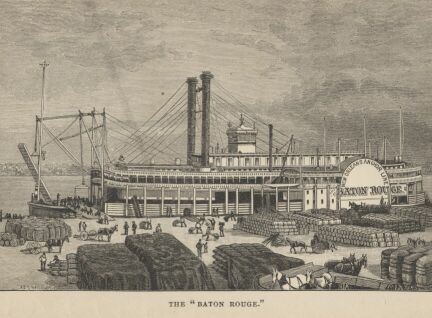
My chief was presently hired to go on a big New Orleans boat, and I packed my satchel and went with him. She was a grand affair. When I stood in her pilot-house I was so far above the water that I seemed perched ona mountain; and her decks stretched so far away, fore and aft, below me, that I wondered how I could ever have considered the little 'Paul Jones' a large craft. There were other differences, too. The 'Paul Jones's 'pilot-house was a cheap, dingy, battered rattle-trap, cramped for room: but here was a sumptuous glass temple; room enough to have a dance in; showy red and gold window-curtains; an imposing sofa; leather cushions and a back to the high bench where visiting pilots sit, to spin yarns and 'look at the river;' bright, fanciful 'cuspadores' instead of abroad wooden box filled with sawdust; nice new oil-cloth on the floor;a hospitable big stove for winter; a wheel as high as my head, costly with inlaid work; a wire tiller-rope; bright brass knobs for the bells; and a tidy, white-aproned, black 'texas-tender,' to bring up tarts and ices and coffee during mid-watch, day and night.  Now this was 'something like,' and so I began to take heart once more to believe that piloting was a romantic sort of occupation after all.  The moment we were under way I began to prowl about the great steamer and fill myself with joy. She was as clean and as dainty as a drawing-room; when I looked down her long, gilded saloon, it was like gazing through a splendid tunnel; she had an oil-picture, by some gifted sign-painter, on every stateroom door; she glittered with no end of prism-fringed chandeliers; the clerk's office was elegant, the bar was marvelous, and the bar-keeper had been barbered and upholstered at incredible cost.  The boiler deck (i.e. the second story of the boat, so to speak) was as spacious as a church, it seemed to me; so with the forecastle; and there was no pitiful handful of deckhands, firemen, and roustabouts down there, but a whole battalion of men. The fires were fiercely glaring from a long row of furnaces, and over them were eight huge boilers!  This was unutterable pomp. The mighty engines--but enough of this.  I had never felt so fine before. And when I found that the regiment of natty servants respectfully 'sir'd' me, my satisfaction was complete.
            -from Chpt VI, “A Cub Pilot’s Experience”

The second part of the work, Twain decides to return to the river a couple of decades later and journey incognito.  He wants to see what is changed on the river from the pre-Civil War days to the industrialized Gilded Age.   

AFTER twenty-one years' absence, I felt a very strong desire to see the river again, and the steamboats, and such of the boys as might be left; so I resolved to go out there.  I enlisted a poet for company, and a stenographer to 'take him down, 'and started westward about the middle of April.

As I proposed to make notes, with a view to printing, I took some thought as to methods of procedure.  I reflected that if I were recognized, on the river, I should not be as free to go and come, talk, inquire, and spy around, as I should be if unknown; I remembered that it was the custom of steam boatmen in the old times to load up the confiding stranger with the most picturesque and admirable lies, and put the sophisticated friend off with dull and ineffectual facts: so I concluded, that, from a business point of view, it would be an advantage to disguise our party with fictitious names.  The idea was certainly good, but it bred infinite bother; for although Smith, Jones, and Johnson are easy names to remember when there is no occasion to remember them, it is next to impossible to recollect them when they are wanted.  How do criminals manage to keep a brand-new ALIAS in mind?  This is a great mystery. I was innocent; and yet was seldom able to lay my hand on my new name when it was needed; and it seemed to me that if I had had a crime on my conscience to further confuse me, I could never have kept the name by meat all.

We left per Pennsylvania Railroad, at 8 A.M. April 18.
            -from Chpt XXII, “I Return to My Muttons”

And so he is going incognito since in the interim years he had become world famous as a writer.  The fact that he left by railroad is germane.  What in the 1850s was the most natural way to head down the center of the country, that is by river boat, was now outdated.  The industrial revolution had created better, more efficient means of traversing the huge country, railroad. 

The further we drove in our inspection-tour, the more sensibly I realized how the city had grown since I had seen it last; changes in detail became steadily more apparent and frequent than at first, too: changes uniformly evidencing progress, energy, prosperity.

But the change of changes was on the 'levee.' This time, a departure from the rule. Half a dozen sound-asleep steamboats where I used to see a solid mile of wide-awake ones!  This was melancholy, this was woeful. The absence of the pervading and jocund steam boatman from the billiard-saloon was explained.  He was absent because he is no more. His occupation is gone,
his power has passed away, he is absorbed into the common herd, he grinds at the mill, a shorn Samson and inconspicuous.  Half a dozen lifeless steamboats, a mile of empty wharves, a negro fatigued with whiskey stretched asleep, in a wide and soundless vacancy, where the serried hosts of commerce used to contend!  Here was desolation, indeed.

'The old, old sea, as one in tears,
Comes murmuring, with foamy lips,
And knocking at the vacant piers,
Calls for his long-lost multitude of ships.'

 
The towboat and the railroad had done their work, and done it well and completely. The mighty bridge, stretching along over our heads, had done its share in the slaughter and spoliation.
Remains of former steamboat men told me, with wan satisfaction, that the bridge doesn't pay. Still, it can be no sufficient compensation to a corpse, to know that the dynamite that laid him
out was not of as good quality as it had been supposed to be.
 

The pavements along the river front were bad: the sidewalks were rather out of repair; there was a rich abundance of mud.  All this was familiar and satisfying; but the ancient armies of drays, and struggling throngs of men, and mountains of freight, were gone; and Sabbath reigned in their stead. The immemorial mile of cheap foul doggeries remained, but business was dull with them; the multitudes of poison-swilling Irishmen had departed, and in their places were a few scattering handfuls of ragged negroes, some drinking, some drunk, some nodding, others asleep.  St. Louis is a great and prosperous and advancing city; but the river-edge of it seems dead past resurrection.

Mississippi steam boating was born about 1812; at the end of thirty years, it had grown to mighty proportions; and in less than thirty more, it was dead! A strangely short life for so majestic a creature.  Of course it is not absolutely dead, neither is a crippled octogenarian who could once jump twenty-two feet on level ground; but as contrasted with what it was in its prime vigor, Mississippi steam boating maybe called dead.

It killed the old-fashioned keel-boating, by reducing the freight-trip to New Orleans to less than a week.  The railroads have killed the steamboat passenger traffic by doing in two or three days what the steamboats consumed a week in doing; and the towing-fleets have killed the through-freight traffic by dragging six or seven steamer-loads of stuff down the river at a time, at an expense so trivial that steamboat competition was out of the question.
            -from Chpt XXII, “I Return to My Muttons”

In that interim period, Twain had also left living in the south and became a northerner.  The return to southern culture certainly pulls him back into his roots, providing a divide between who he was and who he is now.  As one might expect with Twain, language is part of the dichotomy.  Here he has traveled down to New Orleans and starts hearing distinctions.

I found the half-forgotten Southern intonations and elisions as pleasing to my ear as they had formerly been.  A Southerner talks music. At least it is music to me, but then I was born in the South. The educated Southerner has no use for an r, except at the beginning of a word.  He says 'honah,' and 'dinnah,' and 'Gove'nuh,' and 'befo' the waw,' and so on. The words may lack charm to the eye, in print, but they have it to the ear. When did the r disappear from Southern speech, and how did it come to disappear?  The custom of dropping it was not borrowed from the North, nor inherited from England. Many Southerners--most Southerners--put a y into occasional words that begin with the k sound.  For instance, they say Mr. K'yahtah (Carter) and speak of playing k'yahds or of riding in the k'yahs. And they have the pleasant custom--long ago fallen into decay in the North--of frequently employing the respectful 'Sir.'  Instead of the curt Yes, and the abrupt No, they say 'Yes, Suh', 'No, Suh.'

But there are some infelicities. Such as 'like' for 'as,' and the addition of an 'at' where it isn't needed.  I heard an educated gentleman say, 'Like the flag-officer did.'  His cook or his butler would have said, 'Like the flag-officer done.'  You hear gentlemen say, 'Where have you been at?' And here isthe aggravated form--heard a ragged street Arab say it to a comrade:'  I was a-ask'n'  Tom whah you was a-sett'n' at.' The very elect carelessly say 'will' when they mean 'shall'; and many of them say, 'I didn't go to do it,' meaning 'I didn't mean to do it.'  The Northern word 'guess'--imported from England, where it used to be common, and now regarded by satirical Englishmen as a Yankee original--is but little used among Southerners.  They say 'reckon.' They haven't any 'doesn't' in their language; they say 'don't' instead. The unpolished often use 'went' for 'gone.'  It is nearly as bad as the Northern 'hadn't ought.' This reminds me that a remark of a very peculiar nature was made here in my neighborhood (in the North) a few days ago: 'He hadn't ought to have went.  'How is that? Isn't that a good deal of a triumph?  One knows the orders combined in this half-breed's architecture without inquiring: one parent Northern, the other Southern.  To-day I heard a schoolmistress ask, 'Where is John gone?'This form is so common--so nearly universal, in fact--that if she had used 'whither' instead of 'where,' I think it would have sounded like an affectation.
                        -from Chpt XLIV, “City Sights” 

For Twain the sound of a language, its nuances, are just as much a locator of time and place than is the rugged landscape. 

Thursday, February 13, 2014

Lines I Wished I’d Written: My Boyhood's Home by Mark Twain

There are several movements in Twain’s Life on the Mississippi; one of them is a return back to Twain’s boyhood.  As Twain journey's back up the river, he journey's back to his youth.  I gave a little excerpt under “Lines I Wished I’d Written” of Twain’s boyhood ambition of being a steamboat pilot on the grand river, but toward the end of the memoir Twain returns to his boyhood home of Hannibal.  This little vignette provides a nice complement to that boyhood passage.  In this work Twain doesn’t hit you over the head with biting humor, but he does have his tongue in cheek here and there.  Here he returns home after twenty-nine years and anonymously starts enquiring about many of the friends and folk he knew.  Finally he enquires about himself and gets a startling answer.  From chapter LIII, “My Boyhood’s Home.” 

At seven in the morning we reached Hannibal, Missouri, where my boyhood was spent. I had had a glimpse of it fifteen years ago, and another glimpse six years earlier, but both were so brief that they hardly counted.  The only notion of the town that remained in my mind was the memory of it as I had known it when I first quitted it twenty-nine years ago. That picture of it was still as clear and vivid to me as a photograph.  I stepped ashore with the feeling of one who returns out of a dead-and-gone generation. I had a sort of realizing sense of what the Bastille prisoners must have felt when they used to come out and look upon Paris after years of captivity, and note how curiously the familiar and the strange were mixed together before them. I saw the new houses--saw them plainly enough--but they did not affect the older picture in my mind, for through their solid bricks and mortar I saw the vanished houses, which had formerly stood there, with perfect distinctness.
It was Sunday morning, and everybody was abed yet. So I passed through the vacant streets, still seeing the town as it was, and not as it is, and recognizing and metaphorically shaking hands with a hundred familiar objects which no longer exist; and finally climbed Holiday's Hill to get a comprehensive view.  The whole town lay spread out below me then, and I could mark and fix every locality, every detail. Naturally, I was a good deal moved. I said, 'Many of the people I once knew in this tranquil refuge of my childhood are now in heaven; some, I trust, are in the other place.'  The things about me and before me made me feel like a boy again--convinced me that I was a boy again, and that I had simply been dreaming an unusually long dream; but my reflections spoiled all that; for they forced me to say, 'I see fifty old houses down yonder, into each of which I could enter and find either a man or a woman who was a baby or unborn when I noticed those houses last, or a grandmother who was a plump young bride at that time.'
From this vantage ground the extensive view up and down the river, and wide over the wooded expanses of Illinois, is very beautiful-- one of the most beautiful on the Mississippi, I think; which is a hazardous remark to make, for the eight hundred miles of river between St. Louis and St. Paul afford an unbroken succession of lovely pictures. It may be that my affection for the one in question biases my judgment in its favor; I cannot say as to that.  No matter, it was satisfyingly beautiful to me, and it had this advantage over all the other friends whom I was about to greet again: it had suffered no change; it was as young and fresh and comely and gracious as ever it had been; whereas, the faces of the others would be old, and scarred with the campaigns of life, and marked with their griefs and defeats, and would give me no upliftings of spirit.
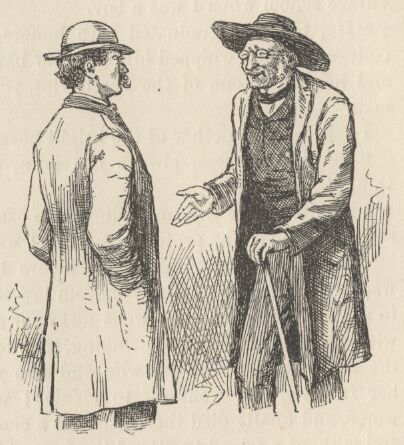
An old gentleman, out on an early morning walk, came along, and we discussed the weather, and then drifted into other matters. I could not remember his face. He said he had been living here twenty-eight years.  So he had come after my time, and I had never seen him before.  I asked him various questions; first about a mate of mine in Sunday school--what became of him?
'He graduated with honor in an Eastern college, wandered off into the world somewhere, succeeded at nothing, passed out of knowledge and memory years ago, and is supposed to have gone to the dogs.'
'He was bright, and promised well when he was a boy.'
'Yes, but the thing that happened is what became of it all.'
I asked after another lad, altogether the brightest in our village school when I was a boy.
'He, too, was graduated with honors, from an Eastern college; but life whipped him in every battle, straight along, and he died in one of the Territories, years ago, a defeated man.'
I asked after another of the bright boys.
'He is a success, always has been, always will be, I think.'
I inquired after a young fellow who came to the town to study for one of the professions when I was a boy.
'He went at something else before he got through--went from medicine to law, or from law to medicine--then to some other new thing; went away for a year, came back with a young wife; fell to drinking, then to gambling behind the door; finally took his wife and two young children to her father's, and went off to Mexico; went from bad to worse, and finally died there, without a cent to buy a shroud, and without a friend to attend the funeral.'
'Pity, for he was the best-natured, and most cheery and hopeful young fellow that ever was.'
I named another boy.
'Oh, he is all right. Lives here yet; has a wife and children, and is prospering.'
Same verdict concerning other boys.
I named three school-girls.
'The first two live here, are married and have children; the other is long ago dead--never married.'
I named, with emotion, one of my early sweethearts.
'She is all right. Been married three times; buried two husbands, divorced from the third, and I hear she is getting ready to marry an old fellow out in Colorado somewhere. She's got children scattered around here and there, most everywheres.'
The answer to several other inquiries was brief and simple--
'Killed in the war.'
I named another boy.
'Well, now, his case is curious! There wasn't a human being in this town but knew that that boy was a perfect chucklehead; perfect dummy; just a stupid ass, as you may say. Everybody knew it, and everybody said it. Well, if that very boy isn't the first lawyer in the State of Missouri to-day, I'm a Democrat!'
'Is that so?'
'It's actually so. I'm telling you the truth.'
'How do you account for it?'
'Account for it? There ain't any accounting for it, except that if you send a damned fool to St. Louis, and you don't tell them he's a damned fool they'll never find it out.  There's one thing sure--if I had a damned fool I should know what to do with him: ship him to St. Louis--it's the noblest market in the world for that kind of property. Well, when you come to look at it all around, and chew at it and think it over, don't it just bang anything you ever heard of?'
'Well, yes, it does seem to. But don't you think maybe it was the Hannibal people who were mistaken about the boy, and not the St. Louis people'
'Oh, nonsense! The people here have known him from the very cradle--they knew him a hundred times better than the St. Louis idiots could have known him. No, if you have got any damned fools that you want to realize on, take my advice--send them to St. Louis.'
I mentioned a great number of people whom I had formerly known.  Some were dead, some were gone away, some had prospered, some had come to naught; but as regarded a dozen or so of the lot, the answer was comforting:
'Prosperous--live here yet--town littered with their children.'
I asked about Miss ----

Died in the insane asylum three or four years ago--never was out of it from the time she went in; and was always suffering, too; never got a shred of her mind back.'
If he spoke the truth, here was a heavy tragedy, indeed.  Thirty-six years in a madhouse, that some young fools might have some fun!  I was a small boy, at the time; and I saw those giddy young ladies come tiptoeing into the room where Miss ---- sat reading at midnight by a lamp.  The girl at the head of the file wore a shroud and a doughface, she crept behind the victim, touched her on the shoulder, and she looked up and screamed, and then fell into convulsions.  She did not recover from the fright, but went mad. In these days it seems incredible that people believed in ghosts so short a time ago.  But they did.
After asking after such other folk as I could call to mind, I finally inquired about MYSELF:
'Oh, he succeeded well enough--another case of damned fool.  If they'd sent him to St. Louis, he'd have succeeded sooner.'
It was with much satisfaction that I recognized the wisdom of having told this candid gentleman, in the beginning, that my name was Smith.

Excerpted cited from Literature Network. 

The old gentleman that Twain interrogates here is just that perfect crusty character (kind of reminds me of me in my opinionated moments!) who has been at one place so long he knows everyone and has a snippy opinion of them.  Makes for perfect comic layering.

Sunday, January 19, 2014

Lines I Wished I’d Written: A Boy’s Ambition by Mark Twain

I’ve been reading Mark Twain’s Life on the Mississippi and thought this passage was well worth sharing.  It comes from Chapter 4, titled, “A Boy’s Ambition.”  Life on the Mississippi is a sort of memoir looking back to Twain’s years as a steamboat pilot on Mississippi River. 

 
WHEN I was a boy, there was but one permanent ambition among my comrades in our village {footnote [1. Hannibal, Missouri]} on the west bank of the Mississippi River. That was, to be a steamboatman. We had transient ambitions of other sorts, but they were only transient.

When a circus came and went, it left us all burning to become clowns; the first negro minstrel show that came to our section left us all suffering to try that kind of life; now and then we had a hope that if we lived and were good, God would permit us to be pirates. These ambitions faded out, each in its turn; but the ambition to be a steamboatman always remained.
 

Once a day a cheap, gaudy packet arrived upward from St. Louis, and another downward from Keokuk. Before these events, the day was glorious with expectancy; after them, the day was a dead and empty thing. Not only the boys, but the whole village, felt this. After all these years I can picture that old time to myself now, just as it was then: the white town drowsing in the sunshine of a summer's morning; the streets empty, or pretty nearly so; one or two clerks sitting in front of the Water Street stores, with their splint-bottomed chairs tilted back against the wall, chins on breasts, hats slouched over their faces, asleep-- with shingle-shavings enough around to show what broke them down; a sow and a litter of pigs loafing along the sidewalk, doing a good business in watermelon rinds and seeds; two or three lonely little freight piles scattered about the 'levee;' a pile of 'skids' on the slope of the stone-paved wharf, and the fragrant town drunkard asleep in the shadow of them; two or three wood flats at the head of the wharf, but nobody to listen to the peaceful lapping of the wavelets against them; the great Mississippi, the majestic, the magnificent Mississippi, rolling its mile-wide tide along, shining in the sun; the dense forest away on the other side; the 'point' above the town, and the 'point' below, bounding the river-glimpse and turning it into a sort of sea, and withal a very still and brilliant and lonely one. Presently a film of dark smoke appears above one of those remote 'points;' instantly a negro drayman, famous for his quick eye and prodigious voice, lifts up the cry, 'S-t-e-a-m-boat a-comin'!' and the scene changes!  The town drunkard stirs, the clerks wake up, a furious clatter of drays follows, every house and store pours out a human contribution, and all in a twinkling the dead town is alive and moving.

Drays, carts, men, boys, all go hurrying from many quarters to a common center, the wharf.  Assembled there, the people fasten their eyes upon the coming boat as upon a wonder they are seeing for the first time. And the boat IS rather a handsome sight, too. She is long and sharp and trim and pretty; she has two tall, fancy-topped chimneys, with a gilded device of some kind swung between them; a fanciful pilot-house, a glass and 'gingerbread', perched on top of the 'texas' deck behind them; the paddle-boxes are gorgeous with a picture or with gilded rays above the boat's name; the boiler deck, the hurricane deck, and the texas deck are fenced and ornamented with clean white railings; there is a flag gallantly flying from the jack-staff; the furnace doors are open and the fires glaring bravely; the upper decks are black with passengers; the captain stands by the big bell, calm, imposing, the envy of all; great volumes of the blackest smoke are rolling and tumbling out of the chimneys--a husbanded grandeur created with a bit of pitch pine just before arriving at a town; the crew are grouped on the forecastle; the broad stage is run far out over the port bow, and an envied deckhand stands picturesquely on the end of it with a coil of rope in his hand; the pent steam is screaming through the gauge-cocks, the captain lifts his hand, a bell rings, the wheels stop; then they turn back, churning the water to foam, and the steamer is at rest. Then such a scramble as there is to get aboard, and to get ashore, and to take in freight and to discharge freight, all at one and the same time; and such a yelling and cursing as the mates facilitate it all with!  Ten minutes later the steamer is under way again, with no flag on the jack-staff and no black smoke issuing from the chimneys.  After ten more minutes the town is dead again, and the town drunkard asleep by the skids once more.

Excerpted cited from Literature Network. 

Isn’t that a lovely passage, full of imagery and pantomime?