This
is Alice’s July newsletter. I explained Alice’s monthly newsletter here.This month focuses on the Sacred Heart of
Jesus.
Before
the newsletter, let us pray: For Pope Leo XIV
Hail
Mary, full of grace…
Hail
Mary, full of grace…
Hail
Mary, full of grace…
St.
Michael the Archangel, defend us in battle; be our protection against the
wickedness and snares of the devil; may God rebuke him, we humbly pray, and do
thou, O Prince of the Heavenly Host, by the power of God, thrust into hell
Satan and all the evil spirits who prowl about the world seeking the ruin of
souls.
Handmaids of Mary St. Michael’s Warriors
July 2026 Newsletter
“The scapular will be for all the sign of our Consecration
to the Immaculate Heart of Mary.”
~Pope
Pius XII
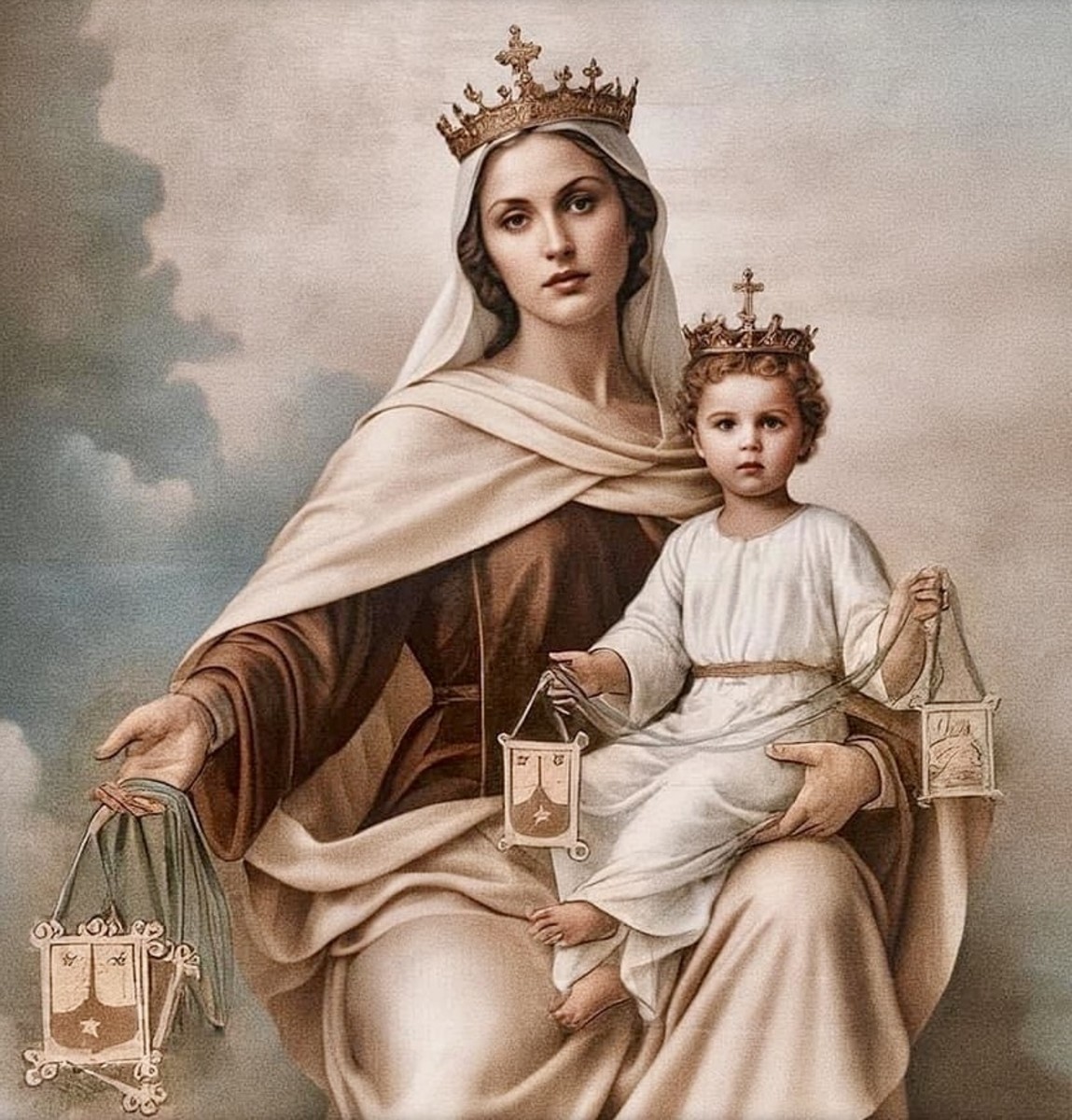
This month on the 16th is the feast of Our Lady of Mt.
Carmel, when Our Lady appeared to St. Simon Stock and gave him the brown
scapular.
Mt. Carmel is in northern Israel near the city of
Haifa.It is also where Elijah
challenged the pagan prophets and revealed the true God (1 Kings 18:16-45).
It is written on the Scapular, “whoever dies while wearing
this scapular shall not suffer eternal fire.”
This, the Sabbatine Privilege, was added to the Brown
Scapular by Pope John XII, making it an official church belief that Mary will
intercede and rescue those who die wearing the Brown Scapular on the first
Saturday after their death.
The Brown Scapular not only spares us the fires of hell, but
we will be quickly delivered from purgatory!!!!
Sursum corda. Can we wonder that the church whose mission is
to soothe the sorrows of our time is always seeking to lift up our hearts by
the treasures we have in the Catholic faith?One of the means by which the Church enables us to participate in her
treasures of grace is with sacramentals.
The Holy Spirit guided me this month to these sacramentals.
1. The Crucifix
One of our most treasured sacramentals is the crucifix.It is the image of Christ on the cross as the
victim for our sins, the price of our redemption.Meditation on the crucifix is one of the most
powerful means of awakening sentiments of sorrow for sin.
The crucifix should be place in a fitting and proper place
in the home, where each may glance at it frequently and think, if only for an
instant, of the love of Him whom it represents and the instrument of our
salvation.
“O Holy Cross, be my victor over all hostile powers, the
remedy for all my ills, my support in my weariness and the guarantee of the
resurrection of my body” Amen.
2. The Sign of the Cross
For Catholics the sign of the cross is a shield and a
safeguard against temptations and dangers that threaten the life of the soul.
St Cyril of Jerusalem said that when we make the sign of the cross the demons
see it, they are reminded of the crucified, and they take flight and hide
themselves and leave us.
All sacraments are administered with the sign of the cross:
in baptism fourteen times, and in the Sacrament of the Sick (Extreme Unction)
twelve times.In the mass no less than
45 times. It occurs with great frequency in the recitation of the Divine
Office.In addition, the Church grants
an indulgence of three years as often as one makes the sign of the cross, and,
as often as the sign of the cross is made with holy watery, an indulgence of
seven years.
3. Holy Water
Water was one of the first objects to be blessed by the
church for use as a sacramental.
It is the common teaching of theologians that holy water
confers actual graces, remits venial sin, and restrains the power of
Satan.It is also an efficacious means
for the relief of the souls in purgatory.As often as we use it devoutly, our good Mother, the church, implores
for us aid, consolation, and strength to do good and avoid evil.
Every Christian home should have a holy water font.These should be placed in convenient places
so that holy water may be taken frequently by the members of the family.May fear of ridicule never deter us from
making use of so a means of grace, both for ourselves and our dear ones, and
for the faithful departed.
Through the sacramentals:
“The lord will grant you love, holy and pure.You will forget the world’s fears.Ah much more, the devil too.Now the demon is manacled today.”
~St.
Therese of Avila
Handmaids of Mary and men of St. Michaels Warriors are
called to greater faith in the Blessed Mother, believing that She will defeat
the devil and bring unity and peace to our beloved Catholic Church.All Mary had to do at Cana was mention to
Jesus “they have no wine,” and Jesus filled all the water jugs with wine.Our part is to trust in Her Power.
“Who is She that comes forth as the Dawn…Terrible as an army
set in battle array…”
Hat tip to Alice for suggesting this would make a good blog
post.
This is my commentary on the Office of Readings for May 19th
2026, a couple of days ago, which was an excerpt from St. Basil’s treatise, On
the Holy Spirit.It has an extra
significance with the weeks leading to Pentecost.
St.
Basil the Great (330-379 AD), or sometimes referred to as St. Basil of
Casearia, was roughly contemporaneous with St. Augustine of Hippo.In some respects, St. Basil is the Eastern
Church’s equivalent to how we hold St. Augustine in the Western Church.Both were hugely influential theologians from
which subsequently flowed doctrine and spirituality.
Just as Augustine addressed several heresies in his
treatises, Basil responds to Pneumatomachianism, which taught that the Holy
Spirit is not God, with On the Holy Spirit,.You can read the entire treatise at New
Advent.The Office of Readings takes
a passage from Chapter 9 of On the Holy Spirit and breaks it down into seven
paragraphs. I will quote the paragraph
and comment below it.
†††
From office of readings May 19th 2026 Second reading From the treatise On the Holy Spirit by Saint Basil the
Great, bishop The work of the Holy Spirit
Paragraph 1:
The titles given to the Holy Spirit
must surely stir the soul of anyone who hears them, and make him realize that
they speak of nothing less than the supreme Being. Is he not called the Spirit
of God, the Spirit of truth who proceeds from the Father, the steadfast Spirit,
the guiding Spirit? But his principal and most personal title is the Holy
Spirit.
Paragraphs
691 and 692 of the Catechism of the Catholic Church lists a number of other
names for the Holy Spirit.Let us list
them all, including the ones St. Basil identifies:
the Spirit of God, Spirit of truth, the steadfast Spirit, the
guiding Spirit, the Holy Spirit, the Paraclete, advocatus (the advocate), consoler,
the Spirit of the promise, the Spirit of adoption, the Spirit of Christ, the
Spirit of the Lord, the Spirit of God, the Spirit of glory.
Paragraph 2:
To the Spirit all creatures turn in
their need for sanctification; all living things seek him according to their
ability. His breath empowers each to achieve its own natural end.
Interesting St. Basil says that “all living things seek him
according to their ability.”Other than
mankind, what other creature did St. Basil have in mind that has the ability to
seek him?All animals have breath, and
so perhaps he considers the breath of the Holy Spirit empowering animals to
their natural end?Is the act of
breathing a supernatural sanctification of the Holy Spirit?It provides life at every moment.From the Nicene Creed, the Holy Spirit is “the
Lord, the giver of life.”
Paragraph 3:
The Spirit is the source of
holiness, a spiritual light, and he offers his own light to every mind to help
it in its search for truth. By nature the Spirit is beyond the reach of our
mind, but we can know him by his goodness. The power of the Spirit fills the
whole universe, but he gives himself only to those who are worthy, acting in
each according to the measure of his faith.
Quoting St. Paul: “Paul, a slave of Christ Jesus, called to
be an apostle and set apart for the gospel of God, which he promised previously
through his prophets in the holy scriptures, the gospel about his Son,
descended from David according to the flesh, but established as Son of God in
power according to the spirit of holiness through resurrection from the dead,
Jesus Christ our Lord” (Rom 1:1-4).
The Holy Spirit is the source of holiness because it
sanctifies, just as he sanctified our Lord, and so was the source of Christ’s power.
Paragraph 4:
Simple in himself, the Spirit is
manifold in his mighty works. The whole of his being is present to each
individual; the whole of his being is present everywhere. Though shared in by
many, he remains unchanged; his self giving is no loss to himself. Like the
sunshine, which permeates all the atmosphere, spreading over land and sea, and
yet is enjoyed by each person as though it were for him alone, so the Spirit
pours forth his grace in full measure, sufficient for all, and yet is present
as though exclusively to everyone who can receive him. To all creatures that
share in him he gives a delight limited only by their own nature, not by his
ability to give.
Contemplate this: The Spirit is present everywhere but yet
present distinctly in each individual.He
permeates everywhere, thereby sanctifying everything, and always
unchanged.He is eternally self-giving
but yet is never diminished.
Paragraph 5:
The Spirit raises our hearts to
heaven, guides the steps of the weak, and brings to perfection those who are
making progress. He enlightens those who have been cleansed from every stain of
sin and makes them spiritual by communion with himself.
Priest: The Lord be with you. People: And with your spirit. Priest: Lift up your hearts. People: We lift them up to the
Lord. Priest: Let us give thanks to the
Lord, our God. People: It is right and just.
“And with your spirit” is a reference of the power of the
Holy Spirit at work through the priest.With
that acknowledgement, the priest exhorts the congregation to lift up their
hearts.From the power of the Spirit the
congregation then lifts them up.
Paragraph 6:
As clear, transparent substances
become very bright when sunlight falls on them and shine with a new radiance,
so also souls in whom the Spirit dwells, and who are enlightened by the Spirit,
become spiritual themselves and a source of grace for others.
“After six days Jesus took Peter, James, and John his
brother, and led them up a high mountain by themselves.And he was transfigured before them; his face
shone like the sun and his clothes became white as light. And behold, Moses and Elijah appeared to them,
conversing with him. Then Peter said to Jesus in reply, “Lord, it is good that
we are here. If you wish, I will make three tents here, one for you, one for
Moses, and one for Elijah.” While he was
still speaking, behold, a bright cloud cast a shadow over them, then from the
cloud came a voice that said, “This is my beloved Son, with whom I am well
pleased; listen to him” (Mt 17:1-5).
The light that emanates from Jesus’s face comes from the
Holy Spirit burning through Him.The
Holy Spirit is there in the scene as the cloud that casts a shadow.The glow in Jesus is a foreshadow of the glow
when we achieve perfect holiness, either in this life or more likely in the
next.
Paragraph 7:
From the Spirit comes foreknowledge
of the future, understanding of the mysteries of faith, insight into the hidden
meaning of Scripture, and other special gifts. Through the Spirit we become
citizens of heaven, we enter into eternal happiness, and abide in God. Through
the Spirit we acquire a likeness to God; indeed, we attain what is beyond our
most sublime aspirations—we become God.
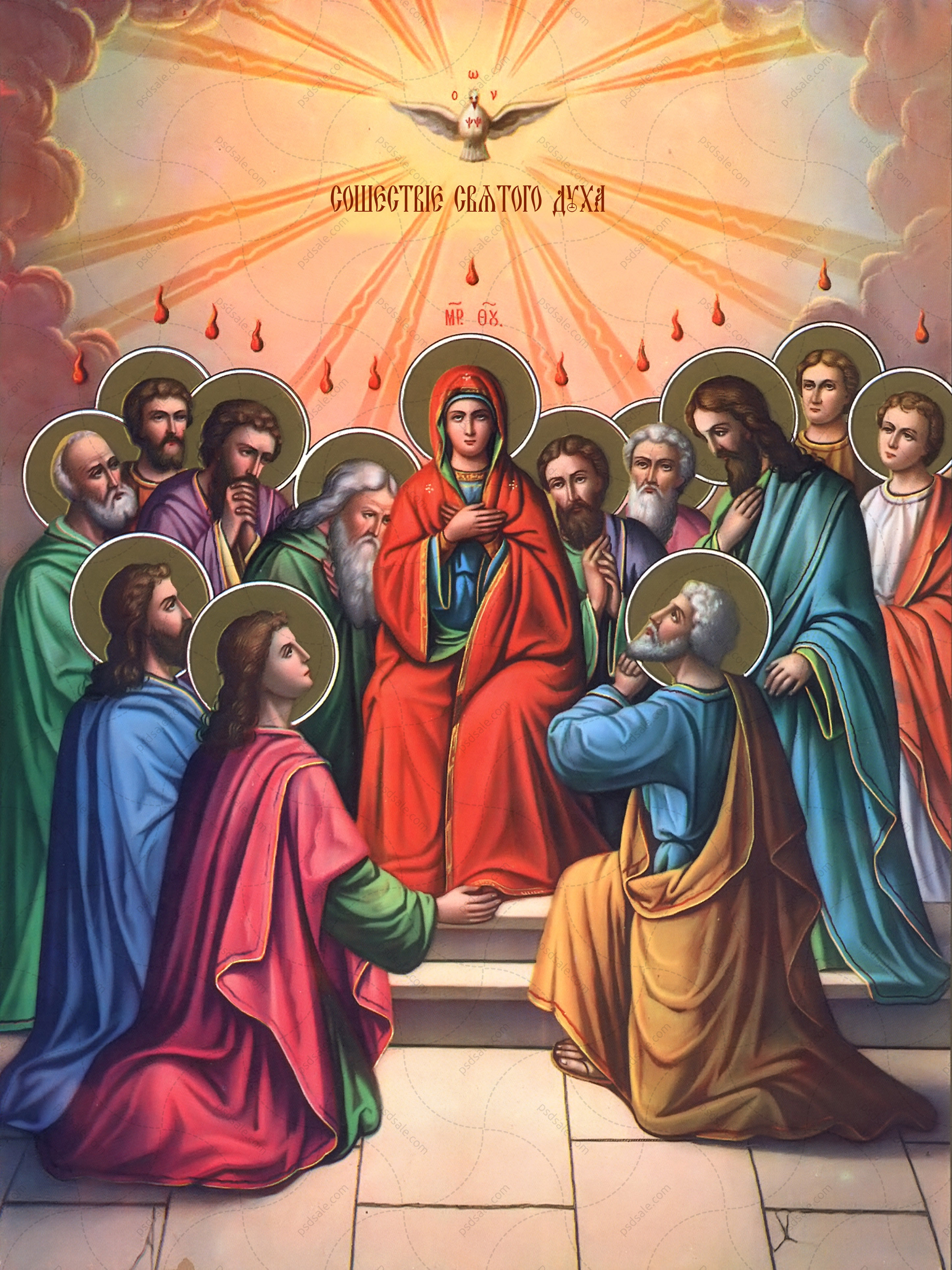
We can only wait for that glorious day with hope and faith.This Sunday we celebrate Pentecost, the
descent of the Holy Spirit.It fulfills
Jesus’s promise that He will send the Paraclete to complete the apostle’s
baptisms.From the Gospel of John: “He
breathed on them and said to them, "Receive the Holy Spirit.Whose sins you forgive are forgiven them, and
whose sins you retain are retained” (Jn 20: 22-23).
The Sixth Sunday of Easter—the second to last
Sunday of the season—continues with Jesus’s Last Discourse, and, if you notice,
these discourses are focused on the coming of the Holy Spirit.These Gospel readings, then, set the stage
for Pentecost, the descent of the Holy Spirit.Jesus tells the disciples that after He dies and rises and stays with
them for a while (forty days) the Holy Spirit will come to them.
I’ve been impressed with the Gospel reflections
of Gina Hens-Piazza who provides reflections at America magazine.She
points out this week that Jesus in this passage is defining what love is.
Jesus, however, is suggesting a different relationship between love and
obedience. He never threatens to withhold love, even when we turn away from the
commandments. Instead, he makes obedience to the commandments the means by
which we love one another. The concrete nature of love in human relationships
becomes the means by which we love him. After all, whether they be mandates of
commission or omission, commandments such as “Honor your father and mother” or
“You shall not commit adultery” aim specifically at cultivating and preserving
loving relationships among people. For Jesus, love is not contingent upon
obedience but is the product of obedience. Divine commandments facilitate love
of one another and result in love of Jesus.
Love in the Christian sense is certainly more
complex than an emotional feeling.
Today’s Gospel:
Jesus said to his disciples:
“If you love me, you will keep my commandments.
And I will ask the Father,
and he will give you another Advocate to be with you always,
the Spirit of truth, whom the world cannot accept,
because it neither sees nor knows him.
But you know him, because he remains with you,
and will be in you.
I will not leave you orphans; I will come to you.
In a little while the world will no longer see me,
but you will see me, because I live and you will live.
On that day you will realize that I am in my Father
and you are in me and I in you.
Whoever has my commandments and observes them
is the one who loves me.
And whoever loves me will be loved by my Father,
and I will love him and reveal myself to him.”
~Jn:14: 15-21
Today’s reflection comes from Fr. Greg Heille O.P. from St. Louis.He is one of the Dominican friars from the
St. Albert the Great Province that provides these “Know Before You Go”
homilies.Fr. Greg rightly emphasizes
the foretelling of the coming of the Holy Spirit in this passage.
Fr. Greg:
Our Jewish brothers
and sisters celebrate a holiday that is called the Festival of Weeks which is
held seven weeks and one day, or 50 days, after Passover…Well fifty days
translates to Pentecost, and so we have in two weeks from now the solemn Feast
of Pentecost, 50 days after our celebration of our Easter Sunday.Early in our Easter season our celebration
was all about “Alleluia, He is Risen, He is Risen Indeed!”But now late in the Easter season our
celebration has more of a spirit of “Veni Sancte Spiritus, Come Holy Spirit."
In a way the Gospel
from John 14 looks ahead to the next four weeks of celebration in our
liturgical cycle.A week from now we
will celebrate the Feast of the Ascension…Our Gospel today in a way gives a
hint of ascension because as we think about Jesus ascending into heaven we can wonder
where is He now.And our Gospel today,
John 14, says, “I will not leave you orphans.I will come to you.”“I will ask
the Father, and he will give you another Advocate to be with you always.”The word advocate in Greek is paraclete, and
its etymology is “one who is called aside to help.”A helper.
So as we approach
Pentecost we ae being promised by Jesus a paraclete, one who will walk along
side of us to help.We will not be left
as orphans…Jesus was brought to life in the Spirit.The Spirit walked with Jesus as His
helper.He was raised to life in the Spirit…And
we begin to realize that what God has done for Jesus so too He does for us.He raises us up in the Spirit.He walks along side of us as a companion, an advocate,
a helper.
That is the heart of our lives in the Spirit.We have a “vital connection to Christ and the
Father through the Holy Spirit.”Be sure
to listen to the end to where Fr. Greg explains that synodality is a walking of
us all together on the Way.
For the pastoral homily, Cardinal Blasé Cupich of Archdiocese of Chicago
combined this Gospel passage with a link to today’s Mother’s Day holiday.
Archbishop Cupich:
We've seen some
remarkable transformations in this group of disciples that formed the early
church.We have Philillip who now very
publicly addresses the people and speaks of Jesus.Philip was the one who wanted death to know
from Jesus the way that he was going.And
Jesus said to him, "How long have you been with me and yet you do not know
me?" But all of a sudden with the gift of the spirit, something changes in
him dramatically.And it occurs to me as
we celebrate Mother's Day that there are many qualities that are reflected in
mothers that we find in this early church that's transformed by the spirit.
The first thing is
the way the the disciples take initiative. Jesus is no longer with them.
They're on their own.And yet they go
out and they make a difference.How
often mothers are the ones in the home who have to take initiative to get
things going. Maybe those times in which there are birthdays or celebrations of
holidays. They're the ones who take the initiative. They're the ones who kind
of learn on the spur of the moment. I remember my own mother who was married
when she was uh a young 22 years old and by the time she was 30, she had six
children and she had to learn how to balance her life and balance being a mother
to all those children. She took initiative much like we see in that early
church.But we also see these early
disciples being willing to adapt and be flexible to the point that there were
new members of the community who were different. We hear about of course the
formation of the deacons. When the Greek Christians felt that they were being
overlooked, the disciples were able to adapt and create a whole new order
within the church that of deacons.They
paid attention to the specifics of the different groups that were there.I think my mother reflected that as well. She
always said that each child was different. The being a parent is not an exact
science simply because there are so many variables in each child that comes
along. She was once asked, "Do you love any of your children more than the
others?" And her answer was swift and clear. No, she said, but only if
they need it.I think that that's the
way each one of us have experienced our mothers as well.That they know us and they look for ways in
which they're going to meet the needs of each one of us in our particular circumstances,
much like the early church was able to do.
Mothers as well were
the point of unity within a family. So often the ones who brought people
together for healing, telling and encouraging us to have forgiveness, but also
the kind of unity that stays with us in our life even when our man mothers pass
from this life. Much like the unity that we hear about in the gospel where
Jesus says, "Even though I will be away from you, I will be in you as my
father is in me and I am in you." How often we are able to carry within us
the voice, the image, the words of our mothers within us. In a way showing us that
the unity within a family is being able to have a sensitivity to the lives of
others but also a fond remembrance of each other no matter what the
circumstances are in life. Even if we are separated by distance or even by
death.
God bless our mothers.They are
the image of Jesus in our lives.
Sunday Meditation: "On
that day you will realize that I am in my Father and you are in me and I in
you.”
How can we not listen to “Veni Creator Spiritus” after Christ’s
foretelling of the Holy Spirit?
January 1st is celebrated as a
religious holiday either to commemorate Christ’s circumcision or to commemorate
His Blessed Mother as the Mother of God, the Theotokos.From Wikipedia:
The Second Vatican Council stated: "Clearly from earliest times the
Blessed Virgin is honoured under the title of Mother of God." and at an
early stage the Church in Rome celebrated on 1 January a feast that it called
the anniversary (Natale) of the
Mother of God. When this was overshadowed by the feasts of the Annunciation and
the Assumption, adopted from Constantinople at the start of the 7th century, 1
January began to be celebrated simply as the octave day of Christmas, the
"eighth day" on which, according to Luke 2:21, the child was
circumcised and given the name Jesus.
In the 13th or 14th century, 1 January began to be celebrated in Rome,
as already in Spain and Gaul, as the feast of the Circumcision of the Lord and
the Octave of the Nativity, while still oriented towards Mary and Christmas,
with many prayers, antiphons and responsories glorifying the maternity of Mary.
Pope John XXIII's General Roman Calendar of 1960 removed the mention of the
circumcision of Jesus and called 1 January simply the Octave of the Nativity.
There is even more to the history, which you
can read for yourself.Today’s Gospel
reading:
The shepherds went in haste to
Bethlehem and found Mary and Joseph,
and the infant lying in the manger.
When they saw this,
they made known the message
that had been told them about this
child.
All who heard it were amazed
by what had been told them by the
shepherds.
And Mary kept all these things,
reflecting on them in her heart.
Then the shepherds returned,
glorifying and praising God
for all they had heard and
seen,
just as it had been told to
them.
When eight days were completed for
his circumcision,
he was named Jesus, the name given
him by the angel
before he was conceived in the womb.
~Lk 2:16-21
It is interesting
that the shepherds “went in haste” where Luke uses the same word as in just the
previous chapter where Mary “went in haste” to visit her cousin Elizabeth.
Here is a wonderful
homily from Fr. James McCurry OFM Con of the Companions of St. Anthony, a Franciscan Friar Conventional association.(Someday I will figure out the various divisions of the Franciscans, but
it always escapes me.)
The homily was delivered in 2021, so don’t be
thrown by his best wishes for the new year of 2021.It is now 2025!
Now for a second homily by another
Franciscan, Fr. Terrance of the Franciscan Friars of the Immaculate.This is a little longer but there is a wealth of knowledge here.
My, my two Franciscans highlighted by a Lay
Dominican.What is the world coming
to.Peace might just ring out…lol. 😋
I love Fr. Terrance.I have been trying to get one of his homilies
into one of these Sunday Meditations ever since I learned of him a little over
a year ago.He is extremely smart.Notice he even quotes a Dominican, St. Thomas
Aquinas at the 9:33 mark where Fr. Terrance provides Aquinas’s definition of
love: “love is to will the good of the other.”(You can read about Aquinas' definition of love in this Word on Fire article by Dr. Tom Neal.)Fr. Terrance also mentions the Sub tuum praesidium the third century papyrus fragment with the earliest Marian prayer.
Solemnity Meditation: “And Mary kept
all these things, reflecting on them in her heart.”
For today’s hymn, what better than the Sub tuum praesidium in an ancient
Gregorian chant, performed here by the sacred music group, Floriani.
Here are the lyrics in Latin:
Sub tuum praesidium
confugimus,
Sancta Dei Genetrix.
Nostras deprecationes ne despicias
in necessitatibus,
sed a periculis cunctis
libera nos semper,
Virgo gloriosa et benedicta
Here is the English translation.
We fly to thy protection,
O Holy Mother of God;
Do not despise our petitions
in our necessities,
but deliver us always
from all dangers,
O Glorious and Blessed Virgin.
You may recognize fragments of the prayer in
the more contemporary (only 500 years old!) Memorareprayer.
Today
is the feast day of the birth of the Blessed Mother. It’s not a holy day of
obligation so it might go unnoticed if you don’t follow the Church calendar. As
many of you know, I’m a Lay Dominican, and the Dominican Order has a special
relationship with the Holy Virgin, and I wanted to share a good article as to
why. As you might know, the Blessed Mother was supposed to have given St.
Dominic the rosary, but there is more than just that. In “Mary, Mother of St.Dominic” by Br. Titus Mary Sanchez, O.P. you can read about our relationship
here.
Filial love of Mary is an
essential aspect of the Dominican character. The Order of Saint Dominic is
Blessed Mary’s Order. Our Order was established by her intercession and has
been sustained by her aid for eight centuries. The Order could not have
survived long if it could only rely upon the wisdom of its men, the learnedness
of its scholars, or the rhetoric of its preachers. If one removed Marian
devotion from our life, what you would find would be unintelligible—it would
simply not be a Dominican friar’s life any longer. Why?
Brother
Titus provides three reasons.I’m just
going to skim them.Please read the
entire article to fully understand.
First,
each friar of the Order of Preachers takes a vow of obedience to the Blessed
Mother.In this way “Our Lady accepts a
friar’s vow as permission to use him however she pleases.”
Second,
the Dominican friar wears a white scapular is gift from the Virgin, given to
Blessed Reginald of Orleans.“Our
habit—our uniform—is from heaven, a gift from our Mother.”
Third,
Dominican friars pray the Salve Regina
and the rosary, which was given to Dominic from the Blessed Mother, daily.
Brother
Titus ends his piece with this wonderful conclusion:
The Order of Preachers is
Mary’s Order. In imitation of St. Dominic, her name ought to be engraved on the
heart of every member of our Order.
It
would be totally appropriate to pray a rosary and/or a Salve Regina today in
her honor.
Oliver
has been searching for his wife ever since she left and now fears she has
become a Catholic or is in the process of euthanasia.He is interrupted by a phone call that the
government has discovered there is a new pope and Felsenburgh has come and
called for a council in which Oliver needs to attend.At the council Oliver hears from Felsenburgh’s
secretary what has come about.Intelligence has learned through the betrayal of Cardinal Dolgorovski
that a new Pope has been elected and has been directing the church from
Nazareth, and that a secret meeting of the leading Catholics is being convened
on the coming Sunday.The President
proposes that each nation in the world send volors over to annihilate all the
heads of the Church and so permanently eliminate all possible succession to the
papacy.The bill is passed.On Saturday Oliver boards the English volor and
travels toward Palestine to be part of the bombing mission.
Book
3, Chapter VI
The
Catholic hierarchy are gathered and crowded at the house in Nazareth, and it is
Pentecost morning.All are gathered
except Cardinal Dolgorovski, and his absence is noticed.Cardinal Corkran recounts a series of events
that explain that Cardinal Dolgorovski has betrayed them, and so it is evident
that the government knows their whereabouts.Pope Silvester says it does not matter.He has had a vision from God of the coming events, and has everyone else
prepare for Mass in two hours.An hour
later the papal attendant priest walks toward the chapel and notices the
country folk rushing to escape.He can
feel the stillness of eternity upon him.At the chapel he falls asleep only to wake in the middle of Mass.As Mass concludes, there is a clamor outside.He goes out to look and it is evident now
that the volors are coming to destroy them.Returning inside he joins the gathered religious in singing the hymn O salutaris hostia.The gathered take the monstrance with the
Blessed Sacrament and process it outside singing the hymn Pange Lingua.And as the
volors approach with their impending arsenal the material world dissolves into
the end of times.
###
I
must have read that section III of the last chapter three or four times.I'm still not sure I got the ending
right.Is it Christ who is be referred
to as the personal pronoun in the repeated "He was coming"?Or is it Felsenburgh?If it is Christ, then my reading above is
correct and it's the apocalypse on which the novel ends, and the victory is the
victory of Christ.If it is Felsenburgh
that is coming, then the novel ends with the destruction of the church and
victory for the atheists.
I
assume the victory is with Christ, or the novel wouldn't make sense.But it is ambiguous, is it not?Is it me?
###
I
have to admit I spent three hours trying to translate all the Latin in that
section III.Finally I realized they
were parts of well-known hymns.Here you
can read about and get the translation of Osalutaris hostia.And here you can read about and get the
translation of Pange lingua gloriosicorporis mysterium.My translation was close in some cases but stilted in others.I wound up taking each part of the Latin
lyric and providing the English translation.Let me give this to you.It may
help in your reading.
Latin
translations of those spoken in Book 3, Chapter VI, Section III
(1)p. 333 [from “O Salutaris Hostia”]
O Salutaris Hostia
// Qui coeli pandis ostium. . .
O
Saving Victim // He opens the door of heaven
(2)
p. 333 [from “O Salutaris Hostia”]
... Uni Trinoque Domino ....
To
the One and Triune Lord.
(3)
p 334 [from “O Salutaris Hostia”]
.. Qui vitam sine termino // Nobis
donet in patria ...._
He
who life without end // Brings us to our home
(4)
p. 334
Pange Lingua
Sing
Tongue
(5)
p. 334 [from Pange Lingua]
..
In suprema nocte coena,_
On
the night of the last supper
(6)
p. 335 [from Pange Lingua]
Recumbens cum fratribus
Observata lège plena
Cibis in legalibus
Cibum turbae duodenae
Se dat suis manibus ....
Reclining
with His brethren,
once
the Law had been fully observed
with
the prescribed foods,
as
food to the gathered Twelve
He
gives Himself with His hands.
(7)
p. 335 [from Pange Lingua]
Verbum caro, panem verum // Verbo
carnem efficit
In
the Word was the true bread // the Word made flesh
(8)
p335 [from Pange Lingua]
Et si census deficit // Ad formandum
cor sincerum // Sola fides sufficit ....
And
if sense is deficient // to form a sincere heart // Faith alone is enough…
(9)
p. 336 [from Pange Lingua]
TANTUM ERGO SACRAMENTUM
VENEREMUR CERNUI
ET ANTIQUUM DOCUMENTUM
NOVA CEDAT RITUI.
Therefore,
the great Sacrament
let
us reverence, prostrate:
and
let the old Covenant
give
way to a new rite.
(10)
p. 336 [from Pange Lingua]
PRAESTET FIDES SUPPLEMENTUM
SENSUUM DEFECTUI ....
May
faith supplement
the
defects of our senses ....
(11)
p. 337 [from Pange Lingua]
.... GENITORI GENITOQUE
LAUS ET JUBILATIO
SALUS HONOR VIRTUS QUOQUE
SIT ET BENEDICTIO
PROCEDENTI AB UTROQUE
COMPAR SIT LAUDATIO.
To
the Begetter and the Begotten
be
praise and jubilation,
greeting,
honour, strength also
and
blessing.
To
the One who proceeds from Both
be
equal praise
(12)
.337 [from Pange Lingua]
PROCEDENTI AB UTROQUE
COMPAR SIT LAUDATIO…
To
the One who proceeds from Both
be
equal praise
###
My
Reply to Irene and Kerstin who mentioned that “Sister” has
a tradition of a title for nurse in England and Germany:
To Irene and Kerstin on
Nursing, I didn't know that. So I now have done some research. It seems the
title "sister" for nurse came about from the middle ages on. Nurses
in hospitals were invariable religious sisters. Actually it may go back all the
way to apostolic times. Phoebe, who is identified as a "deaconess" in
Acts appears to have cared for the sick as part of her responsibilities. The
term apparently stuck in Britain, and I find Benson's use of it to be totally
intentional on his part, carrying the irony that I pointed out earlier.
My
Reply to Joseph on why this dystopian novel doesn’t have
the attention of other great dystopian novels:
Yes. Perhaps more than
just the ending. The religious subject matter itself probably precludes a good
number of people to not care about it. And then there are the Protestants who
recoil from anything Catholic. And then this attacks the secularists
themselves, so they would never buy into it. It's a novel that should be read.
I am going to give it five stars. Except for some minor criticism I pointed out
earlier, this novel should be a classic.
Kerstin
Comment:
Oh my gosh, Manny, this [translation
of Latin] was a herculean endeavor. I was a little disappointed my text didn't
offer the translations. Thank you!
I thought that the novel
ended with Mass and adoration was perfect.
My
Reply to Kerstin:
LOL. it was getting to be
Hurculean. It reminded me of my college days taking Spanish and needing to
translate a passage into English. I was never very good with foreign languages.
Yes, I loved the novel
ending with a Mass and process of the Blessed Sacrament chanting hymns. What a
great movie scene that would make!!
My only criticism of the
ending is that it doesn't seem definitely clear as to what happened. Was it
Christ that was coming with the apocalypse? Or was it Felsenburgh with the
destruction of the church? How do you all read that ending.
Joseph
Reply, agreeing with others that they see the ending as
Christ coming:
It also makes Mabel's
death more ambiguous, it's hard to tell if she dies before Christ's return or
if he comes back in time for her to repent fully which I thought was a really
nice touch.
My
Reply to Joseph:
Hmm, that's interesting.
Now that you mention it, Benson is very particular of the days of the week of
those last chapters. Let me see if I can construct a timeline.
###
My
Reply to Gerri who questioned the ending:
Hi Gerri.Let's see if can address some of your
questions.
"I didn't like the
ending as much as I liked the rest of the book. It was overwritten in my estimation
and that took away from my reading enjoyment."
In what way was it
overwritten?I thought ending with the
Mass and then followed by the religious in procession with the Blessed
Sacrament while chanting hymns was brilliant.I could easily see that as a movie scene.My complaint with the ending was that it left
an ambiguity as to whether the Church was destroyed by the volors or Christ
comes with the end of times in an apocalypse.I think by and large, the ending is supposed to be the latter, the end
of times.It’s the only way to interpret
the last sentence of the novel: “Then this world passed, and the glory of
it.”
I don’t know why Benson
did not make it clear.Perhaps he
thought it was clear.Like a good
symphony, a novel should end with a closed cadence.Beethoven is never hesitant to nail shut a
symphony.No ambiguity with him.;)
“Another thing I
questioned is why Benson didn't wrap up the thread about Oliver.”
That’s another reason to
consider the end of times ending to the novel.All earthly life would be over, and Oliver will face his judgement along
side Felsenburgh.
“Did I miss it or did
anybody continue earlier discussions about the physical similarity between Fr.
Fleming/Pope Silvester and Felsenburgh? Christ/Anti-Christ as the final battle
might indicate?”
No you did not miss
that.It was never brought back up.I was going to ask people’s opinions on
that.We can do that now.I came to the conclusion it was a
Christ/Anti-Christ parallel too.I don’t
feel I know enough about the Book of Daniel and Revelation to have an educated
thought on that.
###
My
Goodreads Review:
A
more precise rating is four and a half stars since it is not a perfect work,
but I erred on the higher side because I thought this a beautifully written and
prophetic novel of ideas.As you can
read from its description, it’s a dystopian novel of a future where secular
humanism has come to dominate the world and seeks the final eradication of
religion, especially Christianity.The
one religion that remains is Roman Catholicism, but any Christian denomination
would have sufficed.The author is a
Roman Catholic priest, so he is writing from what he knows.The novel was written in 1907 and is set a
hundred years into its future, which would make it now.In that future, secular humanism has come to
dominate society and seeks the eradication of all religion, especially
Christianity since it proposes a metaphysical world of a transcendent God who’s
values go beyond the human ego.The
totalitarianism of Orwell has come and gone, but the secular stranglehold of
Benson’s dystopian vision is very much with us.And what does Benson see as the source of the secularist’s power?Humanitarianism, as seen through the ego and
not of Christ, and cold logic at the expense of human values.The Lord of the world has been replaced by a
lord over human beings, all of which will bring the narrative to an apocalyptic
ending.
Not
only is this a novel of ideas but one of extraordinary lyricism.Robert Hugh Benson is a gifted writer.There are scenes delineated in the best
tradition of fine Victorian prose.Here
is an example of a moment when Fr. Percy Franklin, the novel’s central figure,
enters a chapel to pray.
It was drawing on towards
sunset, and the huge dark place was lighted here and there by patches of ruddy
London light that lay on the gorgeous marble and gildings finished at last by a
wealthy convert. In front of him rose up the choir, with a line of white
surpliced and furred canons on either side, and the vast baldachino in the
midst, beneath which burned the six lights as they had burned day by day for
more than a century; behind that again lay the high line of the apse-choir with
the dim, window-pierced vault above where Christ reigned in majesty. He let his
eyes wander round for a few moments before beginning his deliberate prayer,
drinking in the glory of the place, listening to the thunderous chorus, the
peal of the organ, and the thin mellow voice of the priest. There on the left
shone the refracted glow of the lamps that burned before the Lord in the
Sacrament, on the right a dozen candles winked here and there at the foot of
the gaunt images, high overhead hung the gigantic cross with that lean,
emaciated Poor Man Who called all who looked on Him to the embraces of a God.
Such
a simple moment, and yet Benson makes it come alive.And here also is the dramatic entrance into
the novel of its chief antithesis, the newly elected secular President of the
world, dubbed Lord of the World, Julian Felsenburgh.Here he enters on some sort of hovering craft
over a cheering crowd.
High on the central deck
there stood a chair, draped, too, in white, with some insignia visible above
its back; and in the chair sat the figure of a man, motionless and lonely. He
made no sign as he came; his dark dress showed vividedly against the whiteness;
his head was raised, and he turned it gently now and again from side to side.
It came nearer still, in
the profound stillness; the head turned, and for an instant the face was plainly
visible in the soft, radiant light.
It was a pale face,
strongly marked, as of a young man, with arched, black eyebrows, thin lips, and
white hair.
Then the face turned once
more, the steersman shifted his head, and the beautiful shape, wheeling a little,
passed the corner, and moved up towards the palace.
There was an hysterical
yelp somewhere, a cry, and again the tempestuous groan broke out.
There
are many such startling scenes that this novel would make a superb movie.Why hasn’t this been made into a movie?The final climatic scene where the religious
have just finished Mass and are in procession with the Blessed Sacrament
chanting Latin hymns while the onslaught of the destroying bombers make their
way is brilliant.This is a novel that
should have a much wider audience, and should be required reading across
universities if universities had the incentive to be balanced.But they are not.So it behooves you to read the novel for
yourself.