"Love follows knowledge."
"Beauty above all beauty!"
– St. Catherine of Siena

Showing posts with label Papal Document. Show all posts

Tuesday, June 3, 2025

In Memoriam: The Holy Father, Pope Francis


“The joy of the gospel fills the hearts and lives of all who encounter Jesus.”—Pope Francis, Evangelii Gaudium

I’m sure the world knows by now that Pope Francis passed away early Monday morning, April 21st.  From Vatican News, Pope Francis has died on Easter Monday, April 21, 2025, at the age of 88 at his residence in the Vatican's Casa Santa Marta”: 


At 9:45 AM, Cardinal Kevin Farrell, Camerlengo of the Holy Roman Church, announced the death of Pope Francis from the Casa Santa Marta with these words:


"Dearest brothers and sisters, with deep sorrow I must announce the death of our Holy Father Francis. At 7:35 this morning, the Bishop of Rome, Francis, returned to the house of the Father. His entire life was dedicated to the service of the Lord and of His Church. He taught us to live the values of the Gospel with fidelity, courage, and universal love, especially in favor of the poorest and most marginalized. With immense gratitude for his example as a true disciple of the Lord Jesus, we commend the soul of Pope Francis to the infinite merciful love of the One and Triune God."

It was a sad moment for me as well.  When I woke up that Monday morning and looked at my phone, there had been a news bulletin text that stated Pope Francis had died.  If he had died 7:35, Rome time; it was 1:35 AM here. 

Over the years I have had an evolving reaction to Pope Francis.  I was struck with him when he was first elected.  The charm, the smile, the self-effacing jokes, the humility, the off-the-cuff comments that no one would say.  He was a good humored man with people skills that no pope has had in a long time.  I just loved his pastoral touch.  At the time he was elected some twelve years ago, I offered this in my blog:  


We have these two strands in this pope, the disciplined mind of a scholarly Jesuit with the humility, simplicity, and human engagement of the Franciscan ministry.  The implication is that he’s going to challenge the spiritually indifferent trend of western culture, both through rhetorical argumentation and humble example.  And in him we see the real deal.  He is inherently a humble man, lived in a small apartment, cooked his own meals, rode the subway, embraced the people in the slums.  St. Francis embraced and kissed the lepers; Bergoglio washed and kissed the feet of today’s equivalent of the lepers, AIDs patients.

And then after a few days of Pope Francis meeting the world, I posted again on the new Holy Father, with even more glowing terms: 


"The last few days have made it apparent that [Pope Benedict XVI’s] strengths were intellectual at the expense of human contact. Given what I’ve seen of Francis’s human contact approach to his ministry, human contact is much more important than intellectual pontificating, pardon the pun. The intellectual underpinnings of Catholicism are there in the magisterium. Whatever updating B16 did to it is marginal, and non-Catholics weren’t listening anyway. I like what I’ve seen Pope Francis. This contact ministry is the human contact that I’ve argued brings Christ to everyone. Through human contact is where Christ is revealed. Pope Francis is a shot in the arm!"

In 2015, Pope Francis traveled to the United States and celebrated a Papal Mass in New York City.  I was fortunate to be selected to receive a ticket to the Mass representing my parish.  It was such an honor and I had a number of posts leading up to the Papal Mass and then of course the Papal Mass.  You can read those posts and see the pictures I took when you go to this link that calls up those Papal Mass posts.  

I also posted part of Pope Francis’s homily which focused on the isolation of people living in a big city.  I found this part of the homily both moving and penetrating to those who live in a big city such as myself.  


But big cities also conceal the faces of all those people who don’t appear to belong, or are second-class citizens. In big cities, beneath the roar of traffic, beneath “the rapid pace of change”, so many faces pass by unnoticed because they have no “right” to be there, no right to be part of the city. They are the foreigners, the children who go without schooling, those deprived of medical insurance, the homeless, the forgotten elderly. These people stand at the edges of our great avenues, in our streets, in deafening anonymity. They become part of an urban landscape which is more and more taken for granted, in our eyes, and especially in our hearts.


Knowing that Jesus still walks our streets, that he is part of the lives of his people, that he is involved with us in one vast history of salvation, fills us with hope. A hope which liberates us from the forces pushing us to isolation and lack of concern for the lives of others, for the life of our city. A hope which frees us from empty “connections”, from abstract analyses, or sensationalist routines. A hope which is unafraid of involvement, which acts as a leaven wherever we happen to live and work. A hope which makes us see, even in the midst of smog, the presence of God as he continues to walk the streets of our city. Because God is in the city.


What is it like, this light travelling through our streets? How do we encounter God, who lives with us amid the smog of our cities? How do we encounter Jesus, alive and at work in the daily life of our multicultural cities?

And then he implored us to go out and embrace the city and all its inhabitants.


Prince of Peace. Go out to others and share the good news that God, our Father, walks at our side. He frees us from anonymity, from a life of emptiness, and brings us to the school of encounter. He removes us from the fray of competition and self-absorption, and he opens before us the path of peace. That peace which is born of accepting others, that peace which fills our hearts whenever we look upon those in need as our brothers and sisters.


God is living in our cities. The Church is living in our cities. God and the Church living in our cities want to be like yeast in the dough, to relate to everyone, to stand at everyone’s side, proclaiming the marvels of the Wonderful Counselor, the Mighty God, the Eternal Father, the Prince of Peace.


“The people who walked in darkness have seen a great light”. And we, as Christians, are witnesses to this.

As I look back on those words from his homily, Pope Francis had not changed over the years.  The same themes he had at the beginning of his papacy were there at the end.  It was a concern for the outcast, the disenfranchised, the overlooked, the weak, the unaccepted, the lepers of our time.

In time I became somewhat dissatisfied with the Holy Father.  When it came to articulating church teaching, he was not the clearest, and he, also being on the Liberal side of both politics and the Church, his critics conflated his magisterium with his Liberal tendencies so that it gave the appearance that he was either confused or a heretic.  Being conservative myself I succumbed to the worst elements of the conservative’s characterization of Pope Francis.  There is an industry out there, especially in the United States, which is built on making money tearing down the Holy Father and anyone who smacks of not being orthodox.   The conservative language of these radical traditionalists (rad trads for short) tends to lure political conservatives to their side since so much of the jargon overlap.  I too began to conflate Pope Francis’s more Liberal political issues with liberal church teachings.  While I was sure Pope Francis had not taught anything heretical, I assumed he was pushing the Church to some liberal climax of his papacy.

And in some point in the last five years I began to see a disconnect between what I actually read and heard Pope Francis say and what the rad trad critics claimed he taught.  No, Pachamama was not meant to be a fertility goddess, and Pope St.John Paul II also embraced the symbol.  No, Francis never endorsed women priests, never endorsed homosexual lifestyle, and never supported abortion.  He may have had a compassionate heart for those outside the graces of the Church, and he pushed to extend God’s grace to them, but he never overturned Church teaching. 

What I discovered was that this industry was built on distorting Pope Francis’s Magisterial teaching to make it sound he was teaching heresy.  The turning point for me was Fiducia supplicans.  No it does not say that a homosexual union can be blessed.  It says that a couple can be blessed, and if I and my brother walked up to a priest it would satisfy as a couple.  The blessing isn’t even on the couple, it’s on the persons of the couple.  Read it carefully.  Pope Francis kept the doctrine of the Catholic faith while stretching out as far as he could to include the marginalized.  You are supposed to read Papal comments in charity and docility.  When I read this and saw the hysterical outrage and distortions, it dawned on me that there were elements in the Church that were fixated at tearing the Papacy for their own vision of what the church should be.  Well, they weren’t elected Pope.  The Holy Spirit didn’t endow them with anything.  That’s when the scales fell from my eyes.

I’m not going to dwell on the negative.  The Catholic Church has always had its Protestants and Pharisees, and they can find themselves another religion for all I care.  What I care about is Christ going to lepers and healing them.  What I care about is Christ refusing to stone the woman caught in adultery, which can be seen as Christ keeping doctrine while stretching out for the marginalized.  What I care about is the Good Samaritan caring for the injured man.  What I care about is Christ sitting to eat with tax collectors and prostitutes.  What I care about is the Prodigal Son being welcomed back.  What I care about is Christ washing His subordinates’ feet.  What I care about is Christ providing dignity to the Samaritan woman at the well who has had a series of inappropriate relationships.  That is the heart of the Gospel message and that is at the heart of Pope Francis’s magisterial teaching.

There are those who say what we needed was a more precise theologian.  Who knows?  I tend to disagree.   Pope Francis was the pope we needed. He showed us how to live in the love of Christ and provide dignity to every human being. What humanity needs is not another theologian—there are tons of those in every Catholic university—but needs someone to show them how to live out Christ. Pope Francis did just that.

That Pope Francis died after Easter and before Divine Mercy Sunday is most appropriate, if not Providential.  If any pope can be identified as the Pope of Divine Mercy, it is Pope Francis.  One of Pope Francis’s analogies for the Catholic Church was that of a “field hospital' which helps the suffering and marginalized through love, mercy, and charity.  Well, goodness gracious, the first reading from the Divine Mercy Sunday lectionary in Year C is this from Acts of the Apostles:


Many signs and wonders were done among the people

at the hands of the apostles.

They were all together in Solomon’s portico.

None of the others dared to join them, but the people esteemed them.

Yet more than ever, believers in the Lord,

great numbers of men and women, were added to them.

Thus they even carried the sick out into the streets

and laid them on cots and mats

so that when Peter came by,

at least his shadow might fall on one or another of them.

A large number of people from the towns

in the vicinity of Jerusalem also gathered,

bringing the sick and those disturbed by unclean spirits,

and they were all cured.  (Acts 5:12-16)


There is Peter at the head of the “field hospital,” navigating the actions for the cure of those disturbed by unclean spirits!
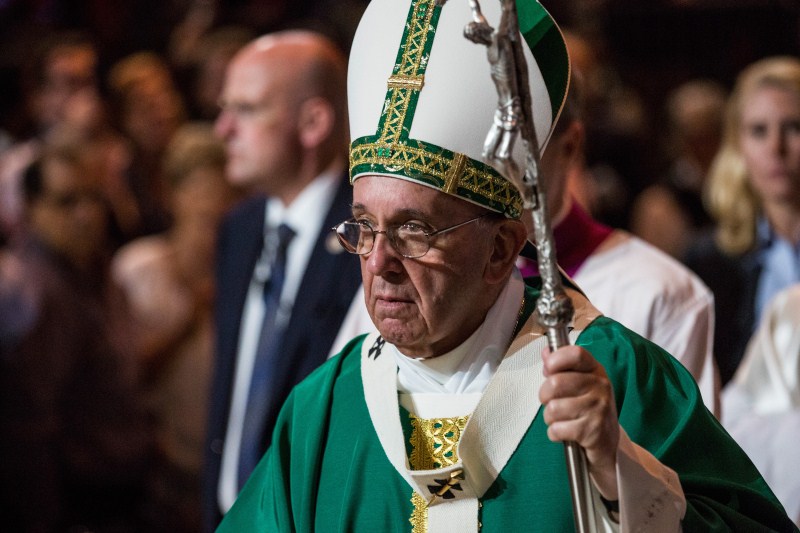


“God is living in our cities. The Church is living in our cities. God and the Church living in our cities want to be like yeast in the dough, to relate to everyone, to stand at everyone’s side, proclaiming the marvels of the Wonderful Counselor, the Mighty God, the Eternal Father, the Prince of Peace.”—Pope Francis, Homily in New York City, 25 September 2015

###

Did I have political disagreements with Pope Francis?  Of course.  I am a conservative and Pope Francis was I think innately a Liberal.  I am a free market capitalist.  I support being tough on criminals.  I want to restrict immigration to just the essential and minimum.  I am skeptical about accommodations with communist regimes.  I support the strengthening of the military in a world where power is used for evil reasons.  Did it really matter Pope Francis might have a different view on these issues?  I don’t think so.  He was the Holy Father and I was not, and in time I listened as a good Catholic should, with docility and respect. 

I cannot say that for his critics, some of whom would bring up my beloved patroness, St. Catherine of Siena as a critic of the pope in her day.  But here is the difference.  St. Catherine of Siena chided Pope Gregory XI in private conversations and in direct letters.  She never criticized Pope Gregory XI in public. 

Have I modified my views in the twelve years of Pope Francis’ papacy?  In thinking it over, though I am not sure if I can attribute it all to Pope Francis, I would have say yes.  I’ve come to the understanding that there must be some sort of accommodation for the lower economic earners in a free market economy; justice cannot be totally achieved by the harshest retributions; I no longer support the death penalty; human dignity must always be upheld; some immigration is charitable and compassionate, and morally required for those escaping human rights violations; use of the military must be implemented with caution and humility.  Over these twelve years I’ve gravitated closer to what President George W. Bush called “compassionate conservatism.”  I think the Holy Father had a hand in that evolution.

Perhaps where Pope Francis influenced me the most was on recognizing the dignity in every person.  Yes, I intellectually, abstractly knew that before, but did I understand it in my bones?  I think in his various papal writings, Pope Francis shaped me to understand it in the encounter with others. 
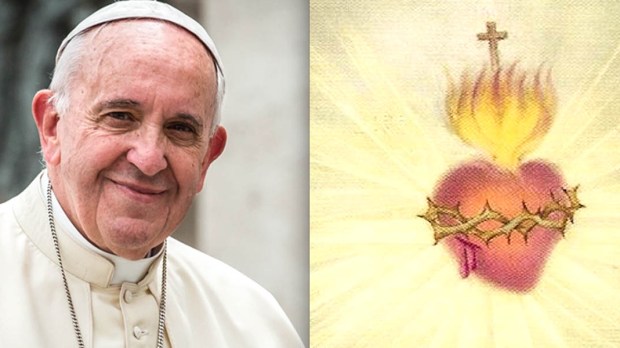


The heart of Christ is ‘ecstasy,’ openness, gift, and encounter. In that heart, we learn to relate to one another in wholesome and happy ways, and to build up in this world God’s kingdom of love and justice. Our hearts, united with the heart of Christ, are capable of working this social miracle”—Pope Francis, Dilexit Nos

###

If there is a single theological doctrine I most associate with Pope Francis, it is his “culture of encounter.”  Yes, I raise what appears on the surface to be a simple exhortation to a profound Christocentric idea.  Pope Francis spoke often on this culture of encounter, so I don’t know if I’m quoting from the fullest explanation, but these are the ones that came up in my search.  He made the first exhortation in his homily at Pentecost shortly after being selected in 2013.  From the Address from the Holy Father on 18 May 2013, he exhorts that the Church must be ready to step out:  


In this “stepping out” it is important to be ready for encounter. For me this word is very important. Encounter with others. Why? Because faith is an encounter with Jesus, and we must do what Jesus does: encounter others. We live in a culture of conflict, a culture of fragmentation, a culture in which I throw away what is of no use to me, a culture of waste.

Notice the mirrored complexity of that thought: In going out to meet the poor, to use an example, we go out to meet Jesus, and in so meeting Jesus, we, in turn, become Jesus meeting the poor.  This is aligned with the homily he gave in NYC I quoted above, going out to the city because Jesus is in the city.  Jesus is there in the poor.

There is also a meditation from the Vatican documents on Pope Francis homily on 13 September 2013


An invitation to work for “the culture of encounter”, in a simple way, “as Jesus did”: not just seeing, but looking; not just hearing, but listening; not just passing people by, but stopping with them; not just saying “what a shame, poor people!”, but allowing yourself to be moved with compassion; “and then to draw near, to touch and to say: ‘Do not weep’ and to give at least a drop of life”. Pope Francis used these words in his homily to describe the message contained in the liturgical readings of the Mass he celebrated at Santa Marta on Tuesday morning.


Focusing in particular on the scene of the widow of Nain, from the Gospel of Luke (7:11-17), the Pope highlighted that this passage from “the Word of God” speaks of “an encounter. There is an encounter between people, an encounter between people who were in the street”. And this, he commented, is “something unusual”. In fact, “when we go into the street, every man thinks of himself: he sees, but does not look; he hears, but does not listen”; in short, everyone goes their own way. And consequently “people pass each other, but they do not encounter each other”. Because, Pope Francis clarified, “an encounter is something else” entirely, and this is “what the Gospel today proclaims to us: an encounter between a man and a woman, between an only son who is alive and an only son who is dead; between a happy group of people — happy because they have encountered Jesus and followed him — and a group of people who weep as they accompany the woman”, who is a widow and is on her way to bury her only son.

There is too much in that meditation to quote, but to further develop Jesus’s encounter with the widow and her son, Pope Francis points out the typology of the encounter:


“The only son who is dead resembles Jesus, and he is transformed into an only son who is alive, like Jesus. And Jesus’ action truly shows the tenderness of an encounter, and not only the tenderness, but the fruitfulness of an encounter. ‘The dead man sat up and began to speak, and Jesus returned him to his mother’. He did not say: ‘The miracle has been done’. No, he said: ‘Come, take him, he is yours’”. That is why “every encounter is fruitful. Each encounter returns people and things to their place”.

And thus in so many of Jesus’s encounters in the Gospels—the Good Samaritan, the woman at the well, the woman to be stoned for adultery, the lepers and those possessed by demons—Jesus is moved and does more than just pass by. 

Thomas J. Eggleston, writing for the Houston Catholic Worker, I think concisely summarized Pope Francis’s theology of encounter:  


With this line of thinking, Christians encounter other people in their imitation of Christ, but on top of that, the disciple encounters other people as a response to having an encounter with Christ in the first place. Francis on a regular basis has spoken of a Culture of Encounter as a goal for human society. A society that espouses a Culture of Encounter facilitates right relationship among humans and involves a spirituality that emphasizes a personal friendship with God who first encounters us in love.

This is not the typical abstract theological thinking of say a Thomas Aquinas nor Pope Benedict XVI.  This is a hands on theology of the moment, one that if I had more space to flesh out is one of an existential nature.  This is not the theology of Ordo amoris that some politicians conveniently want to quote to justify reductions in aiding the needy, but one that forces you to love those before you.  (Pope Leo XIV also weighed in by rebuking such politicians, “Jesus doesn't ask us to rank our love for others.")  Pope Francis was a people person, a people Pope, one who saw the dignity in everyone, who as far as I can tell truly cared for everyone.

###

Finally I want to end with I found a very moving tribute, a statement from Dr. David Anders on his EWTN radio show, Called to Communion.  Someone had called in with a question on Pope Francis on his April 25th, 2025 show at about the 21:33 minute mark and lasts for three minutes.. 

I transcribed what Dr. Anders said, and I present it here, removing some minor verbal ticks that an ad hoc oral expression will have:


“He [Pope Francis] sounded a very consistent note from start to finish through his entire pontificate, and that was that our attachment to the Gospel of Christ must sensitize us to the dignity of the marginalized, the poor, the migrant, the other, those on the peripheries—and sometimes the peripheries could be conceived of in political terms and other times conceived of the guy or the lady in the parish who can’t receive compassion in the confessional—and he always had a heart for whoever is falling through the cracks of the Church’s ministry, how we’re failing to reach them, and a deep willingness to challenge the Church’s traditional ways of doing things, habits and customs that we might be working to defend to prop up the status quo than challenging the status quo in the interest of the apostolate, and ultimately reaching souls.”  -Dr. David Anders, Called to Communion, April 25th, 2025. 

That brought a tear to my eye.  That stands as the best statement on Pope's Francis the man and his pontificate that I heard anywhere.

May the Holy Father rest in peace. 
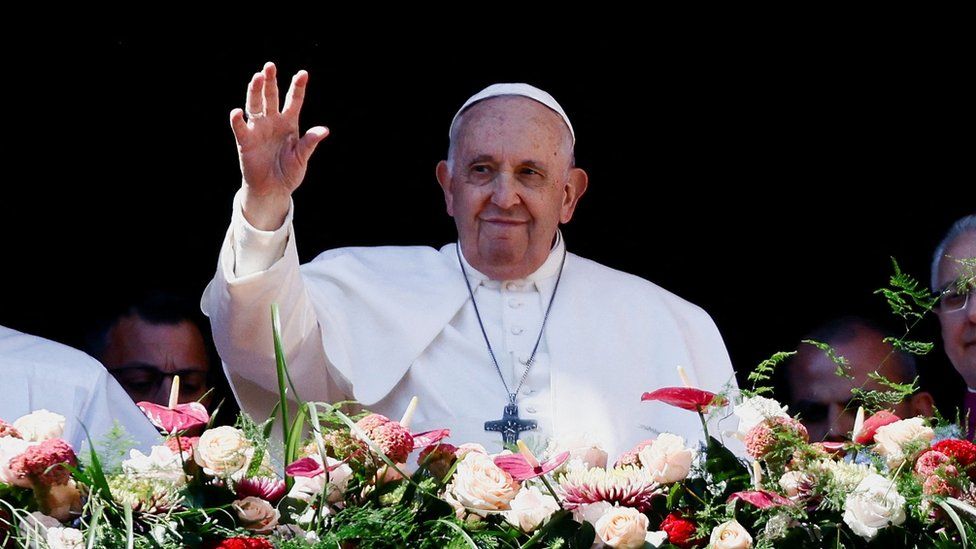


”In the Lord’s Paschal Mystery, death and life contended in a stupendous struggle, but the Lord now lives forever. He fills us with the certainty that we too are called to share in the life that knows no end, when the clash of arms and the rumble of death will be heard no more. Let us entrust ourselves to him, for he alone can make all things new!”—Pope Francis, Urbi et orbi, Easter 2025

Wednesday, January 17, 2024

Defending Fiducia Supplicans: On the Pastoral Meaning of Blessings, Part 3

Part 3 is the last in the series of the defense of the papal Declaration, Fiducia Supplicans.

You can read Part 1 of my defense here.  

Part 2 here.  


Note: This next section was written just before Christmas, and I began to have some doubts, as you will read.

Before I respond to specific comments, and given my schedule before the holidays may not be timely, let me post Cardinal Fernández’s explanation through an interview.  Cardinal Fernández is the man who wrote the document for Pope Francis.  He explains the controversial part this in the interview:


These kinds of blessings are simply simple pastoral channels that help to express people’s faith, even if those people are great sinners.


Therefore, by giving this blessing to two people who spontaneously come forward to request it, one can legitimately ask God to grant them health, peace, prosperity—the things that we all ask for and that a sinner can also ask for.


At the same time, since one can think that in the daily lives of these two persons, not everything is sin, one can therefore pray for them [to receive] a spirit of dialogue, patience, mutual help.


But the declaration also mentions a request for help from the Holy Spirit so that this relationship, which is often unknown to the priest, may be purified of everything that does not respond to the Gospel and the will of God, and may mature along the lines of God’s plan.


As I was saying, sometimes the priest, on a pilgrimage, does not know that couple, and sometimes they are two very close friends who share good things, sometimes they had sexual relations in the past and now what remains is a strong sense of belonging and mutual help. As a parish priest, I have often met such couples, who are sometimes exemplary.


Therefore, since it is not a question of the sacrament of confession(!), but of a simple blessing, it is still asked that this friendship be purified, matured and lived in fidelity to the Gospel. And even if there was some kind of sexual relationship, known or not, the blessing made in this way does not validate or justify anything.


Actually the same thing happens whenever individuals are blessed, because that individual who asks for a blessing — not absolution — may be a great sinner, but we do not deny a blessing to him.


But clearly we have to grow in the conviction that non-ritualized blessings are not a consecration of the person, they are not a justification of all his actions, they are not a ratification of the life he leads. No. No. I do not know at what point we have so exalted this simple pastoral gesture that we have equated it with the reception of the Eucharist. That is why we want to set so many conditions for blessing.

I continue to believe FS is theologically sound.  So where is the disconnect?  It occurred to me this morning waking from a lousy sleep.  I must have been turning this over in my mind.  In my claim-dispute-refutation exercise I said this:


Dispute against claim #3: If you’re blessing a sinner whose identity is integral with a sin, then you are affirming that sin.

Refutation #1

No sinner’s identity is integral to a sin in the eyes of God. It is wrong for a person to identify himself as homosexual, for example, because it reduces the dignity of a human being to a mere act. But it is just as wrong to consider the identity of a person as such because you are doing the same thing in reducing that person to a mere act, even if that person identifies himself as that sin. No one coming before anyone, especially a priest, should be looked at as having the identity as gay or having an identity of a sin.

That refutation may be true but it requires a lot of spiritual growth, a growth not possible to expect from the general public or even the general Catholic layman.  I don’t even know if I have it.  I’ve grown toward it and certainly I try to look at the sinner as not the sin.  As a lay Dominican I’m pushed toward it through regular prayer, frequent confession, spiritual retreats, adoration, and such.  There is no way anyone can expect the general public to not separate the sinner from the sin.  So this ties in to


Dispute against claim #4-1: A gay couple coming before a priest for a blessing de facto implies an affirmation of homosexual marriage/unions.

Unfortunately to the general public that’s how it will be taken.  I don’t know if there will be enough preaching on the subject to change public perception.  This gay identity thing is so engrained in the culture that it will not budge.  While it may be theologically sound, it is not practical.  The Vatican will have to modify FS.

So modify to what?  I think they need to strip the word “couple” out of it and apply the blessing toward individuals or large groups (I’m thinking of the priest who blessed the passengers on the bus.)  Even that can be abused but at least the perception goes away.

So hopefully I answered most of your criticisms.  Have a blessed Christmas if I can’t come back.

###

Note: This was written after Christmas, and overcame the doubt and back to supporting FS.

I was somewhat rushed when I put out my last comment, so let me back fill and also add some further thoughts I’ve had over these last few days.  I have read FS a fourth time now.  I continue to maintain this document is theologically sound.  The critics of this, it seems to me, make two errors, either intentionally or by inference-conclusion bias.  There is also a third criticism of the document which I’ll address as well.

The first error is that of conflating union with couple.  Cardinal Muller does this over and over.  He beats on a strawman argument.  He uses the word union throughout his commentary, and FS clearly states numerous times that no union is being blessed.  A couple does not have to be a union.  A couple, while it may delineate a bond between the two, in no way delineates a specific relationship.  When my wife and I were dating, we were a couple.  With my wife and I being in a married union, we are still a couple.  The nature of what that couple is has changed.  But it’s still the word couple.  A married couple in an irregular union (divorced and remarried without annulment) is also a couple.  You don’t know whether they are living in an adulterous state or as “brother and sister” as they are supposed to live while the annulment process completes.  Two gay men can be a couple in a “union” or in a sexual relationship or in a platonic relationship.  The first two are not acceptable to the Catholic Church.  The third is not a sinful state.  All of these are couples.  The state of grace in these souls is unknown to the outside world.  All of the people in these examples are sinners, including me and if you’re honest including you.  All are in need of grace.  From paragraph 31: “a blessing may be imparted that not only has an ascending value but also involves the invocation of a blessing that descends from God upon those who—recognizing themselves to be destitute and in need of his help—do not claim a legitimation of their own status, but who beg that all that is true, good, and humanly valid in their lives and their relationships be enriched, healed, and elevated by the presence of the Holy Spirit.”  In Catholic anthropology there is no such thing as a gay union.  The document only uses the word union to make clear what is not being blessed.  A couple are any two individuals that are approaching for a blessing.  The nature of their relationship is irrelevant.  They are sinners not claiming to legitimate their status (whatever that may be) but seeking healing by the presence of the Holy Spirit.  If you think that gay platonic relationships don’t exist, you’re wrong.

The other error I keep seeing concerns the nature of a blessing.  As FS delineates, a blessing has multiple functions.  One function is to provide favor or affirmation.  A boy scout helps an old lady across the street and on reaching the other side she blesses him.  That is an affirmation for the good the boy just did.  That is not the type of blessing being offered in FS.  Another type of blessing is that to a sinner as an imparting of grace for the sinner to be spiritually strengthened—that is as I’ve quoted from FS above, to be “healed and elevated by the presence of the Holy Spirit.”  A person not in a state to receive communion walks up with his arms crossed to receive a blessing.  That blessing is not an affirmation of anything.  It is an imparting of grace.  In a confessional, the absolution is a blessing not of what a good job you did but a grace to be strengthened.  In fact the very first words you’re supposed to say in the confessional is “Bless me Father for I have sinned.”  All sorts of sinners receive blessings.  Soldiers going off to battle receive blessings.  People undertaking arduous tasks, say an astronaut, receive blessings.  Criminals in jail receive blessings.  People on their death beds in a coma receive blessings.  None of these is an affirmation of any sin past or present.  The two paragraphs following par. 31 make this clear:


32. Indeed, the grace of God works in the lives of those who do not claim to be righteous but who acknowledge themselves humbly as sinners, like everyone else. This grace can orient everything according to the mysterious and unpredictable designs of God. Therefore, with its untiring wisdom and motherly care, the Church welcomes all who approach God with humble hearts, accompanying them with those spiritual aids that enable everyone to understand and realize God’s will fully in their existence.


33. This is a blessing that, although not included in any liturgical rite, unites intercessory prayer with the invocation of God’s help by those who humbly turn to him. God never turns away anyone who approaches him! Ultimately, a blessing offers people a means to increase their trust in God. The request for a blessing, thus, expresses and nurtures openness to the transcendence, mercy, and closeness to God in a thousand concrete circumstances of life, which is no small thing in the world in which we live. It is a seed of the Holy Spirit that must be nurtured, not hindered.

Do you see that?  FS is quite clear.  It is people’s inference-conclusion bias—otherwise known as jumping to a conclusion—that is the source of the confusion.  The document is not confused.  It’s people’s reading comprehension that has them confused.

A third criticism I see of FS is that the document rests on “legalistic language” or word contrivance.  Well, welcome to theology.  Have you tried reading Thomas Aquinas?  Or how about the Council of Nicaea with the definition of the Trinity?  Three separate persons but it’s still one God because they have one will and are made of one substance?  That’s not “word contrivance”?  Or how about transubstantiation?  The substance of bread and wine are changed to the substance of the Body and Blood of Christ but the material elements of the bread and wine remain the same to the senses?  Hmmm.  Or how about outside of Catholicism, because all religions do this, let’s say the Protestant notion of Once Saved Always Saved?  Because Christ was punished for my sins, I can commit any sin I want because it’s already been satisfied, as long as I believe in Christ?  I can go on with lots of examples.  Those looking suspiciously at another’s theology will always find word contrivance.  FS doesn’t even reach anywhere near the level of word contrivance as any of those examples.  In fact it’s quite clear that couple is not a union.

As I’ve ruminated on this over the last few days what I think has happened is that inference-conclusion bias shaped some readers views and then a hermeneutic of suspicion took root.  Some critics are commenting in good faith; some are setting up strawmen.  As I said before the holidays, the theological distinctions will probably go over the general public’s head and lead to the wrong conclusions.  It would require a large teaching effort on a subject that most priests and bishops even now loath to bring up.  I think FS would have been less controversial if it has used the word “group” instead of couple, and two is also a group.  I think that would have minimized the inference-conclusion bias.  Either they didn’t think of it or the Holy Father has his reasons.  No matter.  I remain docile to the teaching, faith seeking understanding.

Before the holidays I thought the Vatican would have to amend FS in time.  I’m not so sure now.  This was always left to the priest’s discretion, and now the Vatican has made it clear it’s up to the bishops as to the level of implementation.  That flexibility solves all criticism.  I suspect they will leave this alone.

I’m also more hopeful now that I’ve been away from the media on this.  This practice could actually be quite fruitful in teaching the Catholic anthropology of human sexuality.  It could also be quite fruitful in teaching of loving the sinner and not the sin.  I was just watching Johnny Mathis on TV singing a Christmas carol.  I know he’s same-sex attracted.  I know also he’s a Catholic convert.  Being almost ninety I doubt he’s sexually active, but I’m pretty sure he committed sexual sins in his past.  Whatever grace has brought him to sanctity had to do with the presence of the Holy Spirit.  All this blessing is doing is trying to lay the seeds for the Holy Spirit in people’s lives.  I don’t think that’s a bad thing.

But it supposedly took over a hundred years for the public to understand the Trinity

###

Note: This was written just after the New Year as one last final defense.

I have to laugh when I see a polemicist like Robert Royal admit FS is not heretical and yet goes on to rant and rave against the Vatican and the Pope.  From his article today in The Catholic Thing


And as many of us could see at the start – and, therefore, were often accused of not having even read the text – though the document was technically not heretical and even restated Church teaching about real marriage, there was a wide chasm between what was explicitly said and what was implicitly communicated.

Ha!  Not heretical, and no you are reading into what is implicitly communicated.  Somebody must have walked him through what an inference fallacy is because just last week he was saying quite the opposite on TV.  There is no implicit communication in a Magisterial document.  What it says is what it say.  Royal goes on to even say how the effect of the document may have persuaded the German bishops to not go into schism.  And yet he rants and raves about how ill-timed the document is.  Huh?  Polemicists need to rant and rave in order to get clicks and to remove the egg on their face from previous statements.

I acknowledge that there are sincere people who honestly read FS and come away with the impression that the blessing of same-sex couples validates a relationship.  And every time I read their augmenting logic, I see the same application of the fallacy that a same-sex couple must by definition be in a state of sin.  I don’t know the name of that fallacy, but I know it’s a fallacy.  That is a conclusion based on an inference, not a fact.  It wouldn’t even hold up in court.

Yes, I know you’ve got a whole list of people who have succumbed to this fallacy, but there are enough who haven’t.  First off the US Council of Catholic Bishops (USCCB) have come out and supported the document.  I have not seen a single US Bishop dissent from FS, and that would include all the conservative ones, notably Cardinal Salvatore Cordileone.  Bishop Robert Barron, who heads the committee that this would fall under, came out with a specific statement which included:


The document allows for the possibility of blessing those in irregular or same-sex relationships. Despite some misleading reporting in the media, Fiducia Supplicans in no way sanctions irregular bonds or changes the Church’s teaching on marriage and sexuality. It further specifies that no liturgical blessing can be offered to those in such unions, but rather an informal pastoral blessing. This latter benediction is a calling forth of the divine grace to help those who receive it to live more fully in accord with God’s will and to enhance whatever is good, true, and beautiful in their lives.

Bishop Barron’s Word on Fire ministry published a tract (Clarity in Confusion: An Approach to “Fiducia Supplicans”) on the underlying logic of FS, written by a Dr. Richard Declue, who I have never heard of:  


 Here, I think, is another reason for the confusion: a distinction between blessing a same-sex couple and blessing their union. What does it mean to bless same-sex couples but not bless their unions? If you are blessing a couple, are you not blessing their union? In this case, no! And this is what is understandably difficult for people to immediately comprehend. It is not intuitively obvious that you can bless a couple without blessing or condoning their union.


So what kind of blessing are we even talking about, then? What is the purpose? The document describes the kind of blessing it has in mind: “These forms of blessing express a supplication that God may grant those aids that come from the impulses of his Spirit—what classical theology calls ‘actual grace’—so that human relationships may mature and grow in fidelity to the Gospel, that they may be freed from their imperfections and frailties, and that they may express themselves in the ever-increasing dimension of the divine love.” The term actual grace is defined in the Catechism: “Actual graces . . . refer to God’s interventions, whether at the beginning of conversion or in the course of the work of sanctification”.

Esteemed professor of moral theology at The Catholic University, Dr. John Grabowski, who specializes in sexual ethics, issued a positive statement.  Even more significant (at least to me being a Lay Dominican) is that Fr. Thomas Petri, O.P. was quoted in Our Sunday Visitor, the most prolific Catholic publication: 


Dominican Father Thomas Petri, president of the Dominican House of Studies in Washington, told OSV News he agreed with the USCCB’s assessment, saying the Vatican declaration “is clear.”


“There can be no blessing of same-sex relationships in a way that mimics marriage. There can be no ritual. No vestments. No liturgy. Nothing in conjunction with some recent civil ceremony for a couple,” Father Petri told OSV News. “On the contrary, what’s suggested only as a pastoral guidance is the possibility that in some profound religious experience, such as on a pilgrimage or at a spiritual retreat, that a couple striving to live the will of God might spontaneously seek a priest’s blessing (and) that they increasingly be able to do so.”

The Dominican House of Studies is the faculty that teaches theology to Dominicans friars, mostly those in the Eastern Province but accepts widely.  These are no theological slouches, and more importantly they are not of the polemical kind, neither polemical of the left nor of the right. 

But I also hope you’ll watch this less than ten minute homily by Fr. Terrance Chartier of the Franciscan Friars of the Immaculate.  He not only explains FS perfectly and succinctly and how it should be understood, but he also provides an understanding of how it should be applied.  (He even talks about sin of sowing Church discord, which people should take seriously.  I myself have taken that to the confessional more than once.)  He makes many of the same points I made throughout this OP, how all Church documents should be read in in the spirit of docility and not suspicion, and how the potential of abuse is no reason to not generate anything new.  Fr. Terrance also criticizes those on the polemical left and the polemical right.


He even quotes Thomas Aquinas!  Father, you should have been a Dominican!  I’m sending that video to Cardinal Dolan, the bishop of my diocese with a note it should be widely disseminated. 

###

Now that I’ve had a few weeks to be away from the issue and certainly been away from the attacks, let me summarize with my final thoughts.

FS remains to me theologically sound.  The Declaration could have been improved by being more specific that persons are being blessed rather than a couple.  This is the cause of the confusion, but I think the Vatican has clarified it enough and given bishops the flexibility to enact it as best fit their diocese. 

The arguments against are the strawman argument about blessing a gay union, which is false, or that a same-sex couple innately implies a state of sin or, more to the point, a lack of desire to amend one’s life.  There is no affirmation of any sin.  The blessing is an imparting of grace to grow toward holiness.  That it can be abused is no argument.  Any sacrament can currently be abused. 

That the blessing of an irregular or same-sex couple can cause the public to misinterpret Catholic teaching is something that requires attention.  But still I do not feel it warrants concern.  The priest will have to use his judgement, but this now is an opportunity to catechize.  The blessing is a teaching moment, which in due time and practice may bring souls to Christ.

With the intercession of St. Catherine of Siena, patroness of this blog, and my personal patroness, I pray that it does so. 

Friday, January 12, 2024

Defending Fiducia Supplicans: On the Pastoral Meaning of Blessings, Part 2

This is the second post on my defense of the papal Declaration, Fiducia Supplicans.

You can read Part 1 of my defense here.  


A statement from Archbishop Salvatore Cordileone, one of the most conservative of US Catholic bishops:


“I encourage those who have questions to read the Vatican declaration closely, and in continuity with the Church’s unchanging teaching. Doing so will enable one to understand how it encourages pastoral solicitude while maintaining fidelity to the Lord Jesus Christ,”

I’m sick of the radical semi-schismatic Catholics who have built an anti papal industry criticizing everything Pope Francis says.  They never have a positive word to say about any pope.  They went off on Pope Benedict XVI and Pope John Paul II as well.  Listen to real conservatives, not radical ones.

And again, it clearly states that FS is not an affirmation of any sin.  Any abuse is a condemnation on either the priest or the recipient, just like taking communion with mortal sins.  If Fr. Martin has led people astray, he will answer for it in hell.

###

Right, and I believe the response to that would be that in the current document he’s defined the difference between a liturgical and spontaneous blessing.  This is why this document is a development and an addition to the Magisterium.  That’s my understanding/opinion but I’m not a theologian.

I’ll quote from paragraph 31 again:

In such cases, a blessing may be imparted that not only has an ascending value but also involves the invocation of a blessing that descends from God upon those who—recognizing themselves to be destitute and in need of his help—do not claim a legitimation of their own status, but who beg that all that is true, good, and humanly valid in their lives and their relationships be enriched, healed, and elevated by the presence of the Holy Spirit. These forms of blessing express a supplication that God may grant those aids that come from the impulses of his Spirit—what classical theology calls “actual grace”—so that human relationships may mature and grow in fidelity to the Gospel, that they may be freed from their imperfections and frailties, and that they may express themselves in the ever-increasing dimension of the divine love.

###

SA Comment:

And one specifically given to a SS couple as such. If it’s not affirming their couplehood, then what else is it doing? Invoking God’s help in managing household chores in a Godly manner? Quite a small gnat to strain out.

My Response:

The blessing is a means to receive grace to grow in fidelity to the Gospel.

###

I understand the concerns.  The concerns comes down to (1) can this be abused and (2) can this lead to Catholics not understanding the Church doctrine.

I’ve responded to #1 multiple times.  Everything can be abused.  Every day someone is abusing the confessional and the reception of holy communion.  This is no different.  The sin falls double on those not acting in good faith, priest or layman, whoever is at fault.

Can Catholics come to an erroneous conclusion about homosexual acts?  Well look at the information being spread out in these days.  The discussion is all over the place.  Nonetheless, if a gay couple doesn’t understand the intent of the blessing and receive one, at some point if they are practicing in their faith, they will come across it.  It may not be today, it may not be tomorrow, but at some point if they are consistent in their practice they will understand.  And then they will have to make a decision.  The expectation that those in irregular relationships (I don’t just want to single out homosexuals) immediately repent is unrealistic.  It takes time to live the faith to submit to the faith.  It’s now up to the Bishops to teach the doctrine of the sin of homosexual acts, a doctrine that has not changed.  If anything this is an opportunity to explain what they have been reluctant to explain.

WC Comment:

Yes, or in short form, it would have been wiser to remain silent and let the Church’s longstanding position speak for itself. Short of that, every such “blessing” might end with “go and sodomize (or fornicate) no more.” I guarantee that’s not happening with Fr. James Martin and co.

My Response:

Except that the Belgium and German bishops are trying to implement same sex union blessings and needed to be stopped.  This document clearly outlines what is proper and what is not for blessings.  It was probably necessary.

SW Comment:

So FS not only relies on the Church’s perennial doctrine (the definition of marriage and that one cannot bless sin) but “develops” this doctrine with the “Holy Father’s teaching”. And what is this teaching based on – well looking at the footnotes, ~65% is based on what Francis says. He uses no previous Church teachings or quotes from the Fathers to “develop” this. Instead it relies on the “specific and innovative” thought of Francis and on his “pastoral” style. As with his muddying the waters on the death penalty (which changed by him referencing a previous quote of his own), the blessing of same-sex couples and those in “irregular marriages” changes based on the pope’s pastoral feelings. FS is a teaching of Francis and Francis alone.

My Response:

Actually you reminded me.  I meant to go back and look at the footnotes.  So I just did.  So there appears to be three documents that is at the root of the thought: Rituale Romanum (Roman Ritual), De Benedictionibus (The Book of Blessings), Directory on Popular Piety and the Liturgy. Principles and Guidelines.  

The latter two are self explanatory and seem quite appropriate.  Wikipedia’s entry on Roman Ritual:

The Roman Ritual (Latin: Rituale Romanum) is one of the official liturgical books of the Roman Rite of the Latin Church of the Catholic Church. It contains all of the services that a priest or deacon may perform; and are not contained in the Missale Romanum, Pontificale Romanum, or Caeremoniale Episcoporum, but for convenience does include some rituals that one of these books contains.

That seems pretty appropriate too.  I don’t know what else is needed to make a rather simple point about blessings.  Somehow I suspect there has never been a Magisterial document that addressed blessings.  If you know of an appropriate document he should have included, please tell me.  I’m sure all the critics out there would have found one.

SW Comment:

Manny:


I’m sick of the radical semi-schismatic Catholics who have built an anti papal industry criticizing everything Pope Francis says. They never have a positive word to say any pope. They went off on Pope Benedict XVI and Pope John Paul II as well. Listen to real conservatives, not radical ones.


Please give us your official list Manny of whom we are approved to listen to.

My Response:

Semi-schismatic is not anyone’s term.  It’s something I came up with on the spot as I wrote the comment.  I was thinking of all those who repeatedly, time after time, issue after issue, sometimes daily, criticize the Pope, never having a good word to say about him, and often don’t even use his title but often disrespectfully call him by other names, including by his birth last name of Bergoglio, which is to deconstruct him of his title and position as the Vicar of Christ.  I would say people like that are semi-schismatic because their head may say they are Catholic, may even claim to pray for the Pope, but clearly their heart is not in charitable sympathy with the Holy Father.  I could give you a list of a few, but now that you have my definition you can probably identify a lot more than I know.  I try not to hang out in those circles.  I’m not  fan of Pope Francis.  He’s too liberal for me but I feel an obligation to be in charitable sympathy with him.  

WC Comment:

I just don’t see this working out the way you do, Manny. I think the German bishops will feel vindicated by this and will move ahead with their plans. You’re making a distinction between “same sex union blessings” and “same sex couple blessings.” I think the rebellious bishops and priests (rebelling against orthodoxy) will see it as a distinction without a difference and will give their blessings without making any call to repentance at all, possibly condemning souls to eternal separation from God. And as my mother always said, the road to hell is paved with the skulls of bad priests.

My Response:

OK, you’re one of those who believe it will be abused.  As I’ve said, anything can be abused.  Will this change the German bishops?  Probably not.  But at least now the distinction between a liturgical blessing and a spontaneous blessing has been defined.  It’s clear what they’re violating.

SW Comment:

Manny Comment:


But at least now the distinction between a liturgical blessing and a spontaneous blessing has been defined.


I’ll post his again, Manny. Cardinal Muller lays waste to this line of thinking.

c) The new blessings proposed by FS would be pastoral blessings, not liturgical or ritual blessings. Therefore, they would no longer have the limitation of “ritual” or type “b” blessings. They could be applied not only to persons in sin, as in “ritual” blessings, but also to things, places, or circumstances that are contrary to the Gospel.

These “c” type blessings, or “pastoral” blessings are a novelty. Not being liturgical but rather of “popular piety,” they would supposedly not compromise evangelical doctrine and would not have to be consistent with either moral norms or Catholic doctrine. What can be said about this new category of blessing?

first observation is that there is no basis for this new usage in the biblical texts cited by FS, nor in any previous statement of the Magisterium. Nor do the texts offered by Pope Francis provide a basis for this new type of blessing. For already the blessing according to the Roman Ritual (type “b”) allows a priest to bless someone who lives in sin. And this type “of blessing can easily be applied to someone who is in prison or in a rehabilitation group, as Francis says (quoted in FS 27). The innovative “pastoral” blessing (type “c”), in contrast, goes beyond what Francis says, because one could give such a blessing to a reality that is contrary to God’s law, such as an extramarital relationship. In fact, according to the criterion of this type of blessings, one could even bless an abortion clinic or a mafia group.

There’s a lot there.  Let me handle these observations one at a time.  Up front, I do not consider Cardinal Muller one of the semi-schismatics.  He’s sound and I don’t find him biased.

It’s the “c” blessing that’s in question.  Cardinal Muller agrees that this is no different than anything prior  (“For already the blessing according to the Roman Ritual (type “b”) allows a priest to bless someone who lives in sin”) except for the part that “goes beyond” the Roman Ritual.  Yes, that is correct.  That is why I believe this is new development in the Magisterium.  I have stated a couple of times, the document in the third unnumbered paragraph states this is new development.


The value of this document, however, is that it offers a specific and innovative contribution to the pastoral meaning of blessings, permitting a broadening and enrichment of the classical understanding of blessings, which is closely linked to a liturgical perspective. Such theological reflection, based on the pastoral vision of Pope Francis, implies a real development from what has been said about blessings in the Magisterium and the official texts of the Church. This explains why this text has taken on the typology of a “Declaration.”

So whether it’s in the Bible is irrelevant.  That statement actually baffles me.  We all know that Catholic doctrine does not have to be in the Bible.  Against abortion, birth control, the Trinity, the Assumption of Mary, the Immaculate Conception.  None of that is in the Bible.  And I assume that Cardinal Muller is correct, it is not in the Magisterium prior to this.  That’s what makes it a development.  I think Par. 35 might actually be the development: “35. Therefore, the pastoral sensibility of ordained ministers should also be formed to perform blessings spontaneously that are not found in the Book of Blessings.”  Cardinal Muller and Pope Francis are in agreement.  Unless FS specifically contradicts existing Magisterial teaching, then it is in Pope Francis’ purview to develop doctrine.

Now as to Cardinal Muller’s statement that because of FS “one could give such a blessing to a reality that is contrary to God’s law,” that is absolutely not what the document states.  This is the strawman argument that everyone seems to be making.  Par. 5: “Such is also the meaning of the Responsum of the Congregation for the Doctrine of the Faith, which states that the Church does not have the power to impart blessings on unions of persons of the same sex.

Also in the fourth unnumbered paragraph:

It is precisely in this context that one can understand the possibility of blessing couples in irregular situations and same-sex couples without officially validating their status or changing in any way the Church’s perennial teaching on marriage.

And then in Par. 11:

11. Basing itself on these considerations, the Congregation for the Doctrine of the Faith’s Explanatory Note to its 2021 Responsum recalls that when a blessing is invoked on certain human relationships by a special liturgical rite, it is necessary that what is blessed corresponds with God’s designs written in creation and fully revealed by Christ the Lord. For this reason, since the Church has always considered only those sexual relations that are lived out within marriage to be morally licit, the Church does not have the power to confer its liturgical blessing when that would somehow offer a form of moral legitimacy to a union that presumes to be a marriage or to an extra-marital sexual practice. The Holy Father reiterated the substance of this Declaration in his Respuestas to the Dubia of two Cardinals.

I guess part of the confusion is that there are ties in logic back to the 2021 document.  I should dig up that document and read it.  But I do believe in that document it calls for sinners to repent. 

Can one bless an abortion clinic?  Of course not for it’s carrying out of abortions.  That would be blessing a sin.  But what if someone collapses outside with a heart attack and a doctor or nurse from inside rush out and help the man and save his life using medicine or tools from the clinic, can the doctor and nurse request and be blessed?  According to FS I would say they can.  

WC Comment:

I’m begging anyone still following this thread to watch the first 12 minutes of this conversation between Matt Fradd (Pints with Aquinas) and my new favorite apologist Joe Heschmeyer (Shameless Popery (which blog name he got from a Protestant friend as a joke/ribbing, btw)). Begging you!!


I’ve only watched that much so far, but I’m in complete agreement with Joe — this document isn’t a doctrinal change, but it is a “pastoral disaster.” Are you still here @ manny? Will you agree with that?


My Response:

This is  excellent.  Joe H. is great as all those at Catholic Answers.  I think you have to at least go to the 19 minute mark to include the German issue.  The German issue is what has caused the inclusion of the gay couple blessing.  For better or worse.  And I like the way Joe said that you would also not be following Christ if it did not go after the lost sheep.

The entire hour is worth watching.  It was the best unbiased discussion I have seen.

SA Comment:

Do you think they are more likely to do it now than they were before?

My Response:

Immediately it’s not going to make a difference.  If they live a Catholic life and understand Catholic teaching and the Biblical scriptures then I think the seed planted can grow to accept Christ’s obedience over the culture.  It’s like any other sinner.  It takes time.  St. Augustine – the real St. Augustine not you…lol – didn’t drop his sexual sinning over night.  What was his famous line?  “Lord give me chastity, but not yet”  I may be butchering that a little from memory.  But that is what the FS is relying on.  It’s hoping the blessing will plant seeds.   

###

Let’s break this down piece by piece and maybe we can come to the heart of the disagreement.

Let’s start with what we believe FS to state.  These are four potential controversial claims of FS that I see.  If I missed any let me know.

1. FS allows for a spontaneous blessing.

2. FS allows for the blessing of sinners.

3. FS does not allow for the blessing or affirmation of sin, especially gay marriage.

4. FS allows for the blessing of a gay couple as long as it does not affirm their sin.


Now let me state the disputes against each claim and a refutation of the dispute.

Dispute against claim #1: Pope Francis made this distinction up from whole cloth.

Refutation #1:

I don’t know if such a term as spontaneous blessing existed before but it is evident that the practice of spontaneous blessings have always been going on. Just in September when we took a bus down to Washington DC for the Rosary Pilgrimage we had a priest on board and at the beginning he provided a blessing to the bus load. Such informal blessings happens every day. If such a blessing had never been defined in the Magisterium, FS has defined it now.

Refutation #2:

It is within the Pope’s authority to define a new teaching if the new teaching does not violate anything in the Magisterium.  I have not seen one reference to a previous Magisterial teaching that this spontaneous blessing definition would violate.


Dispute against claim #2: You can’t bless a sinner.

Refutation #1:

How is the priest supposed to know the recipient is in a state of grace or not? The very nature of spontaneous blessings would have to be stopped. If a person sneezed in front of a priest, would the priest have to hear his confession before he could say God bless you?

Refutation #2

People walk up to a priest and ask for a blessing all the time. There have been priest’s blessings prior to Congressional openings. We know there are sinners there. Priests bless criminals in jail. I'm sure on my bus there were sinners on board when the priest gave a blessing.  I know that for sure because I am a sinner.  A priestly blessing is not contingent on a soul’s state. You don’t even have to be Catholic to receive such a blessing. This claim is not met in historical practice.


Dispute against claim #3: If you’re blessing a sinner whose identity is integral with a sin, then you are affirming that sin.

Refutation #1

No sinner’s identity is integral to a sin in the eyes of God. It is wrong for a person to identify himself as homosexual, for example, because it reduces the dignity of a human being to a mere act. But it is just as wrong to consider the identity of a person as such because you are doing the same thing in reducing that person to a mere act, even if that person identifies himself as that sin. No one coming before anyone, especially a priest, should be looked at as having the identity as gay or having an identity of a sin.

Refutation #2

FS defines a blessing as not affirming a sin.

Refutation #3

FS clearly states in multiple places that such blessings should be done in a way to not imply that the blessing is affirming a sin.


Dispute against claim #4-1: A gay couple coming before a priest for a blessing de facto implies an affirmation of homosexual marriage/unions.

Refutation #1,

As in the dispute to claim #2, how is a priest supposed to know the couple is a gay union? If me and my brother, or me and my son, or me and a male friend, or even me and a female friend who is not my wife approach a priest for a blessing, how is the priest supposed to know the relationship? Is he supposed to inquire? You would not want such formality for a spontaneous blessing.

Refutation #2

FS clearly states that such a blessing is not an affirmation.


Dispute against claim #4-2: A gay couple coming before a priest will take the blessing to be an acceptance of their homosexual union.

Refutation #1.

a. FS clearly states that no blessing of sin is possible and that such a gay union is not licit.

b. If the gay couple honestly reaches that erroneous conclusion, then the blessing will not be efficacious and in time living out a Catholic life they will learn the truth. Just as beginning Catholics or uncatechized Catholics or exploring non Catholics eventually learn that one can only take communion in a state of grace, homosexuals who truly wish a Catholic life will understand Church teaching on homosexual acts.

c. If the gay couple dishonestly entices such a blessing for self-affirmation, then that is clearly a sin and they condemn themselves.


Dispute against claim #4-3: A liberal priest can use FS to bless a homosexual union.

Refutation #1:

Such a priest would be in violation of Church doctrine and the claims of FS. He would be abusing his vocation, be committing a grave sin, and subject to discipline.

Refutation #2:

A liberal priest could do that now without FS. It’s irrelevant to FS.


Dispute against claim #4-4: The appearance of giving a blessing to a gay couple can cause scandal and lead to a general belief the Catholic Church now approves of gay marriage.

Refutation #1:

FS clearly states otherwise. The Catechism of the Catholic Church clearly states otherwise. No Church teaching would substantiate that claim. Church policy on marriage is articulated as such and actual implementation of policy would reject any request for a gay nuptial. It would be generally known but if such erroneous knowledge starts to take root it becomes incumbent on the bishops to teach otherwise.


Dispute against claim #4-5: This is a step toward the Church approving gay marriage in the future.

Refutation #1.

Church Magisterium has clearly been established that no such definition of marriage can be accepted.

Refutation #2.

FS clearly affirms the established Magisterial teaching of an acceptable marriage. Homosexual marriage is just not possible in the Catholic Church.

You can read Part 3 here, the final post in the defense.