"Love follows knowledge."
"Beauty above all beauty!"
– St. Catherine of Siena

Showing posts with label ashes. Show all posts

Wednesday, March 1, 2017

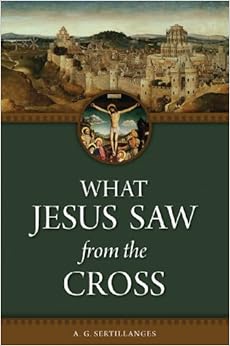
Lent and What Jesus Saw from the Cross

I want to introduce one of my Lenten reads for this year.  Today is Ash Wednesday, the beginning of Lent.  I hope you got your ashes across your forehead today.  You don’t have to be Catholic to receive ashes from a Catholic church.  Ashes are not a sacrament but a sacramental, and so anyone can receive them.  What’s a sacramental?  According to the Catechism of the Catholic Church, “sacramentals are sacred signs which bear a resemblance to the sacraments” but “do not confer the grace of the Holy Spirit” (CCC 1667-1670).  That’s rather theological, so let’s just summarize it as an action or outward sign that helps you get closer to God.  Ash Wednesday is a reminder that one is dust (“Remember that you are dust, and to dust you shall return") and a calling to repent (“Repent, and believe in the Gospel"). 

So this starts Lent where one is called to self-denial, penance, increased prayer, and alms giving.  This Lent I’m giving up the usual deserts and snacks and alcoholic beverages.  Someone also suggested one give up buying all “wants” and make purchases only of necessities.  I thought that was a brilliant self-denial, and so this year I will limit purchasing things only to things that are basic needs.  That’s going to be hard to do with limiting myself from buying books, but it will be a good test.

During Lent I increase devotional and spiritual reads, and a few weeks ago I mentioned I was going to read Compassionate Blood by Fr. Romanus Cessario, O.P. on meditations of Christ’s passion through the words of St. Catherine of Siena.  Now that’s a relatively short read.  A lengthier read is going to be What Jesus Saw from the Cross, published in 1930 by the French Dominican Antonin-Gilbert Sertillanges, O.P. 

The book is basically just what the title implies, a meditation on what Jesus saw looking out while hanging on the cross.  It’s objective is stated in the Prologue:

St. Paul exhorts us to “to on Jesus Christ, and in his words, understood in the spiritual sense in which he intended them, are of immeasurable importance.  However, there is perhaps another sense in which it is not impossible, nor without importance, to put on Jesus Christ.

We may put on Christ in imagination, placing ourselves not at the foot of the cross, nor before it, but upon it, with head bowed beneath the inscription, wearing the crown of thorns, pierced by the nails, feeling the cold, rough wood between our shoulders.  In short, we can make our own the sphere of vision and the emotions that were His, seeing with His eyes and feeling with His heart, remembering, judging, and foreseeing with Him so that, still in this same sense of imaging that we have changed places with Him, it is no longer we who live but Christ who lives in us.

It was in Jerusalem that this thought came to me, while I stood (as I frequently did) on a spot which is uniquely suggestive of such reflections.

Now that’s enticing.  Then I read the first chapter, “The View from the Cross,” and it blew me away.  Here’s a sample:

Having established the site of Calvary and described the Cross, the question still remains, in what direction was the Sufferer facing?  There are mystical authors who orient the Cross to the west—that is to say, they “disorient” it.  Their idea is that the look which regenerates is turned toward us, Israel and the Old Law being forsaken.  This theory, besides being a priori and not free from partiality, finds no confirmation in the situation of Calvary.

As you pass out of the Gate of Ephraim you are facing Mount Gareb, of which Calvary is a small foothill: to turn the gibbet to the west would be to make it face the hills and to hide it from the people.  The idlers of the gate and the loiterers of the esplanade, the passerby who met in great numbers at the crossroads, the folk that clustered everywhere about, the dwellers in the tents set up in the open air for the feast, all these would have been foiled.  The public example made of the victim would have been thwarted; furthermore, the erection of the gibbet and the management of the execution would have been made difficult.  In every way, it would have been a bad arrangement.

No, Jesus faced the gate by which He had come forth, through which came His insulters and those who were greedy for a spectacle.  He offered Himself to those who hated and mocked Him.  He lent Himself to the convenience of His executioners. 

And, if reasons of appropriateness must be added, the new Man looked toward the beginnings, toward the end of the earth from which came civilization together with the light.  He faced as the apse of a church faces, having before His eyes the rampart of a world beyond which He had passed, although He had not forsaken it.  His final glance saluted the Temple, His Father’s house, and the rising sun.


That is excellent prose.  I assume the original French was just as finely written.  For some reason the book doesn’t list the translator, but it does say it was translated in 1948.  A great subject, outstanding writing, intense spirituality, profound meditation, all through the thoughts of a Dominican friar—this is going to be a great read.  I’ll try to post again as I get deeper into the book.

Monday, March 2, 2015

Matthew Monday: Matthew’s First Ashes

Matthew attended his first Ash Wednesday Mass and received ashes for the first time. 


He was a little nervous, but I held him as we approached the altar. 

And while at Mass I usually allow him to have a little toy or pen and paper to occupy him when he gets a bored.  There are a couple of theories on this and I fall on the side that’s impossible for a child to have the attention span to focus the entire hour, especially when he doesn’t have an understanding of what’s being said.  I want him to enjoy Mass, not make it a drudgery.  So I make him pay attention to the parts he understands, but I leave him to himself for the other parts, as long as he doesn’t distract the other parishioners.  At this Ash Wednesday Mass he drew the family and wrote “mom and dad” by himself.  I thought this was excellent.


I know I couldn't write letters when I was in Kindergarten, let alone words, and I don’t think I could draw either.  

Friday, February 27, 2015

Faith Filled Friday: Ashes on the Subway

This apparently is a true story from Sister Theresa Aletheia Noble’s blog, Pursued by Truth about a priest who was robbed on the subway on Ash Wednesday.  It’s really very funny, and the good Sister has a nice Lenten reflection on it.

A Jesuit priest who used to say Mass at our convent was on the subway making his way to visit his mother on Ash Wednesday.

At one stop a young man entered the subway car and told the priest to hand over his wallet. When the priest explained that he did not have a wallet with him, the young man made him empty his pockets.

The priest pulled out his train pass, some change, and a little silver box. The young man demanded to know what was inside the box.

The priest said, “Well, I am a Catholic and it is Ash Wednesday so I am bringing some blessed ashes to someone who is sick.”

The young man responded, “Oh, I am Catholic, can I have some ashes?”

So the priest opened the little box, said the prayer and traced the cross on the man’s forehead.

The young man left at the next stop.


Read Sister Theresa’s little homily on how we all feel like this thief, here.  

Wednesday, March 5, 2014

Ash Wednesday & The Book of Judith

As most of you know, today is Ash Wednesday, a day of fasting, repentance, meditation on our mortality, and the initiation of the Lenten season.

The Wikipedia entry I linked shows the biblical heritage of the ritual, citing Job, Jeremiah, Daniel, First Book of Maccabees, Numbers, and Jonah for citations of the use of ashes in the Old Testament, Matthew and Luke in the New Testament.  It also cites Ezekiel chapter 9 for the marking of sinner’s foreheads for repentance, without any mention of ashes.  But Wikipedia does not mention any citation from the Book of Judith.  

 
I’ve recently been reading the Book of Judith as part of my working through the bible and low and behold I read chapter 4 shortly before Ash Wednesday.  Let me set the context.  The troops of King Nebuchadnezzar of the Assyrians have captured and slaughtered all of Israel’s neighbors and now have directed their attention to them.  The Israelites are preparing for the invasion. 

10They, along with their wives, and children, and domestic animals, every resident alien, hired worker, and purchased slave, girded themselves with sackcloth.
11And all the Israelite men, women, and children who lived in Jerusalem fell prostrate in front of the temple and sprinkled ashes on their heads, spreading out their sackcloth before the Lord.
12The altar, too, they draped in sackcloth; and with one accord they cried out fervently to the God of Israel not to allow their children to be seized, their wives to be taken captive, the cities of their inheritance to be ruined, or the sanctuary to be profaned and mocked for the nations to gloat over.
13The Lord heard their cry and saw their distress. The people continued fasting for many days throughout Judea and before the sanctuary of the Lord Almighty in Jerusalem.
14Also girded with sackcloth, Joakim, the high priest, and all the priests in attendance before the Lord, and those who ministered to the Lord offered the daily burnt offering, the votive offerings, and the voluntary offerings of the people.
15With ashes upon their turbans, they cried to the Lord with all their strength to look with favor on the whole house of Israel.
                        -Jth 4:9-15

I was surprised when I read that passage.  I didn’t recall anyone ever alluding to the Book of Judith for the history behind Ash Wednesday, but there it is.  And what’s startling, is that in this passage they actually mention the sprinkling of ashes on foreheads (verse 11).  Of all the other passages, I think only the First Book of Maccabees references ashes and forehead together.  So the Book of Judith might actually be one of two of the clearest references to the Ash Wednesday ritual in the entire bible.  They will have to update that Wikipedia entry.  :)

 
I love Ash Wednesday and I hope I can get to a mass to receive ashes.  It looks like I will be traveling out of town for work and not sure what my schedule will be like.  I’m looking forward to Lent.  It has replaced the overly commercialized Advent/Christmas season as my favorite time of year.  I know we fast and pray and struggle during the Lenten season, but when you love God fasting, praying, and struggling is sweetness.


May God bless you all on this holy day.