This is the fifth post of
a series of posts on J. R. R. Tolkien’s The Lord of the Rings. This series focuses on the first volume
of the trilogy, The Fellowship of the Ring.
You can find the first
post here.
The second
post here.
The third
post here.
The fourth
post here.
Summary: Bk1 Ch 7_8_9
Chapter 7: In the House of Tom Bombadil
When the hobbits get to Tom Bombdil’s house, they are greeted by a woman, Goldberry, who mysteriously tells them that she is “daughter of the River.” The hobbits are enchanted by her. They ask her who is Tom, and she replies that he is “the Master of wood, water, and hill.” When Tom walks in, he has the hobbits wash and sit down for supper. Afterwards, all tired they were led to a room with beds and quickly fell asleep.
Three of the hobbits had dreams that night. Frodo dreamt of wolves and an eagle that bore him away. Pippin dreamt of being trapped again in the willow tree. Merry dreamt of a flood overfilling the house. Only Sam did not dream but slept contentedly.
In the morning they found that it was raining, and they sat around with Tom telling them stories of the Old Forest. The he told them stories of the Great Barrows, followed by ancient tales from pre-memory. At one point, Frodo asked him, who he was? Tom replied that he was here before the Kings and Barrow-wights, and elves, and even the Dark Lord. When the rain ended, they had another supper, even better than the previous night’s.
After supper, Tom asked Frodo to see the ring, and Frodo handed it to him. Tom put it on his finger, and to everyone’s surprise he did not disappear. Tom handed the ring back to Frodo, and Frodo suspicious that it was not the true ring put it on his finger and he disappeared. After laughing about the disappearance, they all went back to the bedrooms for the night.
Chapter 8: Fog on the Barrow-Downs
After breakfast the next morning, the hobbits resumed their journey heading north. Up the first hill, Frodo realized he had not said goodbye to Goldberry and was about to turn around when she appeared toward the top of the hill. She bid farewell and blessed them. They continued, riding over the hills of the Barrow-Downs. Up and down the hills was slow going.
A fog rolled over the hills, and the hobbits felt trapped. The fog was so thick that it had darkened the sky. At one point Frodo realized the other three were not trailing behind him. When he called out to them only a cold, dark voice responded, and it seemed it came from a tall shadow. The shadow touched him and Frodo fainted.
When he came to, he found the other three hobbits lying beside him. The cold voice sang a deathly song, and its shadowy arm stretched toward Frodo. Frodo grabbed a sword and hacked at the arm. He remembered Tom Bombadil’s song and he sang it, and shortly Tom’s voice could be heard in the distance singing back. When Tom arrived, his magical song drove off the dark shadow.
With that, the other three hobbits came out of their stupor. Tom traveled with them for a while, and in the morning after breakfast Tom gave them the advice to head on the road to the town of Bree and get to an old inn called The Prancing Pony.
Chapter 9: At the Sign of the Prancing Pony
The hobbits come to Bree, the chief town of the region of Bree-land, a region of mixed hobbits and men. The Road ran through Bree and at the foot of a hill stood the Inn with the sign of the Prancing Pony. The Inn was run by Barliman Butterbur, a big folk man.
The hobbits did not receive a warm reception at the inn, but were led to a parlor room to rest and eat. After getting refreshed and rested, the hobbits joined the other guests in the big common room. There they got into discussions with the locals, a mix of hobbits, men, and dwarves. While the other hobbits were enjoying their conversation, Frodo noticed a strange looking man in the shadows against the wall listening intently and quietly smoking his pipe. Frodo was told that such men as that who roam about the countryside are called Rangers, and that particular man goes by the name Strider.
At one point, Strider came over to Frodo, who had been going by the name Mr. Underhill, and introduced himself. Strider told Frodo to restrain his fellow hobbits from talking too much. They had gone on about Bilbo Baggins and his disappearance from the Shire. Frodo realizing the danger of the conversations decided to distract by jumping on the table and talking and singing a song. It drew a loud cheer and applause, but Strider found it even worse than the loose talk of the other hobbits. He told “Mr. Baggins”—knowing his proper name—he would like to have a word with him, but Frodo put him off until later.
In the meantime, someone had seen Frodo just vanish, and Frodo reappearing dispelled that notion. It was now time for everyone to go onto bed, and, as they were going off, and Strider again came over to Frodo requesting a word with him.
###
L Comment:
Thank you very much for the helpful summary, Manny!
As I was reading the chapter 'Fog on the Barrow-Downs', I was struck by how much darker the novel seems compared with when I read it for the first time as a teenager. In its mood and imagery, the chapter resembled other Christian pilgrimage literature, such as the Divine Comedy and The Pilgrim's Progress. The Slough of Despond and parts of the Inferno came to my mind as I imagined Frodo suddenly isolated in the thick fog, the captive of the mysterious and terrifying Barrow-Wight.
My Reply to L:
Yes, I agree L, the Barrows chapter is very dark. It's
probably the first real incident where we see the power of the dark side.
I was thinking of the Divine Comedy in the previous
chapter. Frodo's dream if I remember was first with being chased by a wolf and
then lifted by an eagle. Dante (the character, not the author) is forced to go
through world of the afterlife because he was being pursued by three creatures,
the last being the wolf. And then in Purgatorio Dante is lifted up by eagle
from the lower part of the mountain to the terraces section. There may be parts
of LotR that allude to the Divine Comedy. I have not read Pilgrim's Progress,
but I would imagine such a spiritual journey could have echoes in LotR.
As to Barrows, that is a unique noun for hills or hilly country that only seem to be used in England. Barrows also has a particular allusion to burial grounds. There is probably more to the use of "Barrows" than we understand.
Ellie Comment:
Thank you for these summaries, Manny! They definitely
help a lot, there is so much to remember.
I really loved the chapter about Tom Bombadil, where I
found two big Christian themes, one of which is confession (which is
specifically Catholic, I would say). When Frodo talks with Tom Bombadil,
Tolkien describes Frodo feeling compelled to tell him the whole story, to tell
him even more information he told Gandalf:
"Indeed so much did Tom know, and so cunning was
his questioning, that Frodo found himself telling him more about Biblo and his
own hopes and fears that he had told before even to Gandalf."
I feel like this is a great allusion to a certain divine nature to Tom Bombadil, along with the fact that when Frodo asks Goldberry who Tom really is, she simply replies "He is." which definitely reminded me not only of the "I Am that I Am" of the Old Testament in which God names Himself, but also of the New Testament ("Before Abraham was, I am"). Tom Bombadil is such a strange and intriguing character, I wish Tolkien told us what he actually was, but also this failure to categorize him in Tolkien's world gives his character a great meaning
Michelle Reply to Ellie:
Ellie, I also thought of "I AM" when Goldberry said that.
My Reply to Ellie:
Ellie wrote: "I really loved the chapter about
Tom Bombadil, where I found two big Christian themes, one of which is
confession (which is specifically Catholic, I would say). When Frodo talks with
Tom Bombadil, Tolkien describes Frodo feeling compelled to tell him the whole
story, to tell him even more information he told Gandalf:
"Indeed so much did Tom know, and so cunning was his questioning, that
Frodo found himself telling him more about Biblo and his own hopes and fears
that he had told before even to Gandalf."
"
I did not pick up on that. I will have to go back and re-read that. Thanks for
pointing it out Ellie.
I too picked up on what seems to be the divine nature of Tom Bombadil. However,
I can't see anything Christian in him. He strikes me as some sort of wood demi
god from pagan mythology. I intend to flesh that thought out more but if you
can connect him with some sort of Christian tradition, I would love to see
that.
Kelly Comment:
Tom Bombadil seems to me to be a type of an Adam figure. What he might have been like before the fall. Not divine, but also not affected or limited by sin. When he plays around with the ring and it doesn't have the same effect on him, similar to the temptation that is derived from original sin that everyone else, even Gandalf and Galadriel acknowledge. He also is able to experience joy and shed the weight of darkness quicker than the others. Goldberry seems to share these qualities also.
Michelle Reply to Kelly:
I thought of him like a type of an angel-figure.
My Reply to Kelly:
Kelly that is an interesting thought. I never thought
of that. He does seem to have some sort of magic powers which I don't think
Adam had.
One thing I will say when I do put my thoughts
together is to reference Goldberry's comment that Tom is "Master of wood,
water, and hill." Taken from a Christian perspective, those three elements
could refer to cross, baptism, and death, hill being a burial mound. But then
what does that mean? I don't know.
Can anyone tell if Goldberry is his spouse or his daughter? What exactly is their relationship?
Michelle Reply to Me:
I thought she was his wife, but now I'm wondering if that was an assumption on my part. Hopefully someone else could clarify!
Kelly Reply to Me:
I think Goldberry is his spouse. Also, I am thinking
he is not an allegorical Adam but just a type, who, hints at what man might
have been had he not fallen.
My Reply:
OK, I found it. Goldberry is Tom's wife but only
knowable from outside the LotR. From Wikipedia:
"Goldberry first appeared in Tolkien's 1934 poem,
The Adventures of Tom Bombadil,[4] re-worked into a 1962 poetry collection of
the same name.[5] The poem tells of how she drags Tom into the river before he
escapes, returning later to capture her and make her his bride."
So one has to know an outside source to know their relationship. I only questioned it because Goldberry strikes me as much younger than Tom, and at one point she identifies herself as "the daughter of the River." While that doesn't mean she's Tom's daughter, the suggestion of daughter is raised to the reader.
Kerstin Comment:
Manny wrote: "Three of the hobbits had dreams
that night. Frodo dreamt of wolves and an eagle that bore him away. Pippin
dreamt of being trapped again in the willow tree. Merry dreamt of a flood
overfilling the house. Only Sam did not dream but slept contented."
I wonder if this is also a foreshadowing of what is
going to happen to the characters. With Frodo there will definitely be a
significance with an eagle. I don't quite remember what all happens to Pippin
and Merry. With Sam, he is the faithful servant and quite content in the role.
We'll have to keep this passage in mind as we move
deeper into the tale and see.
Tom Bombadil's feels like a true safe haven. Nothing bad from the outside world threatens or penetrates. The hobbits don't have to worry about anything, just eating, resting, and listening to the tales of Tom. They are being cared for by Tom and Goldberry like beloved children. Tom has slipped into a father figure and Goldberry into a mother figure. It is such a wholesome place they gather strength for the challenges ahead without being aware of it. When they leave Goldberry blesses them like a mother would and Tom steps into the role of protector until they are past the Barrow Downs.
Frances Comment:
You can sense the richness and depth of Tolkien’s genius in the many different images that spring forth from his writing, can’t you? I found this about mysterious Tom: “Bombadil was described in Tolkien’s books as ‘older than the old,’ a benevolent entity who begins life around the time all life began . . . In a 1937 letter to his publisher, Tolkien described Bombadil as ‘the spirit of the vanishing Oxford and Berkshire countryside.’ Tolkien chose not to write in allegory, but it’s clear he saw Bombadil as nature personified — right up to the character’s ambivalence about interfering in the larger world around him. “
###
So what are we to make of Tom Bombdil and Goldberry? They are definitely mysterious. My first reaction when I came to Goldberry inviting the four hobbits into the house was, oh my gosh, a female character! This was the first real female character we have come across, a book that will be fairly sparse of women characters. There are of course the women hobbits at Bilbo’s birthday party and Mrs. Maggot but they are all vague and undeveloped. It’s surprising to me how women enjoy LotR since it’s such a boy oriented book. Perhaps some of the ladies here can answer why they enjoy this boyish book.
My first thought to what
Tom might be was to identify him as some sort of nature deity. He does have some sort of magic powers,
especially with his singing. Goldberry
identifies herself as “daughter of the River.”
Taken literally that is something right out of Greek mythology. Tom is certainly naturally attuned to the
woods, the trees, the stream, and later we see the hills. His stories seem to be about the history of
Middle Earth within the parameters of nature.
All his songs are filled with nature.
Here’s one from chapter seven:
I had an errand
there: gathering water-lilies,
green leaves and
lilies white to please my pretty lady,
the last ere the
year’s end to keep them from the winter,
to flower by her
pretty feet till the snows are melted.
Each year at
summer’s end I go to find them for her,
in a wide pool,
deep and clear, far down Withywindle;
there they open
first in spring and there they linger latest.
By that pool long
ago I found the River-daughter,
fair young Goldberry sitting in the rushes.
He is within nature,
doing things with nature, and using nature for his ends. Goldberry says that he is “Master of wood,
water, and hill." When he
accompanies the hobbits out in Barrow-downs, he comes to a limit to how far he
can go and will go no further. Pippin
asks him if he thinks they will be attacked this evening. Tom answers him with a qualification.
‘No, I hope not tonight,’ answered Tom Bombadil; ‘nor perhaps the next day. But do not trust my guess; for I cannot tell for certain. Out east my knowledge fails. Tom is not master of Riders from the Black Land far beyond his country.’
“Out east my knowledge fails,” is the first time we are told of Tom’s limitation. When the hobbits urge him to continue with them, Tom does not. Take note, in that last sentence, that is the only place where “master” is not capitalized, and it’s linked to a limit beyond his domain.
They begged him to come at least as far as the inn and
drink once more with them; but he laughed and refused, saying:
Tom’s
country ends here: he will not pass the borders.
Tom
has his house to mind, and Goldberry is waiting!
Then he turned, tossed up his hat, leaped on Lumpkin’s back, and rode up over the bank and away singing into the dusk.
His country ends there. It’s almost like he’s linked to a particular plot of earth, and his powers will not be efficacious beyond it. This alludes to a local nature deity in pagan worldview.
On the other hand, if we look at Tom from a Christian perspective, he seems he has been given some sort of divine nature. Goldberry’s description of Tom as “Master of wood, water, and hill” can be taken as a Christian identity. Wood is associated with the cross and the trees in Eden, water as from the river that was once thought to have its source in Eden flowing down to Earth and, of course, associated with baptism, and hill associated with the hill of Calvary and the burial mounds for the dead. Why is “Master” capitalized? I believe it’s capitalized every time someone refers to him as master. “Master” capitalized seems to me to be an allusion to Christ, who is sometimes referred to as “Master” in the Gospels. Tom repeatedly saves the hobbits, from the Old Willow, from the Dark Shadow in the Barrow-downs, and from the dark riders as he gives them the path to get to Bree. He saves them and he does it merely with the spoken word. “For he spoke, and it came to be” (Ps 33:9). Jesus speaks and miracles happened. Now Tom is clearly not Jesus, but perhaps he could be a delegate such as a saint in a hagiography. There are lots of examples, but I’ll just pick a Biblical one. St. Peter brings Dorcas back to life in Acts 9 through the power of words.
I really like Kelly’s
thought that Tom and Goldberry are types for Adam and Eve prior to the
Fall. Frodo asked at one point.
‘Who are you, Master?’ he asked.
‘Eh, what?’ said Tom sitting up, and his eyes glinting in the gloom. ‘Don’t you know my name yet? That’s the only answer. Tell me, who are you, alone, yourself and nameless? But you are young and I am old. Eldest, that’s what I am. Mark my words, my friends: Tom was here before the river and the trees; Tom remembers the first raindrop and the first acorn. He made paths before the Big People, and saw the little People arriving. He was here before the Kings and the graves and the Barrow-wights. When the Elves passed westward, Tom was here already, before the seas were bent. He knew the dark under the stars when it was fearless – before the Dark Lord came from Outside.’
That does put Tom in the mythic past of before the Earth and history were formed. It does put him in an Edenic context. He could be associated with Jesus because Jesus is the new Adam. Tom is the Adam that could have been if Adam and Eve had not disobeyed.
There is a third aspect
to Tom that is suggested in the text. He
is a story-teller.
He then told them many remarkable stories, sometimes
half as if speaking to himself, sometimes looking at them suddenly with a
bright blue eye under his deep brows. Often his voice would turn to song, and
he would get out of his chair and dance about. He told them tales of bees and
flowers, the ways of trees, and the strange creatures of the Forest, about the
evil things and good things, things friendly and things unfriendly, cruel
things and kind things, and secrets hidden under brambles.
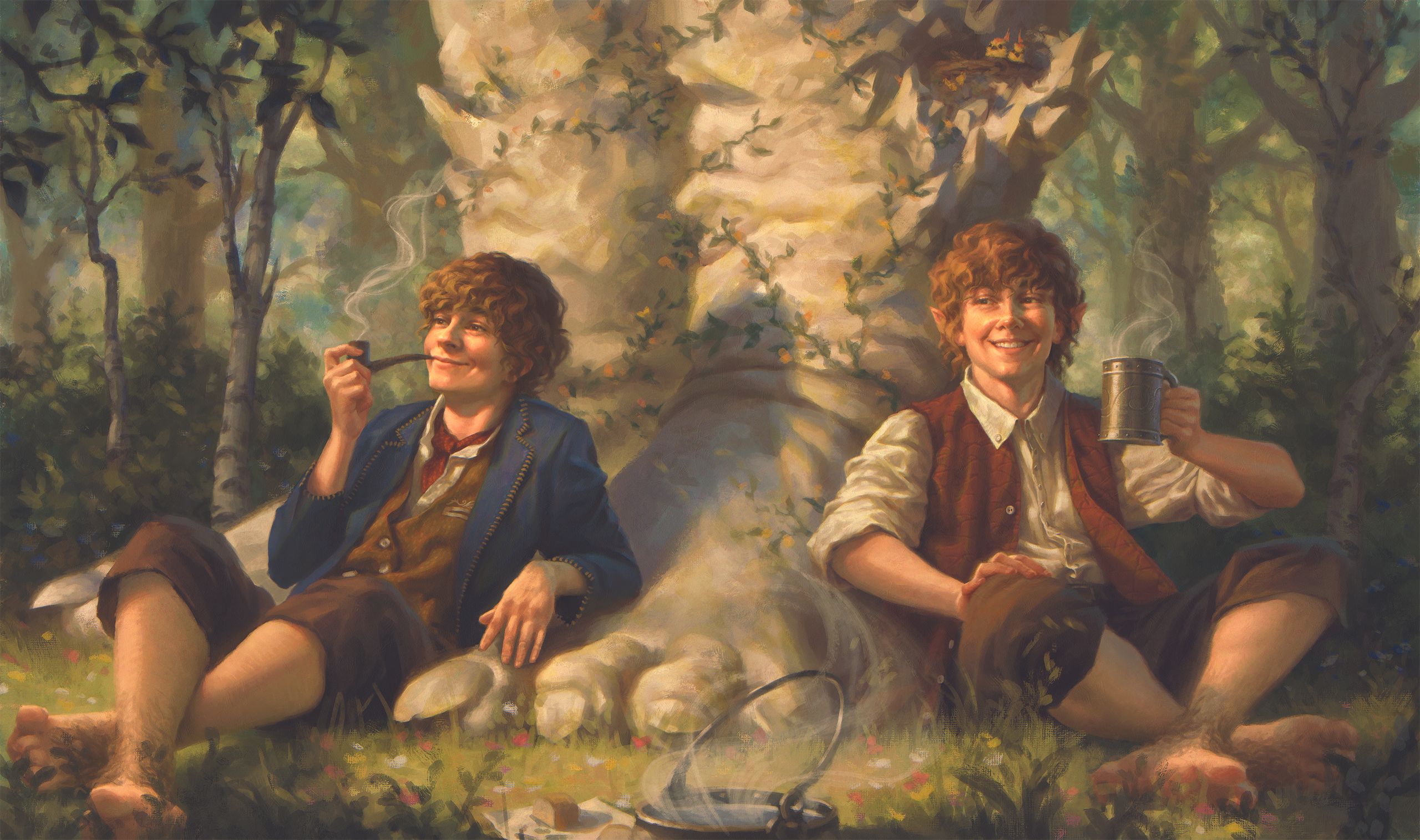
As they listened, they began to understand the lives of the Forest, apart from themselves, indeed to feel themselves as the strangers where all other things were at home. Moving constantly in and out of his talk was Old Man Willow, and Frodo learned now enough to content him, indeed more than enough, for it was not comfortable lore. Tom’s words laid bare the hearts of trees and their thoughts, which were often dark and strange, and filled with a hatred of things that go free upon the earth, gnawing, biting, breaking, hacking, burning: destroyers and usurpers. It was not called the Old Forest without reason, for it was indeed ancient, a survivor of vast forgotten woods; and in it there lived yet, ageing no quicker than the hills, the fathers of the fathers of trees, remembering times when they were lords. The countless years had filled them with pride and rooted wisdom, and with malice. But none were more dangerous than the Great Willow: his heart was rotten, but his strength was green; and he was cunning, and a master of winds, and his song and thought ran through the woods on both sides of the river. His grey thirsty spirit drew power out of the earth and spread like fine root-threads in the ground, and invisible twig-fingers in the air, till it had under its dominion nearly all the trees of the Forest from the Hedge to the Downs.
Tom is a bard, a teller
of stories, one who a sings of history and feats. It is particularly significant in ancient
Celtic cultures where the bards were associated with nature. Here is how Wikipedia describes “bard.”
In the words of the Oxford English Dictionary, the bards were an "ancient Celtic order of minstrel-poets, whose primary function appears to have been to compose and sing (usually to the harp) verses celebrating the achievements of chiefs and warriors, and who committed to verse historical and traditional facts, religious precepts, laws, genealogies, etc."
But such bards existed in
many pre-literate cultures. Homer is
considered a bard. Tom continued with
his tales.
Suddenly Tom’s talk left the woods and went leaping up the young stream, over bubbling waterfalls, over pebbles and worn rocks, and among small flowers in close grass and wet crannies, wandering at last up on to the Downs. They heard of the Great Barrows, and the green mounds, and the stone-rings upon the hills and in the hollows among the hills. Sheep were bleating in flocks. Green walls and white walls rose. There were fortresses on the heights. Kings of little kingdoms fought together, and the young Sun shone like fire on the red metal of their new and greedy swords. There was victory and defeat; and towers fell, fortresses were burned, and flames went up into the sky. Gold was piled on the biers of dead kings and queens; and mounds covered them, and the stone doors were shut; and the grass grew over all.
And Tom goes further and
further back, beyond human memory.
When they caught his words again they found that he had now wandered into strange regions beyond their memory and beyond their waking thought, into times when the world was wider, and the seas flowed straight to the western Shore; and still on and back Tom went singing out into ancient starlight, when only the Elf-sires were awake.
The bard doesn’t just tell a story, he creates reality itself. If you want to read a book on the nature of bards, pick up Alfred Lord’s The Singer of Tales, where Lord “formulates oral tradition as a theory of literary composition and its applications to Homeric and medieval epic. Lord builds on the research of Milman Parry and their joint work recording Balkan guslar poets.” One could think of J.R.R. Tolkien as a bard (albeit that LotR is a written and not an oral composition) by the telling of the tale of this epic. In this sense we could almost see Tom Bombadil as Tolkien himself.
So which is it? Is Tom a pagan nature deity, an Edenic prelapsarian Adam, or a bardic singer of tales? His person, I think, is so mysterious, so rich, and so deep that he encompasses all three. There is no reason to limit his persona.
###

Kerstin Reply to Me:
Manny wrote: " It’s surprising to me how women
enjoy LotR since it’s such a boy oriented book. Perhaps some of the ladies here
can answer why they enjoy this boyish book."
I think first and foremost it is a very good story exceptionally well written.
Everything else is secondary.
We have a quintessential hero's quest here. Man in his divinely ordained role
as protector. What are the characters compelled to fight? The loss of peace,
stability, order, and culture, in other words, they fight for their freedom to
live within their inherited traditions. Now this serves women too. Only in
peace and freedom can one raise stable families and provide for the needs of
daily living. When a population gets enslaved - and this is the big outside
threat - the family unit and thereby the culture that arose from it gets
destroyed.
There is something deeply satisfying, even primal, in a well written hero's
quest.
I would say my favorite female hero in literature is Penelope of the Odyssey.
While her husband, as a result of dumb decisions, wanders around for twenty
years before he finally gets home, she protects home and hearth. But it goes
much deeper than that. Their marriage bed is no ordinary bed, it is carved out
of a tree stump still rooted in the earth which Odysseus built himself. The
house was built around it. On this bed they conceived their son Telemachus, and
in the long years of waiting she is protecting his inheritance. That's quite
heroic for a (young) woman in her prime given she has her choice and lure of
male suitors. Aside from the material aspects, she is protecting at home peace
and stability while the men are off at war.
In contrast, Agamemnon's wife Clytemnestra chose to defile the marriage bed,
and his house and kingdom fell apart.
If one is to fend off threats from the outside, it takes heroic actions of
both, men and women, those that are on the front lines and those who keep the
home fires burning.
Michelle Comment:
There may be only one female so far, but soon Galadriel, Arwen and Eowyn will enter the picture. It's never bothered me with books. Some of my favorite are with male characters. Maybe because I'm in my mid-fifties, who knows.
Kerstin Reply to Me:
Manny wrote: "So which is it? Is Tom a pagan
nature deity, an Edenic prelapsarian Adam, or a bardic singer of tales? His
person, I think, is so mysterious, so rich, and so deep that he encompasses all
three. There is no reason to limit his persona."
Here is another layer: The name Thomas means twin. He is like..., and like...,
etc. Just like a twin who is part of a whole but still wholly separate.
It struck me that Tom Bombadil has an ordinary first name unlike most of the
characters, which are creations of Tolkien.
My Reply to Kerstin:
Oh you're right Kerstin. I didn't realize that. Tom is the only contemporary name in the entire story with the possible except of his wife Goldberry. I guess Goldberry is contemporary, though perhaps unusual. So Tom and Goldberry not only go back to the beginning of time but in a sense they go forward to contemporary time.
###
One other thought on Tom
and Goldberry, and this is perhaps a question and not a thought. How does Tom
and Goldberry figure into the novel? Someone correct me if I'm wrong, but I do
not think they come back into the story. They are only here in these three
chapters: six, seven, and eight. They are not part of the structural story.
Tolkien could have left them out and had the hobbits get into other adventures
on their way to Bree. What purpose does Tom and Goldberry play in the novel?
###
Kerstin Reply:
That's a good question!
It may be to represent the past before the past, the
pre-history. Throughout the story we read about ancestries and legacies of one
sort or another. The history of a person, who somebody's ancestors are, where a
certain people originally came from and why they were forced to settle in a new
place long ago. All these things are still being documented and brought to mind
as relevant. But there must have been something before known history, and Tom
and Goldberry are a remnant of that time.
The value of tradition seems to me another theme in the book.
###
I don’t have much to say about the chapter at the Prancing Pony. I did find it humorous. Here men and hobbits and dwarves and the allusive Rangers, a hodge podge for sure, all gathered together, shared stories, and got drunk. Tolkien must have had his weekly Inklings gatherings at the local pub in mind. The Prancing Pony scene reminded me of the bar scenes in the Star Wars movies where aliens of many eclectic species from across the universe come together to imbibe and fraternize. The scene was so popular that I would say it became a meme in itself, and though I have not seen all the Star Wars movies, that meme was reproduced into all the movies as far as I can tell. Wikipedia has an entry for that original bar scene called Mos Eisley, the name of the town it was to have happened, possibly parallel to the town of Bree. Since Star Wars owed some inspiration to LotR, I have to believe that the bar scene was an imitation of the scene at the Prancing Pony. There is something funny about a gathering of eclectic characters coming together to socialize.
###

Bruce Comment:
This post is direct excerpts from Your
Friend In Reykjavik:
In Icelandic folktales, we have countless stories
about giant, ugly creatures that turn to stone when exposed to the sun. They
are sometimes described as dumb and like tricking people in their favour. They
usually live up in the mountains in caves. In The Hobbit, giant ugly creatures
turn to stone when exposed to the sun. When they are not outside, they stay
inside caves. Tolkien later explained that since trolls were created from stone
by Morgoth using a spell cast in darkness, they change back to their true form
when exposed to the sun, therefore turning to stone.
Tolkien did impressive work; he created all the
characters, a whole new world, and a few languages.
One of the languages was the Angerthas or Dwarf runes.
It was a runic script used by the dwarfs that utilized both runes and glyphs
when written. It was created by the elven loremaster Daeron of Doriath and was
at first called Cirth or Certar Daeron. The dwarfs learned the runes from the
elves and took up that language. Later it became the dwarf language.
While other languages in Middle-Earth, like the Elvish languages (Quenya and Sindarin), were inspired by Latin and ancient Indian, the dwarf runes were inspired by the Nordic runes of the Vikings.
My Reply to Bruce:
Bruce, wow, some good stuff you posted. You should
space it out a little bit so as to not overwhelm. Fascinating the connection
with the Icelandic myths. That seems to be a real strong connection. I bet
there is fodder there for anyone looking to do a term paper or Master's thesis.
What really caught my eye was how you point out that
the various languages within the book are based on current languages. Elvish on
Latin and Dwarf's languages on Germanic. One intuits this but it's good to have
it formally put down to confirm it. The languages should be coming up soon, and
I will definitely keep this in mind.
Some of the numerology you pointed out is also
interesting. It makes sense.