"Love follows knowledge."
"Beauty above all beauty!"
– St. Catherine of Siena

Showing posts with label Suffering. Show all posts

Sunday, October 20, 2024

Sunday Meditation: The Servant of All

On the ongoing journey to Jerusalem, Jesus teaches the apostles many lessons.  In today’s Gospel passage, He teaches them the lesson of true leadership. 


James and John, the sons of Zebedee, came to Jesus and said to him,

"Teacher, we want you to do for us whatever we ask of you."

He replied, "What do you wish me to do for you?"

They answered him, "Grant that in your glory

we may sit one at your right and the other at your left."

Jesus said to them, "You do not know what you are asking.

Can you drink the cup that I drink or be baptized with the baptism with which I am baptized?"

They said to him, "We can."

Jesus said to them, "The cup that I drink, you will drink, and with the baptism with which I am baptized, you will be baptized; but to sit at my right or at my left is not mine to give but is for those for whom it has been prepared."

When the ten heard this, they became indignant at James and John.

Jesus summoned them and said to them,

"You know that those who are recognized as rulers over the Gentiles lord it over them, and their great ones make their authority over them felt.

But it shall not be so among you.

Rather, whoever wishes to be great among you will be your servant;

whoever wishes to be first among you will be the slave of all.

For the Son of Man did not come to be served but to serve and to give his life as a ransom for many."

~Mk 10:35-45

It is interesting that the Gospel reading skips over the few lines before the passage.  There Jesus tells the apostles for the third time that He will be handed over to be abused, scourged, and crucified.  And James and John, oblivious to what He truly is referring to, jump up and want to be exalted.  The apostles in the Gospel of Mark are regularly portrayed as dimwitted. 

This is just a perfect homily for this passage, from Fr. Peter Hahn from Saint Leo the Great Roman Catholic Church in Lancaster, PA.


Now, if you want an even deeper insight into this passage, Fr. Cajetan Cuddy, O.P. provides one through the Encyclopedia of Catholic Theology, “an online, open access resource providing readers with a contemporary presentation of the teaching of the Catholic Church.”  


Fr. Cajetan, I believe, is also with the Dominican House of Studies.  Jesus is not just telling the disciples, don’t be like the typical rulers.  He is saying they have to go beyond even that.  You have to be a suffering servant ruler, because a suffering servant ruler reaches people from the inside, from their conscience.  That is pretty profound.  How many of today’s presidential candidates would be a suffering servant ruler?  None. 


Sunday Meditation: “For the Son of Man did not come to be served but to serve and to give his life as a ransom for many."


This week, let’s listen to John Michael Talbot’s “See My Servant.”


Just so beautiful. 

Sunday, September 22, 2024

Sunday Meditation: Receiving One Child

The journey for Jesus and his apostles continues through Galilee.  Here the apostles do something very disagreeable to Christian sensibility.  They try to become superior over each other.  Jesus slaps this down right away, and he admonishes them by telling them that service and sacrifice is what makes one great in God’s eyes.  He tells them again He will be put to death, and juxtaposed to this prophesy He shows them the true meaning of service.  He takes a child and says those who receive such a child is that who is great.


Jesus and his disciples left from there and began a journey through Galilee, but he did not wish anyone to know about it. 
He was teaching his disciples and telling them,
“The Son of Man is to be handed over to men
and they will kill him, and three days after his death the Son of Man will rise.”  But they did not understand the saying,
and they were afraid to question him.

They came to Capernaum and, once inside the house,
he began to ask them, “What were you arguing about on the way?”  But they remained silent.
They had been discussing among themselves on the way
who was the greatest.  Then he sat down, called the Twelve, and said to them, “If anyone wishes to be first,
he shall be the last of all and the servant of all.” 
Taking a child, he placed it in their midst,
and putting his arms around it, he said to them,
“Whoever receives one child such as this in my name, receives me; and whoever receives me, receives not me but the One who sent me.”

~Mk 9:30-37

I think this was the passage that inspired me to adopt, or at least it confirmed my decision to adopt.  Children are extremely important to Jesus.  Elsewhere Jesus will tell the apostles that unless they need to become like children in order to enter the Kingdom of God. 

To get the full understanding of this passage, I like Fr. Geoffrey’s explanation again.


So the Messiah must not be understood in terms of a conquering king, but as a suffering servant and an innocent child.


Sunday Meditation: “Whoever receives one child such as this in my name, receives me”


I am going to go with this beautiful Communion song, “I Come With Joy (A Child Of God).” 


The first stanza captures today’s themes perfectly:


I come with joy, a child of God,

forgiven, loved and free,

the life of Jesus to recall,

in love laid down for me.

Sunday, September 15, 2024

Sunday Meditation: “But who do you say that I am?”

Jesus had finished his ministry in Galilee and now heads toward Jerusalem.  Still in the north, they stop on the way to Caesarea Philippi, a region which is associated with Roman Imperial power, and Jewish accommodation to Roman rule.  Ruler of Caesarea Philippi at the time was the son of King Herod the Great, Philip the Tetrarch.  So I think it is important to note that Jesus asks who people say He is here against the secular power and authority.


Jesus and his disciples set out

for the villages of Caesarea Philippi.

Along the way he asked his disciples,

"Who do people say that I am?"

They said in reply,

"John the Baptist, others Elijah,

still others one of the prophets."

And he asked them,

"But who do you say that I am?"

Peter said to him in reply,

"You are the Christ."

Then he warned them not to tell anyone about him.


He began to teach them

that the Son of Man must suffer greatly

and be rejected by the elders, the chief priests, and the scribes,

and be killed, and rise after three days.

He spoke this openly.

Then Peter took him aside and began to rebuke him.

At this he turned around and, looking at his disciples,

rebuked Peter and said, "Get behind me, Satan.

You are thinking not as God does, but as human beings do."


He summoned the crowd with his disciples and said to them,

"Whoever wishes to come after me must deny himself,

take up his cross, and follow me.

For whoever wishes to save his life will lose it,

but whoever loses his life for my sake

and that of the gospel will save it."

~Mk 8:27-35

I’ve been searching for new people to provide insight into the Gospel passages, and this homily by Fr. Stephen Koeth, C.S.C. I thought insightful and very passionate.  Fr. Stephan belongs to the Congregation of the Holy Cross, and he really explains the connection to the cross that is alluded to in the Gospel passage.  Here is Fr. Stephan’s homily.


I think we should also interpret this passage in light of yesterday’s feast day, The Exultation of the Holy Cross.  


Sunday Meditation: “Whoever wishes to come after me must deny himself”


How appropriate is this song, “Take Up Your Cross” by John Michael Talbot. 


Saturday, April 29, 2023

Faith Filled Friday: St. Catherine of Siena on Suffering for the Salvation of Souls

This is posted on early morning Saturday, in the wee hours and in the in-between of Friday, which is our faithful remembrance of the Lord’s suffering, and of Saturday, which is April 29th, the feast day of my beloved patroness, and the patroness of this blog, St. Catherine of Siena.  


Painting above is titled, Saint Catherine of Siena and the Beggar by Giovanni di Paolo. You can read about the painting here.  

In the past to commemorate St. Catherine’s feast day I have posted an excerpt from one of her many letters or perhaps a poem prayer she wrote.  But I have never posted an excerpt from her single great book titled, The Dialogue.  The book was initially dictated while Catherine was in a state of mystical ecstasy, but she did attempt to edit herself the writing.  The dialogue is between herself and God the Father, a conversation mostly on truth and love.  The book is the most complex expression of Catherine’s thought, touching on all aspects of Christian faith, from commonplace morality to mystical exchange with the divine.  Indeed, the difficulties I think that some find with the book is that Catherine at times reaches for language to describe a transcendent experience that cannot really be described. 

I excerpt chapter 5, a short two paragraph chapter where the voice is of God the Father responding to Catherine’s wish to take on suffering for the salvation of others.  The salvation of souls was always a deep concern for Catherine.  She felt real horror and pity thinking that some, even though evil, would be damned to hell.  Here is God’s response.


The willing desire to suffer every pain and hardship even to the point of death for the salvation of souls is very pleasing to me.  The more you bear, the more you show your love for me.  In loving me you come to know more of my truth, and the more you know, the more intolerable pain and sorrow you will feel when I am offended.


You asked for suffering, and you asked me to punish you for the sins of others.  What you were not aware of was that you were, in effect, asking for love and light and knowledge of the truth.  For I have already told you that suffering and sorrow increase in proportion to love: When love grows, so does sorrow.  So I say to you: Ask and it shall be given to you.  I will not say no to anyone who asks in truth.  Consider that the soul’s love in divine charity is so joined with perfect patience that the one cannot leave without the other.  The soul, therefore, who chooses to love me must also choose to suffer for me anything at all that I give her.  Patience is not proved except in suffering, and patience is one with charity, as has been said.  Endure courageously, then.  Otherwise you will not show yourself to be—nor will you be—faithful spouses and children of my Truth, nor will you show that your delight is in my honor and in the salvation of souls.  (p. 33)

There are parts of this that I do not fully understand.  For instance, I don’t quite know in a full way how “divine charity is joined with perfect patience.”  I don’t think I really know what perfect patience is.  But I do understand how the desire and request to take on suffering leads to an enlightenment, and in that desire is love of God and neighbor.  With love comes suffering, even with love of God.  I pray for the salvation of all souls. 

I quote from The Catherine of Siena: The Dialogue edition, translated and with an Introduction by Suzanne Noffke, O.P. copyright 1980 by Paulist Press, Inc.  If you have a desire to read it, do not get any other translation but the Noffke translation.  The others you will find are poorly translated and poorly abridged.  It took the Noffke translation to make Catherine’s book readable and coherent in English. 

Sunday, February 14, 2016

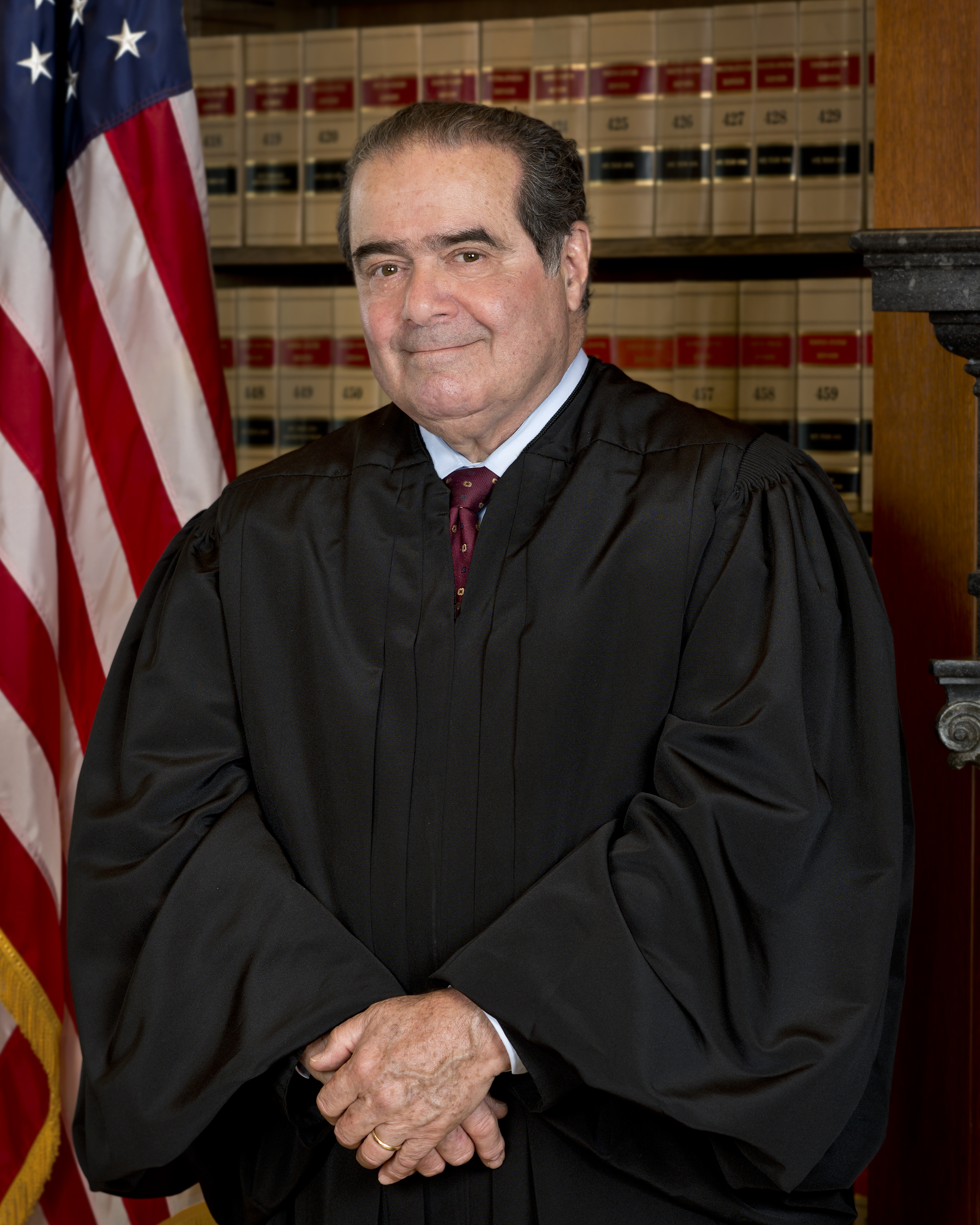
Notable Quote: Have the Courage to Suffer by Antonin Scalia

I guess by now most of the American readers of my blog have heard that Supreme Court Justice Antonin Scalia passed away Saturday.  

I have to say I am a bit heartbroken over it.  Antonin Scalia was a personal hero of mine.  As an Italian-American and a conservative and a Catholic I was so proud of him.  It is my perception that until Scalia hit the national scene, Italian-Americans and Catholics were predominantly center-left on the political scale, which is to say moderate Democrats as far as political party affiliation goes.  And I would assess that over 90% of my family would consider themselves Democrats, even today. 

Now it is without question that it was the Democratic Party which left traditional values behind, which made a new generation look toward the political right for a fit.  As I matured and found my philosophic match, there was no question that I was a conservative.  I think it’s in my genetic makeup.  Antonin Scalia, with his pugnacious personality, his wit and charm, his intellectual brilliance, his devout Catholicism, his loud and larger than life energy—the very essence of Italian male extroversion—his dedication to family and tradition made him an icon for many, but specifically for those of us of Italian ethnicity.  Some of us have crazy uncles and some of us have brilliant uncles: Antonin Scalia was our brilliant uncle, and we could point to him to justify our political leanings.

There are many great Scalia quotes.  I love the one where he’s being interviewed by a writer for New York magazine, which is a publication somewhere left of Pravda, where the interviewer is shocked that Scalia actually believes in heaven and hell.  Scalia leans in to him and adds, “I even believe in the Devil.”  

But the quote of his I most embrace is this one on the courage to be a Christian:

“God assumed from the beginning that the wise of the world would view Christians as fools ... and he has not been disappointed…If I have brought any message today, it is this: Have the courage to have your wisdom regarded as stupidity…Be fools for Christ. And have the courage to suffer the contempt of the sophisticated world.”
            - Speech at Living the Catholic Faith conference, 2012


Antonin Scalia was an intellectual giant compared these petty, conventional “sophisticates.”  There are only a handful of people that I would love to hang out with in heaven, if I should be graced with getting there.  Antonin Scalia is one of them.  May eternal light shine upon him as he rests in peace.