"Love follows knowledge."
"Beauty above all beauty!"
– St. Catherine of Siena

Showing posts with label The Beatitudes. Show all posts

Sunday, February 1, 2026

Sunday Meditation: The Blessed State

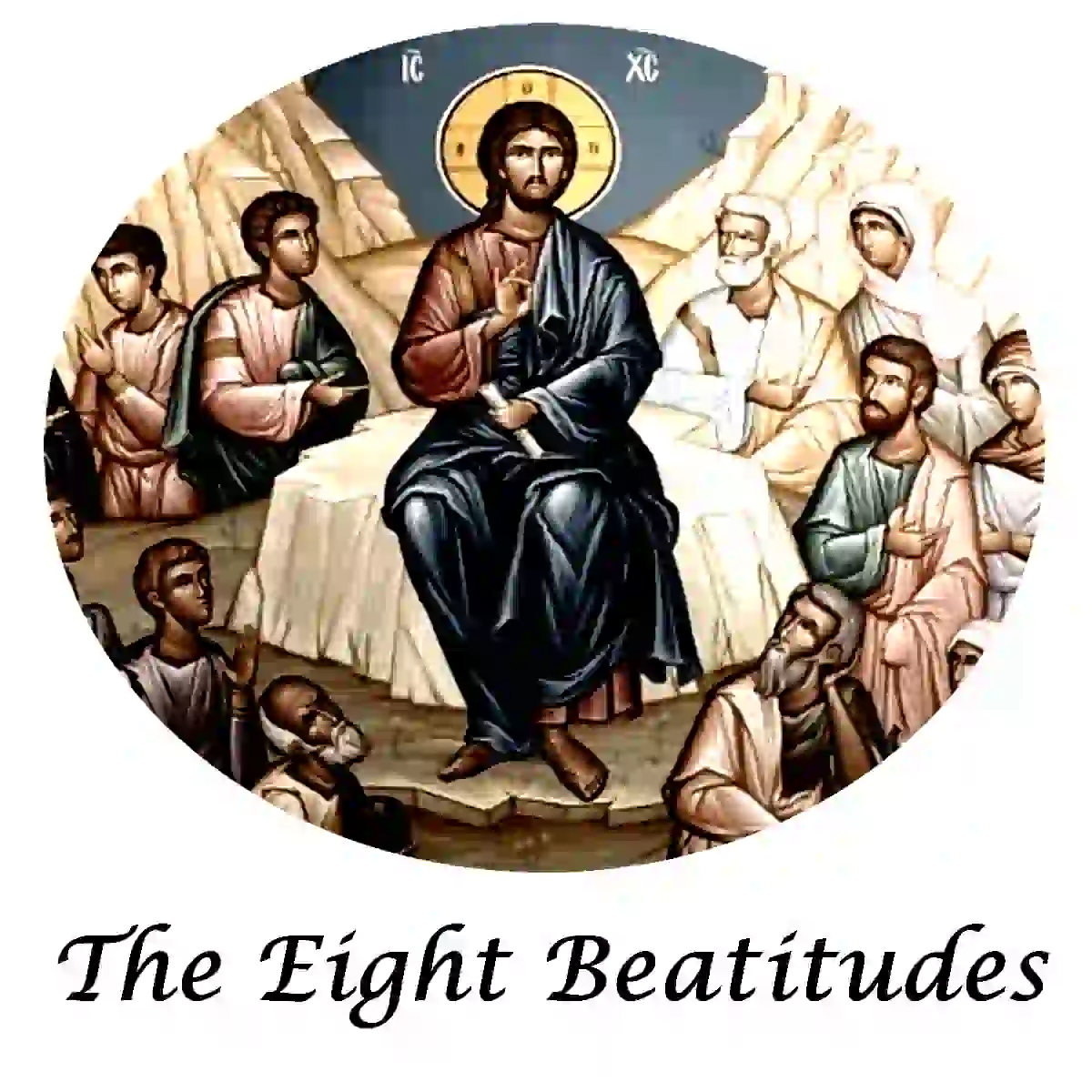
In Matthew’s Gospel, after proclaiming the Kingdom of God, which we saw last Sunday, on the fourth Sunday in Ordinary Time He goes up an mountain and delivers his most profound sermon.  We will get parts of The Sermon on the Mount for a few consecutive Sundays, but today we will get perhaps what might be the core of Jesus’s message, the Beatitudes. 

In Matthew’s version of the Beatitudes Jesus describes eight states or conditions of being which when lived lead to salvation.  It is no coincidence they describe Jesus and I surmise describe out states of being in heaven.  These are what we will become when purified.  Start living them now!


Here is today’s Gospel reading.


When Jesus saw the crowds, he went up the mountain,

and after he had sat down, his disciples came to him.

He began to teach them, saying:

"Blessed are the poor in spirit,

for theirs is the kingdom of heaven.

Blessed are they who mourn,

for they will be comforted.

Blessed are the meek,

for they will inherit the land.

Blessed are they who hunger and thirst for righteousness,

for they will be satisfied.

Blessed are the merciful,

for they will be shown mercy.

Blessed are the clean of heart,

for they will see God.

Blessed are the peacemakers,

for they will be called children of God.

Blessed are they who are persecuted for the sake of righteousness,

for theirs is the kingdom of heaven.

Blessed are you when they insult you and persecute you

and utter every kind of evil against you falsely because of me.

Rejoice and be glad,

for your reward will be great in heaven."

~Mt: 5:1-12


This week I return to Fr. Geoffrey Plant who first orients us within Matthew’s Gospel then at about the eleven minute mark (if you want to skip ahead) begins explaining the Sermon on the Mount.


To me the most insightful aspect of Fr. Geoffrey’s homily is his definition of “blessedness.”

So when [makarios] is used in the New Testament it no longer describes the gods, or the wealthy, or those fortunate in worldly terms.  It denotes the person who is aligned with God; the one whose life is shaped by God’s reign.  It refers to a joy and flourishing that circumstances cannot touch.  For that reason it should not be translated as “happy” in the modern sense.  It means “deeply flourishing,” or being in a state of  “God-given well-being.


Here is someone new to my blog for the pastoral homily, Monsignor Roger Landry of The Pontifical Mission Societies in the U.S.  Msgr Landry speaks from his own mountain top, a rooftop in Manhattan.


Pope St. John Paul II considered this man to have lived out the Beatitudes, now St. Pier Giorgio Frassati.  I have posted on him. 


Sunday Meditation: “Rejoice and be glad, for your reward will be great in heaven."


John Michael Talbot sings the beatitudes.


“Blessed are the pure of heart, for they will see the face of God, they shall see the face of God.”


Friday, October 31, 2025

All Saints Day Meditation: Solemnity of All Saints

Tomorrow is the Solemnity of All Saints, commonly called All Saints Day.  It is normally a holy day of obligation but in my neck of the world, since it falls on a Saturday this year, we are excused from the obligation.  Still we are having a special Mass at my parish for those who wish to attend.  Last year we had Cardinal Dolan come in to celebrate the display of relics our pastor, a great collector of relics, placed in cabinets situated about the Church.  https://ashesfromburntroses.blogspot.com/2024/11/faith-filled-friday-all-saints-day-at.html  There will not be a special celebrant this year, but we will celebrate All Saints through those same relics.  It will be special. 

The Gospel passage for All Saints Day is the same every year, the Beatitudes from the Sermon on the Mount in Matthew’s Gospel.


Here is the Gospel passage.


When Jesus saw the crowds, he went up the mountain,

and after he had sat down, his disciples came to him.

He began to teach them, saying:


"Blessed are the poor in spirit,

for theirs is the Kingdom of heaven.

Blessed are they who mourn,

for they will be comforted.

Blessed are the meek,

for they will inherit the land.

Blessed are they who hunger and thirst for righteousness,

for they will be satisfied.

Blessed are the merciful,

for they will be shown mercy.

Blessed are the clean of heart,

for they will see God.

Blessed are the peacemakers,

for they will be called children of God.

Blessed are they who are persecuted for the sake of righteousness,

for theirs is the Kingdom of heaven.

Blessed are you when they insult you and persecute you

and utter every kind of evil against you falsely because of me.

Rejoice and be glad,

for your reward will be great in heaven."

~Mt 5:1-12


This is a beautiful explanation of what All Saints Day is and why we celebrate it, put together by the YouTube channel, Catholic Saints and Feasts.


The one homily I will embed will come from Cardinal Wilton Gregory of Washington DC speaking on the heroic virtues of St. Dominic de Guzmán.


To pray, to bless, to preach!


All Saints Day Meditation: "The only real sadness, the only real failure, the only great tragedy in life, is not to become a saint."  (French Catholic novelist Leon Bloy)


Let us honor one of the new saints recently canonized in the last few months, one that is ideal with today’s Gospel, the “Man of the Beatitudes.”


“Jesus comes to me every morning in Holy Communion, and I return the visit in the poor.”  -St. Pier Giorgio Frassati.

Sunday, February 16, 2025

Sunday Meditation: The Sermon of the Great Reversal


No, the Sermon of the Great Reversal is not something you have missed in your learning of the New Testament.  It’s my renaming of Luke’s Sermon on the Plain, Luke’s version of the Beatitudes.  On the Sixth Sunday of Ordinary Time, Year C, we are presented with Jesus’s great sermon of Blessedness.  I call it the Sermon of the Great Reversal because Jesus reverses the values of the world and presents us the values of the Kingdom of God.


Jesus came down with the Twelve

and stood on a stretch of level ground

with a great crowd of his disciples

and a large number of the people

from all Judea and Jerusalem

and the coastal region of Tyre and Sidon.

And raising his eyes toward his disciples he said:

            “Blessed are you who are poor,

                        for the kingdom of God is yours.

            Blessed are you who are now hungry,

                        for you will be satisfied.

            Blessed are you who are now weeping,

                        for you will laugh.

            Blessed are you when people hate you,

                        and when they exclude and insult you,

                        and denounce your name as evil

                        on account of the Son of Man.

Rejoice and leap for joy on that day!

Behold, your reward will be great in heaven.

For their ancestors treated the prophets in the same way.

            But woe to you who are rich,

                        for you have received your consolation.

            Woe to you who are filled now,

                        for you will be hungry.

            Woe to you who laugh now,

                        for you will grieve and weep.

            Woe to you when all speak well of you,

                        for their ancestors treated the false prophets in this way.”

~Lk 6:17, 20-26


Fr. Geoffrey Plant instructs us on the language intricacies of this passage, and then enlightens us to the Great Reversal.


This is going to seem odd that Dr. Brant Pitre is going to provide the pastoral explanation of the passage, but he does.  In his explanation of the passage, he connects it with the carrying of our daily crosses.


Where you find happiness is through the detachment of earthly goods.  Does Luke mean to imply a spiritual detachment or an actual detachment?  This might be more controversial, but I think he means actual detachment, actual poverty, actual hunger, actual mourning, and actual rejection.  After all, isn’t that Christ’s life?


Sunday Meditation: “Behold, your reward will be great in heaven.”


John Michael Talbot’s “The Beatitudes” is the proper hymn here.


Sunday, January 29, 2023

Sunday Meditation: The Beatitudes

Today we come to Jesus’ greatest sermon.


When Jesus saw the crowds, he went up the mountain,

and after he had sat down, his disciples came to him.

He began to teach them, saying:

"Blessed are the poor in spirit,

for theirs is the kingdom of heaven.

Blessed are they who mourn,

for they will be comforted.

Blessed are the meek,

for they will inherit the land.

Blessed are they who hunger and thirst for righteousness,

for they will be satisfied.

Blessed are the merciful,

for they will be shown mercy.

Blessed are the clean of heart,

for they will see God.

Blessed are the peacemakers,

for they will be called children of God.

Blessed are they who are persecuted for the sake of righteousness,

for theirs is the kingdom of heaven.

Blessed are you when they insult you and persecute you

and utter every kind of evil against you falsely because of me.

Rejoice and be glad,

for your reward will be great in heaven."

~Mt 5:1-12

The first part of the sermon are the Beatitudes, eight keys to happiness.  Bishop Barron’s homily explains them well.


Let’s look at the first and third since they are similar but promise two very different things. 

"Blessed are the poor in spirit, for theirs is the kingdom of heaven.”

“Blessed are the meek, for they will inherit the land.”

To be poor in spirit and to be meek are nearly synonymous, are they not?  And yet one promises heaven, and the other promises land.  How are we to understand this land?  Pope Benedict XVI explains it.


“The Israelites spent forty years in the desert to arrive at the Promised Land. After they were taken captive to Babylon they waited seventy years to return to their own land. Land is always associated with right worship. Moses’ original demand of Pharaoh was to let the Israelites leave Egypt so they could worship in their own way. The Israelites were exiled to Babylon because they had abandoned right worship for idolatry. So yes, the promise of land is literal in the Old Covenant, connected with faithfulness to God’s covenant. The land is, as Benedict calls it, “a space for obedience, a realm of openness to God, that was to be freed from the abomination of idolatry.” The idea of land was gradually broadened. The Samaritan woman inquires of Jesus: “Our fathers worshipped on this mountain, but you say that in Jerusalem is the place where people ought to worship.” Jesus replies, “Woman, believe me, the hour is coming when neither on this mountain nor in Jerusalem will you worship the Father . . . . But the hour is coming and now is, when the true worshipers will worship the Father in spirit and truth.” (Jn. 4:20-22) The king who rules “from sea to sea” promises a universal place of worship and obedience to God. Thus the land is no longer a piece of earth, but the whole earth, and that is Christ’s Church. Does the beatitude then refer to the land in a physical or a spiritual sense? Again—both, the one and the other.” (Jesus of Nazareth: From Baptism in the Jordan to the Transfiguration, pp 80-81)

Of all eight beatitudes, the third is the only one that is not beyond this world.  And yet it is!