"Love follows knowledge."
"Beauty above all beauty!"
– St. Catherine of Siena

Showing posts with label Imperial Rome. Show all posts

Friday, March 1, 2024

Quo Vadis: A Narrative of the Time of Nero by Henryk Sienkiewicz, Part 4

This is Post #4 of Henryk Sienkiewicz’s historical novel, Quo Vadis.

You can find Post #1 here.  

Post #2, here.

And Post #3 here.  


Chapters 21 thru 27

Summary

Vinicius at the sight of Lygia is frozen and feels an immense feeling of love and desire.  Chilo pulls him away and suggests they go to the cemetery gate to encounter her as she leaves.  But Vinicius, knowing that Croton will be his protection, insists they follow her home and grab her there.  Chilo does not approve of this plan out of fear and he and Croton bicker.  Croton assures them he will protect them all.  After a very long walk following Lygia they arrive at a house.  Vinicius and Croton approach the house while Chilo hides in an ally to watch.

The house is large with many apartments and inside a courtyard they spot Ursus.  They follow Ursus and Vinicius commands Croton to attack and kill him.  In a quick moment Croton puts Ursus in a wrestling lock.  Vinicius leaves them fighting while he barges into the room to find Lygia.  Also in a quick moment he grabs Lygia and forcibly pulls her out but when he goes out the door he finds that Ursus has smashed Croton’s head and is dead.  Ursus seeing Vinicius abducting Lygia springs toward him.  But Lygia screams to “Kill not!” 

Meanwhile Chilo outside is wondering what is happening.  If something has happened to Vinicius, he ponders, he will get the authority of Caesar upon the house.  Then he sees Ursus come out to dispose of Croton’s body, and Chilo runs in fear.  He concludes that Vinicius has been killed.  After a time, he decides it is best to find out what has happened to Vinicius and he decides to go.  But he encounters Ursus in front of his own house as he was about to leave.  Ursus beckons Chilo to go to Vinicius.

What had happened to Vinicius when Lygia prevented Ursus from killing him was that Ursus had pushed him and knocked him unconscious.  When he came to there were people standing above him and he found his left arm broken to the point of distortion.  It had come out of the shoulder socket.  Vinicius thinking they were torturing him asked to be killed.  They did no such thing but tried to heal him.  The Christians Crispus and Glaucus were trying to put his arm back into place.  Lygia too brought in water and dressings for his wounds.  The Christians worry that some retribution will be taken against them but Vinicius hoping not to lose Lygia promises that his authority will prevent that.  He tells them to bring Chilo so he could arrange it.  Lygia convinces Crispus to let them all stay until Vinicius is nursed back to health.

Ursus takes Chilo on that long walk to the house where Lygia is staying.  On the walk the two talk about Christianity and Chilo continues to maintain the charade he is a Christian.  Finally they get to the bed where Vinicius lay.  Vinicius tells him a lie that Croton had tried to kill Vinicius and the Christians had protected him.  Then suddenly Glaucus, who Chilo had betrayed years ago, makes himself known.  Chilo now convinced he will be killed in revenge drops to his knees to beg.  But to Chilo’s shock Galucus forgives him, and Ursus helps him up and leads him out.

Vinicius too is shocked that the Christians should treat Chilo with mercy.  It doesn’t make sense to his pagan understanding.  As he lay in bed recovering Vinicius ponders the values of the Christian people.  As he is being nursed, Lygia explains how Christians are supposed to act in accordance to God.  In a fever Vinicius goes in and out of dreams, dreaming of Lygia, the Apostle Peter, and the other Christians.  The dreams feel like some heavenly state of goodness.  When he wakes he could hear Peter telling the stories of Christ.  At one point Vinicius feels his soul in a state of upheaval.  Finally he dreams of drowning and being pulled into a boat navigated by Peter.  And when in the dream that boat lands, Lygia takes his hand and leads him into a glow of light.  When he wakes he finds Lygia on her knees praying. 

The next day Vinicius awakes with Ursus nursing him.  Vinicius inquires about Ursus’ homeland and Lygia’s history.  She was a king’s daughter and had been given as a child to a Roman commander who in several transfers was given to Pomponia to raise.  Ursus’ country was beyond the Danube filled with heavy forests, and their people are pagan.  He and Lygia became Christian through Pomponia.  Ursus’ awkwardness in feeding Vinicius leads him to get Lygia to take over.  In feeding Vinicius while he is in bed, the closeness between he and Lygia stirs desires in both of them.  Vinicius tells her that he will no longer attain her by force.  She tells him that she believes Caesar is angry with her and does not think it wise to be returned to Pomponia.  He asks about her Christianity and her happiness.  At that moment he could see the difficulties of a relationship with her, he a patrician Roman, she a Christian.  In speaking to him, she was filled with love for him.  But she too realizes the difficulties of such a relationship.

She tries to not go near him as much, but when she sees him delight fills her heart.  She notices that Vinicius has subtlety changed for the good.  He has begun to see all the household as human beings and not slaves.  Slowly he is returning to health.  Christianity still seems absurd to him but the figure of Christ is paramount.  He concludes that he must either love him or hate him, there could be no indifference.  Lygia notices how Christianity is breaking Vinicius and she has pity for him in his struggle.  When he expresses love for her, she rushes away with her heart aflame. 

The next day she reveals to Crispus that she could not trust herself any longer near Vinicius.  Crispus, a presbyter, severe in nature, was indignant.  How could she give in to these passions?  He was visibly angry and told her he was disappointed with her.  Crispus’ loud, angry voice brings the attention of Peter who is then walking into the house with another apostle, Paul of Tarsus.  Sobbing, Lygia explains what had happened, and to Crispus’ surprise, Peter takes the side of Lygia.  He explains that Christ had forgiven many women, and that marriage was a normal thing between men and women.  Crispus expresses his contrition, and he too is forgiven.


###

My Comment:

When Ursus tells about his homeland of Lygia, I became curious to see exactly where this place is located.  As it turns out Lygia was the region of the Germanic tribe the Lugii or sometimes referred to as the Lygii, https://en.wikipedia.org/wiki/Lugii inhabiting central Europe “north of the Sudetes mountains in the basin of upper Oder and Vistula rivers, covering most of modern southern and middle Poland (regions of Silesia, Greater Poland, Mazovia and Lesser Poland).”  That’s in Poland, Sienkiewicz’s homeland.  I guess that should not be a surprise but it did surprise me.  It’s quite natural for an author to integrate his homeland into a story.  In modern Poland, the region would be I think Lower Silesia, whose capital is Wroclaw, and on the modern map bordering Czech Republic and eastern Germany.  Sienkiewicz in the novel mentions the Lygians having battled other Germanic tribes.  The Suevi and the Marcomani are mentioned.  The Lygii, the Suevi, and the Marocmani are all real Germanic people.  Sienkiewicz did his research well.

Kerstin Replied:

The Suebi are the modern day Swabians. I am Swabian :-) They migrated further over the next centuries finally settling roughly south of the Limes (red line) by the 6th century, if I remember correctly.


Part of the Swabians were a people called Alamanni, and they settled the furthest south and west into modern day Switzerland and what is now Alsace in France. This is why the French call Germany Allamagne. The dialects of both are very similar.

My Reply to Kerstin:

How cool is that Kerstin. Italians also call Germans similarly.


By the way, I have some background in the novel as well. The Romans keep talking about going to a city called Beneventum. That is the modern day city of Benevento. The town in Italy where my family is from is not very far from there, maybe a half hour drive and it's only that long because it's winding roads in hilly areas. I've been to Benevento and looked at the Roman ruins.


If you look at a good Italian map (and you can find it on the internet) my home town is mid way between Benevento and another small city named Avellino. Actually I was born in a hospital in Avellino.

Frances Reply to Me:

I found it, Manny. East of Naples, on the Sabato River, in a landscape beautiful with rivers, lakes, mountains and boundless plains. What a heritage!

Michelle’s Reply:

That's terrible!

My Reply to Michelle:

My father’s brother? Yes. It’s hard to think of him as an uncle since I never met him. I think he was in his twenties and my father must have been some ten years younger I’m guessing. My mother still has a picture of Uncle Federico on her wall. He was supposedly a strong swimmer too, which supports the claim that more people who know how to swim drown than those who don’t. Those that know how to swim either take more chances or come across conditions they misjudge (like under currents) that might lead to drowning. My father at the beach would swim way out there, sometimes where lifeguards had to call him in, which is crazy knowing what happened to his brother. But he never drowned or needed rescue. Me, I am a poor swimmer and I tell myself every time I’m confronted with bodies of water. I no longer swim in anything but a swimming pool, and even that has become rare.

My Comment:

I'm having a brain freeze. Who is Bronzebeard or in some translations called Redbeard? For some reason my memory is failing me.


Wait, is that just another name for Nero? Is that only a slang for Nero between Petronius and Vinicius?

Michelle’s Reply:

I think someone else later on in the book referred to Nero as Bronzebeard as well.

Kerstin’s Reply:

Yes, it's Nero. In my translation he is referred to as "Redbeard" all the time by Petronius.


###

Excerpt from Chapter 21, Vinicuis catching sight of Lygia, the end of the ceremony, and Vinicius, Chilo, and Croton following Lygia to her home.


Every drop of blood quivered in the young patrician at sight of her. He forgot the crowd, the old man, his own astonishment at the incomprehensible things which he had heard,—he saw only her. At last, after all his efforts, after long days of alarm, trouble, and suffering, he had found her! For the first time he realized that joy might rush at the heart, like a wild beast, and squeeze it till breath was lost. He, who had supposed hitherto that on "Fortuna" had been imposed a kind of duty to accomplish all his wishes, hardly believed his own eyes now and his own happiness. Were it not for that disbelief, his passionate nature might have urged him to some unconsidered step; but he wished to convince himself first that that was not the continuation of those miracles with which his head was filled, and that he was not dreaming. But there was no doubt,—he saw Lygia, and an interval of barely a few steps divided them. She stood in perfect light, so that he could rejoice in the sight of her as much as he liked. The hood had fallen from her head and dishevelled her hair; her mouth was open slightly, her eyes raised toward the Apostle, her face fixed in listening and delighted. She was dressed in a dark woollen mantle, like a daughter of the people, but never had Vinicius seen her more beautiful; and notwithstanding all the disorder which had risen in him, he was struck by the nobility of that wonderful patrician head in distinction to the dress, almost that of a slave. Love flew over him like a flame, immense, mixed with a marvellous feeling of yearning, homage, honor, and desire. He felt the delight which the sight of her caused him; he drank of her as of life-giving water after long thirst. Standing near the gigantic Lygian, she seemed to him smaller than before, almost a child; he noticed, too, that she had grown more slender. Her complexion had become almost transparent; she made on him the impression of a flower, and a spirit. But all the more did he desire to possess that woman, so different from all women whom he had seen or possessed in Rome or the Orient. He felt that for her he would have given them all, and with them Rome and the world in addition.


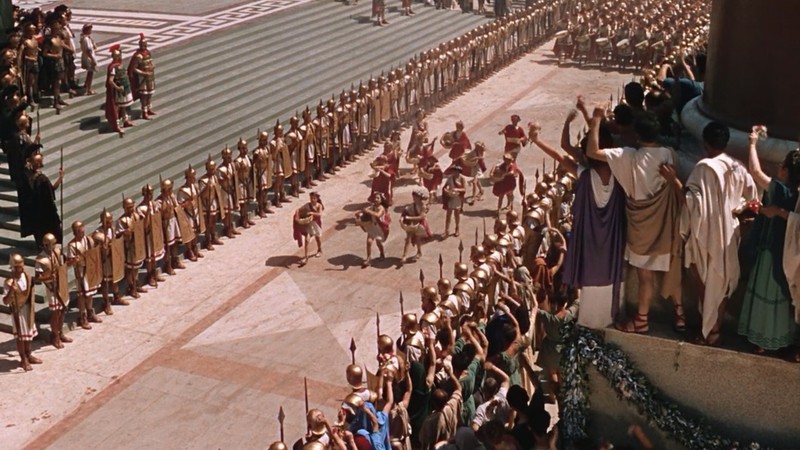
He would have lost himself in gazing, and forgotten himself altogether, had it not been for Chilo, who pulled the corner of his mantle, out of fear that he might do something to expose them to danger. Meanwhile the Christians began to pray and sing. After a while Maranatha thundered forth, and then the Great Apostle baptized with water from the fountain those whom the presbyters presented as ready for baptism. It seemed to Vinicius that that night would never end. He wished now to follow Lygia as soon as possible, and seize her on the road or at her house.


At last some began to leave the cemetery, and Chilo whispered,—"Let us go out before the gate, lord, we have not removed our hoods, and people look at us."


Such was the case, for during the discourse of the Apostle all had cast aside their hoods so as to hear better, and they had not followed the general example. Chilo's advice seemed wise, therefore. Standing before the gate, they could look at all who passed; Ursus it was easy to recognize by his form and size.


"Let us follow them," said Chilo; "we shall see to what house they go. To-morrow, or rather to-day, thou wilt surround the entrances with slaves and take her."


"No!" said Vinicius.


"What dost thou wish to do, lord?"


"We will follow her to the house and take her now, if thou wilt undertake that task, Croton?"


"I will," replied Croton, "and I will give myself to thee as a slave if I do not break the back of that bison who is guarding her."


But Chilo fell to dissuading and entreating them by all the gods not to do so. Croton was taken only for defence against attack in case they were recognized, not to carry off the girl. To take her when there were only two of them was to expose themselves to death, and, what was worse, they might let her out of their hands, and then she would hide in another place or leave Rome. And what could they do? Why not act with certainty? Why expose themselves to destruction and the whole undertaking to failure?


Though Vinicius restrained himself with the greatest effort from seizing Lygia in his arms at once, right there in the cemetery, he felt that the Greek was right, and would have lent ear, perhaps, to his counsels, had it not been for Croton, to whom reward was the question.


"Lord, command that old goat to be silent," said he, "or let me drop my fist on his head. Once in Buxentum, whither Lucius Saturnius took me to a play, seven drunken gladiators fell on me at an inn, and none of them escaped with sound ribs. I do not say to take the girl now from the crowd, for they might throw stones before our feet, but once she is at home I will seize her, carry her away, and take her whithersoever thou shalt indicate."


Vinicius was pleased to hear those words, and answered,—"Thus let it be, by Hercules! To-morrow we may not find her at home; if we surprise them they will remove the girl surely."


"This Lygian seems tremendously strong!" groaned Chilo.


"No one will ask thee to hold his hands," answered Croton.


Tuesday, February 27, 2024

Quo Vadis: A Narrative of the Time of Nero by Henryk Sienkiewicz, Part 3

This is Post #3 of Henryk Sienkiewicz’s historical novel, Quo Vadis.

You can find Post #1 here.  

And Post #2, here


Chapters 15 thru 20

Summary

The narrative suddenly turns epistolary.  First Petronius sends a letter to Vinicius that he and the Roman aristocracy are in the vacation town of Antium.  He provides some of the gossip and some of the machinations between rivals.  He mentions that the pain of little Augusta’s death is still fresh.  Vinicius, in Rome, writes back that despite Chilo’s clandestine excursions into the Christian population, Lygia has not been found.  Chilo has brought back information that the Christians have prayer services in meeting houses.  He tells Petronius that he too in disguised has wandered to some of the prayer houses.

The narrative returns with Chilo having been away from Vinicius for some time, and Vinicius’ emotions toward Lygia gone from love to anger, but he strengthens his resolve to find her and possess her.  Finally after some time Chilo returns to tell him though she has not been found she is certainly among them.  Chilo mentions that he has found an old nemesis, an old man named Glaucus who was responsible for Chilo losing two fingers on his hand and that he had left him at an inn dying of stab wounds after Glaucus’ wife and child were abducted.  He says that robbers had done this to Glaucus, and now Glaucus had apparently joined the Christians.  Vinicius asks him why this should concern him, and Chilo says he must stay away from Glaucus and can no longer search for Lygia.  Vinicius is enraged and says he will kill Chilo himself if he doesn’t continue.  Chilo reluctantly agrees but requests money to have Glaucus killed.  Vinicius advances him a good portion of Chilo’s fee.  Chilo reveals that a certain Paul of Tarsus, a Christian lawgiver, is due to come to Rome and hopes that he can locate Lygia in that gathering.

Chilo again goes undercover to the Christian he has befriended, the old man Euricius.  Chilo explains his need for protection, and Euricius’ son Quartus puts Chilo in contact with Demos who is supposed to have laborers who can work as bodyguards.  Among the laborers is a gigantic man named Urban.  Chilo explains to Urban how this man named Glaucus plans to betray the Christians and must be killed.  Chilo couches the story into a replay of Judas betraying Christ, and that Glaucus is a second Judas.  Urban tells Chilo he will do it despite that he feels guilt still for killing another man accidently.  Urban also tells Chilo of a big Christian gathering at Ostrianum, the cemetery outside the city gates.  There a great apostle of Christ is supposed to give a talk and all the Christians will be there.  There Urban says he will to kill Glaucus.

Petroinus writes another letter to Vinicius.  He tells Vinicius to hire Croton to be his guard as he wanders the streets of Rome.  He will be needed to defend against Ursus when Lygia is found.  He goes on about more political gossip and winds up that at some point he may slice his veins to end his life.

Chilo barges into Vinicius’ home to tell him that he has found Lygia.  He has not exactly found her but knows where she will be that evening.  She will be at Ostrianum with Ursus who has changed his name to Urban.  Chilo cowardly says he will not join Vinicius that evening, but Vinicius compels him with money and with the company of Croton.  Vinicius now is in wild delight.  He will finally possess Lygia.  Chilo explains how Ursus is supposed to kill Glaucus, but wonders if the goodness of Christianity will dissuade Urban.  Chilo explains the Christian God is one of morality.  They all put on cloaks with hoods and head off to Ostrianum. 

At Ostrianum they watched the Christians slowly gather in huge numbers.  Vinicius noticed that the Christians relate to their God with love, unlike any religion he had ever seen.  He did not love his Greco-Roman gods but feared them.  He listened to the Christians sing hymns.  Finally an old man named Peter stepped up on a rock and blessed the crowd with the sign of a cross.  They heard the old man had been a fisherman once and had been Christ’s chief disciple.  Peter began to speak like a father instructing his children, imploring them to be good and pure.  Vinicius notices that Christianity is different from any philosophy he knows.  Peter even speaks on the merits of suffering and even death like that of Christ.  Vinicius is repelled by this teaching.  What kind of God is this?  He concludes that Christianity is madness.  Peter goes on to speak of his witness to Christ, of Christ’s death and how they had found the tomb empty and ultimately come across the Risen Christ.  Vinicius became lost in Peter’s narrative and was torn between belief and unbelief.  Peter kept saying, “I saw.”  As morning began to rise, Chilo pulled Vinicius aside and pointed to Urban and the girl.  Vinicius turned and saw Lygia.


###

My Comment:

Oh my! Was that a spectacular Chapter 20? I was glued.

Madeleine Replied:

I agree, Manny. I'm finding it harder to put down, and really easy to keep up so far. Even though I read it when I was in high school, I really didn't remember much, so it's a whole new book this time.

My Comment:

What is interesting is that Sienkiewicz waited for almost a third of the novel to get to the Christians. Up to now we've barely seen the Christians interact and the anticipation climaxed with St. Peter's sermon. That was highly skilled plotting.

Michelle Replied:

When I knew that St. Peter was about to come onstage I was thrilled!

Joseph Replied:

I agree with Manny on the clever construction of the narrative. Sienkiewicz has gone the extra length to make early Christians seem mysterious to the modern Christian, or at least culturally Christian, people reading the book and having to place themselves in the viewpoint of 1st century Romans.

Galicius Commented:

It seems that Sienkiewicz set himself a goal to present mutual relationship of two worlds pagan—Roman—and Christian. Sienkiewicz was criticized that his portrayal of Christianity pales compared to the pagan world in all its splendor of Roman palaces and life of its citizens, Caesar and his court. We get another description soon of a feast hosted by Tigellinus for Caesar in Chapter XXXI. It seems to me though that this is to be expected. Christians in Rome during Nero had to hide underground. How was Sienkiewicz to portray them in material terms? Christianity as seen by Vinicius in Lygia is perhaps best explained in Chapter XXXIV: “that beauty of a new kind altogether was coming to the world in her, such beauty as had not been in it thus far; beauty which is not merely a statue, but a spirit.” (Sorry for moving ahead but I do not think I am giving away anything of the story.)

Michelle Replied to Galicius:

He might be showing more of the Roman world, but he also shows how empty it is. Vinicius seems to be more discontent with Rome as the story continues.

My Reply to Galicius:

Yes, it seems he is setting out to contrast two world views, but I would disagree with those that claim the Roman world is presented in splendor. Yes, there are riches and power dramatized but I think it presents the Roman world as a bunch of overindulgent egotists who only care about themselves. The old Roman virtues of nobility and piety are long gone and what is left in this post Republican world is self-centeredness and hedonism. I don't find this a positive portrayal of the Roman world. It also feels very true.

Galicius Replied:

My above remarks were misunderstood—as if Sienkiewicz was representing Roman culture positively and purposely belittling the faithful Christians. We will see that this plebeian Christian culture that is depicted as little and pale compared to the aristocratic and powerful official patricians will be victorious in the end. Remember that God and Ursus is with them.

Madeleine’s Comment:

I am liking the rich detail in the novel. Sienkiewicz does bring his characters to life while giving us the context that envelops their lives. The pagans are definitely more sensually oriented than the Christians, and I like how Vinicius gradually begins to understand what is missing in the pagan world. Will he give himself over to Christ and will he be able to love Lygia with a holy Christian love? Suspense building here.

Kerstin’s Comment:

The roller-coaster of emotions Vinicius goes through in chapter 16 seems excessive to our sensibilities. Here is a young Pagan man who has yet to encounter the meaning of "love your neighbor as yourself". Ligyia is more object to him rather than a person.

My Reply to Kerstin:

I thought so too at first but that's where I saw Sienkiewicz building the psychologies of the pagan world (with its variety) and the Christian world. I am marveling at how the author is capturing the psychology of the pagan world.

Frances’s Comment:

I’d like to recommend Tom Holland’s excellent study of ancient cultures here. The title is Dominion (with a superb reproduction of Dali’s ‘’Christ of St. John of the Cross” on its cover). In it Tom Holland writes of his awakening to the cruelty of the ancient world: “The more you study the world of the ancient Romans the more alien they seem to be. Theirs was a culture built on systematic exploitation, an economy founded on slave labor,” and — to Kerstin’s point — “the absolute right of free Roman males to have sex with anyone they wanted and in any way they wanted . . . ‘’

My Reply to Frances:

I have thought of this book too while reading Quo Vadis. The central thesis of Holland's historical book is that there was a stark and lasting change in the world views/psychologies of the pagan world and the Christian world. I have not read this book but I have read reviews and heard Holland interviewed.


This is Holland's book Dominion: How the Christian RevolutionRemade the World. I bet you can find interviews of Holland on YouTube.  


Frances’s Reply:

Thank you, Manny. One of the best interviews I’ve found on YouTube is “Unbelievable? Tom Holland and Tom Wright: How St. Paul changed the world.” A conversation you’ll want to listen to again and again.


###

Excerpts from chapter 20.  Vinicius and Chilo sneak into a Christian ceremony in the middle of the night and witness Peter giving a homily.  I’m going to split this into two parts.  First Vincius’s observations of the Christian ceremony.


Vinicius had seen a multitude of temples of most various structure in Asia Minor, in Egypt, and in Rome itself; he had become acquainted with a multitude of religions, most varied in character, and had heard many hymns; but here, for the first time, he saw people calling on a divinity with hymns,—not to carry out a fixed ritual, but calling from the bottom of the heart, with the genuine yearning which children might feel for a father or a mother. One had to be blind not to see that those people not merely honored their God, but loved him with the whole soul. Vinicius had not seen the like, so far, in any land, during any ceremony, in any sanctuary; for in Rome and in Greece those who still rendered honor to the gods did so to gain aid for themselves or through fear; but it had not even entered any one's head to love those divinities.


Though his mind was occupied with Lygia, and his attention with seeking her in the crowd, he could not avoid seeing those uncommon and wonderful things which were happening around him. Meanwhile a few more torches were thrown on the fire, which filled the cemetery with ruddy light and darkened the gleam of the lanterns. That moment an old man, wearing a hooded mantle but with a bare head, issued from the hypogeum. This man mounted a stone which lay near the fire.


The crowd swayed before him. Voices near Vinicius whispered, "Peter! Peter!" Some knelt, others extended their hands toward him. There followed a silence so deep that one heard every charred particle that dropped from the torches, the distant rattle of wheels on the Via Nomentana, and the sound of wind through the few pines which grew close to the cemetery.


Chilo bent toward Vinicius and whispered,—"This is he! The foremost disciple of Christ-a fisherman!"


The old man raised his hand, and with the sign of the cross blessed those present, who fell on their knees simultaneously. Vinicius and his attendants, not wishing to betray themselves, followed the example of others. The young man could not seize his impressions immediately, for it seemed to him that the form which he saw there before him was both simple and uncommon, and, what was more, the uncommonness flowed just from the simplicity. The old man had no mitre on his head, no garland of oak-leaves on his temples, no palm in his hand, no golden tablet on his breast, he wore no white robe embroidered with stars; in a word, he bore no insignia of the kind worn by priests—Oriental, Egyptian, or Greek—or by Roman flamens. And Vinicius was struck by that same difference again which he felt when listening to the Christian hymns; for that "fisherman," too, seemed to him, not like some high priest skilled in ceremonial, but as it were a witness, simple, aged, and immensely venerable, who had journeyed from afar to relate a truth which he had seen, which he had touched, which he believed as he believed in existence, and he had come to love this truth precisely because he believed it. There was in his face, therefore, such a power of convincing as truth itself has. And Vinicius, who had been a sceptic, who did not wish to yield to the charm of the old man, yielded, however, to a certain feverish curiosity to know what would flow from the lips of that companion of the mysterious "Christus," and what that teaching was of which Lygia and Pomponia Græcina were followers.

Second excerpt is part of Peter’s homily.


The old man closed his eyes, as if to see distant things more distinctly in his soul, and continued,—"When the disciples had lamented in this way, Mary of Magdala rushed in a second time, crying that she had seen the Lord. Unable to recognize him, she thought him the gardener: but He said, 'Mary!' She cried 'Rabboni!' and fell at his feet. He commanded her to go to the disciples, and vanished. But they, the disciples, did not believe her; and when she wept for joy, some upbraided her, some thought that sorrow had disturbed her mind, for she said, too, that she had seen angels at the grave, but they, running thither a second time, saw the grave empty. Later in the evening appeared Cleopas, who had come with another from Emmaus, and they returned quickly, saying: 'The Lord has indeed risen!' And they discussed with closed doors, out of fear of the Jews. Meanwhile He stood among them, though the doors had made no sound, and when they feared, He said, 'Peace be with you!'


"And I saw Him, as did all, and He was like light, and like the happiness of our hearts, for we believed that He had risen from the dead, and that the seas will dry and the mountains turn to dust, but His glory will not pass.


"After eight days Thomas Didymus put his finger in the Lord's wounds and touched His side; Thomas fell at His feet then, and cried, 'My Lord and my God!' 'Because thou hast seen me thou hast believed; blessed are they who have not seen and have believed!' said the Lord. And we heard those words, and our eyes looked at Him, for He was among us."


Vinicius listened, and something wonderful took place in him. He forgot for a moment where he was; he began to lose the feeling of reality, of measure, of judgment. He stood in the presence of two impossibilities. He could not believe what the old man said; and he felt that it would be necessary either to be blind or renounce one's own reason, to admit that that man who said "I saw" was lying. There was something in his movements, in his tears, in his whole figure, and in the details of the events which he narrated, which made every suspicion impossible. To Vinicius it seemed at moments that he was dreaming. But round about he saw the silent throng; the odor of lanterns came to his nostrils; at a distance the torches were blazing; and before him on the stone stood an aged man near the grave, with a head trembling somewhat, who, while bearing witness, repeated, "I saw!"


Friday, February 23, 2024

Quo Vadis: A Narrative of the Time of Nero by Henryk Sienkiewicz, Part 2

This is Post #2 of Henryk Sienkiewicz’s historical novel, Quo Vadis.

You can find Post #1 here.  


Chapters 7 thru 14

Summary

At the palace, Acte, Nero’s former mistress but now a palace attendant, was assigned to prepare Lygia for the feast.   Lygia undesiring to attend fearfully let Acte dress her.  A bond formed between the two of them.  Acte, educated, had read the writings of Paul of Tarsus, and compassionately advised Lygia on how to act in Nero’s company.  They discussed the mystery of why she had been brought to Nero’s palace.  To Acte’s surprise, Lygia, though lovely before, had transformed into the most beautiful of young women. 

They entered the feast and walked among eminent noblemen and senators.  Lygia was frightened and wanted to escape.  She saw Vinicius come in with Petronius.  Acte took her to the dining area and there was Caesar himself.  Vinicius approached her, and she found him handsome.  He pledged to her again.  She asked him why she had been taken to Caesar’s palace, and Vinicius calmed her by saying he would stay by her, and promised to take her to his house.  He sat by her at table.  At one point, drunk, he grabbed her by the arm, but Acte interfered by calling attention to Nero.  It was true.  Lygia had caught Nero’s eye, and Vinicius backed down.

Petronius and Nero have a conversation about Vinicius’s attraction to Lygia.  Other noblemen join in the conversation, a sort of imperious male talk of life and women.  Finally Poppaea, Nero’s wife entered and became the center of attention.  Lygia turned to Vinicius to ask if such a beautiful woman could be Poppaea, who she had heard as a Christian was notoriously evil.  But Vinicius, even more drunk, grabbed at her again.  Her once trust in Vinicius had now turned dread.  What stopped him were the musicians that had come to perform.  Music, reciting of poetry, and dramatic dialogues became the center of attention.    Athletes then came, wrestlers performing for entertainment.  Clowns and dancers followed.  The feast was turning into a bacchanal, and guests were undressing.  Drunken guests were shouting and grabbing at the dancers. 

Finally Vinicius blurts out to Lygia that Nero had taken her from Aulus for him, and that the next evening he will have her brought to his home.  Wildly drunk he rose and put his arms around her neck and pressed his lips on hers.  But Lygia’s giant guard, Ursus, pulled him off her and tossed him aside.  The giant picked up his queen and took her back to her room.  Vinicius called for her and then fell drunk to the floor.  Many of the guests were also lying about drunk.

Ursus had taken Lygia to Acte’s apartments.  Lygia and Ursus want to leave the palace altogether and are ready to return to Aulus’s home, but Acte tells them that it would be an insult to Caesar in which he would take his revenge on Aulus and Pomponia, and Lygia would still be forced to go to Vinicius.  Acte tries to convince Lygia to be resigned to her fate given the power of all the men involved.  Lygia will not accept it.  She and Ursus drop to their knees and pray which moves Acte.  After prayer, Lygia comes up with a new plan.  When Vinicius’ slaves come to take her away, Ursus and scores of other Christians will intercept the entourage and whisk Lygia away and make their way to the far reaches of the empire.

Acte did not like the plan.  She did not think it would work and could not understand why Lygia would refuse to be Vinicius’ concubine or perhaps possibly even wife.  But she marvels at Lygia’s calm as they rest, Lygia falling asleep while Acte awake in dread.  In the afternoon, while waiting for evening for Vinicius’ retinue to arrive and take her away, Lygia and Acte take a walk in the garden.  Poppaea comes upon them and noticing Lygia’s beauty wonders if Nero intends to take her for a mistress.  But Lygia explains that the plan was for Vinicius to taker her that evening and implores Poppaea to persuade Caesar to send her back to Aulus’s home.  Relieved, Poppaea tells her that evening Lygia will be Vinicius’ whore and walks away.  Evening comes and Vinicius’ retinue arrives, and Lygia hugs Acte goodbye.

Meanwhile Vinicius was waiting at his house with Petronius for Lygia to arrive, having prepared to start a feast when she got there.  Petronius admonishes Vinicius about his behavior at Nero’s feast.  It was no way to win over a lady.  As the retinue travels toward Vinicius’s home, it is overwhelmed by Christians who free Lygia.  Ursus kills a man who tried to whisk away Lygia, and Ursus and Lygia abscond into the dark streets of the city.  The slaves who had ushered Lygia in the retinue break the news to Vicinius, and Vinicius in his anger kills an old slave who had taken care of him as a child.

After flogging the rest of the slaves, Vinicius in his anger cannot rest.  He first contemplates a theory that Aulus and Pomponia had sent a party to attack the retinue.  He vows revenge against them.  Then he settles on a theory that Nero himself had attacked the retinue to take Lygia.  Here too he vows revenge but then in the reasoning of Nero’s superior power he resigns to have lost her.  He decides to go to Nero’s palace to discern if she is there.

At the palace Vinicius finds that Nero has been occupied with the illness of his newborn child Augusta, and could not have been the source of Lygia’s escape.  Acte explains to him that the child was with Poppaea when they came across Lygia in the garden, and that now Poppaea suspects that Lygia has cast a spell on Augusta.  If Augusta dies, both Nero and Poppaea will blame Lygia and she will be killed.  She also tells him that Lygia had loved him until his brutish behavior at Nero’s feast.  That she loved him cut to his heart, and he felt immense guilt. 

Vinicius and Petronius make a plan to try to find her.  They send slaves to watch the exits of the city.  They send patrols out to find her and Ursus.  They deduce that only their co-religionists would have gotten together and freed her.  To relieve Vinicius of his stress, Petronius offers him his beautiful female slave, Eunice.  Vicinius has no interest and Eunice resists.  Petronius has Eunice flogged nonetheless for resisting, suspecting that she refused to leave his household because she’s in love with someone there.

The next morning, a man who Eunice knows and who Petronius suspects is the man Eunice loves, presents himself to Petronius and Vinicius.  His name is Chilo Chilonides, a man of many talents and learning, and says he will find Lygia for them.  They promise to reward him with a small fortune if he delivers her.  His first order of business is to figure out what is her religion since only co-religionists would have taken such an initiative.  When he learns that Lygia had drawn a fish symbol, he concludes that she might be a Christian.  Petronius and Vinicius find it impossible to believe she is a Christian.  They hold such prejudiced notions about Christians and their practices. 

A few days later, Augusta dies, and Nero is in a rage.  Petronius tried to console him.  Chilo returns to confirm that the fish symbol stands for Jesus Christ, the god of the Christians.  Chilo then reveals that he through his investigation has “become Christian” himself.  He tells them the story of how he met with a freedman, Pansa, who is a Christian, and Pansa brought him to a house of prayer, and that by doing so he has infiltrated the Christians, becoming friends with an old man named Euricius.  The Christians seem to trust him and has been led into their company.  Through this he hopes to find Lygia.  Vinicius provides him with the necessary money to maintain this cover.


###

Celia Commented:

Manny, your summaries are like gold!! I have read through Chapter 7 so am not reading the summary yet. I AM loving the book and its message. Lygia reminds me of St Cecilia, my patron saint. She converted her pagan husband, as I think Lygia will do. I have seen at least three versions of this book. The one I started with was awful. I could not follow the story. I am now reading the Kindle Unlimited version which is easy to follow and well written. Yet a third version is the hardback that I borrowed to get page numbers. It too is good although I am not reading it.

Kerstin Commented:

Sienkiewiecz does a great job in describing the decadent, crude, and even brutish life of the Roman upper class without himself using crude language. The contrast to the innocent Lygia could not be greater.


I do see some types emerging. We'll see if they hold up.


Petronius: He represents all that is noble in the Pagan world of Rome. He is still a Pagan though, and so does not have a full understanding of virtues, vices, and morals, which is only possible in light of Christ.


Vinicius: He is the passionate young buck who even from a Roman perspective needs gentling and civilizing. He spent years fighting in the provinces, not exactly a place to learn the ways of a gentleman. His attraction to Lygia is not just her outer beauty, but the inner beauty formed by her Christian faith. He doesn't realize it yet, but to win her he must undergo a profound change of heart. This will be quite an uphill climb for him since he messed up so badly.


Lygia: She represents the emerging Christianity in all its splendor and beauty. It is her virtue that beguiles, her meekness and gentleness. At the same time she is a warrior in her own right, her weapons are prayer and full submission to God. She will not compromise her values. The newness of Christianity is also a stumbling block for the surrounding Pagan culture, as it has no reference whatsoever and rumors abound. Pomponia instructed Lygia how to navigate these obstacles. We will see how she will fare on her own. Up to now she had been so sheltered and innocent.

Bruce Commented:

Regarding Nero, the early Church historian Eusebius in his Ecclesiastical history recounts, “When Nero’s power was firmly established, he gave himself up to unholy practices and took up arms against the God of the universe.” “His perverse and extraordinary madness led him to senselessly destroy innumerable lives. In his lust for blood, he did not spare even his nearest and dearest, but in various ways did away with mother, brothers, and wife alike, and countless other members of his family,” as well as his former tutor and Stoic philosopher Seneca, “as if they were personal and public enemies.”


The Roman historian Tacitus, in his Annals, says this about Nero’s persecution of the Christians: “But all human efforts, all the lavish gifts of the emperor, and all the sacrificing to the gods, did not banish the sinister popular belief that the fire was ordered by Nero. To destroy this rumor, Nero fastened the guilt and inflicted the most exquisite tortures on a class hated for their abominations, called Christians by the populace.”


Tacitus continues, “At first, those who confessed were arrested. Then, on their evidence, a huge multitude was convicted, not so much of the crime of fire than for hatred of mankind. These deaths were accompanied by derision: covered in animal skins they were to perish torn by dogs, or affixed to crosses to be burnt as torches when the sun set. Nero offered his gardens for the show and staged games in the Circus, mixing with the crowd in the garb of a driver riding a chariot,” which was behavior not befitting an emperor. “This roused pity. Although guilty and deserving of extreme measures, the Christians’ annihilation seemed to arise not from public utility but for one man’s brutality.”

My Reply to Bruce:

Thank you Bruce. It seems the novel is following the history very closely.

###

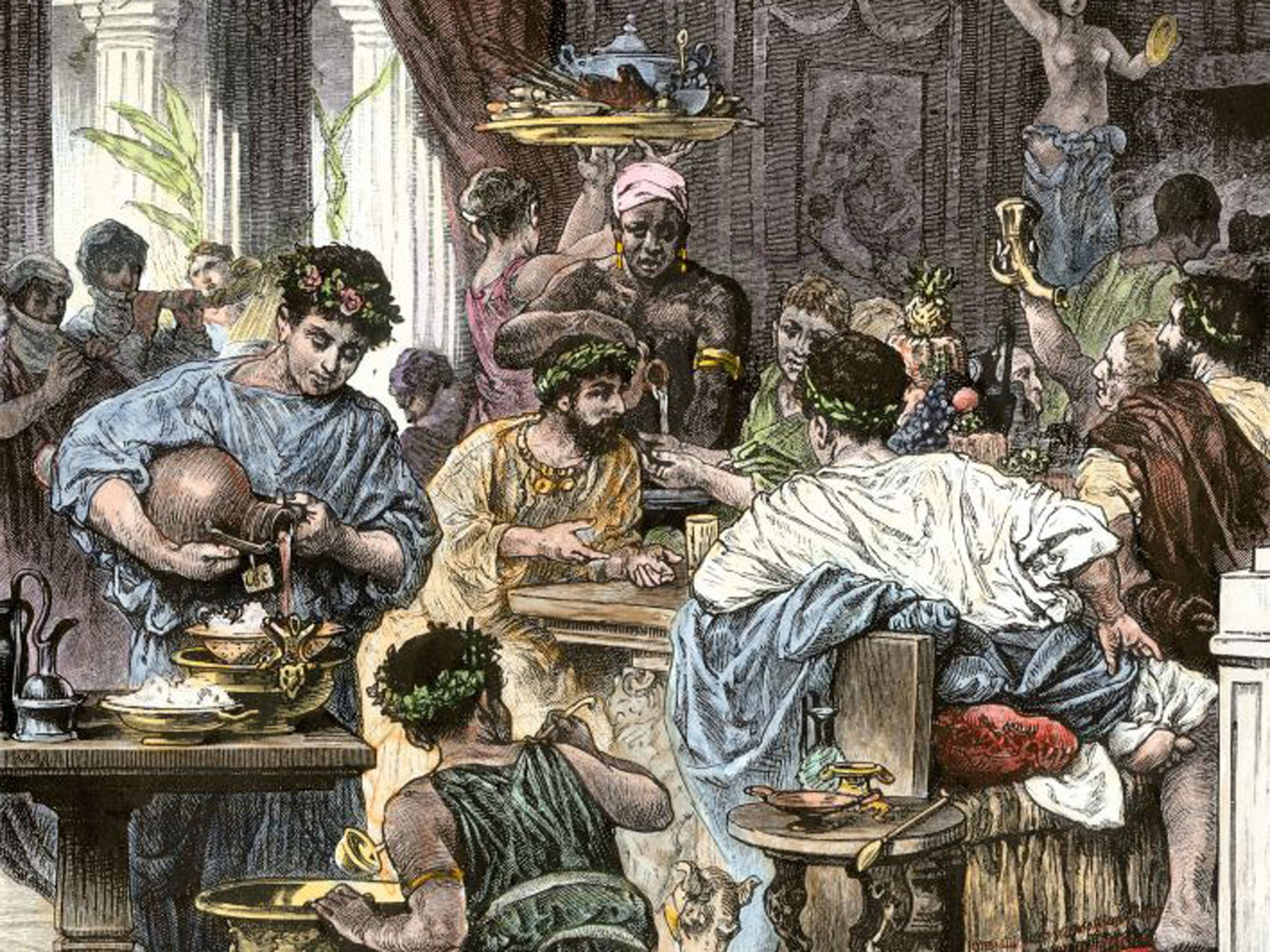
Excerpt from Chapter VII, a scene from Nero’s wild and drunken feast where Lygia was completely out of place.


The pulse beat oppressively in Lygia's hands and temples. A feeling seized her that she was flying into some abyss, and that Vinicius, who before had seemed so near and so trustworthy, instead of saving was drawing her toward it. And she felt sorry for him. She began again to dread the feast and him and herself. Some voice, like that of Pomponia, was calling yet in her soul, "O Lygia, save thyself!" But something told her also that it was too late; that the one whom such a flame had embraced as that which had embraced her, the one who had seen what was done at that feast and whose heart had beaten as hers had on hearing the words of Vinicius, the one through whom such a shiver had passed as had passed through her when he approached, was lost beyond recovery. She grew weak. It seemed at moments to her that she would faint, and then something terrible would happen. She knew that, under penalty of Cæsar's anger, it was not permitted any one to rise till Cæsar rose; but even were that not the case, she had not strength now to rise.


Meanwhile it was far to the end of the feast yet. Slaves brought new courses, and filled the goblets unceasingly with wine; before the table, on a platform open at one side, appeared two athletes to give the guests a spectacle of wrestling.


They began the struggle at once, and the powerful bodies, shining from olive oil, formed one mass; bones cracked in their iron arms, and from their set jaws came an ominous gritting of teeth. At moments was heard the quick, dull thump of their feet on the platform strewn with saffron; again they were motionless, silent, and it seemed to the spectators that they had before them a group chiselled out of stone. Roman eyes followed with delight the movement of tremendously exerted backs, thighs, and arms. But the struggle was not too prolonged; for Croton, a master, and the founder of a school of gladiators, did not pass in vain for the strongest man in the empire. His opponent began to breathe more and more quickly: next a rattle was heard in his throat; then his face grew blue; finally he threw blood from his mouth and fell.


A thunder of applause greeted the end of the struggle, and Croton, resting his foot on the breast of his opponent, crossed his gigantic arms on his breast, and cast the eyes of a victor around the hall.


Next appeared men who mimicked beasts and their voices, ball-players and buffoons. Only a few persons looked at them, however, since wine had darkened the eyes of the audience. The feast passed by degrees into a drunken revel and a dissolute orgy. The Syrian damsels, who appeared at first in the bacchic dance, mingled now with the guests. The music changed into a disordered and wild outburst of citharas, lutes, Armenian cymbals, Egyptian sistra, trumpets, and horns. As some of the guests wished to talk, they shouted at the musicians to disappear. The air, filled with the odor of flowers and the perfume of oils with which beautiful boys had sprinkled the feet of the guests during the feast, permeated with saffron and the exhalations of people, became stifling; lamps burned with a dim flame; the wreaths dropped sidewise on the heads of guests; faces grew pale and were covered with sweat. Vitelius rolled under the table. Nigidia, stripping herself to the waist, dropped her drunken childlike head on the breast of Lucan, who, drunk in like degree, fell to blowing the golden powder from her hair, and raising his eyes with immense delight. Vestinius, with the stubbornness of intoxication, repeated for the tenth time the answer of Mopsus to the sealed letter of the proconsul. Tullius, who reviled the gods, said, with a drawling voice broken by hiccoughs,—"If the spheros of Xenophanes is round, then consider, such a god might be pushed along before one with the foot, like a barrel."


But Domitius Afer, a hardened criminal and informer, was indignant at the discourse, and through indignation spilled Falernian over his whole tunic. He had always believed in the gods. People say that Rome will perish, and there are some even who contend that it is perishing already. And surely! But if that should come, it is because the youth are without faith, and without faith there can be no virtue. People have abandoned also the strict habits of former days, and it never occurs to them that Epicureans will not stand against barbarians. As for him, he—As for him, he was sorry that he had lived to such times, and that he must seek in pleasures a refuge against griefs which, if not met, would soon kill him.


When he had said this, he drew toward him a Syrian dancer, and kissed her neck and shoulders with his toothless mouth. Seeing this, the consul Memmius Regulus laughed, and, raising his bald head with wreath awry, exclaimed,—"Who says that Rome is perishing? What folly! I, a consul, know better. Videant consules! Thirty legions are guarding our pax romana!"


Here he put his fists to his temples and shouted, in a voice heard throughout the triclinium,—"Thirty legions! thirty legions! from Britain to the Parthian boundaries!" But he stopped on a sudden, and, putting a finger to his forehead, said,—"As I live, I think there are thirty-two." He rolled under the table, and began soon to send forth flamingo tongues, roast and chilled mushrooms, locusts in honey, fish, meat, and everything which he had eaten or drunk.


But the number of the legions guarding Roman peace did not pacify Domitius.


No, no! Rome must perish; for faith in the gods was lost, and so were strict habits! Rome must perish; and it was a pity, for still life was pleasant there. Cæsar was gracious, wine was good! Oh, what a pity!