"Love follows knowledge."
"Beauty above all beauty!"
– St. Catherine of Siena

Showing posts with label Healing. Show all posts

Sunday, March 15, 2026

Sunday Meditation: The Anointing of the Eyes

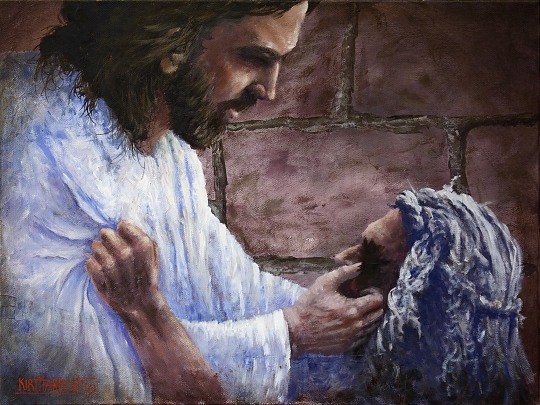
Are the readings longer during Lent?  Today, Year A of the Fourth Sunday in Lent, must be the longest reading of the entire three-year lectionary.  Today we read the entire ninth chapter of John’s Gospel.  But it is a fantastic read, one that could classify as a short story.  Jesus comes across a man who is blind from birth and cures him.  But the story only starts there.  The city folk and especially the Pharisees who witness the miracle then try to figure out how and why the man was cured, and who the miracle worker was.  I’ll let the homilists I selected below explain most of it to you.  But I did want to focus on a particular word the blind man uses when asked to explain how he got his vision.  He says, “The man called Jesus made clay and anointed my eyes and told me, ‘Go to Siloam and wash.’”  He says his eyes were “anointed.”  I had puzzled over what the connections were between the first reading, the selection of David for king, and this reading.  Then I realized both the boy and the blind man were anointed.


Here is today’s Gospel reading.


As Jesus passed by he saw a man blind from birth.

His disciples asked him,

“Rabbi, who sinned, this man or his parents,

that he was born blind?”

Jesus answered,

“Neither he nor his parents sinned; it is so that the works of God might be made visible through him.

We have to do the works of the one who sent me while it is day.

Night is coming when no one can work.

While I am in the world, I am the light of the world.”

When he had said this, he spat on the ground

and made clay with the saliva,

and smeared the clay on his eyes,

and said to him,

“Go wash in the Pool of Siloam” —which means Sent—.

So he went and washed, and came back able to see.


His neighbors and those who had seen him earlier as a beggar said,

“Isn’t this the one who used to sit and beg?”

Some said, “It is, “

but others said, “No, he just looks like him.”

He said, “I am.”

So they said to him, “How were your eyes opened?”

He replied,

“The man called Jesus made clay and anointed my eyes

and told me, ‘Go to Siloam and wash.’

So I went there and washed and was able to see.”

And they said to him, “Where is he?”

He said, “I don’t know.”


They brought the one who was once blind to the Pharisees.

Now Jesus had made clay and opened his eyes on a sabbath.

So then the Pharisees also asked him how he was able to see.

He said to them,

“He put clay on my eyes, and I washed, and now I can see.”

So some of the Pharisees said,

“This man is not from God,

because he does not keep the sabbath.”

But others said,

“How can a sinful man do such signs?”

And there was a division among them.

So they said to the blind man again,

“What do you have to say about him,

since he opened your eyes?”

He said, “He is a prophet.”


Now the Jews did not believe

that he had been blind and gained his sight

until they summoned the parents of the one who had gained his sight.

They asked them,

“Is this your son, who you say was born blind?

How does he now see?”

His parents answered and said,

“We know that this is our son and that he was born blind.

We do not know how he sees now,

nor do we know who opened his eyes.

Ask him, he is of age;

he can speak for himself.”

His parents said this because they were afraid

of the Jews, for the Jews had already agreed

that if anyone acknowledged him as the Christ,

he would be expelled from the synagogue.

For this reason his parents said,

“He is of age; question him.”


So a second time they called the man who had been blind

and said to him, “Give God the praise!

We know that this man is a sinner.”

He replied,

“If he is a sinner, I do not know.

One thing I do know is that I was blind and now I see.”

So they said to him,

“What did he do to you?

How did he open your eyes?”

He answered them,

“I told you already and you did not listen.

Why do you want to hear it again?

Do you want to become his disciples, too?”

They ridiculed him and said,

“You are that man’s disciple;

we are disciples of Moses!

We know that God spoke to Moses,

but we do not know where this one is from.”

The man answered and said to them,

“This is what is so amazing,

that you do not know where he is from, yet he opened my eyes.

We know that God does not listen to sinners,

but if one is devout and does his will, he listens to him.

It is unheard of that anyone ever opened the eyes of a person born blind.

If this man were not from God,

he would not be able to do anything.”

They answered and said to him,

“You were born totally in sin,

and are you trying to teach us?”

Then they threw him out.


When Jesus heard that they had thrown him out,

he found him and said, Do you believe in the Son of Man?”

He answered and said,

“Who is he, sir, that I may believe in him?”

Jesus said to him,

“You have seen him,

the one speaking with you is he.”

He said,

“I do believe, Lord,” and he worshiped him.

Then Jesus said,

“I came into this world for judgment,

so that those who do not see might see,

and those who do see might become blind.”


Some of the Pharisees who were with him heard this

and said to him, “Surely we are not also blind, are we?”

Jesus said to them,

“If you were blind, you would have no sin;

but now you are saying, ‘We see,’ so your sin remains.

~Jn:9:1-41


I was absolutely glued to Bishop Robert Barron’s homily on this passage this Sunday.


Bishop Barron:

Right at the beginning, it says Jesus passed by. He saw a man blind from birth. So his disciples asked him, "Rabbi, who sinned, this man or his parents?" Listen now to the answer of Jesus. Neither he nor his parents sinned. It is so that the works of God might be made visible through him. Let me just say something brief about this.  I think it's so important. Not many days ago, I was watching a replay of the movie Jackie, which is about Jackie Kennedy in the wake of the assassination of her husband. And it's a good kind of heart aching movie, but she's in dialogue in the course of movie with an elderly priest played by the great John Hurt, the English actor.  And she's suffering, of course. Why did this happen? How could God have possibly allowed this horrible thing to happen to my husband, to me, to our family? And the parole priest says, "Let me let me share a parable with you." And he tells this story and he gives that answer of Jesus. It's not because of his sin or anyone's sin.  It's that the works of God might be made visible through him. You know, we all suffer [to] different degrees. I get it.  But we all suffer and we're always looking for the answer. Why? Why? Why?  Why is God allowing this? Let this answer, everybody, sink in. Let it sink in. That when you're going through some terrible suffering, that the works of God might be made visible in you.  Somehow God is using this struggle, this difficulty, this pain for his purposes.


Oh that is profound.  God allows tragedy for us to bring about the Kingdom of God on earth.  There is so much more that Bishop Barron brings out of this passage: the dirt and spittle as elements for the sacraments, the dual nature of the incarnation, and the salve as the healing mixture for salvation.  “We are healed by our contact with Him.”  What a great homily.


For the pastoral homily, I present the homily from another bishop, Bishop John E. Keehner of Sioux City, Iowa.


Bishop Keehner:

But isn't there a bit of blindness in each of us which prevents us from seeing our own faults? Preventing us from understanding our own place in the world and our relationships with others? Don't we all have a blind spot which periodically gets us into trouble when we fail to notice those things we so easily take for granted? Don't we all occasionally fail to see the truth of our prejudice which prevent us from seeing in those around us the image and the likeness of God? Don't we all occasionally fail to see the truth of our relationships, even our relationship with God, so that we assume that there will always be the time we need to do whatever it is we need and want to do in life. There will always be another day for us to mend a broken relationship or to heal the wounds we have inflicted on others because of our selfishness. The season of Lent is passing quickly away.  Have we taken time this season to examine our hearts so that we might recognize that we are in fact blind?

Mea culpa, mea culpa, mea culpa.  Routinely I am proven to have been blind to some issue or some insight to another’s life.  Perhaps it would be wise to take a moment before criticizing someone to realize that you are blind to their life unless—to mix metaphors—you stand in their shoes.


Sunday Meditation: “Neither he nor his parents sinned; it is so that the works of God might be made visible through him.”


Oh I love this hymn, “Christ Be Our Light.”  It was written by Bernadette Farrell, who I learned from her Wikipedia entry is from England. 


Christ, be our light! Shine in our hearts

Shine through the darkness

Christ, be our light!

Shine in your church gathered today

Performed by the Frank Brownstead Choir.  

Sunday, December 14, 2025

Sunday Meditation: Rejoice! Make a Space in Your Heart

In the Third Sunday of Advent in Year A, John the Baptist from prison has his disciples ask if Jesus is the messiah.  Jesus replies with evidence of what He has done: the blind see, the lame walk, lepers are cleansed, the deaf hear, and the dead are raised.  Jesus is alluding to not just the first reading of today’s lectionary but several other Old Testament prophesies.  Three years ago I embedded a video from Dr. Brant Pitre explaining the allusions.  Not only do the allusions point to a messiah, but it points to the coming of God.

The Third Sunday of Advent is the turn from the stern exhortations from John the Baptist to the joyful coming of the Jesus, and so we have the rose candle for the celebration.  All of nature rejoices with the coming birth.


Here is the Gospel passage.


When John the Baptist heard in prison of the works of the Christ,

he sent his disciples to Jesus with this question,

"Are you the one who is to come,

or should we look for another?"

Jesus said to them in reply,

"Go and tell John what you hear and see:

the blind regain their sight,

the lame walk,

lepers are cleansed,

the deaf hear,

the dead are raised,

and the poor have the good news proclaimed to them.

And blessed is the one who takes no offense at me."


As they were going off,

Jesus began to speak to the crowds about John,

"What did you go out to the desert to see?

A reed swayed by the wind?

Then what did you go out to see?

Someone dressed in fine clothing?

Those who wear fine clothing are in royal palaces.

Then why did you go out?  To see a prophet?

Yes, I tell you, and more than a prophet.

This is the one about whom it is written:

Behold, I am sending my messenger ahead of you;

he will prepare your way before you.

Amen, I say to you,

among those born of women

there has been none greater than John the Baptist;

yet the least in the kingdom of heaven is greater than he."

~Mt 11:2-11


Fr. Geoffrey Plant explains the fullness of the significance of Gaudete Sunday. 


“So when John the Baptist asked, “Are you the one who is to come?” he was drawing on this rich tapestry of expectation: the Coming One was the long-awaited agent of God’s final and saving intervention in the world.”  He would be not just a messiah, but a Divine Messiah.  Both John and Jesus start their ministry with a call for repentance but they understand it differently.  The winnowing fan and the unquenchable fire on one side while on the other side is “mercy, healing, forgiveness, and inclusion.”  That is what confused John and made him ask the question. 

Here is another new homilist, this from United States Conference of Catholic Bishops (USCCB).  I did not know the USCCB had a daily reflection and Sunday homily on YouTube.  It looks like it’s about a year old.  They seem to alternate bishops to give the reflection or homily.  Oh this is a nice find.  Today’s homily is not even by a full bishop.  It’s from Most Rev. Jeffrey R. Haines, Auxiliary Bishop of the Archdiocese of Milwaukee. 


“So what does this mean for us?  It means for making space for preparing to receive Christ, a reception of Jesus each week especially at Christmas requires that our prayer and worship strengthen us to take on the challenges of our lives and our world….How can we begin to create a space in our heart this advent? We can be signs of joy to our families, our communities and those we meet.”  That is the pastoral message for this Gaudete Sunday.  Rejoice!


Sunday Meditation: "Go and tell John what you hear and see: the blind regain their sight, the lame walk, lepers are cleansed, the deaf hear, the dead are raised, and the poor have the good news proclaimed to them.”


Not a hymn today but the dramatization of this scene as portrayed in The Chosen.


The realism of The Chosen sometimes makes me wince a little, but overall it is very well done.


Sunday, October 12, 2025

Sunday Meditation: The Compassion of the Great Healer

For the Twenty-Eighth Sunday in Ordinary Time in Year C, we get Jesus healing of the ten lepers.  Three years ago I pointed out important healing was in Christianity.  We see Jesus the healer in this passage.  But there is also Jesus the priest.  Part of the duties of an Old Testament priest was to determine what was ritually pure and what wasn’t.  Those with a skin disease were not ritually pure, and the priests had the authority to exclude anyone with a skin disease and then accept them back when cured.  And so, having heard of the miraculous powers of this Jesus of Nazareth, ten lepers appeal to Jesus to be cured.


Here is the Gospel passage.


As Jesus continued his journey to Jerusalem,

he traveled through Samaria and Galilee.

As he was entering a village, ten lepers met him.

They stood at a distance from him and raised their voices, saying,

"Jesus, Master! Have pity on us!"

And when he saw them, he said,

"Go show yourselves to the priests."

As they were going they were cleansed.

And one of them, realizing he had been healed,

returned, glorifying God in a loud voice;

and he fell at the feet of Jesus and thanked him.

He was a Samaritan.

Jesus said in reply,

"Ten were cleansed, were they not?

Where are the other nine?

Has none but this foreigner returned to give thanks to God?"

Then he said to him, "Stand up and go;

your faith has saved you."

~Lk 17:11-19


There are several twists in this passage.  The first is that the lepers know of Jesus as having the power to cure.  Second that the one who is grateful is a Samaritan.  I’ll save the third for below.

Let Fr. Geoffrey Plant explain the passage and how it connects to the First Reading.


I think it particularly important that the healing allowed the diseased to return to society.  The healing makes them whole in various ways.

The pastoral homily is from a Dominican Friar from the Western Province, Br. John Vianney Russell, O.P.  Br. John Vianny, and yes he is not even a priest yet, provides the third twist that blew my socks off.


Is that impressive!  The third twist is that the cured leper does go to the priest.  He returns to Jesus, the Great High Priest who can make anyone pure.

Now one last thing.  The pastor (Fr. Anthony Gonzales) at this morning’s Mass at my parish in his homily said all ten were healed but only one was saved.  Do you think that true? 


Sunday Meditation: "Go show yourselves to the priests."


Let’s return to John Michael Talbot with “Healer of My Soul” for the hymn.


That lovely melody heals as well.


Sunday, October 27, 2024

Sunday Meditation: Blind Bartimaeus

Jesus and his followers are almost to Jerusalem, and Jesus going through Jericho performs the last miracle in the Gospel of Mark before entering the Holy Week in Jerusalem.  We come to the miracle of healing Bartimaeus’ blindness.  There is so much that can be said from this one little passage.  How Jericho is the city of Joshua’s conquest, how Bartimaeus calls out to the Messiah (Son of David), how he was rebuked but still persistent, how Jesus cures him and he follows the Way, casting off his only possession, his cloak, and how this is the second healing of blindness in the Mark sandwiched containing the apostles’ metaphorical blindness.


As Jesus was leaving Jericho with his disciples and a sizable crowd, Bartimaeus, a blind man, the son of Timaeus,

sat by the roadside begging.

On hearing that it was Jesus of Nazareth,

he began to cry out and say,

"Jesus, son of David, have pity on me."

And many rebuked him, telling him to be silent.

But he kept calling out all the more,

"Son of David, have pity on me."

Jesus stopped and said, "Call him."

So they called the blind man, saying to him,

"Take courage; get up, Jesus is calling you."

He threw aside his cloak, sprang up, and came to Jesus.

Jesus said to him in reply, "What do you want me to do for you?"

The blind man replied to him, "Master, I want to see."

Jesus told him, "Go your way; your faith has saved you."

Immediately he received his sight and followed him on the way.

~Mk 10:46-52

Here is someone new to my Sunday Meditations to explain it, Professor Curtis Mitch from the St. Paul Center, the same institute Dr. Scott Hahn started and runs.


For a more pastoral understanding to apply it to your life, Jeff Cavins has a short talk. 


Sunday Meditation: "Jesus, son of David, have pity on me."


John Michael Talbot’s “Surrender to Jesus” is just so beautiful.


Sunday, September 29, 2024

Sunday Meditation: Cutting Sin from Your Life

As they continue their journey with Jesus, the disciples continue to show how obtuse they are.  Someone not of their group is driving out demons, and they want to stop him.  This leads Jesus into a little sermon, first on doing the good, then on causing sin, and then on what to do if one sins repeatedly. 


At that time, John said to Jesus,

"Teacher, we saw someone driving out demons in your name,

and we tried to prevent him because he does not follow us."

Jesus replied, "Do not prevent him.

There is no one who performs a mighty deed in my name

who can at the same time speak ill of me.

For whoever is not against us is for us.

Anyone who gives you a cup of water to drink

because you belong to Christ,

amen, I say to you, will surely not lose his reward.


"Whoever causes one of these little ones who believe in me to sin, it would be better for him if a great millstone

were put around his neck

and he were thrown into the sea.

If your hand causes you to sin, cut it off.

It is better for you to enter into life maimed

than with two hands to go into Gehenna,

into the unquenchable fire.

And if your foot causes you to sin, cut if off.

It is better for you to enter into life crippled

than with two feet to be thrown into Gehenna.

And if your eye causes you to sin, pluck it out.

Better for you to enter into the kingdom of God with one eye

than with two eyes to be thrown into Gehenna,

where 'their worm does not die, and the fire is not quenched.'"

~Mk 9:38-43, 45, 47-48


Jeff Cavins identifies just how important cutting sin is from your life.


As I look at Jesus’s sermon, there doesn’t seem to be a logical transition from not stopping outsiders from healing to radically cutting sin from one’s life.  For some reason the lectionary stops on verse 48, but perhaps verses 49 and 50 actually pulls all three elements of his sermon together: “Everyone will be salted with fire.  Salt is good, but if salt becomes insipid, with what will you restore its flavor? Keep salt in yourselves and you will have peace with one another.” (Mk 9:49-50)  By cutting out sin, one is purified as being salted, and those that are salted are those that can go and drive out demons.  The final outcome of cutting out sin is peace! 


Sunday Meditation: “If your hand causes you to sin, cut it off.”


Our hymn today will be “Go in Peace,” by John Michael Talbot


He just has beautiful song after beautiful song.