"Love follows knowledge."
"Beauty above all beauty!"
– St. Catherine of Siena

Showing posts with label Feast of Corpus Christi. Show all posts

Monday, June 8, 2026

Sunday Meditation: The Flesh That is True Food

Today is the second solemnity following Pentecost.  Last week was the Solemnity of the Holy Trinity.  Today is the Solemnity of the Most Holy Body and Blood of Christ, also known as the Feast of Corpus Christi. On Friday we will celebrate the Solemnity of the Sacred Heart of Jesus.  The Church gives us these feasts to understand the mystery that is the nature of God.  Think on the last four solemnities: the Holy Spirit comes in dwell at Pentecost, the Trinity comprises the one God; the Body and Blood of Jesus brings us into communion; and the sacred heart that reveals His infinite compassion.

For Year A, the lectionary takes us to the heart of the Bread of Life Discourse.  Allow me to quote St. Thomas Aquinas who is the Doctor most associated with the understanding of the Eucharist.


One eats Christ’s flesh and drinks his blood in a spiritual way if he is united to him through faith and love, so that one is transformed into him and becomes his member: for this food is not changed into the one who eats it but it turns the one who takes it into itself.  And so this is a food capable of making a human being divine.  [Quoted from Magnificat, June 2026, p.91]


Today’s Gospel:


Jesus said to the Jewish crowds:

"I am the living bread that came down from heaven;

whoever eats this bread will live forever;

and the bread that I will give

is my flesh for the life of the world."


The Jews quarreled among themselves, saying,

"How can this man give us his flesh to eat?"

Jesus said to them,

"Amen, amen, I say to you,

unless you eat the flesh of the Son of Man and drink his blood,

you do not have life within you.

Whoever eats my flesh and drinks my blood

has eternal life,

and I will raise him on the last day.

For my flesh is true food,

and my blood is true drink.

Whoever eats my flesh and drinks my blood

remains in me and I in him.

Just as the living Father sent me

and I have life because of the Father,

so also the one who feeds on me

will have life because of me.

This is the bread that came down from heaven.

Unlike your ancestors who ate and still died,

whoever eats this bread will live forever."

~Jn::51-58


Who better to preach on the Body and Blood of Christ than a Dominican friar, Fr. Greg Heille from the Chapel of Aquinas Institute of Theology in St. Louis, MO.


Fr. Greg:

The feast goes back to the year 1264.  Pope Urban IV lived in Orvieto, not far outside of Rome.  And he called upon the Dominican friar, Thomas Aquinas, to write the hymns and the prayers for this feast day, for the mass and for the liturgy of the hours.  We still treasure some of these hymns, for example, Panje Lingua, which includes Tantum Ergo, which is sung at Benediction.  We love to hear Panis Angelicus. And so many celebrations of the church.  The Dominican Order was only founded less than 50 years before.  And Thomas Aquinas wrote these beautiful prayers.  The opening prayer, the collect for mass today, is written by Thomas Aquinas, and it is a prayer that we pray as Dominicans at the beginning of our divine office for morning prayer, and for evening prayer, the prior or the leader of the community prays this prayer, which we will pray at mass this weekend.  "God, who has left us in a wonderful sacrament a memorial of your passion.  Grant, we ask that we may venerate the sacred mystery of your body and blood.  So that we may always feel in ourselves the fruit of your redemption.  Who lives and reigns with God the Father, in unity with the Holy Spirit, God, world without end, amen.


In some of our parishes we will hear a long sequence before the gospel.  This long sequence was also written by Aquinas. And here is the end of that sequence as he wrote it.  “Jesus Good shepherd. True bread. Jesus. Have mercy on us.  You feed us. You watch over us. You make us see good things in the land of the living.  You who know all things and prevail, who nourish us mortals here, make us, there, your table companions, joint heirs, and members of the community of saints.  Amen.”


The Eucharist is joyfully celebrated this weekend because we return to it again and again week by week and day by day to be nourished with the bread of life.  This is a central sacrament of our Christian life, to return to the altar of the Lord, to receive the bread of life, and to be united in our faith, in this true presence of the body, and the blood of Christ.


I think Fr. Greg’s point that we celebrate the Body of Christ joyfully is insightful.  Can anything possibly give us more joy than to be united with Jesus Christ?


For the pastoral homily I return to Archbishop of Detroit Edward J. Weisenburger.


Archbishop Weisenburger:

I must acknowledge I'm indebted to my good friend and trusted biblical scholar, Bishop Daniel Mueggenborg of Reno, Nevada. I was moved by some of his reflections. In one commentary on this passage. He notes how strongly the passage stresses the realism of Jesus' presence in the Eucharist. In many other passages, the biblical term "soma" is used in Greek to refer to "body," and that's an accurate translation. But in John's gospel, John records Jesus not as using the word or the identity "soma," but rather the evangelist uses the term "sarx." "Sarx" in Greek has only one very specific meaning, which is "flesh." It hearkens back to the opening words of John's gospel when we read "In the beginning was the word, and the word was with God, and eventually the word became flesh (sarx)." Now, please note that a term like soma, for "body," could have a symbolic meaning, not sarx. That term "flesh" has no meaning other than the corporeal human reality of a very physical being. Jesus wants to be crystal clear, and he's adamant. He Himself is really and truly present; flesh, blood, soul, divinity in the food and drink he gives us in the Eucharist.


A second Greek word to take note of is "trogein," which very specifically means the physical act of "munching," as in munching on a piece of food. Some might even find such a word mildly offensive in relation to consuming the Eucharist. A different Greek word, "phragein," would be much more respectable, but it could have a more figuratively meaning, such as digesting something intellectually. But here again Jesus in John's Gospel is going out of His way to make very firm His point. He's giving us a real gift of His body and blood. And to receive this gift, we must physically consume it.


A third point to note is that throughout the sixth chapter of John's Gospel, the Evangelist is drawing a beautiful parallel between "the people of Israel receiving manna in the desert" and "Jesus' gift of Himself in the bread of life." Just as manna gave the people nourishment to continue their journey to the way to the Promised Land, so too the gift of the Eucharist is meant to nourish you and me in our journey towards salvation. The Israelites would encounter many hardships and had to be sustained for such a journey. The same is true for us.  The Eucharist truly is our manna in the desert. It is food for eternal life, and it is a sharing in the very body, blood, soul, divinity of Jesus.  What our Lord is stressing in this teaching is that a disciple is not merely someone who follows Jesus and obeys his teachings. No, a true disciple is one who is transformed by the very Christ they receive.  A true disciple is one who grows into the likeness of the God they encounter in the form of bread and wine.


Upon hearing the Teacher, we read that many "grumbled" at Jesus. That phrase, "grumble," is the same word in Greek used to describe the Hebrews in their response to Moses' leadership in the desert. A grumbling, a murmuring. It implies a hostility, a discontent, ultimately a rejection. And sadly, we read that many of Jesus' own disciples, upon hearing this teaching, found it to be too hard, too much. And the gospel says many of them left Him because of it. But note that in response to this rejection, Jesus does not change His teaching in any way. Instead, He challenges those who hear Him to remain, and to believe and to accept what He reveals. He will not bend the truth to their desires or their sensitivities. But He does conclude, "Blessed are those disciples who are able to accept His teaching." And their faith is voiced beautifully by St. Peter, who will say, "Master, where else can we go?  You alone have the words of eternal life."

I think most of us in the Catholic faith accept eating of Christ’s body and blood without grumbling. But that’s a pretty low bar.  Combine the two homilies today to accept Christ with joy.


Sunday Meditation: “For my flesh is true food, and my blood is true drink.”


“I Received the Living God” is such a beautiful hymn, and so Catholic!


I received the living God,

and my heart is full of joy.

I received the living God,

and my heart is full of joy.


Jesus said: I am the Bread

kneaded long to give you life;

you who will partake of me

need not ever fear to die.


I received the living God,

and my heart is full of joy.

I received the living God,

and my heart is full of joy.


Jesus is joy!

Sunday, June 22, 2025

Sunday Meditation: The Mystery of Christ’s Body and Blood

Last week we celebrated the Solemnity of the Most Holy Trinity.  This week we follow it up with the Solemnity of the Body and Blood of Christ, otherwise known as the Solemnity of Corpus Christi.  This feast was inspired by a Norbertine canoness who was later canonized as St. Juliana of Liège.  She had visions of Eucharistic adoration and was able to convince her local bishops to institute a local feast on the Body and Blood of Christ.  One of those bishops would eventually become Pope Urban IV.  In 1264 Pope Urban instituted the Solemnity of the Body and Blood of Christ as a universal feast for the Church.  He asked Thomas Aquinas to compose the liturgical prayers for the new feast.  In addition to the prayers, Aquinas composed some of the most beautiful hymns on the Eucharist that we sing even today.  That’s the short version of how the feast came about.  If you want to read the entire history from St. Juliana to Pope Urban to St. Thomas Aquinas, this article at The Pillar is the most comprehensive.  

For the Gospel on this feast in Year C, we read from St. Luke’s version of the feeding of the five thousand. 


Jesus spoke to the crowds about the kingdom of God,

and he healed those who needed to be cured.

As the day was drawing to a close,

the Twelve approached him and said,

"Dismiss the crowd

so that they can go to the surrounding villages and farms

and find lodging and provisions;

for we are in a deserted place here."

He said to them, "Give them some food yourselves."

They replied, "Five loaves and two fish are all we have,

unless we ourselves go and buy food for all these people."

Now the men there numbered about five thousand.

Then he said to his disciples,

"Have them sit down in groups of about fifty."

They did so and made them all sit down.

Then taking the five loaves and the two fish,

and looking up to heaven,

he said the blessing over them, broke them,

and gave them to the disciples to set before the crowd.

They all ate and were satisfied.

And when the leftover fragments were picked up,

they filled twelve wicker baskets.

   ~Lk 9:11-17


Fr. Geoffrey Plant provides a thorough understanding of the Solemnity’s significance. 


So the key takeaway is that Christ’s exhorting us to “remembrance” of His institution of the Eucharist is not just a recall to memory.  It is the making present of a past event, which in this case is the Last Supper’s institution of the Eucharist, the sacrifice at Calvary, and the Resurrection of our Lord.

The pastoral homily comes from Fr. Patrick Briscoe O.P. from Our Sunday Visitor. 


Are you satisfied when you receive the Body and Blood? 


Sunday Meditation: They all ate and were satisfied.


For the hymn, it is tradition to sing the Corpus Christ Sequence between the second reading and the Gospel.  Here in the original Latin composed by St. Thomas Aquinas.  


Here are the first few stanzas.


Lauda Sion Salvatórem

Lauda ducem et pastórem

In hymnis et cánticis.


Quantum potes, tantum aude:

Quia major omni laude,

Nec laudáre súfficis.


Laudis thema speciális,

Panis vivus et vitális,

Hódie propónitur.


Quem in sacræ mensa cœnæ,

Turbæ fratrum duodénæ

Datum non ambígitur.

You can find all the lyrics with their translation at the Wikipedia entry I linked above.

If you wish to hear it in English, this chant is well done.


Sunday, June 2, 2024

Sunday Meditation: The Solemnity of the Most Holy Body and Blood of Christ

Right after the Feast of the Holy Trinity the liturgical calendar gives us the Feast of the Most Holy Body and Blood of Christ, also known as the Feast of Corpus Christi.  As we have done now for several years at my parish, we had a Corpus Christi procession right after the Saturday Vigil Mass.  I didn’t take any pictures this year, but it was not any different than in 2021  or in 2023.  


On the first day of the Feast of Unleavened Bread,

when they sacrificed the Passover lamb,

Jesus’ disciples said to him,

"Where do you want us to go

and prepare for you to eat the Passover?"

He sent two of his disciples and said to them,

"Go into the city and a man will meet you,

carrying a jar of water.

Follow him.

Wherever he enters, say to the master of the house,

'The Teacher says, "Where is my guest room

where I may eat the Passover with my disciples?"'

Then he will show you a large upper room furnished and ready.

Make the preparations for us there."

The disciples then went off, entered the city,

and found it just as he had told them;

and they prepared the Passover.


While they were eating,

he took bread, said the blessing,

broke it, gave it to them, and said,

"Take it; this is my body."

Then he took a cup, gave thanks, and gave it to them,

and they all drank from it.

He said to them,

"This is my blood of the covenant,

which will be shed for many.

Amen, I say to you,

I shall not drink again the fruit of the vine

until the day when I drink it new in the kingdom of God."

Then, after singing a hymn,

they went out to the Mount of Olives.

~Mk 14:12-16, 22-26


I found that Fr. Geoffrey Plant’s explanation of all three readings, providing their context, was absolutely superb.  This is one of Fr. Geoffrey’s best, so I do encourage you to view it.


That exegesis of the Body and Blood of Jesus as we Catholics understand it is one I will go back to over and over.

Now for something different from Bishop Robert Barron.  Instead of explaining the readings for this week’s homily, Bishop Barron goes through what Eucharistic Adoration has meant to him and to other saints. 


I love Eucharistic Adoration.  I wish I could do it more often.  I certainly encourage all to go. 


Sunday Meditation: “This is my body…This is my blood of the covenant”


Finally a song from John Michael Talbot.


Sunday, June 11, 2023

Sunday Meditation: Solemnity of the Body and Blood of Christ

Today is the second of the three feasts that reveal the nature of God, the Solemnity of the Body and Blood of Jesus Christ, also known as Corpus Christi.  The Gospel in Year A is one we all know.


Jesus said to the Jewish crowds:

"I am the living bread that came down from heaven;

whoever eats this bread will live forever;

and the bread that I will give

is my flesh for the life of the world."


The Jews quarreled among themselves, saying,

"How can this man give us his flesh to eat?"

Jesus said to them,

"Amen, amen, I say to you,

unless you eat the flesh of the Son of Man and drink his blood,

you do not have life within you.

Whoever eats my flesh and drinks my blood

has eternal life,

and I will raise him on the last day.

For my flesh is true food,

and my blood is true drink.

Whoever eats my flesh and drinks my blood

remains in me and I in him.

Just as the living Father sent me

and I have life because of the Father,

so also the one who feeds on me

will have life because of me.

This is the bread that came down from heaven.

Unlike your ancestors who ate and still died,

whoever eats this bread will live forever."

        Jn 6: 51-58


Jeff Cavins provides a wonderful explanation. 


Now, a tradition of a procession with the Body of Christ has been revived, and I have posted in the past on my parish’s Corpus Christi procession.  Well, we did it again in this year of the Eucharistic Revival, this time following the Saturday Vigil Mass,  Here are pictures and a video clip of our procession


And you can see us coming out of the church with an Italian Marching band playing some hymns.

 We had a few children who had received their First Communion last month to sprinkle rose petals ahead of the Blessed Sacrament. 


“This is the bread that came down from heaven…whoever eats this bread will live forever.”

Sunday, June 6, 2021

Sunday Meditation: Corpus Christi

Today is the Solemnity of the Most Holy Body and Blood of Christ otherwise known as the Feast of Corpus Christi.  It’s interesting to read that this most holy feast goes back to the 12th century and is technically supposed to be celebrated on a Thursday, replicating the institution of the Eucharist at the Last Supper on Holy Thursday.  It gets transferred to Sunday for convenience.  And so, meditate on this reading from today’s Gospel.


“While they were eating, he took bread, said the blessing, broke it, and gave it to them, and said, “Take it; this is my body.”  Then he took a cup, gave thanks, and gave it to them, and they all drank from it.  He said to them, “This is my blood of the covenant, which will be shed for many.  Amen, I say to you, I shall not drink again the fruit of the vine until the day when I drink it new in the kingdom of God.”

       -Mark 14:22-25

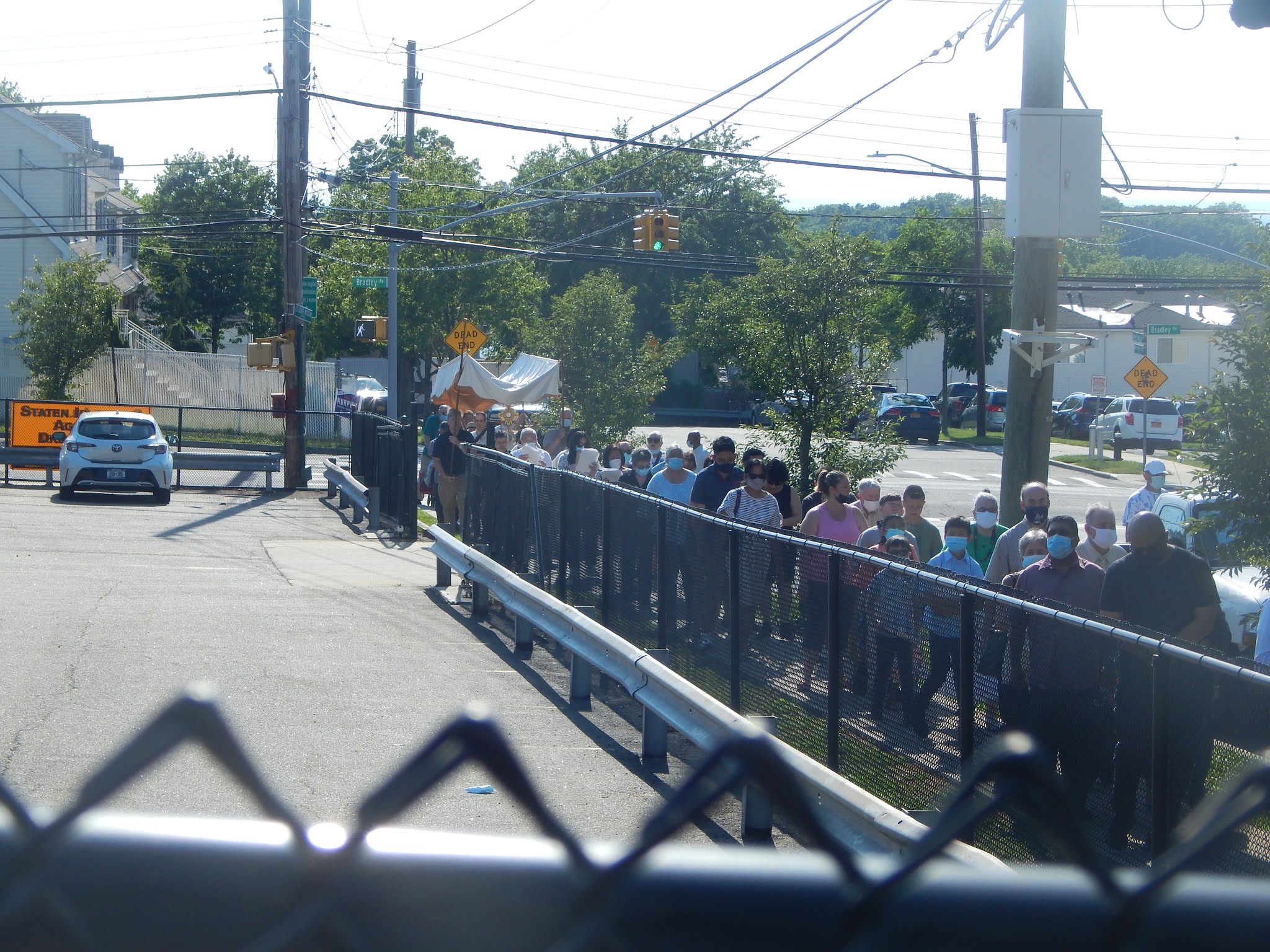
This year at my church, St. Rita in Staten Island, we started the ancient practice of processing with the Blessed Sacrament through the neighborhood after Mass.  We did this after the Saturday vigil Mass yesterday.  I took some pictures of the procession. 

Here we are coming out of the church.  There would be a canopy for Blessed Sacrament.


We went around the block, two by two, either praying out loud or signing some hymns.
 Our musical director brought in a trumpet player to accompany the hymns at Mass, and he followed with his trumpet too.  The kid there in the grey shirt is Matthew.


That’s the procession from behind me.  I was about a third from the front.  In front is our pastor Fr. Eugene with the altar servers carrying a crucifix. 


Our Assistant Pastor, Fr. Anthony, carried the monstrance with the Blessed Sacrament the whole way.  Apparently tradition is that the Blessed Sacrament goes in the rear of the procession under the canopy.


Finally we turned the corner and headed back into the church. 


But from here the angle I had was focused to the center of the canopy.  I had not wanted to go directly up to the Blessed Sacrament to take a picture.  It felt so irreverent.  But from here I could capture it and zoom in.  Here.


There!  There is Jesus, Body, Blood, Soul, and Divinity.  It is that which gives us everlasting life.

Edit:  I must add this in.  I just came across the most brilliant homily by Bishop Robert Barron explaining this feast.  It's almost 14 minutes long, but it's worth every second.