"Love follows knowledge."
"Beauty above all beauty!"
– St. Catherine of Siena

Showing posts with label Satire. Show all posts

Sunday, January 31, 2021

Utopia by St. Thomas More, Part 4

This is the fourth and final post in a series on St. Thomas More’s Utopia. 

You can find the first post here.
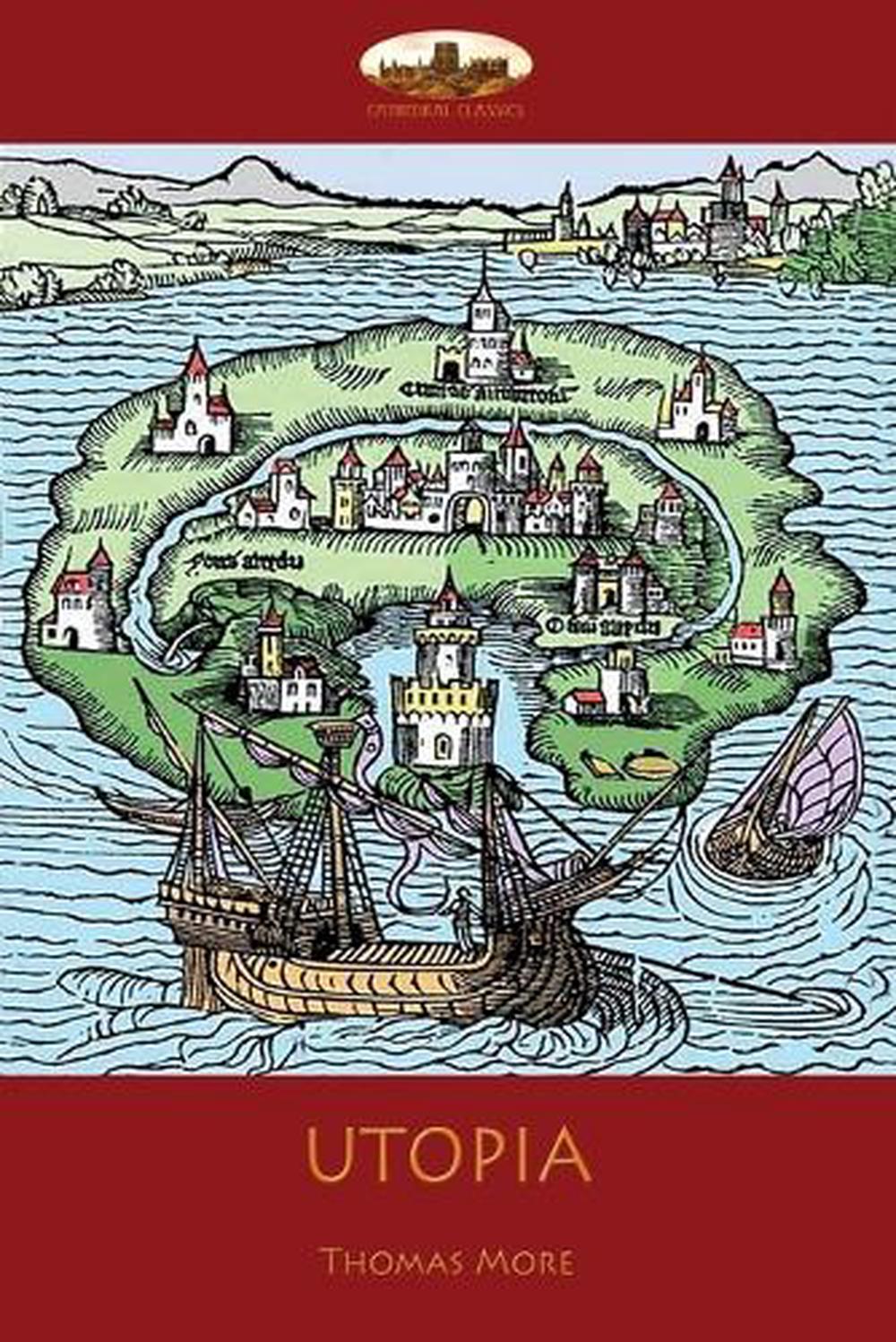
Second post here.

Third post here. 


This brings Utopia to a close with my Goodreads review.


Goodreads Review


Ultimately this grew to a rating of three and a half stars but I rounded down.  It grew to that (it could have been lower) because I think I finally understood it, but even now I have some lingering doubts.  Even if I do understand it correctly, I think there is an inherent flaw that prevents me from a higher rating.

First, it was only after I understood Thomas More’s life leading to the writing of Utopia did I find that so much of his prior experiences are developed in the book.  He spent part of his early life living with religious clerics and even at a monastery, and he writes of the Utopians’ religious practices.  He was well educated, especially in the classics, and he writes of the Utopians’ love of education and classical philosophy.  He was a member of parliament, and brings up the Utopians’ civil organization.  He was a sheriff and lawyer, and he brings up the Utopians’ justice and jurisprudence.  He was a legal representative for merchants across international barriers, and he speaks of the Utopians’ trade policies.  He was in midlife at the time of the writing, having married, fathered four children, and lived through the passing of his wife in childbirth, and he writes on the Utopians’ household, marital, and social conventions.  The only aspect of life he describes that he personally did not seem to personally experience was of the Utopians’ military practices.  One assumes, though, that a man at the service of the king and parliament would have picked ideas on warfighting.

The key to understanding the book I think lies in understanding the mouthpiece for all of the Utopian practices.  Despite Thomas More the author creating the character Thomas More in the book, the mouthpiece for the advocacy of Utopian life is the character Raphael Hythloday.  Do Raphael Hythloday’s opinions and values represent the author’s?  Or is Raphael Hythloday just a foil for More the author to knock down and satirize?  The fact that he does not have his stand in be the mouthpiece should tell us something.  Clearly there are passages that could not rationally be supported by More, but then there are passages that might.  The ambiguity is perplexing.

Even the name Raphael Hythloday is ambiguous.  Raphael alludes to the archangel, and so on one hand his name may be suggesting the bringing forth of divine wisdom.  But Hytholday means (I am told) in classical Greek “speaker of nonsense.”  So which is it, wisdom or nonsense? 

I’m not going to get into the details here in a summary review but one over time can only come to the conclusion that Hythloday is at best an eccentric and at worst a kook.  He advocates the Utopian practice of being married naked, and checking the body of one’s spouse as a prospective buyer checks out a horse.  He advocates limiting the size of cities to a specific population, and that you need a passport to travel within the country.  He says the Utopians economy is built on agriculture but yet most of the people don’t actually work, and those that do only work six hours per day.  In what farming community could that possibly be true?  It’s impossible.  It’s nowhere! 

So what are we to make the book?  The book fails for me because it is impossible to distinguish what are serious propositions to improve society and what are “nonsense” ramblings of an eccentric old man, and if all is to be taken as nonsense ramblings, to what end?  “Utopia” means “nowhere.”  So why should we read about this nonexistent and not even possible ideal?  Ultimately then it would be a farce, but the tone of the work doesn’t feel like a farce.  Why should we go through a 134 pages of silly notions?  Is More satirizing the Utopians?  Is he satirizing the exploration writings that was becoming a formal genre in his day?  Or is he satirizing philosophic treatises with kooky old Hythloday as a silly savant?  Ultimately I can’t tell.

But on a second read, I have to admit, I was entertained.  Once I came to the conclusion that Hythloday is just an oddball not to be taken seriously I enjoyed the zaniness of the monologue.  As a philosophic work, Utopia has its issues.  As a tongue-in-cheek farce I found it a worthwhile read which allowed me to raise the rating.


Wednesday, January 6, 2021

Utopia by St. Thomas More, Part 3

This is the third post in a series on St. Thomas More’s Utopia. 

You can find the first post here.

Second post here: 


As I look at More’s key life experiences prior to the writing Utopia, you can connect a number of the subjects he brings up in the book to his life.  He brings up the Utopians’ religion and rituals; he lived a good deal of his life with religious clerics and even at a monastery.  He brings up the Utopians’ organization of towns and population; he was a member of parliament and presumably charged with the responsibility of civil management.  He speaks of the Utopians’ sense of justice and jurisprudence; well, he was both a lawyer and a sheriff.  He speaks of the Utopians’ trade policies, and he was a legal representative for merchants across international barriers.  He speaks of the Utopian’s household arrangements, and marital and social conventions; he was a man in midlife, having married and fathered four children, and by the writing of the work a widower.  He speaks of the Utopians’ high level of education and value in philosophy, and More himself was a well-educated man in classical philosophy. The one aspect of the work where the connection back to his life is tenuous, if actually nonexistent, is with that of the Utopians’ military organization and war-fighting doctrines.  There doesn’t seem to be any military service in More’s life.  But nonetheless as a parliamentarian and servant to the King he must have come into contact with issues of warfare.  

Now when I say in the paragraph above that More “writes” of these aspects of Utopians’ life, he puts those words in a character’s mouth.  There are several characters in Utopia and one of them is Thomas More himself as a fictional character.  It should be noted that More the author does not put those words in Thomas More the character’s mouth.  It is not More the character who is speaking of and praising the Utopians; it is a character named Raphael Hythloday.  And this is where I think the difficulty lies in understanding the intent of Utopia.  Do Raphael Hythloday’s opinions and values represent the author’s?  Or is Raphael Hythloday just a foil for More the author to knock down and satirize?  Clearly there are passages that could not rationally be supported by More, but then there are passages that might.

Even the name Raphael Hythloday is ambiguous.  Raphael alludes to the archangel, and so on one hand his name may be suggesting the bringing forth of divine wisdom.  But Hytholday means (I am told) “speaker of nonsense.”  So which is it, wisdom or nonsense? 

More the author makes Hythloday a strange character.  He’s a bearded old man, a Portuguese sailor, and explorer who traveled with Amerigo Vespucci where he learned of many cultures and where he found the perfect in the Utopians.  He is certainly an eccentric in that he prizes the strange aspects of Utopian life.  Perhaps “eccentric” is putting it too mildly.  Perhaps we, the reader, are to look at him as an oddball or a kook.  He speaks at length in what must have been several hours of rambling.  I found his support for the marriage customs hilarious:


Before marriage some grave matron presents the bride, naked, whether she is a virgin or a widow, to the bridegroom, and after that some grave man presents the bridegroom, naked, to the bride. We, indeed, both laughed at this, and condemned it as very indecent. But they, on the other hand, wondered at the folly of the men of all other nations, who, if they are but to buy a horse of a small value, are so cautious that they will see every part of him, and take off both his saddle and all his other tackle, that there may be no secret ulcer hid under any of them, and that yet in the choice of a wife, on which depends the happiness or unhappiness of the rest of his life, a man should venture upon trust, and only see about a handsbreadth of the face, all the rest of the body being covered, under which may lie hid what may be contagious as well as loathsome.  (p. 94, Kypros Press. Kindle Edition.)


Now that is an example of Hythloday as a kook, and More the author lampooning the values of the Utopians.  In other places it’s not so clear.  For instance, here Hythloday explains the nature of the Utopians’ laws.


“They have but few laws, and such is their constitution that they need not many. They very much condemn other nations whose laws, together with the commentaries on them, swell up to so many volumes; for they think it an unreasonable thing to oblige men to obey a body of laws that are both of such a bulk, and so dark as not to be read and understood by every one of the subjects. (p. 98)


Well, that sounds rather practical, a body of laws that are short and to the point.  Who could be against that?  All in all, it’s not always clear whether More is satirizing or conceptualizing an ideal. 

Perhaps the one notion that is a sticking point to modern day readers is what appears to be Hythloday’s endorsement of communism, and, because in this case it doesn’t appear to be satire, coming as an endorsement from More the author.  More the character himself at the end leaves open the possibility of such an endorsement. 


When Raphael had thus made an end of speaking, though many things occurred to me, both concerning the manners and laws of that people, that seemed very absurd, as well in their way of making war, as in their notions of religion and divine matters—together with several other particulars, but chiefly what seemed the foundation of all the rest, their living in common, without the use of money, by which all nobility, magnificence, splendour, and majesty, which, according to the common opinion, are the true ornaments of a nation… (p. 133)


So “many things” of the Utopians seemed rather absurd but not the living in common and the elimination of money.  Is More really endorsing that?  Is More the character in lock step with More the author?  On the one hand, what is being conceptualized is the Benedictine rule of living in common.  On the other hand, the Utopians apply it not to a monastery, where individual bachelors of a single gender choose such a life, but across a nation where families form the basic unit of society.  More the author and married man would realize that a monastic lifestyle could not work in a lay society because the family would no longer be the basic unit.  Indeed, I know of no example of one where it has.  Unfortunately the tone of the writing is not indicative of the author’s intent. 

As one thinks about it, however, the entire economic concept propounded in the book through the Utopians is absurd.  Families living together?  The majority of people idle, and yet agriculture being the primary means of sustenance, where the few that do work only labor six hours a day?  In what farming community could that possibly be true?  It’s impossible.  It’s nowhere! 

So what are we to make the book?  The book fails for me because it is impossible to distinguish what are serious propositions to improve society and what are “nonsense” ramblings of an eccentric old man, and if all is to be taken as nonsense ramblings, to what end?  “Utopia” means “nowhere.”  So why should we read about this nonexistent and not even possible ideal?  Ultimately then it would be a farce, but the tone of the work doesn’t feel like a farce.  Why should we go through a 134 pages of silly notions?  Is More satirizing the Utopians?  Is he satirizing the exploration writings that was becoming a formal genre in his day?  Or is he satirizing philosophic treatises with kooky old Hythloday as a silly savant?  Ultimately I can’t tell.

But on a second read, I have to admit, I was entertained.  Once I came to the conclusion that Hythloday is just an oddball not to be taken seriously I enjoyed the zaniness of the monologue.  As a philosophic work, Utopia has its issues.  As a tongue-in-cheek farce I found it a worthwhile read. 

I thought this was a very informative video on St. Thomas More and Utopia.


Thursday, December 10, 2015

Lines I Wished I’D Written: From “Tobermory” by Saki

I’ve been reading a bunch of Saki’s short stories, which is easy to do since his short stories are excellent, fun, and very short, so short that at seven pages in my edition, “Tobermory” is one of Saki’s longer stories.  Saki, the pen name of H. H. Munro, wrote satiric short stories at the turn of the 20th century England, up to 1916, when unfortunately he was killed in World War One.  Last year I highlighted his story, “Sredni Vishtar” and said how talented one needed to be to write stories under a half dozen pages. 

“Tobermory” had me laughing out loud.  The situation is outrageously fantastic—a talking cat—and yet Saki convinces us immediately.  I wonder if Saki was inspired by H. G. Wells, the science fiction writer, who a few years earlier had written The Island of Doctor Moreau, where a mad scientist invents a machine to make animals speak.  While Wells’ novel is rather somber and serious, Saki’s short story satiric and hilarious. 

The story is set at Lady Blemely’s house-party, what I imagine is an upscale Victorian tea party of a near dozen guests.  One of the guests is a “homely” chap, a scientist named Mr. Cornelius Apin, who makes the astonishing claim that he has invented a process where he can make animals talk human language.  Here’s the opening paragraph;

It was a chill, rain-washed afternoon of a late August day, that indefinite season when partridges are still in security or cold storage, and there is nothing to hunt - unless one is bounded on the north by the Bristol Channel, in which case one may lawfully gallop after fat red stags. Lady Blemley's house- party was not bounded on the north by the Bristol Channel, hence there was a full gathering of her guests round the tea-table on this particular afternoon. And, in spite of the blankness of the season and the triteness of the occasion, there was no trace in the company of that fatigued restlessness which means a dread of the pianola and a subdued hankering for auction bridge. The undisguised open-mouthed attention of the entire party was fixed on the homely negative personality of Mr. Cornelius Appin. Of all her guests, he was the one who had come to Lady Blemley with the vaguest reputation. Some one had said he was "clever," and he had got his invitation in the moderate expectation, on the part of his hostess, that some portion at least of his cleverness would be contributed to the general entertainment. Until tea-time that day she had been unable to discover in what direction, if any, his cleverness lay. He was neither a wit nor a croquet champion, a hypnotic force nor a begetter of amateur theatricals. Neither did his exterior suggest the sort of man in whom women are willing to pardon a generous measure of mental deficiency. He had subsided into mere Mr. Appin, and the Cornelius seemed a piece of transparent baptismal bluff. And now he was claiming to have launched on the world a discovery beside which the invention of gunpowder, of the printing-press, and of steam locomotion were inconsiderable trifles. Science had made bewildering strides in many directions during recent decades, but this thing seemed to belong to the domain of miracle rather than to scientific achievement.

I’m taking the quotes from The Literature Network’s electronic copy, where you can read the entire thing.  Please do, you’ll find it enjoyable.  Let me continue on a little more.  The guests must have been told of this outrageous invention by the scientist himself, and of course everyone is in disbelief.  I imagine the guests looking at this sort of geeky scientist and thinking he’s just trying to be pretentious to cover his lack of people skills by telling them he’s made their cat, Tobermory, speak English.  It’s Lady Blemely’s husband who challenges him.

"And do you really ask us to believe," Sir Wilfrid was saying, "that you have discovered a means for instructing animals in the art of human speech, and that dear old Tobermory has proved your first successful pupil?"

"It is a problem at which I have worked for the last seventeen years," said Mr. Appin, "but only during the last eight or nine months have I been rewarded with glimmerings of success. Of course I have experimented with thousands of animals, but latterly only with cats, those wonderful creatures which have assimilated themselves so marvellously with our civilization while retaining all their highly developed feral instincts. Here and there among cats one comes across an outstanding superior intellect, just as one does among the ruck of human beings, and when I made the acquaintance of Tobermory a week ago I saw at once that I was in contact with a `Beyond-cat' of extraordinary intelligence. I had gone far along the road to success in recent experiments; with Tobermory, as you call him, I have reached the goal."

Mr. Appin concluded his remarkable statement in a voice which he strove to divest of a triumphant inflection. No one said "Rats," though Clovis's lips moved in a monosyllabic contortion which probably invoked those rodents of disbelief.

If the guests seem rather stuck up, they are.  The story turns on intelligence—who has it and who doesn’t—with the cat being the superior to the humans, who are mostly lame.  The other guests start to chime in.

"And do you mean to say," asked Miss Resker, after a slight pause, "that you have taught Tobermory to say and understand easy sentences of one syllable?"

"My dear Miss Resker," said the wonder-worker patiently, "one teaches little children and savages and backward adults in that piecemeal fashion; when one has once solved the problem of making a beginning with an animal of highly developed intelligence one has no need for those halting methods. Tobermory can speak our language with perfect correctness."

This time Clovis very distinctly said, "Beyond-rats!" Sir Wilfrid was more polite, but equally sceptical.

"Hadn't we better have the cat in and judge for ourselves?" suggested Lady Blemley.

Sir Wilfrid went in search of the animal, and the company settled themselves down to the languid expectation of witnessing some more or less adroit drawing- room ventriloquism.

In a minute Sir Wilfrid was back in the room, his face white beneath its tan and his eyes dilated with excitement. "By Gad, it's true!"

His agitation was unmistakably genuine, and his hearers started forward in a thrill of awakened interest.

I found that so laugh-out-loud funny.  Sir Wilfred, a rather stiff man, comes in shocked and disconcerted.  Notice how Saki has built up the anticipation.  The outrageous claim is made while sitting around a living room where no one believes it; so one goes off stage to witness it and comes back to confirm it.  And suddenly the cat wonders into the room himself to prove it to the reader.  Not only is it funny but the drama itself makes “real” in the fiction what is actually impossible.

Collapsing into an armchair he continued breathlessly: "I found him dozing in the smoking-room and called out to him to come for his tea. He blinked at me in his usual way, and I said, 'Come on, Toby; don't keep us waiting'; and, by Gad! he drawled out in a most horribly natural voice that he'd come when he dashed well pleased! I nearly jumped out of my skin!"

Appin had preached to absolutely incredulous hearers; Sir Wilfred's statement carried instant conviction. A Babel-like chorus of startled exclamation arose, amid which the scientist sat mutely enjoying the first fruit of his stupendous discovery.

In the midst of the clamour Tobermory entered the room and made his way with velvet tread and studied unconcern across to the group seated round the tea- table.

Saki picked the perfect pet to do this with.  I don’t think a dog would have worked as well.  The cat is even more supercilious than the guests.  Now Saki has set this up perfectly. 

A sudden hush of awkwardness and constraint fell on the company. Somehow there seemed an element of embarrassment in addressing on equal terms a domestic cat of acknowledged mental ability.

"Will you have some milk, Tobermory?" asked Lady Blemley in a rather strained voice.

"I don't mind if I do," was the response, couched in a tone of even indifference. A shiver of suppressed excitement went through the listeners, and Lady Blemley might be excused for pouring out the saucerful of milk rather unsteadily.


And the story goes on to where Tobey starts telling things about the guests he has overheard that people would not want to have said in public.  It is a perfect situation from which to develop satire.  The guests ultimately decide they must have Tobey killed so their secrets won’t come out.  I will say that the very extreme shortness of the story made the ending a bit dissatisfying.  It was too much of a happenstance to bring it to a close.  I imagine Saki was word limited and couldn’t develop a proper conclusion.  But I might be wrong, you tell me.  Was the conclusion satisfying? 


If you wish, you can hear along with the story with this audio recording.  It’s always fun to hear a story.