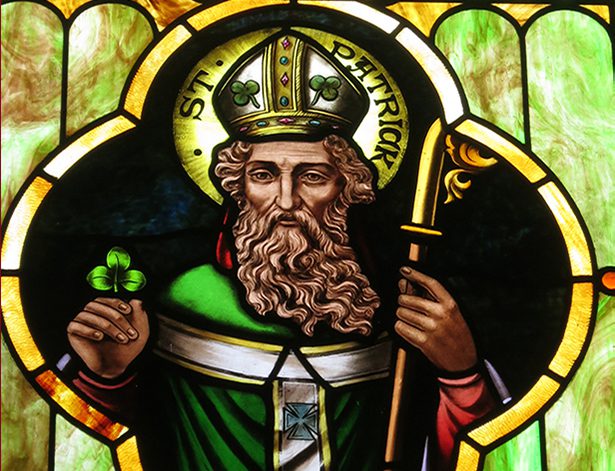
"Love follows knowledge."
"Beauty above all beauty!"
– St. Catherine of Siena

Showing posts with label St. Patrick's Day. Show all posts

Friday, March 17, 2023

St. Patrick’s Day 2023

I’m ethnically Italian but I have a devotion to St. Patrick, the real St. Patrick, not the distorted silly festival St. Patrick that is dressed in what is supposed to pass as green bishop garb.  Why is it that festivals left to secular devices almost all lead to bacchanals?  I remember as a college kid meeting up with other students in Manhattan for the St. Patrick’s Day parade, drinking green beer, and then sitting at an Irish pub named Molly Bloom—named after a character in James Joyce’s novel Ulysses—and talking Irish literature.  I can still quote a few of Yeats’ poems!  [“Turning and turning in the widening gyre/The falcon cannot hear the falconer…”]

And I remember in the years after college meeting up with some of my boyhood friends—none of which were actually Irish—every St. Patrick’s Day at a local Brooklyn tavern named Pippin’s Pub, where on St. Patrick’s Day they would give out free corned beef sandwiches all night.  We’d drink Guinness—our tastes had developed beyond green beer—and later in the night swing down Irish whiskies and listen to Steely Dan on the jukebox.  [“They got a name for the winners in the world/I want a name when I lose/They call Alabama the Crimson Tide/Call me Deacon Blues”] I’m not sure why Steely Dan felt appropriate for March 17th, but it was hip, and I think Irish was hip back then in New York City, at least on St. Patrick’s Day.  There was certainly Irish music played on the juke, but I remember Steely Dan.  I can tell you the hangovers weren’t hip.

But such is New York City’s version of St. Patrick’s Day. 

By the way, I discovered a wonderful podcast from Ireland called The Brendan Option, hosted by Fr. Brendan Kilcoyne who from a Catholic perspective gives his opinions on the new Ireland, and they are not very positive.  Here he laments at what has happened to the St. Patrick’s Day parades in Ireland where he wants to cancel the parade altogether.


Besides agreeing with his many opinions, I just love his gift of gab that apparently so many Irish have.  And I love his accent.  If you don’t watch it, here’s a little quote from the episode he put on the description pages:


I want this vulgar, drink-sodden, bullsh!t that is commonly called St. Patrick's Day to stop so that the celebration of a major Catholic figure in the Irish Catholic experience is not ruined.

Since those days attending Irish pubs I got married and became religious.  Not that marriage and developing faith necessarily follow or are connected, but I will attest that in marriage God does actually call you, and whether you listen or not is up to the individual.  Be that as it may, I discovered my Catholic faith, assessed it against other faiths and other versions of Christianity, and came down solidly on Catholicism. 

One of the many blessings of Catholicism are the lives of the saints.  They are our models and our heroes.   Reading about saint’s lives can be a real pleasure to faithful Catholics, and I encourage it.  Yes, some of the hagiography can be hard to believe, but the moral instruction is the critical element, and moral instruction is missing from much of our contemporary literature.  Or perhaps to say it in another way, much of the moral instruction we get from contemporary literature is frankly immoral.  Flannery O’Connor, the Catholic American writer, has a great quote that shows Catholic’s admiration of saint’s lives where she says this about a character: “She could never be a saint, but she thought she could be a martyr if they killed her quick.”  I forget which novel or story that came from but it shows that even in a satirical line that Catholic’s measure their lives against those of saints. 

Which brings me to St. Patrick, the real St. Patrick.  I don’t go to the St. Patrick’s Day Parade in Manhattan any more, but one of the pleasures of this day is to read the story of St. Patrick.  And every year I seem to discover something new about him.  We know more of his life than people probably realize.  I’m sure most have heard how as a teenager he was kidnapped from what is now England or Wales and brought to Ireland as a slave, and in time e escaped and after six years made his way back home.  You probably also know he had a calling to evangelize the very people who enslaved him, and so with great risk went back to Ireland and in time converted the island to Christianity. 

That’s the short version, but there is a lot in-between that has been glossed over, and it’s not just the hagiographic Patrick driving the snakes out of Ireland.  I particularly enjoyed reading Catholic League’s Bill Donohue’s post on St. Patrick’s life.  The calling to go back to Ireland came in Patrick’s sleep, and while still a young man realized he needed to be a priest to fully answer the call, and so went to France and was tutored under monks at a monastery, and after two decades was made a bishop of the diocese of Ireland.  His dream of finally answering the call was realized.  This probably put him in his forties, but he went on to live into his seventies or eighties (the actual length disputed) which would have given him a good thirty to forty years evangelizing in Ireland.

How do we know so much of St. Patrick’s life?  Beside he being included in historical annals, two documents have been preserved which he wrote.  His autobiography, Confessio, and a letter to a Roman war lord (or nobleman) named Coroticus and apparently a Christian denouncing his enslavement of Irish in Britain.  The letter is referred to as the Letter to the soldiers of Coroticus.  This is how the letter opens.


I declare that I, Patrick, – an unlearned sinner indeed – have been established a bishop in Ireland. I hold quite certainly that what I am, I have accepted from God.  I live as an alien among non-Roman peoples, an exile on account of the love of God – he is my witness that this is so. It is not that I would choose to let anything so blunt and harsh come from my mouth, but I am driven by the zeal for God. And the truth of Christ stimulates me, for love of neighbours and children: for these, I have given up my homeland and my parents, and my very life to death, if I am worthy of that. I live for my God, to teach these peoples, even if I am despised by some.

Donohue points out that no public person in history had ever publically denounced slavery.  Patrick was the first.  Coroticus had apparently raided, plundered, killed and enslaved, and Patrick was furious.  Paragraph 15


I do not know what to say, or how I can say any more, about the children of God who are dead, whom the sword has touched so cruelly. All I can do is what is written: ‘Weep with those who weep’; and again: ‘If one member suffers pain, let all the members suffer the pain with it’. This is why the church mourns and weeps for its sons and daughters whom the sword has not yet slain, but who were taken away and exported to far distant lands, where grave sin openly flourishes without shame, where freeborn people have been sold off, Christians reduced to slavery: slaves particularly of the lowest and worst of the apostate Picts.

Donohue also points out that Patrick particularly identified the crime of enslaving women: “So where will Coroticus and his villainous rebels against Christ find themselves – those who divide out defenceless baptised women as prizes, all for the sake of a miserable temporal kingdom, which will pass away in a moment of time” (par. 19).  Donohue identifies Patrick as being ahead of his time when it came to human rights.


What makes this all the more dramatic is the way the pagan world thought about women: the idea that women were equal to men was totally foreign to them. But the women understood what Patrick was saying, and gravitated to him in large numbers. The Christian tenet that all humans possess equal dignity had taken root.

And so, when Fr. Brandan denounces the drunken debauchery that has become the St. Patrick’s Day festivities, he is upset at the besmirching of a great man and holy saint.  

Saint Patrick pray for us.


Thursday, March 17, 2022

St. Patrick’s Confessio

St. Patrick’s Confession in the original Latin is called his Confessio.  It’s an actual little autobiography written by the future saint, of which we celebrate his feast day today, written toward the end of his life, somewhere towards the middle to end of the fifth century.  Here are the opening paragraphs.


My name is Patrick. I am a sinner, a simple country person, and the least of all believers. I am looked down upon by many.


My father was Calpornius. He was a deacon; his father was Potitus, a priest, who lived at Bannavem Taburniae. His home was near there, and that is where

I was taken prisoner. I was about sixteen at the time.


At that time, I did not know the true God. I was taken into captivity in Ireland, along with thousands of others. We deserved this, because we had gone away from God, and did not keep his commandments. We would not listen to our priests, who advised us about how we could be saved. The Lord brought his strong anger upon us, and scattered us among many nations even to the ends of the earth. It was among foreigners that it was seen how little I was.


Translation from Latin by Pádraig McCarthy, Avoca, Co. Wicklow. © 2003 and used with permission from the website.  

It’s not a very long read, some eighteen pages and makes for a very good Lenten read on this feast day.  Here is a LibraVox recording of the Confessio, if you wish to read along or just listen. 


Here are some of my takeaways after reading it. 


·   Patrick had a great love for his fellow human beings.  He was not Irish, was enslaved by the Irish pagans, and went back once he had escaped to not only evangelize but care for them.  Throughout the Confessio he never has a bad word to say about anyone.  He was a true missionary, always having the best interest of those he evangelized.  I could feel his tender heart in this little passage looking back to those he touched.


In the knowledge of this faith in the Trinity, and without letting the dangers prevent it, it is right to make known the gift of God and his eternal consolation. It is right to spread abroad the name of God faithfully and without fear, so that even after my death I may leave something of value to the many thousands of my brothers and sisters – the children whom I baptised in the Lord.


·   He had a great knowledge of the scriptures.  He quotes or alludes to scripture in almost every paragraph.  Notice how many Biblical references are in this one paragraph alone.  The Biblical reference in brackets in red are my addition to the paragraph.


It is right that we should fish well and diligently, as the Lord directs and teaches when he says: “Follow me, and I will make you fishers of men.” [Mat 4:19] And again he says through the prophets: “Behold, I send many fishers and hunters, says God” [Jer 16:16]; and other such sayings. Therefore it is very right that we should cast our nets, so that a great multitude and crowd will be taken for God. Also that there should be clerics to baptise and encourage a people in need and want. This is what the Lord says in the gospel: he warns and teaches in these words: “Go therefore and teach all nations, baptising them in the name of the Father and of the Son and of the Holy Spirit, teaching them to observe all that I have commanded you; and behold I am with you all days, even to the end of the age.” [Mat 28:19-20] Again he says: “Go out therefore to the whole world and announce the gospel to every creature. Whoever believes and is baptised will be saved; whoever does not believe will be condemned.” [Mk 16:15-16]  And yet again: “This gospel of the kingdom will be announced all over the world, as testimony to all the nations; and then will come the end.” [Mat 24:14] In the same way, the Lord foretold this through the prophet as he said: “And it will come about in the last days, says the Lord, that I will pour out my Spirit on all flesh, and your sons and your daughters will prophesy; your young people will see visions and your older people will dream dreams. Indeed, on my servants, men and women, I will pour out my Spirit and they will prophesy.” [Joel 2:28-29] Hosea says: “Those who were not my people, I will call my people; and her who has not obtained mercy, I will name the one who has obtained mercy. In the place where it was said: You are not my people: there they will be called children of the living God.” [Hosea 2:23-24 and Hosea 1:10]


·         He was a Church Father and should be regarded as so.  He was a younger contemporary of St. Augustine of Hippo (354-430) and St. John Chrysostom (337-407).  St. Patrick’s life span is not known with certainty but Wikipedia lists it as 385-461.

·         He was truly a simple countryman as he states above.  While his Confession is pious, it does not seem to exhibit a “bookish” learning of deep theological argument.  But it feels very honest.  Here he describes why he is writing at his advanced age.


Now, in my old age, I want to do what I was unable to do in my youth. My sins then prevented me from really taking in what I read. But who believes me, even were I to repeat what I said previously? I was taken prisoner as a youth, particularly young in the matter of being able to speak, and before I knew what I should seek and what I should avoid. That is why, today, I blush and am afraid to expose my lack of experience, because I can’t express myself with the brief words I would like in my heart and soul.


·         He had a moment of great conversion, not unlike many people today who have such moments.  But it came from prayer, which is a daily must.  Here he describes it.


After I arrived in Ireland, I tended sheep every day, and I prayed frequently during the day.  More and more the love of God increased, and my sense of awe before God. Faith grew, and my spirit was moved, so that in one day I would pray up to one hundred times, and at night perhaps the same. I even remained in the woods and on the mountain, and I would rise to pray before dawn in snow and ice and rain. I never felt the worse for it, and I never felt lazy – as I realise now, the spirit was burning in me at that time.

·         After returning to his home after six years of enslavement in Ireland, it was through a dream that he was pulled to return. 


A few years later I was again with my parents in Britain. They welcomed me as a son, and they pleaded with me that, after all the many tribulations

I had undergone, I should never leave them again. It was while I was there that I saw, in a vision in the night, a man whose name was Victoricus coming as it were from Ireland with so many letters they could not be counted. He gave me one of these, and I read the beginning of the letter, the voice of the Irish people. While I was reading out the beginning of the letter, I thought I heard at that moment the voice of those who were beside the wood of Voclut, near the western sea. They called out as it were with one voice: “We beg you, holy boy, to come and walk again among us.” This touched my heart deeply, and I could not read any further; I woke up then. Thanks be to God, after many years the Lord granted them what they were calling for.

How marvelous that he was referred to as “holy boy.”  Even though it was in a dream, I suspect he was actually referred to in that way.

·         I was amazed to find out that he is the first recorded person in history to denounce slavery.  According to Bill Donohue of the Catholic League, in his tribute to St.Patrick: 


 No public person before him had denounced slavery, widespread though it was. Jesus was silent on the subject, Aristotle thought it was a natural way of life, and neither master nor slave saw anything fundamentally wrong with it. Patrick did.


Though he did not invoke natural law specifically, he was instinctively drawn to it. He taught that all men were created equal in the eyes of God, and that the inherent dignity of everyone must be respected.


Patrick did more than preach—he lashed out at the British dictator, Coroticus, harshly rebuking him for his mistreatment of the Irish. In fact, Patrick found his Irish converts to be more civilized than Coroticus and his band of thugs.

·         He was profoundly humble.  Here he explains why he went back to Ireland to preach and serve, despite having been brutally enslaved there:


So I want to give thanks to God without ceasing. He frequently forgave my lack of wisdom and my negligence, and more than once did not become very angry with me, the one who was meant to be his helper. I was not quick to accept what he showed me, and so the Spirit prompted me. The Lord was merciful to me a thousand thousand times, because he saw in me that I was ready, but that I did not know what I should do about the state of my life. There were many who forbade this mission. They even told stories among themselves behind my back, and the said: “Why does he put himself in danger among hostile people who do not know God?” It was not that they were malicious – they just did not understand, as I myself can testify, since I was just an unlearned country person. Indeed, I was not quick to recognise the grace that was in me; I know now what I should have done then.

I think Patricius, son of Calpornius, was a great and heroic man.  He earned the title of Saint Patrick.  May we get many graces from his inspiration.

The last couple of years I posted on St. Patrick’s famous prayer, “St. Patrick’s Breastplate.”  Every year on March 17th for the last few years I have prayed it.  Pray it and listen to it here.


Wednesday, March 17, 2021

Happy St. Patrick’s Day

Last year I posted the St. Patrick’s Breastplate prayer and a beautiful recitation of it.  Go back and pray and listen to it.  It’s worth it.  It’s a prayer one should pray regularly, but if you forget, today is the opportune time to do it at least once for the year.

Today I want to link to an expounding of the prayer by Fr. Patrick Briscoe, OP, “St.Patrick’s Breastplate UNPACKED” over at Aleteia. 

Let me give you a sample. 


St. Patrick’s Breastplate (also called the Lorica, from the Latin word for Roman armor) is a prayer to take up arms in spiritual battle. Summoning the forces of heaven to combat the armies of hell, this prayer attributed to the Apostle of Ireland contains a wealth of theological wisdom. On the feast of St. Patrick, take a moment to pray and reflect on these ancient, powerful words.


I arise today

Through a mighty strength, the invocation of the Trinity,

Through belief in the Threeness,

Through confession of the Oneness

of the Creator of creation.


St. Patrick’s prayer starts with the central mystery of the Christian faith: the Holy Trinity. The Christian God is one in three, three in one. The eternal Father begets the Son, and together they breathe forth the Holy Spirit. Eternal and infinite, the love of Father, Son, and Spirit pours forth upon the world. The diffused goodness of God, a goodness so great that it cannot be contained, spills out upon all creation, making and forming the world in love.


Oh read the entire article.  It’s a beautiful prayer and a great explanation.

I also found another musical version, this by Dwight Beal, who I have never heard of.  He takes some liberties with the words to fit his melody, but the spirit is faithful to the prayer.  He calls it "The Hymn of St. Patrick."


It’s beautiful.  Happy St. Patrick’s Day.  And remember, it's a religious day first and foremost.


Tuesday, March 17, 2020

Music Tuesday: St. Patrick's Breastplate

I haven’t had a Music Tuesday post in a while.  What better day than today, March 17th, St. Patrick’s Day, to post a musical version of St. Patrick’s Breastplate.  Whether St. Patrick actually wrote it, I’m not exactly sure, but it goes back deep into Irish roots. 

First here’s the prayer:

St. Patrick's Breastplate.

I arise today
Through a mighty strength, the invocation of the Trinity,
Through belief in the Threeness,
Through confession of the Oneness
of the Creator of creation.

I arise today
Through the strength of Christ's birth with His baptism,
Through the strength of His crucifixion with His burial,
Through the strength of His resurrection with His ascension,
Through the strength of His descent for the judgment of doom.

I arise today
Through the strength of the love of cherubim,
In the obedience of angels,
In the service of archangels,
In the hope of resurrection to meet with reward,
In the prayers of patriarchs,
In the predictions of prophets,
In the preaching of apostles,
In the faith of confessors,
In the innocence of holy virgins,
In the deeds of righteous men.

I arise today, through
The strength of heaven,
The light of the sun,
The radiance of the moon,
The splendor of fire,
The speed of lightning,
The swiftness of wind,
The depth of the sea,
The stability of the earth,
The firmness of rock.

I arise today, through
God's strength to pilot me,
God's might to uphold me,
God's wisdom to guide me,
God's eye to look before me,
God's ear to hear me,
God's word to speak for me,
God's hand to guard me,
God's shield to protect me,
God's host to save me
From snares of devils,
From temptation of vices,
From everyone who shall wish me ill,
afar and near.

I summon today
All these powers between me and those evils,
Against every cruel and merciless power
that may oppose my body and soul,
Against incantations of false prophets,
Against black laws of pagandom,
Against false laws of heretics,
Against craft of idolatry,
Against spells of witches and smiths and wizards,
Against every knowledge that corrupts man's body and soul;

Christ to shield me today
Against poison, against burning,
Against drowning, against wounding,
So that there may come to me an abundance of reward.

Christ with me,
Christ before me,
Christ behind me,
Christ in me,
Christ beneath me,
Christ above me,
Christ on my right,
Christ on my left,
Christ when I lie down,
Christ when I sit down,
Christ when I arise,
Christ in the heart of every man who thinks of me,
Christ in the mouth of everyone who speaks of me,
Christ in every eye that sees me,
Christ in every ear that hears me.


We should add "Christ to shield me today against unseen viruses."

Here’s a musical version by David Ruis.


Happy St. Patrick’s Day.  

Monday, April 8, 2019

Matthew Monday: I Found My Four Leaf Clover


For St. Patrick’s Day, Matthew’s class had to write a short story for a fourth grade writing assignment.  I thought it was cute and worth sharing.  It’s titled “I Found My Four Leaf Clover,” and this would be the first short story Matthew will have ever written.


Hi, my name is Matthew.  I live in New York.  I have to tell you a story.  It’s about me finding a four leaf clover.  It was just an ordinary day when I was playing at the park with my dad.  The ball went on the grass and I saw the four leaf clover.  Then I showed him and then luck started to happen.

After I got back from the park, I was tired, so I went on my mom’s computer, and I had so much luck in the game.  It was amazing, and my dad bought lottery tickets.  We won the lottery.  Then I screamed “we’re rich.”  All the money was 80 billion dollars.  I was so happy.  I also got ten kittens.  I played with them so much.  They were so cute.  Then it was almost three o’clock during the day and I had so much luck.  I also got some cool baseball cards.  I got a super rare card.

Then the day was almost over and we ordered pizza, and it was so yummy.  I had four pieces of pizza.  It was delicious.  Then around nine o’clock I was about to go to bed.  My mom said I can stay up to ten o’clock.  That was fun.  I hope you have a happy St. Patrick’s Day.  I also hope you liked my story.

I think if we won $80 billion we would have more than pizza for dinner.  And I tell you what, Matthew my boy, if we won that much I’d let you stay up to eleven o’clock. 

Monday, March 4, 2019

Matthew Monday: Staten Island St. Patrick’s Day Parade


On St. Patrick’s Day, New York City holds what I’ve heard is the largest St. Patrick’s Day parade in the world.  Staten Island, one of five boroughs of New York City but only 6% of the city population, has such a large Irish-American contingency it holds its own parade.  But to avoid interfering with the big parade, it holds its own St. Patrick’s Day parade a couple of weeks before. 

Most grammar schools don’t march in the parade, Catholic or not, but a woman at Matthew’s school signed the school up this year.  It was not coordinated with the school, so only four parents and their children showed up.  My wife, who is friends with the woman who signed us up, was one, and so Matthew, my wife, and I marched.  It was a lot of fun.  I’ve got some pictures and video clips to share.

The route is a good mile and a half long, and mostly with a sloping downhill grade.  However, someone had to park the car at the end of the route and then walk up to the starting point.  You guessed it, that was me!  So I walked it twice, and the first time was with the sloping uphill grade. 

Here we are at the grouping place.  There’s about a dozen of us. 


The hardest part of the entire day was the waiting.  I dropped the two off at ten thirty.  We didn’t start marching until a quarter to two, over three hours.  As you can imagine, the kids (and the parents, truth to tell) got restless.

There was snow on the ground.  Here’s a picture of Matthew eyeing a snowball retaliation.


And when I said the kids were restless, here’s a picture of one of Matthew’s school friends giving him a good swift punch.


Off on the march holding the school banner.


Here’s a look down Forest Avenue. 


We were at the back of the parade.  Most of the floats and large groups of school bands were way ahead.

Right behind us were a bagpipe group, and they played some beautiful Irish marching music.  I think they were called the United Gaelic Pipe Band.


Here’s a sample of their playing.


As you may have noticed, ahead of us was a Bassett Hound group or club which provided us some entertainment. 

They were really cute.  Here’s a few pictures.


DSCN_1864


Here’s another movie clip as we walk by the dignitary stand with the Parade Marshall.


Not all the kids got to walk.  Some got rides.


And finally a picture of all our kids at the end of the route.