"Love follows knowledge."
"Beauty above all beauty!"
– St. Catherine of Siena

Showing posts with label Leo Tolstoy. Show all posts

Saturday, December 14, 2019

Short Story Analysis: Where Love Is, There God Is Also by Leo Tolstoy

This is a Leo Tolstoy story written in 1885 after his religious conversion (which occurred sometime in the 1870s), and it most definitely reflects his new found faith. 

A quick summary of the story would be thus.  Martuin Avdyeitch, a shoemaker, falls into despair but rises out of his despair when he follows a friend’s advice to read the New Testament.  The more he read, the more engaged he became and in time had what might be called a religious conversion out of his despair.  One night while dozing he heard a voice that said He was coming the next day.  Martuin took that voice to be Christ, and so he awaited Him by having tea and food ready.  The next day on separate occasions, he came to the aid of needy people (an old man, a woman with child, and an old woman robbed by a street urchin) with hospitality.  Still no Christ arrived by the end of the day.  As he goes to bed he hears a voice asking if he recognized Him.  Upon inquiring, out of the shadows steps the old man, the woman and child, and the old lady and street urchin.  You can read the Wikipedia entry on this story here.  

You can read the entire story at Project Gutenberg, here.  

 There’s not all that much to analyze.  It’s a simple story.  The transitions of the story can be seen with the transitions in Martuin’s internal state.  (1) Despair, which is further developed by the death of Martuin’s remaining child.  (2) Desire to learn Christ’s message, inspired by an old man paying Martuin a visit, and developed by Martuin unable to put down the Gospels.  (3) Joyful, as a result of the change in Martuin’s life from the gospel message.  This joyful state leads Martuin to compassionately aid the three needy people passing by his shop.  (4) Surprise with the epiphany that those needy people were all Christ, and that He had paid him a visit.

Some observations. 

Martuin was already a good man before his last child died, and he was already on a path toward embracing religion.

Avdyeitch had plenty to do, because he was a faithful workman, used good material, did not make exorbitant charges, and kept his word. If it was possible for him to finish an order by a certain time, he would accept it; otherwise, he would not deceive you,—he would tell you so beforehand. And all knew Avdyeitch, and he was never out of work.

Avdyeitch had always been a good man; but as he grew old, he began to think more about his soul, and get nearer to God. Martuin's wife had died when he was still living with his master. His wife left him a boy three years old. None of their other children had lived. All the eldest had died in childhood. Martuin at first intended to send his little son to his sister in the village, but afterward he felt sorry for him; he thought to himself:—

“It will be hard for my Kapitoshka to live in a strange family. I shall keep him with me.”

And Avdyeitch left his master, and went into lodgings with his little son.  But God gave Avdyeitch no luck with his children. As Kapitoshka grew older, he began to help his father, and would have been a delight to him, but a sickness fell on him, he went to bed, suffered a week, and died. Martuin buried his son, and fell into despair.

A faithful workman who didn’t deceive people in search of God, Martuin may well have been on a path to religiosity.  If hospitality is one of the themes, we see it here with deciding not send off his son.  And Martuin buys that shop on account of keeping his son.  The love for his son and its subsequent hospitality we see sets up the conditions for the main part of the story.

The old man who comes to visit Martuin is also another example of hospitality.  There seems to be a lot of old people in this story.  That old man is given some mysterious details.  He comes from Troïtsa, a monastery, so he’s a religious man.  He had been “wandering about” for seven years.  Is this another Christ figure?  I would consider it so.

I love the gradual change in Martuin as he reads the Gospels culminating with his conversion. 

And the more he read, the clearer he understood what God wanted of him, and how one should live for God; and his heart kept growing easier and easier. Formerly, when he lay down to sleep, he used to sigh and groan, and always thought of his Kapitoshka; and now his only exclamation was:—

“Glory to Thee! glory to Thee, Lord! Thy will be done.”

And from that time Avdyeitch's whole life was changed. In other days he, too, used to drop into a public-house as a holiday amusement, to drink a cup of tea; and he was not averse to a little brandy, either. He would take a drink with some acquaintance, and leave the saloon, not intoxicated, exactly, yet in a happy frame of mind, and inclined to talk nonsense, and shout, and use abusive language at a person. Now he left off that sort of thing. His life became quiet and joyful. In the morning he would sit down to work, finish his allotted task, then take the little lamp from the hook, put it on the table, get his book from the shelf, open it, and sit down to read. And the more he read, the more he understood, and the brighter and happier it grew in his heart.

Martuin’s conversion seems to parallel Tolstoy, who he too fell into despair but was pulled out of it by his understanding of Christ.  Even Martuin now sitting and working at his craft gives me an image of Tolstoy sitting and writing.

I would say that concludes the first half of the story.  The second half of the story is Martuin putting his new found faith into action.  We see Martuin feeling compassion for the three separate needy people.  Each of the needy people seem to have their personal weaknesses.  Martuin provides hospitality by giving them tea and food, and in the case of the old woman and the urchin serves as a peacemaker.  The three episodes read like a folk tale. In each episode Martuin applies Christian principles to bring about harmony.  Each person Martuin helps gives him a blessing in some way.  As the title of the story stipulates, where love is, Christ is there too.

Some other thoughts.  Is the fact that Tolstoy makes him a shoemaker or shoe repairer have any significance?  Taking care of other people’s feet suggests a humility.  It recalls Christ washing the apostle’s feet or the sinful woman washing Jesus feet with her tears.  Martuin knowing the shoes of all the people in town seems to suggest a humble servant.

Perhaps the most striking detail in this story is how Martuin’s shop is below ground and that he is looking upward out of the window to the street.  Is he looking heavenward?  Does it emphasize humility again?  Does it suggest death, as in being buried?  Perhaps all, perhaps none.  I’m not sure.  It’s a wonderful detail though.

###

Excerpts from our discussion at Goodreads Catholic Thought Book Club.

Kerstin commented:
I've been thinking if I have ever seen a "basement" shop here in the US, where you have to go down a few steps from street level to enter. And I don't recall.

To me this detail invokes a sense of being sheltered, a place to retreat, almost a burrow. You only exit when necessary. Martuin, for the most part, doesn't leave. In this sheltered place is where his battered heart seeks refuge. He doesn't see beyond his own pain. Then Christ generates a rebirth. First very subtly by giving him the desire to read the Gospels, and his first venture into the outside world is to purchase a New Testament. And like a seed ready to germinate he drinks in the living waters of the Word and he opens up. Instead of only noting inanimate boots belonging to a person passing by his window he actually looks further, sees and recognizes their faces. He grows beyond himself and sees their struggles and is no longer imprisoned by his own. He is now ready to bring Christ to the people around him. He rejoins the community.

My Reply:
I have seen them here in NYC.
Interesting thought. It does suggest rebirth, perhaps resurrection. I had not thought of that.

Gerri Commented:
I definitely sense a theme of rebirth in the story. But, also, I wondered if Christ's message would have reached someone who wasn't as good a man as Martuin. His foundation is strong, it isn't on sand. And I'm trying to determine the significance of the story's emphasis on shoes, feet, walking, etc. Perhaps metaphors for life's journey? Martuin's limited line of sight also stands out to me. When he looks out that window, he can only see feet/shoes. He has to go out of his way to bend and look up enough to see the passerby's face or to see what's going on in the street. It's only when he makes that effort that he begins to see the Christ-figures that are visiting him.

My Reply:
Yes, Gerri that limited line of sight caught me eye too. I like the way you stated it. Perhaps that's it in itself: limitation of sight. And I like the thought of being buried below ground too.

Lawanda remembered hearing a Johnny Cash song having a very similar story line.  And she found the song, “The Christmas Guest.” 


Merry Christmas.

Wednesday, April 13, 2016

Short Story Analysis: Master and Man by Leo Tolstoy, Part 1

I was searching for a short story to break up a few of the reads I have going on, and since this blizzard (which I posted on here) hit I longed for a story about winter and I recalled a famous Leo Tolstoy story about two men being trapped in a blizzard.  Now I had read “Master and Man” many years ago—over twenty years, if not thirty—and it has always stuck with me.  It really is a great short story.  Actually it’s on the longer side of a short story.  My edition ran for forty pages, which makes it close to a novella, and I had remembered it as a short novel.  But Wikipedia, that ever pervasive corpus of knowledge, categorizes it as a short story.  I also noticed while reading the Wikipedia entry that it was published in 1895, which makes it a relatively late story in Tolstoy’s body of work, and squarely in his most religiously inspired works.

First off, you can read it on line, and I believe this is the same translation I read.


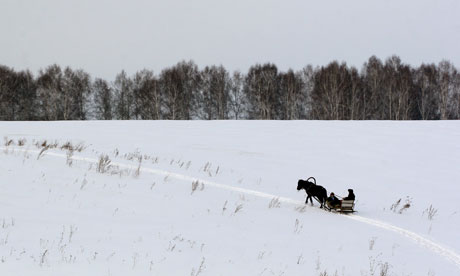
The story is about a merchant who has this immediate opportunity to purchase a grove at a bargain price, and goes off to complete the deal before someone else takes it. Faced with impending bad weather, he brings along his servant.  It’s winter and he misjudges the weather, and they are caught in a blizzard, and it becomes a question of survival. 

The story is told in ten chapters, and I’m going to summarize it for you by providing the kernel action of each chapter.  Here:

I.  We are introduced to Vasili Andreevich, a merchant and church elder, and his laborer, Nikita.  Vasili has to go to purchase a grove at what he sees as a huge bargain.  It is very cold and Vasili against his wishes takes Nikita with him.

II. The depart and after a while with the wind blowing harder than they anticipated and it starting to snow they realized for the first time they were lost.

III.  They come upon a village and come across three peasants, where they ask for directions and are pointed out.  Suddenly they realize they are off the road are now lost for the second time, and now a full blizzard is coming down.

IV.  They come to another village and they stop at a rich household where they warm up and are offered to spend the night.  But Vasili afraid he will lose his bargain insists that they can make it to their destination.  One of the sons of the household sets out with them as a guide.

V. After the son leaves them at a turning point, the two continue but the blizzard has so intensified that they can’t see a few feet in front.  Shortly they are lost now for the third time, and they just miss driving over a ravine.  The circle around but the horse has reached a point of exhaustion and refuses to go on.

VI. Nikita unharnesses the horse and decides to hunker down for the night.  They try to sleep but Vasili unable and now in a panic decides it’s best to search for a house rather than freeze to death.  He mounts the horse and goes off into the blizzard.

VII.  Nikita, too tired to go with Vasili allows sleep to overcome him, all with the thought that it will be his death.

VIII. Vasili stumbles about in the blizzard, the horse escapes from under him, so that now he is horseless and lost.

IX.  In a panic he circles about and finds where he started, the sled with Nikita.  He finds Nikita near death and he realizes it has all been his fault.  This sting of conscience rises to an epiphany of his inconsideration and selfishness and opens Nikita’s coat and his and presses his body against Nikita’s to warm him.  In this position Vasili has a dream of someone calling him.

X. In the morning we find that it is Nikita who is alive and Vasili who has died.  The peasants rescue Nikita.

The story hinges on the term “master.”  It is set “in the seventies,” which means 1870s, and this is important given it was published in 1895, a full twenty years after the setting.  Tolstoy sets the story at a time when serfdom was abolished in Russia.  From Wikipedia: 

In 1861 Alexander II freed all serfs in a major agrarian reform, stimulated in part by his view that "it is better to liberate the peasants from above" than to wait until they won their freedom by risings "from below".

Serfdom was abolished in 1861, but its abolition was achieved on terms not always favorable to the peasants and served to increase revolutionary pressures. Between 1864 to 1871 serfdom was abolished in Georgia. In Kalmykia serfdom was only abolished in 1892.

Though Nikita, the peasant, is no longer a serf, he has lived as a dependent serf for most of his life.  Not only is he indebted to Vasili, but Nikita has a psychological and relational mentality of a subordinate.  But the relationship is even more than that; it’s a class structure of lower rank.  And with that comes a responsibility for Vasili to protect and care for Nikita.  Now that the serfs are free, will Vasili still feel this obligation?  To some degree he does.  We learn in the first chapter that Vasili had recently given Martha, Nikita’s wife, “wheat flour, tea, sugar, and a quart of vodka, the lot costing three rubles, and also five rubles in cash, for which she thanked him as for a special favour.”  There is an implied serf/master arrangement that has continued, of which Vasili points out:

‘What agreement did we ever draw up with you?' said Vasili Andreevich to Nikita. 'If you need anything, take it; you will work it off. I'm not like others to keep you waiting, and making up accounts and reckoning fines. We deal straight-forwardly. You serve me and I don't neglect you.'

And when saying this Vasili Andreevich was honestly convinced that he was Nikita's benefactor, and he knew how to put it so plausibly that all those who depended on him for their money, beginning with Nikita, confirmed him in the conviction that he was their benefactor and did not overreach them.

'Yes, I understand, Vasili Andreevich. You know that I serve you and take as much pains as I would for my own father. I understand very well!' Nikita would reply. He was quite aware that Vasili Andreevich was cheating him, but at the same time he felt that it was useless to try to clear up his accounts with him or explain his side of the matter, and that as long as he had nowhere to go he must accept what he could get.

This master and servant relationship cannot be minimized.  “You serve me and I don’t neglect you,” Vasili says.  You know that I serve you.”  It is critical to their relationship owing to a feudal construct, and it points to a social hierarchy.  Does Vasili really take care of Nikita?  Yes, but he also cheats him.

This hierarchy is further established in that Nikita is also a master, not of a people but of the domestic animals.  Also from the first chapter we see Nikita hitching up the horse.

Now, having heard his master's order to harness, he went as usual cheerfully and willingly to the shed, stepping briskly and easily on his rather turned-in feet; took down from a nail the heavy tasselled leather bridle, and jingling the rings of the bit went to the closed stable where the horse he was to harness was standing by himself.

'What, feeling lonely, feeling lonely, little silly?' said Nikita in answer to the low whinny with which he was greeted by the good-tempered, medium-sized bay stallion, with a rather slanting crupper, who stood alone in the shed. 'Now then, now then, there's time enough. Let me water you first,' he went on, speaking to the horse just as to someone who understood the words he was using, and having whisked the dusty, grooved back of the well-fed young stallion with the skirt of his coat, he put a bridle on his handsome head, straightened his ears and forelock, and having taken off his halter led him out to water.

Picking his way out of the dung-strewn stable, Mukhorty frisked, and making play with his hind leg pretended that he meant to kick Nikita, who was running at a trot beside him to the pump.

'Now then, now then, you rascal!' Nikita called out, well knowing how carefully Mukhorty threw out his hind leg just to touch his greasy sheepskin coat but not to strike him--a trick Nikita much appreciated.

After a drink of the cold water the horse sighed, moving his strong wet lips, from the hairs of which transparent drops fell into the trough; then standing still as if in thought, he suddenly gave a loud snort.

'If you don't want any more, you needn't. But don't go asking for any later,' said Nikita quite seriously and fully explaining his conduct to Mukhorty. Then he ran back to the shed pulling the playful young horse, who wanted to gambol all over the yard, by the rein.

The horse Mukhorty is there throughout the story as they lose their way through the blizzard.  Nikita is his master, also with an obligation for his wellbeing.  Notice the contrast in personality.  For Vasili it is a social obligation, and only that.  There is no love or benevolence in it.  Nikita is tender and kind even to the domesticated beasts.  He speaks to the horse as if they are equals.  Vasili on the other hand speaks to Nikita in the language of exchange, of commerce.  Vasili undergoes a dramatic realization that Nikita is a man of equal standing before God at the story’s climax.


Stay tune for the story’s dramatic conclusion in a Part 2 post.  


Wednesday, April 6, 2016

Lines I Wished I’d Written: The Panic in the Blizzard from Tolstoy’s “Master and Man”

When we had our one big snow storm earlier this winter, I decided I wanted to read a story set in a snow storm.  I had read Leo Tolstoy’s story “Master and Man” many years ago, and decided it would be perfect.  It’s a story of a rich land owner, Vasili Andreevich, and his servant Nikita, who get lost in a snowstorm.  I’m in the middle of a short story analysis of this great story, and will post it when I’m done.  But in the meantime I wanted to post this great section.  It’s chapter VIII of the story.  Nikita has given up trying to find his way out of the blizzard and resolved that he will die.  Vasili is in a panic and is making a vain attempt to find his way.  He pushes the horse, Mukhorty, through the forest only to come back to the same place he started.  

Meanwhile Vasili Andreevich, with his feet and the ends of the reins, urged the horse on in the direction in which for some reason he expected the forest and forester's hut to be. The snow covered his eyes and the wind seemed intent on stopping him, but bending forward and constantly lapping his coat over and pushing it between himself and the cold harness pad which prevented him from sitting properly, he kept urging the horse on. Mukhorty ambled on obediently though with difficulty, in the direction in which he was driven.

Vasili Andreevich rode for about five minutes straight ahead, as he thought, seeing nothing but the horse's head and the white waste, and hearing only the whistle of the wind about the horse's ears and his coat collar.

Suddenly a dark patch showed up in front of him. His heart beat with joy, and he rode towards the object, already seeing in imagination the walls of village houses. But the dark patch was not stationary, it kept moving; and it was not a village but some tall stalks of wormwood sticking up through the snow on the boundary between two fields, and desperately tossing about under the pressure of the wind which beat it all to one side and whistled through it. The sight of that wormwood tormented by the pitiless wind made Vasili Andreevich shudder, he knew not why, and he hurriedly began urging the horse on, not noticing that when riding up to the wormwood he had quite changed his direction and was now heading the opposite way, though still imagining that he was riding towards where the hut should be. But the horse kept making towards the right, and Vasili Andreevich kept guiding it to the left.

Again something dark appeared in front of him. Again he rejoiced, convinced that now it was certainly a village. But once more it was the same boundary line overgrown with wormwood, once more the same wormwood desperately tossed by the wind and carrying unreasoning terror to his heart. But its being the same wormwood was not all, for beside is there was a horse's track partly snowed over. Vasili Andreevich stopped, stooped down and looked carefully. It was a horse-track only partially covered with snow, and could be none but his own horse's hoofprints. He had evidently gone round in a small circle. 'I shall perish like that!' he thought, and not to give way to his terror he urged on the horse still more, peering into the snowy darkness in which he saw only flitting and fitful points of light. Once he thought he heard the barking of dogs or the howling of wolves, but the sounds were so faint and indistinct that he did not know whether he heard them or merely imagined them, and he stopped and began to listen intently.

Suddenly some terrible, deafening cry resounded near his ears, and everything shivered and shook under him. He seized Mukhorty's neck, but that too was shaking all over and the terrible cry grew still more frightful. For some seconds Vasili Andreevich could not collect himself or understand what was happening. It was only that Mukhorty, whether to encourage himself or to call for help, had neighed loudly and resonantly. 'Ugh, you wretch! How you frightened me, damn you!' thought Vasili Andreevich. But even when he understood the cause of his terror he could not shake it off.

'I must calm myself and think things over,' he said to himself, but yet he could not stop, and continued to urge the horse on, without noticing that he was now going with the wind instead of against it. His body, especially between his legs where it touched the pad of the harness and was not covered by his overcoats, was getting painfully cold, especially when the horse walked slowly. His legs and arms trembled and his breathing came fast. He saw himself perishing amid this dreadful snowy waste, and could see no means of escape.

Suddenly the horse under him tumbled into something and, sinking into a snow-drift, began to plunge and fell on his side. Vasili Andreevich jumped off, and in so doing dragged to one side the breechband on which his foot was resting, and twisted round the pad to which he held as he dismounted. As soon as he had jumped off, the horse struggled to his feet, plunged forward, gave one leap and another, neighed again, and dragging the drugget and the breechband after him, disappeared, leaving Vasili Andreevich alone on the snow-drift.

The latter pressed on after the horse, but the snow lay so deep and his coats were so heavy that, sinking above his knees at each step, he stopped breathless after taking not more than twenty steps. 'The copse, the oxen, the lease-hold, the shop, the tavern, the house with the iron-roofed barn, and my heir,' thought he. 'How can I leave all that? What does this mean? It cannot be!' These thoughts flashed through his mind. Then he thought of the wormwood tossed by the wind, which he had twice ridden past, and he was seized with such terror that he did not believe in the reality of what was happening to him. 'Can this be a dream?' he thought, and tried to wake up but could not. It was real snow that lashed his face and covered him and chilled his right hand from which he had lost the glove, and this was a real desert in which he was now left alone like that wormwood, awaiting an inevitable, speedy, and meaningless death.

'Queen of Heaven! Holy Father Nicholas, teacher of temperance!' he thought, recalling the service of the day before and the holy icon with its black face and gilt frame, and the tapers which he sold to be set before that icon and which were almost immediately brought back to him scarcely burnt at all, and which he put away in the store-chest. He began to pray to that same Nicholas the Wonder-Worker to save him, promising him a thanksgiving service and some candles. But he clearly and indubitably realized that the icon, its frame, the candles, the priest, and the thanksgiving service, though very important and necessary in church, could do nothing for him here, and that there was and could be no connexion between those candles and services and his present disastrous plight. 'I must not despair,' he thought. 'I must follow the horse's track before it is snowed under. He will lead me out, or I may even catch him. Only I must not hurry, or I shall stick fast and be more lost than ever.'

But in spite of his resolution to go quietly, he rushed forward and even ran, continually falling, getting up and falling again. The horse's track was already hardly visible in places where the snow did not lie deep. 'I am lost!' thought Vasili Andreevich. 'I shall lose the track and not catch the horse.' But at that moment he saw something black. It was Mukhorty, and not only Mukhorty, but the sledge with the shafts and the kerchief. Mukhorty, with the sacking and the breechband twisted round to one side, was standing not in his former place but nearer to the shafts, shaking his head which the reins he was stepping on drew downwards. It turned out that Vasili Andreevich had sunk in the same ravine Nikita had previously fallen into, and that Mukhorty had been bringing him back to the sledge and he had got off his back no more than fifty paces from where the sledge was.


This is such great writing.  One feels the panic and desperation.  The horse brings Vasili back to Nikita where the story’s climax will occur.  You can read the story on line, here.  I found the story even greater in this reading than when I read it many years ago.  Stay tuned for my analysis.


Saturday, October 17, 2015

Reading Lists: 10 Russian Novels to Read

I never thought of a category for something like this, but I think it’s a natural for a literature blog.  It occurred to me that everyone loves reading lists.  Why is that?  Is it because we put books in queue to be read?  Or is it because we tend to place books into categories, either by era or by nationality or by genre or even something as individualistic as taste?  Is it because many people like to (I don’t) place books in a hierarchy of prominence?  Perhaps it’s all of those reasons.  Nonetheless we love book lists.

In honor of the recent Nobel Prize winner in literature, Svetlana Alexievich, Andrew D. Kaufman at The Daily Beast put together a list of “ten Russian novels to read before you die.”    

Before I get to the list, let me say something about Svetlana Alexievich.  I’ve never heard of her.  She writes in Russian, which is akin to Belarusian, and she was born in Ukraine from a Belrussian father and a Ukrainian mother.  They moved to Belarus when she was a child.  What’s interesting is that she is a journalist by profession and her books are a sort of non-fiction chronicling of people in their actual voices.  Some people have been calling this a new style, and perhaps it is.  I can’t make that judgement since I haven’t read anything from her.  Maybe she does something different but it sounds a lot like the work of Studs Terkel who wrote quite a few books in a oral history format. And I’m sure there are other writers who have put together books from oral history.  Perhaps the way Svetlana weaves together the story is original.  Either way, congratulations to her.

Here is Kaufman’s Russian novels list to read.  I’m just going to provide the list.  Go over to his site to read why this author and a little something on each work.

1. Eugene Onegin (1833) by Alexander Pushkin
2. A Hero of Our Time (1840) by Mikhail Lermontov
3. Fathers and Sons (1862) by Ivan Turgenev
4. War and Peace (1869) by Leo Tolstoy
5. The Brothers Karamazov (1880) by Fyodor Dostoevsky
6. Doctor Zhivago (1959) by Boris Pasternak
7. And Quiet Flows the Don (1959) by Mikhail Sholokhov
8. Life and Fate (1960) by Vasily Grossman
9. One Day in the Life of Ivan Denisovich (1962) by Alexander Solzhenitsyn
10. The Funeral Party (2002) by Lyudmila Ulitskaya

Let me say that I consider the Russian novel to be the greatest of all the nationally categorized novels.  The Russian author seems to capture both humanity and the intensity of life, and fit it into a transcendent world view.  I love Russian novels.

Kaufman’s list is interesting.  He seems to limit himself to a single work for each writer, and he lists them chronologically so that he stretches from the beginning of the Russian novel down to the contemporary. 

I’ve only read four on that list: Fathers and Sons, War and Peace, The Brothers Karamazov, and One Day in the Life of Ivan Denisovich.  Interesting he doesn’t include Mikhail Bulgakov’s The Master and Margarita, which I have not read but was supposed to be one of the great Russian works of the 20th century.  I’ve been wanting to read that for some time now but haven’t been able to fit it in.

I highly endorse Turgenev’s Fathers and Sons.  It’s one of the great novels of the 19th century, and really captures a time and place and a generational struggle. I've been trying to find something else to read by Turgenev.  I think I have a few of his short stories somewhere.

I also endorse War and Peace, and while I don’t consider it the greatest novel of all time as some do, it is a great work.  Actually I don’t consider it to be Tolstoy’s greatest work.  I would replace it with Anna Karenina.  Not only do I find that to be a greater work, but more manageable in length. 

The Brothers Karamazov truly is a great work, perhaps in the top five of all time great novels ever written, but as I’ve mentioned I’m currently reading Dostoyevsky’s Crime and Punishment, and amazingly that is as great a work as well.  Dostoyevsky might have two novels in the top five novels ever written.  And it might be a little easier to read than The Brothers Karamazov. 

Solzhenitsyn’s One Day in the Life of Ivan Denisovich is an interesting work and an important work as far as documenting the miserable life in the Soviet Union.  But I found it to be a bit boring.  It didn’t seem to rise to a high tension.  I think the point was the soul crushing routine of life in a Soviet prison camp.  Curiously Kaufman does not pick Solzhenitsyn’s The Gulag Archipelago.  I have never read it, but it’s the book which won him the Nobel Prize.


I haven’t hyperlinked all these writers and their books here.  You can find them all on Wikipedia.  If you’ve read any of these or have some other suggestions on Russian novels, please comment.

Wednesday, April 9, 2014

Literature in the News: Tolstoy in Crimea

Crimea, that peninsular on the Black Sea where Russia and Ukraine were recently playing tug of war, has been in the news, and was also in the news when Leo Tolstoy served as an officer for Russia in the Crimean War in the 1850s.  I came across this article (titled, “How the Horrors of Crimea Shaped Tolstoy”) in the New Republic  by a Charles King on how serving in the Crimean War shaped Tolstoy’s view of war, which was later infused into his novels.  Mr. King’s bio line says he’s a professor of International Affairs, so I’m not quite sure what his expertise is in Tolstoy, but the article seems credible enough and worthy to share. 

Leo Tolstoy was 26 years old when he first saw the ramparts of Sevastopol. The weather in Crimea in the early winter of 1854—subtropical, cool but not cold—was a paradise compared with the harsh snow and ice farther north. The city itself, though, was in chaos. The heights above the port were ringed with earthworks of woven saplings and packed dirt and stone. Below, the narrow entrance to the harbor was blocked by the hulls of wooden ships deliberately sunk by the Russian navy, placed there to block the invaders. “There are thousands of different objects,” Tolstoy wrote, “thrown in heaps here and there; soldiers of different regiments, some provided with guns and with bags, others with neither guns nor bags, crowd together; they smoke, they quarrel.” 

A junior officer in an artillery brigade, Tolstoy already knew something of the exhilaration and horror of battle. For nearly three years, he had been in the Caucasus, the Russian empire’s mountainous southern frontier, in the middle of a grinding counterinsurgency campaign against upland Muslims. He had seen native villages destroyed and besieged, with the great forests of Chechnya whittled down to nothing—a strategy of the Russian army to deny shelter to Chechen raiding parties. Muslim gunmen would wait in the underbrush and aim their long guns at the Russian sappers sent to hack away a clearing on either side of a road. Not that Tolstoy had placed himself in the line of fire. By his own admission, he spent much of his time there in a Cossack stanitsa, or fortified village, hunting, drinking, “running after Cossack women,” and “writing a little,” as he noted in his diary.
 

Readers of my blog might recall Tolstoy’s Chechnya experience led to his novel, The Cossacks, which I read and examined last year.  You can read about that here.   
 

While Chechnya was more of a raid, incursion, and reconnaissance between small tribal factions, Crimea was Tolstoy’s first experience of major set armies in modern warfare.  From King’s article: 

When he arrived in Crimea, Tolstoy found himself in the middle of a war that did not yet have a name. For years, tensions had been rising between the two great powers in the Near East, the Russian and Ottoman empires. Czar Nicholas I claimed a right to protect the lives and property of Orthodox Christians inside Ottoman lands, including those who controlled access to the holy sites in Jerusalem. The Ottoman sultan, Abdülmecid I, countered that Orthodox Christians—who formed more than a third of all his subjects—were under no particular threat. The czar’s claims, he said, were merely a pretext for interfering in his domestic affairs. 

and  

Britain, France, and Sardinia came to the Ottomans’ aid. By the time Tolstoy arrived in Crimea, most of the great battles of the war were already past. Russian infantry had been put to flight by an Anglo-French force at the River Alma, the Light Brigade had made its doomed cavalry charge at Balaklava, and brutal hand-to-hand combat at Inkerman had broken Russia’s fighting will and ensured that the rest of the conflict would be focused on the desperate defense of Sevastopol. The war became a siege, with the Russians defending the heights against cannonades and bayonet charges. 

Tolstoy was there to witness the results: British and French ships sitting within cannon shot of the Crimean coast; creaking wooden carts being pulled up the steep hills, loaded with corpses; the constant roar of the Russian batteries; and the repeated thrusts of Allied troops, tripping over their greatcoats and slipping downhill in the mud.
 

Tolstoy’s writing career actually was initiated while serving. 

Tolstoy had spent much of the siege writing dispatches from the city, realistic accounts that, in an era of intense press censorship, provided Russia’s reading public with some of its first true-life accounts of battle. They appeared in The Contemporary, an influential St. Petersburg literary journal, and as hard-nosed pieces of reportage—with as much gore as could pass the state censor—they made him almost instantly famous. 

“On the earth, torn up by a recent explosion, were lying, here and there, broken beams, crushed bodies of Russians and French,” he wrote in his final installment from the scene of battle, later collected as Sevastopol Sketches, “heavy cast-iron cannon overturned into the ditch by a terrible force, half buried in the ground and forever dumb, bomb-shells, balls, splinters of beams, ditches, bomb-proofs, and more corpses, in blue or in gray overcoats, which seemed to have been shaken by supreme convulsions . . .” Tolstoy had arrived in Crimea as a casual patriot; he was now a committed skeptic.
 

King then ends his article with this interesting observation from the point of view of another writer who happened to be in Crimea a decade later. 

A decade after the war, in 1867, Mark Twain visited Sevastopol and walked over the old battlefields with a group of American tourists, kicking up bits of shrapnel and shards of bone. U.S. newspapers had carried news of the fighting, and photographers had captured images from the front lines. The telegraph and glass-plate photography had made their debut as tools of war reporting. “Sevastopol is probably the worst battered town in Russia or anywhere else,” Twain wrote in The Innocents Abroad. “But we ought to be pleased with it, nevertheless, for we have been in no country yet where we have been so kindly received.” 

By this stage, Tolstoy was on the other side of his journey of disillusionment, one that had begun in the forests of Chechnya and ended on the Black Sea coast. He was nursing the ideas that would define his work as a mature writer: that battles were a form of deliberate folly, that the only enduring nation was humanity, that ordinary Russians were always better than the rulers whom history seemed to give them. While Twain was looking over the ruins of Sevastopol, Tolstoy was far to the north, back home on the old family estate at Yasnaya Polyana. He was in the final stretch of a manuscript he had decided to call War and Peace.
 

As it turns out, Russia did take Crimea from the Ottoman Empire, and apparently has retaken it from Ukraine.  History does sometimes repeat itself, though this second iteration was without any battle.  War is a terrible thing, and Tolstoy learned firsthand.  Read Charles King’s entire article.

Saturday, June 8, 2013

Book Excerpt: The Cossacks by Leo Tolstoy, Part 3

You can read Part 1 of Book Excerpt: The Cossacks by Leo Tolstoy here and Part 2 here. Excerpts taken from etext from Wikisource Library through Classic Literature By Great Authors ; translation by Louise and Aylmer Maude.
 
In the first blog on The Cossacks I delineated the central character Olenin, an overly sophisticated, disillusioned, even cynical young man who decides to leave his Moscow life for a military stint in the wilds of the Caucasus.  On the second blog I delineated his contracting character, Lukashka, a young Cossack man who is heroic and at one with the nature of his upbringing.  Both these characters fall in love with the beautiful Cossack girl, Maryanka, and so the novel forms a triangle.  Lukashka and Maryanka are betrothed by their parents in a traditional arrangement, but besides the arrangement there is a true, youthful attraction, and they are presented as a natural and likely couple.   Olenin is the outsider, the rich man from Moscow, from the big and sophisticated city.  He has denied that love is possible or even real, but once in contact with the natural elements and natural people, his outlook is challenged and he starts to change.  He becomes drawn to Maryanka, at whose parent’s home he is a lodger.  Here is a passage when Olenin first meets Maryanka.


Olenin ran up the steps of the porch and pushed open the door of the hut. Maryanka, wearing nothing but a pink smock, as all Cossack women do in the house, jumped away from the door, frightened, and pressing herself against the wall covered the lower part other face with the broad sleeve of her Tartar smock. Having opened the door wider, Olenin in the semi-darkness of the passage saw the whole tall, shapely figure of the young Cossack girl. With the quick and eager curiosity of youth he involuntarily noticed the firm maidenly form revealed by the fine print smock, and the beautiful black eyes fixed on him with childlike terror and wild curiosity. 'This is SHE,' thought Olenin. 'But there will be many others like her' came at once into his head, and he opened the inner door.  [chpt 10]
 
Love at first sight, love from contact through the eyes is a motif in several of Tolstoy’s works.  (It happens with Lukashka and Maryanka later on as well.)  There is a magic when Tolstoy brings two people’s eyes in contact as they fall in love.  Such a moment happens here to Olenin: “'This is SHE,' thought Olenin.”  But notice how in the very next thought that moment of love becomes warped: “'But there will be many others like her' came at once into his head.”  He has choked off the feeling of love with the thought of sexual objectification.  It isn’t the “she” he embraces, but the sexual object.  Let’s compare Lukashka’s interaction with Maryanka.  A group of girls including Maryanka are talking about the lodger at Maryank’s house when Lukashka walks over and listens.  Finally Lukashka feels a pang of jealousy.


Lukashka rose and raised his cap.

'I expect I had better go home too, that will be best,' he said, trying to appear unconcerned but hardly able to repress a smile, and he disappeared behind the corner of the house.

Meanwhile night had entirely enveloped the village. Bright stars were scattered over the dark sky. The streets became dark and empty. Nazarka remained with the women on the earth-bank and their laughter was still heard, but Lukashka, having slowly moved away from the girls, crouched down like a cat and then suddenly started running lightly, holding his dagger to steady it: not homeward, however, but towards the cornet's house. Having passed two streets he turned into a lane and lifting the skirt of his coat sat down on the ground in the shadow of a fence. 'A regular cornet's daughter!' he thought about Maryanka. 'Won't even have a lark--the devil! But just wait a bit.'

The approaching footsteps of a woman attracted his attention. He began listening, and laughed all by himself. Maryanka with bowed head, striking the pales of the fences with a switch, was walking with rapid regular strides straight towards him. Lukashka rose. Maryanka started and stopped.

'What an accursed devil! You frightened me! So you have not gone home?' she said, and laughed aloud.

Lukashka put one arm round her and with the other hand raised her face. 'What I wanted to tell you, by Heaven!' his voice trembled and broke.

'What are you talking of, at night time!' answered Maryanka. 'Mother is waiting for me, and you'd better go to your sweetheart.'

And freeing herself from his arms she ran away a few steps. When she had reached the wattle fence of her home she stopped and turned to the Cossack who was running beside her and still trying to persuade her to stay a while with him.

'Well, what do you want to say, midnight-gadabout?' and she again began laughing.

'Don't laugh at me, Maryanka! By the Heaven! Well, what if I have a sweetheart? May the devil take her! Only say the word and now I'll love you--I'll do anything you wish. Here they are!' and he jingled the money in his pocket. 'Now we can live splendidly. Others have pleasures, and I? I get no pleasure from you, Maryanka dear!'

The girl did not answer. She stood before him breaking her switch into little bits with a rapid movement other fingers.

Lukashka suddenly clenched his teeth and fists.

'And why keep waiting and waiting? Don't I love you, darling? You can do what you like with me,' said he suddenly, frowning angrily and seizing both her hands.

The calm expression of Maryanka's face and voice did not change.

'Don't bluster, Lukashka, but listen to me,' she answered, not pulling away her hands but holding the Cossack at arm's length. 'It's true I am a girl, but you listen to me! It does not depend on me, but if you love me I'll tell you this. Let go my hands, I'll tell you without.--I'll marry you, but you'll never get any nonsense from me,' said Maryanka without turning her face.

'What, you'll marry me? Marriage does not depend on us. Love me yourself, Maryanka dear,' said Lukashka, from sullen and furious becoming again gentle, submissive, and tender, and smiling as he looked closely into her eyes.

Maryanka clung to him and kissed him firmly on the lips.

'Brother dear!' she whispered, pressing him convulsively to her. Then, suddenly tearing herself away, she ran into the gate of her house without looking round.    [Chpt 13]
 

Their courting is youthful, natural, even impulsive.  Lukashka’s jealousy sets up the love triangle, the conflict, and the narrative tension.  Olenin, on the other hand, courts Maryanka at Beletski’s party.  Prince Beletski is an acquaintance of Olenin’s from Moscow society who is a rising officer in the army and has arrived during the summer to participate with Olenin’s troop.  While in the Caucuses he arranges evening parties, a sort of meat market gathering where Beletski lures women and then brags about his conquests.  He has brought the Moscow sophistication to the country, and when he hears about Olenin’s attraction to Maryanka, he brings them together at his party.  Here Olenin notices Maryanka at the party. 

Olenin noticed Maryanka among the group of girls, who without exception were all handsome, and he felt vexed and hurt that he met her in such vulgar and awkward circumstances. He felt stupid and awkward, and made up his mind to do what Beletski did. Beletski stepped to the table somewhat solemnly yet with confidence and ease, drank a glass of wine to Ustenka's health, and invited the others to do the same. Ustenka announced that girls don't drink. 'We might with a little honey,' exclaimed a voice from among the group of girls. The orderly, who had just returned with the honey and spice-cakes, was called in. He looked askance (whether with envy or with contempt) at the gentlemen, who in his opinion were on the spree; and carefully and conscientiously handed over to them a piece of honeycomb and the cakes wrapped up in a piece of greyish paper, and began explaining circumstantially all about the price and the change, but Beletski sent him away. Having mixed honey with wine in the glasses, and having lavishly scattered the three pounds of spice-cakes on the table, Beletski dragged the girls from their comers by force, made them sit down at the table, and began distributing the cakes among them. Olenin involuntarily noticed how Maryanka's sunburnt but small hand closed on two round peppermint nuts and one brown one, and that she did not know what to do with them. The conversation was halting and constrained, in spite of Ustenka's and Beletski's free and easy manner and their wish to enliven the company. Olenin faltered, and tried to think of something to say, feeling that he was exciting curiosity and perhaps provoking ridicule and infecting the others with his shyness. He blushed, and it seemed to him that Maryanka in particular was feeling uncomfortable. 'Most likely they are expecting us to give them some money,' thought he. 'How are we to do it? And how can we manage quickest to give it and get away?'    [Chpt 24] 

It ‘s in that setting that Maryanka, now become mesmerized with the social scene, and begins to feel tempted to Olenin’s entreats.  It comes to a head one day when Olenin is drunk. 

Olenin drank with Eroshka, with the other Cossack, and again with Eroshka, and the more he drank the heavier was his heart. But the two old men grew merry. The girls climbed onto the oven, where they sat whispering and looking at the men, who drank till it was late. Olenin did not talk, but drank more than the others. The Cossacks were shouting. The old woman would not let them have any more chikhir, and at last turned them out. The girls laughed at Daddy Eroshka, and it was past ten when they all went out into the porch. The old men invited themselves to finish their merry-making at Olenin's. Ustenka ran off home and Eroshka led the old Cossack to Vanyusha. The old woman went out to tidy up the shed. Maryanka remained alone in the hut. Olenin felt fresh and joyous, as if he had only just woke up. He noticed everything, and having let the old men pass ahead he turned back to the hut where Maryanka was preparing for bed. He went up to her and wished to say something, but his voice broke. She moved away from him, sat down cross-legged on her bed in the corner, and looked at him silently with wild and frightened eyes. She was evidently afraid of him. Olenin felt this. He felt sorry and ashamed of himself, and at the same time proud and pleased that he aroused even that feeling in her.

'Maryanka!' he said. 'Will you never take pity on me? I can't tell you how I love you.'

She moved still farther away.

'Just hear how the wine is speaking! ... You'll get nothing from me!'

'No, it is not the wine. Don't marry Lukashka. I will marry you.' ('What am I saying,' he thought as he uttered these words. 'Shall I be able to say the same to-morrow?' 'Yes, I shall, I am sure I shall, and I will repeat them now,' replied an inner voice.)

'Will you marry me?'

She looked at him seriously and her fear seemed to have passed.

'Maryanka, I shall go out of my mind! I am not myself. I will do whatever you command,' and madly tender words came from his lips of their own accord.

'Now then, what are you drivelling about?' she interrupted, suddenly seizing the arm he was stretching towards her. She did not push his arm away but pressed it firmly with her strong hard fingers. 'Do gentlemen marry Cossack girls? Go away!'

'But will you? Everything...'

'And what shall we do with Lukashka?' said she, laughing.

He snatched away the arm she was holding and firmly embraced her young body, but she sprang away like a fawn and ran barefoot into the porch: Olenin came to his senses and was terrified at himself. He again felt himself inexpressibly vile compared to her, yet not repenting for an instant of what he had said he went home, and without even glancing at the old men who were drinking in his room he lay down and fell asleep more soundly than he had done for a long time.  [Chpt 34]

And so what Tolstoy has set up through the triangle is a decision point for Maryanka, and then the culmination of the struggle between Olenin and Lukashka.  You would expect the resolution of that struggle, perhaps a life and death fight between the antagonists, to be the climax of the novel.  However, it isn’t, and it never takes place.  Maryanka, in effect, does make a decision, though not a considered choice.  Tolstoy projects a culminating conflict but it never happens.  An event, which I won’t spoil for the reader here, occurs that changes the trajectory of the narrative. 

To be forthright, I can’t claim I understand why Tolstoy ended the novel in this fashion.   I can’t say if it holds together.  Intuitively it seems off.  But I’ve only read this once and I would need at least another reading—especially now that I know how it ends—to see if Tolstoy has found a sparkling and fitting, though original, ending or one that is forced and flawed.  Perhaps in the future I will read this novel again.  It’s worth a second read.  This is definitely an enjoyable novel, especially if you like Tolstoy.  In the meantime, anyone that has read the novel, I would appreciate your thoughts, especially on the ending.