"Love follows knowledge."
"Beauty above all beauty!"
– St. Catherine of Siena

Showing posts with label Year A. Show all posts

Monday, August 17, 2026

Sunday Meditation: For the Lost Sheep

On the Twentieth Sunday of Ordinary Time in Year A, Jesus continues His Galilean ministry only for this passage He takes a side trip north.  Why does He go north?  Well, it’s hardly ever mentioned when it comes to the exegesis of this passage, but the clue is in the response to the Canaanite woman.  He tells her He came for the lost sheep of Israel.  Jesus is in the area of the lost ten tribes of Israel who were conquered by the Assyrians and then absorbed into their population.  The lost sheep are gone and only God can reconstitute them.

Matthew chooses to call the woman a “Canaanite.”  This was anachronistic for Matthew’s time.  The people of the area had long ceased to be seen as “Canaanites,” a term from First Temple times, some eight hundred years prior.  In the same corresponding passage in Mark’s Gospel, Mark calls her the Philo-Phoenician woman, and that’s how people in Jesus’ time would have called her.  So Matthew is choosing a term that heightens the enemies of Israel, which would further alienate the woman.

So grasp this.  Jesus is coming to reconstitute the twelve tribes, but ten of them are absorbed into a new, pagan culture.  Within the “Canaanite” woman are both cultures but, in a sense, alienated.  Jesus in response to her request tells her He has come for the lost Jews.  She has identified Jesus as the Mesiah, “Son of David,” and so she reveals her bi-furcated nature.  Through her humility and faith, Jesus transcends the structure of the priority that the children of Israel eat first and the “dogs” eat scraps.  The new pagan culture, through faith, contains the Jewish past. 

Thomas Aquinas in his Homily #4 identifies five aspects of the woman’s response which should serve as a model for us.


(1) Humility: “ Yet the dogs eat.” (2) Her patience, since she patiently endured the seeming reproaches of Our Lord. (3) Her prayer, “ Have mercy on me, O Lord.” (4) Her perseverance : she did not cease asking till she obtained what she desired. (5) Her faith: “O woman, great is thy faith.” 



Today’s Gospel:


At that time, Jesus withdrew to the region of Tyre and Sidon.

And behold, a Canaanite woman of that district came and called out,

"Have pity on me, Lord, Son of David!

My daughter is tormented by a demon."

But Jesus did not say a word in answer to her.

Jesus' disciples came and asked him,

"Send her away, for she keeps calling out after us."

He said in reply,

"I was sent only to the lost sheep of the house of Israel."

But the woman came and did Jesus homage, saying, "Lord, help me."

He said in reply,

"It is not right to take the food of the children

and throw it to the dogs."

She said, "Please, Lord, for even the dogs eat the scraps

that fall from the table of their masters."

Then Jesus said to her in reply,

"O woman, great is your faith!

Let it be done for you as you wish."

And the woman's daughter was healed from that hour.

~Mt: 15:21-28


For the exegetical homily, I’m going to turn to Fr. Mike Schmidt who I think zeros in on why this passage is so powerful.  Let’s set aside the historical context and let Fr. Mike focus on the spiritual.


Fr. Mike:

If you've ever been in a situation where there's you know some kind of like medical emergency or not even medical emergency but typically situation where the you've tried all of your options like you've exhausted all of your options whether that be you know a joint has failed and you're like man I'm in so much pain or maybe there's like a cancer diagnosis and you went through all of the treatments sometimes it's a mental health issue where you're like I I've seen a counselor I've tried medication all these things where it seems like, okay, there's and there's and there's no other option. There's no other you're desperate. You've ever been in that situation where you're just so desperate, like you've tried everything and nothing has helped, and you find yourself in the exact same place as you were before, but you're not even in the exact same place as you were before. You're in a worse place because before you tried all these other options, uh you had hope.  But after having tried everything and nothing's worked, you realize, is there room for hope?  And this is the place of desperation, right? And this again, this is the place that a lot of us can find ourselves and probably a lot of us will find, maybe all of us will find ourselves at some point in our life where we have tried everything and nothing's helped. We've tried everything and nothing has worked.


Now, I I've talked to some people who will see that the intercessory petitionary prayer, they will see that as kind of like a less than prayer where it's that that's for those people who don't really trust God. And you know, a couple weeks ago again, I I I mentioned this. I said that sometimes people ask me, "Hey, Father Mike, what do you need prayers for?" And my answer is often times, I don't know. I I just I know that God I know that God knows and I know that God is give me going to give me the best.  And so there that's a certain level of trust, right? a certain level of trust where we basically do say that we say, "God, I trust you that you're going to give me what I need." Petitionary prayer, intercessory prayer, we know that that's not for those who are less spiritually advanced for a couple reasons. Number one is because Jesus did do petitionary prayer. Jesus did do intercessory prayer and we are not more advanced than Jesus. That's the number that's the first thing we have to understand. The second thing is this that approaching God to again prayer is a petition where we are interceding on behalf of ourselves or someone else.  That kind of prayer asking God for what we know or what we need or what we want.  It's an exercise of what it is to be a son or daughter of God. I mean just imagine if we if we didn't approach the Lord with our with our needs or we didn't approach the Lord with our wants that could be a sign that we're not willing to open our hearts to God and and tell him and show him our hearts.


The third thing is this. I think there's a certain kind of trust. Again, there is a real trust that says, "God, you know best, so I won't even ask." Again, I think that's not bad. That's a certain kind of trust. God, you know best, I won't even ask. There's also a kind of trust that says, God, you know best. So, I will ask for what I want. I will ask for what I need and then I will trust that you will give me the best. And I think that's even a deeper trust. It's one thing to just be like, hands off, God, you give me whatever you you need to give me.  There's a deeper kind of trust that says, God, I'm going I know you're going to give me what's best. I'm also going to reveal my heart to you. I'm going to ask you for something and then I'm going to trust that you give me what is best because again that is a profound act of trust because we know this. We know that God can have it. God will answer. We know that God's answers are at least three things. He one of at least three things. He could say yes. He could say no. He could say wait.  We know that when we come before God like the Canaanite woman in the gospel today and we're desperate and we say God this is what I need. He can say yes. He can say no. And he can say wait. So here's the question.  When I ask when I'm desperate, when I come before God and say God, this is what I need or this is what I want. The question is this.  Can God tell me no? Can God tell me no?  The further question is, what do I do when God tells me no?  I love this. What happened in the Gospels? Well, what someone might say is that she persists. Maybe even they would say that she argues with Jesus maybe.  But the first thing that she does is Jesus tells her no.  And she stays. This is this is this is so so important.  Jesus gives his answer. Jesus tells her no.  And she stays there. Question. Can God tell me no and I won't go anywhere?  Because our temptation, my temptation, our our temptation is to be mercenaries, right? To give our to give our hearts to the high to the highest bidder, to give our faith, to give our trust, to give our allegiance to the highest bidder.


Trust is what is at the heart of the Canaanite woman’s appeal. 


For the pastoral homily I’m going to turn to Cardinal Blase Cupich who focuses on the differences of the in group and the out group.


Cardinal Cupich:

Established groups can very easily fall into the temptation, the trap of defining who's in and who is out, who belongs and who doesn't, a difference between us and them.  We see that so often in society and it can happen even in the life of the church. People who are veterans of the faith begin to act as though they're quite settled with their own community where they can be their own insular group, a self-referential community as Pope Francis often spoke of, and even tie themselves to a political party as though they are a political party at prayer.  But what we see in Isaiah the prophet and in Jesus words in the Gospel of Matthew today is that that is a temptation we should put aside.  And we see this in this story of this Canaanite woman. She indeed is a foreigner, speaks a different language, is a pagan.  And yet she comes to Jesus with a need.  And at first, of course, the disciples want to send her away. She's a bother to us. And Jesus even recognizes the prejudice in their heart to the point where the cruelty of that line.  The dogs in fact should not be given the master's food.  He says that to unveil and show the cruelty of categorizing people according to those who belong and those who don't.  But instead, what comes to the surface is her need as a human being, as a mother for her child, about her human dignity that cuts across all of those prejudices and categorizations we make of people.


Three years ago when this passage came up in the lectionary, I offered this interpretation as to why Jesus refers to her as a dog.  I want to re-emphasize it because I think Cardinal Cupich is alluding to similar.


Jesus and the apostles have been walking in a foreign country and come across lots of pagans.  The apostles being sinners and proud of their heritage mumbling to each other lots of what we would call racist language as they talk about people they see.  Jesus overhears them and picks up on this language not to insult the woman but to bring down the pride of his Jewish apostles.  It is the apostles who are cut to the heart. 

Cardinal Cupich:

Sometime later, Jesus would say to them, "If you have faith and do not doubt, if you say And here is this woman who shows her human dignity as someone who can love, love her daughter and she is asking Jesus to show that same love for her.  It's so very important in our lives to make sure we examine ourselves from time to time within the life of the church, but also in society that we do not create these boundaries and these walls to the point where we disregard the real human needs of others, the dignity of people, feeling as though we can cast them aside like the disciples wanted to do because they're going to make some demands on us or they're a bother to us.

Without being political, I see exactly what Cardinal Cupich is alluding to, and I agree.


Sunday Meditation: "I was sent only to the lost sheep of the house of Israel."


How about this lovely hymn for today, “Jesus, My Lord, My God, My All/”


Jesus, my Lord, my God, my all

How can I love Thee as I ought?

And, how revere this wondrous gift

So far surpassing hope or thought?


Sweet Sacrament, we Thee adore

O, make us love Thee more and more


Had I but Mary's sinless heart

To love Thee with, my dearest King

O with what bursts of fervent praise

Thy goodness, Jesus, would I sing


Sound, sound His praises higher still,

And come, ye angels, to our aid,

'Tis God, 'tis God, the very God

Whose power both man and angels made


Sweet Sacrament, we Thee adore!


Monday, August 10, 2026

Sunday Meditation: Faith and Hope on the Sea of Galilee

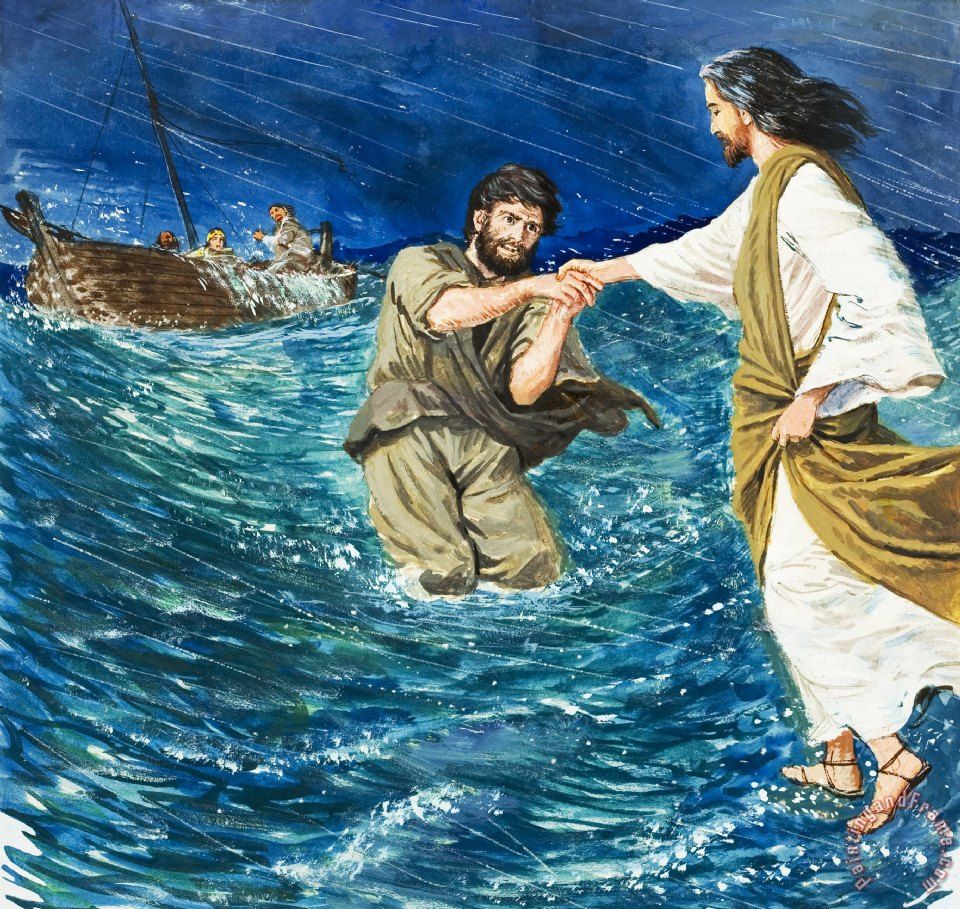
Today, Year A’s Nineteenth Sunday in Ordinary Time, we continue following Jesus and the apostles after the Feeding of the Five Thousand.  Jesus disperses the crowd and sends the apostles off on their boat while he goes up the hillside to pray alone.  The boat encounters a storm, and Jesus heads out to the apostles, walking on the water.  You know the passage.  Peter asks if he could be allowed to walk on the water, and after Jesus acknowledges and Peter does take a few steps, he loses faith and starts to sink.  Jesus then saves him. 

There are a couple of mysterious details in this passage.  Let me bring them out in the form of questions and try to answer them, but rest assured I’m not all that confident in my answers.

Why does Jesus send them off alone to the boat while He goes away from them? 


Prayer is certainly important to Jesus, but the fact He “made them get into a boat” suggests He has orchestrated all the subsequent events.  All details should be filtered with this detail.

Why does He walk on water to go out to them?  Couldn’t He calm the sea and wait for the boat to dock? 


Jesus walking on water is a theophany, a manifestation of His divinity.  He intended to manifest to the apostles.  This appears to be the reason to send them off while He stays back.

Why is the boat on the sea on the fourth watch, which is supposed to be between 3 and 6 AM?  That’s not a particularly safe time to be on water in ancient times. 


It’s obviously overcast and the surroundings would be totally dark.  A natural impulse would be to head back to shore but Jesus wanted them out and so they were obedient.  As Dr. Pitre will explain below, they were fishermen, and so used to going on the sea at night.  Perhaps the bad weather caught them by surprise.

Why did Peter want to walk on the water?


It’s not exactly a natural inclination.  He sees Jesus walking on water, did Peter want to emulate Him?  Was he just looking for a thrill?  Was he trying to show off?  I guess we will never know.


Today’s Gospel:


After he had fed the people, Jesus made the disciples get into a boat

and precede him to the other side,

while he dismissed the crowds.

After doing so, he went up on the mountain by himself to pray.

When it was evening he was there alone.

Meanwhile the boat, already a few miles offshore,

was being tossed about by the waves, for the wind was against it.

During the fourth watch of the night,

he came toward them walking on the sea.

When the disciples saw him walking on the sea they were terrified.

“It is a ghost,” they said, and they cried out in fear.

At once Jesus spoke to them, “Take courage, it is I; do not be afraid.”

Peter said to him in reply,

“Lord, if it is you, command me to come to you on the water.”

He said, “Come.”

Peter got out of the boat and began to walk on the water toward Jesus.

But when he saw how strong the wind was he became frightened;

and, beginning to sink, he cried out, “Lord, save me!”

Immediately Jesus stretched out his hand and caught Peter,

and said to him, “O you of little faith, why did you doubt?”

After they got into the boat, the wind died down.

Those who were in the boat did him homage, saying,

“Truly, you are the Son of God.”

~Mt: 14:22-33


Our old friend, Dr. Brant Pitre, brings out the exegetical main points.


Dr. Pitre:

It's important to recall the setting of this miracle.  It takes place after the famous feeding of the 5,000 in the Gospel of Matthew.  So one of the reasons this is important to highlight is because the same sequence occur in all the Gospels so for example in Matthew and Mark and in John all of those Gospels—three of the four actually—three of the four Gospels have accounts of the walking of Jesus on the water and in all three that that account immediately follows the feeding of the 5,000, so it's like a pair of miracles: Jesus feeds the 5,000 and then he walks on the water, so it's in the wake of him having performing this amazing miracle feeding 5,000 people from five loaves and two fish that Jesus then withdraws and he goes up the mountain to pray right.  So it gets late and then while he is up in the mountain praying the disciples set off across the Sea of Galilee in the boat.  Now a couple elements about the context: where exactly does this take place on the Sea of Galilee?  Well we don't the exact location but we do know the Sea of Galilee to this day is not a very…small lake it's about seven miles wide at its widest point and it was the kind of beating heart of Galilee, and is the place of fishing and industry and disciples knew it well and when they're in their boat [it] is important the first thing you notice is they're not right next to shore; it says there are many furlongs distant from the land now in John's account of this miracle he actually says they're about four miles from the shore.


Also notice the time it's the fourth watch of the night, so this is in the middle of the night sometime between three o'clock and six o'clock in the morning now most of us wouldn't get on a boat and be out in the middle of the night between 3 and 6 a.m.  But for the Apostles they were pretty used to this because as fishermen it was actually customary to fish at night we'll see that in a gospel John that they spend all night fishing and they don't catch anything so they are traveling in the middle of the night and something they're pretty used to.  What they're not used to however is being on the water in the middle of the night in the middle of the lake and seeing a man coming to them walking on the waves of the sea, and that's what Jesus does here in this account, he comes to them walking on the sea.  Now when they experience this their first reaction is fear right and they assume that he's a ghost pretty interesting a point there because it shows us that apparently at least some of the disciples believed in ghosts.


Jesus says something very interesting, he says take heart don't be afraid.  I'll pause there for a second; this is a clue to us that we should characterize this account Jesus walking on the water as a theophany.  A theophany as I've mentioned in other videos is an appearance of God.  It's where God reveals his power and his glory and its presence to his people on earth, and one of the things you'll see over and over again in accounts of theophanies in the Bible is that people are always afraid, like when they see God they're afraid, and God's response to their fear is often to quell it.  Right to say be calm don't be afraid and then to speak to them to give them some message, so in this case Jesus says take heart have no fear and then he says it is I.  Now the Greek, the literal Greek behind that expression which most Bibles render—“it is I”—is “egō eimi,” which literally in Greek means take heart, “I am so,” that's quite the same thing as it is me.  [It] literally just says take heart I now.   On the one hand the expression I am, egō eimi, can be used to identify someone right so if I ask you a question is that you and you say I am it could respond by saying yes it's me.  Right so that can be the sense or the meaning of it, but the literal meaning of the word in context is more than that Jesus isn't just identifying himself; he's also taking the divine name of God.


From the Old Testament and using it as his own, so in other words he's alluding to the most famous theophany in the Bible, the theophany of the appearance of God to Moses on Mount Sinai in the book of Exodus chapter 3.  So in that theophany God comes to Moses and he calls Moses to go to the people of Israel who were slaves in Egypt and to set them free and to bring a message of deliverance, and Moses says well if I go to them whose name shall I give them, what name will I tell them is the name of the God who sent me?  And the Lord says to Moses, “I am Who I am, tell them I am has sent you to them.” Right this is my name for all generations God goes on to say, so the name that the expression, “I am,” is more than just an identification; it's the divine name, so when you take Jesus's use of the term, “I am,” you couple it with the fact that he is walking on water and that he's saying don't be afraid which is standard theophany language from the Old Testament, [all] three things together show to us that Jesus is revealing his divinity.


That’s a pretty clear exegesis.  For the pastoral homily, I’m going to knock you out of your socks with this from Pope Leo XIV.


Pope Leo XIV:

Dear brothers and sisters, happy Sunday. Today's gospel speaks of Jesus approaching his disciples by walking on the waters of the Sea of Galilee in the midst of a storm. Following the miracle of the loaves and fish, the master urges his disciples to get into the boat and set out while he withdraws to the mountain to pray by himself. Once away from the shore, the disciples find themselves at the mercy of the wind and struggle to make headway. After a successful experience in which they had been the protagonists of a miraculous sign, they now find themselves helpless and frightened in the face of the threat of the waves and the headwind. As the night was drawing to a close, Jesus came towards them across the choppy waters, and terrified, they mistook him for a ghost. But he said to them, "Take heart. It is I. Do not be afraid.” The Lord's presence changes everything. Peter even manages to take a few steps across the waves towards him. But then losing his nerve, he begins to sink and Jesus saves him. When the master then steps into the boat, the storm subsides and a profession of faith spontaneously springs out of the disciples hearts.  Truly, you are the son of God. To realize this point, it was not enough for them simply to have witnessed a miracle nor to have succeeded in the eyes of the people. Instead, they had to experience their own weakness and within it recognize God's presence. Only this experience could open their eyes and hearts to his closeness, finding peace even in the midst of the storm. 

Notice the point.  It’s not just witnessing the miracle that changes the apostle’s hearts.  It’s the fear and anxiety they experience that changes them.  They had to experience the terror for their souls to find peace.

Pope Leo XIV:

Sometime later, Jesus would say to them, "If you have faith and do not doubt, if you say to this mountain, be lifted up and thrown into the sea, it will be done." This is similar to what they experienced on the lake. The peace of Christ who had been on the mountain praying reached them in the midst of the raging waters. This miracle then teaches us something important. First, not to get carried away by success and never to be presumptuous. At the same time, not to despair even in moments of darkness when we feel powerless in the face of problems. And despite our efforts, it seems as though we are going backwards rather than forwards. Whatever the circumstances, Jesus does not abandon us. And if we humbly welcome him into the boat of our lives through prayer, the sacraments, and listening to his word, in him we will find peace, light, and strength for our journey. May who is proclaimed blessed for her faith, help us to live in a trusting surrender to God.

Ultimately what I think Pope Leo is getting at is that there is a relationship between faith and hope.  The apostles had a momentary shaking of faith; Peter walking on the water loses faith and begins to drown.  What does he do?  He calls out to Jesus.  The calling is an act of hope.  The apostles did not despair.  One may have a shaking of one’s faith from the tumultuous events in our lives—and that is natural—but keeping hope in Jesus is the key to salvation.


Sunday Meditation: But when he saw how strong the wind was he became frightened; and, beginning to sink, he cried out, “Lord, save me!”


What hymn could be better for this reading than “Take My Hand, Precious Lord,”  Words: Thomas A. Dorsey, 1932.  I played this three years ago for this reading, and I will never miss an opportunity to play my most beloved hymn.  And I absolutely love this version by a not so well known jazz singer named Jimmy Scott.


Precious Lord, take my hand,

Lead me on, let me stand,

I am tired, I am weak, I am worn;

Through the storm, through the night,

Lead me on to the light:


Refrain

Take my hand, precious Lord,

Lead me home.


When my way grows drear,

Precious Lord, linger near,

When my life is almost gone,

Hear my cry, hear my call,

Hold my hand lest I fall:


Refrain


When the darkness appears

And the night draws near,

And the day is past and gone,

At the river I stand,

Guide my feet, hold my hand:


Refrain


I want this song and this version played at my funeral.  I said this on YouTube comments for this song: “I think Jimmy Scott's rendition of this beautiful hymn is my all time favorite.  There is such suffering in his voice.  It feels so honest.” 

Sunday, August 2, 2026

Sunday Meditation: Splagchnizomai

For the Eighteenth Sunday of Ordinary Time, Year A, we have concluded Matthew’s Discourse of the Parables, and now we continue on with Jesus’s Galilean ministry.  Today we are presented with Matthew’s version of the Feeding of the Five Thousand.  This passage has a lot more depth than a simple miracle that Jesus performs.  The homilies I will embed go into them in depth but let me point out a few details and thoughts that are either too briefly touched on or not touched on at all.

As we see, Jesus’ multiplication of the loaves alludes to a number of other feasts, both before Jesus on that deserted hill or after.  Let me just numerically list a few.  I don’t think this is comprehensive but it’s probably more than pointed out in any homily.


1.     The offering of bread and wine by Melchizedek upon Abraham’s victory following the Battle of Siddim.

2.     The manna in the desert during the Exodus.

3.     All the Jewish feasts of the Old Testament: Passover, Unleavened Bread, First Fruits, Rosh Hashanah, Pentecost, Atonement, Sukkot.

4.     Elijah’s miracle of the unending supply of flour and oil for the widow of Zarephath.

5.     The banquet of Herod where he decapitates John the Baptist.  (Notice that this precedes Jesus’s feeding in Matthew’s Gospel and is in stark contrast.  Herod’s is the banquet leading to death, Jesus’s leading to life.

6.     The Wedding Feast at Cana.

7.     The Last Supper and the Institution of the Eucharist.

8.     The heavenly Marriage of the Supper of the Lamb in Revelations 19.

9.     The Eschatological Banquet, prophesied in Isaiah 25:6-8, and described in Luke 14 (Parable of the Great Banquet), Matthew 22 (the Parable of the Marriage Feast), and elsewhere.

We can see the connections of Jesus’s feeding as it echoes across the scriptures.  You will hear both homilists today connect this passage with compassion, and I don’t think that can be emphasized enough.  Jesus is moved in His Sacred Heart to pity.  Consider, He has just heard the news of His cousin’s death.  He goes away to meditate and pray.  The first thing He does when He sees the multitude is have pity.  He heals, and then He wants to feed them.


Today’s Gospel:


When Jesus heard of the death of John the Baptist,

he withdrew in a boat to a deserted place by himself.

The crowds heard of this and followed him on foot from their towns.

When he disembarked and saw the vast crowd,

his heart was moved with pity for them, and he cured their sick.

When it was evening, the disciples approached him and said,

“This is a deserted place and it is already late;

dismiss the crowds so that they can go to the villages

and buy food for themselves.”

Jesus said to them, “There is no need for them to go away;

give them some food yourselves.”

But they said to him,

“Five loaves and two fish are all we have here.”

Then he said, “Bring them here to me,”

and he ordered the crowds to sit down on the grass.

Taking the five loaves and the two fish, and looking up to heaven,

he said the blessing, broke the loaves,

and gave them to the disciples,

who in turn gave them to the crowds.

They all ate and were satisfied,

and they picked up the fragments left over—

twelve wicker baskets full.

Those who ate were about five thousand men,

not counting women and children.

~Mt: 14:13-21


Both homilies today could serve as both exegetical and pastoral homilies.  I wasn’t sure which I should put in which slot, but I go with that of Archbishop of Detroit, Edward J. Weisenburger for the exegetical.


Archbishop Weisenburger:

Brothers and sisters, this is Archbishop Weisenburger, and this weekend is the 18th Sunday in Ordinary Time. And our Gospel passage is the miracle of the multiplication of loaves and fishes. You may not know it, but it's the only miracle in all four gospels.  That's how intensely embedded it was in the minds and hearts of the faithful.   Now, to break open the inner meaning of this text, my remarks today are in two parts, which are simply: the context then and the context now.  First, the context then. The Gospel says that Jesus had just learned of the beheading of St. John the Baptist, which was no doubt a great blow to him.  He likewise was exhausted and trying to escape the crowds for a little rest and renewal. And even though it's late in the day, the crowds follow him. His disciples note that due to the late hour and the fact the crowds are hungry and without food, they urge Jesus to just send them away.  But instead, as we all know the story, Jesus multiplies those loaves and fishes, more like little crackers and some sardines for a child's lunch. And with what little he has, she creates a banquet. But please stop to think, the beheading of John the Baptist also took place at a banquet, Herod's banquet. The "feeding of the 5000" is meant to be seen in stark contrast to the banquet of Herod. Herod's feast was a celebration of arrogance, conspiracy, and murder.  Jesus' banquet was a celebration of healing, faithful obedience, and caring for others through the sharing of food and compassion. Moreover, Jesus' banquet is foreshadowing of the Eucharistic banquet. In  this way, it reveals that the celebration of   the Mass is always meant to be a countercultural sign of the Kingdom of God dawning in our midst.


Okay, that was the context then. But the words  from today's Gospel that haunt me are Jesus' rebuke to his own followers who want to send the hungry, weary crowds away. It's Jesus line, "No, you give them something to eat!"  It's that line that gets me every time…. Brothers and sisters, I would be the first to tell you, yes, the Church needs your financial commitment. I'm  not against anyone's support. But what both Jesus and a crotchety, but perhaps holy priest teach us is that there's something sacred, something life-changing, something humanizing, and something that helps fashion us into the divine when we encounter in a direct, immediate way our Christ in the poor.  No one in the end really can do it for me.  And in the end, you really shouldn't try   to do it for anyone else. It's a redemptive experience, an experience each of us needs, and an experience that can make all the difference in our own faith journey.

The ellipsis leaves off the story the Archbishop tells about the retired priest who feeds the homeless.  It would make the quote too long, but make sure you listen to it.  Feeding the hungry in person instead of just writing a check is a “redemptive experience” each of us needs.

Here is another new find as a homilist, this time from The Catholic University of the Philippines, the University of Santo Tomas run by friars of the Dominican Order.  Here is Fr. Christian Dale Dakila offering an insightful homily.


Fr. Christian:

One of the most beautiful lines in today's gospel is not the multiplication of the loaves. It is not even the miracle itself. The most beautiful line comes before the miracle. When Jesus disembarked and saw the vast crowd, his heart was moved with pity for them.  Before Jesus fed the crowd, he first saw them. Before he performed a miracle, he first noticed their suffering. Before he gave them bread, he first gave them attention.  The miracle of the loaves began not with power but with compassion.  The gospel tells us that Jesus had withdrawn to a deserted place. He himself was grieving the death of John the Baptist. He wanted solitude and silence. Yet when he saw the people, he did not see an interruption.  He saw wounded sheep longing for a shepherd. His heart was moved with pity.  Splagchnizomai (σπλαγχνίζομαι).  The original gospel word speaks of a compassion so deep that it comes from the very depths of one's being. It was literally moved to the gut.  And it is not simply feeling sorry for someone but it is allowing another person's pain to enter your own heart and perhaps that is what many people hunger for today. Not only bread or only money but only success. Many people are hungry for someone who will truly listen. 

Splagchnizomai is a movement of compassion inside the very core of our beings.  Today We might consider Splagchnizomai as being in the Sacred Heart of Jesus.  But you can see that the Gospel is referring to more than just a simple pity.

Fr. Christian:

The hunger of the human heart is deeper than physical hunger. This is why today's gospel remains relevant. The crowd was hungry for bread. But before Jesus multiplied the loaves, he spent the day healing them, teaching them, and accompanying them. He listened to their deeds, to their pain, to their hopes. The miracle started because Jesus paid attention.  Brothers and sisters, listening is becoming a lost art. Today we have more ways of communicating than ever before. Yet many people feel more unheard than ever before. We send messages instantly.  We can contact anyone in seconds. We can speak to thousands through social media. Yet many cannot find one person willing to listen deeply. Sometimes we are physically present but emotionally absent. We hear words but do not hear hearts.  We listen only long enough to prepare our reply. But Jesus teaches us another way. The Lord listens first and he acts. Perhaps this is why he tells his disciples something surprising.  The disciples say, "Send them away." Jesus says, "Give them some food yourselves." The disciples only see the problem.  Jesus sees the possibility. The disciples see scarcity. Jesus sees generosity.  The disciples count five loaves and two fish. Jesus counts willing hearts. And perhaps that command remains for us today. Give them some food yourselves.  Feed those who are hungry, lonely, grieving, confused. Feed those who are losing hope. And sometimes the first food we can offer is not advice. It is our listening. Sometimes people do not need answers, they need presence.

It’s not just physical hunger we are called to heal.  Listening is a form of care taking, especially for those lonely, those grieving, and those losing hope.  Lord, make me an instrument of your peace; where there is despair, let me bring hope.


Sunday Meditation: When he disembarked and saw the vast crowd,

his heart was moved with pity for them, and he cured their sick.


I love this hymn, “Come to the Water.” 


O let all who thirst,

 let them come to the water.

 And let all who have nothing,

 let them come to the Lord:

 without money, without price.

 Why should you pay the price,

 except for the Lord?


 And let all who seek,

 let them come to the water.

 And let all who have nothing,

 let them come to the Lord:

 without money, without strife.

 Why should you spend your life,

 except for the Lord?


Let all who have nothing, let them come to the Lord, without price.