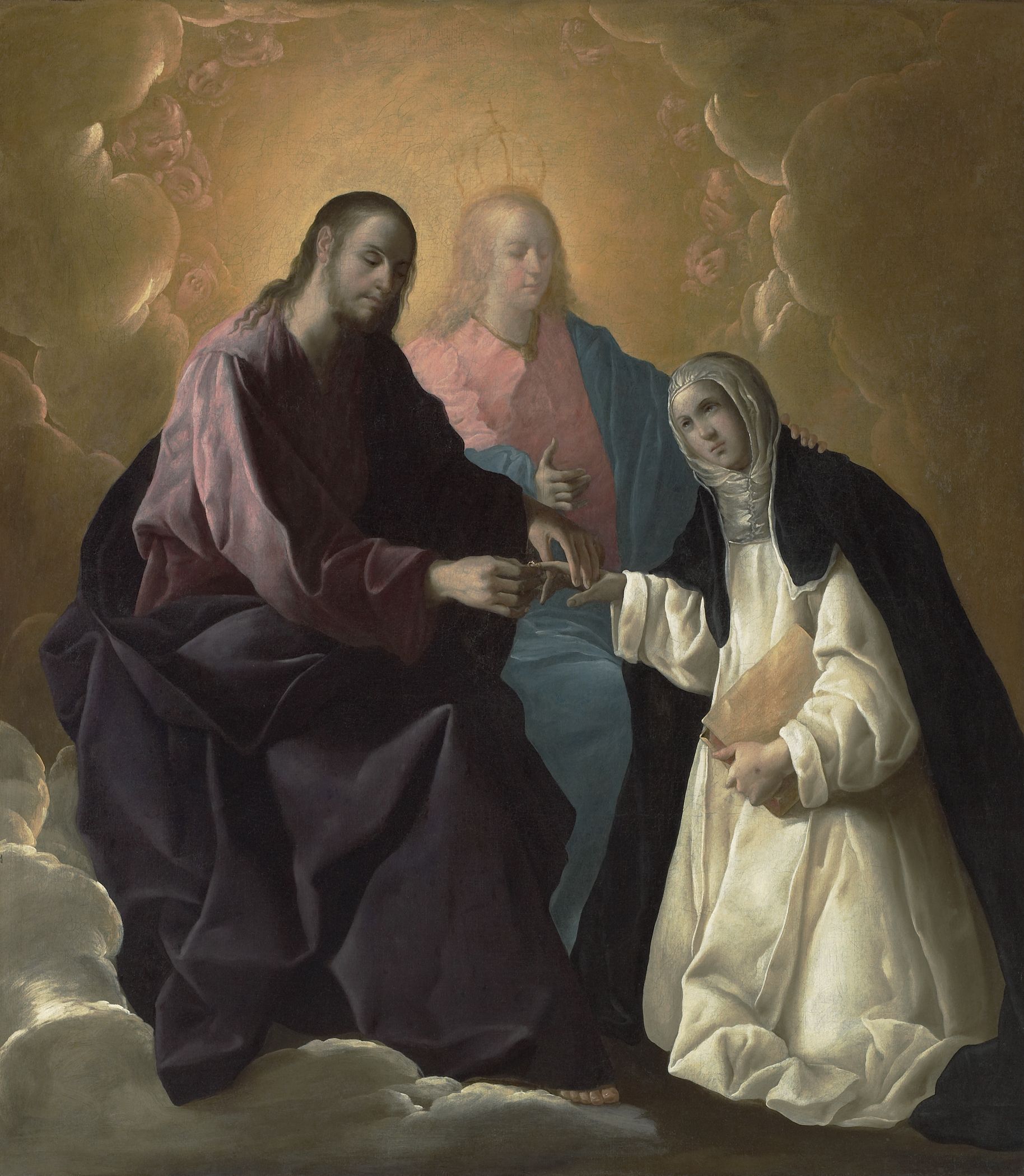
Today, April 29th, is the feast day of St. Catherine of Siena, patron saint of this blog and my personal patron, as many of you know. In honor of this day I want to go through one of her letters, a letter to Giovanna d’Angiò, also known as Joanna I of Naples, the queen of Naples in Catherine’s day. This letter is remarkable for several reasons, which I’ll get to.

First
some context. Suzanne Noffke in her
editing of The Letters of Catherine of
Siena provides this biographical note about Queen Joanna:
GIOVANNA D’ANGIÒ (Jeanne
d’Angou): Letters T133, T138, T143, T312, T317, T348, T362.
Great-granddaughter of Charles Martel, she became queen of Naples in 1333, when she was only seven. She was licentious, violent, and fickle, an opportunist of the first degree. It was she who had sold Avignon (which she owned as Countess of Provence) to the pope for a nominal sum in 1347 after convincing him of her innocence in the murder of her husband, Andrew of Hungary. She ruled over the liveliest and most splendid court in the peninsula, and eventually sided with the Clementine cause in the schism of 1378. Urban VI excommunicated her in 1380 and enthroned Charles of Durazzo in her place. (p. 540, The Letters of Catherine of Siena, Vol 1, 2000)
The “T133, etc” are a numbering scheme of Catherine’s letters, and it shows that Catherine sent seven letters in all to Joanna in her life. We also see that Joanna was a very worldly woman, experienced in court intrigue going back to her childhood. She came from a long lineage of famous aristocracy, and was a very powerful woman who had to kill off a husband in order to retain power. She herself would later be murdered as well. The letter we are going to examine is T143, and despite the numbering sequence, this is the second letter to Joanna. The first letter was to ask Joanna to contribute to a crusade that Pope Gregory XI was trying to organize.
There are six paragraphs to the letter after the heading and introduction, and I’ll number them at the beginning for clarity. The letter was written on the fourth of August in 1375, before Catherine’s trip to Avignon to convince the Pope to move back the papal court to Rome. Since her first letter, it seems from the language that Joanna has written back to Catherine. The letter is also taken from Suzanne Noffke’s The Letters of Catherine of Siena, Volume 1.
To Giovanna d’Angiò,
Queen of Naples
4 August 1375
In the name of Jesus
Christ Crucified and of gentle Mary
Honorable and dearest
mother, milady the queen,
(1) Your unworthy servant and the slave of Christ’s servants is writing to you in the precious blood of God’s Son. I long to see you a true daughter and spouse consecrated to our dear God. You are called daughter by First Truth because we were created by God and came forth from him. This is what he said: “Let us make humankind in our image and likeness.” And his creature was made his spouse when God assumed our human nature. Oh Jesus, gentlest love, as a sign that you had espoused us you gave us the ring of your most holy and tender flesh at the time of your holy circumcision on the eighth day. You know my reverend mother, that on the eighth just enough flesh was taken from him to make a circlet of a ring. To give us a sure hope of payment in full he began by paying this pledge. And we received the full payment on the wood of the most holy cross, when this Bridegroom, the spotless Lamb, poured out his blood freely from every member and with it washed away the filth and sin of humankind his spouse.
We see in the first paragraph Catherine’s humble diminution of herself, “servant” and “slave”and taking on Christ’s mantle by writing in His “precious blood.” The blood imagery is of paramount importance to Catherine, and we’ll see it in the body of this letter. Now here’s one of the amazing things of this letter. Catherine was a twenty-eight year old uneducated woman of no title, and yet she tells the queen “I long to see you a true daughter and spouse consecrated to our dear God.” Who is Catherine to tell the queen she wants to see her in any manner at all? We will see this sort of chutzpah throughout the letter.
Now
the italic writing is Noffke’s way of showing Catherine’s spontaneous breaking
from addressing the letter’s recipient to addressing Christ in prayer. “Oh Jesus, gentlest love, as a sign that you
had espoused us you gave us the ring of your most holy and tender flesh at the
time of your holy circumcision on the eighth day.” Now here we get the second remarkable thing
of this letter, Catherine’s imagery of ring when envisioning the snipped off
flesh of Christ’s circumcision, when “on the eighth just enough flesh was taken
from him to make a circlet of a ring.”
And then she calls this flesh and loss of blood an initial payment for
the final payment of blood He will make on the cross. Isn’t that unbelievably creative, to see that
particular piece of flesh as a ring? Catherine
had poet’s eye for imagery and it spills over in all her writing. Let’s continue with the letter.
(2) Notice that the fire of divine charity gave us a ring not of gold but of his own purest flesh. This gentlest of fathers celebrated his wedding with us in a feast not of animal flesh but of his own precious body. This food is Lamb, roasted over the fire of charity on a wood of the sweet cross. So I beg you most courteously in Christ Jesus to lift up your heart and soul with all your affection, energy, and caring, to love and serve so gentle and dear a Father and Spouse as God, high eternal Truth, who tenderly loved us without being loved.
Here
she continued with the ring imagery, the wedding imagery, the crucified Christ
imagery, and her exhortation for the queen to be holy.
(3) Let no one then, nor any status or grandeur, any power or other human glory (all of which are empty and vanish like the wind) lure us away from this true love, our soul’s life and glory and happiness. So will we show that we are faithful spouses. And when we love no one other than our Creator and desire nothing apart from him, then everything we love and everything we do is for him. Whatever we see to be outside his will—vice and sin, all injustice and every other wrong—we hate so much that, because of the holy hatred we have conceived against sin, we would sooner die than break faith with our eternal Spouse. Let us, oh let us be faithful, following in the footsteps of Christ crucified, scorning vice and embracing virtue, undertaking and accomplishing for him every great deed!
Now
here’s the third remarkable moment in the letter, telling the queen not to seek
status, grandeur, power, or glory! This
is Queen Giovanna d’Angiò she is writing to.
Catherine may not know the queen’s full history, but she must know the
queen has a reputation of seeking power.
Or perhaps not. Now here’s
another bit of irony, telling this queen they should be “faithful spouses” of
Christ. Giovanna will be married four
times and one of her husbands she had killed off.
(4) I want you to know, my reverend lady, that my soul is jubilantly happy after receiving your letter. It gave me great consolation because, it seems to me, you have a holy and wholesome readiness to give both your possessions and your life for the glory of the name of Christ crucified. You can show no greater sacrifice or love than to be ready to give even your life, if necessary, for him. Oh what a great joy it will be to see you giving blood for blood! May I see the fire of holy desire so growing in you at the resemblance of the blood of God’s Son that you may be leader and patroness of this holy crusade just as you bear the title of the queen of Jerusalem. Thus the holy place will no longer be held by these evil unbelievers but honorably possessed by Christians, and by you as something of your own.
Now
in the fourth paragraph Catherine finally gets to the point of the letter. She is responding with gratitude in what
seems the queen’s letter back from Catherine’s request to contribute to the
crusade was in the affirmative. And then
Catherine prays that the queen will be the leader of the crusade to take back
what she thinks is Joanna’s rightful title of Queen of Jerusalem. Now she cannot be alluding to Joanna as
another Joan of Arc, who was not born for another 37 years. But it does seem to give imagery of Joanna off
to battle in a suit of armor. I’ll just
provide the last two paragraghs:
(5) I want you to know
that the holy father wants this very badly.
So I would like you to show your good will (which the Holy Spirit has
put into your soul) by sending him word of it to even further increase his
desire. I would like you to ask to make
this holy crusade—you in particular, and all the other Christians who might
want to join you. For it would stand up
and declare your willingness to do this, and if you put your holy resolution
into action, you will find Christians very willing to follow you. I beg you for love of Christ crucified to be
zealous about this. And I, as far as my
weakness allows me, shall pray God’s supreme eternal goodness to give you clear
guidance in this and all your good works, and to increase in you desire upon
desire.
(6) Ablaze with the fire
of love may you go forward from your reign in this poor fleeting life to that
eternal city of Jerusalem, the vision of peace, where divine mercy will make us
all kings and queens, lords and ladies.
There he who in his tender love helps us carry every load will himself
reward our every effort.
Keep living in God’s holy love.
Jesus! Jesus! Jesus!
Done on the fourth day of August.
I love the passion of Catherine’s exhortations. Unlike the queen she has a simple innocence. The future letter will not have Catherine speaking so reverently to the queen. In 1378 the Church experienced the Great Western Schism, and Catherine and the Queen fell on opposite sides of the issue. Indeed, Queen Joanna would be excommunicated for her support of the schismatic pope. Catherine would not be pleased with the queen. I wrote about this later interaction when I discussed Catherine's biography.
I
pray that all who read this receive God’s blessing on St. Catherine’s feast
day.