"Love follows knowledge."
"Beauty above all beauty!"
– St. Catherine of Siena

Showing posts with label Naturalism. Show all posts

Tuesday, January 27, 2026

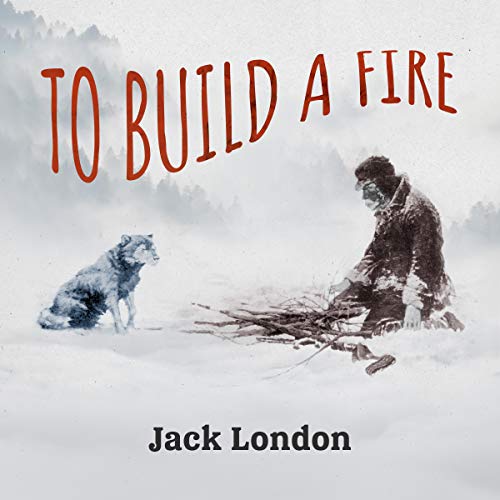
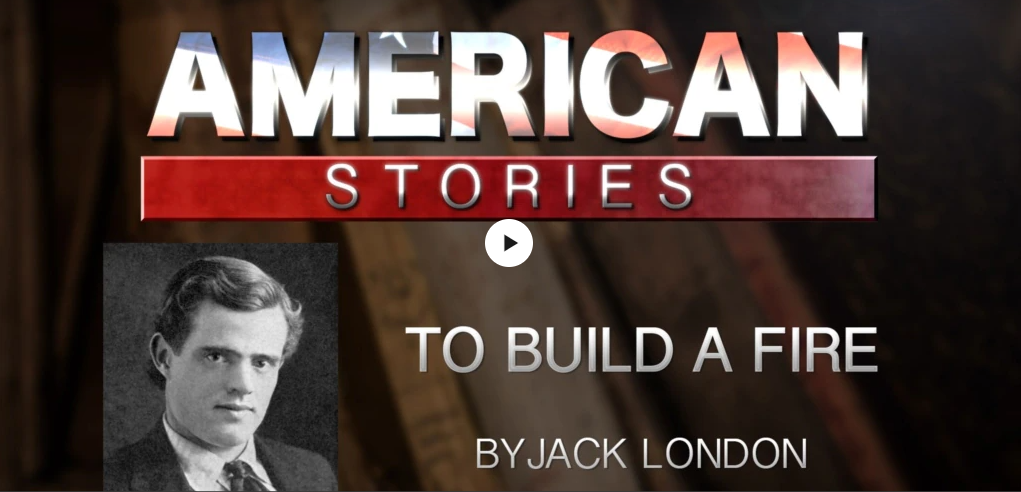
Short Story Analysis: “To Build a Fire” by Jack London, Part 2

This is the second of two posts on my analysis of Jack London’s short story, “To Build a Fire.”

You can find Post #1 here. 

Post #1 introduced the story and analyzed the first three of six parts of the story.  This post will analyze the las three parts and conclude the analysis.


Part 4:

Another critical event happens, the bulk of snow on the tree above the fire, loosened by the heat, fell onto the fire snuffing it out (289).  The man with frozen, uncooperative fingers attempts and fails repeatedly to build another (292).

The collapse of the snow from the tree is beautifully described.


But before he could cut the strings, it happened. It was his own fault or, rather, his mistake. He should not have built the fire under the spruce tree. He should have built it in the open. But it had been easier to pull the twigs from the brush and drop them directly on the fire. Now the tree under which he had done this carried a weight of snow on its boughs. No wind had blown for weeks, and each bough was fully freighted. Each time he had pulled a twig he had communicated a slight agitation to the tree--an imperceptible agitation, so far as he was concerned, but an agitation sufficient to bring about the disaster. High up in the tree one bough capsized its load of snow. This fell on the boughs beneath, capsizing them. This process continued, spreading out and involving the whole tree. It grew like an avalanche, and it descended without warning upon the man and the fire, and the fire was blotted out! Where it had burned was a mantle of fresh and disordered snow.  (289)

Notice the repetition of “it happened” with the “it happened” when his feet broke through the ice (287), the first critical event of the story.  The repetition provides a nice rhythm to the narrative.  Also I’m struck to the use of the passive voice.  Even though it both instances, the man makes a mistake of discernment, the events are framed as an act done to him.  This gives agency to the strength and power of nature against his feeble human capabilities.

The writing between the snuffing out of the fire and the failure to build another description interspersed with the man’s panic, regret and the awareness of his freezing and burning flesh is a masterpiece of narrative.  Here’s one paragraph.


The old-timer on Sulphur Creek was right, he thought in the moment of controlled despair that ensued: after fifty below, a man should travel with a partner. He beat his hands, but failed in exciting any sensation. Suddenly he bared both hands, removing the mittens with his teeth. He caught the whole bunch between the heels of his hands. His arm-muscles not being frozen enabled him to press the hand-heels tightly against the matches. Then he scratched the bunch along his leg. It flared into flame, seventy sulphur matches at once! There was no wind to blow them out. He kept his head to one side to escape the strangling fumes, and held the blazing bunch to the birch-bark. As he so held it, he became aware of sensation in his hand. His flesh was burning. He could smell it. Deep down below the surface he could feel it. The sensation developed into pain that grew acute. And still he endured it, holding the flame of the matches clumsily to the bark that would not light readily because his own burning hands were in the way, absorbing most of the flame. (291)

After several attempts at building the fire, he reaches a point of resignation.


A large piece of green moss fell squarely on the little fire. He tried to poke it out with his fingers, but his shivering frame made him poke too far, and he disrupted the nucleus of the little fire, the burning grasses and tiny twigs separating and scattering. He tried to poke them together again, but in spite of the tenseness of the effort, his shivering got away with him, and the twigs were hopelessly scattered. Each twig gushed a puff of smoke and went out. The fire-provider had failed. (292)


###

Part 5:

Having resigned to not having the ability to start another fire, the thought of killing the dog and using its cavity body heat to warm his hands comes to him (292).  After finally catching the dog, the man’s hands were too frozen to kill the dog as well (293).

This paragraph captures his failure and the state of his physical condition at that moment.

But it was all he could do, hold its body encircled in his arms and sit there. He realized that he could not kill the dog. There was no way to do it. With his helpless hands he could neither draw nor hold his sheath-knife nor throttle the animal. He released it, and it plunged wildly away, with tail between its legs, and still snarling. It halted forty feet away and surveyed him curiously, with ears sharply pricked forward. The man looked down at his hands in order to locate them, and found them hanging on the ends of his arms. It struck him as curious that one should have to use his eyes in order to find out where his hands were. He began threshing his arms back and forth, beating the mittened hands against his sides. He did this for five minutes, violently, and his heart pumped enough blood up to the surface to put a stop to his shivering. But no sensation was aroused in the hands. He had an impression that they hung like weights on the ends of his arms, but when he tried to run the impression down, he could not find it.  (293)

Nature has overwhelmed just about all his physical capabilities.  I am particularly struck by that image of not knowing where his numbed, frozen hands are.  I wonder if that is something that really happens in such a situation or it’s something London imagined.  Obviously he couldn’t have personally experienced that.


###

Part 6:

The man has reached a panic state and all he can now do is run toward the camp in hopes he can reach it before he dies (293).  Throughout his mind experiences delusions until he finally collapses and dies.  (295)

It is with the failure to start a fire and to kill the dog that the reality of his death becomes firm.  He has exhausted all options and panic ensues.


A certain fear of death, dull and oppressive, came to him. This fear quickly became poignant as he realized that it was no longer a mere matter of freezing his fingers and toes, or of losing his hands and feet, but that it was a matter of life and death with the chances against him. This threw him into a panic, and he turned and ran up the creek-bed along the old, dim trail. The dog joined in behind and kept up with him. He ran blindly, without intention, in fear such as he had never known in his life. Slowly, as he ploughed and floundered through the snow, he began to see things again--the banks of the creek, the old timber-jams, the leafless aspens, and the sky. The running made him feel better. He did not shiver. Maybe, if he ran on, his feet would thaw out; and, anyway, if he ran far enough, he would reach camp and the boys. Without doubt he would lose some fingers and toes and some of his face; but the boys would take care of him, and save the rest of him when he got there. And at the same time there was another thought in his mind that said he would never get to the camp and the boys; that it was too many miles away, that the freezing had too great a start on him, and that he would soon be stiff and dead. This thought he kept in the background and refused to consider. Sometimes it pushed itself forward and demanded to be heard, but he thrust it back and strove to think of other things. (293)

You can the contemplatio of weighing the possibilities running through his head.  A reader can only feel some real pity for him. 

Finally  the man reaches his demise in the concluding paragraph of the story.


Then the man drowsed off into what seemed to him the most comfortable and satisfying sleep he had ever known. The dog sat facing him and waiting. The brief day drew to a close in a long, slow twilight. There were no signs of a fire to be made, and, besides, never in the dog's experience had it known a man to sit like that in the snow and make no fire. As the twilight drew on, its eager yearning for the fire mastered it, and with a great lifting and shifting of forefeet, it whined softly, then flattened its ears down in anticipation of being chidden by the man. But the man remained silent. Later, the dog whined loudly. And still later it crept close to the man and caught the scent of death. This made the animal bristle and back away. A little longer it delayed, howling under the stars that leaped and danced and shone brightly in the cold sky. Then it turned and trotted up the trail in the direction of the camp it knew, where were the other food-providers and fire-providers.  (295)

As in most great short stories, the conclusion has been projected all along, though wrapped in the air of uncertainty, but when it does come it comes abruptly.  Even the finality of his death remains in uncertain tension in that last paragraph until the dog confirms it with his sniff.  What a powerful story.

There was a short film dramatizing “To Build A Fire” which is worth watching.  It’s mostly faithful to the story, and after having read it I think watching the film will enhance your experience.  Here it is.


Which is more powerful, the story or the film?  I always go with the story but that film was well done.

###

The theme of the story is the overwhelming power of nature against the small physicality of humanity.  We see man’s limitations lead to his demise.  The man was incapable of seeing how thick was the ice, and that led to his feet cracking through and getting wet.  The overwhelming power of the cold would incapacitate his hands to function.  He could not build a fire once his hands were frozen. 

We also see the man contrasted against the dog, who’s instincts are better suited to survive.  The dog is in his indigenous climate.  The man is alien to the place.  The dog survives; the man doesn’t.

We also see the man’s hubris leads to his demise.  The man’s sense of pride—he doesn’t need a companion in this climate, and he thinks those that do as “womanish”—is contrasted against the dog’s humility.  The dog realizes the danger and attaches himself to the means of survival.  The man, despite his inexperience—a chechaquo (283)—sets out on such a trek alone and did not take the Old-Timer’s advice.  When he builds the first fire, he has a moment of exalted pride.  The nature snuffs the fire out almost in retaliation to such pride.

Pride leading to a downfall is a classic trope of tragedy.  In tragedy the audience—the reader in this case—has pity for the suffering protagonist and fear that what happens to him could happen to the reader.  Aristotle says in his Poetics that the aim of the writer of tragedy is to instill pity and fear for the purposes of catharsis.  I certainly have pity for the man, and I certainly feel fear for the situation, but I’m not sure I have reached catharsis.  Catharsis is supposed to release emotions in the audience, leaving the audience with a sense of relief or enlightenment.  I suppose I am enlightened, but I am not sure I am relieved.  The man ultimately died and we wish it otherwise.


Thursday, January 22, 2026

Short Story Analysis: “To Build a Fire” by Jack London, Part 1

This is the first of two posts on my analysis of Jack London’s short story, “To Build a Fire.”


The first thing to realize about this story is that there are two versions, one London wrote in 1902 and one in 1908.  They are significantly different though the premises of the stories are the same.  I had read the 1902 version of “To Build a Fire” and never thought much of it. I could not understand how it could be so famous. I just had an opportunity to revisit the story.  It was the 1908 version and it was great. This I can see being a great story.  It is incredibly tense. 

Jack London is best remembered as the author of The Call of the Wild, a novel set in the arctic Yukon from the point of view of a house dog who finds himself lost in the arctic and reverts to his wild instincts.  He also wrote another novel, almost equally as good, called White Fang, a novel from the point of view of a wild arctic wolfdog that gets domesticated.  I loved both novels and recommend them both.  Jack London lived only to 40 years old (1876-1916) and was an adventurist, journalist, and writer.  He used the experiences from his adventures to form most of his fiction.  If you want to compare London with various writers, I would say good analogues would be Stephan Crane and Ernest Hemingway.  London’s writing can be categorized as Naturalism, a literary movement in the late 19th century that sought to view humanity as mere animal and nature as deterministic, overwhelming, and confining.  In that sense, Stephan Crane might be a closer analogy than Hemingway, though there is some of that in Hemingway as well.  Whether you agree with the philosophy or not, it makes for great outdoor adventure stories.

“To Build a Fire” is also set in the Yukon north, but this 1908 story is told from the point of view of an unnamed human, male narrator.  [The 1902 version, the point of view is also from a male character, Tom Vincent, who needs to build a fire to stay alive in the Yukon but in that version that character calmly builds the fire and survives.  There is no dog in the 1902 version and is about one-third the length of the 1908 version.]  The narrative is one direct arc from setting off on the Yukon trail to meet up with his friends in a camp to ultimately * SPOILER * collapsing and freezing to death.  For the purpose of analysis, I divide the story into six parts.  I will walk you through the six parts.

First though, if you wish to read the story, you can find it online at American Literature.Com.  There are a number of audio reads on YouTube of “To Build a Fire” but frankly the best read is from a Substack called Classics Read Aloud.  Ruby Love, the owner of the Substack is a fantastic reader.  In my analysis, I will be citing from the Short Stories of Jack London: Authorized One Volume Edition, Edited by Earle Labor, Robert C. Leitz III, Milo Shepherd; Macmillan Publishing Company, New York, 1991. 


###

Part 1:

The man sets off on the Yukon trail to meet up with his friends who are at camp some ten miles away (p. 282) and concludes at twelve noon when the man comes to a fork in the road (p. 286).  It is cold, colder than what the man understands, and though he is conscious of the danger ignores it.  Here is the opening paragraph that speaks to the strangeness of the environment.


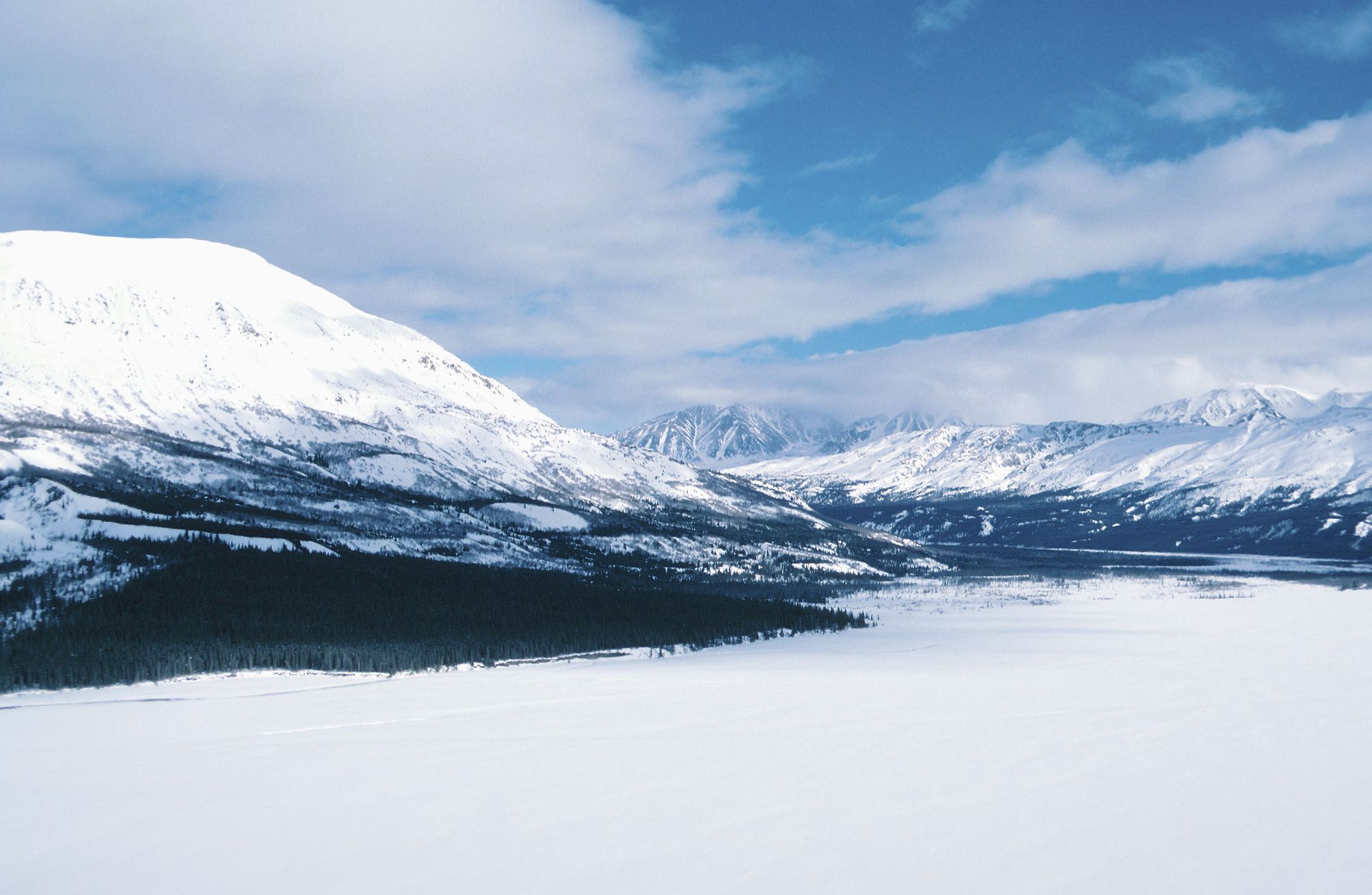
Day had broken cold and grey, exceedingly cold and grey, when the man turned aside from the main Yukon trail and climbed the high earth- bank, where a dim and little-travelled trail led eastward through the fat spruce timberland. It was a steep bank, and he paused for breath at the top, excusing the act to himself by looking at his watch. It was nine o'clock. There was no sun nor hint of sun, though there was not a cloud in the sky. It was a clear day, and yet there seemed an intangible pall over the face of things, a subtle gloom that made the day dark, and that was due to the absence of sun. This fact did not worry the man. He was used to the lack of sun. It had been days since he had seen the sun, and he knew that a few more days must pass before that cheerful orb, due south, would just peep above the sky- line and dip immediately from view.  (282)

Following the man is a dog who’s instinct understood the danger better than the man.


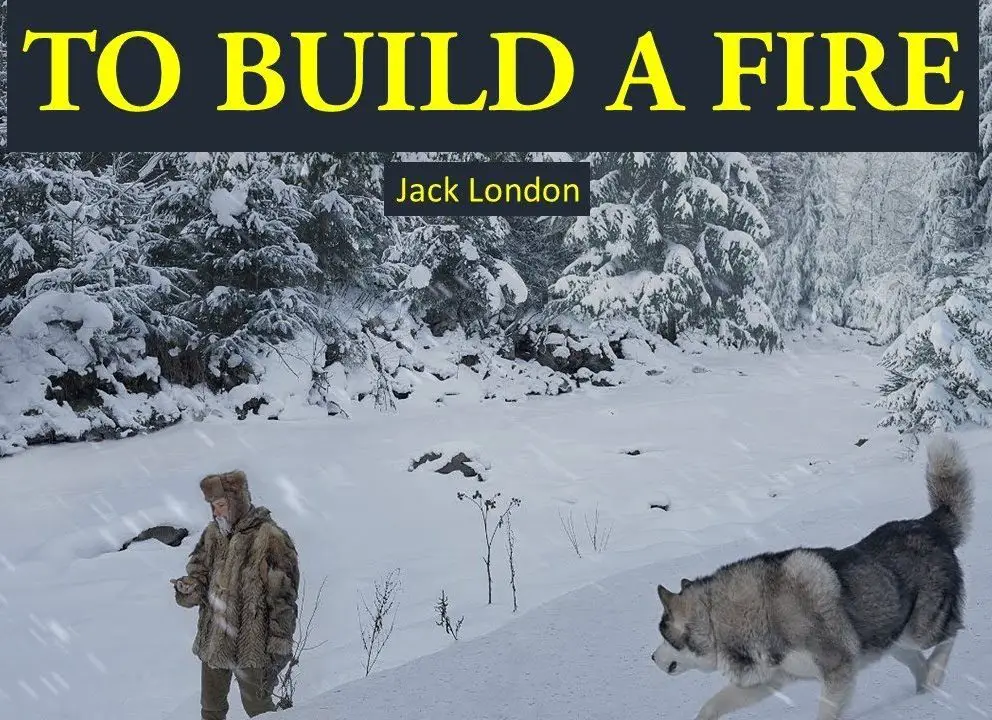
At the man's heels trotted a dog, a big native husky, the proper wolf-dog, grey-coated and without any visible or temperamental difference from its brother, the wild wolf. The animal was depressed by the tremendous cold. It knew that it was no time for travelling. Its instinct told it a truer tale than was told to the man by the man's judgment. In reality, it was not merely colder than fifty below zero; it was colder than sixty below, than seventy below. It was seventy-five below zero. Since the freezing-point is thirty-two above zero, it meant that one hundred and seven degrees of frost obtained. The dog did not know anything about thermometers. Possibly in its brain there was no sharp consciousness of a condition of very cold such as was in the man's brain. But the brute had its instinct. It experienced a vague but menacing apprehension that subdued it and made it slink along at the man's heels, and that made it question eagerly every unwonted movement of the man as if expecting him to go into camp or to seek shelter somewhere and build a fire. The dog had learned fire, and it wanted fire, or else to burrow under the snow and cuddle its warmth away from the air. (283-4)

Here we see just how cold it is—beyond the man’s imagination—but instinctually the dog understands it.  What author is suggesting is the power of nature to overwhelm human capability to withstand it, and that man’s loss of instinct is a danger to himself.  The wild dog understands it because of his instinct.

Part of the trail the man is on runs along a frozen creek bed, and while the creek is frozen there are unfrozen spots that pose danger if one breaks through the ice and gets wet.  Wetness in this environment means instant freeze and the death of flesh.  The man calls these thin ice spots with water underneath, “traps.”  If he got wet he would be forced to build a fire to warm the flesh and dry the clothing.  At one point he forces the dog to walk over the ice to discern the danger.


In the course of the next two hours he came upon several similar traps. Usually the snow above the hidden pools had a sunken, candied appearance that advertised the danger. Once again, however, he had a close call; and once, suspecting danger, he compelled the dog to go on in front. The dog did not want to go. It hung back until the man shoved it forward, and then it went quickly across the white, unbroken surface. Suddenly it broke through, floundered to one side, and got away to firmer footing. It had wet its forefeet and legs, and almost immediately the water that clung to it turned to ice. It made quick efforts to lick the ice off its legs, then dropped down in the snow and began to bite out the ice that had formed between the toes. This was a matter of instinct. To permit the ice to remain would mean sore feet. It did not know this. It merely obeyed the mysterious prompting that arose from the deep crypts of its being. But the man knew, having achieved a judgment on the subject, and he removed the mitten from his right hand and helped tear out the ice- particles. He did not expose his fingers more than a minute, and was astonished at the swift numbness that smote them. It certainly was cold. He pulled on the mitten hastily, and beat the hand savagely across his chest.  (286)


###

Part 2:

At noon, the man arrives at a fork in the creek, stops to eat, and feels the bitter cold on his exposed flesh (286).  He continues on when he breaks through ice and gets his feet wet (287).


At twelve o'clock the day was at its brightest. Yet the sun was too far south on its winter journey to clear the horizon. The bulge of the earth intervened between it and Henderson Creek, where the man walked under a clear sky at noon and cast no shadow. At half-past twelve, to the minute, he arrived at the forks of the creek. He was pleased at the speed he had made. If he kept it up, he would certainly be with the boys by six. He unbuttoned his jacket and shirt and drew forth his lunch. The action consumed no more than a quarter of a minute, yet in that brief moment the numbness laid hold of the exposed fingers. He did not put the mitten on, but, instead, struck the fingers a dozen sharp smashes against his leg. Then he sat down on a snow-covered log to eat. The sting that followed upon the striking of his fingers against his leg ceased so quickly that he was startled, he had had no chance to take a bite of biscuit. He struck the fingers repeatedly and returned them to the mitten, baring the other hand for the purpose of eating. He tried to take a mouthful, but the ice-muzzle prevented. He had forgotten to build a fire and thaw out. He chuckled at his foolishness, and as he chuckled he noted the numbness creeping into the exposed fingers. Also, he noted that the stinging which had first come to his toes when he sat down was already passing away. He wondered whether the toes were warm or numbed. He moved them inside the moccasins and decided that they were numbed.  (286-7)


Even before he cracks through the ice, the cold is starting to affect his flesh.  And then it happens.


The man took a chew of tobacco and proceeded to start a new amber beard. Also, his moist breath quickly powdered with white his moustache, eyebrows, and lashes. There did not seem to be so many springs on the left fork of the Henderson, and for half an hour the man saw no signs of any. And then it happened. At a place where there were no signs, where the soft, unbroken snow seemed to advertise solidity beneath, the man broke through. It was not deep. He wetted himself half-way to the knees before he floundered out to the firm crust.  (287-8)

I’m struck on how London slips in, “And then it happened” in the middle of the paragraph.  This is actually the defining event of the story.  The rest of the story emanates from there.  One would have thought it would have been better highlighted.  Intuitively I might have started a new paragraph.  But if you want to suggest that the importance of events to a single person are incredibly small to ongoings of nature, I think London has chosen well. 


###

Part 3:

The man’s feet break through the ice and are soaked halfway up to his knees (288).  He then builds a fire to dry his clothes and warm his flesh (289).


He worked slowly and carefully, keenly aware of his danger. Gradually, as the flame grew stronger, he increased the size of the twigs with which he fed it. He squatted in the snow, pulling the twigs out from their entanglement in the brush and feeding directly to the flame. He knew there must be no failure. When it is seventy- five below zero, a man must not fail in his first attempt to build a fire--that is, if his feet are wet. If his feet are dry, and he fails, he can run along the trail for half a mile and restore his circulation. But the circulation of wet and freezing feet cannot be restored by running when it is seventy-five below. No matter how fast he runs, the wet feet will freeze the harder.

Part of the power of this story is that we are privy to the man’s thoughts as he experiences his environment and processes the events.  I have a word for such narrative process, contemplatio, the Latin word for contemplation.  It is sometimes referred to as “free indirect discourse” or “internal focalization.”  But I think those terms are broader.  Contemplatio focuses more on the character’s weighing of options or figuring out the circumstances and possibilities.  Anyway, that’s my term.  Here are some examples in this section.


All this the man knew. The old-timer on Sulphur Creek had told him about it the previous fall, and now he was appreciating the advice. Already all sensation had gone out of his feet. To build the fire he had been forced to remove his mittens, and the fingers had quickly gone numb. His pace of four miles an hour had kept his heart pumping blood to the surface of his body and to all the extremities. But the instant he stopped, the action of the pump eased down.

We see there his mind processing the old-timer’s advice and applying it to his circumstance.  London continues this processing—contemplatio—in the next paragraph.


The fire was a success. He was safe. He remembered the advice of the old-timer on Sulphur Creek, and smiled. The old-timer had been very serious in laying down the law that no man must travel alone in the Klondike after fifty below. Well, here he was; he had had the accident; he was alone; and he had saved himself. Those old-timers were rather womanish, some of them, he thought. All a man had to do was to keep his head, and he was all right. Any man who was a man could travel alone. But it was surprising, the rapidity with which his cheeks and nose were freezing. And he had not thought his fingers could go lifeless in so short a time. Lifeless they were, for he could scarcely make them move together to grip a twig, and they seemed remote from his body and from him. When he touched a twig, he had to look and see whether or not he had hold of it. The wires were pretty well down between him and his finger-ends.


Notice all he contemplates there: the old-timer’s advice, how he had now found it wrong, the hubristic thought that “all a man had to do was to keep his head…” and that he was such a man, and the thoughts on how his brain’s control of his lifeless fingers was “down.”  In addition to the contemplation, we see the irony that he had been warned of the dangers and because of his hubris had disregarded it.