"Love follows knowledge."
"Beauty above all beauty!"
– St. Catherine of Siena

Showing posts with label Miracle. Show all posts

Sunday, January 19, 2025

Sunday Meditation: The Bridegroom at Cana

On the Second Sunday in Ordinary Time in Year C we get the Sign of the Wedding Feast at Cana.  I purposely titled this post “The Bridegroom at Cana” because it seems to me that the bridegroom of the actual wedding is transposed by the Eternal Bridegroom.  Here Jesus performs the miracle—called a “sign” by the John Evangelist—of transforming water into wine when at the wedding they are attending in the nearby village of Cana the wine has run out.  Notice how the headwaiter gives credit to the bridegroom for the good wine but in actuality it was the Bridegroom who provided the gift.


There was a wedding at Cana in Galilee,

and the mother of Jesus was there.

Jesus and his disciples were also invited to the wedding.

When the wine ran short,

the mother of Jesus said to him,

“They have no wine.”

And Jesus said to her,

“Woman, how does your concern affect me?

My hour has not yet come.”

His mother said to the servers,

“Do whatever he tells you.”

Now there were six stone water jars there for Jewish ceremonial washings,

each holding twenty to thirty gallons.

Jesus told them,

“Fill the jars with water.”

So they filled them to the brim.

Then he told them,

“Draw some out now and take it to the headwaiter.”

So they took it.

And when the headwaiter tasted the water that had become wine,

without knowing where it came from

— although the servers who had drawn the water knew —,

the headwaiter called the bridegroom and said to him,

“Everyone serves good wine first,

and then when people have drunk freely, an inferior one;

but you have kept the good wine until now.”

Jesus did this as the beginning of his signs at Cana in Galilee

and so revealed his glory,

and his disciples began to believe in him.

~Jn 2:1-11


Fr. Terrance Chartier of the Franciscan Friars of the Immaculate provides a profound homily on the meaning of this miracle.  He gives us observations I never realized here and I will bet you haven’t either. 


I think the world of Fr. Terrance.  Have you ever connected the Wedding Feast at Cana with the Marriage Feast of the Lamb in the Book of Revelation?  I haven’t.  The observation of the imperfect number six of the jars leads one to connect the wine as the fulfillment of water as Jesus is the fulfillment of the Old Testament. 

Fr. Patrick Briscoe O.P. of Our Sunday Visitor gives a wonderful pastoral homily


With confidence, let us turn to our Blessed Mother for the hope we have in Christ, the Bridegroom.


Sunday Meditation: “The headwaiter called the bridegroom and said to him, “Everyone serves good wine first, and then when people have drunk freely, an inferior one.”


No hymn this week, but the video clip from the episode on the Wedding Feast at Cana from The Chosen.


Perhaps not the best exegesis of the Gospel passage, but well done nonetheless.


Friday, November 19, 2021

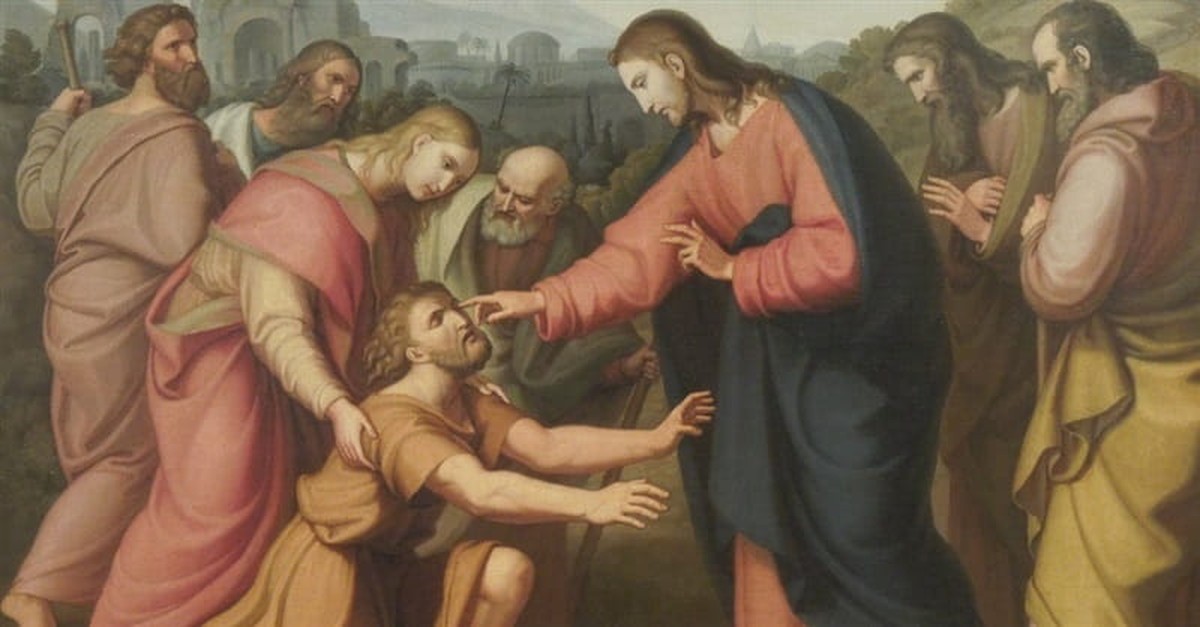
Faith Filled Friday: You Are Bartimaeus

There was a marvelous meditation in last month’s Magnificat (October 2021, p. 356-7) taken from a St. Josemaría Escrivà homily regarding the Bartimaeus passage in Mark.   Escrivà (1902-1975) was a priest from Spain who founded the religious institution, Opus Dei, an organization where mostly lay people commit to a life of holiness.  Here’s the Gospel passage first:


They came to Jericho.  And as he was leaving Jericho with his disciples and a sizable crowd, Bartimaeus, a blind man, the son of Timaeus, sat by the roadside begging.  On hearing that it was Jesus of Nazareth, he began to cry out and say, “Jesus, son of David, have pity on me.”  And many rebuked him, telling him to be silent. But he kept calling out all the more, “Son of David, have pity on me.”  Jesus stopped and said, “Call him.” So they called the blind man, saying to him, “Take courage; get up, he is calling you.”  He threw aside his cloak, sprang up, and came to Jesus.  Jesus said to him in reply, “What do you want me to do for you?” The blind man replied to him, “Master, I want to see.”  Jesus told him, “Go your way; your faith has saved you.” Immediately he received his sight and followed him on the way.  (Mk 10:46-52)


One certainly identifies with the blind man and we empathize with his predicament.  Escrivà puts us into Bartimaeus’ shoes. 


Don’t you feel the same urge to cry out?  You who are also waiting at the side of the way, of this highway of life that is so very short?  You who need more light, you who need more grace to make up your mind to seek holiness?  Don’t you feel an urgent need to cry out, Jesus, son of David, have pity on me?  What a beautiful aspiration for you to repeat again and again!  I recommend that you meditate slowly on the events preceding the miracle, to help you keep this fundamental idea clearly engraved upon your minds: what a world of difference there is between the merciful Heart of Jesus and our own poor hearts!  This thought will help you at all times, and especially in the hour of trial and temptation, and also when the time comes to be generous in the little duties you have, or in moments when heroism is called for. 

Yes, meditate on Bartimaeus’ helplessness, and that the only power he has is to call on Him.  That is us, today, here and now, in a desperate state with the only real power we have is to call on Him: Jesus, son of David, have pity on me. Escrivà continues to turn the screw on your Bartimaeus predicament:


Many of them rebuked him, telling him to be silent, as people have done to you, when you sensed that Jesus was passing your way.  Your heart beat faster and you too began to cry out, prompted by an intimate longing.  Then your friends, the easy life, your surroundings, all conspired to tell you: “Keep quiet, don’t cry out.  Who are you to be calling Jesus?  Don’t bother him.”  But poor Bartimaeus would not listen to them.  He cried out all the more.  Our Lord, who had heard him right from the beginning, let him persevere in his prayer.  He does the same with you.  Jesus hears our cries from the very first, but he waits.  He wants us to be convinced that we need him.  He wants us to beseech him, to persist, like the blind man waiting by the road from Jericho.  Let us imitate him.  Even if God does not immediately give us what we ask, even if many people try to put us off our prayers, let us still go on praying.

So when Escrivà puts us in Bartimaeus’ shoes, it’s not that we are transported to Bartimaeus’ time.  We are Bartimaeus in our contemporary time.  Imagine now our Lord approaching you, and just as Bartimaeus can’t see Jesus, so too are you blind to Him.  Escrivà continues for the climax:


And now begins a marvelous dialogue that moves us and sets our hearts on fire, for you and I are now Bartimaeus.  Christ, who is god, begins to speak and asks, What do you want me to do for you?  The blind man answers, Lord, that I may see.  How utterly logical!  How about yourself, can you really see?  Haven’t you too experienced at times what happened to the blind man of Jericho?  I can never forget how when meditating on this passage many years back, and realizing that Jesus was expecting something of me, I made up my own aspirations: “Lord, what is it you want?  What are you asking of me?”  I had a feeling that he wanted me to take on something new and the cry Master, that I may see, moved me to beseech Christ again and again.  Lord, whatever it is that you wish, let it be done.

And so you ask Him, I want to see, and if you let Him touch your eyes, you can see Him.  After this encounter, Bartimaeus followed Jesus all the way to Jerusalem to His Passion.  In those moments you do see Jesus, when you feel His touch on your eyes, you can do nothing else but follow Him all the way.

This was a moving meditation.