"Love follows knowledge."
"Beauty above all beauty!"
– St. Catherine of Siena

Showing posts with label Painting. Show all posts

Tuesday, March 15, 2022

Literature in the News: Debate on Auden’s “Musee des Beaux Arts”

I came across this interesting reaction to an explication of W. H. Auden’s great poem “Musee des Beaux Arts”.  The retort was from Lee Segal reacting in his article in City Journal, “Misreading Auden: About suffering, and art, the NewYork Times is usually wrong,” against an article in The New York Times by Elisa Gabbert interpreting Auden’s poem, “A Poem (and a Painting) About the Suffering That Hides in Plain Sight.”   

Now to be fair, I cannot read Gabbart’s initial essay since I do not subscribe to the Times, and my number of free views to one of their articles has exceeded their policy, so I can only go by Segal’s characterization of her interpretation.  But perhaps you can read the Times article, and, if so, please correct me if I am unfair.  I found the exchange interesting, mainly because I happen to love this poem.  But set aside Segal's polemic against the politically Liberal point of view from the newspaper and the author.  I don't want to get into that.  Let me give you my view.

First the poem, and I can publish it since it’s in the public domain.


Musee des Beaux Arts

W. H. Auden


About suffering they were never wrong,

The old Masters: how well they understood

Its human position: how it takes place

While someone else is eating or opening a window or just walking dully along;

How, when the aged are reverently, passionately waiting

For the miraculous birth, there always must be

Children who did not specially want it to happen, skating

On a pond at the edge of the wood:

They never forgot

That even the dreadful martyrdom must run its course

Anyhow in a corner, some untidy spot

Where the dogs go on with their doggy life and the torturer's horse

Scratches its innocent behind on a tree.


In Breughel's Icarus, for instance: how everything turns away

Quite leisurely from the disaster; the ploughman may

Have heard the splash, the forsaken cry,

But for him it was not an important failure; the sun shone

As it had to on the white legs disappearing into the green

Water, and the expensive delicate ship that must have seen

Something amazing, a boy falling out of the sky,

Had somewhere to get to and sailed calmly on.


I really can’t do better than the short explanation of the poem given in Wikipedia’s entry.  


Auden's free verse poem is divided into two parts, the first of which describes scenes of "suffering" and "dreadful martyrdom" which rarely break into our quotidian routines: "While someone else is eating or opening a window or just walking dully / along." The second half of the poem refers, through the poetic device of ekphrasis, to the painting Landscape with the Fall of Icarus (c. 1560s), at the time thought to be by Bruegel, but now usually regarded as an early copy of a lost work. Auden's description allows us to visualize this specific moment and instance of the indifference of others to a distant individual's suffering, inconsequent to them, "how everything turns away / Quite leisurely from the disaster ... the white legs disappearing into the green." The disaster in question is the fall of Icarus, caused by his flying too close to the sun and melting his waxen wings.

So there are two parts to the poem, both which are expressions on the theme that humanity just moves on from tragedies all around us.  The Wikipedia entry states the poem as giving us instances “of the indifference of others to a distant individual's suffering, inconsequent to them.”  The entry goes on to say the poem is in two parts.  The first part give some random, mundane examples of tragedies we seem to ignore, and the second part, an “ekphrasis,”—that is a description of a work of a visual art—of “Landscapewith the Fall of Icarus” by Pieter Bruegel the Elder.    

So before I get to Segal and Gabbert, here is Bruegel’s painting.
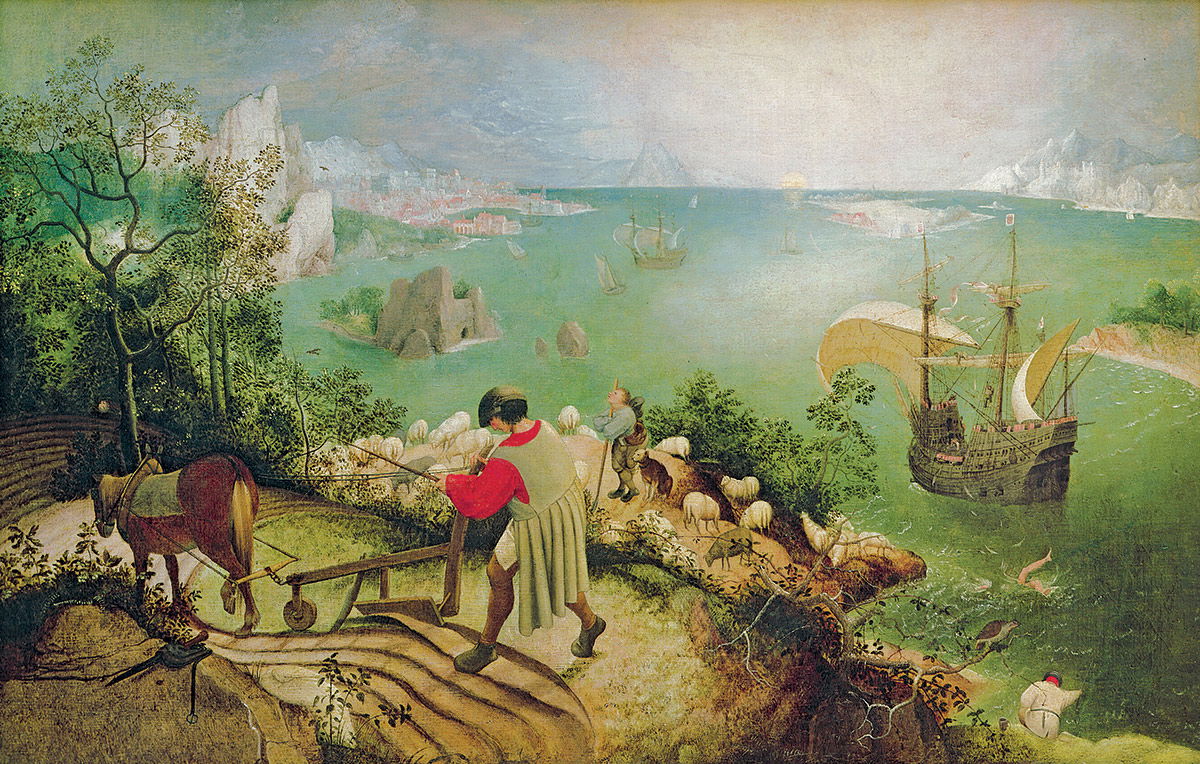

For those that don’t get the allusion, the painting references the ancient Greek myth of Icarus where Daedalus, a master craftsman, builds wings for him and his son Icarus to escape from the island of Crete through flight.  But Icarus being young and headstrong flies too high and the sun melts the wings and he plunges into the sea to his death.  In the lower right of the painting you can see Icarus feet just before he submerges.

So I think one could summarize the difference between Segal’s and Gabbert’s interpretations is over the word “indifference.”  Segal states Gabbert’s interpretation of the poem with this paragraph.


No work of art can be summed up in a series of categorical statements about its “message,” but Gabbert tells us that Auden’s poem is a straightforward exposure of people who let bad things happen—she is perhaps thinking of Ukraine—and do nothing. “Ignoring [human suffering],” she writes, in a summary of Auden’s intentions in writing the poem, “is the most natural thing in the world. It is also a moral error.”

He later chides her for confusing the theme of the painting with the theme of the poem.


Gabbert does not refer to Auden’s religious beliefs, and when she does take up the poem’s allusions to Christian motifs, she gets them wrong. “The painting,” she writes, both confusing the poem with the painting and the painting’s own possible meanings, “is about the fraught relation between attention and disaster—as is the poem: Something’s only a disaster if we notice it.” Yet in the painting, Icarus’s fall is still a disaster, though no one sees it. And in the poem, Christ’s “dreadful martyrdom” and Icarus’s fall are still disasters, though no one sees them. Auden even refers to the boy’s fall as a “disaster.”

Segal’s interpretation of the painting is subtly different.  The indifference is not a callousness nor uncaring but an acceptance.


The poem is not about the “fraught relation between attention and disaster,” whatever that means. It is about disaster and suffering happening in the midst of lives untouched by disaster and suffering. Auden writes, “About suffering they were never wrong/The Old Masters: how well they understood its human position; how it takes place/While someone else is eating or opening a window or just walking along.” The poem describes how even Christ’s torture happened obscurely, mundanely: “even the dreadful martyrdom must run its course . . . in some untidy spot/Where the dogs go on with their doggy life and the torturer’s horse/Scratches its innocent behind on a tree.”


Gabbert believes that the Old Masters, in the manner of editorial writers, were bothered by the fact that suffering was “easy to ignore.” For Auden, though, the Old Masters understood suffering’s “human position.” Blindness or indifference to suffering isn’t an error easily corrected by an adjustment to your moral posture. It is a profoundly ambiguous and complex essence of being human.

I would quibble with Segal’s “It is about disaster and suffering happening in the midst of lives untouched by disaster and suffering.”  “Untouched by disaster and suffering”?  Who’s life is untouched by disaster and suffering?  Everyone is touched.  Nonetheless Segal sees the indifference as a “complex essence of being human.”  He goes on to explain it further.


For in Bruegel’s painting, the ploughman is paying absolute attention to his work; the fisherman is absolutely fixed on fishing; the sailors are completely caught up in sailing, and “the sun shone as it had to.” Rather than a spectacle of selfishness, these people and nature itself are “forgetting themselves in a function,” which is a form of agape, of love for the work of living. Even the sun, so destructive to Icarus on the one hand, nourishes the life-giving seeds the farmer is planting in the earth on the other. Perhaps we cannot fulfill the saintly idea of loving our neighbor, but we can, in the ordinary motions of our lives, perform the work at hand, and thus cause no harm to our fellows, even if, the human condition being what it is, we do not possess the capacity to relieve suffering whenever and wherever we witness it. Maybe that is why the ploughman is the largest figure in the painting, occupying the foreground nearly in the center of the picture. “No one having laid the hand upon the plow, and looking on the things behind, is fit for the kingdom of God,” as Luke 9:62 has it. Surely Auden knew that exhortation to keep your eye on the work of God; on, that is, the work of earning the gift of your portion of mortal existence.

I think Segal is saying that the poem sees tragedies are part of the universal order.   Tragedies which lead to human suffering happen all the time and are part of the human condition, so the indifference is not a moral failing but an understanding that suffering is just as routine as the mundane, human activity we all participate in.  It is part of God’s order.  If that’s what he is saying, and I’m not exactly sure what he means by “a profoundly ambiguous and complex essence of being human,” then I agree, “the dreadful martyrdom must run its course.” 


Monday, September 14, 2015

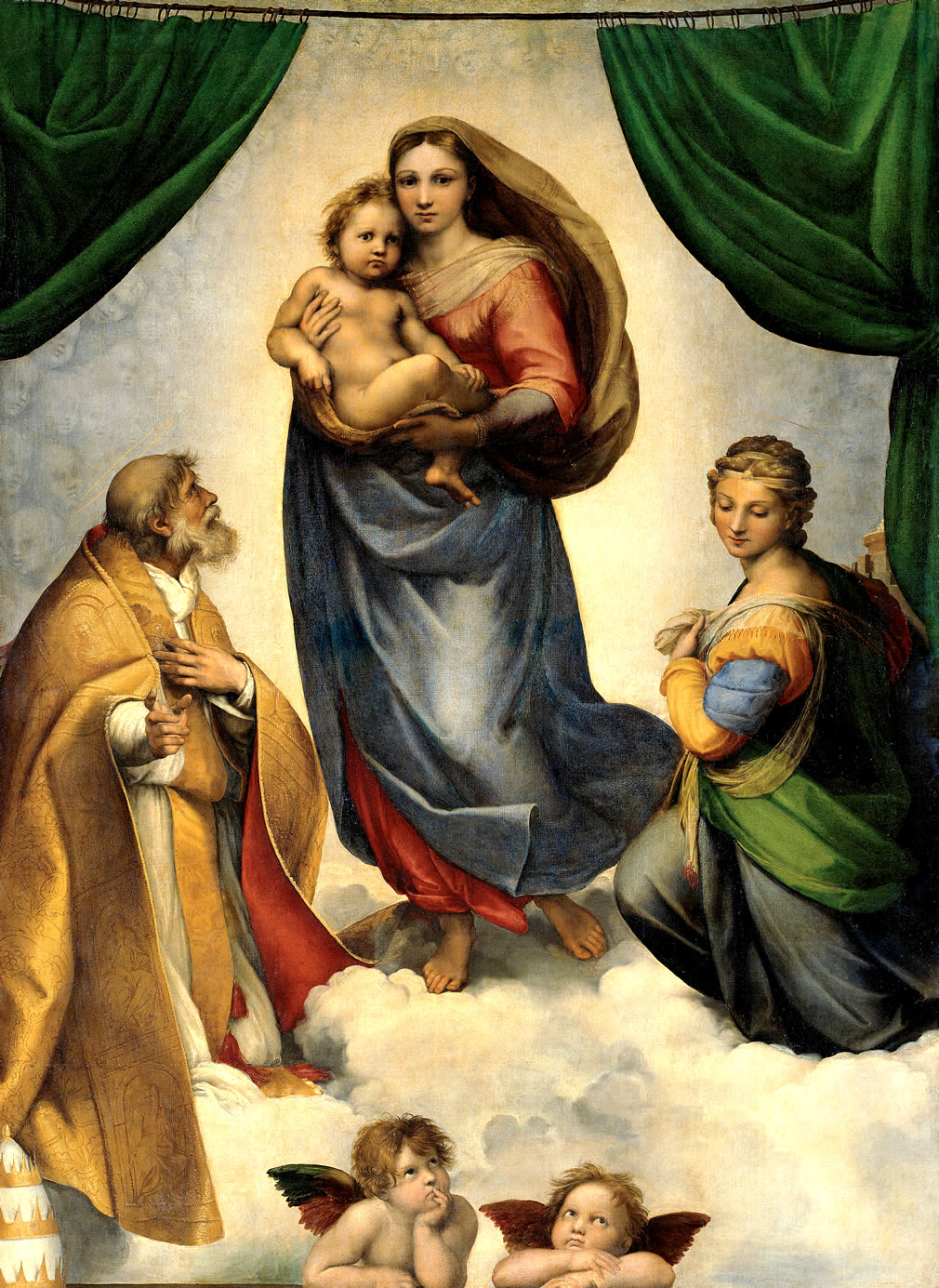
Art: The Sistine Madonna by Raphael

The August 2015 issue of Magnificat magazine featured this painting as its monthly art essay and I was really taken in.  This wonderful painting was painted for the Benedictine Monastery of San Sisto, and not the Sistine Chapel as its name might suggest.  It is sometimes referred to as the Madonna Standing on Clouds with Saints Sixtus and Barbara, and personally I think that’s a better name. 


There is so much to point out in this painting.  The structure is circular the Madonna and Child at the top of the circle, Pope Saint Sixtus IV looking upward, Saint Barbara looking downward, and the two icon angels looking back up to complete the circle.  The color scheme is interesting.  The yellows, greens, and browns contrast nicely with the Blessed Virgin’s blue gives the Holy Mother a position of prominence. 

There is an interesting contrast of the neat and tidy Saint Barbara with the disheveled Saint Sixtus.  The Blessed Virgin also seems to be mostly neat, except for her windblown garments, which connects her with the other female figure.  The hair on the Christ child and on the two angels are tousled and disarrayed, connecting them with the male figure.  What that means, I’m not sure.

The choice of the supporting figures is also interesting.  We know why Pope Saint Sixtus IV was chosen.  The painting was commissioned by his nephew and wanted to honor his uncle.  Sixtus is characterized as frail and human, which further connects him to the human child.  But why Saint Barbara?  I’m not sure.  We know her to be both a virgin and martyr.  Her elegance connects her with the Virgin, but her stateliness seems to surpass that of the Virgin.  The cute angels, fleshy and human-like, at the bottom are also connected with the incarnate Christ child, but their whimsical expressions seem to miss the significance and the gravity of the moment.

The drama is also interesting.  The Virgin and child seem to come from behind a green veil (suggesting the earth, perhaps) and walk down as if from heaven.  Sixtus is pointing out of the canvas to the viewer, pointing the Christ child to the beholder of the painting.  The infant Jesus clearly has an expression of being vexed.  The Magnificat essay, by a Fr. Michael Morris, O.P., professor at the Dominican School of Philosophy and Theology at Berkley, CA, explains the finger point and the Holy Child’s expression with this:

Recent scholarship has discovered that inside the basilica the painting was designed to hang opposite a scene of the crucifixion.  Thus the look of fear that envelops the infant Jesus reveals a natural human response to the sight of pain and death.

I wonder if that is correct.  Would Raphael paint a scene considering that another painting sitting opposite would explain the significance of his painting?  What if one of the paintings were to be relocated, as has his Sistine Madonna was relocated to Dresden, Germany in the 18th century?  Or what if someone decided to rearrange the chapel?  The significance of the pointing hand would be lost, and Raphael certainly would have considered that possibility.  Here’s what I think.  The earthly veil has been opened and we have made our way up toward heaven to face our eternal fate.  Suddenly you come upon the Virgin and child who have come to meet you, and your impulse is to join both Sixtus and Barbara in kneeling before the Lord.  I think Sixtus is pointing to us the observer, and Christ looks on in judgement. 

What do you think?

Friday, May 22, 2015

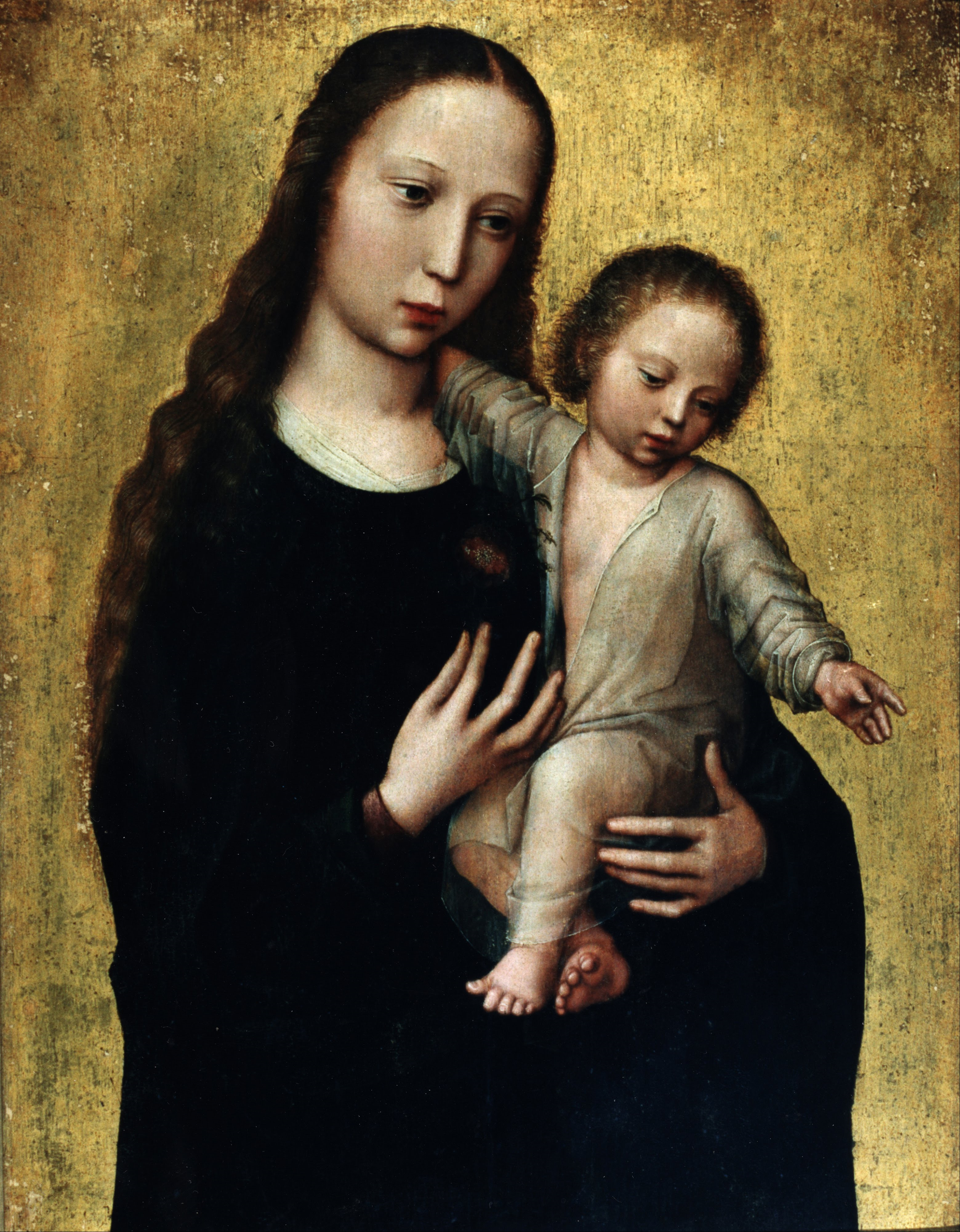
Faith Filled Friday: The Virgin Mary with Child Jesus in a Shirt

May is Mary's month, and I should post something in honor of the Blessed Mother.  How about this lovely 16th century painting by Ambrosius Benson, titled, The Virgin Mary with Child Jesus in a Shirt.


I love the face and the wavy hair that is both mirrored in the two subjects.  I love Mary's dress, and the general direction of the movement looking down, which I supposed implies a looking down toward humanity.  I wonder at the transparency of the shirt on the Child Jesus.  Does it suggest His dual nature of man and God?  If so, then does the darkly opaque dress on the Blessed Mother, which is in complete contrast, suggest her humanity?  Good questions.  Lovely painting.

If you want to know why May is Mary's month, read Kimberly Cook's blog at CatholicMom.

Wednesday, April 1, 2015

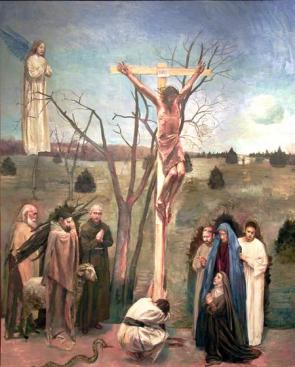
Art: The Crucifixion with Saints, Painting by John Collier

Keeping with the holy week, I’m presenting this painting by a contemporary artist, John Collier.  Collier is a best known for sculpture, especially the sculpture at the 9/11 Ground Zero Memorial, and you can see a PBS interview about his Ground Zero sculptures here.   I learned of Collier as he was a guest on the EWTN show, The Journey Home, which of course makes him a Catholic convert.  

Frankly I was very intrigued by this painting more than his sculpture as I did a search of his work.  


In the Old Testament the life of Christ has many "prefigurations," and His Crucifixion is no exception. Here we see: Abraham and Isaac, Isaiah who foresaw the life and suffering of Jesus, John, "the Disciple whom Jesus loved." Also we find Mary, St. Francis, St. Trse of Lisieux, Mary Magdalene and Father Maximilian Maria Kolbe, all to remind the viewer of what truly was given to us on the cross.


The selection of saints is certainly interesting but what really captures me is the layout.  Look at how small it makes the humans in the fore.  With angel hovering above and behind, it projects to perspective upwards, toward heaven.  Look at all that space above and behind the cross.  The cross is pushed much forward into the foreground.  And this is the only Crucifixion painting I have ever seen with a naked tree behind the cross.  Is that the tree from the Garden of Eden?  Or the tree of life?  

And you learn more about John Collier here.

Saturday, September 7, 2013

Painting: Giorgione's La Tempesta

In Mark Helprin's novel A Soldier of the Great War, the painting, La Tempesta, by the 15th century Venetian painter figures prominently.  See my post on the novel here. The painting is worth a blog of its own.  Here it is.


“In Giorgione’s painting you find very little red.  The dominant colors are green and gold: green, of course, being the color of nature, and gold the divine and tranquil color of which, like perfection, so little exists.  The painters of Giorgione’s time, by and large, spoke in these terms.  Red was the instrument with which they portrayed mortality; green, nature; gold, God.  With the notable exception scattered from painter to painter and school to school, you will find this born out subtly and simply."
                               Mark Helprin, from A Soldier of the Great War, p. 832

This is a great painting.  I love Helprin's commentary on it.  Read more commentary that I excerpted in my blogs on Helprin's novel. 

Friday, March 29, 2013

Faith Filled Friday: "Crucifix" by Giovanni Cimabue

Holy, holy, holy.


Painting by Giovanni Cimabue, "Crucifix," 1268, detail.  You can see the entire painting here and read about it here.

Have a blessed holy weekend.

Friday, January 11, 2013

Faith Filled Friday: Adoration of the Magi

This past Sunday was the Feast of the Epiphany, a celebration of the day the Magi arrived to the Christ child.  This week’s FFF I am going to post discussion of a modern representation on the Adoration of the Magi subject. 

 
In her fine blog, Simcha Fischer asks whether there are rules for art when engaging a religious subject.  In particular she explores this contemporary painting by an artist named Tai-Shan Schierenberg, strangely titled, “The Adoration of the Magi.”


I agree that the fact that it’s not three exotic men in a barn setting does not disqualify it as religious art.  Contemporary art, as in art from every age, can update the details of the subject to fit it to its time and place.  But then she pushes further:


But what happens when we not only update clothes and hair and remove the easily-recocognizable symbols, but go a little further? This, I argue, is what artist Tai-Shan Schierenberg has done in "The Adoration of the Magi," and I believe that he's made a work of art which is not religious at all, despite its title. It's a good piece, but it's secular. Why? Because of where the focus is.

 
What is missing clearly is the Christ child.  She continues.


So let's look at this "Adoration of the Magi." Is it a problem that these "Magi" are not kings or wise men, that they're not even all men, that they don't have historically accurate clothes or hair, or that they don't show any signs of bearing gifts or of having traveled afar? Not necessarily. These departures from more traditional art may irritate or perplex you, but they aren't enough, in themselves, to disqualify this painting as religious art.


The reason I call it a secular painting is because it kind of . . . doesn't have God in it. The Magi's faces take up most of the canvas; but that's not what I mean. I mean is that this painting is about the "Magi" themselves, and not about God. A depiction of the Adoration of the Magi might have all sorts of elements in it, but it absolutely must contain at least an indication that what they are adoring is God. This is what is lacking in this picture, and that is what makes it not religious art.


You can tell by the shadows and highlights that the light source is above and to the right, out of the frame. As I've discussed before, what light is doing in a painting is -- well, enlightening.  In a traditional piece of art depicting the Magi, the light would be emanating from below, from the Christ Child, or from above, from the divinely-appointed guiding star. In this painting, there is a significant break: the light -- late morning sunlight, from the looks of it -- is from above, from behind the faces, and to the viewer's right. And it's pretty clearly just the sun. Why this innovation, if not to make a point?

 And her final point is:


But what is the expression on their faces, as they look at him? They are withholding judgment. Their oddly prominent lips are closed and at rest, without anything to say. This is not a meaningless, mute painting, though. It portrays very poignantly the religious experience that so many modern people have: they have come to see what the fuss is about. And there it is. They look at God, and they don't know what to think.


These are modern magi: exceedingly clean, healthy, and decent, confident but courteous. But do they adore? I don't see it. I don't think they see God, at all.

This is how I commented.


Simcha

I did not read the comments section, so I don’t know if I’m repeating someone else’s thoughts. I’m only addressing your understanding of the painting. You might be right, but there is another way to look at it. It could be that the “Magi” are experiencing a profound religious experience. In the biblical story all the Magi know is that a king will be born in Bethlehem. They do not know that this king will be transcendent and divine. When they get there their experience is profound, penetrating to the soul. The biblical story doesn’t go into detail, only that they “prostrated” themselves before our Lord. The question is what did this profound experience constitute? Did they suddenly realize their whole lives have been working toward the wrong end of holiness? Is their new life, after the epiphany, a burden now after new knowledge?

This is not unprecedented. Read TS Eliot’s poem “The Journey of the Magi.”
There is burden in the journey and there is burden in their new life. It is a realization of a new cross they have to bear. Here’s the last stanza:


All this was a long time ago, I remember,
And I would do it again, but set down
This set down
This: were we led all that way for
Birth or Death? There was a Birth, certainly
We had evidence and no doubt. I had seen birth and death,
But had thought they were different; this Birth was
Hard and bitter agony for us, like Death, our death.
We returned to our places, these Kingdoms,
But no longer at ease here, in the old dispensation,
With an alien people clutching their gods.
I should be glad of another death.


Now getting back to the painting. It depends on whether the artist is being cynical in the title with “Adoration” or whether “Adoration” is encompassing a deeper, total Truth that projects toward the crucifixion. The shadows can suggest that and can suggest the burdens of their personal sins and the cross they now will bear.


Anchoress also cited Simcha’s blog, and had her take on it, agreeing with Simcha. 
 
In my response to Anchoress’s blog, I also said this:

 Let me also add that the Christ child is clearly implied between the painting’s title and the focus of attention. So God is not necessarily absent. He clearly is not, and sometimes things are more powerful if they are offstage. A traditional painting of the Epiphany has the child as the center, and clearly the subject. Here for better or worse the subject is the soul transforming experience of the Magi.

One of the meanings of “epiphany” is this:
a sudden, intuitive perception of or insight into the reality or essential meaning of something, usually initiated by some simple, homely, or commonplace occurrence or experience.
The painting captures the sudden epiphany of the magi.


So it comes down to these questions.(1) Are the facial expressions of the Magi revealing indifference or a soul transforming moment which point to the crucifixion?(2) Is the artist being cynical with the title or do we take him at his word? (3) Is the painting a better painting with or without the Christ child present? (4) How would you assess (poor, mediocre, good, great) the painting? and (5) Is this a religious painting or not?

I don't profess to be an expert here. Simcha's and Anchoress's reading are certainly possible. The facial expressions can point to anything. If you ask me, that is the failing of this painting, the fact that it's so ambigous on the very foundation of its subject. Personally I think this is a mediocre painting at best.

What are your thoughts?