"Love follows knowledge."
"Beauty above all beauty!"
– St. Catherine of Siena

Showing posts with label A Child's Christmas in Wales. Show all posts

Thursday, December 26, 2019

Short Story Analysis: A Child's Christmas in Wales by Dylan Thomas, Part 2


You can read Part 1 of this story’s analysis here and hear Dylan Thomas read the story.  

In Part 1 I mentioned that I thought it odd for Thomas to use “Prothero” as a Welsh name.  Lawanada Commented on that:

Lawanda’s Comment:
ust a little help with the surname Prothero. Prothero is indeed Welsh and the English form would be Roderickson.
Some notable Protheros: (copied from houseofnames.com)

Stephen Prothero – American professor in the Dept of Religion at Boston University and author of numerous books on religion in the US, including the New York Times bestseller Religious Literacy.

Mark W. Prothero (1957-2014), American attorney in Washington State, best known for serving as defense co-counsel for the Green River Killer, serial killer Gary Ridgway

Dan Prothero, San Francisco-based independent record producer, recording engineer and record collector

Rolla W. Prothero, American politician, Mayor of Baraboo, Wisconsin 1951-54.

John A. Prothero, American Republican politician, Presidential Elector for South Dakota, 1892.

Gareth John Prothero (b. 1941), Welsh international rugby union player.

Rowland Edmund Prothero (1851-1937), British administrator, author & politician, created 1st Baron Ernle in 1919.

Sir George Walter Prothero (1848-1922), English writer and historian, a former President of the Royal Historical Society.

My Reply:
Wow, Lawanda, I am very surprised. I guess I have never seen Welsh written, but the names listed on that Wikipedia link on Welsh surnames all sound very Anglo-Saxon. If Welsh was derived from Gaelic, then perhaps I can see Prothero being Welsh. Perhaps Thomas intends it to be searching for a pre-British Welsh name. Thank you for clarifying.

Kerstin Commented:
We have snow coming down by the bucket-full today :)

Seriously now, yes he is exaggerating, but for anyone who has lived in Northern Europe for a while, especially England, it can rain, rain, rain for days without end. There may be a break here and there, but the impression is that it rains without reprieve.
Growing up in Southern Germany I do recall a few summers in the 70s when we really didn't get a summer. It happens when over the Azor Islands the summer high pressure systems don't get fully established keeping the clouds away. Then what you get is one low pressure system after another like pearls on a string and the temperatures stay, at the most, in the mid-60s and at night into the 40s. It's downright depressing!

Also part of this living in innocence and the sense of belonging and feeling sheltered is that children live very much in the present moment. We lose this as we grow older. Their experiences are so vivid precisely because they live in the present. We are most alive when we are in the present moment, the moment where God dwells.

These days there is a lot of talk about "mindfulness," one of these ubiquitous ersatz-terms formed in a secular culture that purposefully shuns the Christian past. Yet despite all that, being made in the image of God, people are looking for the vividness of the present moment, for the encounter with God.

My Reply:
Well, keep it in your part of the country! :-P It just rained here five out of the last six days. Cold weather tends to be dryer, so I can't say I've seen it snow for more than two days in a row. Now twelve days of snow is definitely an exaggeration!

Your other comments were right on Kerstin.

###

One last thought on the story.  Dylan Thomas is a poet and this does come close to a prose poem, One should appreciate the poetic elements of the writing.  I already quoted two wonderful passages above.  Plunging hands in the snow and pulling out the memory of the fire at Mrs. Prothero remains for me an incredible image.  And snow falling in buckets and the drifts “shallawling” (what a wonderful word, a present participle of the noun shawl) the ground and snow growing out of the roofs as if it were vegetation.  There is artistry in every paragraph.

Notice his use of alliteration in this passage.

Years and years ago, when I was a boy, when there were wolves in Wales, and birds the color of red-flannel petticoats whisked past the harp-shaped hills, when we sang and wallowed all night and day in caves that smelt like Sunday afternoons in damp front farmhouse parlors, and we chased, with the jawbones of deacons, the English and the bears, before the motor car, before the wheel, before the duchess-faced horse, when we rode the daft and happy hills bareback, it snowed and it snowed.

Notice the “w” sounds: wolves, Wales, whisked, wallowed, when, we, with, wheel.  (By the way, I looked it up; there had not been wolves in Wales for at least 500 years before.  More exaggeration!)  Notice the “s” sounds: sang, smelt, Sunday, snowed.  Notice the “h” sounds: harp, horse, happy, hills.  Notice the “p” sounds: petticoats, parlors.  Also, out of the 86 words in the paragraph, a full eighteen have an “s” ending sound to compliment the initial “s” sounding words.  That paragraph just sounds beautiful.  And its pacing is rhythmic.  The four  “when” clauses just pounds the rhythm. 

Or how about this marvelous descriptive passage of the snow filled streets:

Not many those mornings trod the piling streets: an old man always, fawn-bowlered, yellow-gloved and, at this time of year, with spats of snow, would take his constitutional to the white bowling green and back, as he would take it wet or fire on Christmas Day or Doomsday; sometimes two hale young men, with big pipes blazing, no overcoats and wind blown scarfs, would trudge, unspeaking, down to the forlorn sea, to work up an appetite, to blow away the fumes, who knows, to walk into the waves until nothing of them was left but the two curling smoke clouds of their inextinguishable briars.

Again you can find the alliteration, the “s” sounds, the “b” sounds, the “f” sounds.  It’s a subtle alliteration, not the overbearing alliteration of an old Anglo-Saxon poem, where five of six words in a line might start with the same consonant.  It’s neatly interspersed to accentuate the Englishness of the language.  What I also like about this passage is its rhythm, this time generated by short phrases separated by commas: “an old man always”/fawn- bowlered”/ “yellow-gloved”/” at this time of year”/” with spats of snow” which leads into a longish clause followed by more short phrases separated by commas: “sometimes two hale young men”/” with big pipes blazing”/” no overcoats and wind blown scarfs”/” would trudge”/” unspeaking” and so on, ending with a longish clause.  The overall structure of the passage is longish clause as opening statement, series of short phrases, longish clause, series of short phrases, longish clause.  Not just poetry has rhythm.  Great prose develops rhythms too.

And how about the vividness of Christmas dinner:

For dinner we had turkey and blazing pudding, and after dinner the Uncles sat in front of the fire, loosened all buttons, put their large moist hands over their watch chains, groaned a little and slept. Mothers, aunts and sisters scuttled to and fro, bearing tureens. Aunt Bessie, who had already been frightened, twice, by a clock-work mouse, whimpered at the sideboard and had some elderberry wine. The dog was sick. Auntie Dosie had to have three aspirins, but Auntie Hannah, who liked port, stood in the middle of the snowbound back yard, singing like a big-bosomed thrush.

I just love the abundance of that passage.  It’s only 98 words but it captures the food, the uncles, the fire place, the aunts, the singing, the sleeping, the drinking, the dog, the mouse. 

There are other passages I could highlight, but they exhibit the similar attributes as these.

And lastly I should highlight some of the memorable phrases: “the carol-singing sea,” “Eskimo-footed artic marksmen,” “the gong was bombilating,” postmen “with sprinkling eyes and wind-cherried noses, on spread, frozen feet” who “crunched up to the doors and mittened on them manfully.  Sometimes a whole sentence is superb such as this: “Men and women wading, scooping back from chapel, with taproom noses and wind-bussed cheeks, all albinos, huddled their stiff black jarring feathers against the irreligious snow.”  Albinos refers to being covered with snow, and nice contrast between coming from chapel and the irreligious snow.  Descriptions such as the delicate aunts who were “poised and brittle, afraid to break, like faded cups and saucers.”  And of course that ending that is so evocative, “I said some words to the close and holy darkness.”  That is so much more powerful than if he had said, “I prayed to God” or “I said my bedtime prayers.”  Dylan Thomas is a wonderful poet. 

I said above that it felt the story was created ad hoc. Perhaps now I have second thoughts about that.  Perhaps the flow of the narrative was ad hoc but there is so much wonderful craft inside the narrative that it had to be honed.  For me, this was an outstanding work of art.

###
Frances Commented:
Manny, your observations are excellent, professional. In your reading of “wolves, Wales, whisked, wallowed . . . ,” were you reminded of these lines: “Wiry and white-fiery and whirlwind-swivelled snow...?” Gerard Manley Hopkins composed “The Wreck of the Deutschland” at St. Bruno’s College in Wales.
“So long as he remained in the surroundings of North Wales . . . his Muse rejoiced in a glad springtime. . . But from the time he went north into the waste land of industrial Lancashire, his enthusiasm was abated.” (Landscape and Inscape, by Peter Milward, S.J.)

My Reply:
I know I've read “The Wreck of the Deutschland” but unfortunately it doesn't come back to me without refreshing my memory. Alliteration is a large part of Gerard Manly Hopkins. Hopkins use of alliteration is usually like that of the old Anglo-Saxon poetry, sometimes reshaping the modern language. I think Thomas, here at least, accentuates the English rather than alters it. That's not to say I dislike what Hopkins does. Just different intentions.

Kerstin Commented:
Since Anglo-Saxon has a lot of German in it, I had to think of a poem I remember from childhood that was written in this style. When I was 8 or 9 I used to know all 6 verses by heart. Now I can only recite the first!

Friedrich Rückert (1788 - 1866)

Roland, der Ries'

Roland, der Ries', am
Rathaus zu Bremen,
steht er ein Standbild
standhaft und wacht.

Roland, der Ries', am
Rathaus zu Bremen,
männlich die Mark einst
hütend die Macht.

...

Trying to translate it would be impossible to keep the alliteration, except for the third line.

Roland the giant
At city hall in Bremen
Stands as a statue
and watches

My Reply:
That's very interesting Kerstin. It makes me wonder if alliteration is integral to German poetry. Beowulf was actually written on the continent by the people who would eventually move on to Britain. But it was a specific group of Germanic tribes, so I don't know whether their version of the language and literature made its way into the modern German language. Actually as I think about it, I know very little of the development of German. I'm fairly knowledgeable on the Romance languages and English of course, but with English we usually start its history with Beowulf. I would imagine the development of German would be complex, with all the different tribes as they made their way south over time from Scandinavia.

###

My Review at Goodreads:

This is a prose poem on a nostalgic retrospective of a time more innocent, a look back to the poet’s Christmases as a child in Wales.  Through voices and sounds coming from the past, through humor and exaggeration, even mock epic, through suggestions of faith and boyish activities, Dylan Thomas builds a world where joy and love and, indeed, belonging that evokes the spirit of Christmas.  The voices and sounds, conveyed through sparkling prose which is near poetic, are part of his soul, and as he falls asleep he relives that innocent time.  And then after the exhilaration of a child’s Christmas elation, he gets into bed, says “some words to the close and holy darkness,” and then falls asleep.  Sleep frames the story, pleasant sleep, grace-filled sleep.
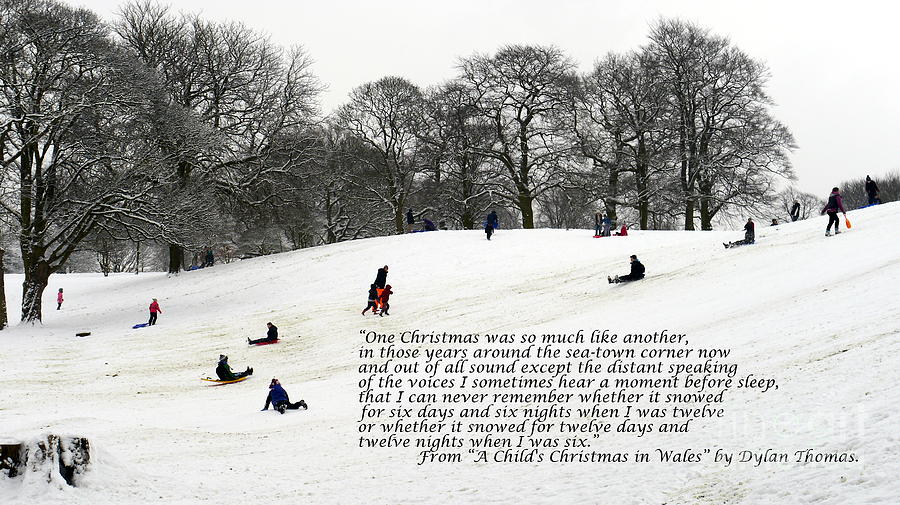


Tuesday, December 17, 2019

Short Story Analysis: A Child's Christmas in Wales by Dylan Thomas, Part 1

You can read the story here.  
After you read it, you can listen to Dylan Thomas read the story at the embedded YouTube video at the end of this post.

I have to say, this was a strange piece, but an entertaining and charming piece once you understand it.  From what I gathered, it was mostly improvised, so either the rhetorical shifts were planned or more likely ad hoc.  I would not call this piece a traditional short story.  I'm not sure I would call it a story at all since characters do not encounter conflicts which are eventually resolve.  While Thomas uses a lot of narrative, I think the best genre to place this piece in is a personal essay, which is a prose narrative derived from experience.  This is a nostalgic reminiscing of what the narrator's Christmases were like. 

The narrator is Dylan Thomas himself, obviously since it is personally derived, and as to being prose I might argue it is heightened prose, almost prose poetry.  This shouldn't surprise us.  Dylan Thomas is a well-known poet. 

Let me just point out the rhetorical shifts.  It starts with a generic "One Christmas was so much like the other..." and then into that marvelous metaphor of a snow pile representing piles of Christmases, he plunges his hand and pulls out one specific Christmas.

All the Christmases roll down towards the two-tongued sea, like a cold and headlong moon bundling down the sky that was our street; and they stop at the rim of the ice-edged, fish-freezing waves, and I plunge my hands in the snow and bring out whatever I can find. In goes my hand into that wool-white bell-tongued ball of holidays resting at the rim of the carol-singing sea, and out come Mrs. Prothero and the firemen.

This one Christmas is the time when there was a fire at his friend's house, and Thomas narrates the events that led him and his friend to call the fire brigade which put out the fire.  That narrative runs several paragraphs until the fire is put out when Thomas returns back to a summary narrative, “Years and years ago, when I was a boy…”  But at the end of that paragraph Thomas has a small boy interject: “But here a small boy says: ‘It snowed last year, too. I made a snowman and my brother knocked it down and I knocked my brother down and then we had tea.’"  We realize that until now, it has been a monologue, and with the boy Thomas shifts the story into a dialogue. 

That dialogue sets up a tension between the present Christmas, as represented by the boy, and the past nostalgic Christmas as described by the narrator.  After a few exchanges between the two, the boy’s questions and comments get very short and the narrator’s response get longer and longer and more elaborative.  It’s almost as if there is a call and response—to use a musical term—between the boy’s leading call and the narrator’s return response. 

At one point the narrator brings up three friends from his nostalgic past, Jim, Dan, and Jack, and I think—though the text is not clear—he starts recalling conversations with them, boyish small talk about hippos and throwing snowballs and writing in the snow.  After more reminisces of Christmas activities with his friends, including singing of Christmas carols, the narrator brings the story to an end by recalling going to bed with a prayer.

That’s a little primer on understanding the narrative.  More later on the themes.

###

I see two elements of the story that comprises its style, which are critical for understanding the story and appreciating its artistry, exaggeration and humor. 

We see exaggeration everywhere: cats which are described as “sleek and long as jaguars,” snowfall described as coming down in “buckets from the sky,” mittens made for giant sloths, and footprints that were the size of hippo tracks.  The narrator tells us he couldn’t remember if it “snowed for six days and six nights when I was twelve, or whether it snowed for twelve days and twelve nights when I was six.  Whether it was six or twelve days, it would be pretty rare for snow to fall for that many days straight.  Whether it be Mrs. Prothero described as a town crier in Pompei when encountering the fire or the uncles holding out their cigars “as though waiting for an explosion,” Thomas stretches credulity even for a work that is rich in nostalgia.  This is the tone of a tall tale, almost Mark Twainian in style.  One could almost hear echoes of Tom Sawyer in the narrator.

Humor too is everywhere, in almost every paragraph.  Let me point out a few.  When the cries of fire are heard, the boys drop their snowball hunting of cats to investigate. Humorously the narrator ponders, “Something was burning all right; perhaps it was Mr. Prothero.”  And when boys are asked to do something, they throw their snowballs at the fire, just missing Mr. Prothero.  When the fire brigade does come and turn on their hoses, Mr. Prothero just barely escapes from being splashed.  When Miss Prothero, Jim’s aunt comes down after the fire, her words are obliviously disconnected.  “Would you like anything to read?” she asks. 

There are several little boys in the narrative but when the little boy in the present time that serves as a foil to the nostalgic past speaks of his brother knocking down the snowman, he states in a sort of slapstick activity that he knocked down his brother in return.  And in response to that present day boy’s mention of snow, the narrator has to up his tale:

 "But that was not the same snow," I say. "Our snow was not only shaken from whitewash buckets down the sky, it came shawling out of the ground and swam and drifted out of the arms and hands and bodies of the trees; snow grew overnight on the roofs of the houses like a pure and grandfather moss, minutely ivied the walls and settled on the postman, opening the gate, like a dumb, numb thunderstorm of white, torn Christmas cards."

Oh no, he is saying, you don’t have the same snow we had years ago.  As if the snow back then was really any different.  It’s sort of like the old timer who tells their kids that back when he was a child he had to walk three miles to school with no shoes and frequent blizzards. 

And when the present day boy asks about uncles, the narrator says, “There were always uncles at Christmas.  The same Uncles.”  Ah, those crazy relatives at family Christmas parties.  I still remember my crazy uncles at similar Christmas parties.  Do we all have crazy uncles?  They sure make for good humor.  And the narrator’s uncles were large men, “trying their new cigars, holding them out judiciously at arms' length, returning them to their mouths, coughing, then holding them out again as though waiting for the explosion.”  These uncles must only smoke these cigars once a year since they seem so inexperienced at it.  And the aunts too are portrayed as humorous: aunts not wanted in the kitchen, sit like “faded cups and saucers,” afraid they might break.  And Aunt Hannah, lacing “her tea with rum, because it was only once a year.”  And yet whenever we see Aunt Hannah she is drinking some sort of alcoholic beverage, so that “once a year” is an inside joke.  She’s obviously a lush. 

There’s one specific type of humor that runs throughout that’s particularly noticeable, that is, mock epic.  Mock epic is a satire of epic elements, undercutting the narrative for humor.  We see the great hunt not of jaguars but of family cats, not with weapons but with snowballs, the two hunters “fur-capped and moccasin trappers from Hudson Bay.”  Goodness, this is Wales, not the Klondike North.  And later in the narrative he recalls he and his friends were “snow-blind travelers lost on the north hills, and vast dewlapped dogs, with flasks round their necks, ambled and shambled up to us, baying "Excelsior."  They are in Wales, not lost the Swiss Alps. 

Extended lists are also a feature of epics, such as in the weapons and horses of Homeric combatants.  In this story the lists are of presents, useful presents such as a zebra scarf that stretch to the galoshes and tam-o’-shanters (type of hat) that fit “victims of head-shrinking tribes.”  And there were useless presents such as a conductor’s outfit with a false nose that came with a machine that punched tickets, “a celluloid duck that made, when you pressed it, a most unducklike sound, a mewing moo that an ambitious cat might make who wished to be a cow,” some sort of assembly game for “Little Engineers” that came with instructions that no one could figure out, “Oh, easy for Leonardo!” he exclaims, a reference I think to the engineering diagrams of Leonardo da Vinci.  And candied “cigarettes” and dog whistles to drive the old folks nuts.  The humor may be subtle at times, but it’s extraordinaire. 

To compliment these two stylistic elements, I see at least three motifs that run through the story.  First is the religious motif.  We get references to deacons, church bells, bishops ringing bells in the belfry, references to two Christmas carols, both having religious theme, “Hark the Herald” and “Good King Wenceslas.”  The one they sing, “Good King Wenceslas” is about a saintly king braving snowy, winter weather.  And finally there is the concluding prayer “to the close and holy darkness” just before the narrator falls asleep.  The religious motifs are tangential, but they come regularly.

The other motif I noticed is the frequent references to voices and sounds.  The word “voice” is actually mentioned eight times in this little story, and we have references to cat sounds, ocean sounds, gongs “bombilating,” church bells, “rat-a-tat-tat” knocking on doors, bird sounds, a duck toy that makes an “unducklike” sound, dog whistles, and singing, boys singing, cousins and uncles singing, Aunt Hannah singing, probably drunkenly, and even a ghost singing.  Voices and sounds also recur regularly, and given that Thomas is a poet, he would be particularly sensitive to voices and sounds.

The third motif is that of boys.  Boys are frequent throughout the story.  There is the narrator thinking back to when he was a boy.  There is Jim, and then later Dan and Jack, boyhood friends.  There is the boy that interrupts the adult narrator.  They all do boyish things, like throw snowballs at cats, or knocking down snowmen or amble through the snow filled hills, get excited about calling fire brigades, writing in the snow, making footprints in the snow, telling tall tales, and singing Christmas carols.  This is very much a boyish story.  How old do you think these boys are?  They seem a shade older than my son now who is ten, but I take it that they are before puberty.  I kind of envision them as about eleven or twelve.  And Thomas does mention twelve in the opening paragraph, though he isn’t sure.

So when you take these two stylistic elements, exaggeration and humor, and the three motifs, the religious motif, the voices and sounds motif, and the boyish motif, it rolls all together into the central theme of a time of innocence and belonging.  The narrator is looking back at a better time when there was joy and love, even though as a boy you may not have even realized it.  I think the concluding “close and holy darkness” image summarizes this.  Darkness can be fearful, but here it’s close—part of the community—and holy. 

A couple of other thoughts.  I find the name “Prothero” unusual for a Welsh family.  I looked up common Welsh surnames and there is nothing remotely like it.  Check here.  What is the significance?  I can’t put my finger on it but it either was based on a real fact of a family that lived near Thomas or he made it up for a particular reason.  Maybe he liked the way it sounded.  I can’t help hearing an echo of Prospero, the lead character from Shakespeare’s The Tempest.  But none of the Protheros seem anything like Prospero.

Another thought.  The story begins with just before going to sleep and ends with falling asleep.  In the first paragraph the narrator tells us that it is “the distant speaking of the voices I sometimes hear a moment before sleep” that brings back the memories of the Christmases from his youth.  The voices and sounds are part of his soul, and as he falls asleep he relives the innocent time.  And then after the exhilaration of a child’s Christmas elation, he gets into bed, says “some words to the close and holy darkness,” and then falls asleep.  Sleep frames the story, pleasant sleep, grace-filled sleep.