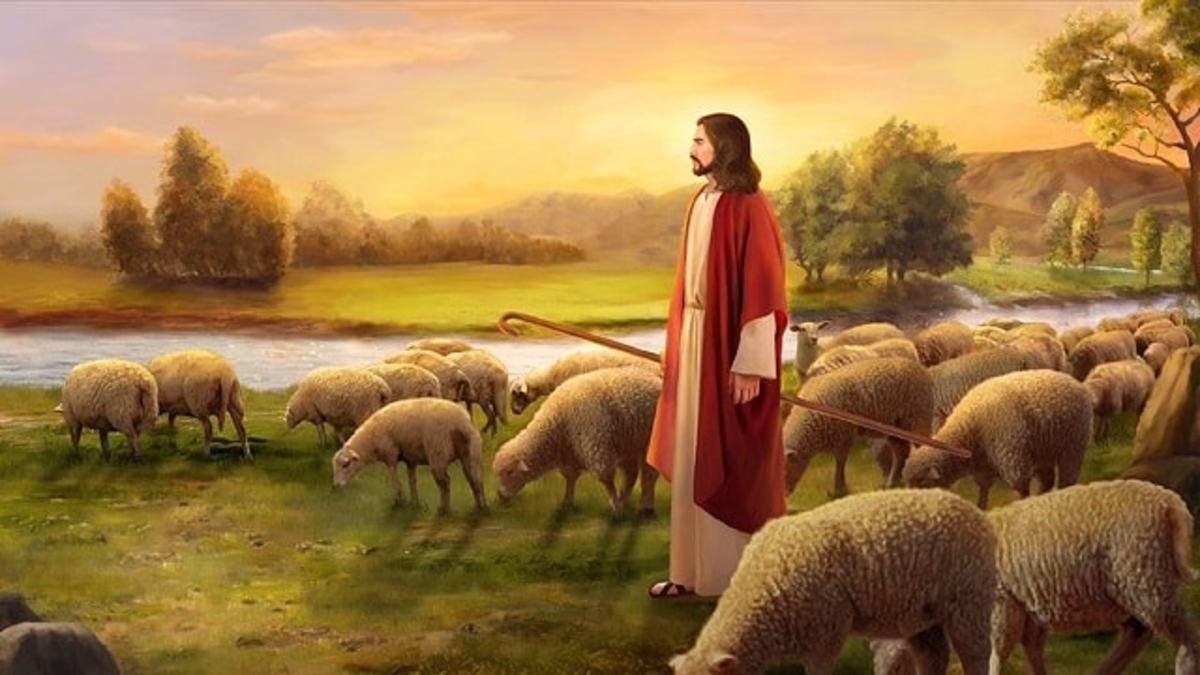
The Gospel passage for the Fourth Sunday of Easter is always on a section of Chapter 10 of John’s Gospel, the chapter of the Good Shepherd. Year A has the beginning of the chapter where Jesus compares Himself to the gate and gatekeeper of the sheep pen. Three years ago I embedded a wonderful exegesis from Dr. Brant Pitre. It is worth going back to hear it. The key is understanding the Old Testament allusion Jesus is making from Ezekial. The bad sheep are the past leaders of Israel.
To the shepherds, thus says the Lord GOD: Woe to the shepherds of Israel who have been pasturing themselves! Should not shepherds pasture the flock? You consumed milk, wore wool, and slaughtered fatlings, but the flock you did not pasture. You did not strengthen the weak nor heal the sick nor bind up the injured. You did not bring back the stray or seek the lost but ruled them harshly and brutally. So they were scattered for lack of a shepherd, and became food for all the wild beasts. They were scattered and wandered over all the mountains and high hills; over the entire surface of the earth my sheep were scattered. No one looked after them or searched for them. (Ez 34:2-6)
And Ezekial goes on to say that God Himself
will one day shepherd the people.
For thus says the Lord GOD: Look! I myself will search for my sheep and examine them. As a shepherd examines his flock while he himself is among his scattered sheep, so will I examine my sheep. I will deliver them from every place where they were scattered on the day of dark clouds. I will lead them out from among the peoples and gather them from the lands; I will bring them back to their own country and pasture them upon the mountains of Israel, in the ravines and every inhabited place in the land. In good pastures I will pasture them; on the mountain heights of Israel will be their grazing land. There they will lie down on good grazing ground; in rich pastures they will be pastured on the mountains of Israel. I myself will pasture my sheep; I myself will give them rest—oracle of the Lord GOD. (Ez 34: 11-15)

Today’s Gospel:
Jesus said:
"Amen, amen, I say to you,
whoever does not enter a sheepfold through the gate
but climbs over elsewhere is a thief and a robber.
But whoever enters through the gate is the shepherd of the sheep.
The gatekeeper opens it for him, and the sheep hear his voice,
as the shepherd calls his own sheep by name and leads them out.
When he has driven out all his own,
he walks ahead of them, and the sheep follow him,
because they recognize his voice.
But they will not follow a stranger;
they will run away from him,
because they do not recognize the voice of strangers."
Although Jesus used this figure of speech,
the Pharisees did not realize what he was trying to tell them.
So Jesus said again, "Amen, amen, I say to you,
I am the gate for the sheep.
All who came before me are thieves and robbers,
but the sheep did not listen to them.
I am the gate.
Whoever enters through me will be saved,
and will come in and go out and find pasture.
A thief comes only to steal and slaughter and destroy;
I came so that they might have life and have it more abundantly."
~Jn:10: 1-10
This is a great homily from our old friend Fr. Terrance Chartier.
He is so thorough on all the facets of this Gospel passage. I can only highlight a couple of his points.
Fr. Terrance:
In John 10:2, it says
that the good shepherd enters the sheepfold through the door or through the
gate, not through some other sneaky means. Now, what does this mean? Well, it
means that Jesus does things in the right way. The sheepfold is an image for
his church. So, Jesus acts through his
church. He enters the sheepfold through the door of the church. He's united
with his children through the sacraments. unites himself to us through the
sacraments. The catechism at number 1213
calls baptism the gateway to life in the spirit and the door which gives access
to the other sacraments. So Jesus uses
the means which he himself has established namely the sacraments and the
hierarchy of the church in order to reach his children his sheep. Shepherds in the church who have the heart of
the good shepherd, therefore act in accord and in conformity to the church.
They don't get at the sheep by going around the church or ignoring the church
or disobeying the church. Those who do so to quote our Lord's words are thieves
and robbers.
Secondly, the good shepherd calls his own sheep by name. John 10:3. When we were baptized, we were actually given a Christian name. We were given a baptismal name. And the catechism at number 2156 notes that through your name, Jesus, the good shepherd knows you personally. So through baptism, we belong to him. But after baptism, we truly belong to him or we continue to belong to him if we listen to his voice. My sheep hear my voice. He says in (John 10:27) meaning that we belong to Christ, if we live our life in conformity to his teaching and his commandments, if we strive to be faithful to the commandments, then Jesus really does know us on an intimate personal level. What will he say on judgment day to those who are condemned? He will say to them, quote, "I never knew you. Depart from me, you evildoers." (Matthew7:23). So when Jesus speaks to you now, when he speaks in your conscience and through the godly people in your life, you need to hear his voice. You need to listen to him.
There are more insights worth listening to including an exegesis of the 23rd psalm.
For the pastoral homily I will present to you someone who I have not embedded
on these Sunday homilies before, a Dominican from The Province of St. Albert
the Great—that’s the province from the Midwest of the United States—Fr. Charlie
Brouchard O.P.
There is no transcript to copy from, but I particularly liked his story about when he was in the novitiate and had to round up sheep in a camp experience with the other novitiates. “Those sheep neither recognized our voices nor followed us. In fact they were quite determined to not get on that truck and protested in every possible way they could, including leaving little presents all over the ground and on us!”
“We can say we believe there are many sheep gates to choose among but Jesus is suggesting to us in effect there is only one that will lead us to happiness and salvation.”
“One of the issues this [recent Catholic conversions] raises for us is whether we have spoken or behaved in a way that might have attracted even one single person to the faith. Has my witness in what I say or what I do made anyone say, “Oh maybe the Catholic Church...is the sheepgate that Jesus is talking about.”
The Church through our witness is the voice of Jesus calling out to the sheep.
Sunday Meditation: "Whoever
enters through me will be saved, and will come in and go out and find pasture."
Let’s return to John Michael Talbot with his “The Lord is My Shepherd.”
The Lord is my
shepherd;
I shall not want
Beside restful waters
I am there
In the pasture of
plenty
My soul lies down
So come all you
thirsty
Your soul shall be
refreshed
And come all you
inflicted
And be healed
For though we walk
In the darkness now
No evil shall be
feared
If the light of His
banner
Be at our side
The Lord is my
shepherd;
I shall not want
Beside restful waters
I am there
In the pasture of
plenty
My soul lies down
And come
All you hungry
At the table by His
bread
And come now
And be anointed
Overflow
With His goodness
And His kindness
For the rest of your
years
As you dwell within
the hosue
Of our Lord
The Lord is my
shepherd;
I shall not want
Beside restful waters
I am there
In the pasture of
plenty
My soul lies down