"Love follows knowledge."
"Beauty above all beauty!"
– St. Catherine of Siena

Showing posts with label German. Show all posts

Wednesday, August 24, 2016

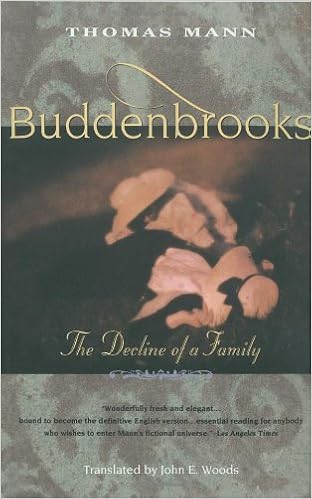
Buddenbrooks: The Decline of a Family by Thomas Mann, Part 2

I am thoroughly enjoying Thomas Mann’s Buddenbrooks: The Decline of a Family, and I gave some initial thoughts on the work about a month ago, here.  

I was only about a third of the way when I wrote that post, and today I’m nearly 60% (430 of 731) complete.  The father of the family, Johann Buddenbrooks (JB3), has long passed away, and the children have reached middle age and manifested their dysfunctionalities.  Tom, the oldest, vain and consumed by profit, has taken over the Buddenbrooks business, Christian has developed into a hypochondriac and fails at every endeavor he’s put to, Tony has married and divorced twice to horrible choices for husbands, and despite her saying she is now a mature woman is actually quite childlike in her naiveté, and Clara, the most religious of the children, has married a poor pastor and decided to live a simple and humble Christian life. 

As I mentioned in that July post the key I think to understanding this novel is to arrive at a reason for the family decline.  It’s there in the subtitle, “The Decline of a Family.”  I gave a list of possible reasons for that decline in that July post, and one of them was the “breakdown of the family.”  It is true that the children’s families are not anywhere as strong as their parent’s.  Tom marries the reclusive Gerda, whose sole passion in life is to play the violin; Christian has not married so far but has had affairs with loose, theater women, even a married woman, and even fathered a child.  Tony has been divorced twice, first to a scheming swindler and second to a lazy philanderer.  Clara has married far below her station, but in accordance to her faith and heart.  Perhaps her name, “Clara” which means “clear, bright” is a hint toward the theme of the novel—the name also famously belongs to St. Claire of Assisi, who is often depicted as holding a light— and let us remember that Clara is the child who we see Johann the father bless her at birth, as I quoted in the Part 1 post.  

But Clara the character is a relatively minor character, and if Thomas Mann were trying to bring this point to the fore he would have integrated her more into the narrative.  She is not dysfunctional as the other three; she is not as attractive as the other three, and her personality is introverted and muted.  Those are all contrasts to the other three, and that is something to take note of.  Still the dysfunctionality of the children does not really get to the heart of the question.  Sure the dysfunctionality somewhat leads to decline, but why are they dysfunctional to begin with?  Why would the children of JB3 and Elizabeth, from a wealthy and loving family, be lesser people from their parents?  While I’ve added to the list of possible causes, I’ve yet to feel I’ve come to the theme. 

I want to conclude this post with an extended quote from a scene between the two brothers, Tom and Christian, where Christian is pushed out of the Buddenbrooks business because of his incompetence and the embarrassment he has caused the firm while joking at the town Club the night before.  Here we see Tom the hard businessman and Christian the irresponsible fool.  Christian as usual has come in late to work the next morning.

He [Christian] was smoking—he had just finished breakfast and a quick game at the Club.  His hat was cocked a little low and he was swinging his yellow walking stick, the one from “out there,” with the carved ebony bust of a nun on the knob.  He was obviously in good health and the best of moods.  He was humming some melody or other as he came into the office, said, “Morning, gentlemen,” although it was a lovely spring afternoon, and added as he strode to his seat, “Have to get  bit of work done.” 

But the counsel [Tom] stood up and as he walked past he said, without looking at Christian, “Ah—a couple of words with you, my friend.”

Christian followed him.  They walked rather rapidly through the outer room.  Thomas had crossed his hands behind his back, and involuntarily Christian did the same and turned his head toward his brother, so that his large nose, its bony hook set squarely between his hollow cheeks, jutted out above his drooping reddish-blond English mustache.  As they moved across the courtyard, Thomas said, “I’ll ask you to accompany me while I take some air in the garden, my friend.”

Let me just break in here and tell you that for quite some time, Thomas has been repulsed and frustrated with his brother.  They are complete opposite in nature, Tom the disciplined businessman, Christian the devil-may-care bohemian.  Tom is seething within, and yet he is controlled and calls his brother, “my friend,” which he is clearly not.  Let me resume.

“Fine,” Christian replied.  And then came a long silence, during which they followed the outside path, passing the rococo façade of the “Portal” and skirting the garden, which was just coming into bloom.

Finally the counsel took a quick breath and said in a loud voice, “I am terribly angry—on your account.”

“My account?”

“Yes.  Someone at the Harmony told me about a remark you made yesterday at the Club—a remark so out of place, so indescribably tactless that I cannot find words for it.  And the fiasco was soon complete—you were given the most dreadful dressing-down on the spot.  Do you care to recall the incident?”

“Oh, now I know what you mean.  Who told you all this?”

“What does it matter?  Döhlmann.  And, of course he told me in a voice so loud that people who perhaps hadn’t heard about it yet could gloat over it, too”

“Yes, Tom, I must tell you, I felt quite embarrassed for Hagenström.”

“You felt…That’s really too much.  Now, listen to me!” the counsel shouted, stretching both his hands before him, palms up, and he tilted his head to one side, giving it a demonstrative and excited shake.  “There you are surrounded by both business and professional men, where everyone can hear you, and you say, ‘Seen in the light of day, actually, every businessman is a swindler’—you who are a businessman yourself, a part of the firm that strives with might and main, for absolute integrity, for a spotless reputation.”

“Good heavens, Thomas, it was a joke.  Although, actually…” Christian started to add, wrinkling his nose and thrusting his head forward at a little angle.  And, holding this pose, he walked a few more steps.

“A joke!  A joke!” the counsel shouted.  “I think I can take a joke—but you saw for yourself how your joke was taken.  ‘Well, I for one think very  highly of my profession.’  That was Hermann Hagenström’s answer.  And there you sat—a man who has wasted his life away, who has no respect for his own profession.”

“Yes, Tom, but what does one say then?  I assure you that the whole mood was shot to hell.  People were laughing as if they agreed with me.  And there sits Hagenström, all dreadfully serious, and says, “Well, I for one…’ What a stupid fellow.  I was truly embarrassed for him.  I thought long and hard about it lying in bed last night, and it gave me such a strange feeling.  I don’t know whether you know it, it’s…”

“Stop babbling, I beg you, stop babbling,” the counsel interrupted.  His whole body trembled with anger.  “I will admit, yes, I will admit that his answer perhaps did not fit the mood, that it was in bad taste.  But one seeks out the proper audience for saying something like that—if it really must be said.  But you don’t lay yourself open to such an insolent dressing-down.  Hagenström used the opportunity to get back, not at you, but at us, us.  Surely you realize what he meant with his ‘I for one,’ don’t you?  He meant: ‘Apparently you come by such notions in your brother’s office, Herr Buddenbrook.’  That’s what he meant, you ass!”

“Well, ‘ass’ is a bit…” Christian said with a chagrined, anxious look on his face.

“In the final analysis, you don’t belong just to yourself alone,” the counsel continued.  “But I assure you it is a matter of total indifference to me if you personally make a ridiculous fool of yourself.  And when don’t you make a fool of yourself?” he shouted.  He was white, and blue veins were clearly visible on his narrow temples, from which his hair fell back in two waves.  He had lifted one pale eyebrow, and even the stiffened, long ends of his mustache showed his anger; and as he spoke he flung his words with dismissive gestures on the gravel path at Christian’s feet.  “And you are making a fool of yourself with your little love affairs, with your buffoonery, with your sicknesses, with your remedies for your sicknesses.”

Tom claims an important point, which highlights the internal tension within the family: “In the final analysis, you don’t belong just to yourself alone.”  Each of the family members belongs to the firm, and so have an internal tension between their individuality and the family identity.  We saw this earlier when Tony felt it impossible to marry man she first loved because he was outside the business world.

“Oh, Thomas,” Christian said, shaking his head very seriously and lifting an index finger rather ungracefully, “as far as that goes, that’s something you can’t really understand.  The thing is—a man has to come to terms with his own conscience, so to speak.  I don’t know if you know the feeling.  [Dr.] Grabow prescribed a salve for the muscles here on my neck.  Fine.  And if I don’t use it, forget to use it, I feel quite lost and helpless and get all nervous and anxious and unsure of myself, and when I’m in that state I can’t swallow.  But if I use it, then I feel I’ve done my duty and that everything is in order; my conscience is clear, and I feel calm and content, and swallowing is absolutely effortless.  I don’t think the salve itself does it, you see.  But the main thing, you understand, is that one idea can only be canceled by an opposing idea.  I don’t know if you know the feeling…”

Oh yes, yes! the counsel shouted and held his head in both hands for a moment.  “Go ahead and do it!  Do what you must, but don’t talk about it.  Don’t babble on about it.  Leave other people in peace with your disgusting sensibilities.  You make a fool of yourself from morning till night with your indecent babblings.  But let me tell you this, I’ll repeat once more: I could not care less if you personally make a fool of yourself; but I forbid you, do you hear me, I forbid you ever to compromise the firm in the manner in which you did yesterday evening.”

Christian offered no response to this, except that he slowly ran his hand through his thinning reddish-blond hair and his face turned serious and anxious, his eyes drifting about absent-mindedly, seeing nothing.  He was doubtless still preoccupied with what he himself had last said.  There was a long pause.

Let me break in here again.  Both characters dysfunctions are apparent here.  Yes, Christian by making that “All businessmen are swindlers” comment was degrading to the firm, and Hagenström is a company rival who will try to make hay from it, but in the end it was just a joke, and nothing does come of it. Christian is seen as an unserious dilettante, but Thomas is overly effected by a joke.  He’s over reacting, because his character is vain and can’t accept a smudge to his persona.  Plus he has come to hate his brother.  Let me continue because this reaches to a very important point.

Thomas stalked away in quiet desperation.  “All businessmen are swindlers, you say,” he began again.  “Fine.  Are you tired of your job?  Do you regret having become a businessman?  You once convinced Father to allow you to…”

“Yes, Tom,” Christian said pensively, “but I would have much preferred to study.  It must be very nice at a university, you know.  You go to classes when you feel like it, quite voluntarily, you sit down and listen just like in a theater.”

“Just like in a theater.  Oh, you belong in a café chantant, as the comedian.  I’m not joking, I’m in dead earnest.  I am quite convinced that that’s your secret goal in life,” the counsel asserted.  And Christian certainly did not contradict him—just looked wistfully about.

“And you have the audacity to make such a remark, when haven’t the vaguest, not the vaguest idea of what work is.  Because you fill up your days with the theater and strolling about and buffooneries, creating a whole series of feelings and sensitivities and conditions to keep yourself occupied, to observe and nurse them, so that you can shamelessly babble on about them.”

“Yes, Tom,” Christian said, a little morosely, running his hand across his head again.  “That’s true; you’ve put it quite accurately.  That’s the difference between us, you see.  You enjoy watching a play, too, and you once told me, just between us, that you had your little affairs, and there was a time when you preferred reading novels and poems and such.  But you’ve always known how to reconcile that with regular work and a purpose in life.  That’s what I lack, you see.  I get totally used up by the other things, all the junk, you see, and have nothing left for the respectable part of life.  I don’t know if you know the feeling, but…”

Perhaps Christian has articulated another reason for the family’s decline: Christian lacks a purpose in life, and perhaps while the business world might satisfy some people, the children of the owner of the Buddenbrook’s firm may not have the inherent disposition to carry on his business, and therefore their directed purpose is in opposition to their natural inclinations.  Still, while we might see this with Christian, and perhaps Tony to a lesser extent, but Tom is clearly in a life that is congruent with his natural inclinations, and so is Clara’s.

“So, then, you do understand!”  Thomas shouted stopping in his tracks and crossing his arms on his chest.  “You admit it to your own shame, and yet you go on in the same old way.  Are you a dog, Christian?  Good God in heaven, a man has his pride!  One doesn’t go on living a life that one wouldn’t even think of defending.  But that’s what you do.  That’s who you are.  It’s enough for you just to perceive something and understand it and describe it.  No, my patience is at an end, Christian.”  And the counsel took a step backward, lifting his arms violently so that they stood straight out at his sides.  “It’s at an end, I tell you.  You draw your salary and never come to the office—although that’s not what exasperates me.  Go ahead and piddle your life away, just as you’ve done so far.  But you compromise us, no matter where you are, where you go.  You’re an abcess, an unhealthy growth on the body of your family.  You’re a scandal to the whole town, and if this house were mine I would turn you out, I would show you the door!” he shouted, gesturing wildly across the garden, the courtyard, the large entryway.  He could no longer contain himself—it was an explosion of all the rage he had stored up inside him.

“What is the matter with you, Thomas!” Christian said, now seized by a fit of anger himself—which looked rather odd on him.  He stood there in a pose not unusual for bowlegged people, bent in a kind of question mark, his head, belly and knees shoved forward, and his round, deep-set eyes, as large now as he could make them, had a flush around the edges that spread down to his cheekbones—just like his father when he was angry.  “How dare you speak like that to me,” he said.  “What have I ever done to you?  I’ll go, all on my own, you don’t need to throw me out.  Shame, shame!” he added as a heartfelt reproach and accompanied the words with a quick snapping movement of one hand, as if he were catching a fly.

Strangely enough, Thomas did not react with a more violent outburst, but silently lowered his head and started slowly back on the path around the garden.  It seemed to have satisfied him, to have actually done him good, finally to have made his brother angry, to have at last enabled him to react vigorously and raise some protest.

Tom has reached a point where the conversation is gravitating to where he wanted to go, that is, finding a way to push Christian out of the firm.  His anger and repulsion now transitions to Machiavellian reasoning.

“Believe me,” he said quietly, his hands crossed behind his back again, “when I say this conversation has been painful for me, Christian, but it had to happen sometime.  There is something awful about such scenes within a family, but we had to have it out once and for all.  And now we can discuss these matters quite calmly, my boy.  You’re not happy at your present position, I see, right?”

“No, I’m not, Tom.  You’re right there.  You see, at the start I was really quite content, and I do have things better here than I would in a strange office.  But I lack independence, I think.  I always envy you when I see sitting there and working, and it isn’t really work for you.  You don’t work because you have to—you’re in charge, you’re the boss, and you let others do your work for you.  You make your calculations and supervise things and are quite free.  That’s something very different.”  (p. 312-17)

I won’t quote any more.  It goes on to where Christian is pushed out of the Buddenbrooks firm and set up as a partner in another firm in Hamburg.  Later, we find out he’s a failure there too. 


Fantastic scene.  This is one of those passages I wished I had written.  


Wednesday, July 13, 2016

Buddenbrooks: The Decline of a Family by Thomas Mann

I’ve been reading Buddenbrooks a great novel by the German Nobel Literature Prize winner Thomas Mann, and I have to say I am engrossed in it.  I’m only a third of the way (completed 242 of 731 pages) and I am already convinced that this is ranks with the top tier of great novels.  It’s an epic, family generational novel centered on Buddenbrooks family that runs the family “firm” also referred to as Buddenbrooks.  The Buddenbrooks are a successful, upper middle class bourgeoisie family from Northern Germany.  Most of the novel is set in Lübeck, with occasional excursions into Hamburg and the German Baltic coast.  What a wonderful coincidence that this was the very region of Germany I visited and blogged about here a few years ago. 

The firm was established in 1768 by Johann Buddenbrook (let’s call him JB1 since there are a series of Johan Buddenbrooks) but that predates the novel.  The opening is set in 1835 with JB3 at the height of the family wealth hosting an extraordinarily elegant party on the occasion of buying a new home.   JB3 is also a Consul, which I take to be some part of the city government, and so family has both wealth and prestige.  More importantly, I think, is that we see the family at the height of harmony.  Here is the opening scene.  Monsieur Johan Buddenbrook is JB2 and Madame Antoinette Buddenbrook is his wife.  Tony is the daughter of JB3 and his wife Elisabeth, Madame Buddenbrook.

“What does this mean—What—does this mean…” 

“Well, now, deuce take it, c’est la question, ma très chère demoiselle!

Madame Buddenbrook was sitting beside her mother-in-law on the sofa, its clean lines accented with white enamel and a golden lion’s head, its cushions upholstered a pale yellow; she first shot a glance at her husband, the consul, who was seated in an armchair beside her, and then came to the rescue of her young daughter, who was perched on her grandfather’s knee near the window.

“Tony!” she said.  “I believe God made me—“

And little Antonie, a petite eight-year-old in a dress of softly shimmering silk, was thinking hard, her pretty blond head turned slightly toward her grandfather, but her grey-blue eyes directed into the room without seeing anything.  She first repeated “What does this mean,” then slowly said, “I believe God made me,” and quickly added, her face brightening, “—and all creatures,” and, suddenly finding the track smooth—she was unstoppable now and her face beamed with happiness—she rattled the whole article, as prescribed by her catechism, newly revised and published under the auspices of an august and wise senate in this year of our Lord, 1835.  Once you were moving, she thought, it felt just like racing down “Jerusalem Hill” on the sled with her brothers in winter: every thought vanished from your mind, and you couldn’t stop if you wanted to.

“Including clothes and shoes,” she said, “meat and drink, hearth and home, wife and child, fields and cattle…”  But at these words, old Monsieur Johann Buddenbrook burst into laughter, a high, pinched giggle that he had secretly kept at the ready.  He laughed in delight at being able to mock the catechism, had presumably arranged this little exam for just that purpose.  He inquired about Tony’s fields and cattle, asked how much she wanted for a sack of wheat, and offered her a contract.  His round, pastel pink, good-humored face—try as he would he could not look mean—was framed in snow-white powdered hair, and something like the merest hint of a pigtail brushed the wide collar of his mouse-gray frock coat.  He had not, at seventy proved untrue to the fashion of his youth; he had dispensed with lace between the buttons and the oversized pocket, but never in his life had he worn long trousers.  His broad double-chin rested comfortably on the wide lace jabot.

They all joined in the laughter, mainly out of respect for the head of the family.  Madame Antoinette Buddenbrook, née Duchamps, giggled exactly like her husband.  She was a stout lady with thick white curls at her ears, her unadorned black dress with pale grey stripes expressed simplicity and modesty, and her beautiful white hands clasped a small velvet reticule on her lap.  Over the years, her features had curiously become very like her husband’s.  Only the shape and lively dark hue of her eyes hinted at her half-Latin origins; her grandfather had been French-Swiss, but she was born in Hamburg.

Her daughter-in-law, Elisabeth Buddenbrook, née Kröger, laughed the Kröger laugh, which began with a splutter as her chin was pressed against her chest.  She was, like all Krögers, a person of great elegance, and though perhaps not a beauty, by her clear and cheerful voice, by her easy, sure, and gentle movements, she impressed everyone with her serenity and confidence.  Her reddish hair, which swept back high on her head in a little crowning swirl and lay in broad, carefully coiffed waves over her ears, matched well with her extraordinary soft white complexion and the few little freckles.  The most characteristic feature of her face, with its rather long nose and small mouth, was the lack of any indentation between lower lip and chin.  Her short bodice with high puffed sleeves was fitted to a narrow skirt of filmy silk patterned in bright flowers and open at a neck of perfect beauty, adorned by a satin ribbon glistening with a spray of large diamonds.

The consul fidgeted and bent forward in his armchair.  He wore a cinnamon jacket with broad lapels and leg-of-mutton sleeves that closed tight just below the wrist.  His fitted trousers were of a white, washable fabric and trimmed with a black stripe down each side.  The silk cravat wound around his stiff high-wing collar was fluffed to fill the broad, open neck of his multicolored vest.  He had something of his father’s deep-set, blue, watchful eyes, though perhaps with a more preoccupied expression; but his features were much less full than the old man’s. 

Madame Buddenbrook turned to her daughter-in-law, pressing her arm with one hand and giggling as she spoke into her own lap: “Oh, mon vieuw, always the same, is he not, Bethsy?”  She pronounced it “ollweez.”

The consul’s wife merely waved this aside with her delicate hand, setting her gold bracelet jingling softly; and then the hand performed a gesture peculiarly her own, moving from one corner of her mouth up to her coiffure, as if tucking back a hair that had strayed to her lips.

The consul, however, said with a mixture of indulgent amusement and reproach in his voice, “Now, Father, you are making fun of the most sacred matters again!”


This is quoted from the Vintage International Edition which has the highly acclaimed translation by John E. Woods.   


That opening scene seems so innocuous but it’s pregnant with meaning.  The elegance and wealth are quite obvious, as is the family harmony.  We see a touch of generational distinction between JB2 and JB3, which highlights the coming generational distinctions.  It is from this wealth and success that will have a downward slope as the novel progresses.  What is most interesting is that Mann opens the novel with a discussion of religion, and indeed the Buddenbrook’s Christian (Lutheran, to be exact, though I don’t know if that’s distinction of significance) faith plays a large role the novel.  It is also interesting that eight-year old Tony is at the center of the religious discussion because from what I understand as a mature woman she will have lost her faith by the end of the novel.  So in parallel with the decline of the business and the decline of the family as the Nineteenth Century progresses we have a decline in faith.

The style of the novel owes a great deal in my opinion to Stendahl’s and Leo Tolstoy’s novels.  The novel clearly ascribes to Realism as the aesthetic principle, and in the novel that means excruciating detail as it tries to recreate reality.  Also the genre evokes the family saga novel. That Wikipedia entry lists a number of family saga novels, but the family novel this reminds me the most isn’t even listed there, that is D. H. Lawrence’s novel of the three generations of the Brangwen family in The Rainbow.  

As with many of these epic, family saga novels in the tradition of Realism there are a huge number of characters to keep straight.  Here is a little family genealogy chart I’ve put together that might help the reader.
JB1

Old Johann (JB2),
  Josephine (1st wife)
Gottlieb (1st son, mother dies on childbirth), Stüwing (wife)
Children Frederike, Henriette, Pfiffi
  Antonette  (2nd wife)
            Johann (JB3), Elisabeth (wife)
                        Thomas (b. 1825)
                        Antoinette, “Tony” (b. 1827)
                        Christian (b. 1828)
                        Clara (b. 1838)

Tony marries Bendix
            Erika (b. 1846)

Thomas marries Gerda
            Johann “Hanno” (JB4 b. 1861)
                       

It is striking that the opening lines of the novel asks, “What does it mean?” lines uttered by Tony.  It is pointing the reader to the question, what is the cause of this great decline?  I cannot admit it is clear to me yet, here after reading one third of the novel.  I’ve listed in the back cover a series of possibilities, and I’ll share them with you.  They may all be part of a grand reason in an intertwined sort of way, but I don’t know.  Here’s my list, based of course on inductive reasoning from various scenes, in no particular order:
1. Breakdown of the family
2. Loss of faith and idealism
3. Rise of the lower classes displacing the middle and upper
4. Economic degeneration
5. Breakdown of social order
6. Wealth gained without work or sacrifice
7. Increase in the material aspects of life
8. Wealth as a dissolver of noble values
9. God’s will

Finally I want to provide one final scene from the beginning of the novel that crystallizes the idyllic life at the beginning of the novel.  Elisabeth has just given birth to their last child, Clara, and Consul Johann (JB3) leaves his writing desk to check on his wife and child.  Jean is the name his wife uses for him; Klothilde is a niece the Buddenbrook’s are raising at their home.   

He heard the sound of dainty, hasty chimes.  Just above the secretary hung a painting in muted colors, a depiction of an old-fashioned marketplace and a church, and in its steeple, a real clock had just struck ten in its distinctive tones.  The consul closed the case full of family records and carefully put it away in a black drawer of the secretary.  Then he went across to the bedroom.

Here the walls were hung with dark fabric in the same large-flowered pattern used for the long draperies of the new mother’s bed.  A feeling of peace and convalescence, of triumph over fear and pain, hung in the air, along with the scents of eau de cologne and medicines, their traces blended by the gentle warmth of the stove.  Only dim light filtered through the closed curtains.

Both grandparents were standing side by side, bent over the cradle and watching the sleeping child.  The consul’s wife, however, lay in bed, wearing an elegant lace jacket, her reddish hair perfectly coiffed, a happy smile playing over her rather pallid face.  She put out her lovely hand to greet her husband, a gold bracelet tinkling at the wrist, and as was her habit she turned the palm upward as far as possible, which seemed to heighten the warmth of her gesture. 

“Well, Bethsy, how are you feeling?”

“Splendid, splendid, my dear Jean!”

Her hand still in his, he turned toward his parents and lowered his face to the baby girl, who was breathing in rapid, noisy gasps, and for a whole minute he took in the warm, benign, touching fragrance she emitted.  “God bless you,” he said in hushed tones, kissing the brow of this little creature—whose tiny, wrinkled yellow fingers bore an awful resemblance to a chicken’s claws.

“She drank and drank something wonderful,” Madame Antoinette remarked.  “Just look at the stupendous weight she’s gained.”

“Would you believe me if I say she looks like my Netty?” old Johan Buddenbrook said, his face absolutely radiant with happiness and pride.  “Those flashing black eyes, the devil take me if …”

The old woman modestly waved this aside.  “Ah, how can anyone speak of resemblance at this point?  You’re going to church, Jean?”

“Yes, it’s ten—high time we left, I’m just waiting for the children.”

And the children could be heard now.  They were storming noisily down the stairs, to the accompaniment of Klothildes’s audible, chastening hisses; but when they entered the room, all dressed in their little fur coats—St. Mary’s still bore winter’s chill of course—they did so softly and cautiously, first of all because of their little sister, and second, because they had to compose themselves for Sunday worship.  Their faces were red and excited.  What a holiday!  The stork, definitely a very strong and muscular stork, had brought all sorts of marvelous things beside the new sister: for Thomas, a new sealskin school bag; for Antonie, a large doll with real—how extraordinary!—real hair; a colorful picture book for well-behaved Klothilde, who in her quiet, grateful way was occupied almost exclusively with a bag of sweets the stork had also brought; and for Christian, an entire puppet theatre, complete with Sultan, Death, and the Devil.

They kissed their mother and were permitted one cautious peek behind the green silk curtains, and then, together with their father, who had thrown on his cape and picked up his hymnal, they quietly set out for church, the Sunday calm broken only by piercing cries from the newest member of the family, who had suddenly awakened.


What a beautiful scene.  The birth of a child is the ultimate blessing.  Again it is pregnant with meaning.  I won’t get into all of it, but notice the painting in the first paragraph I quoted.  It displays a marketplace and a church, representative of the values of Christianity and the commerce, the values which are at the center of the novel.  Here they are crystallized in an idyllic moment.  But also in the painting is a clock, a symbol of time.  Time in the painting is frozen, and so the idyllic moment is frozen, but time in reality will progress, and change will head downward.


So far I adore this novel.


Thursday, July 31, 2014

Poetry: “Pentecost” by Annette von Droste-Hülshoff, Part 2

Almost two months ago I posted on my discovery of theGerman poet, Annette von Droste-Hülshoff and included a poem titled “Pentecost” both in the original German and an English translation.  As I mentioned in the post, a German friend was the one who made me aware of her poetry.  Well, my German friend, her first name being Barbara, read the post, and being an English teacher in Germany her interest was stimulated by the English translation.  She wrote me a nice note with her thoughts on the translation, and I have her permission to post them.  So this was a treat: to have someone who is fluent in both her native German and English, and is very knowledgeable on literature break down in detail a translation of a famous German poem.  I just had to share this.  She starts her letter this way: 

I was quite amazed to see that you had put her poem "Pentecost" on your blog - in English AND German! I had never read a translation of one of her poems before so I was curious whether too much was "lost in translation". As you already stated in your blog, you see a "red flag" when the translator tries to stick to rhyme scheme and meter. So I spent a nice evening comparing, sometimes amazed about the beauty in the English version, sometimes sighing about things that got lost. 

First, here is the original German poem:
Pfingstsonntag 

Still war der Tag, die Sonne stand
So klar an unbefleckten Domeshallen;
Die Luft, von Orientes Brand
Wie ausgedörrt, ließ matt die Flügel fallen.
Ein Häuflein sieh, so Mann als Greis,
Auch Frauen knieend; keine Worte hallen,
Sie beten leis!  

Wo bleibt der Tröster, treuer Hort,
Den scheidend doch verheißen du den Deinen?
Nicht zagen sie, fest steht dein Wort,
Doch bang und trübe muß die Zeit uns scheinen.
Die Stunde schleicht; schon vierzig Tag
Und Nächte harrten wir in stillem Weinen
Und sahn dir nach.  

Wo bleibt er nur, wo? Stund' an Stund',
Minute will sich reihen an Minuten.
Wo bleibt er denn? Und schweigt der Mund,
Die Seele spricht es unter leisem Bluten.
Der Wirbel stäubt, der Tiger ächzt
Und wälzt sich keuchend durch die sand'gen Fluten,
Die Schlange lechzt.  

Da, horch, ein Säuseln hebt sich leicht!
Es schwillt und schwillt und steigt zu Sturmes Rauschen.
Die Gräser stehen ungebeugt;
Die Palme starr und staunend scheint zu lauschen.
Was zittert durch die fromme Schar,
Was läßt sie bang' und glühe Blicke tauschen?
Schaut auf! Nehmt wahr!  

Er ist's, er ist's; die Flamme zuckt
Ob jedem Haupt; welch wunderbares Kreisen,
Was durch die Adern quillt und ruckt!
Die Zukunft bricht; es öffnen sich die Schleusen,
Und unaufhaltsam strömt das Wort
Bald Heroldsruf und bald im flehend leisen
Geflüster fort.  

O Licht, o Tröster, bist du, ach,
Nur jener Zeit, nur jener Schar verkündet?
Nicht uns, nicht überall, wo wach
Und Trostes bar sich eine Seele findet?
Ich schmachte in der schwülen Nacht;
O leuchte, eh' das Auge ganz erblindet!
Es weint und wacht.  

Annette von Droste-Hülshoff

Once again, here is the English translation:

Pentecost
by Annette Von Droste-Hulshoff
 

The day was still, the sun's bright glare
Fell sheer upon the Temple's beauteous wall
Withered by tropic heat, the air
Let, like a bird, its listless pinions fall.
Behold a group, young men and gray,
And women, kneeling; silence holds them all;
They mutely pray! 

Where is the faithful Comforter
Whom, parting, Thou didst promise to Thine own?
They trust Thy word which cannot err,
But sad and full of fear the time has grown.
The hour draws nigh; for forty days
And forty wakeful nights toward Thee we've thrown
Our weeping gaze.  

Where is He? Hour on hour doth steal,
And minute after minute swells the doubt.
Where doth He bide? And though a seal
Be on the mouth, the soul must yet speak out.
Hot winds blow, in the sandy lake
The panting tiger moans and rolls about,
Parched is the snake.  

But hark! a murmur rises now,
Swelling and swelling like a storm's advance,
Yet standing grass-blades do not bow,
And the still palm-tree listens in a trance.
Why seem these men to quake with fear
While each on other casts a wondering glance?
Behold! 'Tis here!  

'Tis here, 'tis here! the quivering light
Rests on each head; what floods of ecstasy
Throng in our veins with wondrous might!
The future dawns; the flood-gates open free;
Resistless pours the mighty Word;
Now as a herald's call, now whisperingly,
Its tone is heard.  

Oh Light, oh Comforter, but there
Alas! and but to them art Thou revealed
And not to us, not everywhere
Where drooping souls for comfort have appealed!
I yearn for day that never breaks;
Oh shine, before this eye is wholly sealed,
Which weeps and wakes. 

Barbara continues:

All in all, considering the difficulties of translating poetry, it is a good translation. But in several places, AvD's language is stronger, richer, more consistent in imagery. If you want to know the details - read on. If you don't, just skip the next lines and wait for my next letter, which will deal with your last letter and a few other things. :-) 

“AvD” is Barbara’s abbreviation for Annette Von Droste-Hulshoff.  Next Barbara goes stanza by stanza to highlight where she disagrees with the translation.  Barbara’s analysis is indented, and my comments to her analysis break in below. 

Stanza 1: "The Temple's beauteous wall" - almost a hit, but AvD says "immaculate", a word which has certain religious connotations (as in "Immaculate Conception"). 

Stanza 2: "The hour draws nigh" - So far, I have only encountered the expression "draw nigh" in contexts where it means "approach", and my dictionary says the same. AvD writes, "Die Stunde schleicht", meaning that it creeps or crawls, i.e. time passes very slowly as it often does when you are waiting for something to happen. Moreover, in German there is an alliteration as both words begin with the sound 'sh'.  

Excellent.  There would be no way for one not fluent in German to pick up on those subtleties.    

Stanza 3: You already drew your readers' attention to such alliterations and repetitions. A repetition (also found in l. 1 of stanza 2) is "Wo bleibt ...", which - I must admit - is almost untranslatable. Relatively close translations are "Why does He fail to appear" or "Wherever has He got to", but both are somehow unsatisfactory and useless in a poetic text. These are questions that German people may ask who are waiting desperately for someone to turn up. 
"Though a seal/ be on the mouth, the soul must yet speak out"
The (rather common) metaphor of the seal is not in the German text, and I don't know why it should be used here because a seal on the mouth always means that the person is not allowed to speak, be it that someone else forbade it or the person him- or herself. AvD uses a metaphor in the next line: "the soul speaks out bleeding silently". 
In the following, AvD uses imagery from nature, from the hot desert, which she already described in the first stanza. This imagery from nature is one of the weaker points of the translation. "Hot winds blow" - that's rather plain; AvD writes about a whirlwind whirling the dust through the air ("Der Wirbel stäubt" - I need a sentence to explain her three words!). And now there seems to be water - but the floods ("Fluten") consist of sand only. The translation could give people the impression there was a lake after all, though with a lot of sand in it. But I like the way the actions of the tiger and the snake are rendered. 

Ah, now the insertion of that “seal” metaphor is a significant failure on the part of the translator.  One can accept a roundabout way to translate something that is untranslatable and to simplify the nature imagery, but to create a metaphor where one doesn’t exist is a distortion.  Idioms might have to be glossed over, but metaphors in poetry are the poem’s soul.   

Stanza 4: (Are you still here? I admire your patience ...)
"a murmur" (of people?) - AvD says "Säuseln", which is the sound of a very light breeze so she stays within the imagery of nature. The whirlwind on the ground did not seem to make any unusual noise, but now everyone can hear that the wind is getting stronger "swelling and swelling and rising to a roaring storm" - the storm is already there, not just advancing. Am I too petty here? I suppose I am.
"wondering glance" - "fearful and glowing (fiery) glance(s)". Now there's the beginning of the next group of images - fire.
"'Tis here" - "Perceive" 

No, you did not lose me…lol.  I think the translator was using murmur for the breeze.  A breeze murmurs is a cliché in English, and the translator was being unimaginative.   

Stanza 5: "'Tis here" - "It's Him"
"quivering light" - not strong enough. AvD talks about flaring or flashing flames.
"the future dawns" - "the future breaks (open) - slow versus rapid process. 

"Whisperingly ... is heard" - AvD writes about a silent whisper which is like begging for something. And it is not only heard but - as the "flood-gates" are now open, releasing a lot of water - the words are like a river making its way. But the translator mentions this aspect in the line before. 

Stanza 6: ll. 1f and 3f are questions. 

"Ich schmachte in der schwülen Nacht" - In German, the word "schmachten" has three connotations:
1. feeling a strong hunger, starving
2. being in a dungeon, underfed and robbed of your freedom
3. having a strong craving for your lover 

So we might say that here is a hungry soul waiting for salvation, for a sign of the Lord, for comfort. In the translation the soul is only waiting for "day that never breaks" - an invention of the translator. Moreover, the night is "schwül", i.e. sultry, which brings us back to the imagery of the hot, almost unbearable weather, giving us the impression of a soul that finds its present state almost unbearable. 

I have no idea why the translator did not translator those lines into questions.  Seems like another significant flaw.  And thank you for dissecting the line “Ich schmachte in der schwülen Nacht."  Even with my extremely poor German I can hear the beauty in that line.   

And thank you Barbara for taking the time to write this.  I certainly appreciate it.