
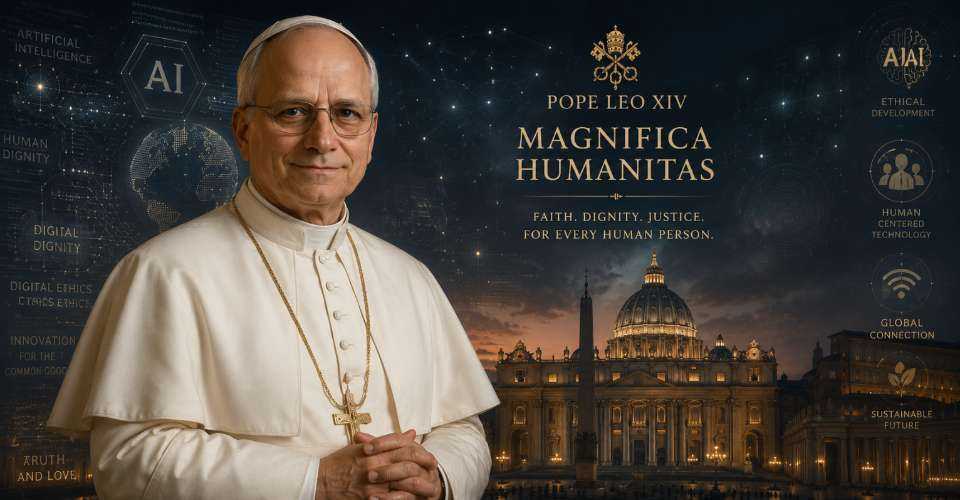
As many of you know on May 25th, Pope Leo
published his first encyclical, Magnifica Humanitas, on the cautions and
moral use of artificial intelligence (AI).
The encyclical established the Catholic Church’s social teaching on the
use of AI, especially in regard to human dignity and the common good. Let me say up front, I have not read the
encyclical but I have read summations and excerpts. The details of the encyclical are not the
concern of this post. What I do what to
point out is the starting quote within the document.
Magnifica Humanitas contains a quote from J.R.R. Tolkien’s epic novel, Lord of the Rings. More specifically it quotes from a piece of dialogue from one of its main characters, the character who represents wisdom and moral rectitude of the wizard, Gandalf the Grey. After his sacrificial act of saving the fellowship at the expense of his life, Gandalf will later in a “resurrection” of sorts, return as Gandalf the White, the name change reflecting a process of purification. But as “Gandalf the Grey” he symbolizes a man of wisdom. Indeed, grey has long been associated with wisdom and prudence, alluding to the ancient Greek “grey-eyed” goddess of wisdom, Athena. But I think it also associates with those of us in a particular age group of grey-haired or grey-bearded. (Ha, that’s one of the few benefits of reaching my age!) Where I work we sometimes refer to the experience “old-timers” as “the grey beards.”
With that context, let’s turn to the quote:
It is not our part to master all
the tides of the world, but to do what is in us for the succour of those years
wherein we are set, uprooting the evil in the fields that we know, so that
those who live after may have clean earth to till.

There has been several commentaries in the public domain on
why Pope Leo chose this quote. I’m going
to draw on two.
James T. Keane in writing in the Catholic magazine, America, “Why Pope Leo’s new encyclical quotes Gandalf: Literary images of hope and faith in ‘Magnifica Humanitas’ “ first offers surprise:
Of all the startling things one
might find in a papal encyclical, a quote from J. R. R. Tolkien might take the
cake. It’s not the first time a novel has made an appearance in such a format,
as The Brothers Karamazov showed up in Pope Francis’ “Dilexit Nos,” but
who would ever have thought The Lord of the Rings would appear in a
magisterial document?
But there it is—a quote from
Gandalf right smack in the middle of the text…As for the horrifically mixed
metaphor, blame Tolkien, not the pope.
Ha! The mixed
metaphor he refers to is the “tide” metaphor which opens the quote with the
tilling of soil as to the solution the tides present. That is a mixed metaphor but Tolkien has put
the quote into the mouth of Gandalf, so it would follow common speech patterns of
dialogue rather than formal prose. But
even in formal prose, I personally do not find mixed metaphors problematic per
se. They become problematic if they
confuse or contradict. I don’t find that
to be the case here.
Also interesting is that Pope Francis had used a quote from
a novel, The Brothers Karamazov. Over
the years I had found Pope Francis to have a very good knowledge of literature. I think recall the Holy Father quoting Dante
and Borges and Cervantes. There are
others I’m sure but my memory is faulty.
He actually wrote a letter on the use of literature in the formation of
priests and religious. I published my reading
of it here.
Pope Francis also had an Apostolic Letter commemorating the passing of
Dante Algheri, and I published two posts on reading through it, here and here. I don’t know if Pope Leo is as knowledgeable
of literature as Pope Francis, but he is following in his footsteps on drawing from
classic literature.
Kean provides the context of Leo’s Magnifica Humanitas to show how the Tolkien (through Gandalf) quote is relevant.
Paragraph 90 [of Magnifica
Humanitas] gives us the most important question: “We are called to reflect
on the great ‘construction sites’ of our era and ask: What are we building?”
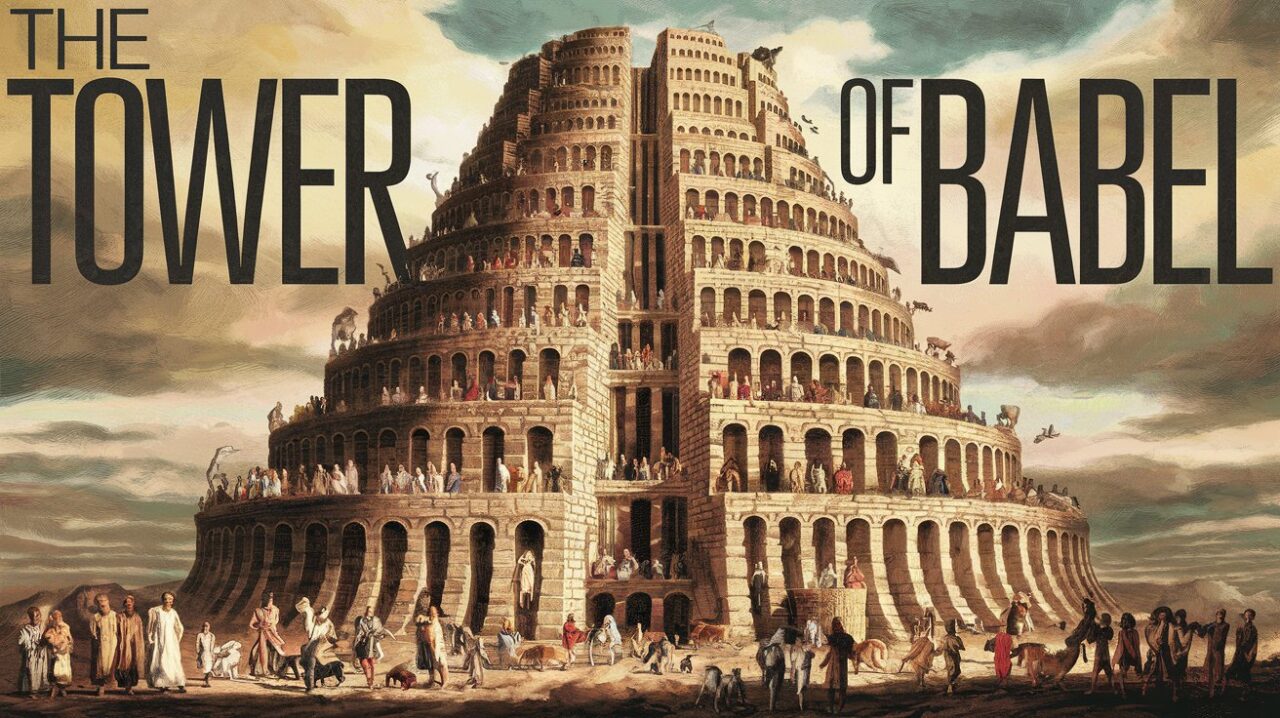
Throughout “Magnifica Humanitas,” the two images he uses to represent the
choice before us are of the Tower of Babel from Genesis and Nehemiah’s slow
reconstruction of Jerusalem from the Book of Nehemiah: The first story tells of
the thoughtless arrogance taken on by a humanity that sees its own
glorification as the goal of existence; the second tells of the humble and
painstaking act of constructing something holy, brick by brick. You can guess
which one our Augustinian pope prefers.
So, concerning artificial intelligence, the central subject
matter of the encyclical, Pope Leo is not innately opposed to AI, but he calls
into question the manner of its use and the implications of its purport. Pope Leo uses two opposing Biblical images to
present the possibilities. With AI, we
could be building a Tower of Babel, a prideful challenge to God’s
providence. Or we could be rebuilding
Jerusalem after the destruction of the Temple from the Babylonian siege. The first is degradation of human dignity;
the second is working with God for the building of human institutions. Kean consolidates Pope Leo’s thesis.
What are we building? What are the great construction sites of our era? A tower to the heavens, the A.I. enthusiasts tell us, whether you want it or not. It can’t be stopped. Perhaps not, “Magnifica Humanitas” concedes, but it certainly doesn’t have to be a folly that destroys human solidarity forever. It could be a new work of a magnificent humanity, holy and built on the ideas and images and labors of a humanity that seeks more than simply efficiency or profit.
Could it be possible that artificial intelligence would be
holy and transcend efficiency or profit?
Highly unlikely.
Joseph Pearce, writing in the National Catholic Register, “Why Pope Leo Quoted Tolkien’s Gandalf,” has a little different perspective on Pope Leo’s quote of Gandalf.
Essentially, Gandalf is saying that
localism is the only effective response to globalism. None of us, as
individuals, as mere pint-sized hobbits in a world of great and largely dark
powers, can defeat the power of global corporations and the invasive technology
that they are trying to impose upon us. “It is not our part to master all the
tides of the world.”
On the other hand, we are called
“to do what is in us for the succour of those years wherein we are set.” We are
only called to attend to the times in which we live and to work to make the
world in which we find ourselves a better place by loving and serving those
around us. It is pointless worrying about how evil our own time is and equally
pointless to vainly wish that things were different.
“I wish it need not have happened
in my time,” Frodo complains to Gandalf.
“So do I,” Gandalf replies, “and so
do all who live to see such times. But that is not for them to decide. All we
have to decide is what to do with the time that is given us.”
Other than Pearce’s touch of contemporary ideology (“localism is the only effective response to globalism”), he is identifying that Gandalf is stating that resolving the immediate needs of your neighbors will cure what is wrong with the world at large. If everyone paid attention to one’s neighbors, the aggregate attention would bring about the Kingdom of God. And it’s not the geographic restrictions that Pearce identifies. He sees Gandalf’s quote temporally as well.
No, we cannot choose the time in which we are born. We might wish to have lived, as Frodo does, in more peaceful and virtuous times, unravaged by war and wickedness, but that is not for us to decide. What we do need to decide is what to do with the time that is given us in the times in which we find ourselves. In the words that Pope Leo quotes, Gandalf tells us that we cannot stop all the wars and all the wickedness, we cannot “master all the tides of the world,” but we can decide to fight wickedness where we find it in our own small sphere of influence, “uprooting the evil in the fields that we know, so that those who live after may have clean earth to till.”
In the context of the situation, Pearce sees Gandalf’s quote
as containing a moral directive to Frodo.
Our calling, our responsibility, is to be good and faithful stewards of the good things we’ve been given and to be good and faithful servants of the Lord our God and of those who are our neighbors in the Shire in which we live, and of those who will be born after us.
And so, this I think is where Pope Leo is coming from. Artificial Intelligence requires a moral
responsibility to not use it in a prideful, self-centered way, and to consider
the benefits to the common good that it could contain as a glorification of God.

No comments:
Post a Comment