"Love follows knowledge."
"Beauty above all beauty!"
– St. Catherine of Siena

Showing posts with label Jeff Cavins. Show all posts

Sunday, September 7, 2025

Sunday Meditation: The Cost of Discipleship

So last week the gist of Jesus’s message was a disciple’s need to have humility.  Perhaps that wasn’t very shocking.  Today, on the Twenty-Third Sunday in Ordinary Time, Jesus, in His sermon on the pilgrimage to Jerusalem, stuns the journeying crowd: you must hate mother, father, family, and everything to follow Him.  We know this is hyperbole, but I suspect it’s because the great crowds following and probably pressing up against Him that causes Him to reach for a sensational metaphor. 


Great crowds were traveling with Jesus, and he turned and addressed them, “If anyone comes to me without hating his father and mother, wife and children, brothers and sisters, and even his own life, he cannot be my disciple.

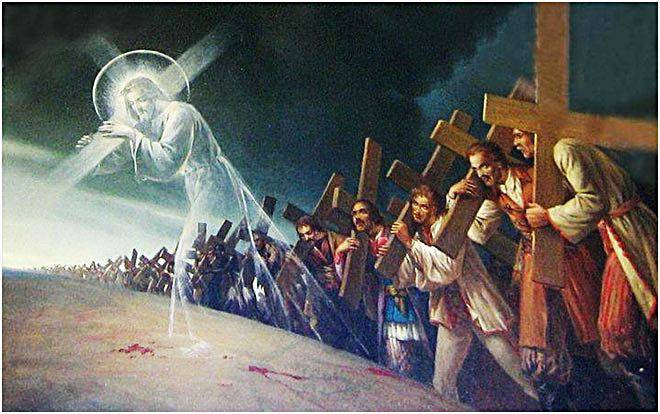
Whoever does not carry his own cross and come after me cannot be my disciple.

Which of you wishing to construct a tower does not first sit down and calculate the cost to see if there is enough for its completion?

Otherwise, after laying the foundation and finding himself unable to finish the work the onlookers should laugh at him and say,

‘This one began to build but did not have the resources to finish.’

Or what king marching into battle would not first sit down and decide whether with ten thousand troops he can successfully oppose another king advancing upon him with twenty thousand troops?  But if not, while he is still far away, he will send a delegation to ask for peace terms.

In the same way, anyone of you who does not renounce all his possessions cannot be my disciple.” 

~Lk 14:25-33


I hadn’t found a homily from Fr. Terrance Chartier of the Franciscan Friars of the Immaculate in quite a while.  He’s one of my favorite homilists.  He doesn’t disappoint.


I love the way Fr. Terrance links Jesus’s hyperbole to Old Testament examples, showing the continuity between Old and New.  But of even more importance I think is Fr. Terrance’s pointing out that you can’t really love your family as you should until you have prioritized love for God first.  Jesus is the source.  One flows to the other.  Praise be Jesus, and don’t forget our Blessed Mother’s birthday tomorrow.

Jeff Cavins provides a solid pastoral homily on this difficult passage.


No, don’t hate mom and dad.  But you need to count the cost of discipleship.  That is why Jesus provides the builder and war general illustrations.


Sunday Meditation: “Whoever does not carry his own cross and come after me cannot be my disciple.”


I absolutely love this Christian hymn, “All for Jesus.”  I don’t know who sings it, but it’s lovely.


Let my hands perform His bidding,

Let my feet run in His ways;

Let my eyes see Jesus only,

Let my lips speak forth His praise.

Sunday, June 29, 2025

Sunday Meditation: The Solemnity of Peter and Paul

Today is the third feast Sunday following Pentecost, and today is one that is fixed to the 29th of June.  When it doesn’t fall on a Sunday, it used to be a Holy Day of Obligation, and it still is in some parts of the world.  Where it is not, such as the United States, it is transferred to the following Sunday.


There are several Gospel readings for this feast, depending on whether the Mass is a vigil, day, or night.  I will choose the day Mass for Year C:


When Jesus went into the region of Caesarea Philippi

he asked his disciples,

“Who do people say that the Son of Man is?”

They replied, “Some say John the Baptist, others Elijah,

still others Jeremiah or one of the prophets.”

He said to them, “But who do you say that I am?”

Simon Peter said in reply,

“You are the Christ, the Son of the living God.”

Jesus said to him in reply, “Blessed are you, Simon son of Jonah.

For flesh and blood has not revealed this to you, but my heavenly Father.

And so I say to you, you are Peter,

and upon this rock I will build my Church,

and the gates of the netherworld shall not prevail against it.

I will give you the keys to the Kingdom of heaven.

Whatever you bind on earth shall be bound in heaven;

and whatever you loose on earth shall be loosed in heaven.”

   ~Mt 16:13-19


That is the often quoted passage of Jesus handing the keys of heaven and hell, binding and loosing to St. Peter.

Fr. Geoffrey Plant once again provides a thorough understanding of the Solemnity’s significance. 


Amazing this feast day goes back to the third century!  That when the Church was still being persecuted.  I really like that quote from St. Augustine: “Both apostles share the same feast day, for these two were one, and even though they suffered on different days, they were as one.  Peter went first and Paul followed.  And so we celebrate this day made holy by the apostles’ blood.  Let us embrace what they believed, their life, their labors, their sufferings, their preaching, and their confession of faith.”

Also fascinating is that in the New Testament, Peter is mentioned by three names: Peter (154 times), Simon (75 times), and Cephas (7 times). 

Jeff Cavins provides us a pastoral preaching (he is not a priest to call it a homily) on this Solemnity. 


Of particular note is the pattern Cavins points out between the Gospel and the Acts of the Apostles, between Jesus and the apostles after the Resurrection, and then between the first half of Acts with Peter and the second half with Paul.  And so there are parallels between Jesus, Peter, and Paul. 


Sunday Meditation: “But who do you say that I am?”


For the hymn, I’m going to bet you never heard this before.  “St. Paul’s Blues” by John Michael Talbot. 


Has anyone heard that before?  I did not think John Michael Talbot ever took on the blues form.  I’m not sure what to think. 


Sunday, January 5, 2025

Solemnity Meditation: The Magi

On this second Sunday of Christmas, we celebrate the Solemnity of the Epiphany of the Lord.  Who were these strange men—the Gospel does not say they were kings—who followed a star to baby Jesus?  Well I had four blog posts on the reading of Fr. Dwight Longenecker’s book, The Mystery of the Magi.  If you really want to know who these mysterious men were—not the fable of Balthazar, Caspar, and Melchior—but the real history, read my posts.  Here is blog post #4 on Fr. Longenecker’s book, and from there are links to Posts one, two, and three.  The real history is more astonishing than the legend. 

However, Matthew’s spiritual significance is just what epiphany means.   Epiphany is a revelation of God, a theophany, and here the Magi reveal to the world that baby Jesus is the Christ, King of the Jews.


When Jesus was born in Bethlehem of Judea,

in the days of King Herod,

behold, magi from the east arrived in Jerusalem, saying,

“Where is the newborn king of the Jews?

We saw his star at its rising

and have come to do him homage.”

When King Herod heard this,

he was greatly troubled,

and all Jerusalem with him.

Assembling all the chief priests and the scribes of the people,

he inquired of them where the Christ was to be born.

They said to him, “In Bethlehem of Judea,

for thus it has been written through the prophet:

And you, Bethlehem, land of Judah,

are by no means least among the rulers of Judah;

since from you shall come a ruler,

who is to shepherd my people Israel.”

Then Herod called the magi secretly

and ascertained from them the time of the star’s appearance.

He sent them to Bethlehem and said,

“Go and search diligently for the child.

When you have found him, bring me word,

that I too may go and do him homage.”

After their audience with the king they set out.

And behold, the star that they had seen at its rising preceded them,

until it came and stopped over the place where the child was.

They were overjoyed at seeing the star,

and on entering the house

they saw the child with Mary his mother.

They prostrated themselves and did him homage.

Then they opened their treasures

and offered him gifts of gold, frankincense, and myrrh.

And having been warned in a dream not to return to Herod,

they departed for their country by another way.

~Mt 2:1-12


Fr. Geoffrey Plant as usual does a thorough of explaining the historical and biblical significance of the Epiphany.


Fr. Geoffrey gives a handful of theories of where the Magi came from but none of them agree with Fr. Longenecker’s research.  I would go with Fr. Longenecker. 

Now for a sermon on the spiritual significance of the epiphany, let’s turn to Jeff Cavins.


It occurs to me that the light given off by Christ shines through the Magi.  Let the light of Christ shine through you.  Let your person be a manifestation of Christ, an epiphany to the world.

We don’t see much of how the Magi are transformed by their visit, but the poet T.S. Eliot speculates on how one particular Magus (singular for Magi) is transformed in his great poem “The Journey of the Magi.”  I provided a detailedanalysis of the poem here if you wish to read and understand this great work of poetry.    


Solemnity Meditation: “Where is the newborn king of the Jews?  We saw his star at its rising and have come to do him homage.”


Instead of a hymn this week, I am going to provide a reading by someone named Arthur L. Wood of T.S. Eliot’s he Journey of the Magi.” 


I selected this clip since it provided the words, but that is also an excellent reading.

Sunday, December 8, 2024

Sunday Meditation: The Salvation Of God

The Second Sunday of Advent is reserved for the appearance of John the Baptist, and in in Year C we get Luke’s presentation of St. John set in his historical and political context, having received the word of God in the desert and quoting from the Book of Isaiah (Is 40:3-5).


In the fifteenth year of the reign of Tiberius Caesar,

when Pontius Pilate was governor of Judea,

and Herod was tetrarch of Galilee,

and his brother Philip tetrarch of the region

of Ituraea and Trachonitis,

and Lysanias was tetrarch of Abilene,

during the high priesthood of Annas and Caiaphas,

the word of God came to John the son of Zechariah in the desert.

John went throughout the whole region of the Jordan,

proclaiming a baptism of repentance for the forgiveness of sins,

as it is written in the book of the words of the prophet Isaiah:


    A voice of one crying out in the desert:

    “Prepare the way of the Lord,

        make straight his paths.

    Every valley shall be filled

        and every mountain and hill shall be made low.

    The winding roads shall be made straight,

        and the rough ways made smooth,

    and all flesh shall see the salvation of God.”

~Lk 3:1-6

What is interesting is that what Isaiah actually says in that last line is that “all flesh shall see the glory of God.”   I don’t know the original languages, so I don’t know why the distinction between the “glory of God” and “salvation of God.”  All the major translations use “glory” in the Isaiah and “salvation” in Luke.  Is there an actual distinction?  What exactly is Luke referring to when he says all will see the “salvation of God?”  So when I go to Bible Reference and I ask about Luke 3:6, it says this: 


In this context, "the salvation of God" is a reference to the Messiah, the Promised One, who is Christ. The prediction is that all people will be made aware of this Savior (Romans 1:18–20), not that all people will be saved by Him (John 3:36). The gospel is universal in its availability: any who want to repent and express faith can be saved by doing so (John 6:37; 2 Peter 3:9). Not all will choose that path (John 3:18).

So then, John the Baptist is expanding on Isaiah, not quoting him exactly. I don't think any of the homilies mention that.

This week I’ll come back to Fr. Geoffrey Plant to expound on the passage, and he does a particularly good job on explaining the historical allusions.


Now for a homily applying it more to one’s life and faith, I turn to Jeff Cavins.


Sunday Meditation: “All flesh shall see the salvation of God.”


Oh, this is such a lovely Christian contemporary song, “Ready the Way,” by Curtis Stephan.


Make ready the way…

Sunday, November 3, 2024

Sunday Meditation: The Love of God

Last week Jesus was at Jericho on His way to Jerusalem.  Today we find Him in Jerusalem, and it is during Holy Week.  Because we have split off the Gospel readings between Easter and Ordinary Time, we have already read Jesus’s triumphant Palm Sunday entrance into Jerusalem.  Now we pick up on events prior to the Last Supper, which we already read.

Today Jesus is questioned by a Scribe.


One of the scribes came to Jesus and asked him,

"Which is the first of all the commandments?"

Jesus replied, "The first is this:

Hear, O Israel!

The Lord our God is Lord alone!

You shall love the Lord your God with all your heart,

with all your soul,

with all your mind,

and with all your strength.

The second is this:

You shall love your neighbor as yourself.

There is no other commandment greater than these."

The scribe said to him, "Well said, teacher.

You are right in saying,

'He is One and there is no other than he.'

And 'to love him with all your heart,

with all your understanding,

with all your strength,

and to love your neighbor as yourself'

is worth more than all burnt offerings and sacrifices."

And when Jesus saw that he answered with understanding,

he said to him,

"You are not far from the kingdom of God."

And no one dared to ask him any more questions.

~Mk 12:28-34


Fr. Geoffrey Plant gives one of his comprehensive explanations for this passage. 


If you didn’t know, Fr. Geoffrey tells us there are 613 commandments in  the Torah!  So you are way off if you think there are only the Ten Commandments.  I also thought the comment by Amy-Jill Levine (who is Jewish by the way, but a New Testament Scholar) observes that Jesus actually added to the Shema, “with all your mind.”  That is not there in Deuteronomy.  Look carefully at the first reading from today. 

Again, Jeff Cavins does another fine outline from a pastoral point of view. 


Sunday Meditation: "You are not far from the kingdom of God."


Why not far?  Why are you not yet in the Kingdom of God?  Something to meditate on. 

In lieu of a hymn this week, I want to give you the Shema in the Hebrew.  From a Rabbi at myjewishlearning:


Sunday, October 27, 2024

Sunday Meditation: Blind Bartimaeus

Jesus and his followers are almost to Jerusalem, and Jesus going through Jericho performs the last miracle in the Gospel of Mark before entering the Holy Week in Jerusalem.  We come to the miracle of healing Bartimaeus’ blindness.  There is so much that can be said from this one little passage.  How Jericho is the city of Joshua’s conquest, how Bartimaeus calls out to the Messiah (Son of David), how he was rebuked but still persistent, how Jesus cures him and he follows the Way, casting off his only possession, his cloak, and how this is the second healing of blindness in the Mark sandwiched containing the apostles’ metaphorical blindness.


As Jesus was leaving Jericho with his disciples and a sizable crowd, Bartimaeus, a blind man, the son of Timaeus,

sat by the roadside begging.

On hearing that it was Jesus of Nazareth,

he began to cry out and say,

"Jesus, son of David, have pity on me."

And many rebuked him, telling him to be silent.

But he kept calling out all the more,

"Son of David, have pity on me."

Jesus stopped and said, "Call him."

So they called the blind man, saying to him,

"Take courage; get up, Jesus is calling you."

He threw aside his cloak, sprang up, and came to Jesus.

Jesus said to him in reply, "What do you want me to do for you?"

The blind man replied to him, "Master, I want to see."

Jesus told him, "Go your way; your faith has saved you."

Immediately he received his sight and followed him on the way.

~Mk 10:46-52

Here is someone new to my Sunday Meditations to explain it, Professor Curtis Mitch from the St. Paul Center, the same institute Dr. Scott Hahn started and runs.


For a more pastoral understanding to apply it to your life, Jeff Cavins has a short talk. 


Sunday Meditation: "Jesus, son of David, have pity on me."


John Michael Talbot’s “Surrender to Jesus” is just so beautiful.


Sunday, May 26, 2024

Sunday Meditation: The Solemnity of the Most Holy Trinity

The Easter season has ended and we are back into Ordinary Time.  [As an aside, Ordinary Time does not mean it is ordinary, but that it is numbered, as in ordinal numbers.  There is an ordinal number associated with each week.]  Technically I think we are in the eighth week of Ordinary Time, but the week after Pentecost is fixed for the Solemnity of the Most Holy Trinity.  The Gospel reading is quite short.  It’s the first mentioning of the Trinity in scripture.


The eleven disciples went to Galilee,

to the mountain to which Jesus had ordered them.

When they all saw him, they worshiped, but they doubted.

Then Jesus approached and said to them,

"All power in heaven and on earth has been given to me.

Go, therefore, and make disciples of all nations,

baptizing them in the name of the Father,

and of the Son, and of the Holy Spirit,

teaching them to observe all that I have commanded you.

And behold, I am with you always, until the end of the age."

~Mt 28:16-20

This is the homily I think most priests fear, trying to explain the Trinity.  It has been aid that if a priest speaks for more than ten minutes on the Trinity, he will slip unknowingly into heresy.  After scanning a dozen homilies and explanations of the Trinity, I’m not sure which one I should embed.  Let’s go with Bishop Barron.


Confused?  Perhaps Jeff Cavins makes it cleaner.


How about a third.  This is even simpler, from John Michael Talbot.


Sunday Meditation: “In the name of the Father, and of the Son, and of the Holy Spirit.”


Let’s not worried about understanding the Trinity.  Let’s just embrace Him.


Sunday, May 12, 2024

Sunday Meditation: The Prayer for Unity and Truth

For those of us who celebrated Thursday as the Solemnity of the Accession, we get an additional set of readings in the lectionary.  Actually we get the appropriate set of readings.  It’s those who have their Ascension oddly displaced that lose out on a set of readings.  And how appropriate that today Christ prays for us!  Think about this.  Thursday Christ ascended.  The disciples locked themselves in the upper room in fear and prayed.  They prayed for nine days, the very first novena, until Pentecost Sunday when the Holy Spirit came down upon them.  And so, today, while we are locked in prayer, Jesus prays along with us.


Lifting up his eyes to heaven, Jesus prayed saying:

“Holy Father, keep them in your name that you have given me,

so that they may be one just as we are one.

When I was with them I protected them in your name that you gave me,

and I guarded them, and none of them was lost

except the son of destruction,

in order that the Scripture might be fulfilled.

But now I am coming to you.

I speak this in the world

so that they may share my joy completely.

I gave them your word, and the world hated them,

because they do not belong to the world

any more than I belong to the world.

I do not ask that you take them out of the world

but that you keep them from the evil one.

They do not belong to the world

any more than I belong to the world.

Consecrate them in the truth. Your word is truth.

As you sent me into the world,

so I sent them into the world.

And I consecrate myself for them,

so that they also may be consecrated in truth.”

~Jn 17:11-19


What Jesus prayed for was unity and Truth.  Jeff Cavins explains the passage.


I also thought highly of Fr. Ebuka Immanuel Polycarp’s reflection. 


Have you started your Pentecost Novena?  You know, I forgot to start on Thursday, but I will start now.  I think one can make up the days of a Novena if you start late or miss.  I do it all the time.


Sunday Meditation: “I consecrate myself for them, so that they also may be consecrated in truth.”


Today happens to also be Mother’s Day, at least in the United States, if not elsewhere.  There is a classic Italian song simply called, Mama, https://en.wikipedia.org/wiki/Mamma_(song) which is so appropriate for today.  Here is Luciano Pavarotti’s rendition.


Here is a rough English translation which doesn’t do the song any justice.


Mamma  (English translation)


Mamma 

Mamma I am very happy

because I am returning to you

my song is telling you

that it is the most beautiful day for me

Mamma I am very happy

why should we live apart?


Mamma, only for you

my song flies

Mamma, you will stay with me

you'll not be alone anymore

how much I love you

these words of love

that my heart is whispering to you

maybe are not longer used


Mamma, but my most beautiful song is you

you are my life

and for the rest of my life I'll never leave you again


I can feel your tired hand

looking for my golden curls

I can hear, and your voice is a whisper

the lullaby of back then

today, your white head

I want to hold tight to my heart.


To all the Mothers who may read this, Happy Mother’s Day!