"Love follows knowledge."
"Beauty above all beauty!"
– St. Catherine of Siena

Showing posts with label Triduum. Show all posts

Friday, April 3, 2026

Triduum Meditation: The Silence of Holy Saturday

Two years ago I initiated a meditation for the holy three days before Easter Sunday referred to as the Pascal Tridium.  Each year I would highlight one of the three days.  I started with Holy Thursday, and last year was Good Friday.  This year I will offer a meditation on Holy Saturday.

There is no Mass celebrated on Holy Saturday, nor as in Good Friday an opportunity for a recital of the Passion and Adoration of the Wood of the Cross.  There are no readings nor homilies.

Perhaps the best place to start for Holy Saturday is at the thirteenth and fourteenth stations of the Stations of the Cross: Jesus taken down from the cross and placed in a tomb. 
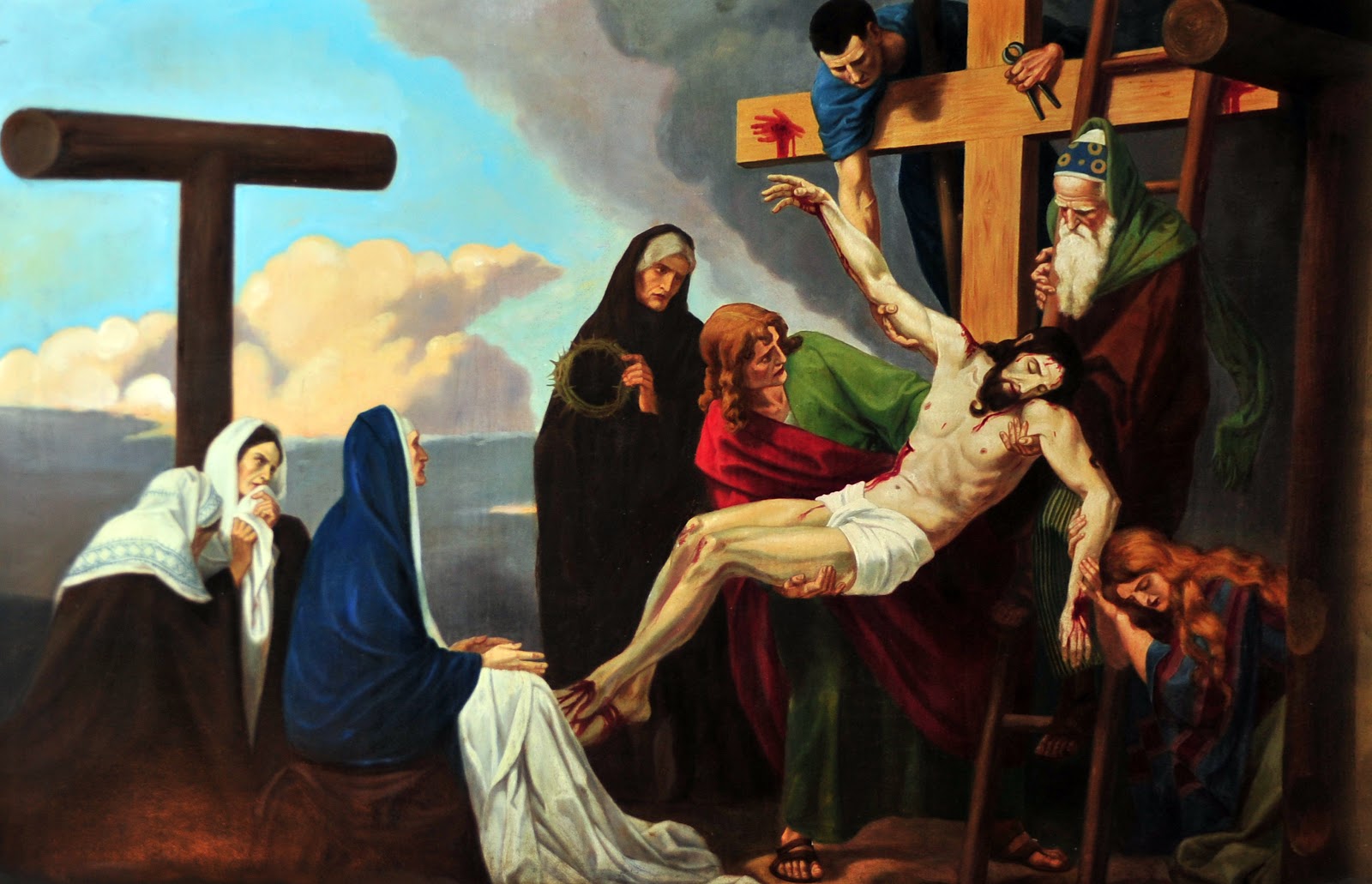


This comes from the last paragraph of the nineteenth chapter of John’s Gospel.


After this, Joseph of Arimathea,

secretly a disciple of Jesus for fear of the Jews,

asked Pilate if he could remove the body of Jesus.

And Pilate permitted it.

So he came and took his body.

Nicodemus, the one who had first come to him at night,

also came bringing a mixture of myrrh and aloes

weighing about one hundred pounds.

They took the body of Jesus

and bound it with burial cloths along with the spices,

according to the Jewish burial custom.

Now in the place where he had been crucified there was a garden, and in the garden a new tomb, in which no one had yet been buried.  So they laid Jesus there because of the Jewish preparation day; for the tomb was close by.

~Jn 19:38-42


We adore you, O Christ, and we praise you, because by your Holy Cross you have redeemed the world.


The distinguishing feature of Holy Saturday is silence and waiting.  There is no liturgy, no celebration, no homilies, no Eucharist.  Jesus’s body is motionless, indeed, lifeless in tomb while His soul travels down to the abode of the dead to raise up all the righteous dead. 


Dominican Fr. Jonah Teller O.P. reflects on the wait.


Fr. Teller:

God sleeps the sleep of death but only for a time.  Hope in him, hope in Christ. So what do we do on this day, this strange day when the stone is still rolled in front of the tomb and we can't see Jesus? What do we do?  I think we just wait.  We just wait there close to Jesus. He's still there. And we hope. And hope is for what you can't see.  But the one who has promised is trustworthy and he will do it. And so whatever it is that we're waiting for, whatever it is we're hoping for, whatever it is we're suffering, any stone rolled in front of any tomb in our lives, any death that we fear, any suffering we experience, we can know confidently that Jesus Christ has already stepped into the middle of it, taken it upon himself, and conquered it. And we can hope that he will share the victory over it with us.  All we have to do is wait.
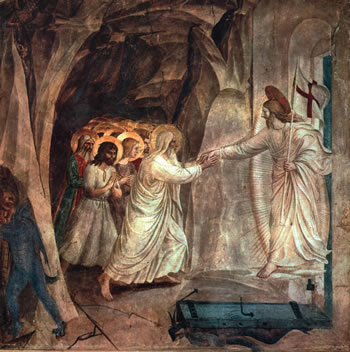


Fra Angelico's The Harrowing of Hell

The Office of Readings of the Liturgy of the Hours has a reading attributed to an ancient unknown writer but sometimes, though questionably, attributed to St. Melito of Sardis.  It is sometimes referred to as “An Ancient Homily on Holy Saturday.”  Whoever wrote it, it was probably written during the second century.

Something strange is happening—there is a great silence on earth today, a great silence and stillness. The whole earth keeps silence because the King is asleep. The earth trembled and is still because God has fallen asleep in the flesh and he has raised up all who have slept ever since the world began. God has died in the flesh and hell trembles with fear.

He has gone to search for our first parent, as for a lost sheep. Greatly desiring to visit those who live in darkness and in the shadow of death, he has gone to free from sorrow the captives Adam and Eve, he who is both God and the son of Eve. The Lord approached them bearing the cross, the weapon that had won him the victory. At the sight of him Adam, the first man he had created, struck his breast in terror and cried out to everyone: “My Lord be with you all.” Christ answered him: “And with your spirit.” He took him by the hand and raised him up, saying: “Awake, O sleeper, and rise from the dead, and Christ will give you light.”

I am your God, who for your sake have become your son. Out of love for you and for your descendants I now by my own authority command all who are held in bondage to come forth, all who are in darkness to be enlightened, all who are sleeping to arise. I order you, O sleeper, to awake. I did not create you to be held a prisoner in hell. Rise from the dead, for I am the life of the dead. Rise up, work of my hands, you who were created in my image. Rise, let us leave this place, for you are in me and I am in you; together we form only one person and we cannot be separated.

For your sake I, your God, became your son; I, the Lord, took the form of a slave; I, whose home is above the heavens, descended to the earth and beneath the earth. For your sake, for the sake of man, I became like a man without help, free among the dead. For the sake of you, who left a garden, I was betrayed to the Jews in a garden, and I was crucified in a garden.

See on my face the spittle I received in order to restore to you the life I once breathed into you. See there the marks of the blows I received in order to refashion your warped nature in my image. On my back see the marks of the scourging I endured to remove the burden of sin that weighs upon your back. See my hands, nailed firmly to a tree, for you who once wickedly stretched out your hand to a tree.

I slept on the cross and a sword pierced my side for you who slept in paradise and brought forth Eve from your side. My side has healed the pain in yours. My sleep will rouse you from your sleep in hell. The sword that pierced me has sheathed the sword that was turned against you.

Rise, let us leave this place. The enemy led you out of the earthly paradise. I will not restore you to that paradise, but I will enthrone you in heaven. I forbade you the tree that was only a symbol of life, but see, I who am life itself am now one with you. I appointed cherubim to guard you as slaves are guarded, but now I make them worship you as God. The throne formed by cherubim awaits you, its bearers swift and eager. The bridal chamber is adorned, the banquet is ready, the eternal dwelling places are prepared, the treasure houses of all good things lie open. The kingdom of heaven has been prepared for you from all eternity.

“I order you, O sleeper, to awake.”  “My side has healed the pain in yours.”  I find that beautiful.  You can hear it being read along with some gorgeous imagery from this video produced by St. Catherine Labouré Church in Wheaton, Maryland.


Sunday Meditation: "They took the body of Jesus and bound it with burial cloths along with the spices, according to the Jewish burial custom.  Now in the place where he had been crucified there was a garden, and in the garden a new tomb…"


Any hymn on such a solemn day must be acapella.  Appropriate I think would be “Go to Dark Gethsemane” here performed by the Lux Choral Society.


Go to dark Gethsemane,

Ye who feel the tempter's pow'r;

Your Redeemer's conflict see;

Watch with Him one bitter hour;

Turn not from His griefs away;

Learn of Jesus Christ to pray.


Follow to the judgment hall;

View the Lord of life arraigned;

O the worm-wood and the gall!

O the pangs His soul sustained!

Shun not suff'ring, shame, or loss;

Learn of Him to bear the cross.


Calv'ry's mournful mountain climb;

There, adoring at His feet,

Mark the miracle of time,

God's own sacrifice complete:

""It is finished!"" Hear Him cry;

Learn of Jesus Christ to die;


Blessed Savior, now in love

Send thy Spirit from above;

Come and dwell with us, we pray;

Amen.

Friday, April 18, 2025

Triduum Meditation: The Friday We Call Good

Last year I started the Triduum Mediation, and I and I started with Holy Thursday.  I intended to post on one day of the Triduum each year.  This year I will post a meditation on Good Friday.

As I said last year, the Pascal Triduum are the three days that lead to the Resurrection on Easter Sunday. 

The Gospel reading for Good Friday is the entire Passion Narrative from the Gospel according to St. John, Jn 18:1-19:42.  I can’t post the entire two chapters, so I’ll take a portion that will have the most resonance to the embedded homilies.


So they took Jesus, and, carrying the cross himself, he went out to what is called the Place of the Skull, in Hebrew, Golgotha.

There they crucified him, and with him two others, one on either side, with Jesus in the middle.

Pilate also had an inscription written and put on the cross.

It read,

“Jesus the Nazorean, the King of the Jews.”

Now many of the Jews read this inscription, because the place where Jesus was crucified was near the city; and it was written in Hebrew, Latin, and Greek.

So the chief priests of the Jews said to Pilate,

 “Do not write ‘The King of the Jews,’ but that he said, ‘I am the King of the Jews’.”

Pilate answered,

“What I have written, I have written.”


When the soldiers had crucified Jesus, they took his clothes and divided them into four shares, a share for each soldier.

They also took his tunic, but the tunic was seamless, woven in one piece from the top down.

So they said to one another,

“Let’s not tear it, but cast lots for it to see whose it will be, “ in order that the passage of Scripture might be fulfilled that says:

            They divided my garments among them,

                        and for my vesture they cast lots.

This is what the soldiers did.

Standing by the cross of Jesus were his mother and his mother’s sister, Mary the wife of Clopas, and Mary of Magdala.

When Jesus saw his mother and the disciple there whom he loved he said to his mother, “Woman, behold, your son.”

Then he said to the disciple,

“Behold, your mother.”

And from that hour the disciple took her into his home.


After this, aware that everything was now finished, in order that the Scripture might be fulfilled,

Jesus said, “I thirst.”

There was a vessel filled with common wine.

So they put a sponge soaked in wine on a sprig of hyssop and put it up to his mouth.

When Jesus had taken the wine, he said,

“It is finished.”

And bowing his head, he handed over the spirit.


Here all kneel and pause for a short time.


Now since it was preparation day, in order that the bodies might not remain on the cross on the sabbath, for the sabbath day of that week was a solemn one, the Jews asked Pilate that their legs be broken and that they be taken down.

So the soldiers came and broke the legs of the first and then of the other one who was crucified with Jesus.

But when they came to Jesus and saw that he was already dead, they did not break his legs, but one soldier thrust his lance into his side, and immediately blood and water flowed out.

An eyewitness has testified, and his testimony is true; he knows that he is speaking the truth, so that you also may come to believe.  For this happened so that the Scripture passage might be fulfilled:

            Not a bone of it will be broken.

And again another passage says:

            They will look upon him whom they have pierced.

~Jn 19:17-37


I will go with Fr. Geoffrey Plant again because he offers so much information.  After he explains Good Friday, Fr. Geoffrey takes us through Jesus last seven words on the cross.  


It is with the fourth cup of the Passover and the death of the Lamb of God that completes the atonement.    I loved that ending from Fr. Geoffrey: “The Evangelists remind us that the life of a Christian is lived in the tension between ‘My God, my God, why have you forsaken me” and “Father, into your hands I commend my spirit.”


Bishop Barron tells us on the horrific nature of the crucifixion.


And despite the horror of the cross, Christians embraced it!


Sunday Meditation: "When Jesus had taken the wine, he said,

“It is finished.” And bowing his head, he handed over the spirit."


This is too solemn a day for a hymn.  Indeed there was no music at Good Friday Mass today, just a Capella.  So another reflection is in due order, this time by two Dominican friars from Our Sunday Visitor, Frs. Patrick Briscoe and Vincent Bernhard O.P. who reflect on Good Friday traditions.


If you’re wondering what a “double genuflection” is, it’s not very mysterious.  I had just never heard it was called anything.  Here is a clip to demonstrate it.


So at Good Friday adoration of the wood of the cross, I had to try a double genuflection after hearing the friars talk about it.  Geez, I almost couldn’t get up with my aging knees.

Thursday, March 28, 2024

Triduum Meditation: Holy Thursday Washing of the Feet

So we come to the Paschal Triduum—the three days that leads to the Resurrection on Easter Sunday.  I’m not going to have a meditation for every day of the Triduum in one year, but I thought I could do one of the days every year for the next three years.  I’ll do them in order, so today, this year, I will provide a meditation on Holy Thursday.

Holy Thursday—also called Maundy Thursday—commemorates the Last Supper but we celebrate it in a liturgy composed from Gospel of John’s version of the Last Supper.  More specifically we highlight Jesus’s washing of the Apostles’ feet.  The Gospel reading describes the action.


Before the feast of Passover, Jesus knew that his hour had come

to pass from this world to the Father.

He loved his own in the world and he loved them to the end.

The devil had already induced Judas, son of Simon the Iscariot, to hand him over.

So, during supper,

fully aware that the Father had put everything into his power

and that he had come from God and was returning to God,

he rose from supper and took off his outer garments.

He took a towel and tied it around his waist.

Then he poured water into a basin

and began to wash the disciples’ feet

and dry them with the towel around his waist.

He came to Simon Peter, who said to him,

“Master, are you going to wash my feet?”

Jesus answered and said to him,

“What I am doing, you do not understand now,

but you will understand later.”

Peter said to him, “You will never wash my feet.”

Jesus answered him,

“Unless I wash you, you will have no inheritance with me.”

Simon Peter said to him,

“Master, then not only my feet, but my hands and head as well.”

Jesus said to him,

“Whoever has bathed has no need except to have his feet washed,

            for he is clean all over;

so you are clean, but not all.”

For he knew who would betray him;

for this reason, he said, “Not all of you are clean.”


So when he had washed their feet

and put his garments back on and reclined at table again,

he said to them, “Do you realize what I have done for you?

You call me ‘teacher’ and ‘master,’ and rightly so, for indeed I am.

If I, therefore, the master and teacher, have washed your feet,

you ought to wash one another’s feet.

I have given you a model to follow,

so that as I have done for you, you should also do.”

~Jn 13:1-15


Fr. Geoffrey Plant explains the historical and Biblical contexts of Maundy Thursday. 


There is one interesting fact that Fr. Geoffrey cites that was startling to me.  He cites Fleming Rutledge’s observation (starting at the 27:00 min mark) that Christ washing his feet in His loin cloth is a corresponding image to Christ in His loin cloth on the cross.  This is not just a foreshadowing but an amplification of the action Christ’s self-sacrificing love teaches from the cross.  I also love the quote Fr. Geoffrey takes from Pope Benedict XVI, from I think Pope Benedict XVI’s Jesus of Nazareth: Holy Week.  Speaking of the foot washing, Pope BXVI says,


Jesus represents the whole of his saving ministry in one symbolic act.  He divests himself of his divine splendor; he, as it were, kneels down before us; he washes and dries our soiled feet, in order to make us fit at the table for God’s wedding feast.

There is one observation on the washing of feet that no one in any of the homilies I sampled across the internet makes, and so this perhaps is a peculiar observation to me.  So if I’m wrong, you can blame me.  So the connection to the washing of feet, or more specifically the lowering of a king to a servant for the sake of his subject can be found with King Rehoboam in First Kings, Chapter 12.  King Rehoboam is the son of King Solomon and the successor to the throne, but King Rehoboam faces a crises.  Jeroboam from the northern Israel is threatening to divide the kingdom by rebelling Israel against Judah.  Why, Jeroboam asks, should Israel subject herself to his authority when Rehoboam and his father have been so tyrannical over Israel?  King Rehoboam seeked advice for an answer.  Jeroboam, confronts him.


(4) “Your father put a heavy yoke on us. If you now lighten the harsh servitude and the heavy yoke your father imposed on us, we will be your servants.”

(5) He [King Rehoboam] answered them, “Come back to me in three days,” and the people went away.

(6) King Rehoboam asked advice of the elders who had been in his father Solomon’s service while he was alive, and asked, “How do you advise me to answer this people?”

(7) They replied, “If today you become the servant of this people and serve them, and give them a favorable answer, they will be your servants forever.”

(8) But he ignored the advice the elders had given him, and asked advice of the young men who had grown up with him and were in his service.

(9) He said to them, “What answer do you advise that we should give this people, who have told me, ‘Lighten the yoke your father imposed on us’?”

(10) The young men who had grown up with him replied, “This is what you must say to this people who have told you, ‘Your father made our yoke heavy; you lighten it for us.’ You must say, ‘My little finger is thicker than my father’s loins.

(11) My father put a heavy yoke on you, but I will make it heavier. My father beat you with whips, but I will beat you with scorpions.’”

(12) Jeroboam and the whole people came back to King Rehoboam on the third day, as the king had instructed them: “Come back to me in three days.”

(13) Ignoring the advice the elders had given him, the king gave the people a harsh answer.

(14) He spoke to them as the young men had advised: “My father made your yoke heavy, but I will make it heavier. My father beat you with whips, but I will beat you with scorpions.”

(15) The king did not listen to the people, for this turn of events was from the LORD: he fulfilled the word the LORD had spoken through Ahijah the Shilonite to Jeroboam, son of Nebat.

(16) When all Israel saw that the king did not listen to them, the people answered the king:

“What share have we in David?*

We have no heritage in the son of Jesse.

To your tents, Israel!

Now look to your own house, David.”


So Israel went off to their tents. (1 Kings 12:4-16)

Notice the King Rehoboam’s receives two sets of advice.  From the elders he is advised: “If today you become the servant of this people and serve them, and give them a favorable answer, they will be your servants forever” (7).  He is first advised to be a servant king.  Who today on Maundy Thursday do we celebrate in a liturgy replicating His actions as a servant King?  Jesus Christ in the washing of the feet.  Does King Rehoboam take this advice to be a servant king?  No as we see in the very next line (8).  He goes on to ask advice from his childhood buddies, and they advise him to put on an even heavier yoke than the heavy yoke his father had put on Israel (10-11).  And this is what he tells Jeroboam (14) and Jeroboam and Israel break away and divide the kingdom (16).  So King Rehoboam is an anti-archetype to King Jesus, negatively foreshadowing Christ’s foot washing.  Notice to the language of “heavy yoke” Rehoboam uses.  Notice how that contrasts with Jesus speaking about His yoke in Matthew eleven:

o

(28) “Come to me, all you who labor and are burdened,* and I will give you rest.

(29) Take my yoke upon you and learn from me, for I am meek and humble of heart; and you will find rest for yourselves.

(30) For my yoke is easy, and my burden light.” (Mt 11:28-30)


Meditation: “Do you realize what I have done for you?”


Wednesday, April 5, 2023

Poetry Analysis: “The Donkey” by G. K. Chesterton

My last Sunday Meditation concerned Palm Sunday, and I brought up the issue of the two donkeys in Matthew’s version of the rendering of Christ’s triumphal entrance into Jerusalem.  Whether one or two, the donkey is a central element of the Passion story.  G. K. Chesterton has an adorable little poem told from the perspective of the donkey. 


The Donkey

BY G. K. CHESTERTON


When fishes flew and forests walked

   And figs grew upon thorn,

Some moment when the moon was blood

   Then surely I was born.


With monstrous head and sickening cry

   And ears like errant wings,

The devil’s walking parody

   On all four-footed things.


The tattered outlaw of the earth,

   Of ancient crooked will;

Starve, scourge, deride me: I am dumb,

   I keep my secret still.


Fools! For I also had my hour;

   One far fierce hour and sweet:

There was a shout about my ears,

   And palms before my feet.


There isn’t too much to analyze.  There is some lovely alliteration in the first stanza with the “f” consonants, which is picked up later with “four-footed” in the second stanza, and “fools” and “far fierce” in the last stanza.  The other alliterative sound is the “s” consonant which is sprinkled in each of the stanzas, but most important to the third stanza.  Each stanza’s second and fourth lines end in full rhyme, but the first and third have a have a slant or distant rhyme. 

The donkey speaks of being born—or is he referring to the origination of the donkey species?—in a strange, malevolent time.  This is linked to the oddity of his being, and, while not being evil himself, he is a “parody” of the devil in appearance.  With this he has had to live an oppressed and afflicted life.  He too is a suffering servant, regularly going through his own passion stations.  But he is redeemed on his “hour,” on Palm Sunday by carrying the triumphal Son of David.

One last element to notice.  Chesterton mostly keeps the meter in every line except for the most key line in the whole poem, the third line of the third stanza: “Starve, scourge, deride me: I am dumb.”  This is a clear allusion to Christ with the donkey considering himself the analogue to Christ, a Christ-figure!  The donkey is saying, that, while I may be your whipping beast, I had the dignity of carrying the Christ.

Here is a lovely reading of the poem.


And here is one of my favorite hymns appropriate for the triumphal entry.


How beautifully sung.  Have a blessed Easter Triduum.