"Love follows knowledge."
"Beauty above all beauty!"
– St. Catherine of Siena

Showing posts with label Pope Leo XIV. Show all posts

Sunday, August 23, 2026

Sunday Meditation: Who Do People Say That the Son of Man Is?

On the Twenty-First Sunday in Ordinary Time in Year A, we get the well-known foundation of the Church in the person of Peter.  Three years ago I embedded a video clip of Dr. Brant Pitre giving the fullest exegesis of how this Gospel passage formed the Catholic Church, the Papacy, and the Church’s authority in the person of Peter.  No other video clip is going to expand on that because that clip said it all.  In that clip, Dr. Pitre quoted the second century theologian and bishop, Irenaeus, from Against Heresies on the early Church’s view of this passage.  It’s worth quoting here.


St. Irenaeus wrote this about the church at Rome and Peter's successors: quote, “the very great the very ancient and universally known church found in and organized at Rome by the two most glorious Apostles Peter and Paul; as also the faith preached to men…comes down to our own time by mean of the successions of the bishops.  For it is a matter of necessity that every Church should agree with this Church [meaning the church at Rome] on account of its preeminent authority, that is, the faithful everywhere…The blessed apostles, then, having founded and built up the Church, committed into the hands of Linus the office of the episcopate [Linus was Peter successor]…To him succeeded Anacletus; after him, in the third place from the apostles, Clement.  To this Clement there succeeded Evaristus. Alexander followed Evaristus; then sixth from the Apostles, Sixtus was appointed; after him Telephorus, who was gloriously martyred; then Hygenus; after him, Pius; then after him Anicetus.  Soter having succeeded Anicetus, Eleutherius does now, in the twelfth place from the Apostles, hold the inheritance of this episcopate.  In this order, and by this succession, the ecclesiastical tradition from the Apostles, in the preaching of the truth have come down to us. and this is the most abundant proof that there is one and the same vivifying faith which has been preserved in the church and the Apostles until now and handed down in truth.”  (Irenaeus, Against Heresies 3.3.2-3; trans. ANF 1.415-16)

This was written in the year 180 A.D.  Don’t ever let anyone dissuade you from knowing that today’s Gospel passage identified Peter and his successors—for this passage shows the rule of succession which some deny—as the foundation to bind and loose, teach and consecrate from Peter to Pope Leo XIV today. That understanding was there from the beginning.

Today’s Gospel:


Jesus went into the region of Caesarea Philippi and

he asked his disciples,

"Who do people say that the Son of Man is?"

They replied, "Some say John the Baptist, others Elijah,

still others Jeremiah or one of the prophets."

He said to them, "But who do you say that I am?"

Simon Peter said in reply,

"You are the Christ, the Son of the living God."

Jesus said to him in reply,

"Blessed are you, Simon son of Jonah.

For flesh and blood has not revealed this to you, but my heavenly Father.

And so I say to you, you are Peter,

and upon this rock I will build my church,

and the gates of the netherworld shall not prevail against it.

I will give you the keys to the kingdom of heaven.

Whatever you bind on earth shall be bound in heaven;

and whatever you loose on earth shall be loosed in heaven."

Then he strictly ordered his disciples

to tell no one that he was the Christ.

~Mt: 16:13-20


My Catholic Life! provides an exegetical aspect that Dr. Pitre doesn’t develop.  It’s worth including here.


My Catholic Life!:

Jesus went into the region of Caesarea Philippi and he asked his disciples, “Who do people say that the Son of Man is?” They replied, “Some say John the Baptist, others Elijah, still others Jeremiah or one of the prophets.” He said to them, “But who do you say that I am?” Simon Peter said in reply, “You are the Christ, the Son of the living God.” Matthew 16:13–16


The symbolism associated with Caesarea Philippi is central to today’s Gospel. Located north of Jesus’ home base in Capernaum, it was a predominantly pagan city known for its shrines to false gods. One of the most prominent was Pan, after whom the region was named Panias (later Banias). Pan, a Greek god, was honored at a shrine near a large cave and spring considered the entrance to Hades. Pan was the god of nature, shepherds, flocks, wild places, fertility, and rustic music, and was often depicted as half man, half goat, with horns and hooves. He played the pan flute and was associated with lust, chaos, and sudden fear—from which we get the word panic.


Additionally, the city was the site of a temple dedicated to the late emperor, Caesar Augustus, who was worshiped as a god throughout the Roman Empire. It was into this spiritually dark pagan setting that Jesus led His disciples—on what may have been a two-day journey—for what culminated in a single, monumental question.


Jesus took the Twelve away from the comfort of their familiar fishing village and Jewish neighbors for a reason. He wanted them to answer His question not in the midst of the familiar and safe, but in a place marked by spiritual confusion and idolatry. Why? So that faith could be professed even there, and divine grace could confront the darkness that permeated the region.

The locations of where the Gospel events occur are usually important to their meaning.  I may have mentioned this before, and here the region of Caesarea Philippi—notice its very Roman derived name—is a contrast to what Jesus is trying to instruct.  If the Roman emperor titled Caesar was considered a god and a son of god, Jesus identifies who the true God and the true Son of God is.


For the pastoral homily I’m going to turn to the successor of St. Peter, the current Holy Father, Pope Leo XIV.  This is from his homily on this passage given today at his Sunday Angelus.  The first four minutes are television introductions.  The Holy Father comes out at just about the 4:00 minute mark. 


Better still, you can read his entire homily at the Vatican Website.  Here are some key excerpts.

Pope Leo XIV:

The Gospel passage makes us understand how decisive this question is for the experience of discipleship.  Indeed, although the twelve apostles had already shared so much of the life and ministry of their teacher, Jesus did not take for granted that they truly knew him or had understood the mystery of the Kingdom of God.  Thus, after asking them what people were saying about him, he addressed them directly: “But who do you say that I am?” (Mt 16:15).


Brothers and sisters, this is a fundamental question for the disciples of every age, and for each one of us.  Faith is not something given to us once and for all.  Rather, we continually need to rediscover the face of Christ and his Gospel, to enter more deeply into his message and to renew the choices we make in our lives, so that they may be consistent with what we profess.  In this way, we can overcome the temptation to think that we already know everything and to reduce faith to mere habit.


The question that is put to us each day — who is Jesus for me, and what does his presence mean in my life? — emerges especially in prayer and when we meditate on the Gospel.  Yet it also arises when we encounter the wounds and needs of our brothers and sisters, and in those relationships and situations that most deeply challenge our conscience.  In our daily lives, in short, we can discover whether the Lord Jesus is for us merely a great figure of history, who said and did important things, or the Christ of God, the One sent to bring us into the love of the Father and to transform our lives and the world in which we live.

The question Jesus poses to the apostles is the question He poses to us, not just once or once a month or once a year.  Jesus poses this question to us every day, and we are to be guided by our response every day.


Sunday Meditation: "You are the Christ, the Son of the living God."


Let’s return to John Michael Talbot for today’s hymn with “Surrender to Jesus.”


Take all my freedom

My liberty, my will

All that I have

You’ve given to me

So I offer it up to You


CHORUS:

I surrender it all to Jesus

I surrender it all to God’s will

I surrender it all for the kingdom of God

I surrender my life, my all


Your grace and Your love

Are wealth enough for me

Grant me these Lord Jesus

And I’ll ask for nothing more


(CHORUS)


I surrender it all for the kingdom of God, my life, my all.  I surrender it all to Jesus.

Monday, August 10, 2026

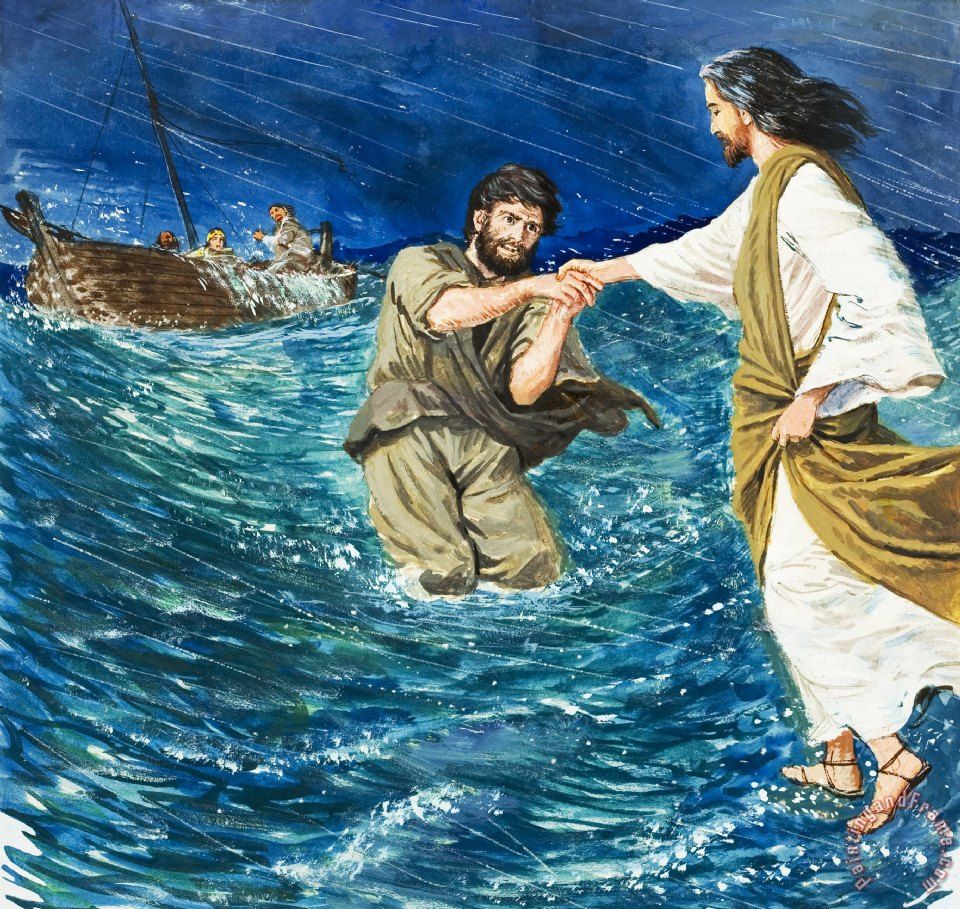
Sunday Meditation: Faith and Hope on the Sea of Galilee

Today, Year A’s Nineteenth Sunday in Ordinary Time, we continue following Jesus and the apostles after the Feeding of the Five Thousand.  Jesus disperses the crowd and sends the apostles off on their boat while he goes up the hillside to pray alone.  The boat encounters a storm, and Jesus heads out to the apostles, walking on the water.  You know the passage.  Peter asks if he could be allowed to walk on the water, and after Jesus acknowledges and Peter does take a few steps, he loses faith and starts to sink.  Jesus then saves him. 

There are a couple of mysterious details in this passage.  Let me bring them out in the form of questions and try to answer them, but rest assured I’m not all that confident in my answers.

Why does Jesus send them off alone to the boat while He goes away from them? 


Prayer is certainly important to Jesus, but the fact He “made them get into a boat” suggests He has orchestrated all the subsequent events.  All details should be filtered with this detail.

Why does He walk on water to go out to them?  Couldn’t He calm the sea and wait for the boat to dock? 


Jesus walking on water is a theophany, a manifestation of His divinity.  He intended to manifest to the apostles.  This appears to be the reason to send them off while He stays back.

Why is the boat on the sea on the fourth watch, which is supposed to be between 3 and 6 AM?  That’s not a particularly safe time to be on water in ancient times. 


It’s obviously overcast and the surroundings would be totally dark.  A natural impulse would be to head back to shore but Jesus wanted them out and so they were obedient.  As Dr. Pitre will explain below, they were fishermen, and so used to going on the sea at night.  Perhaps the bad weather caught them by surprise.

Why did Peter want to walk on the water?


It’s not exactly a natural inclination.  He sees Jesus walking on water, did Peter want to emulate Him?  Was he just looking for a thrill?  Was he trying to show off?  I guess we will never know.


Today’s Gospel:


After he had fed the people, Jesus made the disciples get into a boat

and precede him to the other side,

while he dismissed the crowds.

After doing so, he went up on the mountain by himself to pray.

When it was evening he was there alone.

Meanwhile the boat, already a few miles offshore,

was being tossed about by the waves, for the wind was against it.

During the fourth watch of the night,

he came toward them walking on the sea.

When the disciples saw him walking on the sea they were terrified.

“It is a ghost,” they said, and they cried out in fear.

At once Jesus spoke to them, “Take courage, it is I; do not be afraid.”

Peter said to him in reply,

“Lord, if it is you, command me to come to you on the water.”

He said, “Come.”

Peter got out of the boat and began to walk on the water toward Jesus.

But when he saw how strong the wind was he became frightened;

and, beginning to sink, he cried out, “Lord, save me!”

Immediately Jesus stretched out his hand and caught Peter,

and said to him, “O you of little faith, why did you doubt?”

After they got into the boat, the wind died down.

Those who were in the boat did him homage, saying,

“Truly, you are the Son of God.”

~Mt: 14:22-33


Our old friend, Dr. Brant Pitre, brings out the exegetical main points.


Dr. Pitre:

It's important to recall the setting of this miracle.  It takes place after the famous feeding of the 5,000 in the Gospel of Matthew.  So one of the reasons this is important to highlight is because the same sequence occur in all the Gospels so for example in Matthew and Mark and in John all of those Gospels—three of the four actually—three of the four Gospels have accounts of the walking of Jesus on the water and in all three that that account immediately follows the feeding of the 5,000, so it's like a pair of miracles: Jesus feeds the 5,000 and then he walks on the water, so it's in the wake of him having performing this amazing miracle feeding 5,000 people from five loaves and two fish that Jesus then withdraws and he goes up the mountain to pray right.  So it gets late and then while he is up in the mountain praying the disciples set off across the Sea of Galilee in the boat.  Now a couple elements about the context: where exactly does this take place on the Sea of Galilee?  Well we don't the exact location but we do know the Sea of Galilee to this day is not a very…small lake it's about seven miles wide at its widest point and it was the kind of beating heart of Galilee, and is the place of fishing and industry and disciples knew it well and when they're in their boat [it] is important the first thing you notice is they're not right next to shore; it says there are many furlongs distant from the land now in John's account of this miracle he actually says they're about four miles from the shore.


Also notice the time it's the fourth watch of the night, so this is in the middle of the night sometime between three o'clock and six o'clock in the morning now most of us wouldn't get on a boat and be out in the middle of the night between 3 and 6 a.m.  But for the Apostles they were pretty used to this because as fishermen it was actually customary to fish at night we'll see that in a gospel John that they spend all night fishing and they don't catch anything so they are traveling in the middle of the night and something they're pretty used to.  What they're not used to however is being on the water in the middle of the night in the middle of the lake and seeing a man coming to them walking on the waves of the sea, and that's what Jesus does here in this account, he comes to them walking on the sea.  Now when they experience this their first reaction is fear right and they assume that he's a ghost pretty interesting a point there because it shows us that apparently at least some of the disciples believed in ghosts.


Jesus says something very interesting, he says take heart don't be afraid.  I'll pause there for a second; this is a clue to us that we should characterize this account Jesus walking on the water as a theophany.  A theophany as I've mentioned in other videos is an appearance of God.  It's where God reveals his power and his glory and its presence to his people on earth, and one of the things you'll see over and over again in accounts of theophanies in the Bible is that people are always afraid, like when they see God they're afraid, and God's response to their fear is often to quell it.  Right to say be calm don't be afraid and then to speak to them to give them some message, so in this case Jesus says take heart have no fear and then he says it is I.  Now the Greek, the literal Greek behind that expression which most Bibles render—“it is I”—is “egō eimi,” which literally in Greek means take heart, “I am so,” that's quite the same thing as it is me.  [It] literally just says take heart I now.   On the one hand the expression I am, egō eimi, can be used to identify someone right so if I ask you a question is that you and you say I am it could respond by saying yes it's me.  Right so that can be the sense or the meaning of it, but the literal meaning of the word in context is more than that Jesus isn't just identifying himself; he's also taking the divine name of God.


From the Old Testament and using it as his own, so in other words he's alluding to the most famous theophany in the Bible, the theophany of the appearance of God to Moses on Mount Sinai in the book of Exodus chapter 3.  So in that theophany God comes to Moses and he calls Moses to go to the people of Israel who were slaves in Egypt and to set them free and to bring a message of deliverance, and Moses says well if I go to them whose name shall I give them, what name will I tell them is the name of the God who sent me?  And the Lord says to Moses, “I am Who I am, tell them I am has sent you to them.” Right this is my name for all generations God goes on to say, so the name that the expression, “I am,” is more than just an identification; it's the divine name, so when you take Jesus's use of the term, “I am,” you couple it with the fact that he is walking on water and that he's saying don't be afraid which is standard theophany language from the Old Testament, [all] three things together show to us that Jesus is revealing his divinity.


That’s a pretty clear exegesis.  For the pastoral homily, I’m going to knock you out of your socks with this from Pope Leo XIV.


Pope Leo XIV:

Dear brothers and sisters, happy Sunday. Today's gospel speaks of Jesus approaching his disciples by walking on the waters of the Sea of Galilee in the midst of a storm. Following the miracle of the loaves and fish, the master urges his disciples to get into the boat and set out while he withdraws to the mountain to pray by himself. Once away from the shore, the disciples find themselves at the mercy of the wind and struggle to make headway. After a successful experience in which they had been the protagonists of a miraculous sign, they now find themselves helpless and frightened in the face of the threat of the waves and the headwind. As the night was drawing to a close, Jesus came towards them across the choppy waters, and terrified, they mistook him for a ghost. But he said to them, "Take heart. It is I. Do not be afraid.” The Lord's presence changes everything. Peter even manages to take a few steps across the waves towards him. But then losing his nerve, he begins to sink and Jesus saves him. When the master then steps into the boat, the storm subsides and a profession of faith spontaneously springs out of the disciples hearts.  Truly, you are the son of God. To realize this point, it was not enough for them simply to have witnessed a miracle nor to have succeeded in the eyes of the people. Instead, they had to experience their own weakness and within it recognize God's presence. Only this experience could open their eyes and hearts to his closeness, finding peace even in the midst of the storm. 

Notice the point.  It’s not just witnessing the miracle that changes the apostle’s hearts.  It’s the fear and anxiety they experience that changes them.  They had to experience the terror for their souls to find peace.

Pope Leo XIV:

Sometime later, Jesus would say to them, "If you have faith and do not doubt, if you say to this mountain, be lifted up and thrown into the sea, it will be done." This is similar to what they experienced on the lake. The peace of Christ who had been on the mountain praying reached them in the midst of the raging waters. This miracle then teaches us something important. First, not to get carried away by success and never to be presumptuous. At the same time, not to despair even in moments of darkness when we feel powerless in the face of problems. And despite our efforts, it seems as though we are going backwards rather than forwards. Whatever the circumstances, Jesus does not abandon us. And if we humbly welcome him into the boat of our lives through prayer, the sacraments, and listening to his word, in him we will find peace, light, and strength for our journey. May who is proclaimed blessed for her faith, help us to live in a trusting surrender to God.

Ultimately what I think Pope Leo is getting at is that there is a relationship between faith and hope.  The apostles had a momentary shaking of faith; Peter walking on the water loses faith and begins to drown.  What does he do?  He calls out to Jesus.  The calling is an act of hope.  The apostles did not despair.  One may have a shaking of one’s faith from the tumultuous events in our lives—and that is natural—but keeping hope in Jesus is the key to salvation.


Sunday Meditation: But when he saw how strong the wind was he became frightened; and, beginning to sink, he cried out, “Lord, save me!”


What hymn could be better for this reading than “Take My Hand, Precious Lord,”  Words: Thomas A. Dorsey, 1932.  I played this three years ago for this reading, and I will never miss an opportunity to play my most beloved hymn.  And I absolutely love this version by a not so well known jazz singer named Jimmy Scott.


Precious Lord, take my hand,

Lead me on, let me stand,

I am tired, I am weak, I am worn;

Through the storm, through the night,

Lead me on to the light:


Refrain

Take my hand, precious Lord,

Lead me home.


When my way grows drear,

Precious Lord, linger near,

When my life is almost gone,

Hear my cry, hear my call,

Hold my hand lest I fall:


Refrain


When the darkness appears

And the night draws near,

And the day is past and gone,

At the river I stand,

Guide my feet, hold my hand:


Refrain


I want this song and this version played at my funeral.  I said this on YouTube comments for this song: “I think Jimmy Scott's rendition of this beautiful hymn is my all time favorite.  There is such suffering in his voice.  It feels so honest.” 

Sunday, July 19, 2026

Sunday Meditation: Jesus the Divine Farmer

For the Sixteenth Sunday of Ordinary Time in Year A, Jesus continues His Parables Discourse.  Last Sunday He spoke of the Parable of the Sower.  Today he gives three parables, two continuing with the agricultural motif, and the third using the fruits of the produce to bake bread.  In a sense, these three are interrelated.  First is the parable of the Weeds among the Wheat, second the Parable of the Mustard Seed that grows into a huge tree, and third the Parable of the Leaven that makes the flower from the wheat grow.  All three parables begin with “The Kingdom of Heaven can be compared with…”  So in the first, the wheat must persevere over the weeds.  In the second, in persevering the seed grows to its glory.  In the third, the fruit from the perseverance, the flower, expands into the bread of life, and even, after consecration, the Eucharist.

The first parable is perhaps the most difficult to fathom.  Why would a farmer allow weeds to grow?  He wouldn’t, and that perhaps could be the illogical twist of this parable that Jesus often plants (excuse the pun!) in His parables.  However, I am told there was a particular weed that looked identical to the wheat, and one couldn’t tell until harvest.  If that is so, then the parable is more straight forward but I still think the twist is the point.

As some have pointed out, this parable explains Salvation History.  Evil is allowed to grow alongside the good.    If one follows the analogy, God does not want to disturb the good by destroying the evil.  But then, how many people are all good and how many people are all evil?  Not many, so then as others point out, the parable speaks to the good “wheat” and the bad “weeds” in our hearts.  We contain both, and with patience God is allowing our good to persevere over our bad.

And so, the Kingdom of God is within us!


Today’s Gospel:


Jesus proposed another parable to the crowds, saying:

"The kingdom of heaven may be likened

to a man who sowed good seed in his field.

While everyone was asleep his enemy came

and sowed weeds all through the wheat, and then went off.

When the crop grew and bore fruit, the weeds appeared as well.

The slaves of the householder came to him and said,

'Master, did you not sow good seed in your field?

Where have the weeds come from?'

He answered, 'An enemy has done this.'

His slaves said to him,

'Do you want us to go and pull them up?'

He replied, 'No, if you pull up the weeds

you might uproot the wheat along with them.

Let them grow together until harvest;

then at harvest time I will say to the harvesters,

"First collect the weeds and tie them in bundles for burning;

but gather the wheat into my barn."'"


He proposed another parable to them.

"The kingdom of heaven is like a mustard seed

that a person took and sowed in a field.

It is the smallest of all the seeds,

yet when full-grown it is the largest of plants.

It becomes a large bush,

and the 'birds of the sky come and dwell in its branches.'"


He spoke to them another parable.

"The kingdom of heaven is like yeast

that a woman took and mixed with three measures of wheat flour

until the whole batch was leavened."


All these things Jesus spoke to the crowds in parables.

He spoke to them only in parables,

to fulfill what had been said through the prophet:

I will open my mouth in parables,

I will announce what has lain hidden from the foundation

of the world.


Then, dismissing the crowds, he went into the house.

His disciples approached him and said,

"Explain to us the parable of the weeds in the field."

He said in reply, "He who sows good seed is the Son of Man,

the field is the world, the good seed the children of the kingdom.

The weeds are the children of the evil one,

and the enemy who sows them is the devil.

The harvest is the end of the age, and the harvesters are angels.

Just as weeds are collected and burned up with fire,

so will it be at the end of the age.

The Son of Man will send his angels,

and they will collect out of his kingdom

all who cause others to sin and all evildoers.

They will throw them into the fiery furnace,

where there will be wailing and grinding of teeth.

Then the righteous will shine like the sun

in the kingdom of their Father.

Whoever has ears ought to hear."

~Mt: 13:24-43


Here is someone new to my embedded homilies.  Deacon Malcolm Louis Concessao O.P. from St. Charles Seminary in Nagpur, India.  The seminary is run by Dominicans, and Dn. Malcolm has an “O.P.” at the end of his name which is dear to my heart.  I thought highly of this preaching.


Dn. Malcolm:

Dear brothers and sisters, there is something about God that often confuses us. We know that he is all powerful, all knowing, and perfectly just. Yet, when we look at the world, we ask, why does God allow evil to exist?  Why do the wicked seem to flourish while the innocent suffer? Why does God not remove sin immediately?  These are not new questions. They are as old as humanity itself.  Today's readings invite us [music] to look beyond appearances and discover the mysterious wisdom of God. The book of wisdom gives us a remarkable insight into the heart of God. It says, "Though you are sovereign in strength, you judge with mildness and with great forbearance you govern us."


Human beings often associate power with domination. The more powerful a person is, the more they tend to control others.  God reveals a completely different kind of power. His only potence is not expressed first through punishment but through mercy. Because he is infinitely powerful. He does not need to prove his strength.  Instead, he patiently waits for sinners to return to him. As the sacred author says, "You have given your children good ground for hope because you permit repentance for their sins." Wisdom 12 19.


This divine patience becomes even clearer in the gospel. Jesus tells the parable of a farmer who sows good seeds sin his field.  During the night, an enemy comes and sws weeds among the wheat. When the servants discover them, they immediately ask, "Do you want us to go and gather them?" Their reaction is understandable.  We want evil removed immediately. We want justice now.  But the master's answer [music] surprises us. He says, "No, for in gathering the weeds, you would uproot the wheat along with them. Let both of them grow together until the harvest."  At first, this seems strange. [music] Why allow the weeds to remain? The answer reveals the heart of God. The master is not indifferent to evil.  Rather, he sees something that the servants cannot see. Wheat and weeds look remarkably similar in their early stages. If the servants act too quickly, they may destroy the very crop they hope to protect.  This parable is not simply about good people and bad people. It is about every human heart. Within each one of us there is wheat and there are [music] weeds.  There is generosity and selfishness.  There is faith and doubt, love and pride. If God judged us only by our weakest moments, none of us would stand before him. Yet he patiently continues his work within us. This is where St. John of the Cross offers a profound insight. He teaches that God transforms the soul gradually through purification.  God does not destroy the soul.  He removes everything that prevents it from loving him perfectly.  God patiently uproots the hidden weeds of attachment, pride, self-reliance, and disordered desires so that the wheat of divine love mature.


Often we become discouraged because we still discover weaknesses within ourselves. We expect instant holiness. But God works as a farmer, not as a mechanic. A mechanic repairs a machine in a few hours. A farmer cannot force wheat to grow overnight. Growth requires time, seasons, [music] rain, sunlight, and patient care. So it is with the spiritual life.  God's grace works quietly, often invisibly deep within the soul. Jesus continues with two short parables, my friends, the mustard seed and the yeast.

God works as a farmer, not as a mechanic!  That is so profound and worth remembering.

For the pastoral homily I’m going to go to the chief honcho himself, Pope Leo XIV.  In today’s Angelus, the Holy Father opened my eyes in his explanation of this Gospel.  The video will be filtered through Catholic Snack with their commentary, but the quotes will come from the Holy See’s posting of the sermon.


Pope Leo XIV:

These three short parables recall the coming of the Kingdom of God in history, its action in human lives, and the way it grows, expands and transforms the world from within.Through these images, Jesus warns us against the temptation of thinking that God is a powerful figure who imposes himself by force, who takes over and dominates, or who arrives triumphantly. Instead, God favors smallness, a sign of his discreet love, by which he leaves us free to accept or reject him. His love makes its presence felt even among the weeds, acts in a hidden and invisible way like the smallest of all seeds, and leavens the dough without making a sound.


Brothers and sisters, through these parables, Jesus reveals something important about the manner in which God works in our lives and in history. We sometimes expect God to do something spectacular; we want him to intervene from on high, immediately uprooting the weeds of evil. We imagine a strong and powerful God, and, unfortunately, we also model our way of being Christians and way of being the Church on this image. However, the Kingdom of God spreads even amidst the weeds, requiring us to train our vision so we can discern the good that sprouts despite the darkness of evil, and avoiding rash judgments. It comes like the smallest of seeds and thus calls for patience in accompanying these processes, so that we can recognize it in the little things of daily life and in the simplicity of ordinary existence. It grows invisibly like yeast in flour, and so we are freed from discouragement and invited to have faith even when it seems that God is absent. In fact, he is always with us, and his love is always ready to help us.


God’s way of acting must also become the way in which we live, both as individuals and as the Church, amidst the reality that surrounds us. We are called to adopt a Gospel-centered approach, without hastily opposing others through arrogant judgments, without imposing ourselves through power and force, and without losing trust in God’s work. As the then-Cardinal Ratzinger said, it is a matter of submitting ourselves to the logic of the seed — which is not that of success and greatness, but that of making ourselves small and serving others (cf. Address to Catechists and Religion Teachers, 10 December 2000). In this way, we will become like small seeds of the Gospel that sprout, and leavens of love that transform the dough of the world.

If we are to be channels for God to work through, we must “adopt a Gospel-centered approach, without hastily opposing others through arrogant judgments, without imposing ourselves through power and force, and without losing trust in God’s work.”  The Kingdom of God “spreads even among the weeds”!


Sunday Meditation: “I will announce what has lain hidden from the foundation of the world.”


Finally, the hymn for today will be “As Grains of Wheat” by Laurence Rosania. 


As grains of wheat are gathered

we come together from lives apart.

We bring our hearts to make one whole.

For many are we and broken we come.

But we shall become one.


Each grain must fall and give itself.

It first is broken, then joined with others,

makes one body and one bread.

For many are we and broken we come.

But we shall become one.