It
is the tradition at Matthew’s Catholic school for the eighth grade graduating
class to put on the Stations of the Cross dramatization.This happened last Friday.
To
explain, they don’t act out the stations.They sort of depict the station in a frozen pose.A narrator will explain the station and
induce some sort of exhortation of the heart in the audience, or perhaps ask
the audience to imagine themselves in the scene.
All
fourteen stations are dramatized and all the characters are presented: Christ,
the Roman soldiers, the Blessed Mother, Simon the Cyrene, the women of
Jerusalem, Pontius Pilate, and Veronica.In between each scene, as the actors and stage hands set the stage for
the next station, a chorus sings, “Jesus, remember me, when you come into your
kingdom.”
Matthew
was given the role of a Roman soldier.With that in mind, let me share a few pictures.
The
Second Station, Jesus is given His cross.Matthew’s friend JJ played Jesus.Matthew is the Roman soldier on the right.
The
Third Station, Jesus falls for the first time.Matthew is now on the left.
And
here’s a close up of Matthew.
My
son is developing muscles for a thirteen year old.
Possibly
my favorite of the stations, the Sixth Station, Veronica wipes the face of
Jesus.
A
close up of the Eighth Station.Matthew
is standing like a real soldier.
A
close-up of the Ninth Station, Matthew standing over the fallen Christ.
The
Tenth Station, Jesus is Stripped of His Clothing.
Finally
I’ll jump to the Fourteenth Station, the Burial, since it’s visually dramatic.
Two
pictures that capture all the participates.
It
was beautiful and moving.The kids did a
great job.
Today,
arguably the holiest day of the year, as my custom now for the last five years,
I participated in the annual Way of the Cross over the Brooklyn Bridge. It’s a sort of mini Stations of the Cross
procession, we only do five stations, but the distanced walked is about two and
three quarter miles. It starts in
Brooklyn at the St. James Cathedral-Basilica, and then the pilgrimage ensues by
crossing over the Brooklyn Bridge, stops at Manhattan’s City Hall, stops at the
World Trade Center, and concludes at lower Manhattan’s St. Peter’s Church. It’s organized by local chapter of the Communion and Liberation Movement, which is a Catholic religious organization of
religious and lay members. Fr. Richard Veras seems to be the primary
coordinator, though I don’t know if that is his role. Fr. Veras was the pastor at my parish, St.
Rita’s on Staten Island, for a number of years but has moved on. He has published a number of books and is a
monthly contributor to Magnificat
magazine.
The
form of the events has not changed in the five years. I detailed them in my 2014 entry, which you
can read here.
I
didn’t take a lot of pictures this year.
It was overcast. But here’s one
picture of the procession ahead of me on the Brooklyn Bridge.
You
can see how far long pilgrimage of people ahead of me, and I was toward the
front. The local news lists us in the
hundreds, but it seems more to my non-expert eye.
I
was able to film one of the pieces sung by the wonderful—and I do mean
wonderful with no exaggeration—Communion and Liberation choir. At the St. James Cathedral, they sing “Go to
Dark Gethsemane.” Let me preface, for
some reason my camera just would not focus on the choir. The video is blurred but I did capture the
singing.
We
passed a little garden as you come off the Brooklyn Bridge on the Manhattan
side and the tulips were in bloom.
And
of course we passed the new Liberty Tower at the World Trade Center. I don’t know what that weird sculpture is out
in front, but who understands modern art?
For
Good Friday I was going to post some pictures and video of my annual procession
of the Way of the Cross over the Brooklyn Bridge, but
the batteries in my camera crapped out just after I turned the camera on.This was the 23rd year of the
March, and that surprised me.I didn’t
realize it went back that far.I think
this was my fifth year attending.I
blogged about the first time in 2014, here.
Since
I didn’t get pictures t post, I’m going to provide one last Caryll Houselander
way of the cross station.What could be
more fitting for today, than the twelfth station.
Christ
Dies on the Cross
To His enemies this seems
to be the hour of their triumph and Christ’s defeat, but in fact it is the
supreme hour of His triumph. Now when He seems to be more helpless than He has
ever been before, He is in fact more powerful. When He seems to be more limited,
more restricted, His love is boundless, His reach across the world to the
hearts of men in all ages is infinite.
But to those who look on,
how different what appears to be happening seems to what is really happening.
How certain it seems that Christ has been overcome, that His plan of love for
the world has failed utterly, that He Himself is a failure, His “kingdom” a
pitiful delusion.
Can this be the same
Christ who only three short years ago went up into another mountain and spoke
to the multitudes, filling the heart of each individually with secret joy and
hope?—teaching the poor their own glory, revealing the secret of his personal
beatitude to each one who suffered, to each who was downtrodden or unjustly
treated, showing them each the reality of the poetry of life, the inwardness of
the kingdom which was already theirs if they could receive it with simplicity
and the values of unspoilt children?
Did he not tell them, and
did they not believe, that their very poverty clothed them, not in drab, worn garments,
but in those that, seen by the true vision, are richer than Solomon’s robes,
lovelier than the iridescent lilies growing in the fields of Palestine?
Did he not convince them
that if their hearts were pure, the kingdom of heaven was already theirs—and he
himself, who strewed the wild flowers under their feet and gave them the
morning star, their king?
But now on this other
mountainside how different everything seems to be. What hope is there now for
them? Their king is poorer than any of them. He is stripped of all that he has;
his crown is a ridiculous crown of thorns; he has nothing left of his own, not
even a grave to receive his dead body. Far from being clothed in splendour that
rivals the glory of Solomon, or beauty that rivals the wild flowers, his own
natural beauty is hidden under wounds and bruises.
“He has no comeliness
whereby men shall know him.”
He has never seemed so
helpless as He seems now, not even as a little infant in Bethlehem.
The hands that could
raise the dead to life with a touch, could heal the sick and give sight to the
blind, are nailed to the hard wood: unforgettable, stiffening in death. The
feet that blessed the delicate grass by their touch, that walked on the swiftly
moving waves of the storm at sea, are fastened down to the rough trunk and held
still. The eyes that could see into the depths of the soul are darkening with
the blindness of death. The tongue that spoke the words of eternal love is
swollen with thirst, and stiffened in death. The heart of the man who is love
is turning to a small, hard stone that a man could hold in his hand!
More bitter than all His
other suffering is the desolation of His soul, His own unutterable loneliness,
the sense of being wholly unsupported by any love, emptied out, forsaken even
by God: “. . . and at the ninth hour Jesus cried out with a loud voice, ‘Eloi,
Eloi, lama sabachthani?’ which means, ‘My God, my God, why hast thou forsaken
me?’” (Mark xv. 34).
He seemed to be quite
alone, quite defeated, dying a useless death at the end of a useless life, the
tragic life of a poor deluded dreamer who, because of his fondest delusion that
his love for the world could save it, had come to a still more tragic death, to
die alone, an object only of scorn or pity—not even hated now, since now he is
powerless—beaten. Men hate only when they fear.
“The passers-by
blasphemed against him, tossing their heads. ‘Come now,’ they said, ‘thou who
wouldst destroy the temple and build it up in three days, rescue thyself; come
down from that cross, if thou art the Son of God.’”
But Christ would not come
down from the cross—“I, if I be lifted up,” He said, “will draw all men to me.”
Now He had done just that, He had drawn all men to Him because He was dying all
of their deaths for them; He was giving Himself to them in death, so that in
their turn they would die His death, with His courage, His love, His power to
redeem.
From that moment when He
bowed His head, crying out: “Father, into thy hands I commend my spirit” and
died, everyone indwelt by Him to the end of time would die His death, with His
power to heal and strengthen and redeem themselves and other men by their
dying.
He
came to the tremendous mystery of His death alone, He felt forsaken even by
God; but from that moment until the end of time, no Christian man or woman or
child will die alone. Each one will die Christ’s death, their hands in His
hands, their feet folded upon His feet, the last beat of their hearts the beat
of His heart; and because He has made their deaths His own, theirs too will have
the power of His to save themselves and those whom they love.
Houselander, Caryll. The
Way of the Cross (pp. 79-82). Angelico Press. Kindle Edition.
Let
me leave you with this glorious hymn that is so fitting for today, “What
Wondrous Love is This.”
WE ADORE YOU, O CHRIST, AND
WE PRAISE YOU, BECAUSE BY YOUR HOLY CROSS YOU HAVE REDEEMED THE WORLD.
Since
there was such a positive reception to the excerpt from Caryll Houselander's The Way of the Cross last week, I
decided to provide another. The previous
post is here and you can read about the book here.
All
fourteen stations are fascinating, but there is something a little more
disturbing about the fifth station, the one where Simon the Cyrene is forced to
help Jesus carry the cross up to Calvary.
He was just walking by. He had no intention of following the macabre
procession. He didn’t know Jesus. It’s almost as if we were walking down the
street, turned a corner, and came across a robbery, and somehow got thrown into
the drama. There is such significance in
it and Houselander does a great job of bringing it all out.
Simon
the Cyrene Helps Jesus Carry the Cross
He is labouring under the cross. It is too
much for Him to carry alone. Everyone can see that, but no one offers to help
Him. Someone, then, must be forced. The soldiers seize upon Simon of Cyrene. It
has, or he thinks it has, nothing to do with him. He was simply about his own
business in Jerusalem. It seems to him mere chance that he met this tragic
procession—an unlucky chance for him, but there it is! He is made to take up
the load and help this man, a stranger to him, and whom he supposes to be a
criminal on the way to his execution.
Really there is no chance
in the incident. It is something planned by God from eternity to show men the
way of Christ’s love: “I am the way, the truth, and the life.” It means that no
one is meant to suffer alone. No one is meant to carry his own cross without
some other human being to help him.
Again Christ is proving
to the world that He has come to live the life of all ordinary men on the
simplest human terms. Now as He accepts the reluctant help of Simon—accepts it
because He perforce must, and yet in His humility gratefully—He is showing each
one of us whom He will indwell, what he asks of us and what He wants us to give
to one another.
A man who claims to be
self-sufficient and not to need any other man’s help in hardship and suffering
has no part in Christ. The pride which claims to be independent of human
sympathy and practical help from others is unchristian. We are here to help one
another.
We are here to help
Christ in one another. We are here to help Christ blindly. We must know Him by
faith, not by vision. We must help Him not only in those who seem to be
Christlike, but more in those in whom Christ is hidden: in the most unlikely
people, in those whom the world condemns. It is in them that Christ, indwelling
man, suffers most; it is in them He cannot carry His cross today without the
help of other men.
Houselander, Caryll. The Way of the Cross (pp. 31-32).
Angelico Press. Kindle Edition.
How
many times do we come cross Christ in our daily activities? How many times do you help the person who can’t
carry his cross by himself? Helping the
elderly is the first thing that comes to my mind, but anyone in accident, or
disabled, or a child can easily be overwhelmed by immediate circumstances. When you do so, you are Simon called to help
Christ.
Here’s
a clip from the movie, The Passion of the
Christ that dramatizes the scene.
WE ADORE YOU, O CHRIST, AND
WE PRAISE YOU, BECAUSE BY YOUR HOLY CROSS YOU HAVE REDEEMED THE WORLD.
Excerpt
from Caryll Hollander’s The Way of the
Cross.You can read about the book
at last week’s post, here.
Jesus
is Condemned to Death
“BEHOLD THE MAN!”
He is a man of sorrows.
He is covered in bruises and stripes. He is made a laughing stock. He is
crowned with a crown of thorns. A reed is put into His hand for a sceptre, a
tattered soldier’s cloak is thrown over His naked shoulders. His eyes are
blindfolded. His face is covered with spittings. He is bound like a dangerous
criminal. His own people have chosen a murderer before Him. His friends have
forsaken Him. The kiss of treason burns on His cheek.
“He has no comeliness
whereby we shall desire him!”
“He is a worm and no man,
the reproach of men and the outcast of the people.”
And He is condemned to
death.
“Away with him! Away with
him! Crucify him!”
“Behold the man!”
“Behold the Son of God!”
Behold the man abiding in
mankind!
He had put on our
humanity. He has put you on—and me. He had covered Himself with our shame,
blindfolded His eyes with our blindness, bound Himself with our slavery to
self. He is bruised by our falls. He bleeds from our wounds. He sheds our
tears. He has made Himself weak with our weakness. Faint with our
faintheartedness. He is going to die our death.
All men are condemned to
die, but He is condemned to die not only His own death, but yours and mine, and
that of every man whom He will indwell through all the ages to come.
“Behold the Son of God!”
“This is my beloved son
in whom I am well pleased!”
He alone, of all men
born, need not have died; but because things are as they are, because we have
to pay the price of our sins, and our life on this earth must inevitably be a
journey through suffering to death, Christ has chosen to give Himself to every
man who will receive Him, so that each man who wills can tread that road with
the feet of Christ, and at the end of it he can, if he wills, die not his own
death but Christ’s.
That is why death is the
choice of Divine Love: “Dost thou doubt that if I call on my Father, even now,
he will send more than twelve legions of angels to my side? But how, were it
so, should the scriptures be fulfilled, which have prophesied that all must be
as it is?” (Matt. xxvi.53–54). His bound hands hold back the legions of angels.
He has chosen our
impotence in order to give us the power of His love, our weakness to give us
His strength, our fear to give us His courage, our ignominy to give us His
majesty, our pain to give us His peace, our wounds to give us His power to
heal, our dying to give us His life; our interdependence that we may give Him
to one another.
“Behold the man.”
In Him behold mankind!(pp. 6-8)
All
quotes taken from the 2015 reprint edition by Angelico Press, which is a
republication of the original work published by Sheed and Ward, Inc., 1955.
And
here is a wonderful exegesis on the first station by a young friar from my
favorite of the religious orders, a Matthew Jarvis OP from the Dominican Order,
Province of England.
I
have seen many a devotional passage from Caryll Houslander, but this is the first book I’ve read by
her. This was a perfect Lenten read with
some of her characteristic insights and lovely prose. Houselander was a British Catholic artist,
mystic, and writer during the first half of the twentieth century. In The Way of the Cross, she walks us through the Stations of the Cross, each
chapter being one of the stations. At
each station she puts you in the scene of Christ’s suffering, moves to some
theological point, connects that station to our lives, and concludes with a
prayer poem. In what stands for an
introduction, titled Via Crucis, she
walks you into a church where a group is praying the Stations.
Three o’clock on a grey
afternoon. Outside, a steady drizzle of rain; inside the church, an odd motley
of people.
A smartly dressed woman,
side by side with one who is shabby and threadbare. A boy and girl who appear
to be in love. A very old man, so bowed that he is permanently in an attitude
of adoration. A stalwart young soldier whose polished buttons glitter like gems
in the candlelight. A couple of students, shabbily but elegantly dressed in
corduroys and bright scarves, rubbing shoulders with a gaunt, round-shouldered
man who looks like a tramp. A sprinkle of small children. And behind them all,
as if he felt himself to be the modern Publican, though there is no reason why
he should, a thickset, square-shouldered business man. And a few seconds before
the priest, in come a couple of rather flustered little nuns, like birds
shaking the rain off their black feathers.
What a diversity of
places these people must have come from—luxury flats, tenements, small
boardinghouses, institutions, barracks, studios, colleges, doss houses,
schools, offices, convents. What sharp contrast there must be between their
different lives and circumstances! But they seem to be strangely at one here,
gathered round a crude coloured picture on the wall of the church, “The First Station
of the Cross,” and it seems to come naturally to them to join together in the
same prayer:
“We adore Thee, O Christ,
and we bless Thee.”
“Because by Thy holy
cross Thou hast redeemed the world.”
The tender rhythmic
prayer that has been on the lips of men all through the ages is repeated
fourteen times as they move slowly around the church, following the priest from
station to station, until they reach the last of all, “Jesus Laid in the Tomb.”
(pp. 1-2)
All
quotes taken from the 2015 reprint edition by Angelico Press, which is a
republication of the original work published by Sheed and Ward, Inc., 1955.
Houselander
goes on to explain what the Stations are and their significance, but she
ultimately comes to connect them in us:
Different though each
human being is from every other, uniquely his own though each one’s experience
is, there are certain inevitable experiences which are common to all men and
from which none can escape. One of these is death. Another is love. Every human
being alive is on the road to death. Every one is capable of love for someone, even if it is only for himself,
and the price of love, perhaps particularly of self-love, is suffering. But the
power of love, and this does not
apply to self-love, is to transform suffering, to heal its inevitable wounds.
Now it is easier to
understand what it is that brings the incongruous motley of people together to
“make the Way of the Cross.” Each one meets himself on the Via Crucis, which is the road through death to life. In Christ he
finds the meaning of his own suffering, the power of his own capacity for love.
He finds the explanation of himself in Our Lady too, the Mother of Christ in
whose soul He is formed perfectly, as He was once formed perfectly in her body.
And in those others too, who are taking part in the Passion of the Son of
Man—Simon of Cyrene, Magdalen and John, Veronica, the Women of Jerusalem, the
Good Thief, the Centurion, the man who lent his tomb, the scattered apostles
who crept back, and ran to the empty tomb on the morning of resurrection. Those
in whom, through grace and mercy, Christ is being formed, and growing from the
darkness of the buried seed to His full flowering.(pp. 4-5)
I’m
going to try to give you a sample on each Friday coming up to Easter from a particular
station.During Lent I try to pray the
Stations every night, with a success rate of two out of three nights.I encourage everyone to pray them, even if it’s
occasional.I probably get the most
spiritual uplift from praying the Stations than from any other single prayer or
devotional.If you don’t know how to
pray them, you can read about it here.If it’s easier to do it in community, I’m
sure your local Catholic Church prays them frequently during Lent, but there
are many youtube clips to pray along to.They tend to be filled with meditations that you want to simplify.It doesn’t need take more than fifteen
minutes.Here is one.
Today is the reason I reserved Fridays as the day to post a faith
related subject.Since a child I’ve
stood in awe of this day, even when my faith wasn’t very strong or not at
all.There is something about this day
that I walk quieter, with a gentler step, not wanting to disturb the ground,
the air, the earth.The very universe
stands still today.
Today I will participate in a procession from Brooklyn into Manhattan
on what is called The Way of the Cross.It will be a two and a half mile hike from the St. James Cathedral in
Brooklyn over the Brooklyn Bridge and completing the pilgrimage in St. Peter’s
Church in lower Manhattan. We will be praying the Stations of the Cross, an identified site for each of the fourteen stations. You can read
about it here.It’s an annual event—this will be my first
time participating—and you can read a news clip of a past procession here.
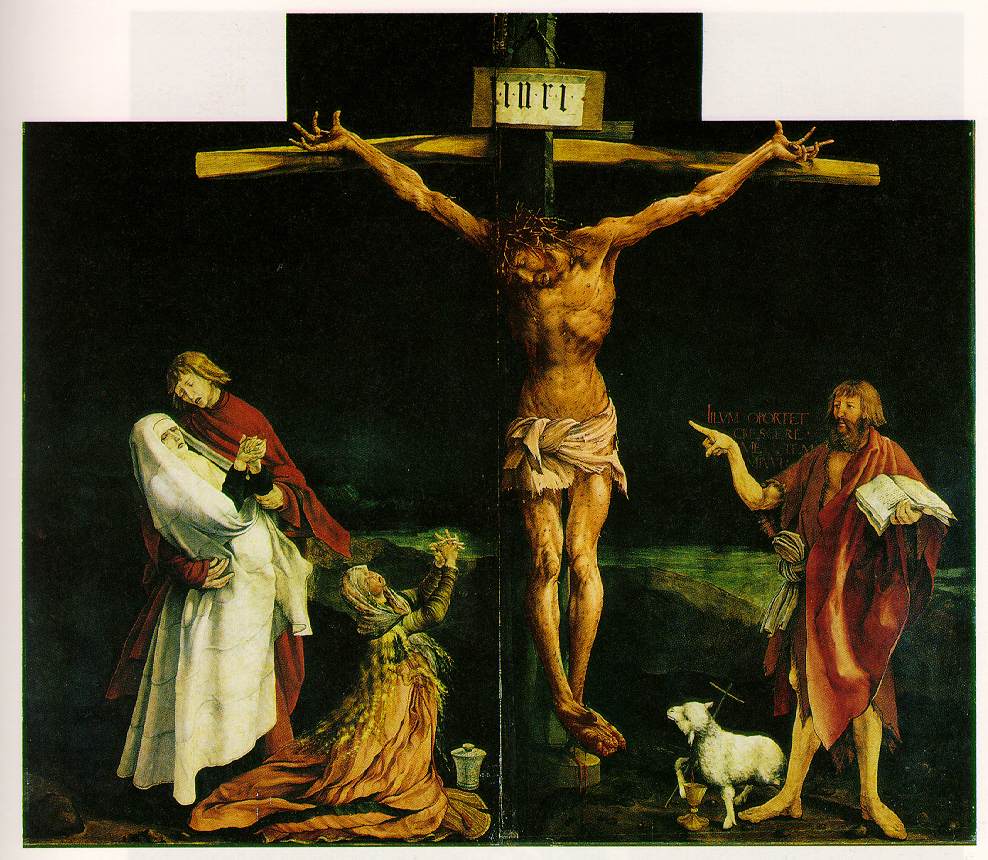
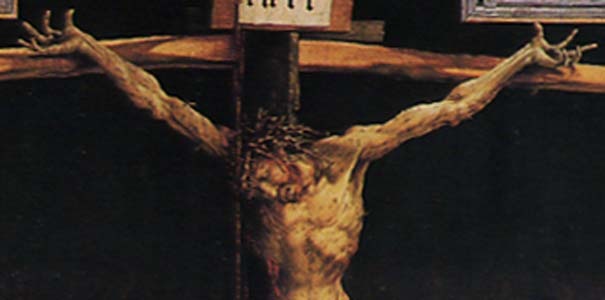
I post today in commemoration one of the most famous crucifixions in all
of art, the centerpiece from Matthias Grunewald’s Isenheim Altarpiece.Here is the entire centerpiece.
Here are two details of Christ, the upper body, and then His face.
We adore You, O Christ, and we
bless You, because by your holy cross You have redeemed the world.