"Love follows knowledge."
"Beauty above all beauty!"
– St. Catherine of Siena

Showing posts with label Obituary. Show all posts

Saturday, December 31, 2022

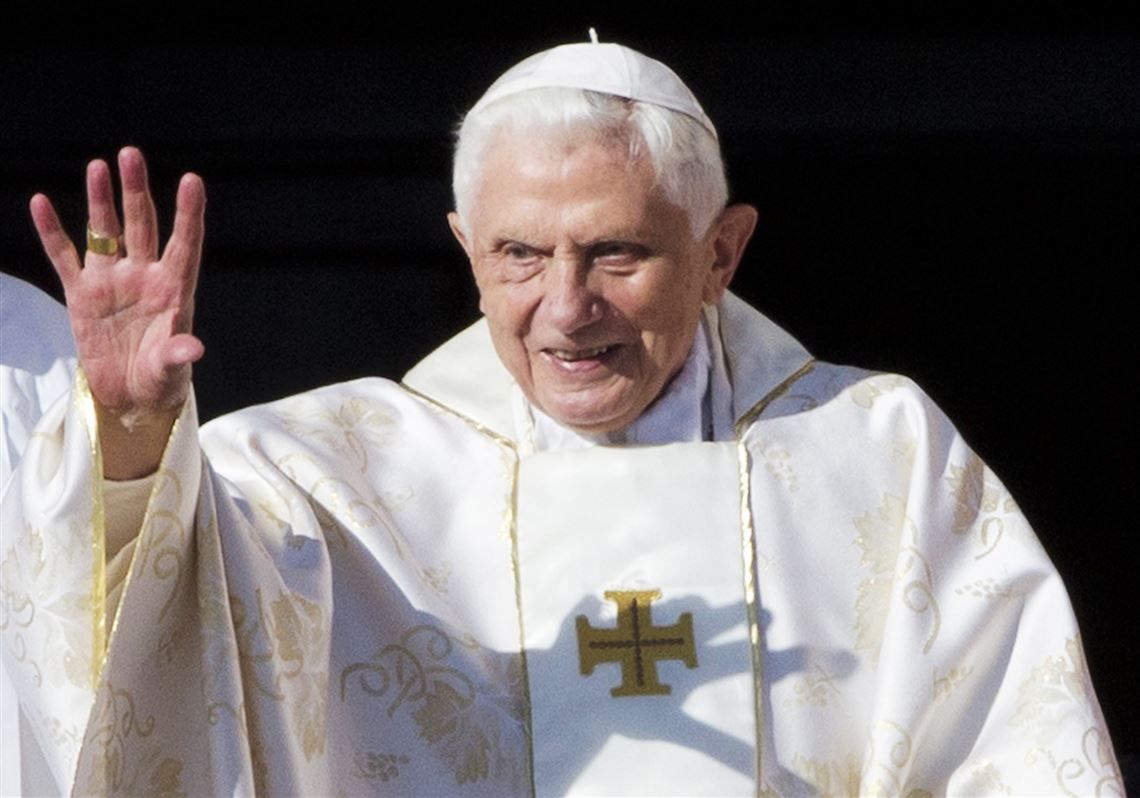
In Memoriam: Pope Emeritus Benedict XVI

Early this morning, as many of you probably know, our beloved Pope Emeritus Benedict XVI passed away at the age of 95. Where do I even begin to summarize his epic life?  He lived through almost a hundred years of eventful history, participated in some of it directly, and wrote about the theological implications of most of it.  He wrote 66 books, three Church Encyclicals, four Apostolic Exhortations, and a number of major speeches.  His output was immense.  He was one of the key intellectuals behind the Vatican II Council, and an intellectual guide for the papacy of his predecessor, Pope John Paul II.  Through it all, and there were many who demonized him both within and outside the Church, he was a gentle man, a lover of the arts, a man of prayer and spirituality.  One aspect of his character that seems to go unnoticed was his humility.  He was an intellectual giant of the type I deeply respect and have always wanted to emulate.  In short, he was my favorite pope of my lifetime.

From what I gathered surfing around the news world, Pope BXVI (my shorthand for Pope Emeritus Benedict XVI) will be remembered for being the first pope in almost 600 years to resign the office.  I have seen criticism of it, but he was 85, frail, in not the best health, and trying to perform the duties of the modern era.  He went on to live ten years, but from accounts he did not expect to live a year. 

If you want a general perspective on his life, writings, and thoughts, this article from Aleteia, “Benedict XVI,the pope of surprises” did what seems to be a thorough job.    

There are many theological ideas that Pope Benedict explored and commented on, but he had a way of bringing out their societal implications.  For instance, he first observed how the relativism of faith has had implications on our society, a concept he called “the dictatorship of relativism.” 


“Today, a particularly insidious obstacle to the task of education is the massive presence in our society and culture of that relativism which, recognizing nothing as definitive, leaves as the ultimate criterion only the self with its desires,” he said in an address in Rome in 2005. “And under the semblance of freedom it becomes a prison for each one, for it separates people from one another, locking each person into his or her own ego.”

Can you see how gay marriage and what I’ll call the relativism of gender has flowed from what contemporary society has determined to be a lack of fixed truths? 

You can easily find the highlights of his life, so I’m not going to list them.  Instead I’m going to embed a video where Bishop Robert Baron puts Pope Benedict XVI’s life and ideas into context.  It’s just over a half hour. 


Finally, BXVI was a great lover of music, and from what I understand an accomplished pianist.  Aleteia  also has an article on BXVI’s favorite musical pieces, and it’s a good deal of Mozart and Bach.  

He seemed to have a special love for Mozart.  From the article:


Pope Benedict XVI once described one of his early encounters with the music of Mozart, while attending a Mass penned by the great composer. He described Mozart’s treatment of the Mass as “music that could only come from heaven; music in which was revealed to us the jubilation of the angels over the beauty of God.” He added:


“The joy that Mozart gives us, and I feel this anew in every encounter with him, is not due to the omission of a part of reality; it is an expression of a higher perception of the whole, something I can only call inspiration out of which his compositions seem to flow naturally.”

The article also goes on to say that the first concert Joseph Ratzinger ever attended was a performance of Mozart’s Requiem Mass.  So as a fitting conclusion to this post, I want to conclude this post with three pieces from “The Requiem in D minor, K. 626.”  First the Introit and Kyrie which are here together.


The third piece will be the Domine Jesu, an appeal to Christ to save the soul of the dead.  


Here are the lyrics in English.


Lord Jesus Christ, King of glory,

deliver the souls of all the faithful departed

from the pains of hell and from the bottomless pit:

deliver them from the lion's mouth,

that hell swallow them not up,

that they fall not into darkness,

but let the standard-bearer holy Michael

lead them into that holy light:

Which Thou didst promise of old to Abraham and to his seed.

That is just so beautiful.  I am certainly saddened by the death of my beloved BXVI.  But given his age, and watching my mother struggle with old age, I can see how it is eventually a blessing.  May Pope Emeritus Benedict XVI continue to bless us from above. 


Eternal rest grant unto him,
O Lord, and let perpetual light
shine upon him.


Tuesday, February 2, 2016

Music Tuesday: Take It Easy by the Eagles


Another old time rock-and-roller passed away last week, Glenn Fry, lead singer of the Eagles.  

From TMZ: 

Glenn Frey, co-founder and guitarist for the Eagles, has died ... TMZ has learned.

We're told the cause of death was a combination of complications from rheumatoid arthritis, acute ulcerative colitis, and pneumonia.

Frey had been battling intestinal issues for months and had surgery in November. We're told in the last few days his condition took a turn for the worse. He died in New York City.

Glenn co-wrote and sang on most of the Eagles hits, including “Take It Easy,” “Tequila Sunrise,” “Lyin’ Eyes,” and “Heartache Tonight,” to name a few. He also co-wrote “Hotel California” and “Desperado” with Don Henley and took home 6 Grammys with the band.

 Here’s some other great reading on Frey.  Here Linda Ronstadt tells how Glen Frey and Don Henley formed the Eagles while working on her band in the early 1970s. 

And here’s Don Henley’s full statement upon hearing of Glenn’s death: 

"He was like a brother to me; we were family, and like most families, there was some dysfunction. But, the bond we forged 45 years ago was never broken, even during the 14 years that the Eagles were dissolved. We were two young men who made the pilgrimage to Los Angeles with the same dream: to make our mark in the music industry -- and with perseverance, a deep love of music, our alliance with other great musicians and our manager, Irving Azoff, we built something that has lasted longer than anyone could have dreamed. But, Glenn was the one who started it all. He was the spark plug, the man with the plan. He had an encyclopedic knowledge of popular music and a work ethic that wouldn't quit. He was funny, bullheaded, mercurial, generous, deeply talented and driven. He loved is wife and kids more than anything. We are all in a state of shock, disbelief and profound sorrow. We brought our two-year 'History of the Eagles Tour' to a triumphant close at the end of July and now he is gone. I'm not sure I believe in fate, but I know that crossing paths with Glenn Lewis Frey in 1970 changed my life forever, and it eventually had an impact on the lives of millions of other people all over the planet. It will be very strange going forward in a world without him in it. But, I will be grateful, every day, that he was in my life. Rest in peace, my brother. You did what you set out to do, and then some."

The song I will remember Glenn Frey will be “Take it Easy.”  Here Glenn singing live.


May he rest in peace.

Tuesday, January 12, 2016

Music Tuesday: RIP, David Bowie

If you haven’t heard, David Bowie passed away yesterday from liver cancer.  From The Hollywood Reporter obituary:  

David Bowie, the genre- and gender-bending British music icon whose persistent innovations and personal reinventions transformed him into a larger-than-life rock star, died Sunday after a battle with cancer, his rep confirmed to The Hollywood Reporter. He was 69.

"David Bowie died peacefully today surrounded by his family after a courageous 18-month battle with cancer. While many of you will share in this loss, we ask that you respect the family’s privacy during their time of grief," read a statement posted on the artist's official social media accounts.

The influential singer-songwriter and producer excelled at glam rock, art rock, soul, hard rock, dance pop, punk and electronica during his eclectic 40-plus-year career. He just released his 25th album, Blackstar, Jan. 8, which was his birthday.

I’m sure there are lots of obits around where you can get the totality of his career.  The BBC summarized his career here.  

Bowie was born David Jones in January 1947 but reinvented himself as David Bowie, in 1966, in order to avoid confusion with the Monkees' Davy Jones.

He went on to study Buddhism and mime, and released his first album, the World of David Bowie, in 1967.

But it was the title track of his second album, Space Oddity, which aroused more than passing interest.

The atmospheric tale of an abandoned astronaut, Major Tom, orbiting the Earth, Space Oddity became a hit in 1969, the year of the first Moon landing.

Initially a hit throughout Europe, it took four years to "break" the United States.

My son Matthew loves “Space Oddity.”  There’s something simple and folkloric about it.  For me David Bowie’s music was either very good or very bad. He experimented with music in a way that suggested to me he didn’t understand music well or didn’t have what Hemingway called a “crap detector.” So when he tried something new it either was brilliant or terrible. That’s probably not true, but that’s my impression. I really thought his Let’s Dance album was very solid as an album. Not sure which of his songs were my favorite, but songs like “Young American” just captured something from the time and place, and of course my youth.

I’m just going to post a few of my favorite Bowie songs.  I just love that hip sax in “Young Americans” and those wonderful lyrics.  


“Rebel Rebel,” might be his greatest song. That was punk rock before punk rock existed.


Here’s some of the lyrics:

You've got your mother in a whirl
She's not sure if you're a boy or a girl
Hey babe, your hair's alright
Hey babe, let's go out tonight
You like me, and I like it all
We like dancing and we look divine
You love bands when they're playing hard
You want more and you want it fast
They put you down, they say I'm wrong
You tacky thing, you put them on

Read more: David Bowie - Rebel Rebel Lyrics | MetroLyrics

Finally I always loved “Let’s Dance.”  It was so 1980s.


And if you say run, I'll run with you
And if you say hide, we'll hide
Because my love for you
Would break my heart in two
If you should fall
Into my arms
And tremble like a flower

Finally I heard that his wife posted this on Twitter when he died: “The struggle is real, but so is God.” 


God rest his soul.  He was an entertainer in the fullest sense.

Thursday, January 7, 2016

Rest in Peace, Florence King

I was saddened to see this morning that Florence King had passed yesterday. I don't have time to write much here. National Review Online has a proper obituary, written by Jack Fowler, and it’s great.  Here’s an excerpt:

Florence King was one of the premier writers of the 20th century. In particular, as a book reviewer, she was unrivaled. And was there a better scourge of multiculturalism than the crotchety, gin-swilling, chain-smoking, off-colored prose perfectionist who fired off verbal mortars from a nicotine-and-tar patina-d apartment on Caroline Street? I don’t think so. She is an important part of the history and fiber of this institution known for harboring great writers. Her thousands upon thousands of adoring fans — many of whom she counted as pen pals (she loved getting letters from her readers) — will agree.

One private thing: Florence was spiritual — at least that she felt the spirit of a few departed souls, especially her famous Granny. That led her to think, maybe . . .  A few months back she asked me to pray for her, and I did, and she was happy to know that rosaries on Bill Buckley’s old beads were being said for her. It gave her comfort, and maybe there were other consequences. But tonight I will say another prayer for her, and I hope you will too, because if you were someone who derived great enjoyment from reading Florence King, know that, at the end, she sought peace, and if we can help her rest in it, we should.

When I was young and a budding conservative, I devoured the old National Review magazines, and one column I could not miss was the Florence King column, which I believe was on the back end of the issue. When I proclaim the rightful superiority of traditional conservatism, Florence King was one of those writers that had an impact on my thinking. Here's how her Wikipedia entry characterizes her conservative philosophy:

King was a traditionalist conservative, but not a "movement conservative," and she objected to much of the populist direction of the contemporary American Right. King labeled herself a "misanthrope." She was an active Episcopalian (though she often referred to her agnosticism), a member of Phi Alpha Theta, and a monarchist.

Monarchist? Well, she probably was and that's about as traditional a conservative as one gets. To be fair, King's father was British, and so that may be referring to her British, Tory leanings.
But she most definitely was a misanthrope. That characteristic is the one I most remember about her. I pulled up a few of her quotes posted on Goodreads. Let me share a few.

She never married and from what I gathered she was mostly a hermit:

“Keep dating and you will become so sick, so badly crippled, so deformed, so emotionally warped and mentally defective that you will marry anybody.”

She was always ready to touch on her misanthropy:

“Misanthropes have some admirable -- if paradoxical -- virtues. It is no exaggeration to say that we are among the nicest people you are likely to meet. Because good manners build sturdy walls, our distaste for intimacy makes us exceedingly cordial. “Ships that pass in the night.” As long as you remain a stranger we will be your friend forever.”

She had the ability to read the very core of people:

“Hell hath no fury like a liberal arts major scorned.”
And,
“The belle is a product of the Deep South, which is a product of the nineteenth century and the Age of Romanticism. Virginia is a product of the eighteenth century. It's impossible to extract a belle from the Age of Reason.”

Being a southerner, she frequently wrote about it.

“One of the most startling phenomena I ever witnessed occurred in the South after the Arab-Israeli Six-day War. I doubt if the world has ever seen such a rapid ceasefire in antisemitism. I heard one Southern man after another say in tones that i can only describe as gleeful: 'by dern, those Jew boys sure can fight!' One man seriously recommended that Congress pass a special act making Moshe Dayan an American citizen so that he could become Secretary of Defense. He had obviously found a new ‘hero;' as he put it 'That one-eyed bastid would wipe out anybody offin the map whut gave us any trouble.”

And
“Southerners have a genius for psychological alchemy ... If something intolerable simply cannot be changed, driven away or shot they will not only tolerate it but take pride in it as well.”

But her greatest gift was her wit and way with words:

“A woman must wait for her ovaries to die before she can get her rightful personality back. Post-menstrual is the same as pre-menstrual; I am once again what I was before the age of twelve: a female human being who knows that a month has thirty days, not twenty-five, and who can spend every one of them free of the shackles of that defect of body and mind known as femininity.”


Rest in peace Florence King, I shall forever remember reading you at night in that beloved magazine.


Sunday, November 30, 2014

Literature in the News: Mark Strand, RIP

 A bit of sad news today.  The renown poet and former American Poet Laureate, Mark Strand, passed away yesterday.  From the New York Times Obituary:


Mark Strand, whose spare, deceptively simple investigations of rootlessness, alienation and the ineffable strangeness of life made him one of America’s most hauntingly meditative poets, died on Saturday at his daughter’s home in Brooklyn. He was 80.

His daughter, Jessica Strand, said the cause was liposarcoma, a rare cancer of the fat cells.

Mr. Strand, who was named poet laureate of the United States in 1990 and awarded the Pulitzer Prize for Poetry in 1999 for his collection Blizzard of One, made an early impression with short, often surreal lyric poems that imparted an unsettling sense of personal dislocation — what the poet and critic Richard Howard called “the working of the divided self.”

The Wikipedia entry states that people confused Strand’s poetry with that of Robert Bly, another leading contemporary American poet, and it’s true for me.  As I went researching for a Strand poem, what I thought was a Starnd poem turned out to be a Bly poem.  Still, as I read through a number of Strand poems this evening, I do think they are quite distinct.  More from the NY Times, this on Strand’s style:

Echoes of Wallace Stevens and Elizabeth Bishop could be heard in his compressed, highly specific language and wintry cast of mind, as could painters like Giorgio de Chirico, René Magritte and Edward Hopper, whose moody clarity and mysterious shadows dovetailed with Mr. Strand’s own sensibility.

I’m not sure how a poet compares to a painter, but I think Liam Grimes (the author of the NYT Obit) has it quite right on comparing Strand to Wallace Stevens and Elizabeth Bishop.  They share a metaphysical style, especially in the way they jump from the abstract to the concrete and vice versa.  Another poet that comes to mind for me that recalls Strand’s style is Marianne Moore, but that’s a momentary gut reaction without any side by side comparison.  

A couple of things stood out for me in his biographic details.  Either I didn’t remember or I didn’t know Strand was Canadian born.  But apparently because his father relocated a number of times for his work Strand spent his defining years on American soil and in other nations.  He definitely sounds American, as you can see by the poets listed above that are similar in voice and style, though I’m not sure there is a distinction between American and Canadian voices.  The other thing that I didn’t realize was that he was Jewish, though I can’t find anything that says he was observant.  His emphasis on death does push him to religious themes, though I have no idea if he was a believer of any sort.  The Obit highlights this poem, titled “The Remains” because it seems to compose his own epitaph.  

I empty myself of the names of others. I empty my pockets.
I empty my shoes and leave them beside the road.
At night I turn back the clocks;
I open the family album and look at myself as a boy.
What good does it do? The hours have done their job.
I say my own name. I say goodbye.
The words follow each other downwind.
I love my wife but send her away.
My parents rise out of their thrones
into the milky rooms of clouds.
How can I sing? Time tells me what I am.
I change and I am the same.
I empty myself of my life and my life remains.


I’ll highlight this poem because I think it’s a better one and because it sounds so much like Wallace Stevens, who I adore as a poet.


The Idea
by Mark Strand

For us, too, there was a wish to possess
Something beyond the world we knew, beyond ourselves,
Beyond our power to imagine, something nevertheless
In which we might see ourselves; and this desire
Came always in passing, in waning light, and in such cold
That ice on the valley's lakes cracked and rolled,
And blowing snow covered what earth we saw,
And scenes from the past, when they surfaced again,
Looked not as they had, but ghostly and white
Among false curves and hidden erasures;
And never once did we feel we were close
Until the night wind said, "Why do this,
Especially now? Go back to the place you belong;"
And there appeared , with its windows glowing, small,
In the distance, in the frozen reaches, a cabin;
And we stood before it, amazed at its being there,
And would have gone forward and opened the door,
And stepped into the glow and warmed ourselves there,
But that it was ours by not being ours,
And should remain empty. That was the idea


Here's a reading of "The Idea" if you want to hear it before you.  I don't know if the reader is Strand himself, but it's well read.


If you want to read an adorable and funny poem by Mark Strand, go over to the Poetry Foundation and read “Eating Poetry.”   


Eternal rest and peace for Mr. Strand.  He seems like a good soul.


Friday, May 30, 2014

Literature in the News: Maya Angelou, In Memoriam

This past week, poet and autobiographer, detailing the life experiences of a southern, African-American woman living through the Jim Crow laws and the transition of Civil Rights movement, passed away.  Her fame rose substantially when in 1993 President bill Clinton selected her as a poet to read at his inaugural address.  I’m not going to get into her politics, but I’ll provide a few thoughts on her poetry and a few snippets of her life, which, as I read these past few days, surprised me. 

You can read what some might call the official obituary at the New York Times.  Here’s a section:  

Though her memoirs, which eventually filled six volumes, garnered more critical praise than her poetry did, Ms. Angelou (pronounced AHN-zhe-low) very likely received her widest exposure on a chilly January day in 1993, when she delivered her inaugural poem, “On the Pulse of Morning,” at the swearing-in of Bill Clinton, the nation’s 42nd president. He, like Ms. Angelou, had grown up in Arkansas.
It began:
A Rock, A River, A Tree
Hosts to species long since departed,
Marked the mastodon,
The dinosaur, who left dried tokens
Of their sojourn here
On our planet floor,
Any broad alarm of their hastening doom
Is lost in the gloom of dust and ages.
But today, the Rock cries out to us, clearly, forcefully,
Come, you may stand upon my
Back and face your distant destiny,
But seek no haven in my shadow,
I will give you no hiding place down here.
Long before that day, as she recounted in “Caged Bird” and its sequels, she had already been a dancer, calypso singer, streetcar conductor, single mother, magazine editor in Cairo, administrative assistant in Ghana, official of the Southern Christian Leadership Conference and friend or associate of some of the most eminent black Americans of the mid-20th century, including James Baldwin, the Rev. Dr. Martin Luther King Jr. and Malcolm X.
 Here’s a poem from which I’ll pull out some of her poetic highs and lows.
 
Still I Rise
by Maya Angelou

You may write me down in history
With your bitter, twisted lies,
You may trod me in the very dirt
But still, like dust, I’ll rise. 

Does my sassiness upset you?
Why are you beset with gloom?
‘Cause I walk like I’ve got oil wells
Pumping in my living room. 

Just like moons and like suns,
With the certainty of tides,
Just like hopes springing high,
Still I’ll rise. 

Did you want to see me broken?
Bowed head and lowered eyes?
Shoulders falling down like teardrops,
Weakened by my soulful cries? 

Does my haughtiness offend you?
Don’t you take it awful hard
‘Cause I laugh like I’ve got gold mines
Diggin’ in my own backyard. 

You may shoot me with your words,
You may cut me with your eyes,
You may kill me with your hatefulness,
But still, like air, I’ll rise. 

Does my sexiness upset you?
Does it come as a surprise
That I dance like I’ve got diamonds
At the meeting of my thighs? 

Out of the huts of history’s shame
I rise
Up from a past that’s rooted in pain
I rise
I’m a black ocean, leaping and wide,
Welling and swelling I bear in the tide. 

Leaving behind nights of terror and fear
I rise
Into a daybreak that’s wondrously clear
I rise
Bringing the gifts that my ancestors gave,
I am the dream and the hope of the slave.
I rise
I rise
I rise.
 

Of the poems I found on the internet, and at PoemHunter you can find a fair selection, the poem she read at President Clinton’s inauguration and “Still I Rise” are probably the two better poems.  I have to say, she was not a great poet.  Some of those stanzas are downright silly.  Here’s where she falters in the poem above, and I’ll pick a quatrain where she isn’t being silly: “Did you want to see me broken?/Bowed head and lowered eyes?/Shoulders falling down like teardrops,/Weakened by my soulful cries?”  Not only isn’t it interesting rhythmically or metrically, it’s basically all cliché.  And the rhyme “eyes/cries” gives it if not quite a nursery rhyme feel, certainly an amateurish feel.  Actually the first eight stanzas, quatrains in the form of ballad stanzas, are a poorly chosen form for what she’s articulating.  Ballad stanzas are a better fit for narrative poetry; see Samuel Taylor Coleridge’s, The Rime of the Ancient Mariner.  Even the New York Times Obit mentions her weakness as a poet.
 

Some reviewers expressed reservations about Ms. Angelou’s memoiristic style, calling it facile and solipsistic. Others criticized her poetry as being little more than prose with line breaks. But her importance as a literary, cultural and historical figure was amply borne out by the many laurels she received, including a spate of honorary doctorates.
 

But then in the last two stanzas of “Still I rise” she breaks from that quatrain form and goes into free verse, and it sparkles.  “Out of the huts of history’s shame/I rise/Up from a past that’s rooted in pain/I rise/I’m a black ocean, leaping and wide,/Welling and swelling I bear in the tide.”  The language is much fresher and devoid of clichés.  The metaphor of her being an ocean is interesting.  Why is that? 

Let’s look at another poem before I answer that.
 

Woman Work
by Maya Angelou
 

I've got the children to tend
The clothes to mend

The floor to mop
The food to shop
Then the chicken to fry
The baby to dry
I got company to feed
The garden to weed
I've got shirts to press
The tots to dress
The can to be cut
I gotta clean up this hut
Then see about the sick
And the cotton to pick. 

Shine on me, sunshine
Rain on me, rain
Fall softly, dewdrops
And cool my brow again. 

Storm, blow me from here
With your fiercest wind
Let me float across the sky
'Til I can rest again. 

Fall gently, snowflakes
Cover me with white
Cold icy kisses and
Let me rest tonight. 

Sun, rain, curving sky
Mountain, oceans, leaf and stone
Star shine, moon glow
You're all that I can call my own.
 

Now there are some mild clichés in there as well, but for the most part it’s also fresh and interesting.  Yes, it’s a simple poem without complexity.  But in its simplicity she finds rhythm.  What is going on in the fresher parts of her poetry is that she finds a natural voice, an oral voice.  Her poetry sounds much better articulated as spoken drama than as poetry on the printed page.  Indeed where she excels is in oral poetry, where she can rely on the articulation of African-American rhythms to provide a lyricism that doesn’t show up in print, or at least not well.  When Angelou tries to write in some poetic form, her lack of skill is evident.  So let’s give Angelou her due as an oral poet. 
 
Oral poetry is much maligned in the past century, but at one time it was the most important part of poetry.  Prior to the twentieth century, if a poem didn’t sound interesting spoken, it was not regarded highly.  For various reasons (partly I feel because pop song has replaced oral poetry as a voiced art) oral poetry has been disparaged since the first world war.  Given Angelou’s past as a dancer, singer, and actress, I can’t help feel she considered herself more an entertainer than a formal poet.  But I don’t have any evidence for that, and I could be wrong. 

I’ve never read any of her memoirs, and until this retrospective on her life these last few days I knew very little.  What was repeatedly mentioned was her kindness.  Peggy Noonan’s Wall Street Journal blog mentions it.  It also references Angelou's Christian faith, and a friend of Angelou’s who said, “She was so close to Heaven,” in the sense she had a mystic side.  Here, from an interview on Oprah she talks of love and God almost reminiscent of Dante.


And then I came across this retrospective, “A Mother’s Light,” from Kathryn Jean Lopez in National Review Online, who  looked at Angelou as a mother and quoted this from an Angelou essay in Family Journal: 

“When I was 16, a boy in high school evinced interest in me, so I had sex with him — just once. And after I came out of that room, I thought, Is that all there is to it? My goodness, I’ll never do that again! Then, when I found out I was pregnant, I went to the boy and asked him for help, but he said it wasn’t his baby and he didn’t want any part of it. 

I was scared to pieces. Back then, if you had money, there were some girls who got abortions, but I couldn’t deal with that idea. Oh, no. No. I knew there was somebody inside me. So I decided to keep the baby… 

…I’m telling you that the best decision I ever made was keeping that baby! Yes, absolutely. Guy was a delight from the start — so good, so bright, and I can’t imagine my life without him.
 

The thing is that Angelou’s mother had money.  She was well off and could have afforded that abortion.  But she chose not to.  That altered my perception of her completely.  She was a pro-life Liberal.  Now that is going against the grain based on what's in the heart, not the head.  She will never be regarded as a great poet, but she will always be regarded as a fine human being.  And that is so much more important. 
 

Eternal rest, grant unto her O Lord and let perpetual light shine upon your good servant.
May Maya Angelou rest in peace.