"Love follows knowledge."
"Beauty above all beauty!"
– St. Catherine of Siena

Showing posts with label Book Review. Show all posts

Wednesday, February 4, 2026

The Lighthouse: A Novel by Michael D. O’Brien, Post #6

This is the sixth and final post on Michael D. O’Brien’s novel, The Lighthouse: A Novel.

You can find Post #1 here. 

Post #2 here. 

Post #3 here. 

Post #4 here.

Post #5 here. 


My chapter by chapter thoughts and discussions can be found in my previous five posts.  This post consists solely of my review of the book at Goodreads.


Goodreads Review


I gave this only two stars.  I did very much want to enjoy and praise this book.  This is my first Michael D. O’Brien novel, and frankly I did not know what to expect.  I had heard of him and had wanted to read one of his novels.  After all he may be the most distinguished Catholic writer of fiction writing today.  But his more well-known works can run anywhere from 500 to 1000 pages, I never had the time to commit to such a long read.  This read was a very manageable 200 pages.


This review will have spoilers.


As you can read in the novel’s blurb, the premise of the novel is we follow the adult life of Ethan McQuarry, a young man in charge of taking care of a lighthouse off the coast of Cape Breton Island in Canada.  Ethan lives with a childhood trauma of having his father abandon him before he was born, raised poorly by a solitary mother, who once he reached an age where he can fend for himself, abandons him too.  When the solitary job of a lighthouse keeper becomes available, he takes it, seeing it as a natural fit for his loner sensibility.  Notably, the lighthouse is situated on a strip of land that is an island at high tide but connected with a walkable strip on low tide.

As a lighthouse keeper he has the time to develop the skill of carpentry and woodworking.  When a dilapidated boat washes up on his island after a storm, Ethan refurbishes the boat.  The boat will eventually become significant.  Ethan also starts sculpting wooden statues from washed up driftwood, most significantly he sculpts men, women, and children who he calls his family.

The plot of the novel can be seen as Ethan’s encounters to what may be called intruders to his island.  There is an iconic, even parablelike, quality to the story.  Two intruders are significant.  Both are doppelgangers to Ethan’s character.  One is Skillsaw Hurley (Skillsaw because he cut off three of his fingers with a power saw), also with childhood trauma, who is Ethan’s double if he had not grown to be societally functional.  Ross, Ethan’s other doppelganger, is a young man who is Ethan’s double because he too has had his father abandon him, but has grown with a good adopting father so that his trauma has not affected his personality.  Unlike Ethan he is very jovial, gregarious, and socially adjusted.

Now on the surface, this all sounds interesting, and the premise of the novel is great.  Alas the execution is terrible.  The flaws just mounted on top of each other.  First, the characters, despite their premises, are really cartoon figures.  There is no depth to them.  O’Brien gives us the exposition of their background with no dramatic or narrative backing.  Second for the central character to be credibly traumatized such trauma requires some narrative development, either through flashback (think Faulkner), through character interplay (think Dickens), or through straight narrative (think of Jane in the early chapters of Charlotte Brontë’s Jane Eyre).  We have to understand his experience, not just be told.  The whole novel rests on Ethan’s personality, and we have only cursory exposition to know how he was formed.

Third, the central theme of the modern world having degenerated because of its lack of Christianity, while a theme having weight and importance, is delineated in a superficial way.  Characters who represent the modern world are even more cartoonish than the central characters.  The freakish, rude granddaughter, with the blue spiked hair, nose ring, and startling clothes, of a conservative elderly Japanese couple is contrasted against her grandparents for us to show the generational decay.  Really?  How many people in the modern world walk around with blue spiked hair and nose rings?  A good writer should be “steel manning” the opposition argument, not “straw manning.”  The contrasts between the characters with traditional values against those who have “modern” values are not very compelling.  Frankly, and I don’t know if the author intended this or not, the motif of mothers in the novel not able to function without husbands borders misogyny.

Fourth, the characterization of showing the hole in Ethan’s heart from his abandonment as a child, is poorly executed.  Ethan’s wooden carvings of family figures is an interesting detail, but when he starts talking to them and calling the mother figure his “wife” and the boy his “child” that calls him “papa,” it just comes across as creepy.  I don’t think O’Brien intends to portray Ethan as creepy.  He is supposed to be a hero with perhaps his childhood trauma as a flaw.  If O’Brien had just left the story with Ethan psychologically compelled to create family figures, I think the reader would have gotten the psychological connection, and it would have been appropriate.  But he takes it a step too far.  The strangest is when Ethan has an imaginary conversation with a real-life woman he met several years earlier and then when “glancing across the room at his artificial wife, he felt a momentary guilt of infidelity.”  Infidelity to a wooden stature?  That’s just silly and awful.  If O’Brien was after some sort of psychological insight to Ethan’s character, this is just poorly done.

Fifth, large swaths of the novel are boring.  The Skillsaw chapter was fascinating because O’Brien interweaved fascinating details that brought out Skillsaw’s distinct personality.  But that was just one chapter.  There were four chapters, nearly forty percent of the novel, where Ross and Ethan were seen working together, first repairing and then launching the boat and then building a workroom for Ethan’s woodworking.  There is an emphasis on the manual labor, and I understand the narrative goal of showing male bonding and even the father/son type relationship between the two.  The narrative goal was proper, but again the execution was lacking.  Unlike the Skillsaw chapter, the details were tedious without opening up elements of their characters.  Perhaps this is subjective on my part but given the lack of narrative to their early formative lives I found I really didn’t care about the manual work.  I do realize that the manual work, even the craftsmanship, carries added significance in this novel, but I have to care about the characters first before I find interest in the work.

Lastly, I could not believe this is how O’Brien brought the story to a conclusion: by having Ethan drown in a happenstance storm?  There are so many unfulfilled lines of narrative.  What about Catherine MacInnis, or some other woman to be Ethan’s wife?  What about that hole in his heart for a spouse and children?  What about his carvings and artistry?  What about that work room he and Ross spent a quarter of the novel constructing?  What about his life in the just purchased lighthouse that he spent his life savings on and now has ownership?  What about his relationship to his biological son that he discovered and now loves?  What about Ethan’s nascent Catholicism?  All of these threads could have been tied together by a religious conversion and perhaps wedding.  All his internal demons brought about by that childhood trauma that governed the length of the story could have been brought to rest.

This ending had nothing to do with the story of the novel.  It is simply a Deus ex machina ending where the author by shear plot device brings the novel to a conclusion.  In addition, it is purely a Hollywood movie type ending, packed with schmaltzy heroic action and a self-sacrificing final act that makes the hero into a Christ figure.  Ethan unintentionally even leaves behind a note that Ross will one day read and learn the secret of their relationship.  This is Hollywood sentimentality.

If you want to read this novel, there are enough positive reviews to justify picking it up.  I for one did not find this worthy.  Perhaps I’m just an outlier.  Perhaps I’m just wrong.  If you read it and you disagree, let me know.  Maybe you can change my mind.


Monday, October 11, 2021

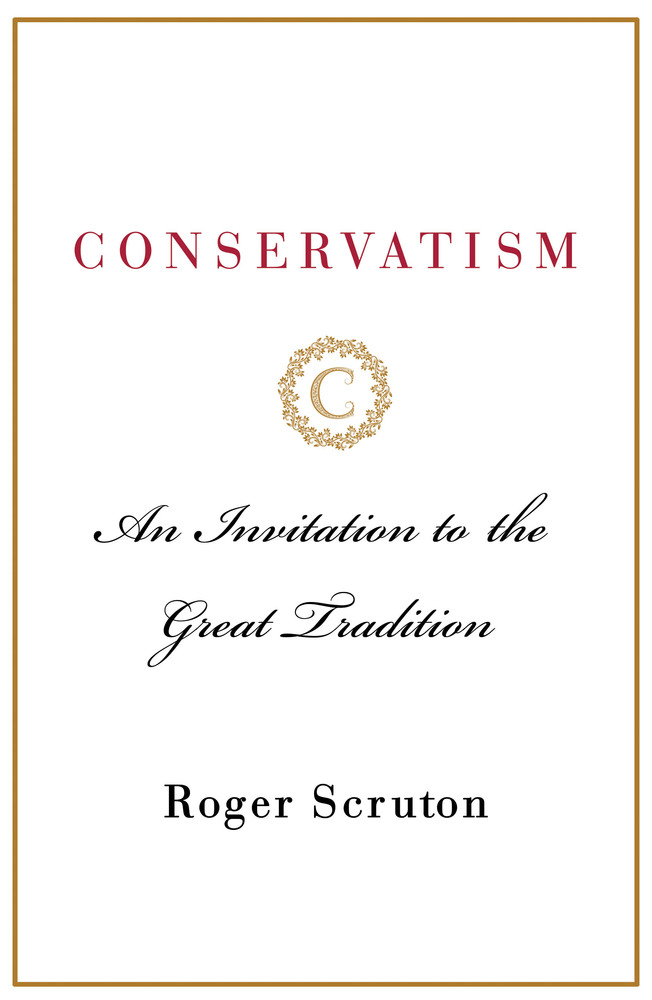
Conservatism: An Invitation to the Great Tradition by Roger Scruton

Published in 2017, a little over two years before his death, this I think was Roger Scruton’s last published work devoted to conservatism proper.  He has written other books on music and art, albeit as seen through a conservative lens, but their primary focus were aesthetic and not civic.  Conservatism: An Invitation to the Great Tradition summarizes a great career of a man who has lived his life in the public square with a particular philosophy that runs against the current of contemporary ethos.  Roger Scruton (1944-2020) was a conservative in the paleo conservative sense, not some neoconservative rebranding of once Liberal thought.  He is British, though has had a voice in European and American conservative circles, a professor of philosophy, has published over 50 books on a wide range of subjects, and for almost twenty years was chief editor at the conservative quarterly, The Salisbury Review.  Prior to the collapse of the Soviet Union, Scruton helped establish underground academic networks in communist controlled countries.


This is an excellent and concise book on the history of modern conservatism by an author who lived through most of the debates of the last fifty years.  When Scruton identifies modern conservatism, he says it is “a product of the Enlightenment,” although acknowledging that conservatism dates back in every era of history.  Conservatism for Scruton is a set of customs, values, and institutions built by a community over time that have proven to sustain, preserve and “ensure [the] community’s long-term survival” and that give it a sense of identity and unity.  Conservatism in the modern sense is a counter to the Liberal emphasis of reshaping society as radical individualism that rose out of the Enlightenment.  “Tradition,” as Scruton observes from Edmund Burke, “is a form of knowledge.”

Scruton walks us through the philosophical ideas that have shaped conservatism going back to Edmund Burke, who argued against a notion of society as a “social contract” (from Jean-Jacques Rousseau) but as a “shared inheritance for the sake of which we learn to circumscribe our demands, to see our own place in things as part of a continuous chain of giving and receiving, and to recognize that the good things we inherit are not ours to spoil but ours to safeguard for our dependents” (p. 45).  Indeed I never signed a social contract but I was certainly born into a shared inheritance.


This is not a book of the ins and outs of political battle over the course of 250 years, but the philosophic developments over that time in Western culture.
  Scruton takes us from the Enlightenment, through the British conservative counter-reaction, through the American founding, through continental European developments, and finally as a reaction to socialism in the twentieth century.  Conservatism for Scruton—and for me, since this has been my view too—is not so much a political philosophy or an economic theory or an intellectual construct, but more a desire to preserve one’s culture and traditions in the face of forced change.  Yes, there is intellectual process which ultimately undergirds that inclination, but foremost is that our culture is our home, which we have ordered through love, and to tear down that home is to violate that love.  Perhaps a summary paragraph of the book is stated as Scruton brings the reader into contemporary times:


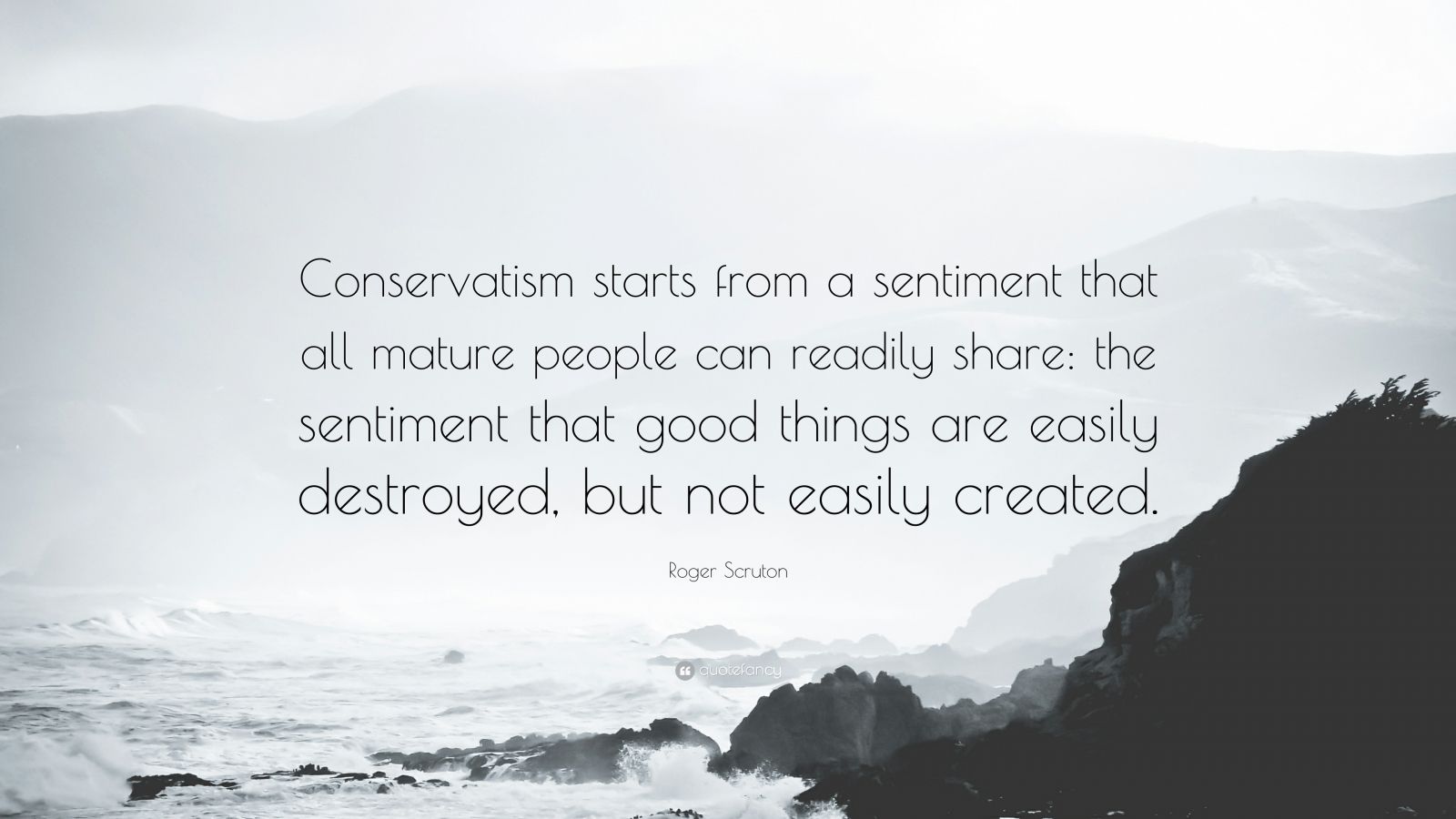
Modern conservatism began as a defense of tradition against the calls of popular sovereignty; it became an appeal on behalf of religion and high culture against the materialist doctrine of progress, before joining forces with the classical liberals in the fight against socialism.  In its most recent attempt to define itself it has become the champion of Western civilization against its enemies, and against two of those enemies in particular: political correctness (notably its constraints on freedom of expression and its emphasis in everything on Western guilt) and religious extremism, especially the militant Islamism promoted by Wahhabi-Salif sects.  In all these transformations something has remained the same, namely the conviction that good things are more easily destroyed than created, and the determination to hold on to those good things in the face of politically engineered changed.  (p. 127)

Scruton brings us through a lot of material and personages in such a short book: Burke, Locke, Hume, Blackstone, Adam Smith (and not just for his economic theories), Samuel Johnson, Jefferson, Madison, Tocqueville, Maistre, Chateaubriand, Coleridge, Arnold, Ruskin, Chesterton, Hayak, even T.S. Eliot, Simone Weil, and D.H. Lawrence.  And of course there is William F. Buckley, Russell Kirk, and Scruton himself.  I can’t name them all, but it is quite a journey.  This is a gem of a book.


Notable quotes from the book:

“We human beings live naturally in communities, bound together by mutual trust.  We have a need for a shared home, a place of safety where our claim to occupancy is undisputed and where we can call on others to assist us in times of threat.  We need peace with our neighbors and the procedures for securing it.  And we need the love and protection afforded by family life.  To revise the human condition in any of those respects is to violate imperatives rooted in biology and in the needs of social reproduction.  But to conduct a political argument as though these factors are too far from the realm of ideas to deserve a mention is to ignore all the limits that must be borne in mind, if our political philosophy is to be remotely believable.  It is precisely the character of modern utopias to ignore these limits – to imagine societies without law (Marx and Engels), without families (Laing), without borders or defenses (Sartre).”  (p. 10)

"The most important input into conservative thinking is the desire to sustain the networks of familiarity and trust on which a community depends for its longevity. Conservatism is what the name says it is: the attempt to conserve the community that we have - not in every particular since as Edmund Burke put it, 'we must reform in order to conserve,' but in all matters that ensure our community's long-term survival."  (12)

“What [Samuel] Johnson believed he also exemplified, which was a firm moral sense combined with a robust eccentricity of manner and a deep respect for aesthetic values.  For Johnson, the established church, which brought people together in a shared recognition of God’s presence in their daily lives, was the heart of political order.  Tolerance should be extended to dissenters and unbelievers, but not at the expense of orthodoxy.” (30)

“Liberals saw political order as issuing from individual liberty; conservatives saw individual liberty as issuing from political order.  What makes a political order legitimate, in the conservative view, is not the free choice that create it, but the free choices that it creates, The question of which comes first, liberty or order, was to divide liberals from conservatives for the next two hundred years.”  (31)

“Conservatism is about freedom, yes.  But it is also about the institutions and attitudes that shape the responsible citizen, and ensure that freedom is a benefit to all.  Conservatism is therefore also about the limits to freedom.  And here, in the potential conflict with the extreme liberal view that values freedom above all other things and refuses to set limits to its exercise, we encounter one of the principal political issues of our times.”  (39)

 "For Maistre, obligation to the sovereign can have no basis in contract or consent, but only piety towards established things.  The true object of political obligation is not the state, but God, and it is in religious duty that the obligation towards all human institutions must ultimately be founded. Moreover, it is God, not man, who is the maker of constitutions, and the ultimate legislator, all French revolutionary thought on this subject being nothing but blasphemy designed to fortify human incompetence." (69)

"Thus in a celebrated essay, ‘Tradition and the Individual Talent’ (1919)…[T.S.] Eliot argued that the originality and sincerity demanded of the artist cannot be reached in isolation, that each new work acquires its expressive power through the tradition that makes room for it, and that in every sphere tradition is a process of continuous adaptation of the old to the new and the new to the old. Without tradition, originality is neither significant nor truly perceivable, and this evolutionary view of tradition is clearly applicable to civil society as a whole.  This essay left a profound mark on literary criticism and also on the practice of poetry.  But its lesson has been learned and repeated by political philosophers too." (93)

“But by the end of the nineteenth century the political philosophy of conservatism had turned in another direction.  In its original form, as described in the first two chapters, conservatism was a response to classical liberalism, a kind of ‘yes, but…’ in answer to the ‘yes’ of popular sovereignty.  It was a defense of inheritance against radical innovation, an institution that the liberation of the individual could not be achieved without the maintenance of customs and institutions that were threatened by a single minded emphasis on freedom and equality.  By the end of the nineteenth century conservatism had begun to define itself in another way, as a response to the gargantuan schemes for a ‘just’ society, to be promoted by a new kind of managerial state.  In this battle conservatism became, to a great measure, the true defender of liberty, against what was at best a rising system of bureaucratic government, at worst, as in the Soviet Union, a tyranny yet more murderous than that of the Jacobins in revolutionary France.” (104)

"Throughout its growth as a modern nation America has been built from below, through the free association of its citizens - a point noted and praised by Tocqueville in Democracy in America.  This has offered scope for conservatism as a philosophy of civil society - a philosophy that outlines and justifies the intrinsic form of civil order, against the attempt to control and amend them through the institutions of the state."  (137)

“This led [Samuel Huntington] to raise, in Who Are We? (2002), the question of American identity.  Written in the wake of the atrocities of 11 September 2001 (the 9/11 attacks on New York and Washington DC), the book argues that it will be impossible to respond in a coherent way to the Islamist threat without regaining confidence in our own identity.  This means confidence not in our political institutions only, but in the spiritual inheritance on which they ultimately rest.  The correct response to Islamist belligerence is, therefore, not simply the reaffirmation of the liberal order and the secular state.  It is the rediscovery of ourselves, in a systemic policy of cultural conservatism.”  (149-50)

This is a great interview shortly after this book was published.


Roger Scruton is one of my idols. 


Wednesday, June 25, 2014

Personal Essay: On Writing on Literature

In my review of Julie Davis’ book Happy Catholic the other week I started the post by saying, “I’m not very good at book reviews.”   

What you say, what exactly is the point of this blog?  Isn’t it to review books?  You’ve been writing for eighteen months on literature and you’re not good at reviewing books?  It’s true, I’m not good at reviewing books.  However, I don’t consider most of what I write here to be book reviews.  Occasionally yes, such as that post on Julie’s book.  Yes, some of my early posts on books were tagged “Reviews” but if you’ve noticed I’ve dropped that tag.  I did that after giving some thought as to what I actually do. 

On reflection, I guess there are at least three types of writing on literature.  Let me go through them. 

(1) You can give a review, which amounts to a subjective reaction to a work.  Most people who write about books in magazines and newspapers are writing book reviews.  Most people who write on the internet about books are also giving you a review.  There are reviews on Amazon and Barnes & Noble web sites, usually submitted by readers.  It is instinctual for people to give reviews.  That is what they read, and that is what they emulate.  The author of the review describes the work, highlights what is distinct about it, tells you what they liked about it, and might provide some sort of rating, similar to how movie critics in the newspapers rate movies.  The review rests on the reaction of the reviewer to the book. 

(2) You can provide analysis, which requires a more objective dissection of the work based on some level of knowledge.  Here the author identifies the structure of the work, how the themes are brought out, the character development and the contrasting characters.  He might bring out the historical context of the work, bring out how the author is relating to his society, contrast it with similar works, or place the work within the author’s other works.  Is there subjectivity?  Well, nothing is perfect, but if a critic is writing analysis he is trying to squeeze out every bit of subjectivity.   Literary analysis amounts to an undergraduate college paper.   

(3) Or finally you can do literary criticism, which is also analysis but set in the context of past criticism.  Literary criticism is what college professors and graduate students do.  When I was a graduate student my papers were literary criticism.  It builds on past criticism and either explores an idea about the work or author that hasn’t been thought before or it expands on some critics previous idea that didn’t go far enough.  Or, perhaps, some new biographical detail of the author’s life has reframed a previous idea, and so past criticism missed a particular theme.  But literary criticism requires a research library and a fair amount of time reading past criticism.  It requires footnoting and giving credit for any idea one picks up from another work of criticism.   

As I was thinking through these types of writing on books, I came across this feature in The New Criterion on literary essayist Joseph Epstein, titled, “On Joseph Epstein: A look at Joseph Epstein’s work, the importance of reading, and the role of the critic.”  Now there’s an essay that coordinates with my blog and especially this post: the importance of reading!  I think the feature essay brings out the differences between the three types of writing on books.  I don’t recall ever reading a Joseph Epstein essay, so I’m somewhat speculating here but let’s explore how the author of the feature, William Giraldi, defines Epstein’s essays.
For more than five decades as a critic and essayist, Joseph Epstein has been one of our most valuable and vociferous antidotes against puerile and invertebrate reviews, a smasher of hype and entrenched pieties among the literati, an arbiter with a bloodstained yardstick, a writer serious about his convictions and his comedy. With Ruskin and Arnold and Wilde, Epstein is a shining example of how essay writing and criticism aspire to equal footing with imaginative literature. The author of twenty-four books—his newest collection, A Literary Education, will be released in June—Epstein illustrates the necessary difference between disposition and argument and never confuses rhetoric with logic, or rationalization with reasoning. By turns cantankerous and comedic, traditional and irreverent, damning and praising, he writes sentences you want to remember. And that, in the last analysis, is the only measure of a writer. 

As I perused Joseph Epstein’s page on Amazon, he’s got an assortment of books: collections of his essays, collections of great essays in literary history in which he edited, biographies of authors, and a collection of his short stories.  He is a writer who has lived a life as a reader.  Giraldi in the paragraph above identifies Epstein as both a critic and an essayist.  As an essayist he associates Epstein’s work with John Ruskin, Matthew Arnold, and Oscar Wilde, quite prestigious company.  But when Giraldi says “essay” I think he means the personal essay, which is not what I’m writing about here.  But Giraldi also fleshes out Epstein’s ability as a critic: 

The average reviewer’s idea of literary comment is indistinguishable from a primary school book report: summary flanked by quotation, interspersed with how the book made him feel, as if his feelings have anything at all to do with the artistic success or failure of what he’s read. They do not. Where the novel is concerned, part of the problem is that many publications harness other novelists to do the reviewing. They must go this route for the obvious reason that our culture currently suffers from a dearth of Edmund Wilsons, H. L. Menckens, Elizabeth Hardwicks, and Lionel Trillings. But one can’t get around the fact that most creative writers don’t know the first thing about the critical mind. They can’t tell F. R. Leavis from R. P. Blackmur and they don’t much care to. They preside over literary comment much the way they preside over their MFA writing classes: either with saccharine equanimity, with a kind of artistic egalitarianism that scoffs at canonical standards, or with bromidic workshop lingo such as “I couldn’t sympathize with the narrator,” or “The plot feels unrealistic to me.” I’ve said this before but I hope you’ll agree that it bears repeating: Criticism is personal and passionate, the product of severe erudition, or it is impotent and dull, the product of mere opinion.

Here Giraldi places Epstein among five of the most renown critics of the 20th century, though H. L. Mencken was more of an essayist.  Where Mencken was scholarly was in writing on the nature and evolution of the English language.  When it came to books and writers, he was more of a reviewer.   

But what is Epstein?  Here Giraldi describes his essays on literature that I think is insightful.

The endemic illusion among many reviewers is that talking about imaginative literature is a lot like talking about life. Try not to believe that. To talk about imaginative literature is to talk about art—artifice and architecture, the liturgical and the linguistic—and Epstein writes about books not through the vista of someone who has lived fully, but rather as someone who has read fully. In other words, he doesn’t make the tyro’s error of confusing art for life, even though he understands that art enhances, enriches, enlarges life. His essays are troves of literary reference and allusion, maps between centuries, countries, genres. More important, the torque and pitch of his literary assertions can be muscular introductions to those writers you don’t know well and also a whole new sheen on those writers you do. 

Now Giraldi is not on the same wavelength as I am when it comes to the three divisions of writing on literature.  So there is a blur of distinction when he refers to Epstein as a “reviewer.”  But there are a couple of hints in the paragraph that suggest Epstein is more than a reviewer as I defined it.  Epstein doesn’t make the “error of confusing art for life.”  That’s a focus on the aesthetics and the subjective reaction to the work.  Also, Epstein’s essays “are troves of literary reference and allusion, maps between centuries, countries, genres.”  That’s an analysis of a work within the context of cultural history.  The essay is an interesting read, if you want to read its entirety.   

So what is it I do with my writing on literature?  Well, I don’t have a research library on hand and there is very little incentive for me to read three books of literary criticism for every work of fiction I wish to write on.  So I don’t do literary criticism.  Actually I have never seen literary criticism on the internet.  Perhaps one day I might post my Master’s Thesis.  It would have to be in five or six installments because of its length. 

I don’t do reviews well because I have been drilled to strive for a pursuit of objectivity, both from my graduate school papers and, perhaps, inherently because I am an engineer by profession.  I’m not claiming that all graduate school papers are objective, and I can assure you not all engineers are objective in their work.  But if you want to be good at both I’ve learned you need to strive for it.   

That is not to say that reviewers of books are in any way lesser.  If anything they might be greater.  Certainly people want an educated person’s opinion of a novel.  People who can project why they enjoyed a work do not produce the “stodgy, old intellectual blogs” such as this.  What I do is hopefully show the literary aesthetics of a work, highlight the creative sections, and link the aesthetics to what makes the work important.