"Love follows knowledge."
"Beauty above all beauty!"
– St. Catherine of Siena

Showing posts with label Dr. Brant Pitre. Show all posts

Monday, September 21, 2026

Sunday Meditation: The Generosity of Grace

For the Twenty-Fifth Sunday in Ordinary Time in Year A, Jesus gives another parable, that of the Workers in the Vinyard.  There is a lot to this parable.  The context goes back to last Sunday’s parable from Matthew’s chapter 18 where Jesus concludes the Community Discourse on the requirement to forgive.  Then we have chapter 19 where Jesus provides his discourse on divorce, the requirement to be as children, and the response to the rich young man on being perfect.  That is all skipped in the Sunday lectionary, which brings us today to chapter 20, a parable which illustrates God’s generosity of grace.  In some ways Jesus is continuing His Community Discourse in these two chapters.  The only shift I think from chapter 18 in these last two chapter is that Jesus shifts from requirements to counsels. 

As an allegory, the Parable of the Workers in the Vineyard sets up the landowner as God, work in the vineyard as doing God’s work, and the day’s pay as a reward in salvation.  God extends His grace to all who do His work, whether for working all day or for just an hour.  I did not embed Fr. Geoffrey’s Plant’s homily on today’s Gospel, but I want to quote his conclusion:


The workers who were employed early in the morning trusted in what they had done. They had laboured for twelve long hours and assumed that God rewards people according to what they have earned. The longer they had worked, the greater they believed would be their reward. But Jesus overturns that expectation. The owner of the vineyard is not an accountant carefully calculating what each worker deserves. He is astonishingly generous. The workers hired at the eleventh hour have no achievements on which to rely. They have nothing to bring except their need. They can only trust in the goodness of the landowner. That is how God's grace works. Grace that can be earned is no longer grace. Grace that can be calculated is no longer grace. Grace that can be claimed as a matter of entitlement is no longer grace. God's grace is not a wage paid for work performed. It is a gift, freely given to those who are willing to receive it. Whether we labour in the vineyard for one hour or for twelve is not ultimately decisive.  God gives salvation as an unmerited gift. 

In some respects, this parable with the workers who worked all day as disgruntled with the owner’s generosity reminds me of the Parable of the Prodigal Son in Luke’s Gospel.  The workers who worked all day express the same sort of injustice as the older brother with the prodigal brother.  Both parables show God’s generosity as being primary over God’s justice.  It’s interesting to note that Matthew the tax collector provides a parable with money while Luke seems to focus more on family dynamics. 

Three years ago I embedded a homily on this passage from Bishop Barron who emphasized St. Catherine of Siena’s famous quote, “All the way to heaven is heaven” in explaining this passage. 


Today’s Gospel:


Jesus told his disciples this parable:

"The kingdom of heaven is like a landowner

who went out at dawn to hire laborers for his vineyard.

After agreeing with them for the usual daily wage,

he sent them into his vineyard.

Going out about nine o'clock,

the landowner saw others standing idle in the marketplace,

and he said to them, 'You too go into my vineyard,

and I will give you what is just.'

So they went off.

And he went out again around noon,

and around three o'clock, and did likewise.

Going out about five o'clock,

the landowner found others standing around, and said to them,

'Why do you stand here idle all day?'

They answered, 'Because no one has hired us.'

He said to them, 'You too go into my vineyard.'

When it was evening the owner of the vineyard said to his foreman,

'Summon the laborers and give them their pay,

beginning with the last and ending with the first.'

When those who had started about five o'clock came,

each received the usual daily wage.

So when the first came, they thought that they would receive more,

but each of them also got the usual wage.

And on receiving it they grumbled against the landowner, saying,

'These last ones worked only one hour,

and you have made them equal to us,

who bore the day's burden and the heat.'

He said to one of them in reply,

'My friend, I am not cheating you.

Did you not agree with me for the usual daily wage?

Take what is yours and go.

What if I wish to give this last one the same as you?

Or am I not free to do as I wish with my own money?

Are you envious because I am generous?'

Thus, the last will be first, and the first will be last."

~Mt: 20:1-16


Though not a homily, let’s turn to Dr. Brant Pitre for the exegesis.


Dr. Pitre:

So just a little bit of background here with the cultural setting that Matthew is imagining.  Here is a situation where you have a wealthy land owner in this case the owner of the vineyard who would hire out day laborers; that was very common in first century Judaism, so a day laborer was a person who would go out into the marketplace of some public place and wait around for the hopes that some wealthy landowner might come and hire them for a temporary job and basically the idea would be is that you'd be hired for one day you'd go out to the field or in this case to a vineyard during the harvest season and you'd work for a day's wage and then you'd be paid that day, so it was sort of a contract work you know just temporary work like a temp worker.

Dr. Nina Heereman, professor of Sacred Scripture at St. Patrick’s Seminary and University in Menlo Park, California, in her explanation of this passage, makes the observation that Jesus and His earthly father Joseph could have been such day laborers waiting to be picked up for a day’s work.  I thought that a great observation.  Dr. Brant continues.


Around sunset time the owner of the vineyard says to call the laborers and give them their wages but start with the last and then go toward the first.  So I want you to feel the force of this difference.  Between the first and the last minute, guys who were working the fields is pretty grave when you really put it in context the men who were called last worked from 5 p.m. to 6 o'clock they worked for one hour right in the cool of the evening the men who were called first worked from 6:00 a.m. to 6:00 p.m. so they pulled a 12-hour shift in the heat of the day as they said in the scorching heat harvesting the grapes.  Okay and as the owner of the vineyard starts to pay out he starts with the guys who were hired at five o'clock and he gives them one Denarius.  Now as soon as the guys who started at 6:00 a.m. see that, their natural assumption is going to be well these guys got paid a Denarius for one hours work then I should make at least twelve times as much because I work 12-hour shift and instead the master gives them each the exact same one Denarius no matter how long they worked.


His response to them is the key.  He says to them first and foremost I'm not unjust because you agree lead with me for a Denarius so I haven't given you any less than you said you would work for.  So he hasn't shortchanged them anything, that's the first point.  The second point is he says I can give whatever I want to whomever I want, in other words am I not allowed to do what I choose with what belongs to me?  So another important point here is that the owner of the vineyard here is not being unjust because it's his money; he can give however much he would like to whomever he likes for whatever amount of work that they've that they performed right, and then the third point is something very interesting there he says or do you begrudge me my generosity.  Right and now that's a English translation; the literal Greek here is it says this is your eye evil.  Because I am good literally is your eye evil because I am good; the imagery there is of an envious eye so you'll see this in the gospel sometimes or the New Testament talk about the lust of the eyes, that's the sin of envy.  It's seeing someone else's possessions something belongs to someone else and desiring to take it for yourself right as if it belongs to you, and so with what the master is saying here is that you are angry because I am generous because your heart is envious for that which does not belong to you that money is his it's not yours it doesn't belong to you have no right to judge how he distributes it right now what does Jesus up to in doing this well

It is an important element of the parable that the early on workers visually see the latter brought on workers get paid a full day’s wage.  A significant part of the parable is understanding the sin of envy as coming through the eyes. 

Let’s turn to Fr. Charlie Bouchard O.P. for the pastoral homily.  He gives a fascinating example out of literature, the short story by Flannery O’Conner, “Revelation.”


Fr. Bouchard:

The readings today, the first reading and the gospel, especially, both give us examples of what biblical scholars sometimes refer to as a biblical reversal.  In other words, we start out seeming to go in one direction, but then God's plan turns things around and changes the outcome into a way that we didn't expect.  This is an example, of course, of the first reading saying that God's ways are not our ways.  And the Bible is full of these stories of biblical reversals.


There is an author by the name of Flannery O'Connor, who some of you have probably heard of.  She wrote stories, almost all of which take place in the Deep South, and they portray life in the South, which is maybe in the early part of the 20th century might seem a little strange to us who did not grow up down there.  But she has one story that I think is a perfect example of this biblical reversal that we're talking about.  It's a story called “Revelation,” and it's about a person named Mrs. Turpin, who lives on a farm, and she's a rather not very pleasant person.  The story portrays her as being very judgmental and kind of pompous. She looks at the poor around her, and she kind of disparages them.  She looks at the blacks around her in a very uh, discriminating uh, racist society, and she judges them very badly. 


And then at the very end of the story, she has this revelation, which is obviously where the title of the story came from.  And she is on her farm out over the pig pen of all things, this dignified woman standing near the pig pen.  And she has this great vision, this revelation of the end times of what God's judgment is going to look like.  And the story tells us that she looks up and sees this vision, this vast swinging bridge extending upward from the earth through a field of living fire.  Upon it, the author tells us, is a vast horde of souls, rumbling toward heaven.  There are whole companies of white trash, clean for the 1st time in their lives, and bands of poor blacks in white robes, and battalions of freaks and lunatics, shouting and clapping and leaping like frogs.  And bringing up the end of the procession, was a tribe of people whom she recognized at once, as those who, like herself and her husband, had always had little of everything, and the God given wit to use it right.  She leaned forward to observe them closer.  They were marching behind the others with great dignity, accountable as they had always been for good order, and common sense, and respectable behavior.  They alone were on key. 


Yet she could see by their shocked and altered faces that even their virtues were being burned away.  In this passage, to me, has always been just an immense theological statement about these biblical reversals.  Mrs. Turpin, who always thought that, you know, she was maybe not the greatest in the world, but certainly somebody who had it together in God's sight.  Somebody who did the right thing, who had common sense, who dressed properly, and yet she was very judgmental.  And so in this judgment scene, she sees all these people that she had really despised and had no use for, marching up to heaven in all their eccentricity, clapping and singing, and being off key perhaps.  Then she sees herself and her husband and others like them, the proper citizens of the town, who are also marching toward heaven.  But they alone were on key, even though they were at the end of the procession. 


And it's an example of how God's generosity really exceeds God's justice.  That God extends this grace of salvation, not only to those who appeared to have earned it, although they were at the very end of the line, but also to those who, perhaps in the judgment of some, did not earn this grace or did not merit salvation.  Those who live difficult, troublesome lives, those who couldn't pay their bills, those whose clothes weren't washed, all of those that Mrs. Turpin had disparaged, were really going 1st into heaven. The last ones we thought that would have been there.  They are the 1st in line, and she and her husband follow at the very end. 

“The last will be first, and the first will be last.” 


Sunday Meditation: “What if I wish to give this last one the same as you?”


This is such a beautiful and appropriate hymn, “Open My Eyes, Lord.”


Open my eyes, Lord,

Help me to see

Open my eyes, Lord

Help me to see Your face

Open my eyes, Lord

Help me to see


Open my ears, Lord

Help me to hear Your voice

Open my ears, Lord

Help me to hear


Open my heart, Lord

Help me to love like You

Open my heart, Lord

Help me to love


Lord, let me love like You.


Sunday, August 23, 2026

Sunday Meditation: Who Do People Say That the Son of Man Is?

On the Twenty-First Sunday in Ordinary Time in Year A, we get the well-known foundation of the Church in the person of Peter.  Three years ago I embedded a video clip of Dr. Brant Pitre giving the fullest exegesis of how this Gospel passage formed the Catholic Church, the Papacy, and the Church’s authority in the person of Peter.  No other video clip is going to expand on that because that clip said it all.  In that clip, Dr. Pitre quoted the second century theologian and bishop, Irenaeus, from Against Heresies on the early Church’s view of this passage.  It’s worth quoting here.


St. Irenaeus wrote this about the church at Rome and Peter's successors: quote, “the very great the very ancient and universally known church found in and organized at Rome by the two most glorious Apostles Peter and Paul; as also the faith preached to men…comes down to our own time by mean of the successions of the bishops.  For it is a matter of necessity that every Church should agree with this Church [meaning the church at Rome] on account of its preeminent authority, that is, the faithful everywhere…The blessed apostles, then, having founded and built up the Church, committed into the hands of Linus the office of the episcopate [Linus was Peter successor]…To him succeeded Anacletus; after him, in the third place from the apostles, Clement.  To this Clement there succeeded Evaristus. Alexander followed Evaristus; then sixth from the Apostles, Sixtus was appointed; after him Telephorus, who was gloriously martyred; then Hygenus; after him, Pius; then after him Anicetus.  Soter having succeeded Anicetus, Eleutherius does now, in the twelfth place from the Apostles, hold the inheritance of this episcopate.  In this order, and by this succession, the ecclesiastical tradition from the Apostles, in the preaching of the truth have come down to us. and this is the most abundant proof that there is one and the same vivifying faith which has been preserved in the church and the Apostles until now and handed down in truth.”  (Irenaeus, Against Heresies 3.3.2-3; trans. ANF 1.415-16)

This was written in the year 180 A.D.  Don’t ever let anyone dissuade you from knowing that today’s Gospel passage identified Peter and his successors—for this passage shows the rule of succession which some deny—as the foundation to bind and loose, teach and consecrate from Peter to Pope Leo XIV today. That understanding was there from the beginning.

Today’s Gospel:


Jesus went into the region of Caesarea Philippi and

he asked his disciples,

"Who do people say that the Son of Man is?"

They replied, "Some say John the Baptist, others Elijah,

still others Jeremiah or one of the prophets."

He said to them, "But who do you say that I am?"

Simon Peter said in reply,

"You are the Christ, the Son of the living God."

Jesus said to him in reply,

"Blessed are you, Simon son of Jonah.

For flesh and blood has not revealed this to you, but my heavenly Father.

And so I say to you, you are Peter,

and upon this rock I will build my church,

and the gates of the netherworld shall not prevail against it.

I will give you the keys to the kingdom of heaven.

Whatever you bind on earth shall be bound in heaven;

and whatever you loose on earth shall be loosed in heaven."

Then he strictly ordered his disciples

to tell no one that he was the Christ.

~Mt: 16:13-20


My Catholic Life! provides an exegetical aspect that Dr. Pitre doesn’t develop.  It’s worth including here.


My Catholic Life!:

Jesus went into the region of Caesarea Philippi and he asked his disciples, “Who do people say that the Son of Man is?” They replied, “Some say John the Baptist, others Elijah, still others Jeremiah or one of the prophets.” He said to them, “But who do you say that I am?” Simon Peter said in reply, “You are the Christ, the Son of the living God.” Matthew 16:13–16


The symbolism associated with Caesarea Philippi is central to today’s Gospel. Located north of Jesus’ home base in Capernaum, it was a predominantly pagan city known for its shrines to false gods. One of the most prominent was Pan, after whom the region was named Panias (later Banias). Pan, a Greek god, was honored at a shrine near a large cave and spring considered the entrance to Hades. Pan was the god of nature, shepherds, flocks, wild places, fertility, and rustic music, and was often depicted as half man, half goat, with horns and hooves. He played the pan flute and was associated with lust, chaos, and sudden fear—from which we get the word panic.


Additionally, the city was the site of a temple dedicated to the late emperor, Caesar Augustus, who was worshiped as a god throughout the Roman Empire. It was into this spiritually dark pagan setting that Jesus led His disciples—on what may have been a two-day journey—for what culminated in a single, monumental question.


Jesus took the Twelve away from the comfort of their familiar fishing village and Jewish neighbors for a reason. He wanted them to answer His question not in the midst of the familiar and safe, but in a place marked by spiritual confusion and idolatry. Why? So that faith could be professed even there, and divine grace could confront the darkness that permeated the region.

The locations of where the Gospel events occur are usually important to their meaning.  I may have mentioned this before, and here the region of Caesarea Philippi—notice its very Roman derived name—is a contrast to what Jesus is trying to instruct.  If the Roman emperor titled Caesar was considered a god and a son of god, Jesus identifies who the true God and the true Son of God is.


For the pastoral homily I’m going to turn to the successor of St. Peter, the current Holy Father, Pope Leo XIV.  This is from his homily on this passage given today at his Sunday Angelus.  The first four minutes are television introductions.  The Holy Father comes out at just about the 4:00 minute mark. 


Better still, you can read his entire homily at the Vatican Website.  Here are some key excerpts.

Pope Leo XIV:

The Gospel passage makes us understand how decisive this question is for the experience of discipleship.  Indeed, although the twelve apostles had already shared so much of the life and ministry of their teacher, Jesus did not take for granted that they truly knew him or had understood the mystery of the Kingdom of God.  Thus, after asking them what people were saying about him, he addressed them directly: “But who do you say that I am?” (Mt 16:15).


Brothers and sisters, this is a fundamental question for the disciples of every age, and for each one of us.  Faith is not something given to us once and for all.  Rather, we continually need to rediscover the face of Christ and his Gospel, to enter more deeply into his message and to renew the choices we make in our lives, so that they may be consistent with what we profess.  In this way, we can overcome the temptation to think that we already know everything and to reduce faith to mere habit.


The question that is put to us each day — who is Jesus for me, and what does his presence mean in my life? — emerges especially in prayer and when we meditate on the Gospel.  Yet it also arises when we encounter the wounds and needs of our brothers and sisters, and in those relationships and situations that most deeply challenge our conscience.  In our daily lives, in short, we can discover whether the Lord Jesus is for us merely a great figure of history, who said and did important things, or the Christ of God, the One sent to bring us into the love of the Father and to transform our lives and the world in which we live.

The question Jesus poses to the apostles is the question He poses to us, not just once or once a month or once a year.  Jesus poses this question to us every day, and we are to be guided by our response every day.


Sunday Meditation: "You are the Christ, the Son of the living God."


Let’s return to John Michael Talbot for today’s hymn with “Surrender to Jesus.”


Take all my freedom

My liberty, my will

All that I have

You’ve given to me

So I offer it up to You


CHORUS:

I surrender it all to Jesus

I surrender it all to God’s will

I surrender it all for the kingdom of God

I surrender my life, my all


Your grace and Your love

Are wealth enough for me

Grant me these Lord Jesus

And I’ll ask for nothing more


(CHORUS)


I surrender it all for the kingdom of God, my life, my all.  I surrender it all to Jesus.

Monday, August 10, 2026

Sunday Meditation: Faith and Hope on the Sea of Galilee

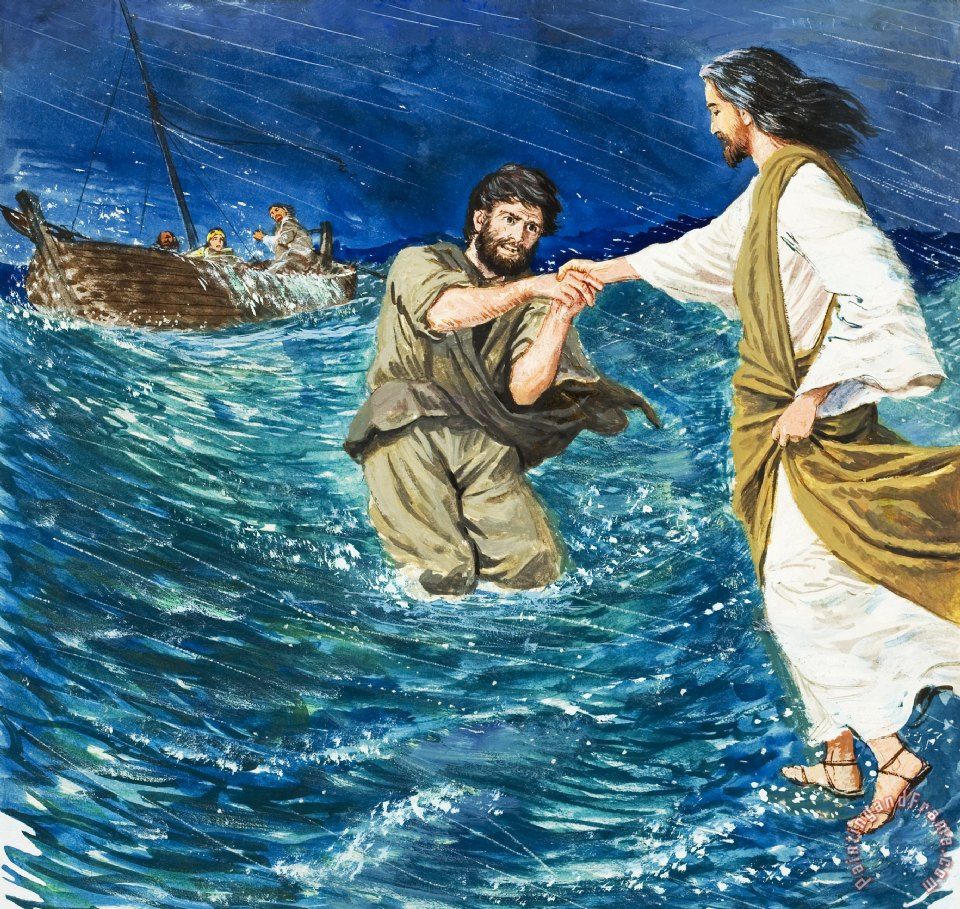
Today, Year A’s Nineteenth Sunday in Ordinary Time, we continue following Jesus and the apostles after the Feeding of the Five Thousand.  Jesus disperses the crowd and sends the apostles off on their boat while he goes up the hillside to pray alone.  The boat encounters a storm, and Jesus heads out to the apostles, walking on the water.  You know the passage.  Peter asks if he could be allowed to walk on the water, and after Jesus acknowledges and Peter does take a few steps, he loses faith and starts to sink.  Jesus then saves him. 

There are a couple of mysterious details in this passage.  Let me bring them out in the form of questions and try to answer them, but rest assured I’m not all that confident in my answers.

Why does Jesus send them off alone to the boat while He goes away from them? 


Prayer is certainly important to Jesus, but the fact He “made them get into a boat” suggests He has orchestrated all the subsequent events.  All details should be filtered with this detail.

Why does He walk on water to go out to them?  Couldn’t He calm the sea and wait for the boat to dock? 


Jesus walking on water is a theophany, a manifestation of His divinity.  He intended to manifest to the apostles.  This appears to be the reason to send them off while He stays back.

Why is the boat on the sea on the fourth watch, which is supposed to be between 3 and 6 AM?  That’s not a particularly safe time to be on water in ancient times. 


It’s obviously overcast and the surroundings would be totally dark.  A natural impulse would be to head back to shore but Jesus wanted them out and so they were obedient.  As Dr. Pitre will explain below, they were fishermen, and so used to going on the sea at night.  Perhaps the bad weather caught them by surprise.

Why did Peter want to walk on the water?


It’s not exactly a natural inclination.  He sees Jesus walking on water, did Peter want to emulate Him?  Was he just looking for a thrill?  Was he trying to show off?  I guess we will never know.


Today’s Gospel:


After he had fed the people, Jesus made the disciples get into a boat

and precede him to the other side,

while he dismissed the crowds.

After doing so, he went up on the mountain by himself to pray.

When it was evening he was there alone.

Meanwhile the boat, already a few miles offshore,

was being tossed about by the waves, for the wind was against it.

During the fourth watch of the night,

he came toward them walking on the sea.

When the disciples saw him walking on the sea they were terrified.

“It is a ghost,” they said, and they cried out in fear.

At once Jesus spoke to them, “Take courage, it is I; do not be afraid.”

Peter said to him in reply,

“Lord, if it is you, command me to come to you on the water.”

He said, “Come.”

Peter got out of the boat and began to walk on the water toward Jesus.

But when he saw how strong the wind was he became frightened;

and, beginning to sink, he cried out, “Lord, save me!”

Immediately Jesus stretched out his hand and caught Peter,

and said to him, “O you of little faith, why did you doubt?”

After they got into the boat, the wind died down.

Those who were in the boat did him homage, saying,

“Truly, you are the Son of God.”

~Mt: 14:22-33


Our old friend, Dr. Brant Pitre, brings out the exegetical main points.


Dr. Pitre:

It's important to recall the setting of this miracle.  It takes place after the famous feeding of the 5,000 in the Gospel of Matthew.  So one of the reasons this is important to highlight is because the same sequence occur in all the Gospels so for example in Matthew and Mark and in John all of those Gospels—three of the four actually—three of the four Gospels have accounts of the walking of Jesus on the water and in all three that that account immediately follows the feeding of the 5,000, so it's like a pair of miracles: Jesus feeds the 5,000 and then he walks on the water, so it's in the wake of him having performing this amazing miracle feeding 5,000 people from five loaves and two fish that Jesus then withdraws and he goes up the mountain to pray right.  So it gets late and then while he is up in the mountain praying the disciples set off across the Sea of Galilee in the boat.  Now a couple elements about the context: where exactly does this take place on the Sea of Galilee?  Well we don't the exact location but we do know the Sea of Galilee to this day is not a very…small lake it's about seven miles wide at its widest point and it was the kind of beating heart of Galilee, and is the place of fishing and industry and disciples knew it well and when they're in their boat [it] is important the first thing you notice is they're not right next to shore; it says there are many furlongs distant from the land now in John's account of this miracle he actually says they're about four miles from the shore.


Also notice the time it's the fourth watch of the night, so this is in the middle of the night sometime between three o'clock and six o'clock in the morning now most of us wouldn't get on a boat and be out in the middle of the night between 3 and 6 a.m.  But for the Apostles they were pretty used to this because as fishermen it was actually customary to fish at night we'll see that in a gospel John that they spend all night fishing and they don't catch anything so they are traveling in the middle of the night and something they're pretty used to.  What they're not used to however is being on the water in the middle of the night in the middle of the lake and seeing a man coming to them walking on the waves of the sea, and that's what Jesus does here in this account, he comes to them walking on the sea.  Now when they experience this their first reaction is fear right and they assume that he's a ghost pretty interesting a point there because it shows us that apparently at least some of the disciples believed in ghosts.


Jesus says something very interesting, he says take heart don't be afraid.  I'll pause there for a second; this is a clue to us that we should characterize this account Jesus walking on the water as a theophany.  A theophany as I've mentioned in other videos is an appearance of God.  It's where God reveals his power and his glory and its presence to his people on earth, and one of the things you'll see over and over again in accounts of theophanies in the Bible is that people are always afraid, like when they see God they're afraid, and God's response to their fear is often to quell it.  Right to say be calm don't be afraid and then to speak to them to give them some message, so in this case Jesus says take heart have no fear and then he says it is I.  Now the Greek, the literal Greek behind that expression which most Bibles render—“it is I”—is “egō eimi,” which literally in Greek means take heart, “I am so,” that's quite the same thing as it is me.  [It] literally just says take heart I now.   On the one hand the expression I am, egō eimi, can be used to identify someone right so if I ask you a question is that you and you say I am it could respond by saying yes it's me.  Right so that can be the sense or the meaning of it, but the literal meaning of the word in context is more than that Jesus isn't just identifying himself; he's also taking the divine name of God.


From the Old Testament and using it as his own, so in other words he's alluding to the most famous theophany in the Bible, the theophany of the appearance of God to Moses on Mount Sinai in the book of Exodus chapter 3.  So in that theophany God comes to Moses and he calls Moses to go to the people of Israel who were slaves in Egypt and to set them free and to bring a message of deliverance, and Moses says well if I go to them whose name shall I give them, what name will I tell them is the name of the God who sent me?  And the Lord says to Moses, “I am Who I am, tell them I am has sent you to them.” Right this is my name for all generations God goes on to say, so the name that the expression, “I am,” is more than just an identification; it's the divine name, so when you take Jesus's use of the term, “I am,” you couple it with the fact that he is walking on water and that he's saying don't be afraid which is standard theophany language from the Old Testament, [all] three things together show to us that Jesus is revealing his divinity.


That’s a pretty clear exegesis.  For the pastoral homily, I’m going to knock you out of your socks with this from Pope Leo XIV.


Pope Leo XIV:

Dear brothers and sisters, happy Sunday. Today's gospel speaks of Jesus approaching his disciples by walking on the waters of the Sea of Galilee in the midst of a storm. Following the miracle of the loaves and fish, the master urges his disciples to get into the boat and set out while he withdraws to the mountain to pray by himself. Once away from the shore, the disciples find themselves at the mercy of the wind and struggle to make headway. After a successful experience in which they had been the protagonists of a miraculous sign, they now find themselves helpless and frightened in the face of the threat of the waves and the headwind. As the night was drawing to a close, Jesus came towards them across the choppy waters, and terrified, they mistook him for a ghost. But he said to them, "Take heart. It is I. Do not be afraid.” The Lord's presence changes everything. Peter even manages to take a few steps across the waves towards him. But then losing his nerve, he begins to sink and Jesus saves him. When the master then steps into the boat, the storm subsides and a profession of faith spontaneously springs out of the disciples hearts.  Truly, you are the son of God. To realize this point, it was not enough for them simply to have witnessed a miracle nor to have succeeded in the eyes of the people. Instead, they had to experience their own weakness and within it recognize God's presence. Only this experience could open their eyes and hearts to his closeness, finding peace even in the midst of the storm. 

Notice the point.  It’s not just witnessing the miracle that changes the apostle’s hearts.  It’s the fear and anxiety they experience that changes them.  They had to experience the terror for their souls to find peace.

Pope Leo XIV:

Sometime later, Jesus would say to them, "If you have faith and do not doubt, if you say to this mountain, be lifted up and thrown into the sea, it will be done." This is similar to what they experienced on the lake. The peace of Christ who had been on the mountain praying reached them in the midst of the raging waters. This miracle then teaches us something important. First, not to get carried away by success and never to be presumptuous. At the same time, not to despair even in moments of darkness when we feel powerless in the face of problems. And despite our efforts, it seems as though we are going backwards rather than forwards. Whatever the circumstances, Jesus does not abandon us. And if we humbly welcome him into the boat of our lives through prayer, the sacraments, and listening to his word, in him we will find peace, light, and strength for our journey. May who is proclaimed blessed for her faith, help us to live in a trusting surrender to God.

Ultimately what I think Pope Leo is getting at is that there is a relationship between faith and hope.  The apostles had a momentary shaking of faith; Peter walking on the water loses faith and begins to drown.  What does he do?  He calls out to Jesus.  The calling is an act of hope.  The apostles did not despair.  One may have a shaking of one’s faith from the tumultuous events in our lives—and that is natural—but keeping hope in Jesus is the key to salvation.


Sunday Meditation: But when he saw how strong the wind was he became frightened; and, beginning to sink, he cried out, “Lord, save me!”


What hymn could be better for this reading than “Take My Hand, Precious Lord,”  Words: Thomas A. Dorsey, 1932.  I played this three years ago for this reading, and I will never miss an opportunity to play my most beloved hymn.  And I absolutely love this version by a not so well known jazz singer named Jimmy Scott.


Precious Lord, take my hand,

Lead me on, let me stand,

I am tired, I am weak, I am worn;

Through the storm, through the night,

Lead me on to the light:


Refrain

Take my hand, precious Lord,

Lead me home.


When my way grows drear,

Precious Lord, linger near,

When my life is almost gone,

Hear my cry, hear my call,

Hold my hand lest I fall:


Refrain


When the darkness appears

And the night draws near,

And the day is past and gone,

At the river I stand,

Guide my feet, hold my hand:


Refrain


I want this song and this version played at my funeral.  I said this on YouTube comments for this song: “I think Jimmy Scott's rendition of this beautiful hymn is my all time favorite.  There is such suffering in his voice.  It feels so honest.”