"Love follows knowledge."
"Beauty above all beauty!"
– St. Catherine of Siena

Showing posts with label The Chosen. Show all posts

Sunday, December 14, 2025

Sunday Meditation: Rejoice! Make a Space in Your Heart

In the Third Sunday of Advent in Year A, John the Baptist from prison has his disciples ask if Jesus is the messiah.  Jesus replies with evidence of what He has done: the blind see, the lame walk, lepers are cleansed, the deaf hear, and the dead are raised.  Jesus is alluding to not just the first reading of today’s lectionary but several other Old Testament prophesies.  Three years ago I embedded a video from Dr. Brant Pitre explaining the allusions.  Not only do the allusions point to a messiah, but it points to the coming of God.

The Third Sunday of Advent is the turn from the stern exhortations from John the Baptist to the joyful coming of the Jesus, and so we have the rose candle for the celebration.  All of nature rejoices with the coming birth.


Here is the Gospel passage.


When John the Baptist heard in prison of the works of the Christ,

he sent his disciples to Jesus with this question,

"Are you the one who is to come,

or should we look for another?"

Jesus said to them in reply,

"Go and tell John what you hear and see:

the blind regain their sight,

the lame walk,

lepers are cleansed,

the deaf hear,

the dead are raised,

and the poor have the good news proclaimed to them.

And blessed is the one who takes no offense at me."


As they were going off,

Jesus began to speak to the crowds about John,

"What did you go out to the desert to see?

A reed swayed by the wind?

Then what did you go out to see?

Someone dressed in fine clothing?

Those who wear fine clothing are in royal palaces.

Then why did you go out?  To see a prophet?

Yes, I tell you, and more than a prophet.

This is the one about whom it is written:

Behold, I am sending my messenger ahead of you;

he will prepare your way before you.

Amen, I say to you,

among those born of women

there has been none greater than John the Baptist;

yet the least in the kingdom of heaven is greater than he."

~Mt 11:2-11


Fr. Geoffrey Plant explains the fullness of the significance of Gaudete Sunday. 


“So when John the Baptist asked, “Are you the one who is to come?” he was drawing on this rich tapestry of expectation: the Coming One was the long-awaited agent of God’s final and saving intervention in the world.”  He would be not just a messiah, but a Divine Messiah.  Both John and Jesus start their ministry with a call for repentance but they understand it differently.  The winnowing fan and the unquenchable fire on one side while on the other side is “mercy, healing, forgiveness, and inclusion.”  That is what confused John and made him ask the question. 

Here is another new homilist, this from United States Conference of Catholic Bishops (USCCB).  I did not know the USCCB had a daily reflection and Sunday homily on YouTube.  It looks like it’s about a year old.  They seem to alternate bishops to give the reflection or homily.  Oh this is a nice find.  Today’s homily is not even by a full bishop.  It’s from Most Rev. Jeffrey R. Haines, Auxiliary Bishop of the Archdiocese of Milwaukee. 


“So what does this mean for us?  It means for making space for preparing to receive Christ, a reception of Jesus each week especially at Christmas requires that our prayer and worship strengthen us to take on the challenges of our lives and our world….How can we begin to create a space in our heart this advent? We can be signs of joy to our families, our communities and those we meet.”  That is the pastoral message for this Gaudete Sunday.  Rejoice!


Sunday Meditation: "Go and tell John what you hear and see: the blind regain their sight, the lame walk, lepers are cleansed, the deaf hear, the dead are raised, and the poor have the good news proclaimed to them.”


Not a hymn today but the dramatization of this scene as portrayed in The Chosen.


The realism of The Chosen sometimes makes me wince a little, but overall it is very well done.


Sunday, November 9, 2025

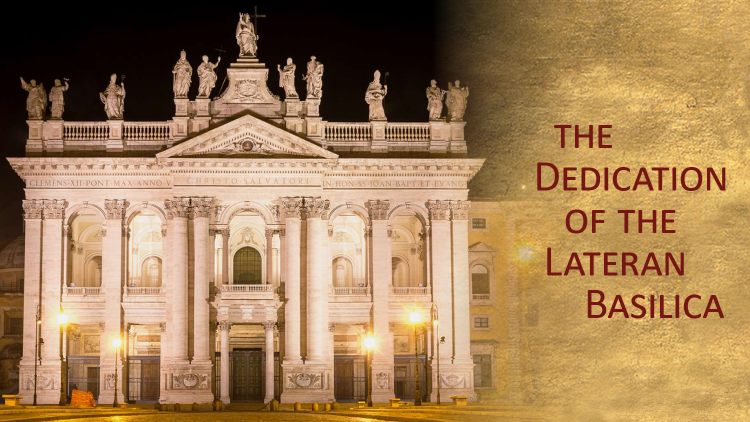
Sunday Meditation: Feast of the Dedication of the Lateran Basilica in Rome

Last week we were deprived of the Thirty-First Sunday in Ordinary Time in lieu of All Souls Day.  This week we are deprived of the Thirty-Second Sunday in Ordinary Time Year C for the Feast of the Basilica of Rome, that is, St. John Lateran.  When the Feast of St. John Lateran  (Nov 9th) falls on a Sunday, just as with All Souls Day last week, it supersedes the regular Sunday readings.

Why are we celebrating a church and why St. John’s Lateran Basilica.  You will have to wait for the excellent homilies.  The Gospel reading is of Jesus cleansing the temple, and the supporting readings also speak of temples. 


Here is the Gospel passage.


Since the Passover of the Jews was near,

Jesus went up to Jerusalem.

He found in the temple area those who sold oxen, sheep, and doves,

as well as the money-changers seated there.

He made a whip out of cords

and drove them all out of the temple area, with the sheep and oxen,

and spilled the coins of the money-changers

and overturned their tables,

and to those who sold doves he said,

"Take these out of here,

and stop making my Father's house a marketplace."

His disciples recalled the words of Scripture,

Zeal for your house will consume me.

At this the Jews answered and said to him,

"What sign can you show us for doing this?"

Jesus answered and said to them,

"Destroy this temple and in three days I will raise it up."

The Jews said,

"This temple has been under construction for forty-six years,

and you will raise it up in three days?"

But he was speaking about the temple of his Body.

Therefore, when he was raised from the dead,

his disciples remembered that he had said this,

and they came to believe the Scripture

and the word Jesus had spoken.

~Jn 2:13-22


Fr. Geoffrey Plant gives a superb explanation of the significance of St. John’s Lateran basilica, the Biblical implications, and ties it to the readings of Ezekiel and St. Paul’s First Letter to the Corinthians. 


That was Fr. Geoffrey at his best.  Do not fail to watch the entire 32 minutes of the homily.  It was perfection.

The pastoral homily is again here embedded from Archbishop Edward Weisenberger from the Archdiocese of Detroit, who provides most excellent photos of the Basilica to go along with his excellent homily,


“We celebrate, I would even say crave sacred space.  Building upon that foundation our churches, chapels, cathedrals, and other places of worship are further made sacred by prayer, sacrament, and faith life that we witness there.  We don’t walk into a building where our grandchildren were baptized, where our parents married, or we celebrated funerals of our loved ones the same way we walk into a grocery store.” 

That says it all!


All Saints Day Meditation: "Take these out of here, and stop making my Father's house a marketplace."


I will not post a hymn for a second week in a row.  Last year when this reading came up during Lent, I posted the Cleansing of the Temple scene from the movie Jesus of Nazareth.  Today I will post the Cleansing of the Temple from the series, The Chosen.


Both renditions are well done but with some differences.  Which one did you think best?

Sunday, July 20, 2025

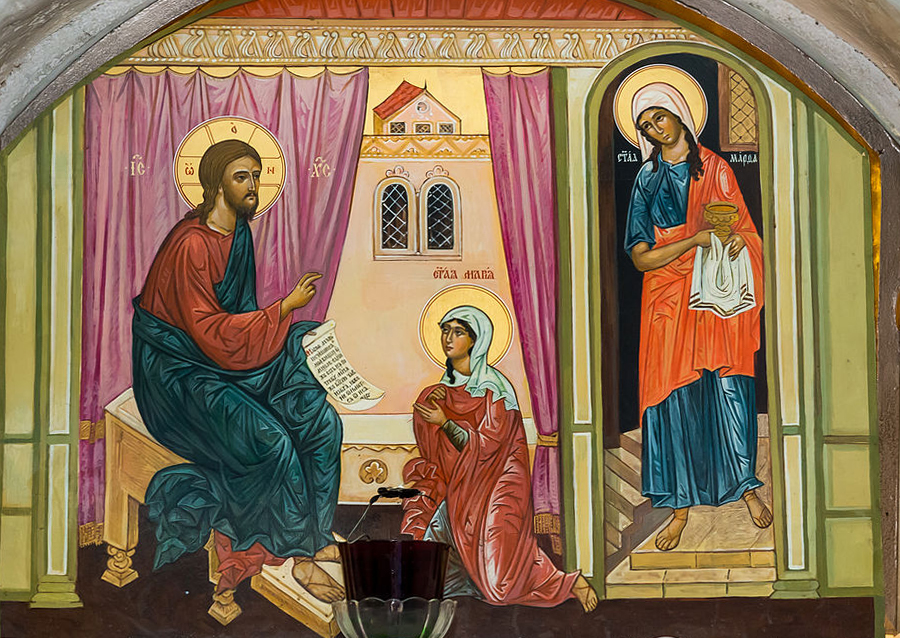
Sunday Meditation: Martha or Mary?

The thing to remember for the Sixteenth Sunday in Ordinary Time in Year C that is not so obvious since these readings in Church come a week apart, is that Luke places the story of Mary and Martha right after the Parable of the Good Samaritan.  That is not a coincidence.  The overt activity of the Good Samaritan is contrasted with the activity of Martha. 


Jesus entered a village

where a woman whose name was Martha welcomed him.

She had a sister named Mary

who sat beside the Lord at his feet listening to him speak.

Martha, burdened with much serving, came to him and said,

"Lord, do you not care

that my sister has left me by myself to do the serving?

Tell her to help me."

The Lord said to her in reply,

"Martha, Martha, you are anxious and worried about many things.

There is need of only one thing.

Mary has chosen the better part

and it will not be taken from her."

   ~Lk 10:38-42


First the explanation of the passage will come from Dr. Brant Pitre.  It’s in two separate videos.  First the pure explanation.


And then the spiritual significance, and listen to the end to here why you need prayer in your life.


So how does the parable of the Good Samaritan fit in?  By the adjacent juxtaposition of the two, Luke wants us to compare.  Jesus is not saying that the Good Samaritan should have not performed his acts of mercy because he was acting like Martha.  His act of mercy is grounded in love of God and neighbor.  Martha’s service is good, but it’s distracted from God.  The Good Samaritan’s activity is not distracted from God.  It is grounded in God.

The great Dominican theologian and mystic, Meister Eckhart, had a different take on this story. This Mr. Matthew Fox explains.


Eckhart can be so innovative.  Martha is mature while Mary is too immature to do both contemplation and activity at the same time.  It's like Mary can't walk and chew gum at the same time but Martha can.  It may be innovative, but I don’t think Christ meant it this way.

For the pastoral sermon, I’m going to go with Sister Mary Mediatrix of All Grace of SOLT.


It's always nice to have a woman give us a perspective on women.


Sunday Meditation: "Martha, Martha, you are anxious and worried about many things.  There is need of only one thing.”


Again no hymn today, just a dramatization of the passage, this time from The Chosen.


That’s not exactly how I would have dramatized it is but adequate.

Sunday, January 19, 2025

Sunday Meditation: The Bridegroom at Cana

On the Second Sunday in Ordinary Time in Year C we get the Sign of the Wedding Feast at Cana.  I purposely titled this post “The Bridegroom at Cana” because it seems to me that the bridegroom of the actual wedding is transposed by the Eternal Bridegroom.  Here Jesus performs the miracle—called a “sign” by the John Evangelist—of transforming water into wine when at the wedding they are attending in the nearby village of Cana the wine has run out.  Notice how the headwaiter gives credit to the bridegroom for the good wine but in actuality it was the Bridegroom who provided the gift.


There was a wedding at Cana in Galilee,

and the mother of Jesus was there.

Jesus and his disciples were also invited to the wedding.

When the wine ran short,

the mother of Jesus said to him,

“They have no wine.”

And Jesus said to her,

“Woman, how does your concern affect me?

My hour has not yet come.”

His mother said to the servers,

“Do whatever he tells you.”

Now there were six stone water jars there for Jewish ceremonial washings,

each holding twenty to thirty gallons.

Jesus told them,

“Fill the jars with water.”

So they filled them to the brim.

Then he told them,

“Draw some out now and take it to the headwaiter.”

So they took it.

And when the headwaiter tasted the water that had become wine,

without knowing where it came from

— although the servers who had drawn the water knew —,

the headwaiter called the bridegroom and said to him,

“Everyone serves good wine first,

and then when people have drunk freely, an inferior one;

but you have kept the good wine until now.”

Jesus did this as the beginning of his signs at Cana in Galilee

and so revealed his glory,

and his disciples began to believe in him.

~Jn 2:1-11


Fr. Terrance Chartier of the Franciscan Friars of the Immaculate provides a profound homily on the meaning of this miracle.  He gives us observations I never realized here and I will bet you haven’t either. 


I think the world of Fr. Terrance.  Have you ever connected the Wedding Feast at Cana with the Marriage Feast of the Lamb in the Book of Revelation?  I haven’t.  The observation of the imperfect number six of the jars leads one to connect the wine as the fulfillment of water as Jesus is the fulfillment of the Old Testament. 

Fr. Patrick Briscoe O.P. of Our Sunday Visitor gives a wonderful pastoral homily


With confidence, let us turn to our Blessed Mother for the hope we have in Christ, the Bridegroom.


Sunday Meditation: “The headwaiter called the bridegroom and said to him, “Everyone serves good wine first, and then when people have drunk freely, an inferior one.”


No hymn this week, but the video clip from the episode on the Wedding Feast at Cana from The Chosen.


Perhaps not the best exegesis of the Gospel passage, but well done nonetheless.


Sunday, September 8, 2024

Sunday Meditation: “Ephphatha!”

In today’s Gospel, we are told Jesus moves about in the gentile world.  Tyre, Sidon, and the Decapolis are Greco pagan inhabited territories.  But here too Jesus will perform a miracle, and a very significant one.  Here He is fulfilling a miracle prophesied in Isaiah chapter 35, which, lo and behold, is matched up today’s the lectionary.


Again Jesus left the district of Tyre

and went by way of Sidon to the Sea of Galilee,

into the district of the Decapolis.

And people brought to him a deaf man who had a speech impediment

and begged him to lay his hand on him.

He took him off by himself away from the crowd.

He put his finger into the man’s ears

and, spitting, touched his tongue;

then he looked up to heaven and groaned, and said to him,

“Ephphatha!”— that is, “Be opened!” —

And immediately the man’s ears were opened,

his speech impediment was removed,

and he spoke plainly.

He ordered them not to tell anyone.

But the more he ordered them not to,

the more they proclaimed it.

They were exceedingly astonished and they said,

“He has done all things well.

He makes the deaf hear and the mute speak.”

~Mk 7:31-37


In this little short explanation Dr. Brant Pitre connects it all.


There is one other allusion that Dr. Pitre doesn’t touch on in this passage to another part of the Old Testament, and that is Genesis.  When the people who are witnesses to this miracle say that Jesus “has done all things well,” it is a slant allusion to Genesis 1:31, “God looked at everything he had made, and found it very good.”  The root of the word “good” of Genesis is the same the word “well” in Mark, at least in the Septuagint translation of the Old Testament.  So the implication is that Christ is recreating mankind anew, or at least healing it to a restored state that had been damaged from the fall.


Sunday Meditation: “Be opened!”


Instead of a song this week, how about the dramatization of this passage in the series The Chosen


Only The Chosen could derive humor from that scene. 

Sunday, June 30, 2024

Sunday Meditation: The Healer

In today’s Gospel, Jesus is still on the Sea of Galilee, and now crosses back to the other side.  While in last week’s reading Jesus admonishes for lack of faith, in today’s Gospel He praises for having faith.  First He comes across a man in moment of crises, the dying of his daughter.  As He goes across town to the man’s house to cure the girl, He comes across a woman who is in her own crises, a woman with a twelve year hemorrhage.  The woman does something that is astonishing, she touches Jesus in the hope of being healed.  She is healed.  Jesus then continues on to the sick girl when it is announced that she has died.  But Jesus undisturbed goes to the home and raises her up.  These two stories are interlocked.


When Jesus had crossed again in the boat

to the other side,

a large crowd gathered around him, and he stayed close to the sea.

One of the synagogue officials, named Jairus, came forward.

Seeing him he fell at his feet and pleaded earnestly with him, saying,

"My daughter is at the point of death.

Please, come lay your hands on her

that she may get well and live."

He went off with him,

and a large crowd followed him and pressed upon him.


There was a woman afflicted with hemorrhages for twelve years.

She had suffered greatly at the hands of many doctors

and had spent all that she had.

Yet she was not helped but only grew worse.

She had heard about Jesus and came up behind him in the crowd

and touched his cloak.

She said, "If I but touch his clothes, I shall be cured."

Immediately her flow of blood dried up.

She felt in her body that she was healed of her affliction.

Jesus, aware at once that power had gone out from him,

turned around in the crowd and asked, "Who has touched my clothes?"

But his disciples said to Jesus,

"You see how the crowd is pressing upon you,

and yet you ask, 'Who touched me?'"

And he looked around to see who had done it.

The woman, realizing what had happened to her,

approached in fear and trembling.

She fell down before Jesus and told him the whole truth.

He said to her, "Daughter, your faith has saved you.

Go in peace and be cured of your affliction."


While he was still speaking,

people from the synagogue official's house arrived and said,

"Your daughter has died; why trouble the teacher any longer?"

Disregarding the message that was reported,

Jesus said to the synagogue official,

"Do not be afraid; just have faith."

He did not allow anyone to accompany him inside

except Peter, James, and John, the brother of James.

When they arrived at the house of the synagogue official,

he caught sight of a commotion,

people weeping and wailing loudly.

So he went in and said to them,

"Why this commotion and weeping?

The child is not dead but asleep."

And they ridiculed him.

Then he put them all out.

He took along the child's father and mother

and those who were with him

and entered the room where the child was.

He took the child by the hand and said to her, "Talitha koum,"

which means, "Little girl, I say to you, arise!"

The girl, a child of twelve, arose immediately and walked around.

At that they were utterly astounded.

He gave strict orders that no one should know this

and said that she should be given something to eat.

~Mk 5:21-43 

There are so many similarities and parallels between the two stories.  A couple of weeks ago I mentioned the story-telling technique of interlocking stories that Mark seems to love as the Markan Sandwich.  

Fr. Geoffrey Plant again this Sunday explains the passage superbly. 


Sunday Meditation: "If I but touch his clothes, I shall be cured."


Instead of a hymn this Sunday, I will provide the wonderful dramatization of this passage as performed in the series, The Chosen.


I find that very gripping.  It captures Jesus’s lack of concern for what I will call Pharisaic reverence for what is more important to Him, mercy.