Hat tip to Alice for suggesting this would make a good blog post.
This is my commentary on the Office of Readings for May 19th 2026, a couple of days ago, which was an excerpt from St. Basil’s treatise, On the Holy Spirit. It has an extra significance with the weeks leading to Pentecost.
St. Basil the Great (330-379 AD), or sometimes referred to as St. Basil of Casearia, was roughly contemporaneous with St. Augustine of Hippo. In some respects, St. Basil is the Eastern Church’s equivalent to how we hold St. Augustine in the Western Church. Both were hugely influential theologians from which subsequently flowed doctrine and spirituality.
Just as Augustine addressed several heresies in his treatises, Basil responds to Pneumatomachianism, which taught that the Holy Spirit is not God, with On the Holy Spirit,. You can read the entire treatise at New Advent. The Office of Readings takes a passage from Chapter 9 of On the Holy Spirit and breaks it down into seven paragraphs. I will quote the paragraph and comment below it.
†††
Second reading
From the treatise On the Holy Spirit by Saint Basil the Great, bishop
The work of the Holy Spirit
Paragraph 1:
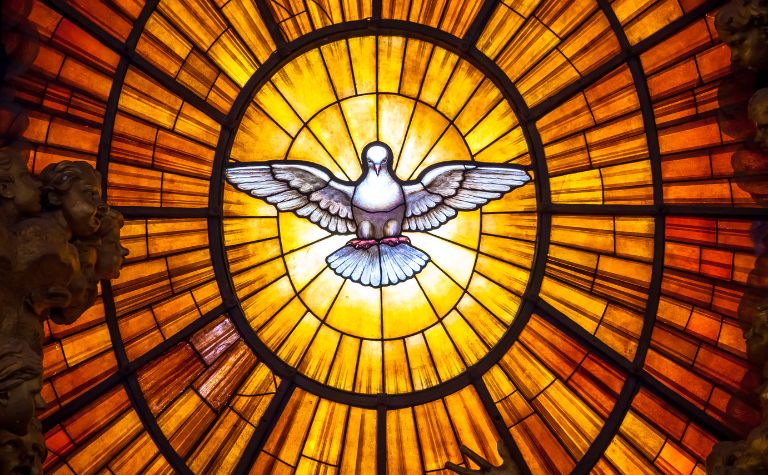
The titles given to the Holy Spirit must surely stir the soul of anyone who hears them, and make him realize that they speak of nothing less than the supreme Being. Is he not called the Spirit of God, the Spirit of truth who proceeds from the Father, the steadfast Spirit, the guiding Spirit? But his principal and most personal title is the Holy Spirit.
Paragraphs
691 and 692 of the Catechism of the Catholic Church lists a number of other
names for the Holy Spirit. Let us list
them all, including the ones St. Basil identifies:
the Spirit of God, Spirit of truth, the steadfast Spirit, the guiding Spirit, the Holy Spirit, the Paraclete, advocatus (the advocate), consoler, the Spirit of the promise, the Spirit of adoption, the Spirit of Christ, the Spirit of the Lord, the Spirit of God, the Spirit of glory.
Paragraph 2:
To the Spirit all creatures turn in their need for sanctification; all living things seek him according to their ability. His breath empowers each to achieve its own natural end.
Interesting St. Basil says that “all living things seek him according to their ability.” Other than mankind, what other creature did St. Basil have in mind that has the ability to seek him? All animals have breath, and so perhaps he considers the breath of the Holy Spirit empowering animals to their natural end? Is the act of breathing a supernatural sanctification of the Holy Spirit? It provides life at every moment. From the Nicene Creed, the Holy Spirit is “the Lord, the giver of life.”
Paragraph 3:
The Spirit is the source of holiness, a spiritual light, and he offers his own light to every mind to help it in its search for truth. By nature the Spirit is beyond the reach of our mind, but we can know him by his goodness. The power of the Spirit fills the whole universe, but he gives himself only to those who are worthy, acting in each according to the measure of his faith.
Quoting St. Paul: “Paul, a slave of Christ Jesus, called to be an apostle and set apart for the gospel of God, which he promised previously through his prophets in the holy scriptures, the gospel about his Son, descended from David according to the flesh, but established as Son of God in power according to the spirit of holiness through resurrection from the dead, Jesus Christ our Lord” (Rom 1:1-4).
The Holy Spirit is the source of holiness because it sanctifies, just as he sanctified our Lord, and so was the source of Christ’s power.
Paragraph 4:
Simple in himself, the Spirit is manifold in his mighty works. The whole of his being is present to each individual; the whole of his being is present everywhere. Though shared in by many, he remains unchanged; his self giving is no loss to himself. Like the sunshine, which permeates all the atmosphere, spreading over land and sea, and yet is enjoyed by each person as though it were for him alone, so the Spirit pours forth his grace in full measure, sufficient for all, and yet is present as though exclusively to everyone who can receive him. To all creatures that share in him he gives a delight limited only by their own nature, not by his ability to give.
Contemplate this: The Spirit is present everywhere but yet present distinctly in each individual. He permeates everywhere, thereby sanctifying everything, and always unchanged. He is eternally self-giving but yet is never diminished.

Paragraph 5:
The Spirit raises our hearts to heaven, guides the steps of the weak, and brings to perfection those who are making progress. He enlightens those who have been cleansed from every stain of sin and makes them spiritual by communion with himself.
People: And with your spirit.
Priest: Lift up your hearts.
People: We lift them up to the Lord.
Priest: Let us give thanks to the Lord, our God.
People: It is right and just.
“And with your spirit” is a reference of the power of the Holy Spirit at work through the priest. With that acknowledgement, the priest exhorts the congregation to lift up their hearts. From the power of the Spirit the congregation then lifts them up.
Paragraph 6:
As clear, transparent substances become very bright when sunlight falls on them and shine with a new radiance, so also souls in whom the Spirit dwells, and who are enlightened by the Spirit, become spiritual themselves and a source of grace for others.
“After six days Jesus took Peter, James, and John his brother, and led them up a high mountain by themselves. And he was transfigured before them; his face shone like the sun and his clothes became white as light. And behold, Moses and Elijah appeared to them, conversing with him. Then Peter said to Jesus in reply, “Lord, it is good that we are here. If you wish, I will make three tents here, one for you, one for Moses, and one for Elijah.” While he was still speaking, behold, a bright cloud cast a shadow over them, then from the cloud came a voice that said, “This is my beloved Son, with whom I am well pleased; listen to him” (Mt 17:1-5).
The light that emanates from Jesus’s face comes from the Holy Spirit burning through Him. The Holy Spirit is there in the scene as the cloud that casts a shadow. The glow in Jesus is a foreshadow of the glow when we achieve perfect holiness, either in this life or more likely in the next.
Paragraph 7:
From the Spirit comes foreknowledge of the future, understanding of the mysteries of faith, insight into the hidden meaning of Scripture, and other special gifts. Through the Spirit we become citizens of heaven, we enter into eternal happiness, and abide in God. Through the Spirit we acquire a likeness to God; indeed, we attain what is beyond our most sublime aspirations—we become God.
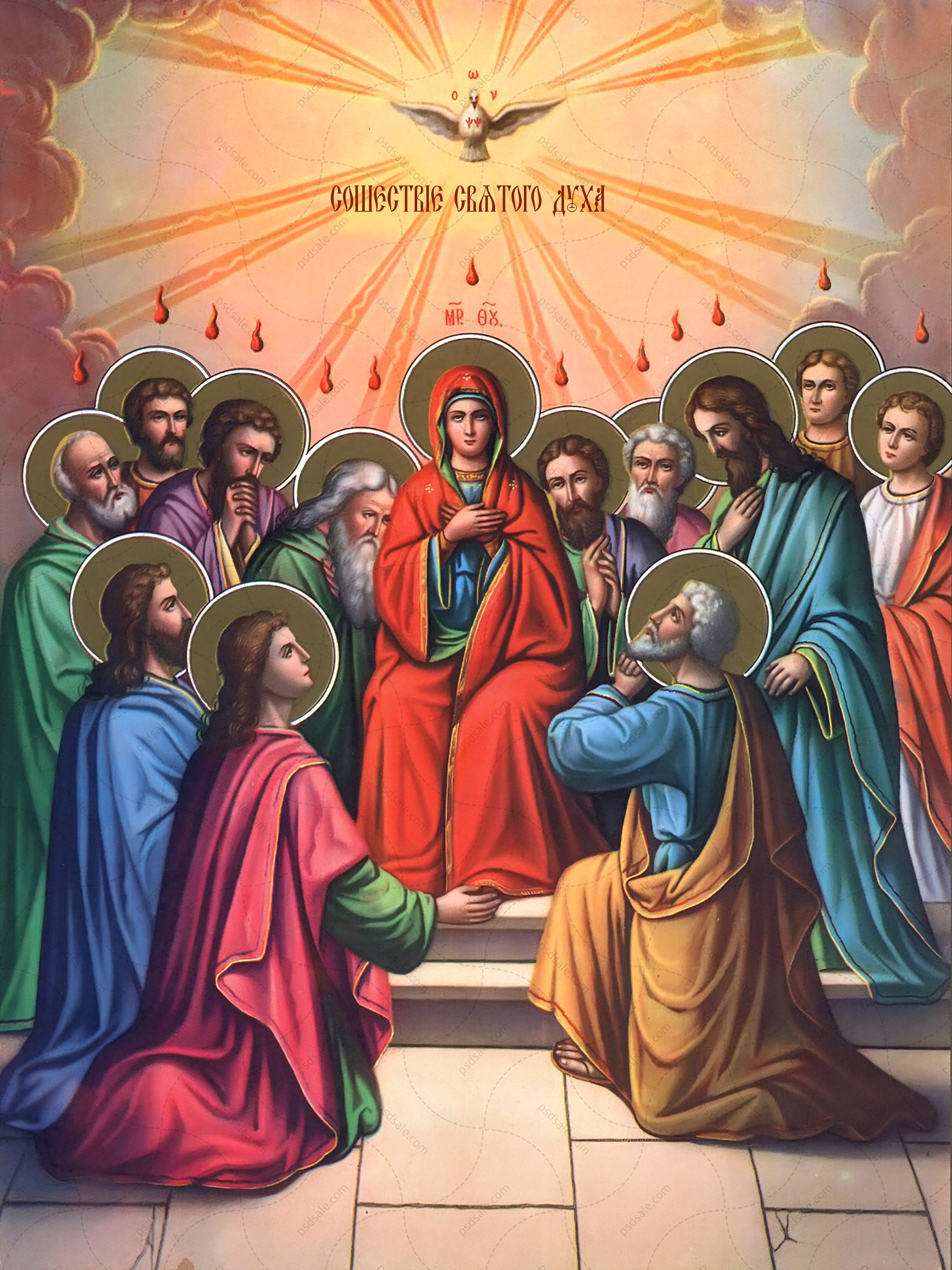
We can only wait for that glorious day with hope and faith. This Sunday we celebrate Pentecost, the
descent of the Holy Spirit. It fulfills
Jesus’s promise that He will send the Paraclete to complete the apostle’s
baptisms. From the Gospel of John: “He
breathed on them and said to them, "Receive the Holy Spirit. Whose sins you forgive are forgiven them, and
whose sins you retain are retained” (Jn 20: 22-23).