This is Part 2 to a follow up to my 2020 Reads where I discuss and evaluate the short stories I read for the year. Part 1, which I discuss the “good” and “ordinary” stories can be found here.
Once again, here’s how I rate all the short stories.
Exceptional
“The
Blue Hotel,” a short story by Stephan Crane.
“A
Good Man is Hard to Find.” A short story by Flannery O’Connor.
“Times
Square,” a short story by William Baer
“Dédé,” a short story by Mavis Gallant.
Good
“The
Turkey,” a short story by Flannery O’Connor.
“The Trouble,” a short story by J. F. Powers.
“Theft,”
a short story by Katherine Ann Porter.
“The Thistles in Sweden,” a short story by William Maxwell.
Ordinary
“Leaf
by Niggle,” a short story by J.R.R. Tolkien.
“The
Magic Paint,” a short story by Primo Levi.
“God
Rest You Merry Gentleman,” a short story by Ernest Hemingway.
“Hermann
the Irascible—A Story of the Great Weep,” a short story by Saki (H.H. Munro).
“Blessed
Harry,” a short story by Edith Pearlman.
So let’s look at the “exceptional” and pick the best short story read in 2020.
“The Blue Hotel,” by Stephan Crane is one of the great American short stories that everyone should read. A foreigner goes out west and while stranded at a hotel because of a snowstorm thinks he’s going to be killed. Stuck inside the Palace Hotel, which is painted blue, because of the storm, the foreigner, who the others call “the Swede,” goes from fear of being killed to braggadocios, belligerent, and aggressive after getting drunk. Accusing the innkeeper’s son of cheating at a friendly card game, the two have a fist fight in the howling blizzard where the Swede pummels the younger man to submission. Leaving the hotel, since he is no longer welcomed, the Swede goes to a saloon where he meets a professional gambler, instigates a quarrel, and meets a tragic end.

Here’s
a short excerpt, where they start playing cards during the storm, and the Swede
becomes paranoid.
Afterward there was a
short silence. Then Johnnie said: "Well, let's get at it. Come on
now!" They pulled their chairs forward until their knees were bunched
under the board. They began to play, and their interest in the game caused the
others to forget the manner of the Swede.
The cowboy was a
board-whacker. Each time that he held superior cards he whanged them, one by
one, with exceeding force, down upon the improvised table, and took the tricks
with a glowing air of prowess and pride that sent thrills of indignation into
the hearts of his opponents. A game with a board-whacker in it is sure to
become intense. The countenances of the Easterner and the Swede were miserable
whenever the cowboy thundered down his aces and kings, while Johnnie, his eyes
gleaming with joy, chuckled and chuckled.
Because of the absorbing
play none considered the strange ways of the Swede. They paid strict heed to
the game. Finally, during a lull caused by a new deal, the Swede suddenly
addressed Johnnie: "I suppose there have been a good many men killed in
this room." The jaws of the others dropped and they looked at him.
"What in hell are
you talking about?" said Johnnie.
The Swede laughed again
his blatant laugh, full of a kind of false courage and defiance. "Oh, you
know what I mean all right," he answered.
"I'm a liar if I
do!" Johnnie protested. The card was halted, and the men stared at the
Swede. Johnnie evidently felt that as the son of the proprietor he should make
a direct inquiry. "Now, what might you be drivin' at, mister?" he
asked. The Swede winked at him. It was a wink full of cunning. His fingers
shook on the edge of the board. "Oh, maybe you think I have been to
nowheres. Maybe you think I'm a tenderfoot?"
"I don't know
nothin' about you," answered Johnnie, "and I don't give a damn where
you've been. All I got to say is that I don't know what you're driving at.
There hain't never been nobody killed in this room."
The cowboy, who had been
steadily gazing at the Swede, then spoke. "What's wrong with you,
mister?"
Apparently it seemed to
the Swede that he was formidably menaced. He shivered and turned white near the
corners of his mouth. He sent an appealing glance in the direction of the
little Easterner. During these moments
he did not forget to wear his air of advanced pot-valor. "They say they
don't know what I mean," he remarked mockingly to the Easterner.
The latter answered after
prolonged and cautious reflection. "I don't understand you," he said,
impassively.
The Swede made a movement
then which announced that he thought he had encountered treachery from the only
quarter where he had expected sympathy if not help. "Oh, I see you are all
against me. I see-"
The cowboy was in a state
of deep stupefaction. "Say," he cried, as he tumbled the deck
violently down upon the board. "Say, what are you gittin' at, hey?"
The Swede sprang up with
the celerity of a man escaping from a snake on the floor. "I don't want to
fight!" he shouted. "I don't want to fight!"
The cowboy stretched his
long legs indolently and deliberately. His hands were in his pockets. He spat
into the sawdust box. "Well, who the hell thought you did?" he
inquired.
The Swede backed rapidly toward a corner of the room. His hands were out protectingly in front of his chest, but he was making an obvious struggle to control his fright. "Gentlemen," he quavered, "I suppose I am going to be killed before I can leave this house! I suppose I am going to be killed before I can leave this house." In his eyes was the dying swan look. Through the windows could be seen the snow turning blue in the shadow of dusk. The wind tore at the house and some loose thing beat regularly against the clap-boards like a spirit tapping.
Throughout it all we see a pitiless universe against the passions of childish men, and the misconception of the nature of the American west as it’s being transformed from wilderness to civilization. Stephan Crane captures the America of the late 19th century—the story was published in 1898—as the country transitioned into the new century. The prose of “The Blue Hotel” is among Crane’s best, integrating image and sound, cadence and pacing, dialogue and description.
You can read or download the story here. It’s Wikipedia entry is here. You can hear the story being read here.
###
Another of the true classics of the American short story is “A Good Man is Hard to Find.” by Flannery O’Connor. A family goes on vacation and, when they their car hits a ditch and rolls over, the men that come to their aid turn out to be murderers escaped from prison. The story centers on the grandmother of the family, a deviously willful woman who is the cause of the accident, and, indeed, the cause for being on that remote road in the first place. The leaders of the escaped convict is nicknamed the Misfit, a man who in many ways is disturbed because he cannot find Jesus. The escaped convicts find the family vulnerable and slowly execute the family members until only the grandmother is left. Finally, her life hanging in the balance she has an epiphany where she can connect to the humanity of the Misfit which leads to her death.
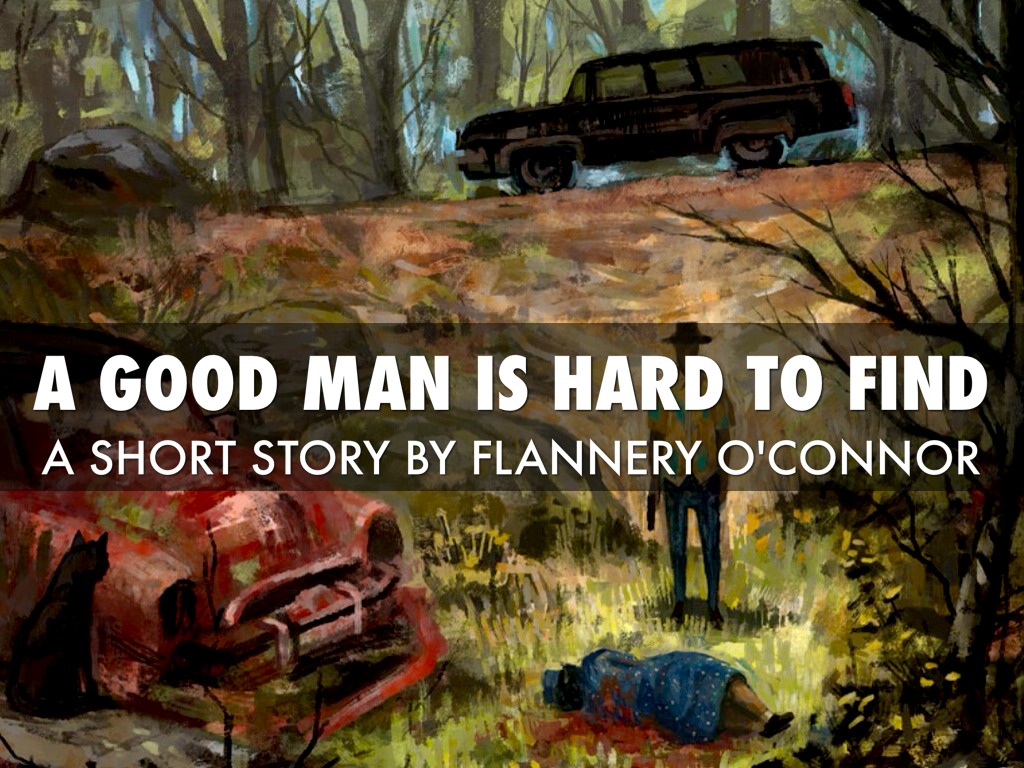
Here is an excerpt, the grandmother trying to talk the Misfit into changing his life, and the Misfit telling her about himself.
“You could be honest too
if you’d only try,” said the grandmother. “Think how wonderful it would be to
settle down and live a comfortable life and not have to think about somebody
chasing you all the time.”
The Misfit kept
scratching in the ground with the butt of his gun as if he were thinking about
it. “Yes’m, somebody is always after you,” he murmured.
The grandmother noticed
how thin his shoulder blades were just behind his hat because she was standing
up looking down on him. “Do you ever pray?” she asked.
He shook his head. All
she saw was the black hat wiggle between his shoulder blades. “Nome,” he said.
There was a pistol shot
from the woods, followed closely by another. Then silence. The old lady’s head
jerked around. She could hear the wind move through the tree tops like a long
satisfied insuck of breath. “Bailey Boy!” she called.
“I was a gospel singer
for a while,” The Misfit said. “I been most everything. Been in the arm
service, both land and sea, at home and abroad, been twict married, been an
undertaker, been with the railroads, plowed Mother Earth, been in a tornado,
seen a man burnt alive oncet,” and looked up at the children’s mother and the
little girl who were sitting close together, their faces white and their eyes
glassy; “I even seen a woman flogged,” he said.
“Pray, pray,” the
grandmother began, “pray, pray…”
“I never was a bad boy
that I remember of,” The Misfit said in an almost dreamy voice, “but somewheres
along the line I done something wrong and got sent to the penitentiary. I was
buried alive,” and he looked up and held her attention to himby a steady stare.
“That’s when you should
have started to pray,” she said. “What did you do to get sent to the
penitentiary that first time?”
“Turn to the right, it
was a wall,” The Misfit said, looking up again at the cloudless sky. “Turn to
the left, it was a wall. Look up it was a ceiling, look down it was a floor. I
forget what I done, lady. I set there and set there, trying to remember what it
was I done and I ain’t recalled it to this day. Oncet in a while, I would think
it was coming to me, but it never come.”
“Maybe they put you in by
mistake,” the old lady said vaguely.
“Nome,” he said. “It
wasn’t no mistake. They had the papers on me.”
“You must have stolen
something,” she said.
The Misfit sneered
slightly. “Nobody had nothing I wanted,” he said. “It was a head-doctor at the
penitentiary said what I had done was kill my daddy but I known that for a lie.
My daddy died in nineteen ought nineteen of the epidemic flu and I never had a
thing to do with it. He was buried in the Mount Hopewell Baptist churchyard and
you can go there and see for yourself.”
“If you would pray,” the
old lady said, “Jesus would help you.”
“That’s right,” The
Misfit said. “Well then, why don’t you pray?” she asked trembling with delight
suddenly.
“I don’t want no hep,” he
said. “I’m doing all right by myself.”
Bobby Lee and Hiram came
ambling back from the woods. Bobby Lee was dragging a yellow shirt with bright
blue parrots in it.
“Thow me that shirt, Bobby Lee,” The Misfit said. The shirt came flying at him and landed on his shoulder and he put it on. The grandmother couldn’t name what the shirt reminded her of. “No, lady,” The Misfit said while he was buttoning it up, “I found out the crime don’t matter. You can do one thing or you can do another, kill a man or take a tire off his car, because sooner or later you’re going to forget what it was you done and just be punished for it.”
The story has an incredible integration of narrative and symbolism, with macabre humor and subtle irony. This is a story crafted with the highest of artistry. There is not a word out of place, not a syllable that would improve the story.
You can find the story in this online collection of O’Connor’s short stories. “A Good Man is Hard to Find” is on page 130. You can read about the story in its Wikipedia entry.
You can hear O’Connor read the story herself here.
I wrote an analysis of this short story for this blog. Part 1 here. Part 2 here.
###
“Times Square,” by William Baer is a story
where two people are fated to meet and fall in love at Times Square in New York
City through individually reading separate stories by fictional authors. Miguel from Buenos Aires, Argentina and
Francesca is from Castello, Italy.
“At exactly 2:15 PM, September 29th, as predestined, he turned the left corner of West Forty-Second Street and Seventh Avenue, moving comfortably within the rapid ebbs-and-flows of the thousands of pedestrians streaming past…” so begins the story. Miguel reads a short story by the fictional Argentine writer Antonio Hernández about meeting a girl in New York’s Times Square and Francesca reads a short story by a fictional Italian writer, Isabella Sorella, about meeting a man at New York’s Times Square. While exploring Times Square, having an ice cream cone in Central Park, looking up books at the main branch of the New York Public Library, and dinner at a restaurant, all enacting the parts of their respective stories—stories which somehow overlap and coordinate—the two fall in love while explaining the sad few years of their recent past.

Here is an excerpt, the couple in the park re-enacting the stories. “AH” refers to Antonio Hernández, and that is an “excerpt” from his story.
Miguel, still standing
and listening, held out his hand.
“Could we dance?” he
asked.
As if on cue.
Francesca, although
clearly surprised, didn’t even bother to say, “I’m really not much of a
dancer,” or something like that, which wasn’t true anyway, and she took his
hand, and they touched for the very first time, and she stood up, and he
stepped gently towards her, and they embraced for the very first time, and it
was truly, as the song speculated, “magical,” even though they both knew that
it was also, on the surface of things, perfectly ludicrous, but they didn’t
care. They were content. They were, in truth, in reality, far more than simply
“content,” as they slowly moved, together and closely, in the beautiful park,
in this strangely beautiful city, to the smooth smooth tenor of Richard Blandon
and the lovely harmonics of the other four Dubs.
When you hear a song in
the park, a slow song, a love song, a lovely song, don’t hesitate. Ask her to
dance. Hold her tenderly, as you would hold the most precious thing on earth.
[AH]
When the song ended, they
again sat down on the bench.
“That was very
beautiful,” he said, and she agreed, and she nodded. “I suppose it was in your story?”
he supposed. “In Sorella’s story?”
“Yes, it was,” she
explained, “but I’m not sure why—and I have no idea why Sorella was so specific
about that particular song.”
“What exactly is it?”
Miguel wondered.
“It’s something they once
called Doo-Wop,” she explained, having looked it up. “It was a kind of mellow,
harmonic style that was apparently very popular in the early days of rock and
roll.”
They both smiled, and
they both shrugged.
“Well, whatever it is,
and whatever it means,” Miguel decided, “it’s very beautiful.”
So they talked some more.
They talked about many things, both significant and frivolous, about her love of children and chocolate bonbons and tennis and Renaissance art and forgotten novenas, and about his love of the tango and the songs of Carlos Gardel and film noirs and formula-one racing and Swiss milk chocolate and much much more.
Baer integrates the fictional stories of the fictional writers and into his fictional story of readers of those fictional writers. I haven’t quite figured out the implications of the fated consequences, the parallels of story and reality, and the Christianity that permeates the story, but I feel the depth of it. Exquisitely crafted and totally charming. It’s the sort of surrealism/magic realism Jorge Luis Borges would write.
###
“Dédé,” by Mavis Gallant is a story set in Paris about an eccentric uncle of a boy living who sets fire to a room in the boy’s house. Dédé, short for Amedée, is a sort of lost young man who doesn’t fit in the world and who is trying to find a life for himself. The young boy is Pascal, son of Dédé’s sister, Sylvie, and her husband, Étienne, who is a court magistrate. The Brouets, mother and father to Pascal, have become a conservative, even bourgeois, despite what seemed a radical youth. Pascal looks to his uncle as a role model, to the horror of both his parents. Dédé is apolitical but is the sort of lost hippie that his sister and husband could have been. A good part of the story deals with a luncheon party at the Brouet’s where Dédé courageously, if not blindly ignorantly, saves the party when a swarm of wasps flies into the kitchen and leads the wasps out by taking the melon that was attracting them and running outside to dump it. This is contrasted with what we learn later that in that morning Dédé had accidently set fire to his bedroom. So what are we to make of Dédé and what will the observing Pascal become.

Here
is an excerpt:
Dédé had come to stay
with the Brouets because his mother, Pascal’s grandmother, no longer knew what
to do with him. He was never loud or abrupt, never forced an opinion on anyone,
but he could not be left without guidance—even though he could vote, and was
old enough to do some of the things he did, such as sign his mother’s name to a
check. (Admittedly, only once.) This was his second visit; the first, last
spring, had not sharpened his character, in spite of his brother-in-law’s
conversation, his sister’s tender anxiety, the sense of purpose to be gained by
walking his little nephew to school. Sent home to Colmar (firm handshake with
the magistrate at the Gare de l’Est, tears and chocolates from his sister,
presentation of an original drawing from Pascal), he had accidentally set fire
to his mother’s kitchen, then to his own bedclothes. Accidents, the insurance
people had finally agreed, but they were not too pleased. His mother was at the
present time under treatment for exhaustion, with a private nurse to whom she
made expensive presents. She had about as much money sense as Harpo, the
magistrate said. (Without lifting his head from his homework, Pascal could take
in nearly everything uttered in the hall, on the stairs, and in two adjacent
rooms.)
When they were all four
at breakfast Mme. Brouet repeated her brother’s name in every second sentence:
wondering if Dédé wanted more toast, if someone would please pass him the
strawberry jam, if he had enough blankets on his bed, if he needed an extra
key. (He was a great loser of keys.) The magistrate examined his three morning
papers. He did not want to have to pass anything to Harpo. Mme. Brouet was
really just speaking to herself.
That autumn, Dédé worked
at a correspondence course, in preparation for a competitive civil-service
examination. If he was among the first dozen, eliminating perhaps hundreds of
clever young men and women, he would be eligible for a post in the nation’s
railway system. His work would be indoors, of course; no one expected him to be
out in all weathers, trudging alongside the tracks, looking for something to
repair. Great artists, leaders of honor and reputation, had got their start at
a desk in a railway office. Pascal’s mother, whenever she said this, had to
pause, as she searched her mind for their names. The railway had always been a
seedbed of outstanding careers, she would continue. She would then point out to
Dédé that their father had been a supervisor of public works.
After breakfast Dédé wound a long scarf around his neck and walked Pascal to school. He had invented an apartment with movable walls. Everything one needed could be got within reach by pulling a few levers or pressing a button. You could spend your life in the middle of a room without having to stir. He and Pascal refined the invention; that was what they talked about, on the way to Pascal’s school. Then Dédé came home and studied until lunchtime. In the afternoon he drew new designs of his idea. Perhaps he was lonely. The doctor looking after his mother had asked him not to call or write, for the moment.
A fascinating character study with superbly drawn characters and a masterful shifting of time, this is one of Mavis Gallant’s best stories. A good podcast reading and a discussion of this story is here.
###
So which is the best of the exceptional?
I think we can drop “Dédé” off first. It would be lowest rank of the four. While well written with vivid characters, it probably doesn’t have the depth of insight as a standalone story as the other three.
“Times Square” can come off next. Unlike “Dede” “Times Square” does have depth of insight, the only problem for me is I don’t think I understand that insight. What do the preordained actions from different stories coming together in being fulfilled in this story imply? Remember this is not God’s word being fulfilled but fictional stories? While this may be interesting, I don’t know if it really carries significance to our lives. Sometimes this surrealism/magic realism makes my head spin.
We are down to “The Blue Hotel” and “A Good Man is Hard to Find,” both great classics of the American short story.
And the winner is…drum roll please…
The winner is “A Good Man is Hard to Find.”
What separates the two? Both extremely well written, both have vivid
characters, both carry depth of insight into the human condition, and both have
rich use of irony. Crane’s prose might
sparkle a little better but O’Connor’s symbolism tied into the narrative
elevates this story ahead. “A Good Man
is Hard to Find” is truly one of the finest crafted short stories I have ever
read.