For the Twenty-Fifth Sunday in Ordinary Time in
Year A, Jesus gives another parable, that of the Workers in the Vinyard.There is a lot to this parable.The context goes back to last Sunday’s
parable from Matthew’s chapter 18 where Jesus concludes the Community Discourse
on the requirement to forgive.Then we
have chapter 19 where Jesus provides his discourse on divorce, the requirement
to be as children, and the response to the rich young man on being perfect.That is all skipped in the Sunday lectionary,
which brings us today to chapter 20, a parable which illustrates God’s generosity
of grace.In some ways Jesus is
continuing His Community Discourse in these two chapters.The only shift I think from chapter 18 in
these last two chapter is that Jesus shifts from requirements to counsels.
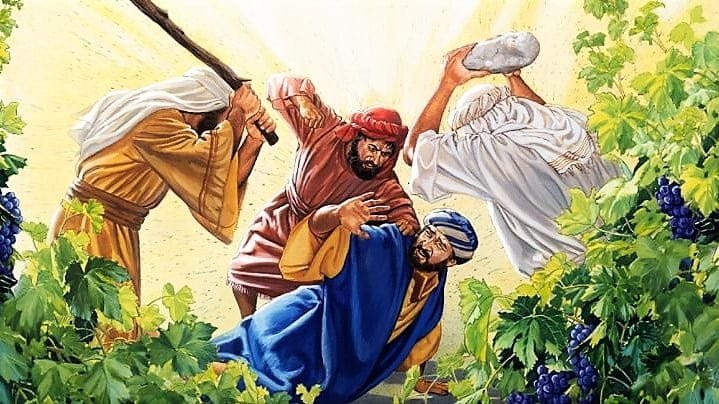
As an allegory, the Parable of the Workers in
the Vineyard sets up the landowner as God, work in the vineyard as doing God’s
work, and the day’s pay as a reward in salvation.God extends His grace to all who do His work,
whether for working all day or for just an hour.I did not embed Fr. Geoffrey’s Plant’s
homily on today’s Gospel, but I want to quote his conclusion:
The workers who were employed early in the morning trusted in what they
had done. They had laboured for twelve long hours and assumed that God rewards
people according to what they have earned. The longer they had worked, the
greater they believed would be their reward. But Jesus overturns that
expectation. The owner of the vineyard is not an accountant carefully calculating
what each worker deserves. He is astonishingly generous. The workers hired at the
eleventh hour have no achievements on which to rely. They have nothing to bring
except their need. They can only trust in the goodness of the landowner. That
is how God's grace works. Grace that can be earned is no longer grace. Grace that
can be calculated is no longer grace. Grace that can be claimed as a matter of
entitlement is no longer grace. God's grace is not a wage paid for work
performed. It is a gift, freely given to those who are willing to receive it.
Whether we labour in the vineyard for one hour or for twelve is not ultimately
decisive.God gives salvation as an
unmerited gift.
In some respects, this parable with the
workers who worked all day as disgruntled with the owner’s generosity reminds
me of the Parable of the Prodigal Son in Luke’s Gospel.The workers who worked all day express the
same sort of injustice as the older brother with the prodigal brother.Both parables show God’s generosity as being primary
over God’s justice.It’s interesting to
note that Matthew the tax collector provides a parable with money while Luke
seems to focus more on family dynamics.
Three
years ago I embedded a homily on this passage from Bishop Barron who
emphasized St. Catherine of Siena’s famous quote, “All the way to heaven is
heaven” in explaining this passage.
Today’s Gospel:
Jesus told his disciples this parable:
"The kingdom of heaven is like a landowner
who went out at dawn to hire laborers for his vineyard.
After agreeing with them for the usual daily wage,
he sent them into his vineyard.
Going out about nine o'clock,
the landowner saw others standing idle in the marketplace,
and he said to them, 'You too go into my vineyard,
and I will give you what is just.'
So they went off.
And he went out again around noon,
and around three o'clock, and did likewise.
Going out about five o'clock,
the landowner found others standing around, and said to them,
'Why do you stand here idle all day?'
They answered, 'Because no one has hired us.'
He said to them, 'You too go into my vineyard.'
When it was evening the owner of the vineyard said to his foreman,
'Summon the laborers and give them their pay,
beginning with the last and ending with the first.'
When those who had started about five o'clock came,
each received the usual daily wage.
So when the first came, they thought that they would receive more,
but each of them also got the usual wage.
And on receiving it they grumbled against the landowner, saying,
'These last ones worked only one hour,
and you have made them equal to us,
who bore the day's burden and the heat.'
He said to one of them in reply,
'My friend, I am not cheating you.
Did you not agree with me for the usual daily wage?
Take what is yours and go.
What if I wish to give this last one the same as you?
Or am I not free to do as I wish with my own money?
Are you envious because I am generous?'
Thus, the last will be first, and the first will be last."
~Mt: 20:1-16
Though not a homily, let’s turn to Dr. Brant Pitre for the exegesis.
Dr. Pitre:
So just a little bit
of background here with the cultural setting that Matthew is imagining.Here is a situation where you have a wealthy
land owner in this case the owner of the vineyard who would hire out day
laborers; that was very common in first century Judaism, so a day laborer was a
person who would go out into the marketplace of some public place and wait
around for the hopes that some wealthy landowner might come and hire them for a
temporary job and basically the idea would be is that you'd be hired for one
day you'd go out to the field or in this case to a vineyard during the harvest
season and you'd work for a day's wage and then you'd be paid that day, so it
was sort of a contract work you know just temporary work like a temp worker.
Dr. Nina Heereman, professor of Sacred Scripture at St. Patrick’s
Seminary and University in Menlo Park, California, in her explanation
of this passage, makes the observation that Jesus and His earthly father
Joseph could have been such day laborers waiting to be picked up for a day’s
work.I thought that a great
observation.Dr. Brant continues.
Around sunset time
the owner of the vineyard says to call the laborers and give them their wages
but start with the last and then go toward the first. So I want you to feel the force of this difference.
Between the first and the last minute,
guys who were working the fields is pretty grave when you really put it in
context the men who were called last worked from 5 p.m. to 6 o'clock they
worked for one hour right in the cool of the evening the men who were called
first worked from 6:00 a.m. to 6:00 p.m. so they pulled a 12-hour shift in the
heat of the day as they said in the scorching heat harvesting the grapes.Okay and as the owner of the vineyard starts
to pay out he starts with the guys who were hired at five o'clock and he gives
them one Denarius. Now as soon as the
guys who started at 6:00 a.m. see that, their natural assumption is going to be
well these guys got paid a Denarius for one hours work then I should make at
least twelve times as much because I work 12-hour shift and instead the master
gives them each the exact same one Denarius no matter how long they worked.
His response to them
is the key. He says to them first and
foremost I'm not unjust because you agree lead with me for a Denarius so I
haven't given you any less than you said you would work for. So he hasn't shortchanged them anything,
that's the first point.The second point
is he says I can give whatever I want to whomever I want, in other words am I
not allowed to do what I choose with what belongs to me? So another important point here is that the
owner of the vineyard here is not being unjust because it's his money; he can
give however much he would like to whomever he likes for whatever amount of
work that they've that they performed right, and then the third point is
something very interesting there he says or do you begrudge me my generosity. Right and now that's a English translation; the
literal Greek here is it says this is your eye evil. Because I am good literally is your eye evil
because I am good; the imagery there is of an envious eye so you'll see this in
the gospel sometimes or the New Testament talk about the lust of the eyes,
that's the sin of envy. It's seeing
someone else's possessions something belongs to someone else and desiring to
take it for yourself right as if it belongs to you, and so with what the master
is saying here is that you are angry because I am generous because your heart
is envious for that which does not belong to you that money is his it's not
yours it doesn't belong to you have no right to judge how he distributes it
right now what does Jesus up to in doing this well
It is an important element of the parable that the early on workers visually
see the latter brought on workers get paid a full day’s wage.A significant part of the parable is
understanding the sin of envy as coming through the eyes.
Let’s turn to Fr. Charlie Bouchard O.P. for the pastoral homily. He gives a fascinating example out of
literature, the short story by Flannery O’Conner, “Revelation.”
Fr. Bouchard:
The readings today,
the first reading and the gospel, especially, both give us examples of what
biblical scholars sometimes refer to as a biblical reversal.In other words, we start out seeming to go in
one direction, but then God's plan turns things around and changes the outcome
into a way that we didn't expect.This
is an example, of course, of the first reading saying that God's ways are not
our ways.And the Bible is full of these
stories of biblical reversals.
There is an author by
the name of Flannery O'Connor, who some of you have probably heard of.She wrote stories, almost all of which take
place in the Deep South, and they portray life in the South, which is maybe in
the early part of the 20th century might seem a little strange to us who did
not grow up down there.But she has one
story that I think is a perfect example of this biblical reversal that we're
talking about.It's a story called “Revelation,”
and it's about a person named Mrs. Turpin, who lives on a farm, and she's a
rather not very pleasant person.The
story portrays her as being very judgmental and kind of pompous. She looks at
the poor around her, and she kind of disparages them.She looks at the blacks around her in a very
uh, discriminating uh, racist society, and she judges them very badly.
And then at the very
end of the story, she has this revelation, which is obviously where the title
of the story came from.And she is on
her farm out over the pig pen of all things, this dignified woman standing near
the pig pen.And she has this great
vision, this revelation of the end times of what God's judgment is going to
look like.And the story tells us that
she looks up and sees this vision, this vast swinging bridge extending upward
from the earth through a field of living fire.Upon it, the author tells us, is a vast horde of souls, rumbling toward
heaven.There are whole companies of
white trash, clean for the 1st time in their lives, and bands of poor blacks in
white robes, and battalions of freaks and lunatics, shouting and clapping and
leaping like frogs.And bringing up the
end of the procession, was a tribe of people whom she recognized at once, as
those who, like herself and her husband, had always had little of everything,
and the God given wit to use it right.She
leaned forward to observe them closer.They were marching behind the others with
great dignity, accountable as they had always been for good order, and common
sense, and respectable behavior.They
alone were on key.
Yet she could see by
their shocked and altered faces that even their virtues were being burned away.In this passage, to me, has always been just
an immense theological statement about these biblical reversals.Mrs. Turpin, who always thought that, you
know, she was maybe not the greatest in the world, but certainly somebody who
had it together in God's sight.Somebody
who did the right thing, who had common sense, who dressed properly, and yet
she was very judgmental.And so in this
judgment scene, she sees all these people that she had really despised and had
no use for, marching up to heaven in all their eccentricity, clapping and
singing, and being off key perhaps.Then
she sees herself and her husband and others like them, the proper citizens of
the town, who are also marching toward heaven.But they alone were on key, even though they were at the end of the
procession.
And it's an example
of how God's generosity really exceeds God's justice.That God extends this grace of salvation, not
only to those who appeared to have earned it, although they were at the very
end of the line, but also to those who, perhaps in the judgment of some, did
not earn this grace or did not merit salvation.Those who live difficult, troublesome lives, those who couldn't pay
their bills, those whose clothes weren't washed, all of those that Mrs. Turpin
had disparaged, were really going 1st into heaven. The last ones we thought that
would have been there.They are the 1st
in line, and she and her husband follow at the very end.
“The last will be first, and the first will be last.”
Sunday Meditation: “What
if I wish to give this last one the same as you?”
This is such a beautiful and appropriate hymn, “Open My Eyes, Lord.”
This is the seventh post of
a series of posts on J. R. R. Tolkien’s The Lord of the Rings.This series focuses on the first volume
of the trilogy, The Fellowship of the Ring.
In the confusion
of the Dark Riders attack and stabbing, Frodo, Strider and Sam take Frodo’s
limp body and place it by the fire.The
companions worry Frodo may not live.Frodo does not die but is terribly weakened.Strider made some balm with vegetation to
nurse the wound.
Despite the pain,
Frodo continued with the journey with the companions in the dark and under the
fear the Dark Riders would return.Strider even decided to return to the road for a while for easier travel.By the marsh of one of the rivers, Strider
finds a beryl—an elf stone, which he takes as a positive sign.Their journey took them to a confluence of
two rivers.Most of the time Frodo rode
on a donkey but there were times he had to dismount to strive on foot.He had difficulties climbing and was physically
getting worse, not better.Along the way
they came across three figures of trolls who had been turned to stone.Sam remembered a song about trolls and sang
it.
At one point they
heard the sound of hooves, and they spotted a white horse, which alleviated
their fears of it being a Dark Rider.Strider went out to meet the rider of the white horse, and he brought
back an elf from the house of Elrond.The elf’s name was Glorfindel.Glorfindel told them he had been tracking them and it was he who left
the beryl as a sign.
As Glorfindel
spoke, Frodo collapsed in pain.Strider
explained what had happened to Frodo, and Glorfindel applied some elf medicine
to the wound which revived Frodo enough to travel on.Glorfindel provided Frodo his white horse to
ride.
Several days later
they reached the Ford of Rivendell, and, with the Dark Riders racing toward
them, the companions rushed across the Ford.Midway across the Dark Riders were about to snag Frodo, but the water
rose to a flood and drowned several of the Dark Riders’s horses and pulled the
others away. Frodo, confused, also fell into the water, where he then passed
out.
Summary:
Bk 2 Ch 1
Book II
Chapter 1: Many
Meetings
When Frodo came
to, he found himself in a bed, and Gandalf above him explaining that he was in
the house of Elrond and that it was now October 24th.Frodo has been unconscious for four nights
and three days.He also explained that
Frodo had nearly died at the Ford.He
told Frodo that there will be a Council as soon as Frodo is well enough to
attend.He explained that Strider, also called
Aragorn, is of the old Kings, and that Glorfindel is an elf lord of a house of
princes.He explained the Dark Riders
are Ringwraiths, and though the horses have perished they are not so easy to
kill, but they are now handicapped without their horses.Gandalf explained that the flood was
commanded by Elrond, which is in his power.
After Frodo
awakened from another sleep, Sam came in and took Frodo about the house.They came upon Merry and Pippin, and everyone
at the house were celebrating in a feast for Frodo’s arrival.He met Elrond and Glorfindel, Elrond’s
daughter Arwen, and her brothers Elladan and Elrohir.Strider was there and a dwarf named
Glóin.
They made their
way to the Hall of Fire, a quiet place of contemplation.In the hall at a table was a dark figure
apparently asleep but as it turned out was meditating.Elrond tried to awaken him but he was awake,
and then Frodo saw that it was Bilbo.They had a splendid and heartfelt reunion.Bilbo introduced Frodo to his friend Dúnadan,
who turned out to be still a third name for Aragorn.Dúnadan had told Bilbo of Frodo’s
adventures.Bilbo asked Dúnadan to help
him with a poem he was composing, and when ready Bilbo chanted the verses of
the poem.Afterward, Frodo went back to
his own room.
###
Comment from Ellie:
There is a lot in these chapters, I think, especially
in the second one, but what I wanted to share here (and I hope it at least
partially belongs to this topic) was a quote from a video essay on Aragorn and
his (healthy) masculinity I watched today; I've always loved the notion that
Aragorn is a great healer AND a great king; and even though he wasn't able to
heal Frodo, we could see this characteristic show itself, for the first time in
the book I think? Here is the quote:
"Your strength is not for yourself. It is for
others. Physical power is important for masculinity, yes, but that is because
it allows us to better protect those whom we love. In carrying out that duty is
one of, if not THE central aspect of a man's job. As long as there have been
wars, it has been largely the role of the man, often sadly the young man, to
defend his nation, his people. ... When Christ child was in danger, it was St.
Joseph who was entrusted with the mission to bring the Holy family to safety.
By nature, man are granted larger frame, denser bones, and more muscle mass
than women. And with those physical advantages comes a duty that cannot be
denied without denying the very essence of what it means to be a man in
relationship with others. Indeed, embracing full authentic virtuous
masculinity, requires one to be in relationship. ... Human beings do not exist
alone; we were not made for ourselves, but rather for each other. Aragorn
clearly knows this. He seeks the company of those who need him, ..."
I do like the line that I think is crucial for the
Catholic faith that "... Human beings do not exist alone; we were not made
for ourselves, but rather for each other. " I think we can even see that
in the second chapter, when all of the characters gather around for a dinner
or, later, to tell stories and sing songs in a great hall; we can even see that
in Bilbo asking Aragorn to help him finish some verses of his song. Again,
there is a great notion of communion and kinship.
To use Tolkien's own words: Aragorn is "a great
instrument in God's hands. A mover, a doer, even an achiever of great things. A
beginner at the very least of large things.”
I really hope this is not too off the topic!!
My Reply to Ellie:
That is a great quote Ellie. The fullness of Aragorn's
character is still to be realized. I think this is something to keep in mind as
we read on. He has always been mysterious to me, and I don't think in my
reading as a young man I understood him. He does seem like the ideal man,
doesn't he? Aragorn as healer is not something I realized or noticed before. I
will definitely keep it in mind as we progress. Thanks.
By the way, where is that quote from?
Ellie’s Reply to
Me:
The quote is from a video essay called "Why We
Need Aragorn’s Example of Masculinity" on a channel called 'Master
Samwise' (the
link is here)
They also have a video on Sam and his character, but I
have yet to watch that one! I definitely recommend watching it!
Kristen Reply to
Me:
Manny wrote: "He does seem like the
ideal man, doesn’t he?"
Very much so. I was just thinking which male characters in literature come
close to him and I’m fumbling a bit. Many times we are presented with a
flawed/immature character who then grows into maturity, but with Aragorn these
years are in the past and yet he plays a major leading role in the quest.
My Reply to
Kerstin:
Good point. It would not typically be the central
character of a novel, because he usually needs to to grow into it. It would
have to be a contrasting character. Hmm, Levin from Anna Karenina, the
contrasting male figure of the Levin and Kitty relationship comes to mind. But
I haven't read the novel in a while, so I'm not sure if that is perfect. Oh,
and there is Atticus Finch - who is usually considered the ideal father - from
To Kill a Mockingbird.
Michelle’s Reply
to Kerstin:
I always liked that about Aragorn. He has a weight of
history and competence about him immediately upon his entry into the story.
It's really unusual.
###
So what seems to
be important in these chapters I think is the near death experience Frodo
undergoes and his resuscitation.Since
leaving the Shire, it has been a struggle for Frodo and the companions,
traversing forest, rivers, and hills, escaping Dark Riders and undergoing
scrutiny.All these hardships climax
with the attack of the Dark Riders, which leaves Frodo “pierced” (the word used
in the second to last paragraph in the chapter “A Knife in the Dark”) and
struggling to fight off the poison or demonic spirit (I can’t tell which)
inherent to the Dark Riders’ weapon.That Tolkien uses the word “pierced” has to allude to the Suffering
Servant passage of Isaiah:
Who would believe what we have heard?To whom has the arm of the LORD been
revealed?He grew up like a sapling
before him, like a shoot from the parched earth; He had no majestic bearing to
catch our eye, no beauty to draw us to him. He was spurned and avoided by men, a
man of suffering, knowing pain, like one from whom you turn your face, spurned,
and we held him in no esteem.Yet it was
our pain that he bore, our sufferings he endured.We thought of him as stricken, struck down by
God and afflicted, But he was pierced for our sins, crushed for our
iniquity.He bore the punishment that
makes us whole, by his wounds we were healed.(Is 53:1-5)
Granted, not
everything in the passage applies to Frodo—he wasn’t spurned—but he certainly
endured suffering and was notably pierced.Frodo is here a Christ-figure by his suffering.But it’s more than that.
Suddenly to his horror Sam found that his master had
vanished; and at that moment a black shadow rushed past him, and he fell. He
heard Frodo’s voice, but it seemed to come from a great distance, or from under
the earth, crying out strange words. They saw nothing more, until they stumbled
over the body of Frodo, lying as if dead, face downwards on the grass with his
sword beneath him. Strider ordered them to pick him up and lay him near the
fire, and then he disappeared. That was now a good while ago.
Frodo’s journey is
a microcosm of human experience.Life
can be a struggle, companionship, joy, suffering, and then deathly pain, and
finally death.Here Frodo metaphorically
dies.He is heard as if “under the
earth.”They stumble over “his
body.”He is “lying as if dead, face
downwards on the grass.”Sam even
despairs in tears for his friend.
Eventually Frodo
does get up, and his companions nurse his wound.He will struggle on, if not mortally wounded
then potentially mortally wounded.
There is a
subsequent confrontation at the Ford.Frodo, atop the white horse, is rushing across the Ford to safety, when
he is pierced again, this time metaphorically:
He shut his eyes and clung to the horse’s mane. The
wind whistled in his ears, and the bells upon the harness rang wild and shrill.
A breath of deadly cold pierced him like a spear, as with a last spurt, like a
flash of white fire, the elf-horse speeding as if on wings, passed right before
the face of the foremost Rider.
Again Tolkien uses
the word “pierced,” and here he could have chosen many ways to describe the
effect of the evil on Frodo.I’d like to
consider this a metaphysical piercing, the cold breath of evil stabbing “like a
spear,” alluding of course to the piercing of Christ on the cross by the Roman
soldier’s spear.
But once across
the Ford, the pack of Dark Riders accost him, forcing Frodo to turn and fight.
But the pursuers were close behind. At the top of the
bank the horse halted and turned about neighing fiercely. There were Nine
Riders at the water’s edge below, and Frodo’s spirit quailed before the threat
of their uplifted faces. He knew of nothing that would prevent them from
crossing as easily as he had done; and he felt that it was useless to try to
escape over the long uncertain path from the Ford to the edge of Rivendell, if
once the Riders crossed. In any case he felt that he was commanded urgently to
halt. Hatred again stirred in him, but he had no longer the strength to refuse.
Suddenly the foremost Rider spurred his horse forward.
It checked at the water and reared up. With a great effort Frodo sat upright
and brandished his sword. ‘Go back!’ he cried.
‘Go back to the Land of Mordor, and follow me no
more!’ His voice sounded thin and shrill in his own ears. The Riders halted,
but Frodo had not the power of Bombadil. His enemies laughed at him with a
harsh and chilling laughter. ‘Come back! Come back!’ they called. ‘To Mordor we
will take you!’
‘Go back!’ he whispered. ‘The Ring! The Ring!’ they
cried with deadly voices; and immediately their leader urged his horse forward
into the water, followed closely by two others.
That’s quite a
scene.You can see the powerlessness of
Frodo as he is about to undergo what might be seen as a Passion narrative.We are told in the next chapter that if he
had been captured, he would have been tormented by the Dark Lord.He is even mocked here, and this might amount
to a crucifixion but for a miracle event, what Tolkien describes as a eucatastrophe.
At that moment there came a roaring and a rushing: a
noise of loud waters rolling many stones. Dimly Frodo saw the river below him
rise, and down along its course there came a plumed cavalry of waves. White
flames seemed to Frodo to flicker on their crests, and he half fancied that he
saw amid the water white riders upon white horses with frothing manes. The
three Riders that were still in the midst of the Ford were overwhelmed: they
disappeared, buried suddenly under angry foam. Those that were behind drew back
in dismay.
With his last failing senses Frodo heard cries, and it
seemed to him that he saw, beyond the Riders that hesitated on the shore, a
shining figure of white light; and behind it ran small shadowy forms waving
flames, that flared red in the grey mist that was falling over the world.
The black horses were filled with madness, and leaping
forward in terror they bore their riders into the rushing flood. Their piercing
cries were drowned in the roaring of the river as it carried them away. Then
Frodo felt himself falling, and the roaring and confusion seemed to rise and
engulf him together with his enemies. He heard and saw no more.
A rushing flood of
the river overturns the Dark Riders.Frodo too falls beneath the waves and goes unconscious.Here is a second metaphorical death for
Frodo.We are told later that Strider
saved him, and he, after some bleak moments in an unconscious state, revives at
Rivendell.He has gone through a
rebirth, a regeneration, perhaps even a resurrection.If we haven’t identified Frodo with Christ
before, we should certainly do so now.
###
Ellie Reply:
Also, Manny, so many good points! I'm really glad you
mentioned the 'eucatastrophe', because the scene with Frodo and the Dark Riders
really seems like the perfect example of a eucatastrophic scene and it's also
important, because Tolkien considered it the most important function of a
fairy-story. In 'On Fairy-Stories" Tolkien explains this term in depth,
but what I really love is his connecting it to the Gospel, when in one of his
letters he writes that: "And I concluded by saying that the Resurrection
was the greatest 'eucatastrophe' possible in the greatest Fairy Story – and
produces that essential emotion: Christian joy which produces tears because it
is qualitatively so like sorrow, because it comes from those places where Joy
and Sorrow are at one, reconciled, as selfishness and altruism are lost in
Love. "
###
There are numerous
interesting details that I can’t completely fathom from the first chapter of
Book II.What exactly is the nature of
Rivendell and of the Elves?Do they have
supernatural powers?It is the Elves
ability to counter the dark powers that saved Frodo from death, pulling out the
splinter that had been embedded in Frodo’s body.That seems to be from more than just skill.Dark powers, one would think, require good
powers to repel them.When Gandalf is
beside Frodo’s bed explaining all that happened, Frodo asked him about the
flood.
‘Who made the flood?’ asked Frodo.
‘Elrond commanded it,’ answered Gandalf. ‘The river of
this valley is under his power, and it will rise in anger when he has great
need to bar the Ford. As soon as the captain of the Ringwraiths rode into the
water the flood was released. If I may say so, I added a few touches of my own:
you may not have noticed, but some of the waves took the form of great white
horses with shining white riders; and there were many rolling and grinding
boulders. For a moment I was afraid that we had let loose too fierce a wrath,
and the flood would get out of hand and wash you all away. There is great vigour
in the waters that come down from the snows of the Misty Mountains.’
How does one
command a flood?How is the river under
Elrond’s power?Now there could be a
non-supernatural explanation.The river
could have been dammed up and the dam opened upon Elrond’s command.But is that what happened?Or was it a supernatural command over nature,
and if so how does that fit into a Christian worldview?Why and how did the waves of the flood take
on the form of great white horses?Does
someone know more about this?
So what is the
nature of elves?Earlier in that
conversation, Frodo asks Gandalf himself.
‘What about Rivendell and the Elves? Is Rivendell
safe?’
‘Yes, at present, until all else is conquered. The
Elves may fear the Dark Lord, and they may fly before him, but never again will
they listen to him or serve him. And here in Rivendell there live still some of
his chief foes: the Elven-wise, lords of the Eldar from beyond the furthest
seas. They do not fear the Ringwraiths, for those who have dwelt in the Blessed
Realm live at once in both worlds, and against both the Seen and the Unseen
they have great power.’
‘I thought that I saw a white figure that shone and
did not grow dim like the others. Was that Glorfindel then?’ ‘Yes, you saw him
for a moment as he is upon the other side: one of the mighty of the Firstborn.
He is an Elf-lord of a house of princes. Indeed there is a power in Rivendell
to withstand the might of Mordor, for a while: and elsewhere other powers still
dwell. There is power, too, of another kind in the Shire. But all such places
will soon become islands under siege, if things go on as they are going. The
Dark Lord is putting forth all his strength.
‘Still,’ he said, standing suddenly up and sticking
out his chin, while his beard went stiff and straight like bristling wire, ‘we
must keep up our courage. You will soon be well, if I do not talk you to death.
You are in Rivendell, and you need not worry about anything for the present.’
Quite a few
details stick out from that passage.The
Elvin-wise Lords “live in both worlds,” can be before the Dark Lords and not be
harmed, and they have “great power.”So
what is the nature of this power?
Glorfindel is an
Elf-lord, and one of the “Firstborn.”Firstborn has a Biblical echo, and why is it capitalized?
We learn there is
a “power in Rivendell” that can “withstand the might of Mordor.”What exactly is the nature of this power, and
must it be supernatural to withstand the evil power of Mordor?Why does Frodo not have to fear while in
Rivendell?
Indeed Rivendell
seems like paradise in many ways.Elves
are “ageless” and shining.Frodo is
saved there and ‘resurrected.”Everything is orderly and ideal.There is a sort of liturgy in the Hall of Fire where songs are chanted
and tales are told.And there are feasts
to form fellowship, and unlike Bilbo’s feast at his birthday at the beginning
of the novel, there is no animosity between the guests.It all seems so heavenly.
So what should we
make of all this?
###
Ellie Comment:
Good questions Manny. I think the answers to all of
these require the reading of The Silmarillion, where the nature of Elves is
explained.
I think the explanation to Elrond's power comes in the
next chapter, The Council of Elrond, where we learn about the three Rings of
Power that the Elves made. If I'm not mistaken, Galadriel of Lothlórien has
one, and I just have to assume that Elrond has one, too; Vilya is the name of
it, and from what I could glean online, it has the ability to heal (with its
help, he probably healed Frodo) and so we can guess that it also has the power
to control some elements. I don't think the elves have "magic powers",
but that they utilize the Rings. But that's for further discussion.
About the Firstborn question - indeed, Elves are
Firstborn, because they were the first "creatures" to be
awakened/made in the world of Arda, particularly Middle-Earth. Yes, there are
the Valar, but I think they are more like angelic creatures, while the Elves
(and subsequently Men), are children of Eru Illúvatar, of the creator who made
them.
I also think that the safety of Rivendell could be
attributed to the fact that Elves are indeed the Firstborn, some of them (I'm
thinking of Glorfindel here) saw the light of Valinor, a place where the Valar
live, a place where they rule, a place where the Elves are trying to go (we
could say it's a place that resembles Heaven?), a place where their true home
is. I think Rivendell might resemble Valinor in the sense that it's a place
full of light, which the Enemy can't reach.
I admit that we are (and will be) bombarded with
information about the First and Second Ages and not all of it is explained in
the LoTR books, so it can be confusing. But indeed all of these questions
probably require a heavy study of Tolkien's works, like The Silmarillion, and
it makes me wonder how he was able to create all of this!
My Reply to Ellie:
Thanks for the explanation Ellie, that is really
helpful. I haven't read the next chapter yet. Perhaps tonight.
Ellie’s Reply to Me:
Of course, always my pleasure! I think the next
chapter is going to give us more information and more stuff to discuss since
it's pretty long and info-dense.
###
One last major
comment on this section.The reunion of
Frodo and Bilbo was magnificent.It was
such a captivating scene that I’m going to quote the passage for everyone’s
enjoyment, despite it being a bit lengthy.This has the feeling to me of being in heaven and reunited with a loved
one.
At length the feast came to an end. Elrond and Arwen
rose and went down the hall, and the company followed them in due order. The
doors were thrown open, and they went across a wide passage and through other doors,
and came into a further hall. In it were no tables, but a bright fire was
burning in a great hearth between the carven pillars upon either side.
Frodo found himself walking with Gandalf. ‘This is the
Hall of Fire,’ said the wizard. ‘Here you will hear many songs and tales – if
you can keep awake. But except on high days it usually stands empty and quiet,
and people come here who wish for peace, and thought. There is always a fire
here, all the year round, but there is little other light.’
As Elrond entered and went towards the seat prepared
for him, Elvish minstrels began to make sweet music. Slowly the hall filled,
and Frodo looked with delight upon the many fair faces that were gathered
together; the golden firelight played upon them and shimmered in their hair.
Suddenly he noticed, not far from the further end of the fire, a small dark
figure seated on a stool with his back propped against a pillar. Beside him on
the ground was a drinking-cup and some bread. Frodo wondered whether he was ill
(if people were ever ill in Rivendell), and had been unable to come to the
feast. His head seemed sunk in sleep on his breast, and a fold of his dark
cloak was drawn over his face.
Elrond went forward and stood beside the silent
figure. ‘Awake, little master!’ he said, with a smile. Then, turning to Frodo,
he beckoned to him. ‘Now at last the hour has come that you have wished for,
Frodo,’ he said. ‘Here is a friend that you have long missed.’
The dark figure raised its head and uncovered its
face.
‘Bilbo!’ cried Frodo with sudden recognition, and he
sprang forward.
‘Hullo, Frodo my lad!’ said Bilbo. ‘So you have got
here at last. I hoped you would manage it. Well, well! So all this feasting is
in your honour, I hear. I hope you enjoyed yourself?’
‘Why weren’t you there?’ cried Frodo. ‘And why haven’t
I been allowed to see you before?’
‘Because you were asleep. I have seen a good deal of
you. I have sat by your side with Sam each day. But as for the feast, I don’t
go in for such things much now. And I had something else to do.’
‘What were you doing?’
‘Why, sitting and thinking. I do a lot of that
nowadays, and this is the best place to do it in, as a rule. Wake up, indeed!’
he said, cocking an eye at Elrond. There was a bright twinkle in it and no sign
of sleepiness that Frodo could see. ‘Wake up! I was not asleep, Master Elrond.
If you want to know, you have all come out from your feast too soon, and you
have disturbed me – in the middle of making up a song. I was stuck over a line
or two, and was thinking about them; but now I don’t suppose I shall ever get
them right. There will be such a deal of singing that the ideas will be driven
clean out of my head. I shall have to get my friend the Dúnadan to help me.
Where is he?’
Elrond laughed. ‘He shall be found,’ he said. ‘Then
you two shall go into a corner and finish your task, and we will hear it and
judge it before we end our merrymaking.’ Messengers were sent to find Bilbo’s
friend, though none knew where he was, or why he had not been present at the
feast.
Isn’t that
special.Some of the charge from the
scene was from the gap between when we last saw Bilbo and the anticipation of
meeting him again.Now wouldn’t the
reunion have had even more anticipation if the scene was pushed even further
into the story?Now who am I to tell
Tolkien how to plot—and I imagine there are very good reasons to have this
reunion at this point—but would the reunion have been even grander if it had
occurred at say two thirds of the way through the trilogy rather than at two
thirds of the way through the first volume?Just a thought.
###
Michelle Comment:
It would have had a greater impact later, except for
the setting deeper into the story. Bilbo is happy in Rivendell, [and I have
trouble imagining him in Mordor].
Michael Comment:
Thank you Manny for your summary, and thanks to
everyone for the fascinating comments and observations on these two chapters.
I wonder whether another aspect of Frodo's Christ-like
nature can be seen through his relationship with Sam, who (e.g. in his
impetuosity and unintended humour) sometimes comes across like Simon Peter.
My Reply to
Michael:
Thank you Michael! That is a very apt comparison which
never crossed my mind, and it does strike me as intentional. We’ll see as we go
on. So would that mean then that Merry and Pippin correspond to James and John?
Frances Comment:
I hope this is not an inapt place to insert a small
scene from real life that sheds light on the beautiful, fatherly character of
the artist J.R.R. Tolkien. In her book Tolkien’s Modern Reading, Holly Ordway
tells us of this lovely incident: When he was a very young, highly strung
little boy, “upstairs in bed at night, Christopher would sometimes become
fearful that his father would work so hard that something terrible would happen
. . .
“On one occasion, unable to hear any noise from
downstairs, he made his way down to his father’s study to check nothing was
wrong. Tolkien was working on a watercolor, the picture of Rivendell. Relieved
to find his father alive and well, Christopher began to weep, and a single tear
—a substantial one — dropped onto the painting. His father did not chastise him
or discard the work in progress. . . Rather, he picked up his brush and
re-painted the tree where the tear had fallen, gently incorporating the little
splash into his design: he changed the leaves.” (Page 292)