"Love follows knowledge."
"Beauty above all beauty!"
– St. Catherine of Siena

Showing posts with label Lord of the Rings. Show all posts

Tuesday, July 28, 2026

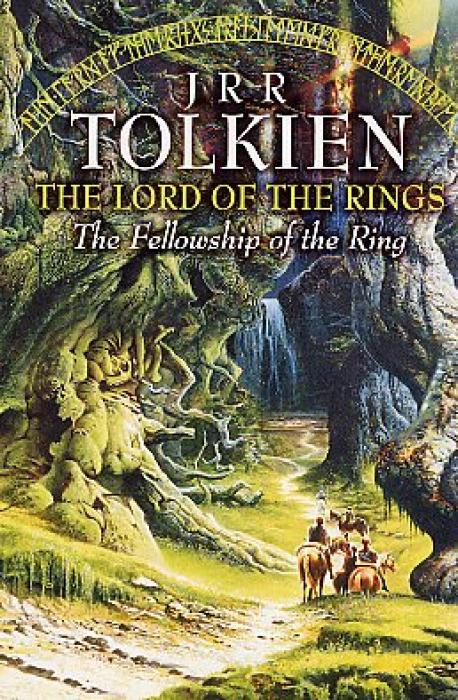
LOTR, The Fellowship of the Ring, Post 4

This is the third post of a series of posts on J. R. R. Tolkien’s The Lord of the Rings.  This series focuses on the first volume of the trilogy, The Fellowship of the Ring.

You can find the first post here. 

The second post here.

The third post here.


Summary: Bk1 Ch 4_5_6

Chapter 4: A Shortcut to Mushrooms

The next morning the hobbits awoke to find the elves gone, but they had left some of their delicious bread.  From the elves’ warning the night before, Frodo wanted to leave for Bucklebury immediately and insisted that the other hobbits let him go alone.  The other hobbits refused leaving him and reaffirmed their commitment to their journey.  Frodo then insisted that they take a shortcut through the forest rather than travel by the road.  As they started off, they heard a distant shrieking cry which made they move on.

Once they came to the end of the forest they were forced to turn southward and they came upon a section of land that was “well-ordered.”  They recognized it as the land of Farmer Maggot, a farmer who many years before had terrified Frodo with his dogs when Frodo was a lad.  Frodo then had been caught stealing some of Maggot’s wild mushrooms, and Frodo had never forgotten.  As they approached the house, they were confronted by Maggot and his three dogs.  After recognizing Pippin and then the others, Maggot invited them in for supper with his wife.  After supper and reminiscing discussion, Maggot with his sons decided to drive them in his wagon the five miles to the ferry.  At the ferry they met Merry who has been waiting for them.  Maggot had left them a surprise of mushrooms.

Chapter 5: A Conspiracy Unmasked

Merry led the others to a flat-bed ferry boat which he had moored at a bank, and climbing on board with the ponies they pushed off.  During the slow float across the river, Frodo felt his life transformed.  When they got to the other side, Sam and Frodo looked back across the river and could see a dark figure that had been following them. 

It was still some distance to go from the Brandywine River to Frodo’s house at Crickhollow, but that dark figure on the other side without a boat would have to spend a day to get to a crossing bridge and another day to get down,  The hobbits felt safe enough to spend one night at Frodo’s house before moving on.  Once they got to the house, where the fifth hobbit, Fatty Bolger, was waiting, Frodo felt it was just like home since the other hobbits had moved his old furniture in.  Each hobbit took a bath, singing and splashing each other, and they had a late supper.  Again Frodo wanted to leave the other hobbits behind because the quest was going to be too dangerous, but to his surprise the other hobbits revealed that they knew about the ring and the quest all along and insisted on going.  So they ate, drank, and sang a song of fellowship.  They decided in the morning to be off and not go by the road but through the Old Forest.  Fatty would not be going.

Chapter 6: The Old Forest

The hobbits got up very early in the morning and headed out.  Fatty Bolger was happy he would be staying behind. 

It was difficult making it through the forest, and it seemed that the surroundings were forcing them in directions they did not want to go.  At one point they realized the trees were shifting to guide them in a particular direction.  At another point the trees allowed them to pass into an opening in the forest, and the hobbits rushed through it.  Merry recognized the valley as leading to the Withywindle River, and they realized they were headed in the wrong direction.  So they veered northward, into a dense wood again. 

It was hot and they were tired.  They had been traveling a fortnight by now, and suddenly as they reached a bank of a stream drowsiness came upon them.  Frodo felt this was an unnatural drowsiness and wanted to move on.  But they laid down, Merry and Pippin down against a huge willow tree.  Sam got up to look for the ponies when he heard a plash.  Frodo was in the water, and when he got out said the tree had pushed him in.  When they looked for the others, Merry and Pippin were trapped inside the crevice of the big willow tree.  The tree had swallowed them up.  They didn’t have an axe, so they decided to try to burn the tree.

Suddenly they heard a strange singing and a man came upon them singing a nonsensical song.  It was Tom Bombadil, and when Frodo and Sam told him about Merry and Pippin, he yelled at Old Man Willow to let them out.  He broke a branch off the willow and started hitting the tree.  Tom started singing inside the crack and lo and behold the willow tree let Merry and Pippin out.  Tom invited the four house to his house for supper, and they accepted.  Tom moved too fast for the hobbits to follow but they followed his voice which continued to sing his nonsensical song.

###


Michelle Comment:

Tom Bombadil is almost like an angel, appearing suddenly when needed, and advising the hobbits 🙂

Ellie Comment:

What I noticed in these chapters was the emphasis on companionship and fellowship, which I think is very important not only in Catholicism but in Christianity in general. Frodo could have left alone, but his friends were there to support him and I think Tolkien wanted to show how important companions are for an individual.


I've also always thought of Tom Bombadil as Tolkien personified in his own book and looking at chapter 6 as well as future chapters, I think Tom Bombadil might be Tolkien, the 'subcreator' who knows a whole lot about what's going on but also he seems like some sort of God-figure, if I can call it that... but that's for future discussions. I think Tom Bombadil is a really fun character but one who has a lot of wisdom to share, somebody who doesn't judge and takes in these stray hobbits

My Reply to Ellie:

Yes, I think you're absolutely right. I planned to elaborate on that in the coming days. But you almost took the words out of my mouth.

Patrick Comment:

Does anybody connect Tom Bombadil with the concept of the Numinous presented in "The Wind in the Willows" chapter 7, "Piper at the Gates of Dawn"?


The god of nature, Pan, a satyr, appeals to the characters in that chapter. Early Christians saw Pan as a Christ-figure.


I mention this because Tolkien loved Kenneth Grahame as a child, and Tom Bombadil fits in the mold of mystical caretaker of nature.

My Reply to Patrick:

Patrick, I am not familiar with The Wind in the Willows (though I have a vague memory of reading some of it years ago) but you might be onto something there. The tree that swallowed Merry and Pippin was a willow tree and was referred to as Old Man Willow. Thanks for that insight.

Kerstin Reply to Patrick:

Tom Bombadil is one of the hardest characters to classify. The mystical caretaker of nature seems to me a favorite one especially from a secular perspective. But I find that too limited. He exudes the joy of life like no other character I know of. Always cheerful and fully aware of his surroundings, probably to a deeper extend than we are. He reminds me of the famous quote by St. Irenaeus, The glory of God is man fully alive. Tom Bombadil is fully alive. The negative things of life don't touch him because he is too alive for them. Julian of Norwich comes to mind as well, All shall be well, and all shall be well, all manner of things shall be well.

My Reply:

Let's hold off discussing Tom Bombadil. The very next chapter is devoted to him. Let's wait for the next section.

L Comment:

Thank you very much for the helpful summary, Manny. The sixth chapter really stood out for me with Tolkien's depiction of the awful unending confusion of the hobbits lost amid the quiet menace of the trees. I felt nearly as dizzy reading it as the poor hobbits must have been trying to find their way through the Old Forest! Tom Bombadil's nonsense verses again reminded me of George McDonald's character Curdie, who makes up nonsense rhymes to ward away goblins in 'The Princess and the Goblin'. I think Curdie is the purest human depiction of courage that I have ever come across in fiction.

My Reply to L:

You're welcome, and that is anoher allusion that is quite possible. I believe Tolkien was a fan of McDonald. I have not read McDonald's The Princess and the Goblin, from which Curdie is from, so I can't comment.

Kerstin Reply to L:

Oh that's a great comparison! I hadn't thought of that at all, and I lead the discussion on the book in 'Victorians!' last year, lol.

Now my follow-up thought would be, what is it about nonsense rhymes that wards off evil? I'll have to think about that.

My Reply to Kerstin:

That is a very interesting question. Late 19th and early 20th century English literature is populated with nonsense rhymes, both as stand alone poems or set pieces within novels. I'm thinking of Lewis Carrol's Alice in Wonderland which contains nonsense rhymes and the poetry of Edward Lear. You can read about nonsense verse here:


There are various forms of nonsense verse. Here are some that I can think of. One is employing words that make sense but together do not seem like a logical statement; second is employing language that is completely made up or are just phonemes; third is a combination of one and two; fourth is a creation of a whole language (here I'm thinking of James Joyce's Finnigan's Wake which is a whole novel in nonsensical language). There may be more. That article doesn't mention it, but I think nonsensical language is linked to folklore.


With Tom Bombadil, my guess is to set him apart from a common society. Shared language is at the basis of a shared community. Someone with his own language and sense is apart from the community or is from a community in one's past. Just like when we read Old English and it seems nonsense to us, so could a person who speaks in an older version of a language suggest a hereditary lineage.


Or he could just be crazy....lol. 


###

Have you noticed how in almost every single chapter, there is a meal shared between several persons? 

From chapter 2, on the last night at Bag Ends:


The four younger hobbits were, however, in high spirits, and the party soon became very cheerful in spite of Gandalf’s absence. The dining-room was bare except for a table and chairs, but the food was good, and there was good wine: Frodo’s wine had not been included in te sale to the Sackville-Bagginses.


‘Whatever happens to the rest of my stuff, when the S.-B.s get their claws on it, at any rate I have found a good home for this!’ said Frodo, as he drained his glass. It was the last drop of Old Winyards.

Later in that chapter, after being on the road and meeting the elves, the hobbits join them for supper.


Pippin sat up and rubbed his eyes. He shivered. ‘There is a fire in the hall, and food for hungry guests,’ said an Elf standing before him.


At the south end of the greensward there was an opening. There the green floor ran on into the wood, and formed a wide space like a hall, roofed by the boughs of trees. Their great trunks ran like pillars down each side. In the middle there was a wood-fire blazing, and upon the tree-pillars torches with lights of gold and silver were burning steadily. The Elves sat round the fire upon the grass or upon the sawn rings of old trunks. Some went to and fro bearing cups and pouring drink; others brought food on heaped plates and dishes.


‘This is poor fare,’ they said to the hobbits; ‘for we are lodging in the greenwood far from our halls. If ever you are our guests at home, we will treat you better.’


‘It seems to me good enough for a birthday-party,’ said Frodo.

Indeed, the next morning after the elves have departed, the hobbits had breakfast with the leftover bread.  In chapter 4, Farmer Maggot invites the hobbits in for supper with his family.


Frodo now accepted the invitation gratefully, to the relief of Pippin and Sam. The sun was already behind the western hills, and the light was failing. Two of Maggot’s sons and his three daughters came in, and a generous supper was laid on the large table. The kitchen was lit with candles and the fire was mended. Mrs. Maggot bustled in and out. One or two other hobbits belonging to the farm-household came in. In a short while fourteen sat down to eat. There was beer in plenty, and a mighty dish of mushrooms and bacon, besides much other solid farmhouse fare. The dogs lay by the fire and gnawed rinds and cracked bones.

In chapter 5, when the hobbits reach Frodo’s house at Crickhollow and have their splashing fun in their baths, they have a late supper.


They had supper in the kitchen on a table near the fire. ‘I suppose you three won’t want mushrooms again?’ said Fredegar without much hope.


‘Yes we shall!’ cried Pippin.


‘They’re mine!’ said Frodo. ‘Given to me by Mrs. Maggot, a queen among farmers’ wives. Take your greedy hands away, and I’ll serve them.’

There are more instances, and let’s not forget the novel starts with a birthday party and moves in short order to another birthday party years after.   This gathering for a meal is certainly more in the novel than just the natural need for people to eat at certain time intervals.  Tolkien, with this rhythmic punctuating of gathering for a meal, is raising the meal to something more than the obvious.  Can we think of it as a metaphor?  I would. 

So what does this metaphor stand for?  When people come together for a meal, they come together in a bond or through the meal they form bonds.  There is a shared goodwill between those at the table.  Family and friends come together for a meal.  You are in communion with those at the table.  Indeed, communion implies Holy Communion.  In Holy Communion one is in communion within the Body of Christ.  Notice at Mass the taking of Holy Communion comes after the Eucharistic prayer that stitches together the whole Church body (living and dead), after the community praying of the Our Father—if we share a Father, then we are brothers and sisters—and after we offer peace to all in the Body.  The holy meal follows that bonding process.  This is what I think Tolkien is suggesting with his rhythmic pacing of meals.  Those at table come into communion.  This is why such a good feeling is shared after the dinner with the elves.  This is why the hobbits have such shared fun in splashing each other as they bathe at Crickenhollow. 

One step then from communion I think is fellowship.  What is fellowship?  From Merriam-Webster’s, and I’ll only include the definitions that apply here:  (1) companionship, (2) community of interest, activity, feeling, or experience, (3) a company of equals or friends; an association, (4) the quality or state of being comradely.  


Fellowship, then, is being in communion of friends with a particular shared interest or activity.  The hobbits are in fellowship with each other with the shared interest of the quest to dispose of the ring.  This fellowship is formed, stitched, and sealed through the process of shared meals.  (Let me guess, there will never be a shared meal between the hobbits and orcs.)  The novel’s first volume is called “The Fellowship of the Ring.”  In time, if I remember correctly, I think the whole first volume is an enlarging of this fellowship. 

###

Kerstin Comment:

Yes! If I remember correctly there is only Gollum in the entire book who goes off and eats alone, but that won't be until "The Return of the King".


There is something so deeply mystical about sharing a meal. We do it all the time and don't think much about it. Yet it gives us sustenance far beyond the nourishment of the body. Who would ever think of having a get-together without a meal or at least some kinds of refreshments?


Thinking about this I am reminded of the Odyssey and how hospitality takes on a very different character than what we're used to today. The arriving stranger, mostly Odysseus or in the beginning his son Telemachus, is offered a meal first, then his name is asked, and what brings him to this particular place. The meal goes before everything else, even asking the stranger his name or who he is!

Bruce Comment:

Also the Iliad and American Indian stories have multiple stories of how a brave soul faces down death by walking fearlessly into an enemy camp to retrieve a daughter, wife, or even a corpse, and there stories nearly always include calmly sharing a meal with an enemy who respects your courage. The story of Leo the Great and Attila the Hun may be another version of this story.


Iliad, Blog 3, Visiting the Enemy Camp, Greeks vs Indians


The Warrior Cultures of the Iliad and the American Indian, Bravely Visiting the Enemy Camp


Thursday, July 9, 2026

Literature in the News: Pope Leo XIV Quotes Gandalf

As many of you know on May 25th, Pope Leo published his first encyclical, Magnifica Humanitas, on the cautions and moral use of artificial intelligence (AI).  The encyclical established the Catholic Church’s social teaching on the use of AI, especially in regard to human dignity and the common good.  Let me say up front, I have not read the encyclical but I have read summations and excerpts.  The details of the encyclical are not the concern of this post.  What I do what to point out is the starting quote within the document.


Magnifica Humanitas contains a quote from J.R.R. Tolkien’s epic novel, Lord of the Rings.    More specifically it quotes from a piece of dialogue from one of its main characters, the character who represents wisdom and moral rectitude of the wizard, Gandalf the Grey.  After his sacrificial act of saving the fellowship at the expense of his life, Gandalf will later in a “resurrection” of sorts, return as Gandalf the White, the name change reflecting a process of purification.  But as “Gandalf the Grey” he symbolizes a man of wisdom.  Indeed, grey has long been associated with wisdom and prudence, alluding to the ancient Greek “grey-eyed” goddess of wisdom, Athena.  But I think it also associates with those of us in a particular age group of grey-haired or grey-bearded.  (Ha, that’s one of the few benefits of reaching my age!)  Where I work we sometimes refer to the experience “old-timers” as “the grey beards.” 

With that context, let’s turn to the quote:

It is not our part to master all the tides of the world, but to do what is in us for the succour of those years wherein we are set, uprooting the evil in the fields that we know, so that those who live after may have clean earth to till.


There has been several commentaries in the public domain on why Pope Leo chose this quote.  I’m going to draw on two.

James T. Keane in writing in the Catholic magazine, America, “Why Pope Leo’s new encyclical quotes Gandalf: Literary images of hope and faith in ‘Magnifica Humanitas’ “ first offers surprise:

Of all the startling things one might find in a papal encyclical, a quote from J. R. R. Tolkien might take the cake. It’s not the first time a novel has made an appearance in such a format, as The Brothers Karamazov showed up in Pope Francis’ “Dilexit Nos,” but who would ever have thought The Lord of the Rings would appear in a magisterial document?

But there it is—a quote from Gandalf right smack in the middle of the text…As for the horrifically mixed metaphor, blame Tolkien, not the pope.

Ha!  The mixed metaphor he refers to is the “tide” metaphor which opens the quote with the tilling of soil as to the solution the tides present.  That is a mixed metaphor but Tolkien has put the quote into the mouth of Gandalf, so it would follow common speech patterns of dialogue rather than formal prose.  But even in formal prose, I personally do not find mixed metaphors problematic per se.  They become problematic if they confuse or contradict.  I don’t find that to be the case here.

Also interesting is that Pope Francis had used a quote from a novel, The Brothers Karamazov.  Over the years I had found Pope Francis to have a very good knowledge of literature.  I think recall the Holy Father quoting Dante and Borges and Cervantes.  There are others I’m sure but my memory is faulty.  He actually wrote a letter on the use of literature in the formation of priests and religious.  I published my reading of it here.  Pope Francis also had an Apostolic Letter commemorating the passing of Dante Algheri, and I published two posts on reading through it, here and here.  I don’t know if Pope Leo is as knowledgeable of literature as Pope Francis, but he is following in his footsteps on drawing from classic literature. 

Kean provides the context of Leo’s Magnifica Humanitas to show how the Tolkien (through Gandalf) quote is relevant.

Paragraph 90 [of Magnifica Humanitas] gives us the most important question: “We are called to reflect on the great ‘construction sites’ of our era and ask: What are we building?” Throughout “Magnifica Humanitas,” the two images he uses to represent the choice before us are of the Tower of Babel from Genesis and Nehemiah’s slow reconstruction of Jerusalem from the Book of Nehemiah: The first story tells of the thoughtless arrogance taken on by a humanity that sees its own glorification as the goal of existence; the second tells of the humble and painstaking act of constructing something holy, brick by brick. You can guess which one our Augustinian pope prefers.

So, concerning artificial intelligence, the central subject matter of the encyclical, Pope Leo is not innately opposed to AI, but he calls into question the manner of its use and the implications of its purport.  Pope Leo uses two opposing Biblical images to present the possibilities.  With AI, we could be building a Tower of Babel, a prideful challenge to God’s providence.  Or we could be rebuilding Jerusalem after the destruction of the Temple from the Babylonian siege.  The first is degradation of human dignity; the second is working with God for the building of human institutions.  Kean consolidates Pope Leo’s thesis.

What are we building? What are the great construction sites of our era? A tower to the heavens, the A.I. enthusiasts tell us, whether you want it or not. It can’t be stopped. Perhaps not, “Magnifica Humanitas” concedes, but it certainly doesn’t have to be a folly that destroys human solidarity forever. It could be a new work of a magnificent humanity, holy and built on the ideas and images and labors of a humanity that seeks more than simply efficiency or profit.

Could it be possible that artificial intelligence would be holy and transcend efficiency or profit?  Highly unlikely.


Joseph Pearce, writing in the National Catholic Register, “Why Pope Leo Quoted Tolkien’s Gandalf,” has a little different perspective on Pope Leo’s quote of Gandalf.

Essentially, Gandalf is saying that localism is the only effective response to globalism. None of us, as individuals, as mere pint-sized hobbits in a world of great and largely dark powers, can defeat the power of global corporations and the invasive technology that they are trying to impose upon us. “It is not our part to master all the tides of the world.”

On the other hand, we are called “to do what is in us for the succour of those years wherein we are set.” We are only called to attend to the times in which we live and to work to make the world in which we find ourselves a better place by loving and serving those around us. It is pointless worrying about how evil our own time is and equally pointless to vainly wish that things were different.

“I wish it need not have happened in my time,” Frodo complains to Gandalf.

“So do I,” Gandalf replies, “and so do all who live to see such times. But that is not for them to decide. All we have to decide is what to do with the time that is given us.”

Other than Pearce’s touch of contemporary ideology (“localism is the only effective response to globalism”), he is identifying that Gandalf is stating that resolving the immediate needs of your neighbors will cure what is wrong with the world at large.  If everyone paid attention to one’s neighbors, the aggregate attention would bring about the Kingdom of God.  And it’s not the geographic restrictions that Pearce identifies.  He sees Gandalf’s quote temporally as well.

No, we cannot choose the time in which we are born. We might wish to have lived, as Frodo does, in more peaceful and virtuous times, unravaged by war and wickedness, but that is not for us to decide. What we do need to decide is what to do with the time that is given us in the times in which we find ourselves. In the words that Pope Leo quotes, Gandalf tells us that we cannot stop all the wars and all the wickedness, we cannot “master all the tides of the world,” but we can decide to fight wickedness where we find it in our own small sphere of influence, “uprooting the evil in the fields that we know, so that those who live after may have clean earth to till.”

In the context of the situation, Pearce sees Gandalf’s quote as containing a moral directive to Frodo.

Our calling, our responsibility, is to be good and faithful stewards of the good things we’ve been given and to be good and faithful servants of the Lord our God and of those who are our neighbors in the Shire in which we live, and of those who will be born after us.

And so, this I think is where Pope Leo is coming from.  Artificial Intelligence requires a moral responsibility to not use it in a prideful, self-centered way, and to consider the benefits to the common good that it could contain as a glorification of God. 


Wednesday, July 1, 2026

LOTR, The Fellowship of the Ring, Post 3

This is the third post of a series of posts on J. R. R. Tolkien’s The Lord of the Rings.  This series focuses on the first volume of the trilogy, The Fellowship of the Ring.

You can find the first post here. 

The second post here.


Summary: Bk1 Ch 2_3

Chapter 2: The Shadow of the Past

Years have gone by since Bilbo vanished from the Shire.  In these years, Frodo kept up a tradition of celebrating Bilbo’s birthday.  He has not married but has kept close to a number of friends, most especially Sam Gamgee, Peregrin Took (called Pippin), and Meriadoc Brandybuck (called Merry).  For seventeen years Frodo lived at Bag End and was quite settled there.  It was as Frodo approached his fiftieth year that the strange itinerants increased through the Shire.  It was in this year that Gandalf after a long absence—he had come a few times for a short while before—showed up finally at Bag End.

Gandalf explained to Frodo what he had learned about the ring.  It was way more powerful than he imagined.  Many rings were made by the elves long ago, some with little power and some with much, and these with much are the Great Rings.  A mortal who keeps one of the Great Rings does not die but continues on withering away until he becomes invisible.  Gandalf asks to look at the ring and Frodo reluctantly hands it over.  Gandalf throws it into the fire and when he pulls it out words in the Elvin language appear inscribed of this ring being the one that rules the other rings.

Gandalf tells the history of the ring.  He tells about Sauron, the Dark Lord, who has returned to Mordor and is aware that the ring is in the Shire.  He tells of the other rings in the poem from the novel’s epigram and how “The Enemy” is out to get the one ring that controls them all, the ring that Frodo possesses.  He tells of how the ring was originally lost and how a hobbit named Déagol found it and his friend Sméagol killed him over it and took it.  Sméagol kept the ring hidden in the Misty Mountains and in time became Gollum.  Later Bilbo came into possession of it as we know.  Gandalf got most of his story from Gollum himself.

Gandalf tells Frodo how he and his friend Aragorn tracked Gollum down and found out how after Gollum losing the ring he went in search of Bilbo.  He also told them how Gollum had made his way to Mordor and told the Enemy of how he lost the ring to Bilbo.  That is why the dark forces have been coming to the Shire and now threaten the Shire.  This is why Frodo must leave the Shire, to protect the Shire, and not have the ring taken by the enemy.

Frodo agrees he has to leave, and just after Gandalf suggests he take a companion with him, Sam Gangee is caught eavesdropping and has heard most of the conversation.  He quickly volunteers to be Frodo’s companion, mostly because he wants to see elves.

###

Chapter 3: Three is Company

Frodo, pushed by Gandalf to depart, becomes hesitant.  He has grown comfortable living in the Shire.  Plus he does not have an excuse to just take off without any reason.  He comes up with the idea to leave on Bilbo’s birthday and by then he will have sold Bag End and his unnecessary possessions and bought a house way east in Buckleberry.  So with the excuse of leaving the Shire and heading to Buckleberry, he will secretly go on from there to hide the ring in Rivendell, the land of the elves.

Bag End is sold to the Sackville-Bagginses, who finally obtain the place they always wanted and glory in the purchase.  Merry and a few of the other hobbit friends go ahead to move the furniture and Frodo’s possessions while Frodo, Sam, and Pippin stay behind to settle the matters and prepare for the longer journey.  They have a final meal at Bag End, a wonderful feast with some of Frodo’s prize wines, and at dusk they head out under cover of the night. 

Along the way they distantly see some dark riders who they sense are searching for them, so they decide to hide in the woods.  They decide to progress not on the road but parallel to the road through brush and woods.  At some point they hear elven singing and come across a group of elves.  The leader is named Gildor Inglorion.  Surprisingly Gildor happens to know Frodo’s name.  They have a wonderful meal together, prepared with the food the elves brought along.  They speak of the Black Riders, of the Enemy and of the increasing sightings of servants of the Enemy.  Gildor advises Frodo to make haste and flee the Shire.  It is extremely dangerous.  With that they all go to sleep.


###

Patrick Comment:

Tolkien builds a world of security by putting the reader at ease. Yet there's always something lurking in the shadows. Gildor brings in the mystical on his journey West.


What struck me is the gap between Bilbo's departure and Frodo's. In the movies, it doesn't imply much time at all. In the books, it's measured in years. Frodo waited a long time for Gandalf to return.


These chapters construct the start of journey outwards.

###

When I did the summary of the first section (Prologue and Chapter 1), I didn’t realize that the ring would be so fully explained immediately after in Chapter 2.  So between the two sections, I think we know a lot about the ring.  There is not much further to say at this point.

So let me use my commentary to highlight a couple of other observations that struck me in these two chapters. 

I found this fascinating.  From Gandalf’s discussion with Frodo when Gandalf tells him about the ring, Gandalf mentions Saruman the White:


 ‘Who is he?’ asked Frodo. ‘I have never heard of him before.’


‘Maybe not,’ answered Gandalf. ‘Hobbits are, or were, no concern of his. Yet he is great among the Wise. He is the chief of my order and the head of the Council. His knowledge is deep, but his pride has grown with it, and he takes ill any meddling. The lore of the Elven-rings, great and small, is his province. He has long studied it, seeking the lost secrets of their making; but when the Rings were debated in the Council, all that he would reveal to us of his ring-lore told against my fears. So my doubt slept – but uneasily. Still I watched and I waited.

“He is the chief of my order.”  What order?  Do they have orders in the novel?  Is that analogous to a religious order?  It makes me think of the Dominicans or the Jesuits.  So what is the charism of the order of “the Wise”? 

###

Another interesting passage is when Gandalf fills Frodo in on the history of the ring.


‘Ah!’ said Gandalf. ‘That is a very long story. The beginnings lie back in the Black Years, which only the lore-masters now remember. If I were to tell you all that tale, we should still be sitting here when Spring had passed into Winter.


‘But last night I told you of Sauron the Great, the Dark Lord. The rumours that you have heard are true: he has indeed arisen again and left his hold in Mirkwood and returned to his ancient fastness in the Dark Tower of Mordor. That name even you hobbits have heard of, like a shadow on the borders of old stories. Always after a defeat and a respite, the Shadow takes another shape and grows again.’


‘I wish it need not have happened in my time,’ said Frodo.


‘So do I,’ said Gandalf, ‘and so do all who live to see such times. But that is not for them to decide. All we have to decide is what to do with the time that is given us. And already, Frodo, our time is beginning to look black.


The Enemy is fast becoming very strong. His plans are far from ripe, I think, but they are ripening. We shall be hard put to it. We should be very hard put to it, even if it were not for this dreadful chance. ‘The Enemy still lacks one thing to give him strength and knowledge to beat down all resistance, break the last defences, and cover all the lands in a second darkness. He lacks the One Ring.

So here we are introduced to Sauron the Great, otherwise known as the Dark Lord.  Is he analogous to Satan, otherwise known as Lucifer?  If it is, it’s an interesting play on light and dark.  Lucifer actually means “light-bearer.” John Milton refers him as the “Prince of Darkness.”  The name Sauron could be a linguistic twist to Satan.  There are a couple of interesting statements in the Wikipedia entry for “Sauron.”  

First: “Tolkien stated in his Letters that although he did not think "Absolute Evil" could exist as it would be "Zero", "in my story Sauron represents as near an approach to the wholly evil will as is possible." He explained that, like "all tyrants", Sauron had started out with good intentions but was corrupted by power, and that he "went further than human tyrants in pride and the lust for domination", being in origin an immortal (angelic) spirit.”

Second: “The classicist J. K. Newman comments that "Sauron's Greek name" makes him "the Lizard", from Ancient Greek σαῦρος (sauros) 'lizard or reptile'.”

I think we can conclude that Sauron is analogous to Satan.  Also the reference to “the Enemy” caught my attention.  Isn’t that our reference to Satan or the forces of Satan?  I don’t know if the term is universal for all Christians, but I have heard referring to Satan in Catholic lingo.  There are a couple Bible verses that refer to Satan as “the enemy,” (Lk 10:19, and 1 Tm 5:14) but hard to tell when you consider it’s a translation.  Have you heard the reference to Satan as “the enemy”?

Also there is a lot of light and dark imagery throughout these early chapters.  I’m not going to cite them here, but I’m sure you’ve seen them.  Perhaps at some point we can elaborate on it.


###

Did the passage where Gandalf describes Sméagol’s murder of Déagol strike people as an allusion to Cain and Able?


But Sméagol had been watching him from behind a tree, and as Déagol gloated over the ring, Sméagol came softly up behind.


‘“Give us that, Déagol, my love,” said Sméagol, over his friend’s shoulder.


‘“Why?” said Déagol.


‘“Because it’s my birthday, my love, and I wants it,” said Sméagol.


‘“I don’t care,” said Déagol. “I have given you a present already, more than I could afford. I found this, and I’m going to keep it.”


‘“Oh, are you indeed, my love,” said Sméagol; and he caught Déagol by the throat and strangled him, because the gold looked so bright and beautiful. Then he put the ring on his finger.

And later Gandalf elaborates further.


‘The murder of Déagol haunted Gollum, and he had made up a defence, repeating it to his “Precious” over and over again, as he gnawed bones in the dark, until he almost believed it. It was his birthday. Déagol ought to have given the ring to him. It had obviously turned up just so as to be a present. It was his birthday-present, and so on, and on.

It’s almost as if Gollum is fated to wander the earth like Cain as a result of the murder.  It’s also rather ironic how Sméagol twice refers to Déagol as “his love” just before he kills him.

###

And speaking of murder, Tolkien brings up the use of the death penalty for this act.  When Frodo hears that Gollum is out trying to find the ring, he expresses fear.


‘But this is terrible!’ cried Frodo. ‘Far worse than the worst that I imagined from your hints and warnings. O Gandalf, best of friends, what am I to do? For now I am really afraid. What am I to do? What a pity that Bilbo did not stab that vile creature, when he had a chance!’


‘Pity? It was Pity that stayed his hand. Pity, and Mercy: not to strike without need. And he has been well rewarded, Frodo. Be sure that he took so little hurt from the evil, and escaped in the end, because he began his ownership of the Ring so. With Pity.’


‘I am sorry,’ said Frodo. ‘But I am frightened; and I do not feel any pity for Gollum.’


‘You have not seen him,’ Gandalf broke in.


‘No, and I don’t want to,’ said Frodo. ‘I can’t understand you. Do you mean to say that you, and the Elves, have let him live on after all those horrible deeds? Now at any rate he is as bad as an Orc, and just an enemy. He deserves death.’


‘Deserves it! I daresay he does. Many that live deserve death. And some that die deserve life. Can you give it to them? Then do not be too eager to deal out death in judgement. For even the very wise cannot see all ends. I have not much hope that Gollum can be cured before he dies, but there is a chance of it. And he is bound up with the fate of the Ring. My heart tells me that he has some part to play yet, for good or ill, before the end; and when that comes, the pity of Bilbo may rule the fate of many – yours not least. In any case we did not kill him: he is very old and very wretched. The Wood-elves have him in prison, but they treat him with such kindness as they can find in their wise hearts.’

There seems to be a tension here between advocacy of the death penalty and prohibition.  Overall it seems to me that Gandalf is speaking for the author here.  Do people agree with that?  I don’t know at what point the Catholic Church began to criticize the use of the death penalty (Pope Paul VI in the 1970s?) but if Gandalf is articulating Tolkien’s position then Tolkien was ahead of his time on this issue writing in the 1940s.  But this is a fascinating moment which I will look for further development as a theme as we read on.

###

Michelle Comment:

I have frequently heard Satan referred to as the Enemy. I wonder if that is something we as Catholics do. Kerstin, did you hear that term outside of Catholicism?

The Cain & Able theory fits, doesn't it?

My Reply to Michelle:

What are your thoughts on the death penalty passage, Michelle? Do you think Gandalf is speaking for Tolkien or do you think this is just meant as a distinction between Gandalf and Frodo?

Michelle Reply:

I didn't read this passage that way. I thought it was a good way to show Gandalf's personality as a wise and just judge when he corrected Frodo. But maybe it is Tolkein shining through since Gandalf, (and his words), are his creation.

Frances Comment:

This material has so many levels of meaning. Several years ago I read an article in the WSJ discussing books about geopolitics. Lord of the Rings was on the list! The author of the piece explained his thinking this way: ‘’LOTR is a thinly disguised Roman a clef of WWII. Put Hitler in the role of evil Sauron, let Mussolini be the wizard Saruman and create a heroic alliance to oppose them. The Hobbits, a peaceful people, carry much of the story. But the rest of the cast are the geopolitical masters of the tale. And what a tale it is — an immense force of evil seeking control of a devastating technology; a shopworn and fractious alliance formed in resistance; a harrowing series of battles across plains, mountains and rivers; and lessons in diplomacy, economic strangulation, courtly betrayal and mind control. . . ‘’

“’The Lord of the Rings is also a cautionary tale about the dangers of the world, as we hear from ancient elven lord Elrond: ‘Let him vow to walk in the dark, who has not seen the nightfall.’ The hobbits try their best to remain naive and innocent. At one point Frodo says, ‘It is useless to meet revenge with revenge: it will heal nothing.’ Maybe so. But the geopolitical lesson of The Lord of the Rings is to fight with all your heart and soul against evil — and build what alliances you can along the way.”

I wish I could name the author of this article, but it was quite an extensive piece of which mention of LOTR was a small part at the end. When clipping it out to save, I lost the author’s name.

Kelly Reply:

I don't read Gandalf's speech about having pity on Smeagol as being about the death penalty. It has always struck me more as being patterned after, 'Judge not lest ye be judged,' or 'which one of you will cast the first stone?' A lesson about how fallen humanity can't really know another's heart.

My Reply to Kelly:

Yeah, Kelly, Gandalf is not speaking from pity. He does say Gollum deserves it: "Deserves it! I daresay he does." It's Bilbo who had pity for him. Gandalf does explain why Gollum should not receive the death penalty, and it's right in line with Catholic teaching: "Then do not be too eager to deal out death in judgement. For even the very wise cannot see all ends. I have not much hope that Gollum can be cured before he dies, but there is a chance of it." The Catholic Church teaches that we should not take life out of God's hands because (1) we don't know God's ends and what purpose every life will have ("even the very wise cannot see all ends") and (2) every person should be allowed to have God's time to repent ("there is a chance that Gollum can be cured before he dies.").


I don't want to make too much of this but it is odd that such a theme be placed here. Is this Tolkien drawing a theme or is he just opining on an issue or both? As to every life having a purpose, I do seem to vaguely remember that Gollum in the end is critical to the destruction of the ring. I think his life does wind up having purpose.

Michelle Reply to Kelly:

It does seem that way, too!

Kerstin Reply to Me:

In the passage there is also an implication of the sacredness of life. Once life is taken it cannot be brought back. Gandalf also hints to the fact that each life has purpose. For even the very wise cannot see all ends. [...] And he is bound up with the fate of the Ring. My heart tells me that he has some part to play yet, for good or ill, before the end


Gollum is bound up with the fate of the Ring. Here we have the binding again, a forever binding that cannot be undone. And with this binding the Ring has turned Sméagol into wretched Gollum. In contrast to a wedding ring, where the wearer does so freely and with consent, here the evil instrument ensnares without consent. The lure and trickery of the object is the precious metal that once desired takes possession.


###

Another detail of note in these two chapters is that we first encounter elves.  What are we to make of them?  How does Gildor know Frodo’s name, that he possesses the ring and is on a quest?  It’s rather strange and I expect it to be answered at some point.

In this first encounter the hobbits hear the elves singing.  So we know the elves are the forgers of the rings, their own language, and they have a love of song and beautiful voices.  In fact, though the hobbits don’t know the elven language, through song somehow the meaning of the lyrics is passed across.  Here is the song they sing.


Snow-white! Snow-white! O Lady clear!

   O Queen beyond the Western Seas!

O Light to us that wander here

   Amid the world of woven trees!


Gilthoniel! O Elbereth!

   Clear are thy eyes and bright thy breath!

Snow-white! Snow-white! We sing to thee

   In a far land beyond the Sea.


O stars that in the Sunless Year

   With shining hand by her were sown,

In windy fields now bright and clear

   We see your silver blossom blown!


O Elbereth! Gilthoniel!

   We still remember, we who dwell

In this far land beneath the trees,

   Thy starlight on the Western Seas.


When I mentioned in the introduction that I was fascinated by Tolkien’s ability to create folklore, here is a prime example.  Folk songs are a component of folklore, and not only does Tolkien create a folklore for the hobbits, he creates one for the elves, and I imagine for other types of humanoids.  I haven’t compared them closely, but elven song seems different than the hobbit songs, and terms of rhythm and diction.  Perhaps I will compare them closely at some point, but just from experiencing them it seems the hobbit songs are much earthier while the elves seem to be more of a high culture.  Who is this Queen they are addressing?  She sounds analogous to the Blessed Virgin Queen, does it not?  And how could the Queen's breath be "bright"?  (See the second line of the second stanza.)  Can breath be luminous?  Hopefully this will be clarified at some point.

###

There is one more detail I want to discuss from this section before I move on to the next.  Let’s look at this passage, when Gandalf and Frodo are discussing taking the ring away from the Shire.


‘As for where I am going,’ said Frodo, ‘it would be difficult to give that away, for I have no clear idea myself, yet.’


‘Don’t be absurd!’ said Gandalf. ‘I am not warning you against leaving an address at the post-office! But you are leaving the Shire – and that should not be known, until you are far away. And you must go, or at least set out, either North, South, West or East – and the direction should certainly not be known.’


‘I have been so taken up with the thoughts of leaving Bag End, and of saying farewell, that I have never even considered the direction,’ said Frodo. ‘For where am I to go? And by what shall I steer? What is to be my quest? Bilbo went to find a treasure, there and back again; but I go to lose one, and not return, as far as I can see.’


‘But you cannot see very far,’ said Gandalf. ‘Neither can I. It may be your task to find the Cracks of Doom; but that quest may be for others: I do not know. At any rate you are not ready for that long road yet.’


‘No indeed!’ said Frodo. ‘But in the meantime what course am I to take?’


‘Towards danger; but not too rashly, nor too straight,’ answered the wizard. ‘If you want my advice, make for Rivendell. That journey should not prove too perilous, though the Road is less easy than it was, and it will grow worse as the year fails.’


‘Rivendell!’ said Frodo. ‘Very good: I will go east, and I will make for Rivendell. I will take Sam to visit the Elves; he will be delighted.’ He spoke lightly; but his heart was moved suddenly with a desire to see the house of Elrond Halfelven, and breathe the air of that deep valley where many of the Fair Folk still dwelt in peace.

“What is to be my quest?” Frodo asks.  And while at the moment the quest is modest—to take the ring away from the Shire—it will grow as we will see later on.  The theme of quest is central to the novel for several reasons.  First it provides the narrative structure to the novel; the novel is about the working out of the quest.  Second it alludes to literature built around quests, such as the Knights of the Round Table on a quest to find the Holy Grail.  Third it provides for the psychological development and growth of the questing hero; the obstacles and struggles along the way shape the hero.  And four, the reader and the reader’s life is joined in some way with the questing hero.  There is a sense that we all in our lives are on a quest to find ourselves, to find God, and to serve a greater cause for the benefit of our family and neighbors.  We begin to see ourselves in Frodo.

This is the nature of quest literature, and I’m sure Tolkien is keenly aware of this.  What is interesting is that right around the time Tolkien is writing LotR, Joseph Campbell is writing his study on the very subject, published in The Hero with a Thousand Faces.  I don’t know if people are aware of Joseph Campbell, https://en.wikipedia.org/wiki/Joseph_Campbell he spent his academic career as a theorist on mythology and literature, and toward the end of his life entered the popular culture with a series of discussions of his theories on Public Broadcasting System (PBS).  I remember finding it fascinating, and it sparked my interest in mythology and folklore.  Campbell claimed that ultimately all stories derive from a single myth he calls the monomyth, and that is of a questing hero.  I believe the early movies of the series of Star Wars—Luke the questing hero out to find his father—was based on the theories of Joseph Campbell.

You can find on the internet analyses of LotR based on Campbell’s theories—here is a very good one, “The Lord of the Rings and Joseph Campbell’s Functions of Mythology” by Seth Tomko  —but what is interesting to me is how I can’t find either of the two commenting on the other.  Perhaps they did and I couldn’t find it, but I did give it a good search on the internet.  I would think they knew of each other.  I would think that Tolkien being an academic himself would have come across the academic work of a mythologist, and Campbell must have certainly heard of the Lord of the Rings, a novel that fits his monomyth theories perfectly. 


Now to be sure, there is much Tolkien would not have liked about Campbell’s theories.  Campbell derives much from Freudian and Jungian psychoanalytic theories, which in my opinion, and perhaps would be in Tolkien’s as well, is a bunch of academic twaddle, that is, sounds good from a PhD perspective but ultimately fails to meet reality in some way.  Perhaps I’m being harsh here, but I don’t put much stock in psychoanalytic theories.  Also Tolkien might object to Campbell in that he seems to imply all religions are essentially alike, a religious relativism.  Now one could argue that all myths point to the one true myth, that is Christianity, an idea that I know C.S. Lewis has articulated.  But Campbell seems to leave it open ended as to what is truth, pointing to something universal and leaving it at that.  Campbell was born Catholic but gravitated toward some vague (at least to me) sense of spirituality.

I do wonder why each have not commented on the other, even if a rejection of the other.  Still, flipping through the various sections of The Hero with a Thousand Faces, Campbell breaks down the elements of the quest in various parts: “The Call to Adventure,” “The Crossing of the First Threshold,” “The Belly of the Whale,” “The Road of Trials,” “Atonement with the Father,” “Apotheosis,” “The Return,” “The Transformation of the Hero,” and so on.  I tried to pick titles that might be more relevant to LotR.  But you can see how many of these elements fit the novel.

So when Frodo asks to where should he go, Gandalf replies, “Towards danger.”  This is the same as Dante as he enters hell in the Divine Comedy.  This is the same as Galahad as he overcomes temptations and evil in combat toward finding the Holy Grail.  This is the same of our very lives as we quest toward our ultimate end.

###

Frances Comment:

Manny, I think your description of quest literature is the explanation for any similarities between Tolkien and Campbell’s works. In the book The Seven Basic Plots: Why We Tell Stories, author Christopher Booker points out that ‘’listening to and reading stories helps make us whole.’’ Overcoming the Monster, Voyage and Return, the Quest are among timeless story lines Booker explores. Tolkien in his way was aware of them, Campbell, too. Other than the literary works that each produced, I don’t think there was any link between the two men. Each wrote independently, conscious of the great themes of timeless literature. I think of Leo Tolstoy’s famous comment, “All great literature is one of two stories: someone goes on a journey or a stranger comes to town.’’ Those words can be used to describe LOTR, too.

Michelle Reply to Frances:

Frances, your knowledge is awesome!

My Reply to Frances:

Nothing I disagree with, Frances. I just find it odd they never commented on each other. Perhaps they have but I couldn't find it. They must have known of each other's work.

Frances Reply to Me:

They may have known of each other; I don’t know how we can be certain. Certainly, with today’s technology, with the internet, they would know of each other. But we’re talking about 1949 (Hero With a Thousand Faces) and the nineteen forties and earlier up to 1954 when LOTR was published. Personally, I think they were coming at the hero’s journey from different perspectives. Campbell was examining the myth of the hero’s journey as it appeared throughout history, throughout literature, throughout religion to explain it as a great archetype.

Tolkien was writing to demonstrate that the truth of Christianity is “at the very root of reality,” and fairy stories and myths “reveal slivers of it, some more, some less.” (Joseph Pearce in quotes)

So, for example, let’s look at the figure of Odysseus, a key figure in Homer’s epic poems The Iliad and The Odyssey. Campbell would be studying him to illustrate and establish the characteristics of myth. Tolkien, however, would be studying him to reveal that the Christian story is the great reality that underlies all higher fairy-stories and myths. He speaks eloquently of this in his great essay “On Fairy Stories.”

I may be mistaken, though. If any one else in our group has a different viewpoint, please share it

Nicole Comment:

I just never understood when Pippin was invited to come along. Am I missing something?

Kerstin Reply to Nicole:

There are a lot of details to keep track of :-)


‘You do not understand!’ said Pippin. ‘You must go – and therefore we must, too. Merry and I are coming with you. Sam is an excellent fellow, and would jump down a dragon’s throat to save you, if he did not trip over his own feet; but you will need more than one companion in your dangerous adventure.’


Merry and Pippin are two of Frodo's oldest friends and they are helping him move from Bag End to Buckland and into his new place in Crickhollow. Frodo is under the impression these two will remain in the Shire and he and Sam will go on. Now Merry and Pippin had long ago figured out all of this had to do with the ring. They knew him too well. So they decided on their own to accompany him on the adventure.

Ellie Comment:

Thank you all for these contributions!! I am falling a little bit behind, and most of these things literally just go over my head, so it's really nice to dig deeper into the themes and especially connect it with our and Tolkien's faith.


What I latched on the most in these chapters was the heavy talk about the One Ring; in my opinion, the Ring is the personification of sin — it's wielded by "the Enemy", it has immense power, but what struck me most was the fact that it makes one slowly disappear and vanish from view. From my experience, I think that's what sin does to what we truly are, our core characteristics. Sin makes us alienated from ourselves, but mainly from God. It's a distrust of God's grace and love and it feels like it has a mind of its own, just like the Ring does.

Kerstin Reply to Ellie:

Not to worry! Schedules in this book club are only guidelines :-) We all follow at a pace we can manage.


Tolkien packs so many details in his tale it is hard to take it all in, especially when reading it the first time. I am astounded how much I have forgotten since the last time I read it.


Ellie, that's a great insight into the ring. I especially like how we get diminished by sin just like the ring makes people who wear it invisible.