"Love follows knowledge."
"Beauty above all beauty!"
– St. Catherine of Siena

Showing posts with label Notable Quote. Show all posts

Friday, November 14, 2025

Faith Filled Friday: The Nature of Christ’s Peace

I came across this striking quote in the October 2025 issue of Magnificat (Vol. 27, No.8) in one of the meditations (p. 280-1) by the Mexican mystic and spiritual writer Blessed Concepción Cabrera de Armida who is sometimes referred to as Blessed Conchita.  According to her Wikipedia entry, she was a prolific writer.  This quote comes from a book she wrote on meditating on the nature of Jesus, both on His human and divine natures, What Jesus is Like.  I’ve put that book in my cart for a future purchase.  Looks like a great advent read.


Fr. Mark Goring tells us a little about Blessed Conchita as he describes another of her books.


Here is this most notable quote.


Peace is not something negative: a lack of conflict.  It is rather something positive: a glimpse of heaven, a beam of tranquility, a ray of God’s own happiness.  The calm that comes from peace is not transitory, but something that is permanent and immortal, like a day when the sun does not set…. The person who is at peace is like a lake that is perfectly serene.  A lake in which God is reflected, in which Jesus the God-Man is imaged.  To achieve that peace, that serenity, one needs a profound humility, a great purity of heart, a tranquil conscience, and a trusting love…. Suffering which we willingly accept brings us peace.  It makes us like him.

            -Blessed Concepción Cabrera de Armida 

First, the notion that peace is a positive value rather than a negative runs counter to our temporal minds.  We envision peace coming after conflict and turmoil, such as after war or some great disturbance.  But I think she’s got that right.  War and turmoil take peace away.

Second, she tries to describe what that peace is: “a glimpse of heaven, a beam of tranquility, a ray of God’s own happiness.”.  It is not transitory but everlasting, “like a day when the sun does not set.”  It comes from God and is God. 

Third, she describes attributes of a person who has this peace: a perfectly serene lake which reflects Jesus.  Jesus is peace and we achieve peace by becoming Him.  One needs humility, purity, conscience (which can be seen as righteousness), and love.  This comes right out of the Beatitudes (Mt 5:3-12).  To be blessed is to achieve the beatitudes and perhaps make them manifest in the world.  “Blessed are the peacemakers, for they will be called the children of God.”  When I read that verse, I imagine “peacemakers” as those who resolve conflicts and wars.  But that might be too narrow a definition.  Peacemakers are those bring tranquility to a moment.  “Lord make me an instrument of your peace” St. Francis of Assisi is said to have prayed.  Bringing such peace is bringing Christ to the moment.

Fourth, to arrive at those attributes, we have to become Christ, especially through the willing acceptance of suffering.  Jesus gives this advice to Martha in Luke 10:41-42 when Jesus says to the hyperactive Martha in response to Martha’s sister Mary: “Martha, Martha, you are anxious and worried about many things.  There is need of only one thing. Mary has chosen the better part and it will not be taken from her.”  Mary has achieved peace in Christ.

I must say that arriving at such peace is very hard to do.  To willingly go through Christ’s passion and crucifixion is not easy in this temporal world.  After all, on this side of heaven, the sunset does give way to nightfall.

Conchita’s passage is so wonderful, I consider it Found Poetry.  Found poetry are passages that were not meant as a poem but a reader sees poetry in it.  With all due respect to Conchita, let me take the parts of her passage and arrange it as a poem.  Remember, this is Conchita’s work, not mine.


Peace


A sudden glimpse, a beam of tranquility,

The ray of God’s own blessedness from His eternal face,

We sit below a sunset that never ends,

Nightfall is extinguished, and with that

The anxiety that is not of the better part.


Peace came dropping slow.

The drops now pooled into a smooth lake.

What is that reflection staring back?  God’s face!

We see Jesus in the circles of a tarn.

We sit at His feet reflecting light.


The kingdom is for the meek and merciful,

The purity of one’s heart shows us God.

We remember the trials of persecution and of turmoil;

We now have comfort and are satisfied.

We are planted at our seats as the children of God.


Haha, that was fun composing it.  Let me know if my poem is any good.

Tuesday, June 3, 2025

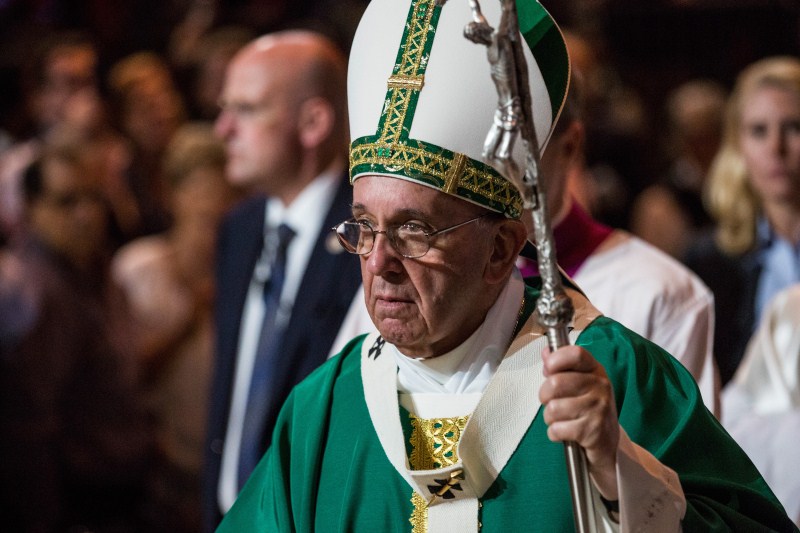
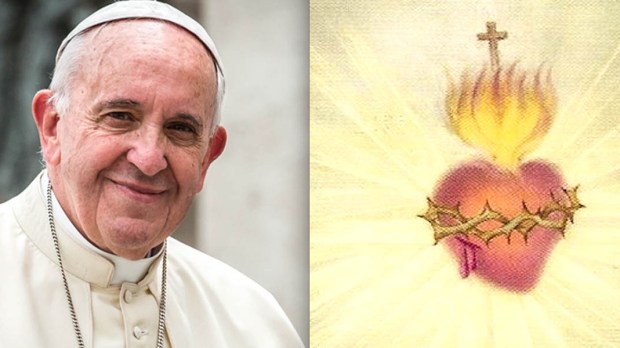
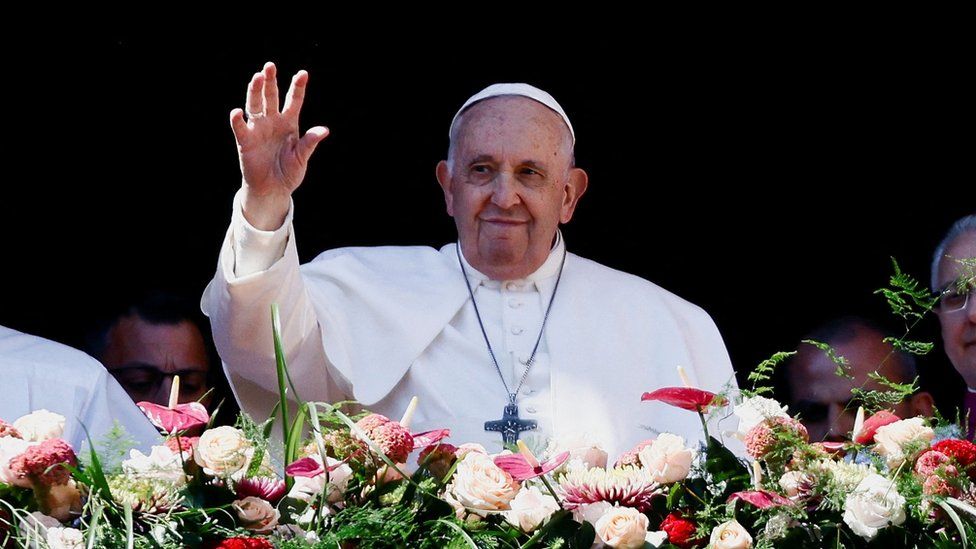
In Memoriam: The Holy Father, Pope Francis


“The joy of the gospel fills the hearts and lives of all who encounter Jesus.”—Pope Francis, Evangelii Gaudium

I’m sure the world knows by now that Pope Francis passed away early Monday morning, April 21st.  From Vatican News,” Pope Francis has died on Easter Monday, April 21, 2025, at the age of 88 at his residence in the Vatican's Casa Santa Marta”: 


At 9:45 AM, Cardinal Kevin Farrell, Camerlengo of the Holy Roman Church, announced the death of Pope Francis from the Casa Santa Marta with these words:


"Dearest brothers and sisters, with deep sorrow I must announce the death of our Holy Father Francis. At 7:35 this morning, the Bishop of Rome, Francis, returned to the house of the Father. His entire life was dedicated to the service of the Lord and of His Church. He taught us to live the values of the Gospel with fidelity, courage, and universal love, especially in favor of the poorest and most marginalized. With immense gratitude for his example as a true disciple of the Lord Jesus, we commend the soul of Pope Francis to the infinite merciful love of the One and Triune God."

It was a sad moment for me as well.  When I woke up that Monday morning and looked at my phone, there had been a news bulletin text that stated Pope Francis had died.  If he had died 7:35, Rome time; it was 1:35 AM here. 

Over the years I have had an evolving reaction to Pope Francis.  I was struck with him when he was first elected.  The charm, the smile, the self-effacing jokes, the humility, the off-the-cuff comments that no one would say.  He was a good humored man with people skills that no pope has had in a long time.  I just loved his pastoral touch.  At the time he was elected some twelve years ago, I offered this in my blog:  


We have these two strands in this pope, the disciplined mind of a scholarly Jesuit with the humility, simplicity, and human engagement of the Franciscan ministry.  The implication is that he’s going to challenge the spiritually indifferent trend of western culture, both through rhetorical argumentation and humble example.  And in him we see the real deal.  He is inherently a humble man, lived in a small apartment, cooked his own meals, rode the subway, embraced the people in the slums.  St. Francis embraced and kissed the lepers; Bergoglio washed and kissed the feet of today’s equivalent of the lepers, AIDs patients.

And then after a few days of Pope Francis meeting the world, I posted again on the new Holy Father, with even more glowing terms: 


"The last few days have made it apparent that [Pope Benedict XVI’s] strengths were intellectual at the expense of human contact. Given what I’ve seen of Francis’s human contact approach to his ministry, human contact is much more important than intellectual pontificating, pardon the pun. The intellectual underpinnings of Catholicism are there in the magisterium. Whatever updating B16 did to it is marginal, and non-Catholics weren’t listening anyway. I like what I’ve seen Pope Francis. This contact ministry is the human contact that I’ve argued brings Christ to everyone. Through human contact is where Christ is revealed. Pope Francis is a shot in the arm!"

In 2015, Pope Francis traveled to the United States and celebrated a Papal Mass in New York City.  I was fortunate to be selected to receive a ticket to the Mass representing my parish.  It was such an honor and I had a number of posts leading up to the Papal Mass and then of course the Papal Mass.  You can read those posts and see the pictures I took when you go to this link that calls up those Papal Mass posts.  

I also posted part of Pope Francis’s homily which focused on the isolation of people living in a big city.  I found this part of the homily both moving and penetrating to those who live in a big city such as myself.  


But big cities also conceal the faces of all those people who don’t appear to belong, or are second-class citizens. In big cities, beneath the roar of traffic, beneath “the rapid pace of change”, so many faces pass by unnoticed because they have no “right” to be there, no right to be part of the city. They are the foreigners, the children who go without schooling, those deprived of medical insurance, the homeless, the forgotten elderly. These people stand at the edges of our great avenues, in our streets, in deafening anonymity. They become part of an urban landscape which is more and more taken for granted, in our eyes, and especially in our hearts.


Knowing that Jesus still walks our streets, that he is part of the lives of his people, that he is involved with us in one vast history of salvation, fills us with hope. A hope which liberates us from the forces pushing us to isolation and lack of concern for the lives of others, for the life of our city. A hope which frees us from empty “connections”, from abstract analyses, or sensationalist routines. A hope which is unafraid of involvement, which acts as a leaven wherever we happen to live and work. A hope which makes us see, even in the midst of smog, the presence of God as he continues to walk the streets of our city. Because God is in the city.


What is it like, this light travelling through our streets? How do we encounter God, who lives with us amid the smog of our cities? How do we encounter Jesus, alive and at work in the daily life of our multicultural cities?

And then he implored us to go out and embrace the city and all its inhabitants.


Prince of Peace. Go out to others and share the good news that God, our Father, walks at our side. He frees us from anonymity, from a life of emptiness, and brings us to the school of encounter. He removes us from the fray of competition and self-absorption, and he opens before us the path of peace. That peace which is born of accepting others, that peace which fills our hearts whenever we look upon those in need as our brothers and sisters.


God is living in our cities. The Church is living in our cities. God and the Church living in our cities want to be like yeast in the dough, to relate to everyone, to stand at everyone’s side, proclaiming the marvels of the Wonderful Counselor, the Mighty God, the Eternal Father, the Prince of Peace.


“The people who walked in darkness have seen a great light”. And we, as Christians, are witnesses to this.

As I look back on those words from his homily, Pope Francis had not changed over the years.  The same themes he had at the beginning of his papacy were there at the end.  It was a concern for the outcast, the disenfranchised, the overlooked, the weak, the unaccepted, the lepers of our time.

In time I became somewhat dissatisfied with the Holy Father.  When it came to articulating church teaching, he was not the clearest, and he, also being on the Liberal side of both politics and the Church, his critics conflated his magisterium with his Liberal tendencies so that it gave the appearance that he was either confused or a heretic.  Being conservative myself I succumbed to the worst elements of the conservative’s characterization of Pope Francis.  There is an industry out there, especially in the United States, which is built on making money tearing down the Holy Father and anyone who smacks of not being orthodox.   The conservative language of these radical traditionalists (rad trads for short) tends to lure political conservatives to their side since so much of the jargon overlap.  I too began to conflate Pope Francis’s more Liberal political issues with liberal church teachings.  While I was sure Pope Francis had not taught anything heretical, I assumed he was pushing the Church to some liberal climax of his papacy.

And in some point in the last five years I began to see a disconnect between what I actually read and heard Pope Francis say and what the rad trad critics claimed he taught.  No, Pachamama was not meant to be a fertility goddess, and Pope St.John Paul II also embraced the symbol.  No, Francis never endorsed women priests, never endorsed homosexual lifestyle, and never supported abortion.  He may have had a compassionate heart for those outside the graces of the Church, and he pushed to extend God’s grace to them, but he never overturned Church teaching. 

What I discovered was that this industry was built on distorting Pope Francis’s Magisterial teaching to make it sound he was teaching heresy.  The turning point for me was Fiducia supplicans.  No it does not say that a homosexual union can be blessed.  It says that a couple can be blessed, and if I and my brother walked up to a priest it would satisfy as a couple.  The blessing isn’t even on the couple, it’s on the persons of the couple.  Read it carefully.  Pope Francis kept the doctrine of the Catholic faith while stretching out as far as he could to include the marginalized.  You are supposed to read Papal comments in charity and docility.  When I read this and saw the hysterical outrage and distortions, it dawned on me that there were elements in the Church that were fixated at tearing the Papacy for their own vision of what the church should be.  Well, they weren’t elected Pope.  The Holy Spirit didn’t endow them with anything.  That’s when the scales fell from my eyes.

I’m not going to dwell on the negative.  The Catholic Church has always had its Protestants and Pharisees, and they can find themselves another religion for all I care.  What I care about is Christ going to lepers and healing them.  What I care about is Christ refusing to stone the woman caught in adultery, which can be seen as Christ keeping doctrine while stretching out for the marginalized.  What I care about is the Good Samaritan caring for the injured man.  What I care about is Christ sitting to eat with tax collectors and prostitutes.  What I care about is the Prodigal Son being welcomed back.  What I care about is Christ washing His subordinates’ feet.  What I care about is Christ providing dignity to the Samaritan woman at the well who has had a series of inappropriate relationships.  That is the heart of the Gospel message and that is at the heart of Pope Francis’s magisterial teaching.

There are those who say what we needed was a more precise theologian.  Who knows?  I tend to disagree.   Pope Francis was the pope we needed. He showed us how to live in the love of Christ and provide dignity to every human being. What humanity needs is not another theologian—there are tons of those in every Catholic university—but needs someone to show them how to live out Christ. Pope Francis did just that.

That Pope Francis died after Easter and before Divine Mercy Sunday is most appropriate, if not Providential.  If any pope can be identified as the Pope of Divine Mercy, it is Pope Francis.  One of Pope Francis’s analogies for the Catholic Church was that of a “field hospital' which helps the suffering and marginalized through love, mercy, and charity.  Well, goodness gracious, the first reading from the Divine Mercy Sunday lectionary in Year C is this from Acts of the Apostles:


Many signs and wonders were done among the people

at the hands of the apostles.

They were all together in Solomon’s portico.

None of the others dared to join them, but the people esteemed them.

Yet more than ever, believers in the Lord,

great numbers of men and women, were added to them.

Thus they even carried the sick out into the streets

and laid them on cots and mats

so that when Peter came by,

at least his shadow might fall on one or another of them.

A large number of people from the towns

in the vicinity of Jerusalem also gathered,

bringing the sick and those disturbed by unclean spirits,

and they were all cured.  (Acts 5:12-16)


There is Peter at the head of the “field hospital,” navigating the actions for the cure of those disturbed by unclean spirits!


“God is living in our cities. The Church is living in our cities. God and the Church living in our cities want to be like yeast in the dough, to relate to everyone, to stand at everyone’s side, proclaiming the marvels of the Wonderful Counselor, the Mighty God, the Eternal Father, the Prince of Peace.”—Pope Francis, Homily in New York City, 25 September 2015

###

Did I have political disagreements with Pope Francis?  Of course.  I am a conservative and Pope Francis was I think innately a Liberal.  I am a free market capitalist.  I support being tough on criminals.  I want to restrict immigration to just the essential and minimum.  I am skeptical about accommodations with communist regimes.  I support the strengthening of the military in a world where power is used for evil reasons.  Did it really matter Pope Francis might have a different view on these issues?  I don’t think so.  He was the Holy Father and I was not, and in time I listened as a good Catholic should, with docility and respect. 

I cannot say that for his critics, some of whom would bring up my beloved patroness, St. Catherine of Siena as a critic of the pope in her day.  But here is the difference.  St. Catherine of Siena chided Pope Gregory XI in private conversations and in direct letters.  She never criticized Pope Gregory XI in public. 

Have I modified my views in the twelve years of Pope Francis’ papacy?  In thinking it over, though I am not sure if I can attribute it all to Pope Francis, I would have say yes.  I’ve come to the understanding that there must be some sort of accommodation for the lower economic earners in a free market economy; justice cannot be totally achieved by the harshest retributions; I no longer support the death penalty; human dignity must always be upheld; some immigration is charitable and compassionate, and morally required for those escaping human rights violations; use of the military must be implemented with caution and humility.  Over these twelve years I’ve gravitated closer to what President George W. Bush called “compassionate conservatism.”  I think the Holy Father had a hand in that evolution.

Perhaps where Pope Francis influenced me the most was on recognizing the dignity in every person.  Yes, I intellectually, abstractly knew that before, but did I understand it in my bones?  I think in his various papal writings, Pope Francis shaped me to understand it in the encounter with others. 


The heart of Christ is ‘ecstasy,’ openness, gift, and encounter. In that heart, we learn to relate to one another in wholesome and happy ways, and to build up in this world God’s kingdom of love and justice. Our hearts, united with the heart of Christ, are capable of working this social miracle”—Pope Francis, Dilexit Nos

###

If there is a single theological doctrine I most associate with Pope Francis, it is his “culture of encounter.”  Yes, I raise what appears on the surface to be a simple exhortation to a profound Christocentric idea.  Pope Francis spoke often on this culture of encounter, so I don’t know if I’m quoting from the fullest explanation, but these are the ones that came up in my search.  He made the first exhortation in his homily at Pentecost shortly after being selected in 2013.  From the Address from the Holy Father on 18 May 2013, he exhorts that the Church must be ready to step out:  


In this “stepping out” it is important to be ready for encounter. For me this word is very important. Encounter with others. Why? Because faith is an encounter with Jesus, and we must do what Jesus does: encounter others. We live in a culture of conflict, a culture of fragmentation, a culture in which I throw away what is of no use to me, a culture of waste.

Notice the mirrored complexity of that thought: In going out to meet the poor, to use an example, we go out to meet Jesus, and in so meeting Jesus, we, in turn, become Jesus meeting the poor.  This is aligned with the homily he gave in NYC I quoted above, going out to the city because Jesus is in the city.  Jesus is there in the poor.

There is also a meditation from the Vatican documents on Pope Francis homily on 13 September 2013


An invitation to work for “the culture of encounter”, in a simple way, “as Jesus did”: not just seeing, but looking; not just hearing, but listening; not just passing people by, but stopping with them; not just saying “what a shame, poor people!”, but allowing yourself to be moved with compassion; “and then to draw near, to touch and to say: ‘Do not weep’ and to give at least a drop of life”. Pope Francis used these words in his homily to describe the message contained in the liturgical readings of the Mass he celebrated at Santa Marta on Tuesday morning.


Focusing in particular on the scene of the widow of Nain, from the Gospel of Luke (7:11-17), the Pope highlighted that this passage from “the Word of God” speaks of “an encounter. There is an encounter between people, an encounter between people who were in the street”. And this, he commented, is “something unusual”. In fact, “when we go into the street, every man thinks of himself: he sees, but does not look; he hears, but does not listen”; in short, everyone goes their own way. And consequently “people pass each other, but they do not encounter each other”. Because, Pope Francis clarified, “an encounter is something else” entirely, and this is “what the Gospel today proclaims to us: an encounter between a man and a woman, between an only son who is alive and an only son who is dead; between a happy group of people — happy because they have encountered Jesus and followed him — and a group of people who weep as they accompany the woman”, who is a widow and is on her way to bury her only son.

There is too much in that meditation to quote, but to further develop Jesus’s encounter with the widow and her son, Pope Francis points out the typology of the encounter:


“The only son who is dead resembles Jesus, and he is transformed into an only son who is alive, like Jesus. And Jesus’ action truly shows the tenderness of an encounter, and not only the tenderness, but the fruitfulness of an encounter. ‘The dead man sat up and began to speak, and Jesus returned him to his mother’. He did not say: ‘The miracle has been done’. No, he said: ‘Come, take him, he is yours’”. That is why “every encounter is fruitful. Each encounter returns people and things to their place”.

And thus in so many of Jesus’s encounters in the Gospels—the Good Samaritan, the woman at the well, the woman to be stoned for adultery, the lepers and those possessed by demons—Jesus is moved and does more than just pass by. 

Thomas J. Eggleston, writing for the Houston Catholic Worker, I think concisely summarized Pope Francis’s theology of encounter:  


With this line of thinking, Christians encounter other people in their imitation of Christ, but on top of that, the disciple encounters other people as a response to having an encounter with Christ in the first place. Francis on a regular basis has spoken of a Culture of Encounter as a goal for human society. A society that espouses a Culture of Encounter facilitates right relationship among humans and involves a spirituality that emphasizes a personal friendship with God who first encounters us in love.

This is not the typical abstract theological thinking of say a Thomas Aquinas nor Pope Benedict XVI.  This is a hands on theology of the moment, one that if I had more space to flesh out is one of an existential nature.  This is not the theology of Ordo amoris that some politicians conveniently want to quote to justify reductions in aiding the needy, but one that forces you to love those before you.  (Pope Leo XIV also weighed in by rebuking such politicians, “Jesus doesn't ask us to rank our love for others.")  Pope Francis was a people person, a people Pope, one who saw the dignity in everyone, who as far as I can tell truly cared for everyone.

###

Finally I want to end with I found a very moving tribute, a statement from Dr. David Anders on his EWTN radio show, Called to Communion.  Someone had called in with a question on Pope Francis on his April 25th, 2025 show at about the 21:33 minute mark and lasts for three minutes.. 

I transcribed what Dr. Anders said, and I present it here, removing some minor verbal ticks that an ad hoc oral expression will have:


“He [Pope Francis] sounded a very consistent note from start to finish through his entire pontificate, and that was that our attachment to the Gospel of Christ must sensitize us to the dignity of the marginalized, the poor, the migrant, the other, those on the peripheries—and sometimes the peripheries could be conceived of in political terms and other times conceived of the guy or the lady in the parish who can’t receive compassion in the confessional—and he always had a heart for whoever is falling through the cracks of the Church’s ministry, how we’re failing to reach them, and a deep willingness to challenge the Church’s traditional ways of doing things, habits and customs that we might be working to defend to prop up the status quo than challenging the status quo in the interest of the apostolate, and ultimately reaching souls.”  -Dr. David Anders, Called to Communion, April 25th, 2025. 

That brought a tear to my eye.  That stands as the best statement on Pope's Francis the man and his pontificate that I heard anywhere.

May the Holy Father rest in peace. 


”In the Lord’s Paschal Mystery, death and life contended in a stupendous struggle, but the Lord now lives forever. He fills us with the certainty that we too are called to share in the life that knows no end, when the clash of arms and the rumble of death will be heard no more. Let us entrust ourselves to him, for he alone can make all things new!”—Pope Francis, Urbi et orbi, Easter 2025

Friday, February 28, 2025

The Voyage of the Dawn Treader: The End of the World

The final chapter of The Voyage of the DawnTreader (Book 5 of The Chronicles of Narnia series by C. S. Lewis) brings the ship to the end of the world.  In order to awaken the sleeping Lords for which the quest had launched, the ship must reach the end of the world and one passenger cross over to Aslan’s country.  Reepicheap, the brave and noble mouse, volunteers to be that sacrificial person. 


The ship goes as far as it can navigate, and Reepicheap, Edmund, Lucy and Eustace embark on a boat to the end.  Edmund, Lucy, and Eustace will only go so far as to reach the portal to cross back from Narnia to Earth, but Reepicheap will cross the end of the world into Aslan’s country.  Caspian had wanted to go, but as King he could not abdicate his throne.  So he stays behind.  This is such a wonderful passage. 


He Caspian] cheered up a little later on, but it was a grievous parting on both sides and I will not dwell on it. About two o'clock in the afternoon, well victualled and watered (though they thought they would need neither food nor drink) and with Reepicheep's coracle on board, the boat pulled away from the Dawn Treader to row through the endless carpet of lilies. The Dawn Treader flew all her flags and hung out her shields to honour their departure. Tall and big and homelike she looked from their low position with the lilies all round them. And even before she was out of sight they saw her turn and begin rowing slowly westward. Yet though Lucy shed a few tears she could not feel it as much as you might have expected. The light, the silence, the tingling smell of the Silver Sea, even (in some odd way) the loneliness itself, were too exciting.


There was no need to row, for the current drifted them steadily to the east. None of them slept nor ate. All that night and all next day they glided eastward, and when the third day dawned—with a brightness you or I could not bear even if we had dark glasses on—they saw a wonder ahead. It was as if a wall stood up between them and the sky, a greenish-grey, trembling, shimmering wall. Then up came the sun, and at its first rising they saw it through the wall and it turned into wonderful rainbow colours. Then they knew that the wall was really a long, tall wave—a wave endlessly fixed in one place as you may often see at the edge of a waterfall. It seemed to be about thirty feet high, and the current was gliding them swiftly towards it. You might have supposed they would have thought of their danger. They didn't. I don't think anyone could have in their position. For now they saw something not only behind the wave but behind the sun. They could not have seen even the sun if their eyes had not been strengthened by the water of the Last Sea. But now they could look at the rising sun and see it clearly and see things beyond it. What they saw—eastward, beyond the sun—was a range of mountains. It was so high that either they never saw the top of it or they forgot it. None of them remembers seeing any sky in that direction. And the mountains must really have been outside the world. For any mountains even a quarter or a twentieth of that height ought to have had ice and snow on them. But these were warm and green and full of forests and waterfalls however high you looked. And suddenly there came a breeze from the east, tossing the top of the wave into foamy shapes and ruffling the smooth water all round them. It lasted only a second or so but what it brought them in that second none of those three children will ever forget. It brought both a smell and a sound, a musical sound. Edmund and Eustace would never talk about it afterwards. Lucy could only say, "It would break your heart." "Why," said I, "was it so sad?" "Sad!! No," said Lucy.


No one in that boat doubted that they were seeing beyond the End of the World into Aslan's country.


At that moment, with a crunch, the boat ran aground. The water was too shallow now even for it. "This," said Reepicheep, "is where I go on alone."


They did not even try to stop him, for everything now felt as if it had been fated or had happened before. They helped him to lower his little coracle. Then he took off his sword ("I shall need it no more," he said) and flung it far away across the lilied sea. Where it fell it stood upright with the hilt above the surface. Then he bade them good-bye, trying to be sad for their sakes; but he was quivering with happiness. Lucy, for the first and last time, did what she had always wanted to do, taking him in her arms and caressing him. Then hastily he got into his coracle and took his paddle, and the current caught it and away he went, very black against the lilies. But no lilies grew on the wave; it was a smooth green slope. The coracle went more and more quickly, and beautifully it rushed up the wave's side. For one split second they saw its shape and Reepicheep's on the very top. Then it vanished, and since that moment no one can truly claim to have seen Reepicheep the Mouse. But my belief is that he came safe to Aslan's country and is alive there to this day.


As the sun rose the sight of those mountains outside the world faded away. The wave remained but there was only blue sky behind it.

Of course this is allegorical.  Aslan is God and Aslan’s country is paradise, located at the farthest east possible.  I was not familiar with the term, “coracle.”  From Wikipedia: “A coracle is a small, rounded, lightweight boat of the sort traditionally used in Wales, and also in parts of the west of Ireland and also particularly on the River Boyne, and in Scotland, particularly the River Spey.”   Reepicheap rides the wave and just suddenly disappears, almost as if he’s assumed into heaven. 


Tuesday, December 10, 2024

Mere Christianity by C. S. Lewis, Post #6

This is the sixth of a series of posts on Mere Christianity by C. S. Lewis.

You can find Post #1 here.    

Post #2 here.  

Post #3 here.  

Post #4 here.  

Post #5 here.  


The last two posts were summaries from Book 3, “Christian Behavior.”  I did not have the space to post notable quotes, so I will take this entire post to quote important passages from all twelve chapters.  I hope you enjoy these quotes.

###

From Chapter 1: The Three Parts of Morality


In reality, moral rules are directions for running the human machine. Every moral rule is there to prevent a breakdown, or a strain, or a friction, in the running of that machine. That is why these rules at first seem to be constantly interfering with our natural inclinations. When you are being taught how to use any machine, the instructor keeps on saying, “No, don’t do it like that,” because, of course, there are all sorts of things that look all right and seem to you the natural way of treating the machine, but do not really work.


⁂


Morality, then, seems to be concerned with three things. Firstly, with fair play and harmony between individuals. Secondly, with what might be called tidying up or harmonising the things inside each individual. Thirdly, with the general purpose of human life as a whole: what man was made for: what course the whole fleet ought to be on: what tune the conductor of the band wants it to play.


From Chapter 2: The Cardinal Virtues


According to this longer scheme there are seven “virtues.” Four of them are called “Cardinal” virtues, and the remaining three are called “Theological” virtues. The “Cardinal” ones are those which all civilised people recognise: the “Theological” are those which, as a rule, only Christians know about…. They are Prudence, Temperance, Justice, and Fortitude.


⁂


There is one further point about the virtues that ought to be noticed. There is a difference between doing some particular just or temperate action and being a just or temperate man. Someone who is not a good tennis player may now and then make a good shot. What you mean by a good player is the man whose eye and muscles and nerves have been so trained by making innumerable good shots that they can now be relied on. They have a certain tone or quality which is there even when he is not playing, just as a mathematician’s mind has a certain habit and outlook which is there even when he is not doing mathematics. In the same way a man who perseveres in doing just actions gets in the end a certain quality of character. Now it is that quality rather than the particular actions which we mean when we talk of a “virtue.”


⁂


The point is not that God will refuse you admission to His eternal world if you have not got certain qualities of character: the point is that if people have not got at least the beginnings of those qualities inside them, then no possible external conditions could make a “Heaven” for them—that is, could make them happy with the deep, strong, unshakable kind of happiness God intends for us.


From Chapter 3: Social Moraility


The first thing to get clear about Christian morality between man and man is that in this department Christ did not come to preach any brand new morality. The Golden Rule of the New Testament (Do as you would be done by) is a summing up of what every one, at bottom, had always known to be right.


⁂


The second thing to get clear is that Christianity has not, and does not profess to have, a detailed political programme for applying “Do as you would be done by” to a particular society at a particular moment. It could not have. It is meant for all men at all times and the particular programme which suited one place or time would not suit another. And, anyhow, that is not how Christianity works.


⁂


All the same, the New Testament, without going into details, gives us a pretty clear hint of what a fully Christian society would be like. Perhaps it gives us more than we can take. It tells us that there are to be no passengers or parasites: if man does not work, he ought not to eat. Every one is to work with his own hands, and what is more, every one’s work is to produce something good…


From Chapter 4: Morality and Psychoanalysis


When a man makes a moral choice two things are involved. One is the act of choosing. The other is the various feelings, impulses and so on which his psychological outfit presents him with, and which are the raw material of his choice. Now this raw material may be of two kinds. Either it may be what we would call normal: it may consist of the sort of feelings that are common to all men. Or else it may consist of quite unnatural feelings due to things that have gone wrong in his subconscious. Thus fear of things that are really dangerous would be an example of the first kind: an irrational fear of cats or spiders would be an example of the second kind.


⁂


That is why Christians are told not to judge. We see only the results which a man’s choices make out of his raw material. But God does not judge him on the raw material at all, but on what he has done with it. Most of the man’s psychological make-up is probably due to his body: when his body dies all that will fall off him, and the real central man, the thing that chose, that made the best or the worst out of this material, will stand naked.


⁂


One last point. Remember that, as I said, the right direction leads not only to peace but to knowledge. When a man is getting better he understands more and more clearly the evil that is still left in him. When a man is getting worse, he understands his own badness less and less.


From Chapter 5: Sexual Morality


We must now consider Christian morality as regards sex, what Christians call the virtue of chastity. The Christian rule of chastity must not be confused with the social rule of “modesty” (in one sense of that word); i.e. propriety, or decency. The social rule of propriety lays down how much of the human body should be displayed and what subjects can be referred to, and in what words, according to the customs of a given social circle. Thus, while the rule of chastity is the same for all Christians at all times, the rule of propriety changes.


⁂


Chastity is the most unpopular of the Christian virtues. There is no getting away from it: the Christian rule is, “Either marriage, with complete faithfulness to your partner, or else total abstinence.” Now this is so difficult and so contrary to our instincts, that obviously either Christianity is wrong or our sexual instinct, as it now is, has gone wrong. One or the other. Of course, being a Christian, I think it is the instinct which has gone wrong.


⁂


In the first place our warped natures, the devils who tempt us, and all the contemporary propaganda for lust, combine to make us feel that the desires we are resisting are so “natural,” so “healthy,” and so reasonable, that it is almost perverse and abnormal to resist them…Like all powerful lies, it is based on a truth—the truth, acknowledged above, that sex in itself (apart from the excesses and obsessions that have grown round it) is “normal” and “healthy,” and all the rest of it. The lie consists in the suggestion that any sexual act to which you are tempted at the moment is also healthy and normal. Now this, on any conceivable view, and quite apart from Christianity, must be nonsense.


⁂


Finally, though I have had to speak at some length about sex, I want to make it as clear as I possibly can that the centre of Christian morality is not here. If anyone thinks that Christians regard unchastity as the supreme vice, he is quite wrong. The sins of the flesh are bad, but they are the least bad of all sins.  All the worst pleasures are purely spiritual: the pleasure of putting other people in the wrong, of bossing and patronising and spoiling sport, and back-biting; the pleasures of power, of hatred. For there are two things inside me, competing with the human self which I must try to become. They are the Animal self, and the Diabolical self. The Diabolical self is the worse of the two.


From Chapter 6: Christian Marriage


The Christian idea of marriage is based on Christ’s words that a man and wife are to be regarded as a single organism—for that is what the words “one flesh” would be in modern English. And the Christians believe that when He said this He was not expressing a sentiment but stating a fact—just as one is stating a fact when one says that a lock and its key are one mechanism, or that a violin and a bow are one musical instrument. The inventor of the human machine was telling us that its two halves, the male and the female, were made to be combined together in pairs, not simply on the sexual level, but totally combined.


⁂


But, of course, ceasing to be “in love” need not mean ceasing to love. Love in this second sense—love as distinct from “being in love”—is not merely a feeling. It is a deep unity, maintained by the will and deliberately strengthened by habit; reinforced by (in Christian marriages) the grace which both partners ask, and receive, from God. They can have this love for each other even at those moments when they do not like each other; as you love yourself even when you do not like yourself. They can retain this love even when each would easily, if they allowed themselves, be “in love” with someone else. “Being in love” first moved them to promise fidelity: this quieter love enables them to keep the promise. It is on this love that the engine of marriage is run: being in love was the explosion that started it.


⁂


This is, I think, one little part of what Christ meant by saying that a thing will not really live unless it first dies. It is simply no good trying to keep any thrill: that is the very worst thing you can do. Let the thrill go—let it die away—go on through that period of death into the quieter interest and happiness that follow—and you will find you are living in a world of new thrills all the time. But if you decide to make thrills your regular diet and try to prolong them artificially, they will all get weaker and weaker, and fewer and fewer, and you will be a bored, disillusioned old man for the rest of your life.


⁂


There ought to be two distinct kinds of marriage: one governed by the State with rules enforced on all citizens, the other governed by the Church with rules enforced by her on her own members. The distinction ought to be quite sharp, so that a man knows which couples are married in a Christian sense and which are not.


From Chapter 7: Forgiveness


I said in a previous chapter that chastity was the most unpopular of the Christian virtues. But I am not sure I was right. I believe there is one even more unpopular. It is laid down in the Christian rule, “Thou shalt love thy neighbour as thyself.” Because in Christian morals “thy neighbour” includes “thy enemy,” and so we come up against this terrible duty of forgiving our enemies.


⁂


I am not trying to tell you in this book what I could do—I can do precious little—I am telling you what Christianity is. I did not invent it. And there, right in the middle of it, I find “Forgive us our sins as we forgive those that sin against us.” There is no slightest suggestion that we are offered forgiveness on any other terms. It is made perfectly clear that if we do not forgive we shall not be forgiven. There are no two ways about it.


⁂


Now a step further. Does loving your enemy mean not punishing him? No, for loving myself does not mean that I ought not to subject myself to punishment—even to death. If one had committed a murder, the right Christian thing to do would be to give yourself up to the police and be hanged. It is, therefore, in my opinion, perfectly right for a Christian judge to sentence a man to death or a Christian soldier to kill an enemy.


From Chapter 8: The Great Sin


The vice I am talking of is Pride or Self-Conceit: and the virtue opposite to it, in Christian morals, is called Humility. You may remember, when I was talking about sexual morality, I warned you that the centre of Christian morals did not lie there. Well, now, we have come to the centre. According to Christian teachers, the essential vice, the utmost evil, is Pride. Unchastity, anger, greed, drunkenness, and all that, are mere fleabites in comparison: it was through Pride that the devil became the devil: Pride leads to every other vice: it is the complete anti-God state of mind.


⁂


Now what you want to get clear is that Pride is essentially competitive—is competitive by its very nature—while the other vices are competitive only, so to speak, by accident. Pride gets no pleasure out of having something, only out of having more of it than the next man. We say that people are proud of being rich, or clever, or good-looking, but they are not. They are proud of being richer, or cleverer, or better-looking than others. If every one else became equally rich, or clever, or good-looking there would be nothing to be proud about. It is the comparison that makes you proud: the pleasure of being above the rest. Once the element of competition has gone, pride has gone. That is why I say that Pride is essentially competitive in a way the other vices are not.


⁂


For Pride is spiritual cancer: it eats up the very possibility of love, or contentment, or even common sense.


From Chapter 9: Charity


Charity means “Love, in the Christian sense.” But love, in the Christian sense, does not mean an emotion. It is a state not of the feelings but of the will; that state of the will which we have naturally about ourselves, and must learn to have about other people.


⁂


The rule for all of us is perfectly simple. Do not waste time bothering whether you “love” your neighbour; act as if you did. As soon as we do this we find one of the great secrets. When you are behaving as if you loved someone, you will presently come to love him. If you injure someone you dislike, you will find yourself disliking him more. If you do him a good turn, you will find yourself disliking him less. … But whenever we do good to another self, just because it is a self, made (like us) by God, and desiring its own happiness as we desire ours, we shall have learned to love it a little more or, at least, to dislike it less.


⁂


Good and evil both increase at compound interest. That is why the little decisions you and I make every day are of such infinite importance.


From Chapter 10: Hope


Hope is one of the Theological virtues. This means that a continual looking forward to the eternal world is not (as some modern people think) a form of escapism or wishful thinking, but one of the things a Christian is meant to do. It does not mean that we are to leave the present world as it is. If you read history you will find that the Christians who did most for the present world were just those who thought most of the next.


⁂


The Christian says, “Creatures are not born with desires unless satisfaction for those desires exists. A baby feels hunger: well, there is such a thing as food. A duckling wants to swim: well, there is such a thing as water. Men feel sexual desire: well, there is such a thing as sex. If I find in myself a desire which no experience in this world can satisfy, the most probable explanation is that I was made for another world. If none of my earthly pleasures satisfy it, that does not prove that the universe is a fraud. Probably earthly pleasures were never meant to satisfy it, but only to arouse it, to suggest the real thing. If that is so, I must take care, on the one hand, never to despise, or be unthankful for, these earthly blessings, and on the other, never to mistake them for the something else of which they are only a kind of copy, or echo, or mirage. I must keep alive in myself the desire for my true country, which I shall not find till after death; I must never let it get snowed under or turned aside; I must make it the main object of life to press on to that other country and to help others to do the same.”


From Chapter 11: Faith


Now Faith, in the sense in which I am here using the word, is the art of holding on to things your reason has once accepted, in spite of your changing moods. For moods will change, whatever view your reason takes. I know that by experience. Now that I am a Christian I do have moods in which the whole thing looks very improbable: but when I was an atheist I had moods in which Christianity looked terribly probable. This rebellion of your moods against your real self is going to come anyway. That is why Faith is such a necessary virtue: unless you teach your moods “where they get off,” you can never be either a sound Christian or even a sound atheist, but just a creature dithering to and fro, with its beliefs really dependent on the weather and the state of its digestion. Consequently one must train the habit of Faith.


⁂


Now I must turn to Faith in the second or higher sense… We never find out the strength of the evil impulse inside us until we try to fight it: and Christ, because He was the only man who never yielded to temptation, is also the only man who knows to the full what temptation means—the only complete realist. Very well, then. The main thing we learn from a serious attempt to practise the Christian virtues is that we fail.


From Chapter 12: Faith


I am trying to talk about Faith in the second sense, the higher sense. I said just now that the question of Faith in this sense arises after a man has tried his level best to practise the Christian virtues, and found that he fails, and seen that even if he could he would only be giving back to God what was already God’s own. In other words, he discovers his bankruptcy.


⁂


All this trying leads up to the vital moment at which you turn to God and say, “You must do this. I can’t.” Do not, I implore you, start asking yourselves, “Have I reached that moment?” Do not sit down and start watching your own mind to see if it is coming along. That puts a man quite on the wrong track. When the most important things in our life happen we quite often do not know, at the moment, what is going on.


⁂


Christians have often disputed as to whether what leads the Christian home is good actions, or Faith in Christ. I have no right really to speak on such a difficult question, but it does seem to me like asking which blade in a pair of scissors is most necessary. A serious moral effort is the only thing that will bring you to the point where you throw up the sponge. Faith in Christ is the only thing to save you from despair at that point: and out of that Faith in Him good actions must inevitably come.

###

This video is a reading from passages from Book 3.