"Love follows knowledge."
"Beauty above all beauty!"
– St. Catherine of Siena

Showing posts with label Augusta Theodosia Drane. Show all posts

Friday, March 5, 2021

Faith Filled Friday: The Madonna Advocata

I had never heard of this icon, and I thought I knew a lot about the Dominican Order, the Order of Preachers.  The story goes back 800 years ago when on February 28th, 1221 St. Dominic de Guzmán established a monastery of nuns in Rome.  From the Catholic News Agency, "St. Dominic entrusted this Marian icon to nuns in Rome 800 years ago":  

Eight hundred years ago, a barefoot St. Dominic carried an icon of the Virgin Mary across Rome to entrust the Marian image to a new community of cloistered nuns, who have safeguarded the icon within the walls of their convent to this day.


The icon, known as the “Advocata,” can be found today in a small chapel on Rome’s highest hill, in the Church of Santa Maria del Rosario on Monte Mario.

The image is absolutely stunning.  Here is the entire image, which has been damaged.


Miraculously the face has not been damaged, and it’s well worth cropping that part of the painting.
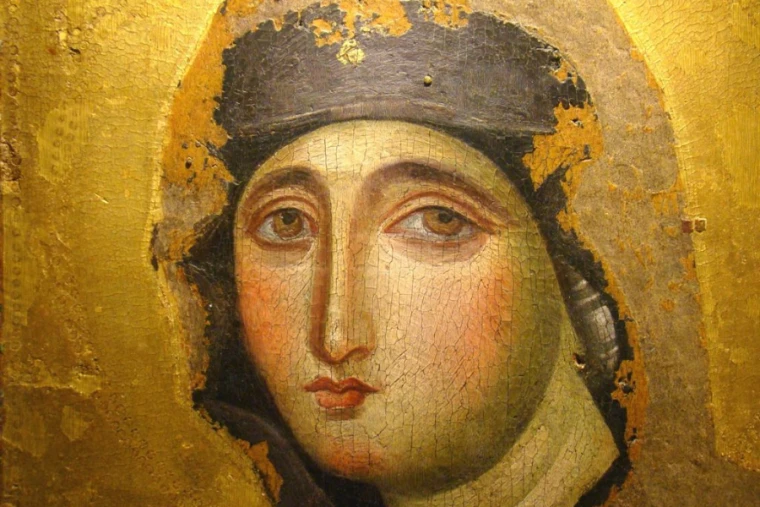
 

My goodness, what a stately, beautiful face.  Who and when was it painted?  Apparently it “dates back to at least the 7th century and has been revered over the centuries as having been painted by St. Luke.”  I’m not sure how it could be dated to the 7th century and be painted by St. Luke, but it says “at least the 7th century,” so who knows. 

I find it amazing that this community of nuns have kept the icon in their possession for 800 years.  According to the article they have moved twice in those years, but careful to preserve the icon.  If the procession took place in February of 1221and St. Dominic died in August of that year, so it was six months before he passed away.  So I went looking through my St. Dominic biographies for this event.  I couldn’t find anything but I was looking toward the end of the biographies since it happened toward the end of his life.  But one of my Lay Dominican sisters found it in the Augusta Theodosia Drane biography, detailed in pages 112 through 117.  Let me quote some key passages.


The most refractory of these religious [sisters] were some who were living at the time in the monastery of Santa Maria in Trastevere, in which was kept a celebrated picture of our Blessed Lady, said to have been painted by St. Luke.  This picture was a particular favorite with the Roman people.  Tradition said that it had been brought to Rome, many centuries before, from Constantinople; that it was the same that had been borne processionally by St, Gregory in the time of the plague, on that Easter day when the words of the Regina Caeli were first heard sung overhead by the voices of the angelic choirs.  After that Sergius III had caused it to be placed in the Lateran Basilica, but in the middle of the night it found its own way back to the majestic old church which seemed its chosen resting place.  The possession of this picture was no inconsiderable addition to the power and popularity of the nuns; without it they were determined never to stir, and there seemed great difficulties in the way of removing it.  (Drane, 112-3)


Quotes taken from The Life of Saint Dominic by Augusta Theodosia Drane, sixth edition, Tan Books, Charlotte, North Carolina, 1988.  [First published in 1857, London]


Well, that’s quite a story of movement, from Constantinople to Rome to the nuns to the Lateran Basilica and then miraculously back to the nuns.  But Dominic proposed and convinced the nuns to relocate to the convent of St. Sixtus, associated with the Basilica of St.Sixtus, a Roman basilica dating back to the seventh century.  One of St. Dominic’s most notable charism was his power of speech and persuasion, and it was evident here.  Thinking on my engineering work, St. Dominic would have been a great project manager and leader.  The story continues onto Ash Wednesday, which in 1221 fell on February 28th.


On Ash Wednesday, which fell that year on the 28th of February, the cardinals assembled at St. Sixtus, wither the Abbess and her nuns also proceeded in solemn procession.  (115)

And later,


Four days after, on the first Sunday in Lent, the nuns took possession of their convent.  They were forty-four in all, including a few seculars, and some religious of other convents.  (116)

But the painting was still not at St. Sixtus.


Dominic waited until nightfall before he ventured to remove the picture so often named; he feared lest some excitement and disturbance might be caused by this being done in broad day, for the people of the city felt a jealous unwillingness to suffer it to depart.  However at midnight, accompanied by the two cardinals Nicholas and Stephen and many other persons, all barefoot and carrying torches, he conducted it in solemn procession to St. Sixtus, where the nuns awaited its approach with similar marks of respect.  It did not return; and its quiet domestication in the new house completed the settlement of the nuns.  They were soon after joined by twenty-one others from various other houses, and thus was formed the second house of religious women living under the rule of St. Dominic.  (117)

So the story in the book differs somewhat from the article.  Nonetheless a beautiful and historic painting with quite a story.

By the way, I posted on the book, The Life of Saint Dominic, when I first read the biography two years ago.  

Wednesday, May 15, 2019

The Life of Saint Dominic by Augusta Theodosia Drane

I completed reading The Life of Saint Dominic by Augusta Theodosia Drane, and thoroughly enjoyed it.  

This is an excellent biography of the famous saint which includes many of the events that led to the institution of the Order of Preachers, otherwise unofficially known as the Dominican Order, and the early members that shaped what is probably the most intellectual of all the religious orders. The book has a nice mix of solid historical facts and what I would say are hagiographic facts (super natural miracles), which I guess you can believe or not. Augusta Theodosia Drane’s prose is quite good though at times reflects the Victorian style – originally published in 1857 – of her day. What she captures most is the humility of the saint – he refused to have the order named after himself – and the sort of magnetic attraction his followers had for him. It is sometimes said St. Dominic “befriended” an order rather than found it. The explosion of Dominican friars after the 1216 founding is remarkable and can be attributed to St. Dominic himself on the strength of his humble charisma. And St. Dominic understood the dire need for a religious order that would engage the general population, preach the Word, and evangelize the fallen away. We are in such a need today. Not as much is known of St. Dominic as for instance his contemporary and counterpart, St. Francis of Assisi, but what is known Drane skillfully weaves into a narrative.

One of the hallmarks of the Order of Preachers is that they are a mendicant order, but yet Dominic, who insisted on committed poverty, came from a noble and well-to-do family.  Here’s how Drane opens the biography with his family background.

It was in the year 1170, during the pontificate of Alexander III, that Dominic Guzman, the founder of the order of Friars Preachers, was born at his father’s castle of Calaroga, in old Castile.  The history of a genealogy, however illustrious, seems scarcely to find its place in the biography of a saint; though indeed few families can boast of one more honorable than that of the Castilia Guzmans.  But if their long line of chivalrous ancestors, and the royal privileges granted to them by the kings of Spain, have no claim to be noticed here, the immediate ancestors of St. Dominic possessed at least one distinction which had a more powerful influence on his life.  They were a family of saints.

Indeed, his mother, Joana de Aza, and one of his brothers are both beatified.  His mother experienced a vision while pregnant with him that would follow him through his life and all the way to today.

The future greatness of her younger son was announced to Joanna even before his birth.  The mysterious vision of a dog, bearing in his mouth a lighted torch which would set fire to the world, appeared to indicate the power of that doctrine which should kindle and illuminate men’s hearts through the ministry of his words. 

That dog carrying a torch in its mouth is one of the icons that is associated with the Dominican order.  In fact, if one breaks “Dominican” into fragments of Latin, it translates into “Hounds of the Lord.”  There is another story of his infancy, one pertaining to his baptism.

The noble lady who held him at the font saw, as the water was poured on his head, a brilliant star shinning on the infant’s forehead; and this circumstance, which is mentioned in the earliest life which we have of the saint (that of Blessed Jordan), bears a singular connection with the beautiful description of his appearance in after-life, left by his spiritual daughter, the Blessed Cecelia; in which she says, among other things, that “from his forehead, and between his brows, there shone forth a kind of radiant light, which filled men with respect and love.”

Those are two icons associated with St. Dominic, the dog carrying a torch in its mouth and a bright star shinning from his forehead.  From these images are what his followers are committed to do, brighten the world with the torch of truth and shine forth with a loving light.

Apparently he was a young genius, so much so that he was sent to the University of Polencia at the age of fourteen.  One of the characteristics that would serve him so well was his lack of attachment to worldly things.  The world of study was precious to him, but not precious enough allow suffering.  At the university there was a famine in the region.  He sold all he had to give to the poor but there was one thing left.

His dear and precious books were all that remained to give; and even those he parted with that their rice might be distributed to the starving multitudes.  To estimate the cost of such an act, we must remember the rarity and costliness of manuscripts in those days, many having probably been laboriously copied out of his own hands.  Yet when one of his companions expressed astonishment that he should deprive himself of the means of pursuing his studies, he replied in words preserved by Theodoric of Apoldia and treasured by after-writers as the first which have come down to posterity, “Would you have me study off those dead parchments when there are men dying of hunger?”

There are many other events that can be highlighted.  His ability to speak to people and convert them.  His conversion among the Albigenses.  Setting up of convents for the women converts.  Receiving the rosary from our Blessed Mother.  Instituting the Order of Preachers with its study and preach.  Transforming his order into a western world wide group.  Attracting through the power of his personality and sacrifice wonderful men that rivaled the Franciscans as an order.

Though Dominic would probably deny it, I think it cannot be emphasized enough that the his persona was initially at the heart of what made him successful in converting souls and attracting dedicated followers.  And that persona was formed and grounded through his life of prayer.  Here is how Drane describes it.

St. Dominic was pre-eminently a man of prayer; it is the feature above all others which we find traced upon his life.  By night or by day, whether alone or with others, silent in contemplation, or surrounded by the distractions of an active apostolic vocation, his heart never stirred from the true and steady center it had so early found in God; and in this one fact lay the secret of all the graces which adorned his most beautiful soul.  It was the source of that interior tranquility which fitted him to be called “the rose of patience,” as well as of the exterior and gracious sweetness to which all have borne testimony, and which with him was nothing else than the fragrant odor preceding from the abiding presence of God.

Some other quotes from the book that provide insight in the character of this noble saint.

"Dominic was anxious to provide for the preservation of another essential of his institute, the pursuit of sacred learning." p. 194

“Gathered from all states of life--knights, courtiers, professors, men of the world, penitents, and saints--the novices of Dominic, as soon as his spirit has breathed over them, display to our gaze and many varieties, one trait of which has the indescribable peculiarity of a family likeness: Sweetness" (p.184)

“The holy joy which shone in him had something singular about it, which drew all men's affections to him so soon as they had looked upon his face. He embraced all in great charity, and so was loved by all; and his rule was to rejoice them that rejoiced, and to weep with them that wept." (p. 143)

“He devoted himself entirely to the salvation of souls by the ministry of preaching, and he bore with a great heart a multitude of affronts, ignominies, and sufferings for the name of Jesus Christ.”  (p. 26)

“But if ever a man possessed the art of persuasion it was the blessed Dominic, whom, as it was said, ‘none ever resist;’ or rather persuasion with him was not art, but nature.  It was the effect of that admirable union of patience, prudence, and firmness, tempered with the charm of a sweet and tranquil gaiety, which gave so wonderful a magic to his intercourse.”  (p. 112)

“Dominic’s idea included a much wider field than any of the more modern founders had attempted.  He had designed an order for preaching and teaching; which for that purpose should apply itself to the study of sacred letters, with the express object of the salvation of souls.”  (p. 61)

So far this might be the best biography of this wonderful saint I've seen. Don't forget St. Dominic's feast day is August 8th.


St. Dominic de Guzman, pray for us.